
The Best Two-Way Radios for Medical Offices (2026 Guide)
What Are the Best Two-Way Radios for Medical Offices?
The Short Answer
The best two-way radios for medical offices are the Motorola CLP1080e, Motorola Curve, and Motorola CLS1410. Each model addresses a different clinical environment: the CLP1080e delivers earpiece-only discretion and an antimicrobial casing for small practices and patient-facing settings; the Motorola Curve provides Frequency Hopping Spread Spectrum encryption and 10 channels for larger offices with strict HIPAA requirements; and the CLS1410 offers the best balance of coverage and simplicity for small-to-medium practices that need reliable all-day communication without a steep learning curve.
But not all radios are suited to a clinical environment. Poor audio intelligibility, dead zones in multi-floor buildings, devices that cannot be sanitized, and open-channel broadcasts that expose patient information are all real risks when the wrong radio is chosen.
This guide covers what to look for, which models are worth considering, and how to match a radio to your practice's size and communication structure — based on over 25 years of selling radios to medical offices of every type.
Why Medical Offices Need Two-Way Radios
Medical offices operate on narrow time margins. A patient whose room has not been prepared, a nurse who cannot be reached for an assist, or a front desk team juggling incoming calls while trying to notify a provider — these are everyday friction points that compound across a full schedule into measurable delays and patient dissatisfaction.
Cell phones introduce two problems that radios eliminate. First, they create HIPAA exposure: a call made in a hallway or waiting room can be overheard by anyone nearby, creating incidental disclosure risk under the HIPAA Privacy Rule (45 CFR § 164.530(c)). Second, they are slower — unlocking, dialing, and waiting for an answer takes significantly longer than push-to-talk.
Overhead intercoms solve the speed problem but worsen the privacy problem. An announcement audible to the entire office — patients included — is the least private communication method available.
Two-way radios solve both: instant push-to-talk transmission, with earpiece options that keep audio private, and privacy code or encryption support that limits who can receive a given channel's transmissions. For a medical office, that combination is difficult to replicate with any other device category.
The pain points that recur consistently across medical offices include:
Room readiness and patient flow. Coordinating when an exam room is clean and ready for the next patient requires real-time communication between clinical and support staff. Without it, providers wait on rooms and patients wait on providers.
Discreet assistance requests. A provider who needs a second set of hands during a procedure, or a nurse who needs a supply without leaving a patient, requires a communication method that works in a clinical setting without disrupting the patient or alerting the entire office.
Emergency response. Medical emergencies require immediate coordination. The OSHA General Duty Clause (29 U.S.C. § 654(a)(1)) requires employers to provide a workplace free from recognized hazards; reliable internal communication is a foundational component of any emergency response capability. A radio with a one-touch emergency alert function is a direct operational response to this obligation.
Multi-department coordination. Larger practices with separate departments — imaging, lab, reception, clinical — need communication channels that allow each team to operate independently and escalate when necessary. Single-channel systems or open broadcasts create cross-talk that slows everyone down.
Device hygiene. Medical offices disinfect surfaces routinely. Radios that cannot withstand standard cleaning chemicals, or that lack antimicrobial casings, become a contamination vector rather than a neutral tool.
What to Look for in a Medical Office Radio
HIPAA Compatibility
HIPAA does not prohibit the use of two-way radios, but it does require covered entities to implement reasonable safeguards against incidental disclosure of protected health information (PHI) under the Privacy Rule (45 CFR § 164.530(c)). For radio systems, this means two things: using earpieces in patient-facing areas to prevent bystander overhear, and using radios with privacy codes, encryption, or Frequency Hopping Spread Spectrum (FHSS) technology to limit who can receive a channel's transmissions.
Analog radios with privacy codes provide a basic level of channel isolation; they are not encrypted. Digital radios using FHSS — like the Motorola Curve — change frequencies thousands of times per second in a pattern only paired radios can follow, making interception effectively impractical. For practices handling sensitive patient discussions over radio, FHSS is the stronger standard.
Your compliance officer should be consulted for full HIPAA program requirements. For a detailed overview of how two-way radios interact with HIPAA obligations, see our guide: HIPAA Compliance and Two-Way Radios.
Earpiece and Discretion
In patient rooms, waiting areas, and consultation hallways, audible radio transmissions are a HIPAA risk and a patient experience problem. Radios with earpiece-only audio — like the CLP series — eliminate both. Staff hear incoming transmissions privately; patients hear nothing.
Antimicrobial Housing
Several Motorola models in the CLP and Curve lines include antimicrobial casings that inhibit the growth of bacteria on the device surface. For a device passed between staff members or handled after patient contact, this is a relevant specification, not a marketing feature.
Battery Life
A full clinical day, including setup and close-down, typically runs 10–12 hours. Radios should cover that window without a mid-shift recharge. The CLP1080e is rated for 12 hours; the Motorola Curve reaches 14 hours on its lithium-ion battery. Multi-unit charging cradles allow overnight replenishment of a full fleet.
Channel Count
Most medical offices operate effectively on three to four dedicated channels: one for front desk and patient flow, one for nursing staff, one for providers, and one for lab or support. Offices with separate departments (imaging, physical therapy, behavioral health) benefit from more channels. Single-channel radios are appropriate only for the smallest practices with minimal role differentiation.
Coverage and Wattage
One watt UHF provides indoor coverage up to 100,000–200,000 sq ft depending on the model, which is sufficient for the large majority of medical office practices. Multi-floor buildings with concrete construction may require a repeater or a step up to a higher-power model. Practices spanning multiple buildings should evaluate LTE-based systems like the Motorola WAVE PTX.
Form Factor and Weight
Staff wearing a radio for an 8–12 hour shift notice its weight. The lightest professional radio currently available — the Motorola CLP1010e at 3.35 oz — is barely perceptible on a belt clip. Radios in the 4–5 oz range are still manageable but worth comparing if comfort is a priority.
Recommended Two-Way Radios for Medical Offices
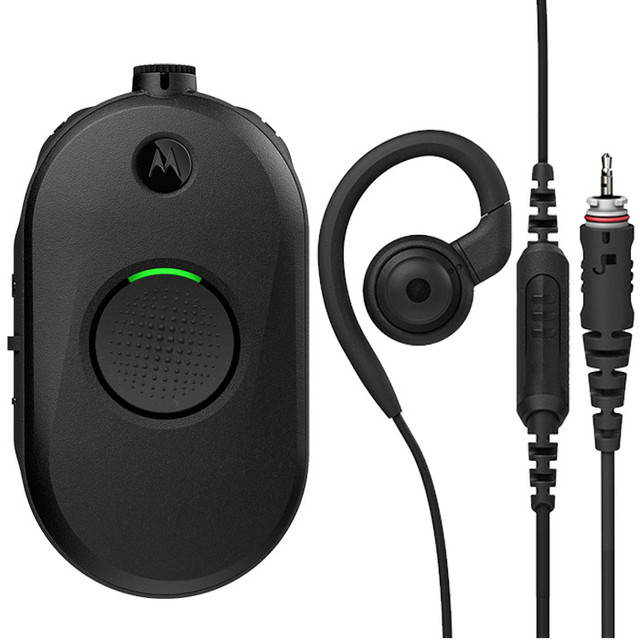
1. Motorola CLP1080e — Best for Small Practices and Patient-Facing Discretion
| Specification | Detail |
|---|---|
| Frequency | UHF (450–470 MHz) |
| Power | 1 watt |
| Channels | 8 |
| Indoor Coverage | 100,000 sq ft / up to 10 floors |
| Battery Life | 12 hours |
| Weight | 3.35 oz |
| Durability | IP54, MIL-STD-810H |
| Housing | Antimicrobial casing |
| Includes | Earpiece and swivel belt holster |
The CLP1080e is the smallest and lightest professional radio on the market. At 3.35 oz, it clips to a uniform belt or coat pocket and becomes essentially invisible during a shift. There is no external speaker — all audio routes through the included earpiece, which means conversations stay private in patient rooms, hallways, and waiting areas. This is the most direct radio-based response to HIPAA's incidental disclosure requirements for oral communications.
The antimicrobial casing inhibits bacterial growth on the device surface — a specification designed specifically for healthcare and food service environments. The IP54 ingress protection rating means it handles dust and liquid splash, and MIL-STD-810H compliance confirms it can survive the drops and physical stress of daily clinical use.
Eight channels give small-to-medium practices enough capacity to segment by role without overcrowding. The large central PTT button is operable with gloves on. The radio is also repeater-capable, meaning coverage can be extended to larger buildings without replacing the fleet.
One-channel and 8-channel versions of the same platform are available: the CLP1010e (1 channel) and the CLP1080e (8 channels). Most medical offices will find the 8-channel version more practical.
Why it fits medical offices specifically
- Earpiece-only audio prevents hallway and waiting room overheard — directly relevant to HIPAA Privacy Rule incidental disclosure standards
- Antimicrobial housing appropriate for hygiene-sensitive clinical environments
- 2.38 oz weight is comfortable for full-shift wear by nursing and clinical staff
- 8 channels support structured role-based communication across departments
- Repeater-capable for multi-floor or larger building coverage
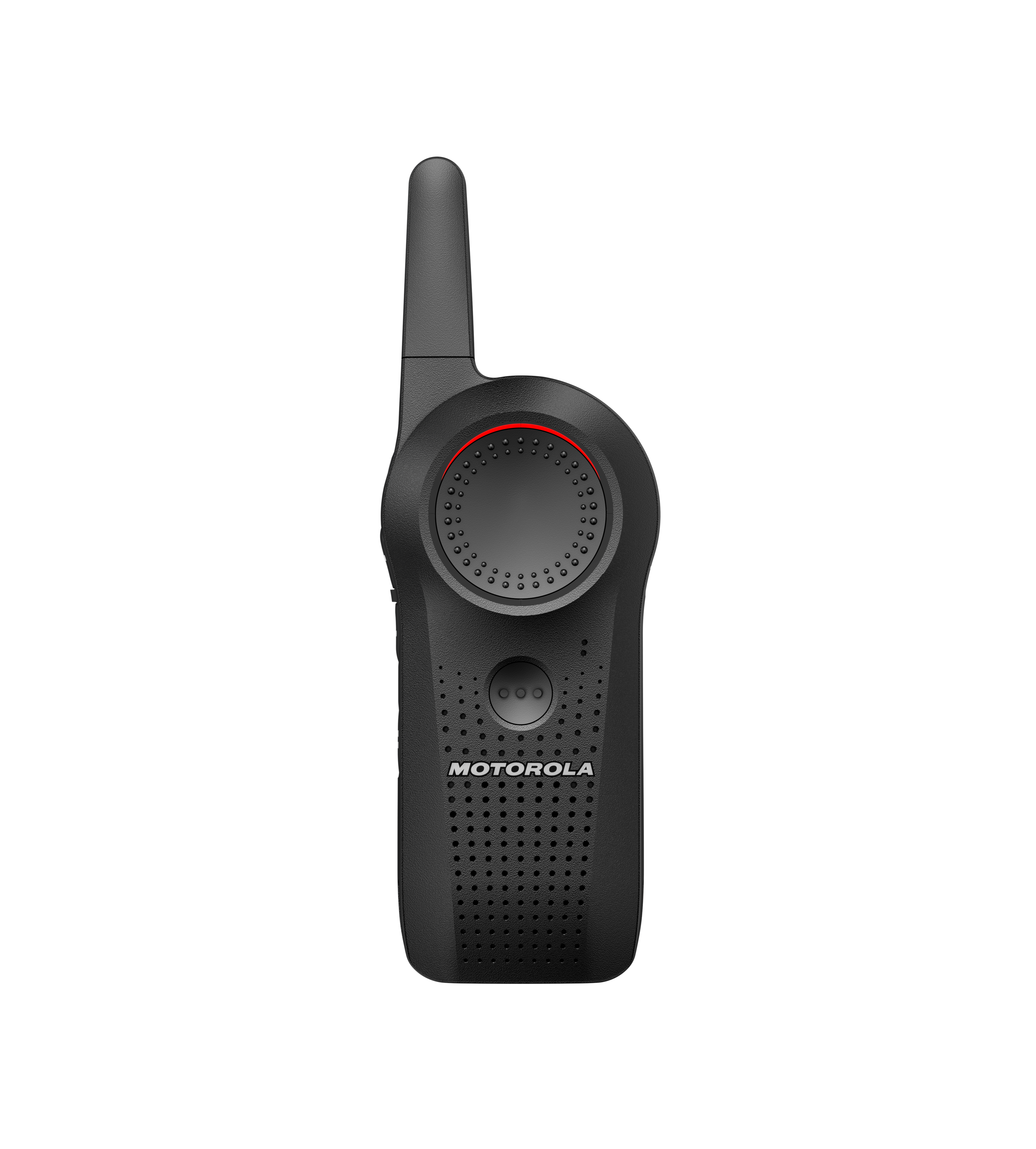
2. Motorola Curve — Best for HIPAA Compliance and Larger Practices
| Specification | Detail |
|---|---|
| Frequency | Digital 900 MHz (902–928 MHz) |
| Power | 1 watt digital (equivalent to ~4 watts analog) |
| Channels | 10 |
| Indoor Coverage | 300,000 sq ft / up to 20 floors |
| Battery Life | 14 hours |
| Weight | 4.2 oz |
| Durability | MIL-STD-810 compliant, water-resistant |
| Housing | Antimicrobial casing |
| Privacy | Frequency Hopping Spread Spectrum, 10,000 privacy codes |
The Motorola Curve is the most HIPAA-compatible radio on this list. It operates using Frequency Hopping Spread Spectrum (FHSS) technology, which changes transmission frequencies thousands of times per second in a pattern known only to paired radios. Paired with 10,000 available privacy codes, this is the closest a business-class radio comes to encrypted communication without requiring a licensed radio system. For practices where patient information is regularly discussed over radio — including urgent care centers and multi-provider group practices — this is the appropriate standard.
Coverage reaches 300,000 sq ft and up to 20 floors — the highest indoor coverage on this list. Its 1-watt digital signal is roughly equivalent in penetrating power to a 4-watt analog signal, meaning it performs through concrete walls, elevator shafts, and multi-wing building layouts that challenge lower-power analog radios.
The Page All and Call All Available functions allow simultaneous broadcast to the entire staff — relevant for emergency situations. The Direct Call feature allows private one-to-one communication. The 14-hour battery covers even the longest clinical shifts without a recharge.
Why it fits medical offices specifically
- FHSS technology and 10,000 privacy codes provide the strongest available HIPAA-compatible privacy for radio transmissions
- 10 channels accommodate full department segmentation for larger practices
- 300,000 sq ft / 20-floor coverage handles multi-story medical buildings
- Direct Call feature allows private one-to-one communication for sensitive coordination
- Antimicrobial casing standard on all units
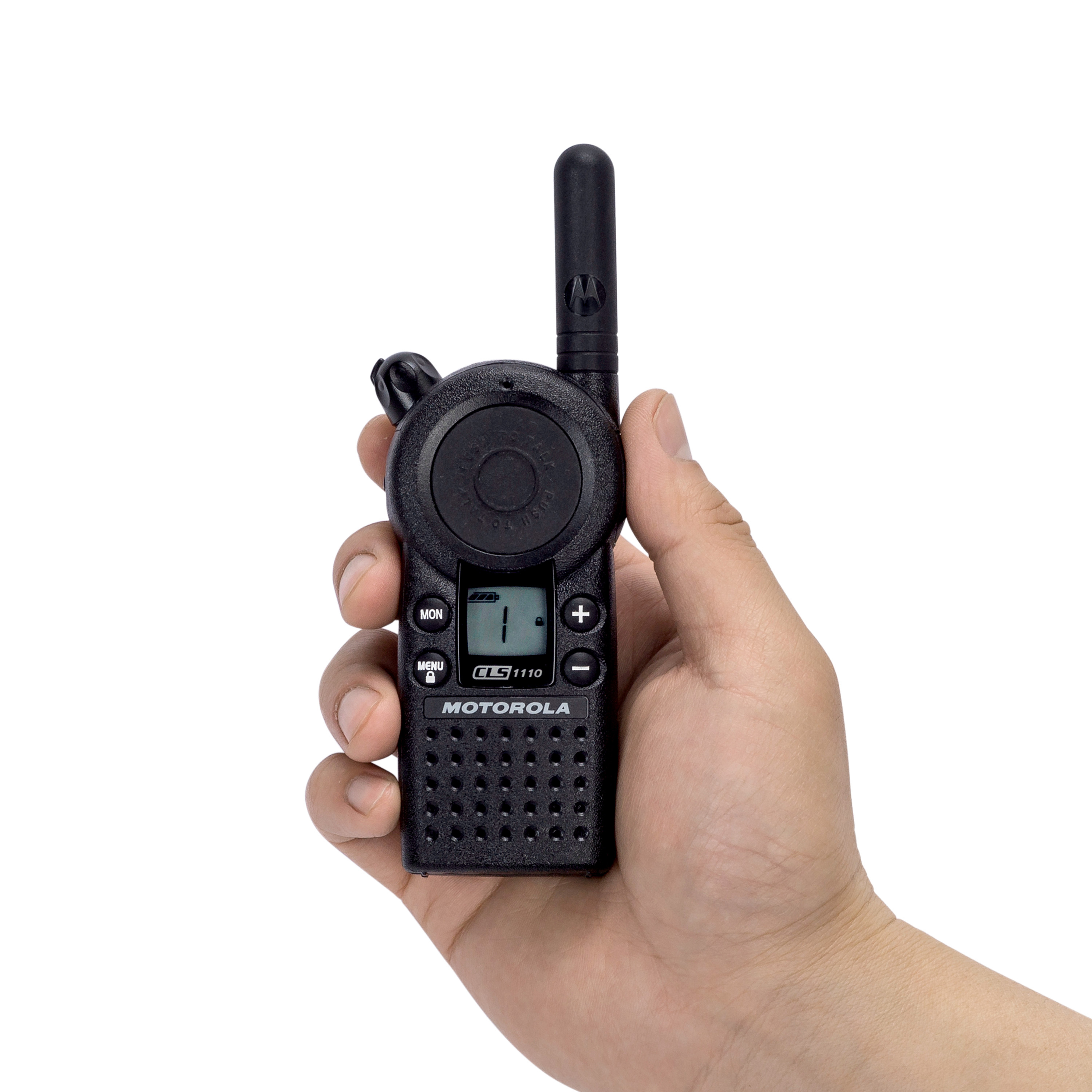
3. Motorola CLS1410 — Best for Ease of Use and Broad Coverage
| Specification | Detail |
|---|---|
| Frequency | UHF (460–469 MHz) |
| Power | 1 watt |
| Channels | 4 |
| Indoor Coverage | 200,000 sq ft / up to 15 floors |
| Battery Life | ~10 hours |
| Special Features | Audible Call Alerts, Vibracall, VOX |
The CLS1410 has been the commercial benchmark for small-to-medium business radios for over 15 years. Its external speaker makes it practical for staff who need to monitor radio traffic without wearing an earpiece constantly — which suits back-office and administrative roles better than the CLP series. For front desk staff who need to hear both incoming radio traffic and patient conversations, having the option to switch between speaker and earpiece is an operational advantage.
Audible Call Alerts and Vibracall technology ensure staff don't miss incoming transmissions even in a noisy clinical environment. VOX (voice-activated transmission) allows hands-free operation when a staff member cannot press the PTT button. Simplified cloning means a fleet of units can be configured identically without programming each radio individually — a practical advantage for practices setting up multiple units.
At 200,000 sq ft and 15 floors of indoor coverage, it outperforms the CLP1080e on range while remaining cost-competitive. It is also available in a 1-channel version (CLS1110) for practices that only need a single channel.
Note: The CLS1410 has an external speaker, which means transmissions are audible in the surrounding area. In patient-facing settings, pairing it with an earpiece accessory is recommended to maintain appropriate privacy.
Why it fits medical offices specifically
- 15-floor / 200,000 sq ft indoor coverage handles mid-size multi-story medical office buildings
- VOX hands-free operation useful during patient care and clinical procedures
- Vibracall silent alert lets staff acknowledge an incoming call without an audible tone in patient areas
- Simplified fleet cloning reduces setup time for practices purchasing multiple units
- Long commercial track record means replacement parts, accessories, and service availability are well-established
Also Worth Considering
Kenwood ProTalk PKT-300 — 2 watts, 6 channels, UHF (450–470 MHz), indoor coverage up to 275,000 sq ft. A strong alternative for practices that prefer Kenwood's build quality or need six dedicated channels without moving to the Curve's digital platform.
Motorola WAVE PTX Series — LTE/Wi-Fi, unlimited range, GPS tracking, emergency alert button. The correct choice for multi-location medical groups or practices spanning multiple buildings where conventional radio range is insufficient. A monthly subscription per device applies.
Coverage by Practice Size: Matching Radio to Building
| Practice Type | Recommended Radio | Coverage Capacity |
|---|---|---|
| Small single-floor practice (<5,000 sq ft) | Motorola CLP1080e or CLP1010e | 100,000 sq ft / 10 floors |
| Mid-size practice / 2–3 floors | Motorola CLS1410 or Kenwood PKT-300 | 200,000–275,000 sq ft / up to 15 floors |
| Large multi-department office / multi-floor | Motorola Curve | 300,000 sq ft / up to 20 floors |
| Multi-location medical group | Motorola WAVE PTX Series | Unlimited (LTE/Wi-Fi) |
Buildings with poured concrete or reinforced masonry walls typically reduce effective RF coverage by 20–30%. If your office has thick concrete construction, plan for one coverage tier higher than your square footage would otherwise suggest. A 4,000 sq ft office in a concrete building may perform more like a 6,000–8,000 sq ft office for signal penetration purposes.
HIPAA, FCC, and Compliance Standards
HIPAA Privacy Rule — Incidental Disclosure
Under 45 CFR § 164.530(c), covered entities must implement reasonable safeguards to limit incidental disclosures of protected health information. The HHS Office for Civil Rights has identified incidental overheard conversations as a recognized risk area. Using radio earpieces in patient-facing settings and selecting radios with privacy codes or encryption directly addresses this standard.
HIPAA does not require encrypted radios; it requires reasonable safeguards appropriate to the risk. For most medical offices, an earpiece-equipped radio with privacy codes constitutes a reasonable safeguard. For practices with higher sensitivity requirements, FHSS technology (Motorola Curve) provides the strongest available protection short of a dedicated encrypted radio system.
Workplace Safety — OSHA General Duty Clause
The OSHA General Duty Clause (29 U.S.C. § 654(a)(1)) requires employers to provide a place of employment free from recognized hazards that are causing or are likely to cause death or serious physical harm. For medical offices, reliable internal communication is a component of emergency preparedness. Radios with one-touch emergency alert functions support the real-time coordination that emergency response procedures require.
Operational Questions
How should channels be structured in a medical office?
A practical channel structure for a four-channel radio like the CLS1410:
- Channel 1 — Front Desk / Patient Flow: Patient arrivals, room readiness notifications, insurance and scheduling coordination
- Channel 2 — Nursing Staff: Room preparation, patient needs, assistance requests between nurses
- Channel 3 — Provider Coordination: Discreet provider-to-nurse communication, procedure assists, result notifications
- Channel 4 — Lab / Support: Lab pickups, supply requests, equipment issues
Offices with eight or ten channels can add dedicated channels for imaging, behavioral health, physical therapy, or a management-only line. The Motorola Curve's Direct Call feature also allows individual staff-to-staff communication without using a shared channel.
How many radios does a medical office need?
A practical starting point is one radio per key operational role per shift: one per exam room nurse or medical assistant, one per front desk station, one per provider, and one per lab or support lead. Most practices find that 6–12 units covers a standard team. Larger group practices with multiple providers and support staff should plan for one unit per active team member who needs to initiate communication, not just receive it.
Can radios be cleaned with medical disinfectants?
The Motorola CLP series and Curve include antimicrobial casings that inhibit bacterial surface growth and are designed to withstand routine disinfectant wiping. Consult the specific model's user guide for approved cleaning agents. Radios should not be submerged; none of the models listed carry an IPX7 or higher submersion rating. The IP54 rating on the CLP series confirms resistance to dust ingress and water splash from any direction — adequate for wipe-down cleaning.
Do radios work in lead-lined X-ray rooms?
Lead-lined X-ray rooms can attenuate RF signals significantly. If your practice has X-ray rooms that require radio coverage, the recommended approach is to step up one watt from what your building size would otherwise suggest, or to use a repeater-capable model like the CLP1080e with an appropriately placed repeater. The Motorola Curve's digital 900 MHz signal has better penetration through dense materials than standard 1-watt UHF analog at comparable specifications.
What is the difference between analog and digital radios for a medical office?
Analog radios (CLS, CLP series) are simpler to operate, more affordable, and perform reliably in straightforward single-building applications. Digital radios (Motorola Curve) offer cleaner audio, better performance in RF-dense environments, stronger privacy features through FHSS, and no FCC licensing requirement on the 900 MHz ISM band. For most medical offices, the modest price difference between analog and digital is justified by the HIPAA privacy advantages alone.
Frequently Asked Questions
Are two-way radios HIPAA compliant?
Two-way radios can be used in a HIPAA-compliant manner when the appropriate hardware and operational practices are in place. HIPAA does not prohibit radio use; it requires covered entities to implement reasonable safeguards against incidental disclosure of protected health information (45 CFR § 164.530(c)). For radio systems, this means using earpieces in patient-facing settings to prevent bystander overhear, and selecting radios with privacy codes or Frequency Hopping Spread Spectrum (FHSS) technology to limit who can receive a channel's transmissions. The Motorola Curve, which uses FHSS and supports 10,000 privacy codes, provides the strongest available HIPAA-compatible protection among the models on this page. Consult your compliance officer for full program requirements.
What is the range of a two-way radio in a medical office building?
Indoor range depends on wattage, frequency, and building construction. A 1-watt UHF radio (CLP1080e) covers up to 100,000 sq ft and 10 floors under typical conditions. The CLS1410 at 1 watt covers up to 200,000 sq ft and 15 floors. The Motorola Curve's digital 900 MHz signal reaches 300,000 sq ft and 20 floors, with performance roughly equivalent to a 4-watt analog radio. Buildings with poured concrete or reinforced masonry walls reduce effective range; in those cases, plan for a higher-coverage model or add a repeater. Outdoor range for all models listed is up to 1 mile under open-air conditions.
How long does the battery last on a medical office radio?
The Motorola CLP1080e is rated for 12 hours of battery life under normal transmission loads. The Motorola Curve provides 14 hours on its rechargeable lithium-ion battery. The CLS1410 provides approximately 10 hours. All three models are sufficient to cover a standard clinical shift without mid-day recharging. For practices running two-shift operations or back-to-back clinical days, multi-unit charging cradles allow overnight replenishment of a full fleet. Motorola and Kenwood commercial batteries are rated for five years of regular field use.
What durability rating should a medical office radio have?
At minimum, look for an IP54 ingress protection rating, which confirms resistance to dust ingress and water splash from any direction. This is the baseline for a device that will be wiped down with disinfectants and potentially exposed to incidental liquid contact. The Motorola CLP1080e and CLP1010e carry IP54 ratings and MIL-STD-810H compliance, confirming resistance to shock, vibration, humidity, and temperature extremes. The Motorola Curve meets MIL-STD-810 standards. None of the radios listed are rated for submersion, which is not required in a standard clinical environment.
How many channels does a medical office radio need?
Most medical offices operate well on three to four channels: front desk and patient flow, nursing staff, provider coordination, and lab or support. Single-channel radios work only for very small practices with no role differentiation. For offices with distinct departments (imaging, physical therapy, behavioral health, administration), six to ten channels allow clean separation without cross-talk. The Motorola CLP1080e provides 8 channels; the Motorola Curve provides 10. The CLS1410 provides 4 channels, which is sufficient for most small-to-medium practices.
Can two-way radios work across multiple floors in a medical building?
Yes. Most UHF and digital radios listed on this page are rated for multi-floor indoor coverage: the CLP1080e for 10 floors, the CLS1410 for 15 floors, and the Motorola Curve for 20 floors. Buildings with concrete construction or elevator shafts may reduce effective floor coverage. If your building has thick masonry walls or you need reliable coverage in basement areas, choose a model one tier above what your floor count would suggest, or add a repeater. The CLP1080e is repeater-capable; contact Tech Wholesale for repeater configuration guidance.
What is Frequency Hopping Spread Spectrum (FHSS) and why does it matter for medical offices?
Frequency Hopping Spread Spectrum is a transmission method in which the radio rapidly switches between frequencies in a pattern known only to paired radios. Because the frequency changes thousands of times per second, a standard scanner or receiver cannot follow the transmission. This makes interception of radio communications effectively impractical without access to a paired device. For medical offices where staff discuss patient information over radio, FHSS provides a significantly stronger privacy safeguard than analog privacy codes alone. The Motorola Curve uses FHSS and supports 10,000 privacy codes. For a full explanation, see our guide: Frequency Hopping Spread Spectrum Explained.
Why Buy from TechWholesale.com
Tech Wholesale has been an authorized dealer of Motorola and Kenwood two-way radios since 1997. Every radio sold through Tech Wholesale carries the full manufacturer warranty — typically two years on commercial-grade models — and qualifies for manufacturer service and repair. There is no gray market inventory and no voided warranties.
What sets us apart for medical office buyers
- Lifetime technical support included with every purchase — call or email our team for the life of your radio fleet, not just during the warranty period
- Free quotes for large teams— request a custom quote for orders of five or more units
- Frequency coordination assistance for Part 90 UHF radios at the time of purchase
- No-pressure consultation — our team will tell you when a less expensive radio fits your practice, not push you toward a higher-margin model
- Free shipping on qualifying orders
- Authorized dealer status for Motorola and Kenwood — full manufacturer warranty on every unit
If you're not certain which radio fits your office layout, team size, and HIPAA requirements, use our Find My Radio tool or request a quote. We'll ask a few questions and come back with a specific recommendation.
1-888-925-5982 Service@TechWholesale.com
Related Reading
On TechWholesale.com
- HIPAA Compliance and Two-Way Radio Usage
- Best Two-Way Radios for Hospitals and Clinics
- Best Two-Way Radios for Dental Offices
- Best Two-Way Radios for Nursing Homes
- Best Two-Way Radios for Rehabilitation Facilities
- Frequency Hopping Spread Spectrum Explained
- UHF vs. VHF — Frequencies Explained
- VOX Explained
- Privacy Codes — Eliminate Outside Interference
- Why Consider Digital Two-Way Radios
- Two-Way Radio FAQs
External Resources
- HHS Office for Civil Rights — Incidental Uses and Disclosures Under HIPAA
- FCC — Business and Industrial Land Transportation Radio Licensing
- FCC Universal Licensing System (ULS) — License Application Portal
- OSHA — General Duty Clause (Section 5(a)(1))
Article by Kristin Wood, a two-way radio consultant @ Tech Wholesale | Authorized Motorola & Kenwood Dealer Since 1997 | Last Updated: May 2026