

Your support teams keep the hospital running around the clock. Business-grade UHF radios give environmental services, transport, security, and engineering instant contact across every floor, so beds turn faster and every request gets handled.
Everything you need to decide is right here! We’ve supplied hundreds of hospitals across the country since 1997. Here’s how to pick the right radio for your business.
Which walkie talkie fits your hospital?
The Quick Answer
- A small department → Motorola CLS1410. Four channels, 4.6 oz on scrubs, and IP55. Simple enough for a floating aide or a new hire on their first shift.
- A large wing with multiple departments → Motorola Curve. Digital 900 MHz crosses poured decks, and frequency-hopping keeps it clear where hospital Wi-Fi and telemetry crowd the spectrum. Ten channels.
- Something discreet, multiple buildings → Motorola SL300-UD. Three watts in a slim profile that carries under a coat. Digital for extended coverage and longer battery life.
- A campus, or staff who work alone → Motorola TLK 25. Runs over the hospital's existing Wi-Fi and LTE. AES-256 encryption, IP67, plus Lone Worker and Fall Alert for overnight security and solo staff.
Table of Contents
Why Hospitals Have Unique Two-Way Radio Requirements
A hotel and a hospital are both large buildings with shift workers and lots of foot traffic. But the communication demands aren't close to the same.
The Real Pain Points in Hospital Communication
Dead zones in critical areas. Stairwells, basements, radiology suites, and ICU wings are often shielded with materials that attenuate signal. A radio that works fine in the lobby may drop out entirely in a lead-lined imaging room. Hospitals need radios that operate on UHF frequencies — which penetrate structural barriers better than VHF — or digital 900 MHz radios with superior building penetration.
Noise and discretion. ERs are loud. Patient rooms require quiet. A radio blasting transmissions in a recovery ward disrupts patients and violates the environment of care. Staff need access to discreet earpieces, VibraCall silent alerts, or radios with no external speaker by design (like the TLK-25) so communication doesn't intrude on care.
Shift length vs. battery life. Hospital shifts commonly run 12 hours. Many radios are rated for 8–10 hours under laboratory conditions (5/5/90 duty cycle: 5% transmit, 5% receive, 90% standby). In a busy hospital environment with more active use, that number drops. Look for radios rated at 12 hours or more, or facilities management should build in a hot-swap rotation with spare charged units.
Hygiene and sanitization. Radios are passed between staff, set down on surfaces, and carried into isolation rooms. They need to withstand frequent cleaning with hospital-grade disinfectants. Antimicrobial housing — standard on the Motorola Curve — and water-resistant ratings (IP54 or better) are not optional features in healthcare; they're baseline requirements.
HIPAA compliance. Any radio conversation that includes patient names, room numbers, diagnoses, or care instructions is protected health information (PHI) under the Health Insurance Portability and Accountability Act. Analog radios on unencrypted frequencies can be monitored by anyone with a scanner. Digital radios — particularly those operating on business-exclusive or encrypted channels — provide a meaningful compliance layer. No two-way radio on its own constitutes full HIPAA compliance, but digital encryption and private channel architecture significantly reduce interception risk.
Department segmentation. A busy 400-bed hospital may have a dozen or more departments that need separate communication channels: ER, ICU, surgery, nursing floors, patient transport, housekeeping, pharmacy, security, facilities/maintenance, and administration. Radios with limited channel counts can create congestion and cross-talk. Plan for at minimum one channel per active department.
Recommended Channel Structure for Hospitals
| Department | Recommended Use |
|---|---|
| Emergency / ER | Triage coordination, incoming patient alerts |
| Nursing (by floor or unit) | Unit-level care coordination, call light response |
| Patient Transport | Wheelchair and stretcher dispatch |
| Housekeeping | Room turnover after discharge, biohazard response |
| Security | Incident response, access control, lockdown coordination |
| Pharmacy | Urgent medication delivery, prescription queries |
| Maintenance / Facilities | Equipment repair, HVAC, elevator issues |
| Administration | Hospital-wide announcements, interdepartmental routing |
The 4 Best Two-Way Radios for Hospitals
1. Motorola CLS1410 — Best Entry-Level Radio for Small Clinics and Departments
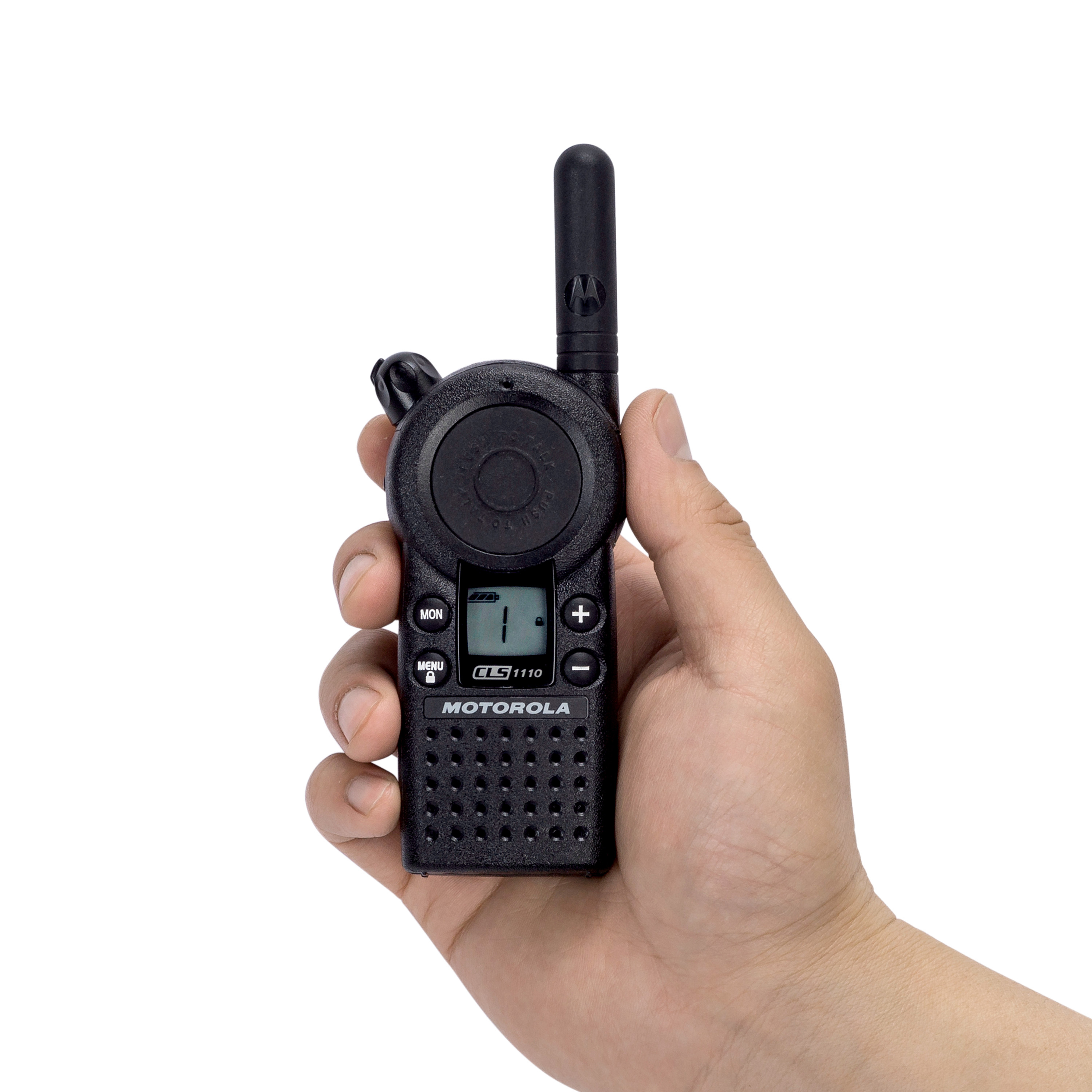
Best for: Medical offices, clinics, single-department hospital teams, and facilities that are replacing an aging analog fleet without increasing budget.
The CLS1410 is a compact, lightweight UHF analog radio that has been a workhorse in healthcare settings for years. It offers 4 channels and 1 watt of power, providing coverage for up to 200,000 square feet or 15 floors, and meets Military Spec 810-C, D, E, F, and G for vibration, shock, dust, and water intrusion. It also meets IP55 standards and includes antimicrobial housing — a meaningful consideration in any hygiene-sensitive environment.
For smaller hospitals or departments that don't need digital features, the CLS1410 delivers reliable, no-frills performance. The VibraCall silent alert allows staff to receive a notification without audible interruption — useful in patient-facing roles. The rechargeable lithium-ion battery supports up to 18 hours of continuous operation, comfortably covering even extended shifts.
| Spec | Detail |
|---|---|
| Channels | 4 |
| Frequency | UHF (459.5–469.5 MHz) |
| Power | 1 watt |
| Coverage | Up to 200,000 sq ft / 15 floors |
| Battery Life | Up to 18 hours |
| Durability | MIL-SPEC 810 C/D/E/F/G; IP55 |
| Weight | 4.6 oz with battery |
| Warranty | 2 years |
Why it works in hospitals: Lightweight enough to clip to scrubs without discomfort, durable enough to survive frequent drops and cleaning, and battery life that outlasts any hospital shift. Its 4-channel structure is ideal for smaller facilities where department segmentation needs are modest.
Limitation: Analog-only transmission means conversations are not encrypted and could be monitored on a scanner. For facilities that handle sensitive patient communications over radio, consider upgrading to a digital model.
2. Motorola Curve — Best for Hospitals Up to 20 Floors
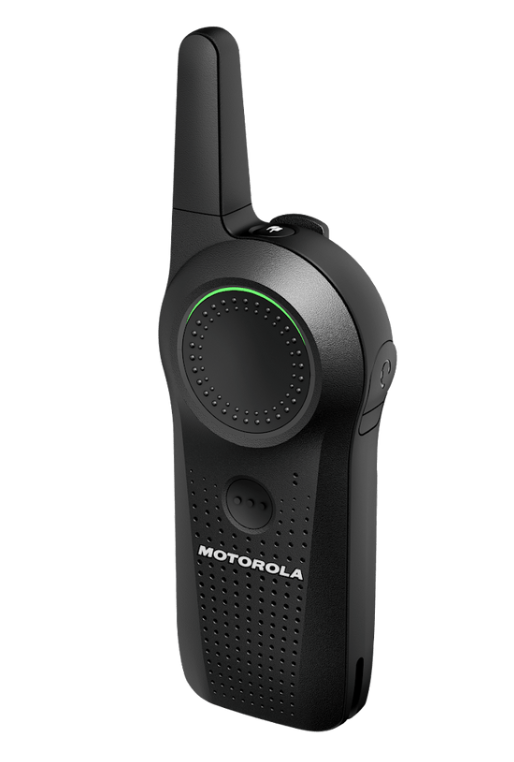
Best for: Mid-size hospitals, nursing teams, and facilities that want digital clarity and antimicrobial housing
The Motorola Curve (model DLR110) is a 900 MHz digital radio purpose-built for demanding indoor environments. It's the successor to the popular DLR series and combines everything that made those radios work well in healthcare with updated features, cloud management capability, and Wi-Fi enhanced calling.
Operating on 10 channels across the 900 MHz band. It covers up to 300,000 square feet or 20 floors. That building penetration makes it particularly strong in hospitals with thick concrete walls between departments. Its polycarbonate housing features built-in antimicrobial properties — an important consideration for hygiene-sensitive environments where radios are shared between staff throughout the day.
The Private Reply feature lets a team member respond directly to a caller without broadcasting to the entire group — ideal for discreet communication in patient-facing roles. The Curve also supports optional Wi-Fi connectivity for advanced features including private voicemail, voice assistant, and cloud-based fleet management through the Curve Portal.
| Spec | Detail |
|---|---|
| Channels | 10 |
| Frequency | 900 MHz (902–928 MHz FHSS) |
| Power | 1 watt digital |
| Coverage | Up to 300,000 sq ft / 20 floors |
| Battery Life | Up to 11.5 hours standard; up to 16 hours with high-capacity battery |
| Durability | MIL-SPEC 810; IP5X |
| Weight | 5.11 oz |
| Warranty | 2 years |
Why it works in hospitals: Digital audio with no static. Antimicrobial housing for infection control environments. The 900 MHz frequency band penetrates hospital-grade construction (concrete, rebar, lead shielding) more reliably than many UHF analog radios, and the 20-floor coverage ceiling handles most hospital footprints. Cloud-based management lets facilities teams update settings and access usage reports remotely through an online dashboard — useful for hospital administrators managing radio fleets across multiple wings.
Limitation: 10 channels may constrain larger hospitals with many departments. Facilities needing more than 10 distinct communication groups should look at the SL300-UD.
Shop the Motorola Curve at techwholesale.com
3. Motorola SL300-UD — Best Professional-Grade Radio for Large Hospitals
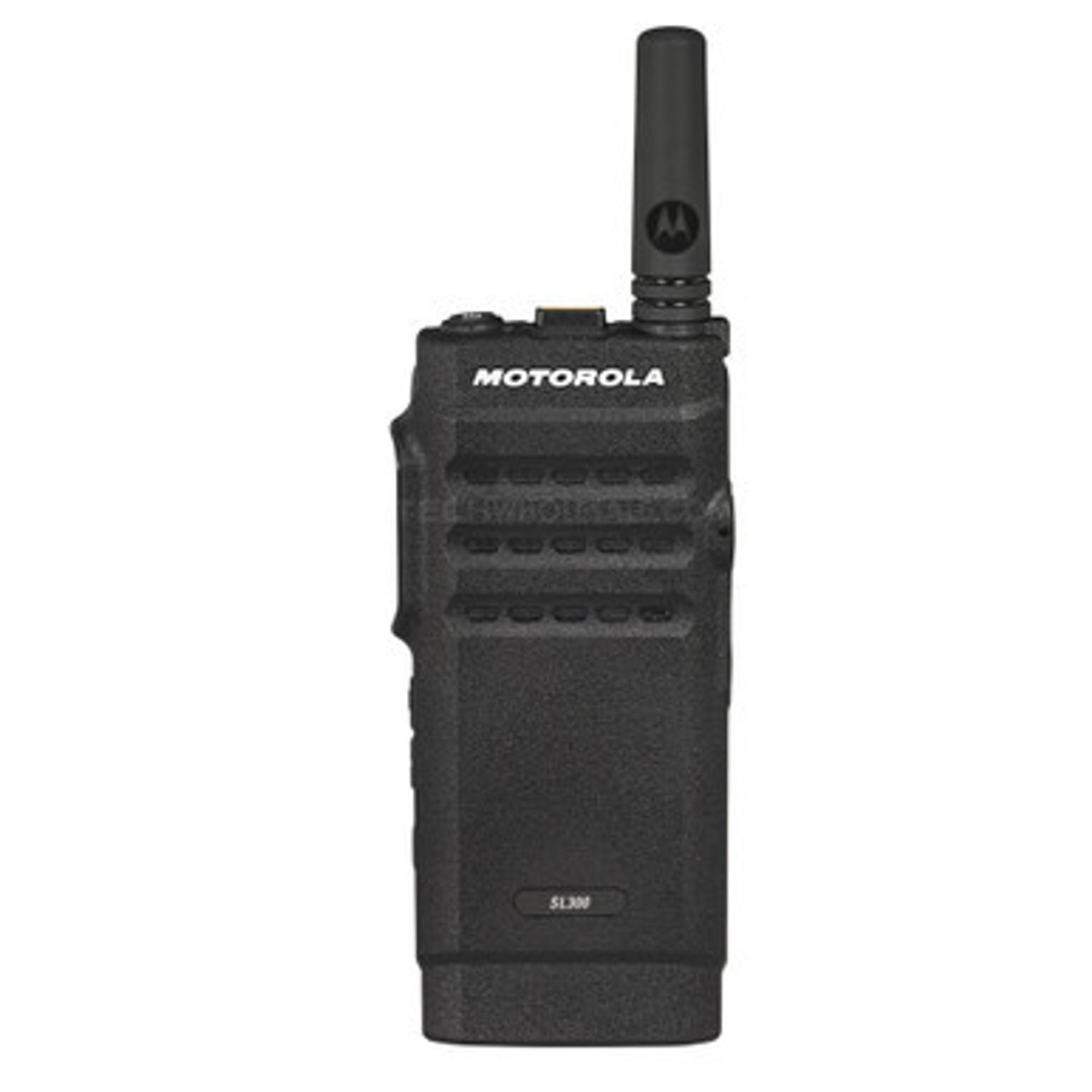
Best for: Large hospitals and multi-wing facilities requiring 99 channels, digital encryption, analog/digital interoperability, and a slim profile that clinical staff will actually want to carry.
The SL300-UD is Motorola's MOTOTRBO-platform radio in an ultra-thin form factor. Measuring under an inch thick, it's ultra-portable with a stubby antenna, curved edges, and a rugged frame — it can be easily carried in pockets without snagging or bulging. That matters in a hospital where nurses and clinicians are already managing stethoscopes, badge clips, and personal protective equipment.
It's capable of operating in analog mode, or as a fully digital programmable radio with up to 99 channels for use on a variety of radio systems. The SL300's innovative antenna design is patented, as is the 12–15-hour IP54 dust/splash-protection battery system, powered by a 2300 mAh Li-Ion rechargeable battery.
The SL300-UD's Transmit Interrupt feature is particularly relevant in hospital emergency scenarios: a supervisor or security coordinator can break into an ongoing conversation to deliver a priority message — a capability that matters during codes, lockdowns, or mass casualty events.
For industries where sensitive information is exchanged over radio — healthcare, corporate facilities, security — the SL300-UD supports digital encryption to keep conversations private and protected from unauthorized access. This encryption capability, combined with private channel programming, represents a meaningful step toward HIPAA-aligned communication practices.
| Spec | Detail |
|---|---|
| Channels | 99 |
| Frequency | UHF (403–470 MHz) |
| Power | 3 watts (Range Max = equivalent to 4W analog) |
| Coverage | Up to 375,000 sq ft / 35 floors |
| Battery Life | 12–15 hours (standard battery) |
| Durability | MIL-SPEC 810 C/D/E/F/G; IP54 |
| Dimensions | 4.95 x 2.17 x 0.87 inches |
| Warranty | 3 years |
Why it works in hospitals: 99 channels gives large hospital systems room to segment every department, floor, and specialty unit without channel conflicts. The SL300 3W digital radio with Range Max delivers communication performance equivalent to most 4W digital radios — meaningful in hospitals where signal must pass through elevator shafts, stairwells, and reinforced walls. The active-view display keeps information readable without a traditional breakable LCD. And the 3-year manufacturer warranty is best-in-class for this category.
Shop the Motorola SL300-UD at techwholesale.com
4. Motorola TLK-25 — Best for Multi-Campus Health Systems and Unlimited Coverage
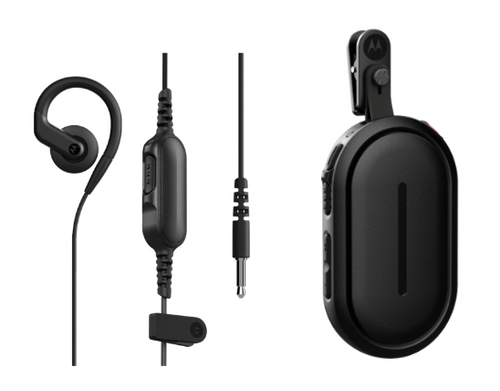
Best for: Hospital networks with multiple buildings, off-site clinics, or mobile staff who need to communicate beyond the range of any traditional two-way radio.
The TLK-25 is a WAVE PTX wearable communication device — not a traditional radio in the conventional sense. It can connect to your existing personal or enterprise Wi-Fi networks or a nationwide LTE network, and a Wi-Fi-only version is also available. For hospital groups operating across multiple campuses, this eliminates range limitations entirely. A charge nurse at one facility can reach a transport coordinator at a satellite clinic as easily as reaching someone on the floor above.
At just 2.5 oz and 0.74 inches thin, it's one of the most compact radios in the Motorola Solutions lineup. The TLK-25 has no external speaker or microphone by design — all audio routes through the included earpiece — which means conversations are entirely private and do not disturb patient areas. This makes it one of the most HIPAA-conscious radio options available.
With Lone Worker mode, the TLK-25 monitors user activity and automatically sends an emergency call if a preset interval passes without interaction. For healthcare workers in isolated areas — overnight security, specimen transport, behavioral health units — this is a meaningful safety feature. With Fall Alert, the TLK-25 detects sudden motion changes or inactivity using its onboard accelerometer and sends an automatic alert to designated personnel if a user falls or becomes immobile.
The device is rated IP67 for dust and water resistance and surpasses military-grade ruggedness standards (MIL-STD 810C, D, E, F, G, H).
| Spec | Detail |
|---|---|
| Connectivity | Wi-Fi (802.11 a/b/g/n/ac, 2.4 & 5 GHz) + LTE |
| Coverage | Unlimited via LTE; full campus via Wi-Fi |
| Battery Life | 12 hours (embedded) |
| Durability | IP67; MIL-STD 810H |
| Weight | 2.5 oz |
| Subscription | Required (WAVE PTX, ~$12/radio/month for base plan) |
| Warranty | 2 years |
Why it works in hospitals: The TLK-25 solves the multi-campus problem that no traditional radio can. It also delivers safety features — lone worker, fall alert, emergency button, indoor location tracking — that are directly relevant to healthcare staff working alone or in elevated-risk environments. All device setup, configuration, and management is handled through the WAVE PTX Administration Portal, accessible from any PC, smartphone, or tablet — giving hospital IT and facilities teams remote control over a distributed radio fleet.
Important operational note: The TLK-25 requires an active WAVE PTX subscription to function. Budget approximately $12 per device per month for the base plan. If LTE connectivity (vs. Wi-Fi only) is needed, verify with your mobile carrier that the device is provisioned correctly. Lease-to-own options are available through techwholesale.com to reduce upfront hardware costs.
Shop the Motorola TLK-25 at techwholesale.com
Quick Comparison: Hospital Radio Models at a Glance
| Model | Coverage | Channels | Battery | Encryption | Best For |
|---|---|---|---|---|---|
| CLS1410 | 200K sq ft / 15 floors | 4 | 18 hrs | No (analog) | Clinics, small departments |
| Motorola Curve | 300K sq ft / 20 floors | 10 | 11.5–16 hrs | Digital (no encryption) | Mid-size hospitals |
| SL300-UD | 375K sq ft / 35 floors | 99 | 12–15 hrs | Yes (digital) | Large hospitals |
| TLK-25 | Unlimited (LTE/Wi-Fi) | Unlimited | 12 hrs | Yes (encrypted) | Multi-campus systems |
Operational Setup Guidance
How Many Radios Does a Hospital Need?
A good starting point is one radio per active staff member per shift, with an additional 20–25% buffer for battery rotation. If 40 staff members are on shift at once and radios charge in 3–4 hours, you may want 48–50 units so no one is waiting for a charged radio. Multi-unit chargers — available for all four models — simplify overnight fleet charging.
Can Hospital Radios Be Disinfected?
Yes. All four models recommended here are built to withstand cleaning with standard hospital disinfectants. The Motorola Curve and CLS1410 feature antimicrobial housing that inhibits bacterial growth on the radio surface. Always check the manufacturer's approved cleaning agent list for each specific model; avoid submerging any radio not rated IP67 or higher.
Do Two-Way Radios Interfere with Medical Equipment?
Modern two-way radios operating on business UHF and digital frequencies are generally compatible with standard hospital equipment when used at appropriate distances. The FDA and Joint Commission recommend following your biomedical engineering department's electromagnetic compatibility (EMC) guidelines for your specific facility. Digital radios (900 MHz FHSS, MOTOTRBO DMR) tend to have a lower interference profile than analog radios. If you operate an ICU, catheterization lab, or MRI suite, consult your biomedical team before deploying new radios.
What Is the Useful Lifespan of a Hospital Two-Way Radio?
Motorola subjects every radio model to an Accelerated Life Test simulating five years of field use before the product is released. With proper care and a charging rotation, most hospitals see four to seven years of service life per unit. The SL300-UD carries a 3-year warranty; the CLS1410, Curve, and TLK-25 carry 2-year warranties. techwholesale.com customers also receive lifetime technical support after purchase.
Frequently Asked Questions
Do hospital two-way radios need to be HIPAA compliant?
HIPAA does not specifically mandate the use of encrypted two-way radios, but the Security Rule (45 CFR § 164.312) requires covered entities to implement reasonable safeguards to protect electronic PHI. When radio conversations include patient names, room numbers, diagnoses, or care instructions, they may constitute PHI. Digital radios with encrypted channels — such as the SL300-UD and TLK-25 — reduce interception risk. Analog radios (including the CLS1410) operate on open frequencies that can be monitored with commercially available scanners. Work with your facility's compliance officer to determine the appropriate standard for your radio communication policy.
What range do hospitals typically need from a two-way radio?
Most hospitals up to 350,000 square feet and 30 floors are well-served by on-site radios such as the Motorola Curve or SL300-UD. Facilities with separate buildings, parking structures, off-site clinics, or mobile transport staff should consider the Motorola TLK-25, which uses LTE to provide unlimited range across any location with cellular coverage.
What battery life is sufficient for hospital use?
A 12-hour minimum is the practical standard for hospital radio deployment, matched to standard shift length. The CLS1410 exceeds this at 18 hours. The Curve reaches 11.5 hours on the standard battery and extends to 16 hours with the optional high-capacity battery. The SL300-UD delivers 12–15 hours. The TLK-25 provides 12 hours on its embedded (non-replaceable) battery. For any model, having spare charged batteries or a hot-swap station available is recommended for facilities running 24-hour operations.
Are two-way radios durable enough for hospital use?
All four models recommended here meet Military Standard 810 specifications for shock, vibration, dust, and humidity. The CLS1410 and Curve meet IP5X dust/humidity ratings. The SL300-UD is IP54 rated (splash and dust resistant). The TLK-25 is IP67 rated (submersion-proof to 1 meter). All have been subjected to Motorola's Accelerated Life Test simulating five years of continuous use. They can withstand the drops, spills, and frequent sanitization that hospital environments demand.
What accessories do hospital radio users typically need?
The most common accessories for hospital environments include:
- Earpieces and surveillance kits — for discreet audio in patient care areas
- Multi-unit chargers — to charge 6+ radios simultaneously overnight
- Spare batteries — for shift rotation on extended deployments
- Swivel belt clips and holsters — for hands-free carry during procedures
- Speaker-microphone accessories — for staff who need PTT without removing the radio from their hip
Motorola CLS Radio Accessories | Motorola Curve Radio Accessories | Motorola SL300 Radio Accessories | Motorola TLK-25 Radio Accessories
Can hospital radios work across multiple buildings or campuses?
Standard on-site radios are limited to their rated indoor range, which typically covers a single large building or campus. For multi-building or multi-campus communication, the Motorola TLK-25 — operating on Wi-Fi and LTE — connects staff across any geography where cellular coverage is available. A repeater can also extend the range of UHF radios like the SL300-UD across buildings in close proximity.
Can two-way radios be used in areas with sensitive medical equipment?
Consult your facility's biomedical engineering department before deploying radios in environments with sensitive equipment such as MRI scanners, cardiac monitors, or infusion pumps. Digital radios (MOTOTRBO DMR, 900 MHz FHSS) generally have a lower electromagnetic interference profile than analog radios. The Joint Commission and FDA provide guidance on electromagnetic compatibility in healthcare environments, and individual hospitals typically have internal EMC policies.
Why Buy from techwholesale.com
techwholesale.com has been an authorized Motorola dealer since 1997. That means every radio ships with its full manufacturer warranty intact, genuine OEM accessories, and no counterfeit risk. It also means our team has spent nearly three decades helping hospitals, clinics, and health systems find the right communication solution — not just the right product listing.
What you get when you buy from techwholesale.com:
- Lifetime technical support — call or email after the sale, every time
- Free programming — radios can be pre-configured for your department channel structure before they ship
- Quotes — for fleet deployments, request a quote
- Lease-to-own options — available on the TLK-25 and other higher-cost models
- Same-day shipping — in-stock items ship from our warehouse, not a drop-ship distributor
- Authorized dealer status — your warranty is fully valid and Motorola-backed
Request a Hospital Radio Quote
Email: Service@TechWholesale.com
Article by Kristin Wood, a two-way radio consultant @ Tech Wholesale | Authorized Motorola & Kenwood Dealer Since 1997 | Last Updated: May 2026