

When a hygienist is ready for a doctor’s exam, every minute the patient waits in the chair puts the whole schedule further behind.
Business-grade UHF or 900 MHz radios with discreet earpieces and hands-free operation let hygienists, assistants, the front desk, and dentists coordinate exams, room turnover, and check-ins without leaving the chair or touching anything with gloved hands.
This is where your search ends! We’ve kept hundreds of dental teams connected across the country since 1997. Here’s how to choose the right radio for your practice.
Which Walkie Talkie Fits Your Dental Practice?
The Quick Answer
- A small practice, three to six operatories → Motorola CLP1010e. Earpiece-only, so nothing is audible from a chair. One channel is enough when everyone works the same floor, and there's nothing for a new hygienist to figure out.
- Multiple roles running at once → Motorola CLS1410. Four channels separates front desk, clinical, sterilization, and doctor pages, so a scheduling question doesn't land in the middle of a room turnover.
- A larger practice, or one with lead-lined operatories → Kenwood PKT-300. Two watts — double everything else here — which is what gets a signal through the lead shielding in an X-ray room or a pan suite. Six channels, expandable to sixteen.
- A group practice or multiple locations → Motorola Curve. Digital 900 MHz, 10 channels, 300,000 sq ft, and antimicrobial housing on a radio that gets handled between operatories all day.
Article by Kristin Wood, a two-way radio consultant @ Tech Wholesale | Authorized Motorola & Kenwood Dealer Since 1997 | Last Updated: August 2026
Dental Office Two-Way Radio Comparison
| Model | Best For | Frequency / Power | Channels | Indoor Coverage | Battery Life | Audio | Antimicrobial |
|---|---|---|---|---|---|---|---|
| Motorola CLP1010e | Small practices, one unified team | UHF 450–470 MHz 1 W |
1 | 100,000 sq ft | Up to 18 hrs | Earpiece-only, no speaker, VOX | Yes |
| Motorola CLS1410 | Front desk, clinical, and hygiene on separate lines | UHF 460–469 MHz 1 W |
4 | 200,000 sq ft | Up to 14 hrs | Built-in speaker, VibraCall, VOX | Yes |
| Kenwood ProTalk PKT-300 | Practices with lead-lined operatories or imaging suites | UHF 450–470 MHz 2 W |
6 | 275,000 sq ft | Up to 14 hrs | Built-in speaker, VOX (headset required) | No |
| Motorola Curve | Group practices and multi-location DSOs | Digital 900 MHz FHSS / 1 W | 10 | 300,000 sq ft | 11.5 hrs (16 with high-capacity battery) | Built-in speaker, Private Reply, VOX | Yes |
Antimicrobial housing is a surface treatment on the radio itself — useful on a unit that moves between operatories, but not a substitute for your infection-control protocol.
Why Dental Offices Need Purpose-Built Two-Way Radios
Most practices try a group text first, or an intercom, or someone walking back to the front. All three break for the same reason: the person you need has both hands in a patient's mouth. A dental office doesn't have a communication problem so much as a hands and attention problem, and that's what changes which radio is right.
Lead-Lined Operatories Block the Signal
In our field testing with dental practices, this is the constraint that separates dental from every other environment we sell into. X-ray rooms are shielded with lead, and lead is close to the worst material a UHF signal can encounter — far more attenuating than the concrete or steel that limits radios elsewhere. A radio that covers a whole suite cleanly can drop out entirely through one shielded wall. That's a physics problem, not an antenna problem, and it has three real fixes: more wattage, a repeater, or a digital platform. It's also the reason square footage is the wrong way to size a dental fleet — a 4,000 sq ft practice with two imaging rooms is a harder RF environment than a 15,000 sq ft office with none.
The Patient Is Six Feet Away
A hygienist can't step out mid-scale, and a patient in the chair can hear everything. A radio announcing that the 2:00 cancelled, or that the doctor is needed in three, is both an awkward moment and a potential disclosure. Earpiece-based communication isn't a preference in a dental practice — for anyone working chairside or at the front desk within earshot of the waiting room, it's the baseline.
Coverage Has to Go Through Walls, Not Across Open Space
A dental suite is a series of small enclosed rooms — operatories, sterilization, lab, private office, front desk — separated by walls, cabinetry, and equipment. That's a fundamentally different problem from covering an open area, and it's why UHF is the standard here. UHF's shorter wavelength moves through building materials far more effectively than VHF, which is built for open line-of-sight outdoors and gives most of its advantage back the moment a signal has to cross a wall. All the radios featured in this guide operate on UHF between 450 and 470 MHz. To learn more about how RF waves penetrate building structures, read our complete breakdown on UHF vs. VHF frequency performance indoors.
What to Look for in a Dental Office Radio
Every dental radio that ends up in a drawer failed one of these six things. Usually it's a button nobody could press with gloves on, or a dead spot behind the imaging wall.
Earpiece or Speaker — and Who Gets Which
This is the first decision, and it's one per role rather than one per practice.
Anyone chairside or within earshot of the waiting room needs an earpiece. That's not just discretion — handpieces, suction, and autoclaves run most of the day, and a small speaker competing with that is hard to understand even when you want to hear it. An earpiece solves both problems at once: audio goes straight to the ear, and the patient six feet away hears nothing.
Speaker radios earn their place in sterilization, the lab, and the back office, where a unit can sit on a counter and someone can hear it across the room without wearing anything.
Radio Weight for All Day Wear
Weight matters more than the spec sheet suggests, because staff wear these for eight hours over scrubs. Under four ounces disappears; over six is noticeable by mid-afternoon and starts snagging on PPE. The CLPe models at 3.35 oz are the lightest here and include the earpiece in the box — on every other model it's a separate accessory, which is the line most practices forget to budget.
How Many Channels a Practice Actually Uses
Three covers most practices: front desk, clinical, and sterilization. The useful question isn't headcount — it's which two conversations can't afford to collide. A scheduling question landing in the middle of a room turnover is the one we hear about most.
Add a fourth for doctor pages or management once a practice runs more than one provider. Above that, the PKT-300's six-to-sixteen and the Curve's ten give you somewhere to put a specialist day, a second location, or a floater without crowding the daily lanes. A single-channel radio works only when the whole team genuinely operates as one unit.
Battery Life Across a Clinical Day
A practice day runs eight to ten hours, and extended-hours or two-shift offices run longer. Look for at least 12 hours rated so there's margin, and note that manufacturer figures are measured under the standard 5/5/90 duty cycle — 5% transmitting, 5% receiving, 90% standby. That's a reasonable description of a normal day and a poor one of a heavy Monday. Treat the number as a ceiling.
For anything past a single shift, a multi-unit charging cradle that docks the whole fleet in one place beats individual chargers scattered around the office — it also means nobody starts a day on a radio someone forgot to plug in.
Cleaning, Antimicrobial Housing, and Ingress Ratings
Two specs matter here that barely register in other industries.
Whether the casing tolerates repeated disinfection. These get wiped down like everything else in an operatory, and the seams and ports are where liquid causes problems. None of these radios are submersible, and none need to be — just avoid saturating a seam.
The ingress rating, which tells you how much moisture the unit actually resists: dust first digit, water second. The CLS1410 is the highest here at IP55, the CLPe models are IP54, and the PKT-300 is IP52 — worth knowing if a radio is going to live near a sterilizer.
Hands-Free Operation with Gloves On
The button matters as much as the feature. A small recessed PTT is unusable with gloves on, and taking a glove off to answer a radio defeats the purpose — that's how radios end up in a drawer. Look for a large tactile button findable without looking.
VOX transmits on voice alone, which is the right answer for anyone whose hands are genuinely committed. One caveat before you spec it fleet-wide: VOX picks up ambient noise, and a dental operatory has plenty. Sensitivity is adjustable, but test it near a running handpiece before committing. On the PKT-300, VOX also requires a headset accessory — it won't trigger off the built-in mic.
HIPAA Considerations for Two-Way Radio Use in Dental Offices
HIPAA's Security Rule (45 CFR Part 164) requires covered entities — including dental practices — to implement technical safeguards that protect electronic PHI from unauthorized access or disclosure. Two-way radio communication is not formally regulated by HIPAA in the same way as electronic health records, but the underlying obligation to protect patient information extends to verbal and radio communication involving patient details.
Standard analog UHF radios transmit on fixed, open frequencies. Anyone with a UHF scanner tuned to the same frequency can hear the transmission. This is a practical risk when radio discussions include patient names, appointment details, treatment status, or clinical coordination that touches on patient identity. This is why you would want to program in privacy codes to your radios.
Practices that use radio communication for patient-adjacent conversations have two options:
- Policy-based approach: Train staff to use general, non-identifying language over radio and discuss any patient-specific detail in person or via a HIPAA-compliant platform. This approach works with any radio.
- Technical approach: Use a radio with FHSS security and rotating privacy codes, such as the Motorola Curve. This significantly reduces the risk of third-party interception regardless of what is transmitted.
No radio is formally "HIPAA certified," because HIPAA does not certify specific technologies. The appropriate question to ask is whether your radio system introduces an unnecessary risk of unauthorized PHI disclosure. For a complete breakdown of patient privacy rules, refer to our comprehensive guide on HIPAA Compliance and Two-Way Radio Communication.
Recommended Two-Way Radios for Dental Offices
1. Motorola CLP1010e — Best for Small Practices
Quick Summary: Motorola CLP1010e
- Best For: Small dental practices, chairside hygienists, and single-team workflows requiring total patient discretion.
- Key Specifications: 1 Watt UHF (450–470 MHz) | 1 Channel | 100,000 sq ft coverage | Up to 18-hour battery life | 3.35 oz | IP54 rating.
- Primary Advantage: Earpiece-only design with no speaker guarantees complete chairside privacy, ensuring patients hear nothing. Includes earpiece in the box.
- Main Trade-off: Single channel prevents role separation between front desk and clinical staff without upgrading to the CLP1080e.
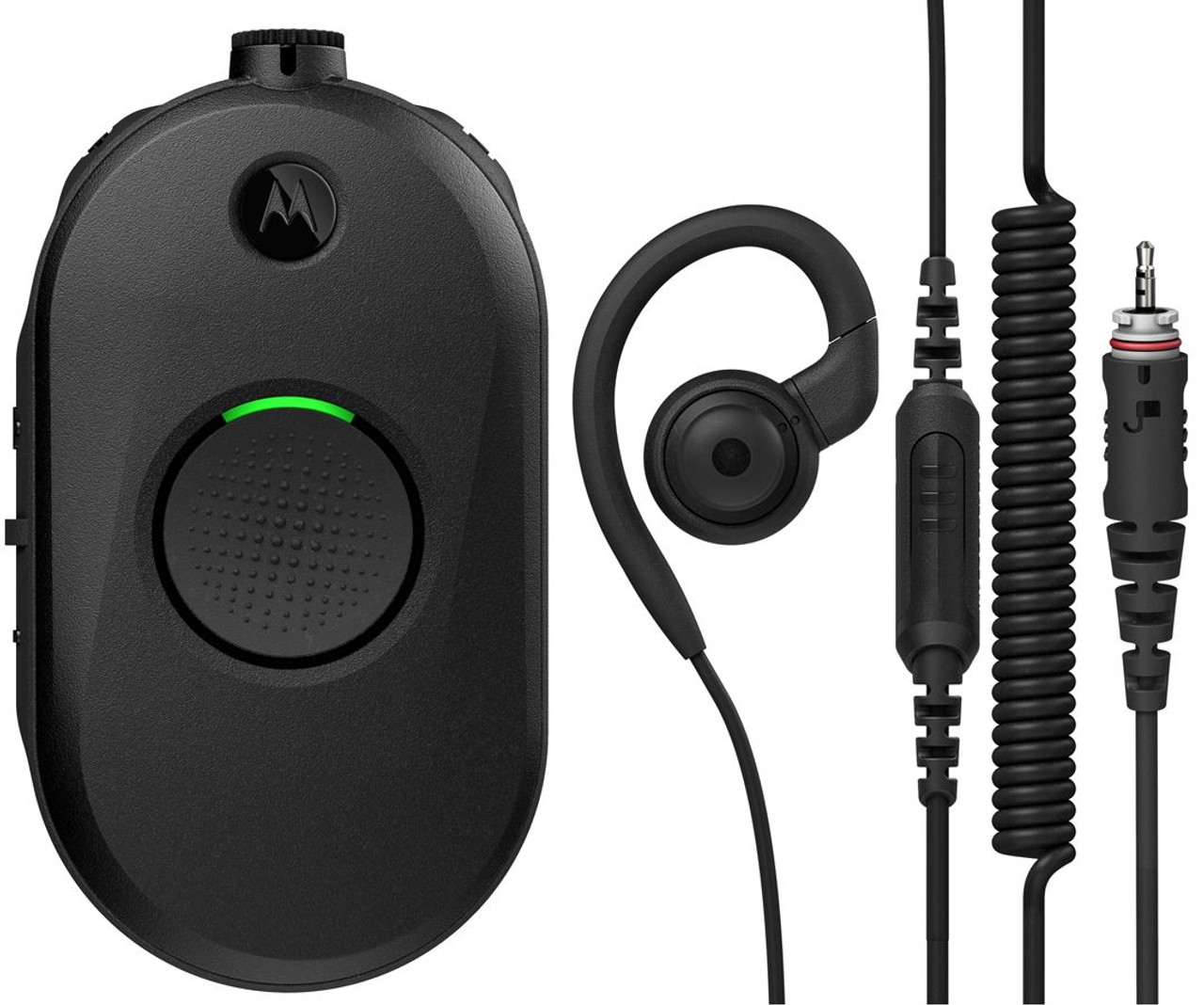
The CLP1010e is the radio we place into dental practices more than any other, and it comes down to one thing: it disappears. At 3.35 oz it clips flat under a lab coat or against a scrub pocket with nothing to snag on PPE, and there's no external speaker at all — audio goes to the included earpiece or nowhere. A patient in the chair hears nothing, which is the baseline requirement for anyone working chairside. The single channel is the right answer more often than practices expect. In an office where the same handful of people cover front desk, clinical, and turnover, one line means nobody is on the wrong channel and a new hygienist is operating it correctly on the first press.
| Specification | Detail |
|---|---|
| Frequency | UHF (450–470 MHz) |
| Power | 1 watt |
| Channels | 1 (upgrade to CLP1080e for 8 channels) |
| Indoor Coverage | Up to 100,000 sq ft / 10 floors |
| Outdoor Range | Up to 1 mile |
| Battery Life | 18 hours |
| Weight | 3.35 oz |
| Casing | Antimicrobial treatment |
| Includes | Swivel belt clip and discreet earpiece |
Pros
- No speaker to leave up at the wrong moment — patient-side silence is designed in, not managed
- Earpiece included in the box; on the CLS1410 and PKT-300 it's a separate accessory
- 3.35 oz, the lightest here, for a radio worn over an eight-hour clinical day
- Antimicrobial housing on a unit that moves between operatories — a surface treatment, not an infection-control measure, but a real one
- Large central PTT button findable with gloves on, without looking
- Repeater-capable, which is one of the three fixes for a lead-lined operatory
Cons
- One channel, so a scheduling question and a room turnover share a line. Practices needing role separation from day one should start with the CLP1080e — same radio, same weight, eight channels.
- Earpiece-only means every person wears one, with no speaker fallback for staff who won't. Sterilization and the back office are usually better served by a speaker radio.
- 1 watt is the least power here. If staff need to talk through a shielded imaging wall rather than near one, this needs a repeater or a step up to the PKT-300.
Buy this if your team works as one unit and everything happens on one floor. Skip it if you have multiple imaging rooms in the signal path, or if front desk and clinical genuinely need separate lines — that's the CLS1410.
One note on mixed fleets: pairing CLPe units for chairside staff with a CLS1410 or two for sterilization and the lab is a common build and works fine, since both are analog UHF and share channels when programmed to matching frequencies.
2. Motorola CLS1410 — Best for Mid-Sized Practices
Quick Summary: Motorola CLS1410
- Best For: Mid-sized dental practices needing separate channels for front desk, clinical, sterilization, and doctor pages.
- Key Specifications: 1 Watt UHF (460–469 MHz) | 4 Channels | 200,000 sq ft coverage | Up to 14-hour battery life | IP55 rating | VibraCall alerts.
- Primary Advantage: VibraCall silent vibration alerts notify staff without loud audio interruptions, and an IP55 rating protects against moisture near sterilizers.
- Main Trade-off: Earpieces are sold separately and must be budgeted for all chairside staff to maintain patient discretion.
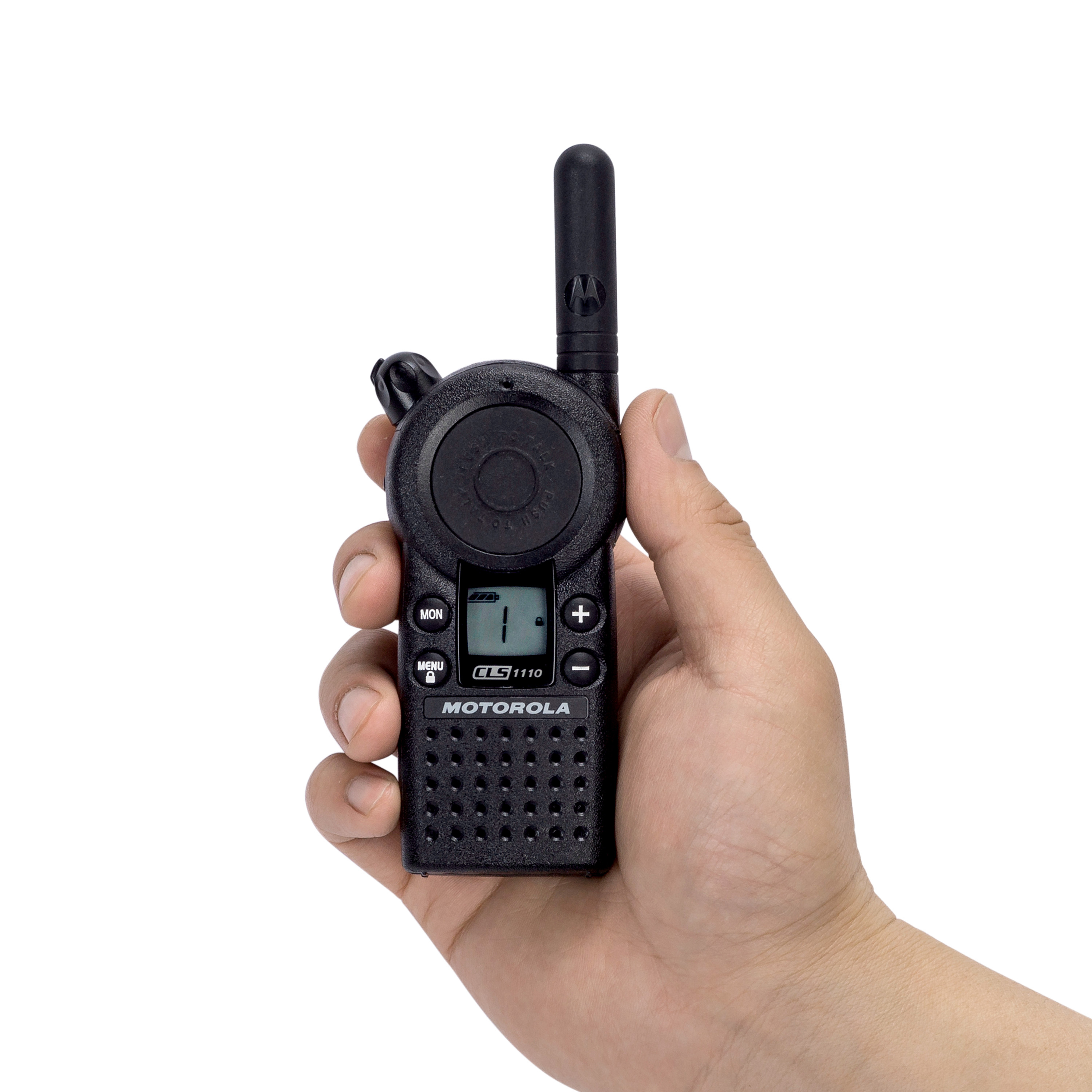
Four channels is the number because it matches how a mid-size practice actually splits: front desk, clinical, sterilization, and a fourth for doctor pages or management. Three would work until the day a second provider is running, and five usually sits empty. The one merge practices regret is putting scheduling on the clinical channel — a question about next Tuesday landing in the middle of a room turnover is the exact collision channels exist to prevent.
The other reason this is the mid-size answer is VibraCall. It vibrates rather than announcing, so a hygienist mid-scale knows they're wanted, finishes what they're doing, and steps away to respond — instead of a transmission landing in front of a patient. That's the middle ground between an earpiece-only radio and one that talks out loud, and it's why this works for staff who won't wear an earpiece all day.
| Specification | Detail |
|---|---|
| Frequency | UHF (460–469 MHz) |
| Power | 1 watt |
| Channels | 4 |
| Indoor Coverage | Up to 200,000 sq ft / 15 floors |
| Battery Life | 14 hours |
| VOX | Yes |
| Call Alert | Audible + Vibracall |
Pros
- Four channels map onto the standard practice structure with nothing left over and nothing missing
- VibraCall gives a silent page without committing the whole fleet to earpieces
- Built-in speaker suits sterilization, the lab, and the back office, where a unit can sit on a counter
- IP55 is the highest moisture rating in this lineup — the one to put near a sterilizer
- Analog UHF, so it shares channels with the CLPe models on matching frequencies. Chairside staff on earpiece-only CLPe units, back-of-house on these, one fleet.
Cons
- Earpieces are a separate accessory here, unlike the CLPe models which include one. Budget them for every chairside and front-desk role — it's the line most practices leave out of the quote.
- The speaker means silence depends on discipline, not design. Anyone in earshot of a patient needs to be wearing the earpiece, and someone has to own that.
Buy this if front desk, clinical, and sterilization need separate lines and most of your team isn't chairside all day. Skip it if everyone works chairside — the CLPe models remove the earpiece-discipline problem entirely — or if shielded operatories are the actual constraint.
3. Kenwood ProTalk PKT-300 — Lead-Lined Operatories or a Larger Suite
Quick Summary: Kenwood ProTalk PKT-300
- Best For: Practices with lead-lined X-ray operatories, imaging suites, or multi-provider offices requiring extra channel capacity.
- Key Specifications: 2 Watts UHF (450–470 MHz) | 6 Channels (expandable to 16) | 275,000 sq ft coverage | Up to 18-hour battery life (with battery saver).
- Primary Advantage: 2-Watt power output doubles standard 1-Watt models to push signals reliably through lead shielding and heavy wall construction.
- Main Trade-off: IP52 water rating offers less moisture protection than the CLS1410, and VOX mode requires an optional headset accessory.
Two watts gives stronger signal through lead in the walls. Lead stops a 1-watt signal in a way drywall and cabinetry don't. If the recurring complaint in your office is that someone standing behind the imaging wall goes silent, this is the fix that doesn't require installing anything. For larger practices six channels standard, expandable to sixteen, gives enough segmentation for large teams. That's room to give a visiting specialist their own line for a Thursday, or to keep a second suite separate without buying a second system.
| Frequency | UHF 450–470 MHz |
|---|---|
| Power | 2 watts high / 0.5 watt low (selectable) |
| Channels | 6 (up to 16 with dealer programming) |
| Indoor Coverage | Up to 275,000 sq ft |
| Battery Life | 14 hrs (up to 18 with battery saver) |
| Weight | 4.87 oz |
| Durability | IP52, MIL-STD-810 C–H |
| Audio | Built-in speaker, VOX (headset required), Privacy Talk |
Pros
- 2 watts — double anything else here, and the most direct answer to lead shielding
- Six channels standard, sixteen with programming, for practices running multiple providers or suites
- 18 hours with battery saver on, the longest runtime here for extended-hours offices
- Privacy Talk voice scrambling keeps a conversation from being casually intelligible on a shared frequency
- Busy Channel Lockout stops two people transmitting over each other on a channel several roles share
- Analog UHF, so it shares channels with the CLPe and CLS models on matching frequencies
Cons
- IP52 is the lowest moisture rating in this lineup — light dripping only. That's worth knowing before assigning one to sterilization, where the CLS1410's IP55 is the better fit.
- No earpiece included, and VOX won't trigger off the built-in mic — it needs a headset accessory. Budget both for chairside roles.
- At 4.87 oz it's the heaviest of the analog options for all-day wear
- Unlocking the full 16 channels requires dealer programming. Send us your channel plan and we'll set it before shipping.
Buy this if staff need to communicate through shielded imaging rooms, or you're running more than four distinct lines. Skip it if coverage isn't actually your problem — a practice with one imaging room where nobody needs to talk through it is better served by the CLS1410 for less, or by the CLPe models if discretion is the priority.
4. Motorola Curve — Best for Large or Multi-Building Practices
Quick Summary: Motorola Curve
- Best For: Multi-building practices, large group practices (DSOs), multi-floor suites, or offices prioritizing digital PHI privacy.
- Key Specifications: 1 Watt Digital 900 MHz (FHSS) | 10 Channels | 300,000 sq ft coverage | 11.5–16 hour battery life | Antimicrobial housing.
- Primary Advantage: Frequency-Hopping Spread Spectrum (FHSS) digital tech prevents scanner eavesdropping and penetrates multi-floor concrete structures cleanly.
- Main Trade-off: Digital 900 MHz protocol is incompatible with analog UHF radios, requiring a full fleet migration if expanding an existing system.
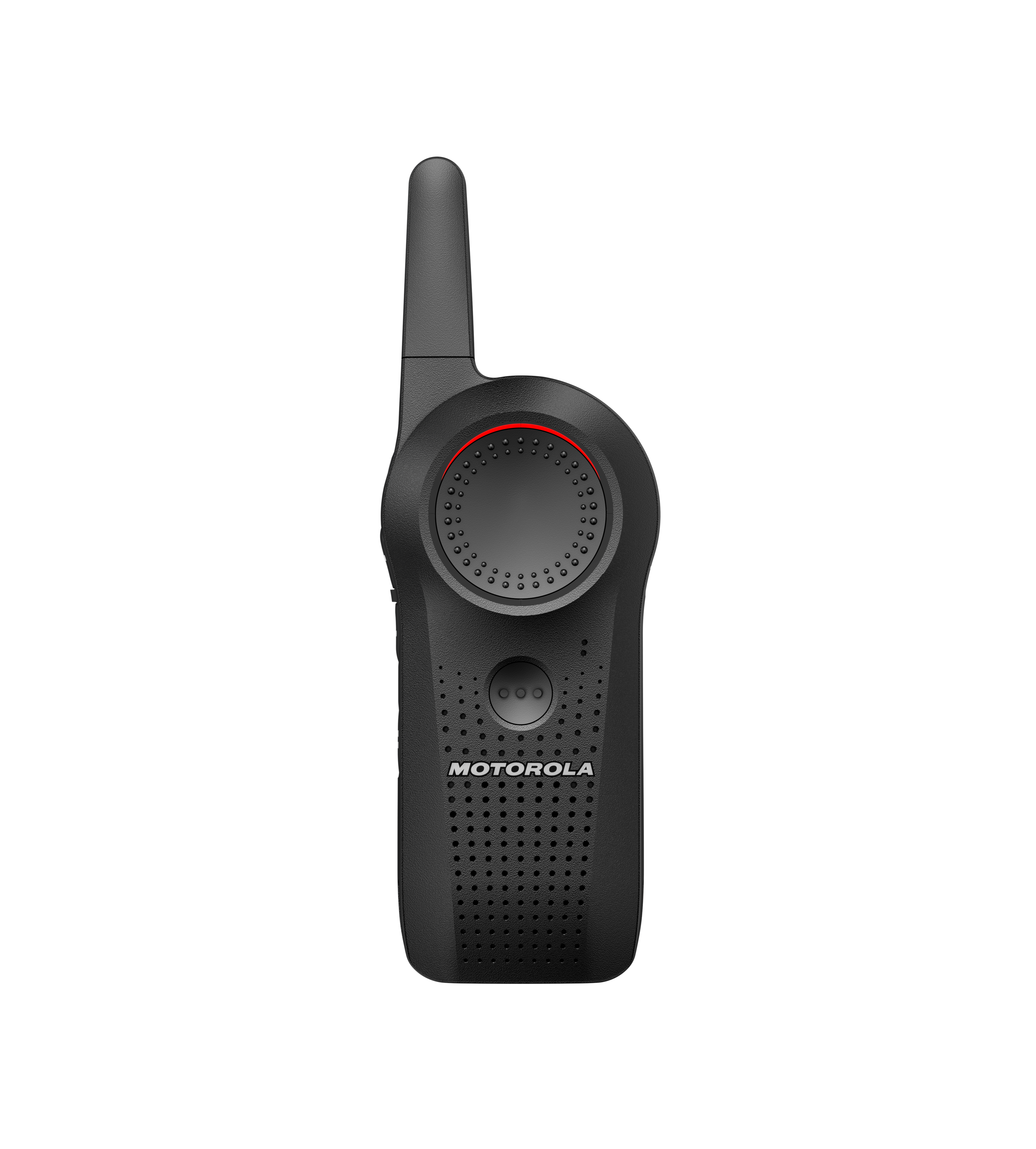
The Curve is a different platform, not a bigger radio — 900 MHz digital instead of analog UHF — and for a dental organization that difference shows up in two places.
The first is buildings. A practice on two floors of a medical office building, or a group with suites in adjacent buildings, is asking a signal to cross elevator shafts, concrete cores, and mechanical spaces. Digital 900 MHz handles that better than 1 watt of analog UHF, and at 300,000 sq ft it's the largest footprint here.
The second is what's on the air. The Curve's frequency-hopping signal doesn't hold a frequency long enough to follow with consumer equipment — which matters for a practice whose radio traffic routinely touches patient names, scheduling, and treatment status.
| Specification | Detail |
|---|---|
| Frequency | Digital 900 MHz (902–928 MHz) |
| Power | 1 watt digital (equivalent to ~4 watts analog) |
| Channels | 10 |
| Indoor Coverage | Up to 300,000 sq ft / 20 floors |
| Battery Life | 11.5 hours |
| Weight | 5.11 oz |
| Privacy Technology | Frequency Hopping Spread Spectrum + 10,000 codes |
| Casing | Antimicrobial treatment, MIL-STD-810 compliant |
Pros
- Largest coverage here at 300,000 sq ft / 20 floors — the only option built for separate buildings or multiple floors
- FHSS makes transmissions impractical to monitor with a standard scanner, unlike open analog frequencies
- Ten channels covers every role across a large practice with room for a second location or a specialist day
- Antimicrobial housing and MIL-STD-810 construction for a radio circulating between operatories
Cons
- It won't talk to your CLP1010e, CLS1410, or PKT-300. Different protocol, not just a different frequency — so if you already run analog UHF, this starts a second fleet rather than expanding the first.
- Built-in speaker, no earpiece-only option. Chairside staff still need an earpiece accessory and the discipline to wear it.
- The shortest battery here on the standard pack; budget the high-capacity battery for extended-hours practices.
- Highest price of the four, and most single-location practices won't use what they're paying for.
Frequently Asked Questions
Do we need an earpiece for every radio?
No — spec them by role (with the exception of the CLPe radios as an earpiece is required). Anyone chairside or within earshot of the waiting room needs one. Sterilization, the lab, and the back office are usually better on a speaker. The CLPe models include an earpiece; on the CLS1410 and PKT-300 it's a separate purchase, which is the line most practices leave out of the budget. Surveillance-style acoustic tube earpieces are the common choice in dental — they sit discreetly and don't tangle in PPE.
Can radios be wiped down with clinical disinfectants?
Yes, all four, with the usual caution: wipe the surface, don't saturate seams, the speaker grille, or the charging contacts. None are rated for submersion and none need to be. The CLPe, CLS and the Curve add antimicrobial housing, which is a surface treatment on the device — useful on a shared unit, not a substitute for anything in your infection-control protocol.
Will radios interfere with dental equipment or imaging?
No. UHF business radios operate well away from the frequencies dental imaging and handpieces use, and none of the models here transmit at power levels that affect clinical equipment. The interference that does occur runs the other direction — autoclaves and motors add ambient noise that makes a small speaker hard to hear, which is a case for earpieces rather than a safety concern.
What if the practice next door is on the same frequency?
Common in medical office buildings, where several practices buy the same radios off the shelf and land on identical default channels. Privacy codes — CTCSS or DCS tones — filter transmissions so your radios only open for your own traffic. They don't encrypt anything, but they stop you hearing the orthodontist upstairs and vice versa. Tell us your building when you order and we'll program you clear of it.
Do the radios arrive ready to use?
Yes, the walkie talkies will work out of the box. The Kenwood PKT-300 ships with 6 of its 16 channels active and needs dealer programming for the rest. Any of them can be reprogrammed with different frequencies or privacy codes by hand.
Can we add radios later or use ones we already own?
Within analog UHF, yes. The CLP1010e, CLS1410, and PKT-300 share channels when programmed to matching frequencies and privacy codes. The Curve runs 900 MHz digital and won't talk to any of them. Send model numbers of anything you have and we'll confirm before you order.
Are there monthly fees to use radios?
No. Radio-to-radio on all four — no airtime, no contract, no app, no subscriptions.
Why Buy from TechWholesale.com
We've been an authorized Motorola and Kenwood dealer since 1997, and dental practices are among the most common fleets we build. Every radio ships with the full manufacturer warranty — two years on the commercial-grade models here — and qualifies for manufacturer service and repair. No gray-market inventory.
What sets us apart for dental practices
- Lifetime technical support included with every purchase — call or email our team for the life of your radio fleet, not just through the warranty period
- Quick quotes — request a custom quote
- No-pressure consultation — our team will tell you when a less expensive radio is the right answer for your practice
- Free shipping on qualifying orders
- Personalized guidance from radio specialists who know dental office environments
If you're not sure which radio fits your practice, use our Find My Radio tool or request a free quote. We'll come back with a specific recommendation based on your floor plan, team size, and communication workflow — no sales pressure, no obligation.
1-888-925-5982 Service@TechWholesale.com
Related Reading
Internal Resources & Guides:
- Guide to HIPAA Compliance for Two-Way Radios — Understand privacy rules and patient information safeguards.
- Frequency Hopping Spread Spectrum (FHSS) Explained — Learn how digital 900 MHz radios secure wireless transmissions.
- Voice-Operated Transmit (VOX) Setup & Best Practices — Hands-free radio operation in high-noise clinical settings.
- UHF vs. VHF Frequencies for Indoor Businesses — Why UHF signal penetration outperforms VHF indoors.
- How to Program Two-Way Radio Privacy Tones — Eliminating cross-talk and channel interference in shared medical buildings.
- Commercial Two-Way Radio FAQs — Common answers regarding frequencies, licensing, and battery care.
Official Regulatory Standards:
- U.S. Department of Health & Human Services: HIPAA Security Rule Summary — Official federal guidelines for safeguarding electronic protected health information.
- OSHA Occupational Noise Exposure Standards — Federal workplace guidelines for acoustic noise safety in medical settings.