

Many nursing homes rely on overhead pages and walking the halls to find help, which disturbs residents and slows every response. Consumer radios don’t hold up to constant disinfectant wipes or being passed between shifts either.
Business-grade UHF radios with earpieces keep every call quiet, and their rugged, antimicrobial housings stand up to round-the-clock use, protecting your investment for years.
You’ve come to the right place! We’ve worked alongside hundreds of nursing homes nationwide since 1997. Here’s how to pick the radio that fits your facility.
Which Walkie Talkie Fits Your Nursing Home?
The Quick Answer
- Direct care staff working in resident rooms and hallways → Motorola CLP1080e. Earpiece-only with no external speaker. Eight channels, antimicrobial housing, and 3.35 oz on a CNA who's already carrying enough.
- Long wings, elevators, and a building that swallows signal → Motorola RMU2040. Two watts of UHF for thick building materials. The louder speaker is the point for maintenance, dietary, and housekeeping.
- A larger facility or a multi-building campus → Motorola Curve. Digital 900 MHz, 300,000 sq ft, and ten channels — Frequency Hopping Spread Spectrum to keep conversations private.
Quick Links
Why Nursing Homes Need Purpose-Built Two-Way Radios
Cell phones and consumer walkie-talkies fail in long-term care for predictable reasons: they tie up a staff member’s hands, they drop signal in elevators and basements, their batteries don’t survive a 12-hour shift, and they put resident information onto channels anyone nearby can hear. Professional radios are built around the realities of a care environment.
Nursing homes face a combination of pressures that few other settings share:
Time-critical resident response. When a call light goes unanswered or a fall isn’t relayed quickly, the resident pays for the delay. Push-to-talk (PTT) communication removes the lag of dialing, unlocking, and texting a phone — one button reaches the right person instantly.
Difficult RF environments. Concrete firewalls, steel-framed elevators, stairwells, basements, and multi-wing layouts block low-powered consumer radios. Coverage has to reach the places staff are least able to afford a dead zone.
Resident privacy. Verbal exchanges about a resident’s condition, medication, or room can constitute protected health information under HIPAA. Open, shared channels and consumer FRS/GMRS radios offer little protection against being overheard by visitors or nearby businesses.
Infection control. Radios are shared between shifts and carried through resident rooms. Antimicrobial housings, standard on the models below, help limit the spread of bacteria on a device that changes hands constantly.
Long shifts and continuous use. Nurses, CNAs, housekeeping, maintenance, and front-desk staff work 8 to 12 hours. A radio has to last the shift, survive daily drops, and be light enough to wear all day without fatigue.
What to Look for in a Nursing Home Radio
Coverage and Power
Match power and frequency to your building, not to a spec-sheet number. A single-story 30-bed home is a very different problem from a multi-wing campus.
- Small, single-building facilities: 1 watt of UHF (or 1 watt digital) covering 100,000–200,000 sq ft is usually sufficient.
- Larger or multi-floor buildings: 2 watts of UHF analog, or 1 watt of 900 MHz digital, penetrates concrete and reaches 250,000–300,000 sq ft.
- Thick concrete or steel construction: step up one power level beyond what square footage alone suggests, or add a repeater.
Battery Life
A care shift runs 8 to 12 hours. Choose a radio rated for at least a full shift under normal transmit-receive loads. Motorola and Kenwood commercial-grade batteries are tested through Motorola’s Accelerated Life Testing to simulate up to five years of field use. Multi-unit chargers let a facility hot-swap or rotate batteries between shifts without downtime.
Channels
Channels keep departments off each other’s traffic. Most nursing homes operate cleanly with three to four: nursing/clinical, housekeeping and maintenance, and administration/front desk, with room for a private management or security channel. Larger campuses with dedicated security or multiple wings benefit from six to ten.
Durability Rating
Look for an ingress-protection (IP) rating and a MIL-STD-810 designation. IP54 indicates protection against dust and splashing water from any direction; IP55 adds resistance to low-pressure water jets. MIL-STD-810 covers shock, vibration, and temperature tolerance — the realities of a radio that gets dropped on tile daily.
Discretion and Hands-Free Use
In resident-facing areas, an earpiece keeps incoming audio private and the environment calm. VOX (voice-activated transmission) lets staff communicate hands-free during a lift or transfer. For back-of-house roles, a built-in speaker is more practical than an earpiece.
Our Top Two-Way Radio Picks for Nursing Homes
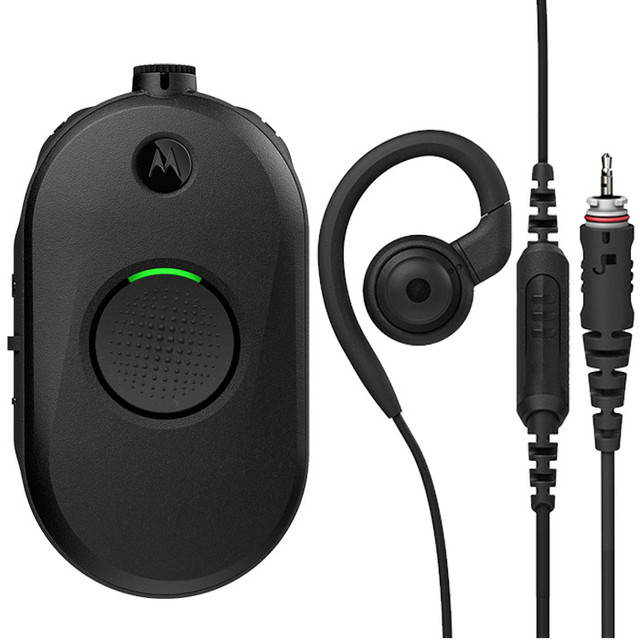
1. Motorola CLP1080e — Best for Resident-Area and Bedside Communication
| Specification | Detail |
|---|---|
| Channels | 8 |
| Power / Frequency | 1 watt, UHF (450–470 MHz) |
| Indoor Coverage | Up to 100,000 sq ft / 10 floors |
| Battery Life | Up to 18 hours (high-capacity battery) |
| Durability | IP54, MIL-STD-810 (C–H) |
| Audio | Earpiece-only (no external speaker) |
| Hygiene | Antimicrobial housing |
The CLP1080e is the radio we reach for first when discretion matters. It operates entirely through its included earpiece — there is no external speaker — so a nurse can take a message at a bedside without a burst of audio disturbing the resident. At roughly the size of a deck of cards with an internal antenna, it disappears on a uniform, and its antimicrobial housing is built for a device that moves room to room.
Why it fits nursing homes specifically
- Earpiece-only audio keeps clinical conversations quiet in resident rooms and common areas.
- Eight channels separate nursing, housekeeping, maintenance, and administration cleanly.
- Up to 18 hours of battery on the high-capacity pack covers a double shift.
- VOX hands-free transmission lets staff communicate during a transfer or lift.
- Repeater-capable if you later need to extend coverage across a larger footprint.
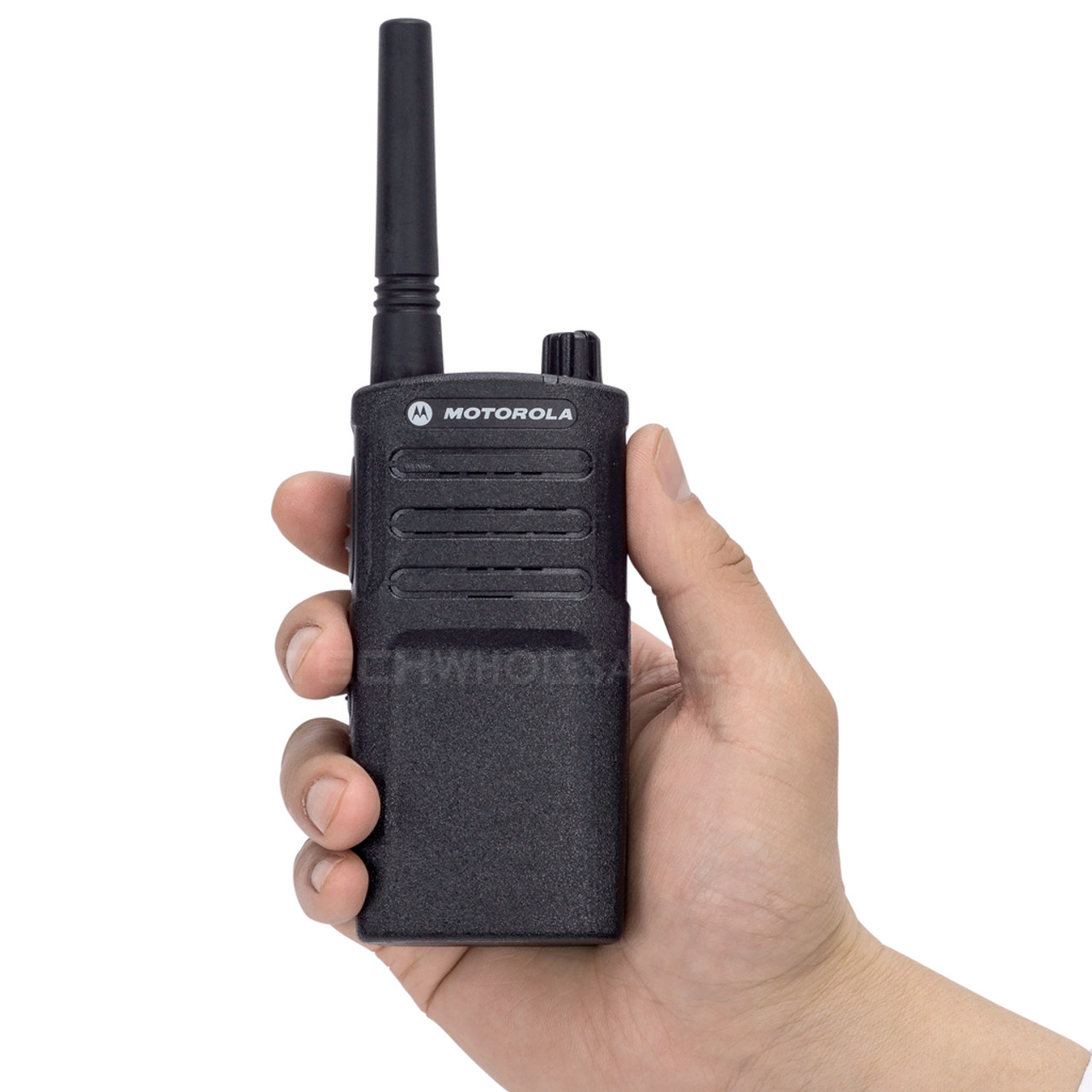
2. Motorola RMU2040 — Best for Larger Buildings, Elevators, and Concrete Construction
| Specification | Detail |
|---|---|
| Channels | 4 |
| Power / Frequency | 2 watts, UHF (450–470 MHz) |
| Indoor Coverage | Up to 250,000 sq ft / 20 floors |
| Battery Life | Up to 15 hours |
| Durability | IP54/55, MIL-STD-810 (C–G) |
| Speaker | 1,500 mW (loud, clear audio) |
| Hygiene | Antimicrobial coating |
When a building has elevators, stairwells, a basement level, or poured-concrete firewalls, the extra wattage of the RMU2040 earns its place. Two watts of UHF penetrates structural materials that defeat 1-watt radios, and its 1,500 mW speaker stays intelligible in a busy dining room or activity hall. The IP55 rating and die-cast chassis hold up to daily handling, and channel announcement with voice alias lets staff confirm their channel without taking the radio off the belt.
Why it fits nursing homes specifically
- 2-watt UHF output reaches elevators, stairwells, basements, and concrete-walled wings.
- Loud 1,500 mW speaker cuts through dining halls, alarms, and activity areas.
- IP54/55 sealing and MIL-STD-810 build survive repeated drops on hard flooring.
- Antimicrobial housing suits a device shared across shifts.
- Note: the RMU2040 is not repeater-compatible; for campuses beyond its range, consider the Curve.
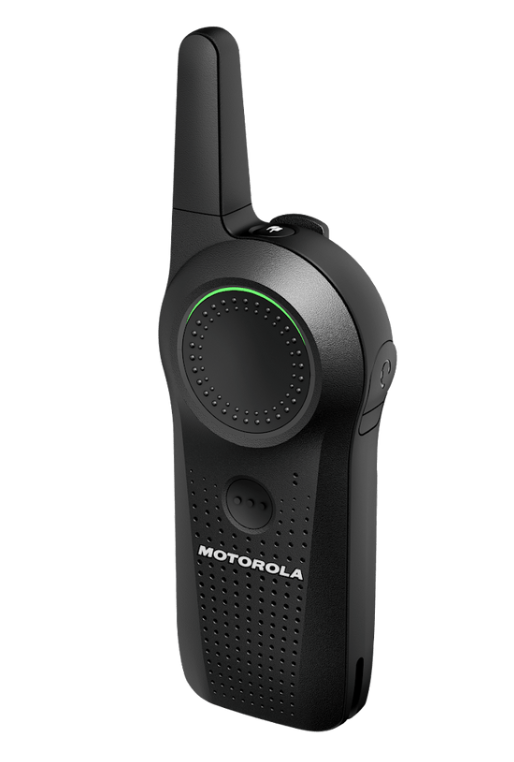
3. Motorola Curve — Best for Large Campuses and Private, HIPAA-Conscious Communication
| Specification | Detail |
|---|---|
| Channels | 10 |
| Power / Frequency | 1 watt digital, 900 MHz (902–928 MHz) FHSS |
| Indoor Coverage | Up to 300,000 sq ft / 20 floors |
| Battery Life | Up to 12 hours |
| Durability | IP5X, MIL-STD-810 |
| Privacy | FHSS digital; Direct Call (one-to-one) |
| Hygiene | Antimicrobial housing |
For a multi-wing or multi-building campus — and for any facility that wants the most privacy-conscious option — the Motorola Curve is our recommendation. Its 900 MHz frequency-hopping spread spectrum (FHSS) signal penetrates concrete and steel more effectively than UHF analog at comparable wattage, and because it is a proprietary digital platform, consumer FRS/GMRS radios in the area cannot receive or interfere with it. That isolation is what makes the Curve a strong fit for verbal exchanges that touch on resident health information.
Why it fits nursing homes specifically
- Ten channels support full department segmentation across large, multi-wing teams.
- Digital FHSS resists eavesdropping and crosstalk — supportive of HIPAA privacy practices for resident information.
- Direct Call enables private, one-to-one conversations for sensitive situations.
- Page All / Call All reaches every staff member instantly during an emergency.
- Antimicrobial housing and MIL-STD-810 build for shared, daily use.
Also Worth Considering
Kenwood ProTalk PKT-300 — 2 watts, 6 channels, UHF (450–470 MHz). A durable, pocket-sized alternative to the RMU2040 for facilities that prefer Kenwood’s build or want six dedicated channels in a compact body.
Motorola WAVE PTX (TLK series) — For nursing home groups operating across multiple locations or states, the WAVE PTX line uses LTE and Wi-Fi for nationwide coverage with no traditional range limit, plus GPS staff location and an emergency button. A per-device service subscription applies.
Nursing Home Radio Comparison
A side-by-side look at the three recommended models. Match the row that fits your building size and communication needs.
| Model | Channels | Power / Frequency | Indoor Coverage | Battery Life | Durability | Best For |
|---|---|---|---|---|---|---|
| Motorola CLP1080e | 8 | 1 W, UHF | 100,000 sq ft / 10 floors | Up to 18 hrs | IP54, MIL-STD-810 | Discreet, earpiece-only resident care; small to mid-size homes |
| Motorola RMU2040 | 4 | 2 W, UHF | 250,000 sq ft / 20 floors | Up to 15 hrs | IP54/55, MIL-STD-810 | Elevators, stairwells, basements, concrete construction |
| Motorola Curve | 10 | 1 W digital, 900 MHz | 300,000 sq ft / 20 floors | Up to 12 hrs | IP5X, MIL-STD-810 | Large campuses; private, HIPAA-conscious communication |
Compliance and Emergency Coordination
Two-way radios intersect with several requirements that apply to skilled nursing and long-term care facilities. Radios are a supporting tool, not a substitute for a written compliance program, but they directly enable several obligations.
Resident Privacy (HIPAA)
Verbal communication about a resident’s condition, medication, or location can be protected health information under the HIPAA Privacy and Security Rules (45 CFR Part 164). Broadcasting that information on open or shared channels creates exposure. A digital FHSS platform like the Motorola Curve, and earpiece-only operation on the CLP1080e, both reduce the chance that resident information is overheard. No radio is “HIPAA-certified” on its own — compliance depends on facility policy and how staff use the equipment — but private, digital, earpiece-based communication supports good privacy practice.
Emergency Preparedness Communication (CMS)
Under the CMS Emergency Preparedness Rule for long-term care facilities (42 CFR §483.73), a facility must develop and maintain an emergency preparedness communication plan, reviewed at least annually. Reliable internal communication that reaches every wing, floor, and outdoor area is part of how a facility carries out that plan during an evacuation, shelter-in-place, or other emergency.
Staff Emergency Reporting (OSHA)
OSHA’s Emergency Action Plan standard (29 CFR 1910.38) requires a means for employees to report emergencies and dangerous situations. A radio fleet with a dedicated alert tone, Page All, or emergency button gives staff that immediate reporting path — useful during medical events, fires, missing-resident situations, and workplace-safety incidents.
Frequently Asked Questions
How much coverage does a nursing home radio need?
Match coverage to building size and construction. A single-building home is usually well served by a 1-watt radio rated to 100,000–200,000 sq ft, such as the CLP1080e. Larger or multi-floor facilities should step up to the 2-watt RMU2040 (up to 250,000 sq ft / 20 floors) or the digital Curve (up to 300,000 sq ft / 20 floors). Buildings with thick concrete or steel should choose one power level higher than square footage alone suggests, or add a repeater.
How long do the batteries last?
All three recommended models cover a full shift. The CLP1080e runs up to 18 hours on its high-capacity battery, the RMU2040 up to 15 hours, and the Curve up to 12 hours. Motorola commercial batteries are tested through Accelerated Life Testing to simulate up to five years of field use. For back-to-back shifts, a multi-unit charger lets staff rotate batteries without downtime.
How durable are these radios — what are the IP and MIL-STD ratings?
The CLP1080e is rated IP54 and meets MIL-STD-810 (C through H). The RMU2040 carries IP54/55 sealing and MIL-STD-810 (C through G). The Curve is rated IP5X for dust and meets MIL-STD-810. IP54 protects against dust and splashing water from any direction; IP55 adds resistance to low-pressure water jets. All three use antimicrobial housings, which is relevant for devices shared between shifts.
Are two-way radios safe for communicating resident health information?
They can be, with the right model and policy. Resident health details can be protected under HIPAA (45 CFR Part 164). The Motorola Curve uses a digital frequency-hopping platform that consumer radios cannot receive, and the CLP1080e’s earpiece-only design keeps incoming audio private. No radio is “HIPAA-certified” by itself — compliance depends on your facility’s policies and staff practices — but private digital and earpiece-based communication reduces the risk of information being overheard.
How many radios does a nursing home need?
A practical starting point is one radio per active staff role per shift: nursing/clinical, CNAs, housekeeping, maintenance, and front desk. A small home often runs well on six to ten units; larger campuses add radios for each wing and for dedicated security positions. We can help you size a fleet to your floor plan and team structure — quantity pricing is available for orders of five or more.
Will radios work in elevators, stairwells, and basements?
Yes, with adequate power. Two watts of UHF (the RMU2040) penetrates elevators, stairwells, and concrete more reliably than 1-watt radios. The Curve’s 900 MHz digital signal also performs well through dense construction. For buildings with persistent dead zones, a repeater extends coverage — the CLP1080e and Curve are repeater/range-extender capable, while the RMU2040 is not.
Can radios support emergency and evacuation coordination?
Yes — this is one of their most important roles. Dedicated channels and alert tones let staff escalate a fall, medical event, fire, or missing-resident situation instantly. Reliable internal communication supports the communication plan required of long-term care facilities under the CMS Emergency Preparedness Rule (42 CFR §483.73) and the employee emergency-reporting requirement under OSHA’s Emergency Action Plan standard (29 CFR 1910.38).
Can radios be shared hygienically between shifts?
Yes. The CLP1080e, RMU2040, and Curve all use antimicrobial housings designed to inhibit the growth of mold and bacteria on the device surface — a meaningful feature in a care environment where radios pass between staff at every shift change and are carried through resident rooms.
Why Buy from TechWholesale.com
Tech Wholesale has sold professional two-way radios to nursing homes, assisted living communities, and healthcare facilities since 1997. We are an authorized dealer for Motorola and Kenwood, so every radio we sell carries the full manufacturer warranty — typically two years on commercial-grade models — and qualifies for manufacturer service and repair.
What sets us apart
- Lifetime technical support with every purchase — call or email our team for the life of your radio fleet, not just through the warranty period.
- No-pressure consultation — if a less expensive radio is the right answer for your building, that’s what we’ll tell you.
- Authorized dealer status — no gray-market inventory, no voided warranties.
- Free shipping on qualifying orders, and quick quotes.
Not sure which radio fits your facility? Use our Find My Radio tool or request a quote. Tell us your building size, layout, and team structure, and we’ll come back with a specific recommendation — no obligation.
1-888-925-5982 | Service@TechWholesale.com
Related Reading
- HIPAA Compliance and Two-Way Radios
- Frequency Hopping Spread Spectrum (FHSS) Explained
- Privacy Codes – Eliminate Outside Interference
- VOX Hands-Free Operation Explained
- UHF vs VHF – Frequencies Explained
- Man Down & Lone Worker Functionality
- CMS Emergency Preparedness Rule for LTC Facilities (42 CFR §483.73)
- HHS — HIPAA Privacy Rule for Professionals
- OSHA Emergency Action Plans (29 CFR 1910.38)
Article by Kristin Wood, a two-way radio consultant @ Tech Wholesale | Authorized Motorola & Kenwood Dealer Since 1997 | Last Updated: June 2026