

Many associations rely on staff cell phones and find out during an emergency that calls drop in the stairwells, elevators, and parking garage. Consumer walkie-talkies don’t fare much better and rarely survive a few years of daily use. Business-grade UHF or 900 MHz radios reach every floor and garage level, and they’re built rugged enough to last for years, protecting the association’s investment.
We’ve equipped hundreds of condo associations across the country since 1997. Here’s how to pick the right radio for your property.
What Makes a Two-Way Radio Right for a Condo Association?
Not all radios are built for the same environment. A radio designed for open construction sites performs very differently inside a multi-story building with thick concrete walls and steel reinforcement. Before you compare models, you need to understand the features that actually matter for condo operations.
Coverage and Power
The single most important factor is coverage. Buy too little power and you'll get dead zones in the parking garage, laundry room, or far end of the property. Buy too much and you're overpaying for range you'll never use.
Here's a simple breakdown:
- Small associations (up to 250,000–275,000 sq ft): 2 watts of power is typically sufficient for reliable indoor communication across 20+ floors.
- Larger associations (350,000–400,000 sq ft): You'll need 3–4 watts on analog, or 1 watt on digital (which is equivalent to roughly 4 watts analog), to punch through heavy walls and cover greater distances.
- Multiple locations or unlimited range: Consider LTE/Wi-Fi-enabled radios like the Motorola WAVE PTX series, which use cellular and internet connectivity rather than traditional radio frequencies.
Thick concrete or reinforced walls? Go one watt stronger than the baseline recommendation to account for signal loss.
Number of Channels
Channels let you segment your team so that every transmission goes to the right people. For a typical condo association, three groups cover most scenarios:
- Maintenance – coordinate repairs, respond to unit issues, manage building systems
- Front Desk/Security – handle guest check-ins, building access, and resident concerns
- Janitorial/Cleaning – report spills, request supplies, and coordinate schedules
That's clean, direct communication. No maintenance team being interrupted by lobby chatter, and no security staff wading through cleaning updates.
Channels also allow private conversations. "Sarah, switch to channel two" takes a discussion off the main line—quick and professional.
Features Worth Prioritizing
When comparing models, look for these capabilities:
- Long battery life: Staff shouldn't be hunting for chargers mid-shift. Aim for 12+ hours of use per charge.
- Clear audio quality: Noisy mechanical rooms and busy lobbies demand crisp, noise-canceling sound. If a message gets lost, so does the response.
- Durability: Look for weather-resistant, drop-tested models. Maintenance teams work in conditions that will test any device.
- Privacy codes or encryption: Resident information and unit-related conversations should stay private.
- Compact, lightweight design: Radios need to clip to a belt or fit in a pocket without slowing anyone down.
- Hands-free (VOX) capability: Voice-activated operation is a major advantage for staff juggling tasks.
- Emergency alert button: One press notifies the entire team—critical for accidents, medical situations, or security threats.
- Ease of use: Large buttons, clear displays, and minimal setup. Your team needs to pick it up and go.
Top Two-Way Radio Picks for Condo Associations
Every recommendation below comes from hands-on experience across thousands of radio deployments. These aren't guesses—they're proven performers with strong track records in real association environments.
Best for Small Associations
Motorola RMU2040
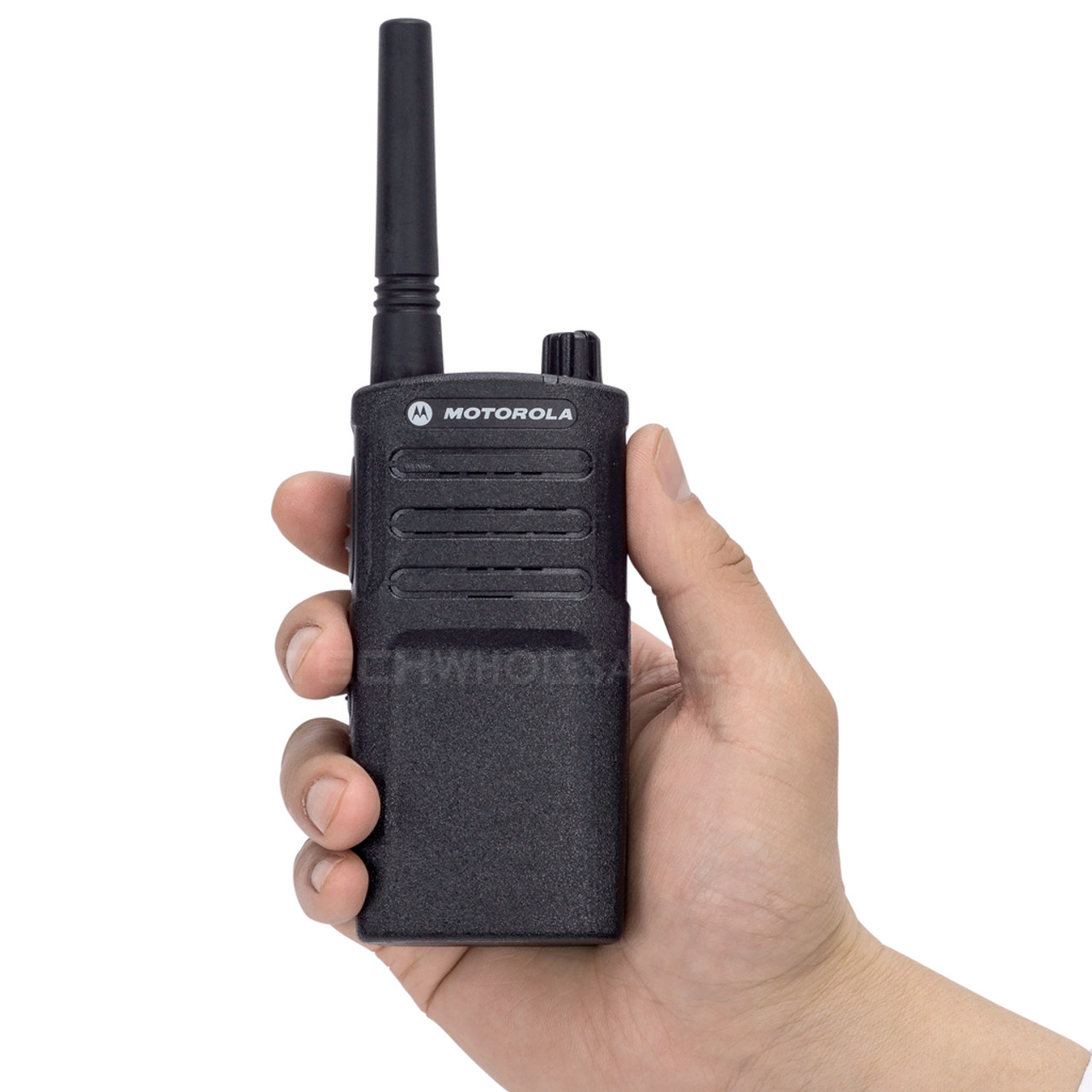
Channels: 4 | Power: 2W UHF | Coverage: 250,000 sq ft / 20 floors
If you need a radio that can handle punishment, the RMU2040 is built for it. Designed to military standard (MIL-STD), it holds up against dust, wind, shock, and vibration. It even features an antimicrobial coating—a practical benefit in shared-use environments.
The 2-watt output covers 250,000 square feet indoors and up to two miles outdoors. Its eight channels give you plenty of room to segment even a sizeable team, and the 99 UHF business-exclusive channels paired with 219 PL/DPL privacy codes keep communications secure.
The built-in display makes navigation easy, and the lithium-ion rechargeable battery ensures power throughout the day. At nine ounces, it's slightly heavier than comparable models, but the trade-off is raw durability and strong signal penetration through concrete and steel.
Bottom line: A powerhouse compact radio for associations that demand reliability and toughness.
Kenwood PKT300
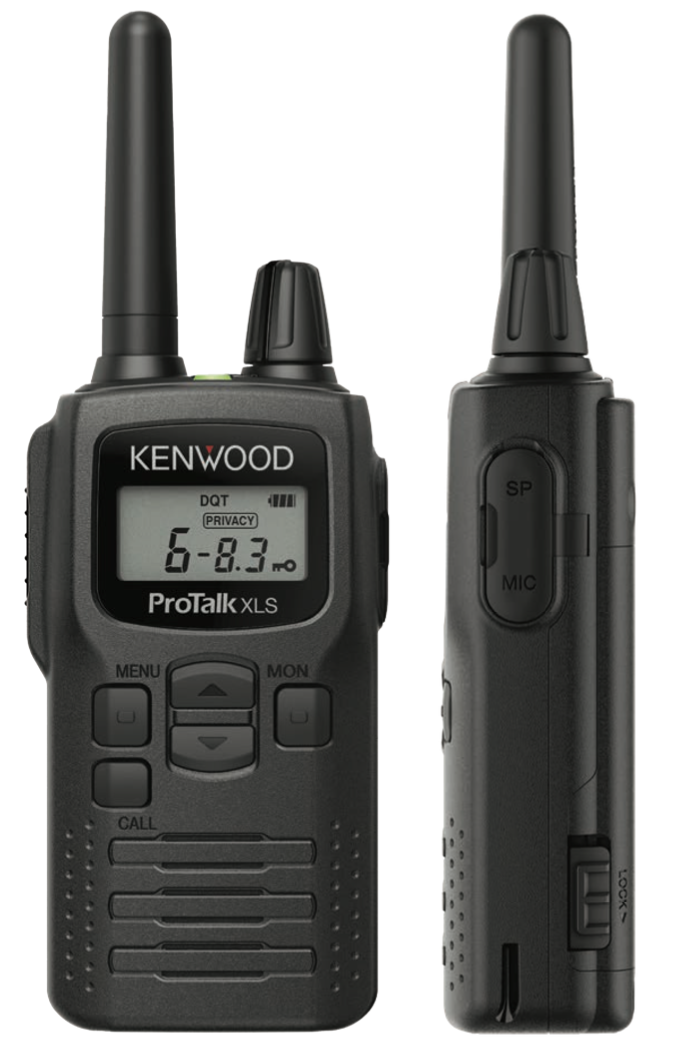
Channels: 6 | Power: 2W UHF | Coverage: 275,000 sq ft / 20 floors
The Kenwood PKT300 is the go-to for associations that want a lightweight, easy-to-carry radio without sacrificing performance. It covers 275,000 square feet indoors and two miles outdoors on just two watts—plenty for most small-to-mid-sized properties.
Six channels give you enough groups to keep operations organized, and the VOX (voice-activated) feature enables true hands-free communication. The package includes a standing charging tray and wall charger, so keeping a full fleet powered is straightforward.
Slim profile, intuitive controls, and solid UHF penetration through walls and concrete make this a staff-friendly choice.
Bottom line: An excellent pick for associations that value ease of use and lightweight design.
Best for Larger Associations
Motorola DTR700

Channels: 50 | Power: 1W Digital (equivalent to ~4W analog) | Coverage: 350,000 sq ft / ~3 miles
The DTR700 operates on the 900 MHz ISM band for great privacy and audio clarity.
Despite its 1-watt rating, the digital signal is equivalent to roughly 4 watts of analog power. With up to 50 channels, 200 contacts, and flexible call options including call-all and private reply, it's the closest thing to a cellular phone without the monthly bill.
Three-mile outdoor range and 350,000 square feet of indoor coverage make it well-suited to larger or multi-building properties.
Bottom line: Ideal for larger associations that need flexibility and digital performance.
Motorola CP100d-UA
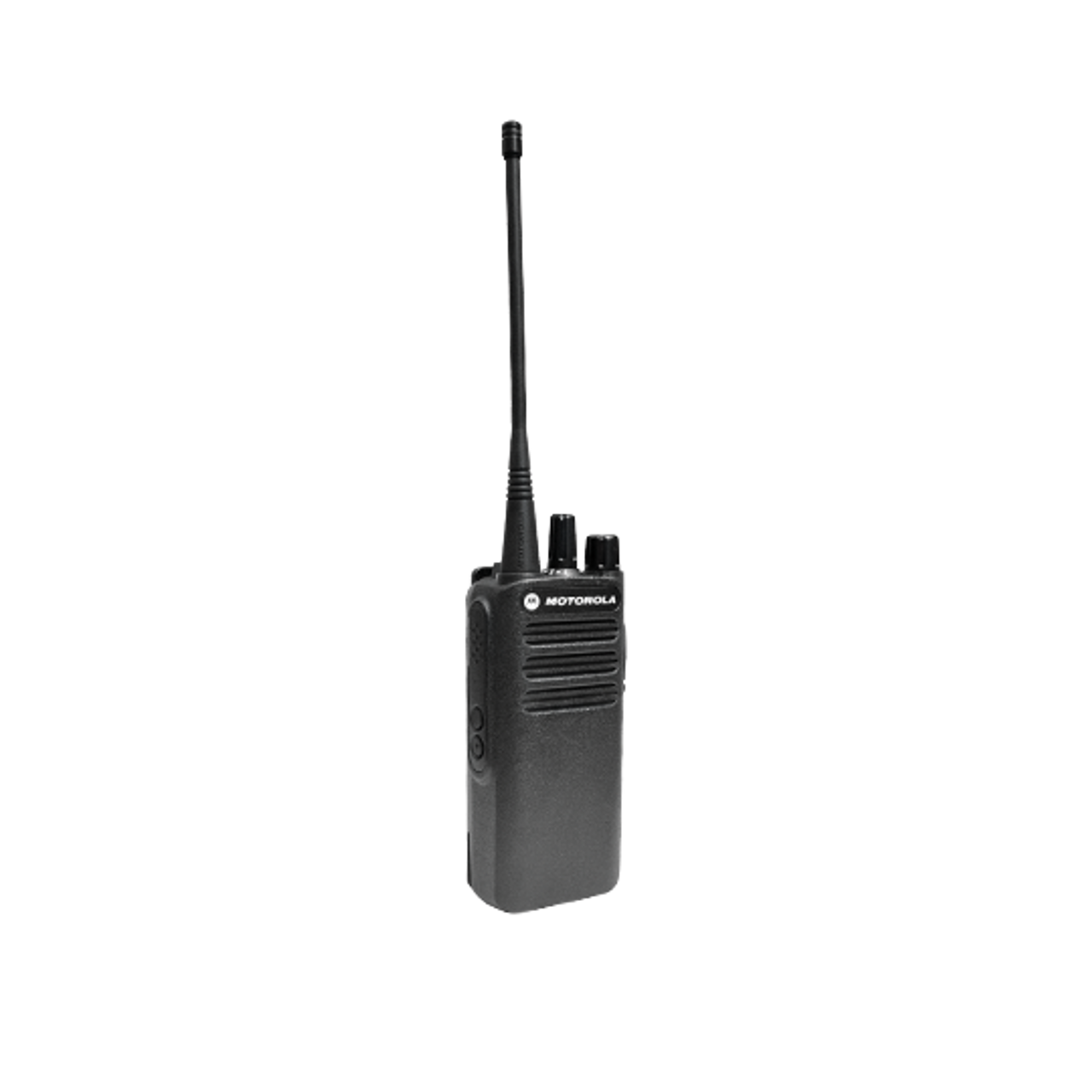
Channels: 16 | Power: 4W UHF | Coverage: 400,000 sq ft indoors / 2–3 miles outdoors
When you need maximum coverage and maximum toughness, the CP100d-UA delivers. Four watts of UHF power sends a signal through walls, around vehicles, and across 30 floors or 400,000 square feet indoors. Outdoors, it reaches up to three miles in good conditions.
The military-grade chassis with metal die-cast and polycarbonate casing meets MIL-STD 810 C–F standards. This radio can handle submersion in mud, drops from height, and even a blast from a firehose. It's IP54-rated, covers 89 business radio frequencies with privacy codes, and supports pre-programmed text messages and voice announcements.
With 16 channels, it can handle a large, multi-department workforce without any confusion. Additional CP100d models offer upgrades to digital and display options.
Bottom line: The top choice for large associations with demanding communication requirements and tough working environments.
Best for Nationwide or Multi-Site Coverage
Motorola WAVE PTX Series
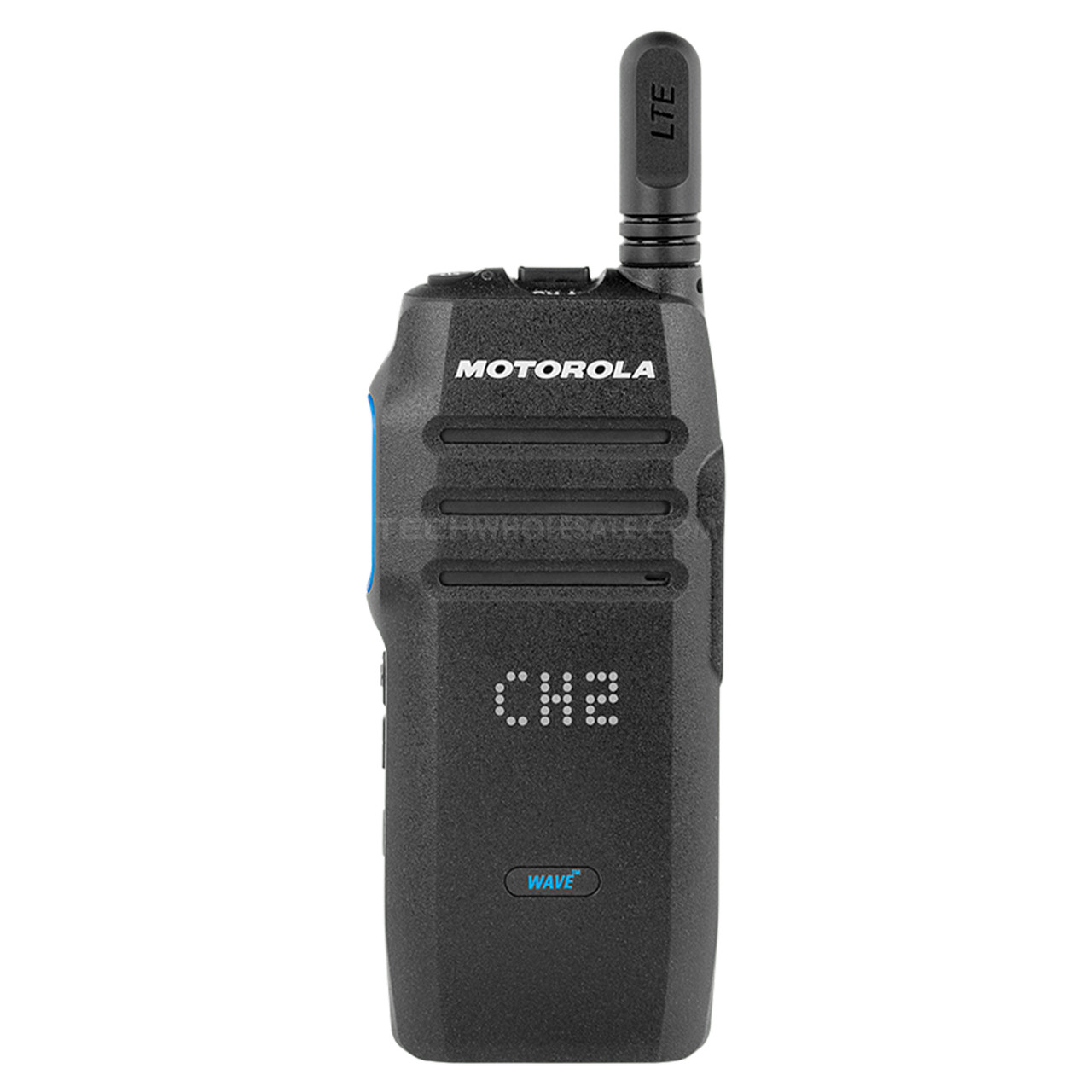
Coverage: Unlimited (LTE & Wi-Fi) | Key Features: GPS tracking, emergency button, smartphone compatibility
For associations managing multiple properties across different cities or states, traditional radio frequencies hit a hard ceiling. The WAVE PTX series removes that ceiling entirely.
These radios connect via LTE and Wi-Fi, meaning coverage isn't limited by building size or geography. GPS tracking lets you locate staff at any time, and a dedicated emergency button alerts the whole team instantly. You can even communicate with WAVE PTX devices directly from a smartphone.
One consideration: this series requires a monthly subscription per device. However, lease-to-own payment options are available to help manage upfront costs.
Bottom line: The smart solution for multi-site operations that need seamless connectivity beyond a single property.
Quick Comparison: Condo Association Two-Way Radios
| Model | Best For | Power | Indoor Coverage | Channels | Key Feature |
|---|---|---|---|---|---|
| Motorola RMU2040 | Small associations | 2W UHF | 250,000 sq ft | 4 | Military-grade durability |
| Kenwood PKT300 | Small associations | 2W UHF | 275,000 sq ft | 6 | Lightweight + VOX |
| Motorola DTR700 | Larger associations | 1W Digital | 350,000 sq ft | 50 | 900 MHz |
| Motorola CP100d-UA | Largest associations | 4W UHF | 400,000 sq ft | 16 | Maximum power + ruggedness |
| Motorola WAVE PTX | Multi-site operations | LTE/Wi-Fi | Unlimited | Unlimited | GPS + smartphone compatible |
Frequently Asked Questions
How many radios does a condo association typically need?
That depends on your staff size and shift structure. A good starting point is one radio per staff member per shift, plus a couple of spares for charging rotation. If you're running maintenance, security, and janitorial teams simultaneously, plan accordingly.
Are two-way radios better than cell phones for condo staff?
For on-site operations, yes. Push-to-talk is faster than dialing. There are no monthly plans per user. And radios work even when cell reception is spotty inside a concrete building. They're also harder to misplace, easier to manage, and don't distract staff with apps and notifications.
What's the typical lifespan of a quality two-way radio?
Motorola and Kenwood radios are tested for five years of regular field use. With proper care—charging cycles followed, drops avoided where possible—many associations get significantly more than that. Manufacturer warranties range from one to three years depending on the model.
What if I'm not sure which model is right for my association?
That's exactly what our team is here for. With over 25 years of experience in the two-way radio industry, we can walk through your specific building layout, team size, and budget to match you with the right solution.
Get the Right Radio—The First Time
The radios your team uses every day have a direct impact on how smoothly your association runs. A clear signal means a faster response. A dead zone means a delayed repair. A short battery means a frustrated staff member hunting for a charger when they should be solving the problem in unit 304.
Motorola and Kenwood have built their reputations on durability, reliability, and clear audio—and that's why associations across the country trust them. Whether you're running a small building or a large multi-site operation, there's a model on this list that fits.
Ready to equip your team? Request a free custom quote from Tech Wholesale and our experts will find the right radio for your association—backed by lifetime tech support from day one.