

Many warehouses pick radios by price and find out that the signal dies behind tall steel racking or at the far end of the building. Consumer walkie-talkies rarely last either, between drops from forklifts, dust, and nonstop shifts.
Business-grade UHF radios push through racking and reach every dock door, and their rugged build holds up shift after shift, protecting your investment for years.
We’ll help you get this right the first time! Since 1997, we’ve outfitted hundreds of warehouses across the US. Here’s how to choose the right radio.
Which Walkie Talkie Fits Your Warehouse?
The Quick Answer
- A small-to-mid operation, straightforward layout → Motorola RMU2080. Eight UHF channels, MIL-SPEC durability, and enough audio output to be heard over a running conveyor.
- A growing distribution center → Kenwood NX-P1300NUK. Five watts and 64 channels, with an analog-to-digital path so a fleet can scale without being replaced.
- Automation, high racking, or dense RF → Motorola DTR700. 900 MHz frequency-hopping digital, which stays clear where analog UHF starts breaking up.
Page by Kristin Wood, Two-Way Radio Consultant at TechWholesale.com. Last updated August 2026.
Quick Links
Recommended Two-Way Radios for Warehouses
Best radio for Small-to-Mid Warehouse Operations - Motorola RMU2080
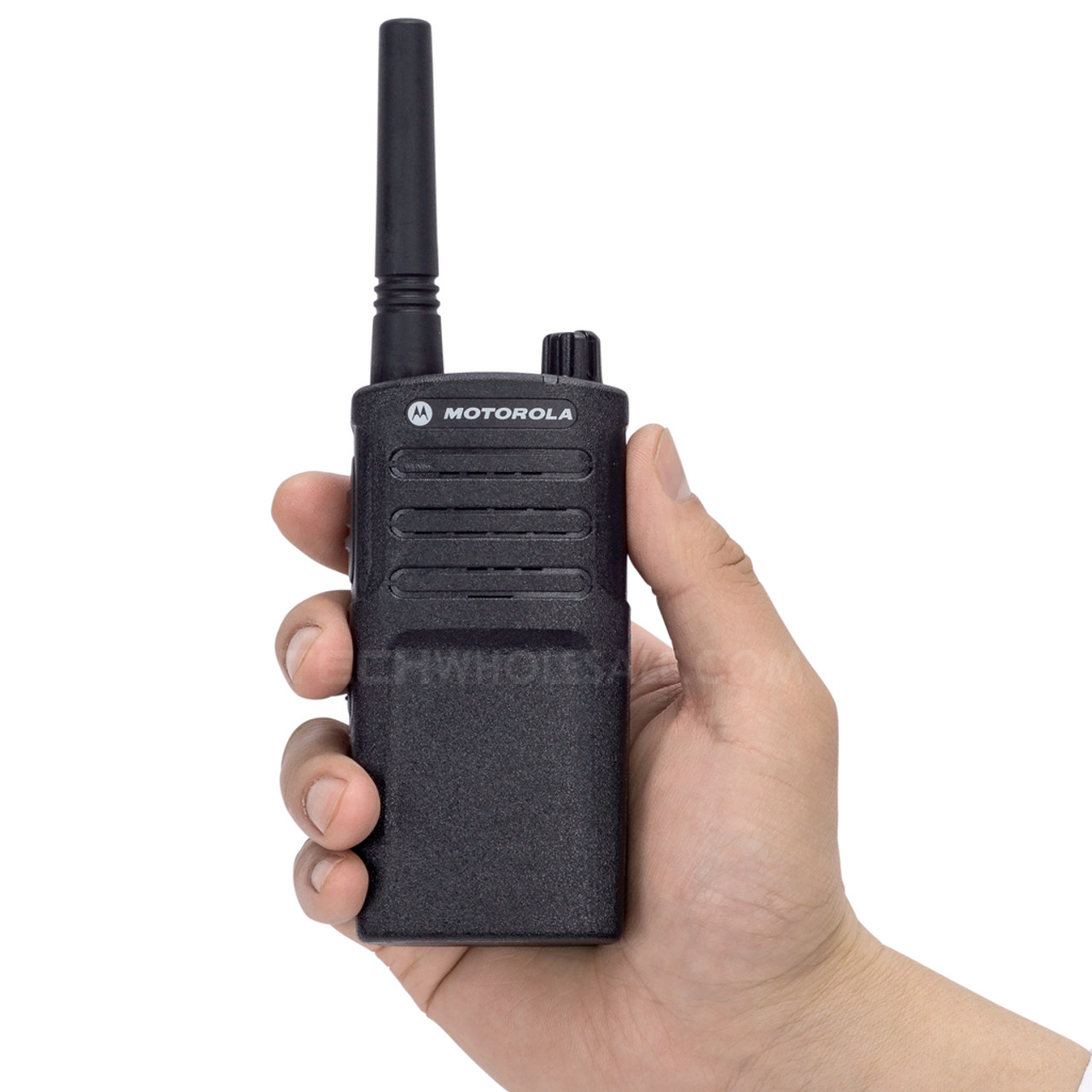
Quick Summary: Motorola RMU2080
- Best For: Small-to-mid warehouse operations with moderate rack density and straightforward floor layouts.
- Key Specifications: 2 Watts UHF (450–470 MHz) | 8 Channels | Up to 250,000 sq ft coverage | 12-hour battery life | IP54/55 rating.
- Pros: High-output 1,500 mW speaker is the loudest in its class, ensuring clear communication over noisy conveyors and forklifts without headsets. Rugged Build IP54/55 and MIL-STD-810. NOAA weather alerts on Channel 8.
- Cons: Analog-only radio with 2 Watts of output power; may thin out in high-bay racking or environments with heavy automation RF noise.
One note on channel 8: NOAA weather is a receive-only channel, so it takes a slot rather than adding one. Plan your channel map around seven if you're using it.
Best radio for Mid-to-Large Distribution Centers - Kenwood NX-P1300NUK
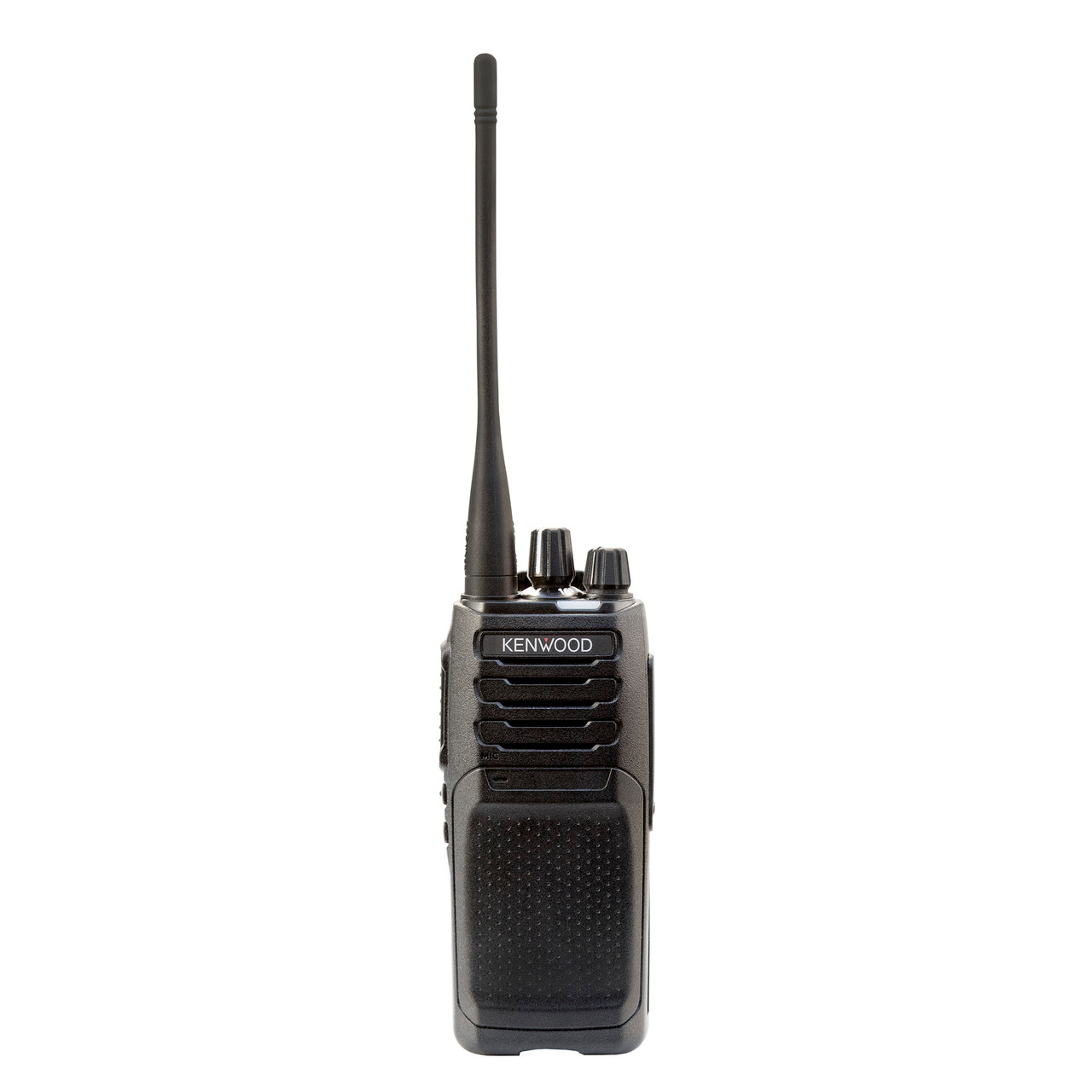
Quick Summary: Kenwood NX-P1300NUK
- Best For: Mid-to-large distribution centers, cold storage facilities, and complex multi-department layouts scaling from analog to digital.
- Key Specifications: 5 Watts UHF (Selectable) | 64 Channels (4 Zones x 16) | NXDN Digital/Analog Mixed Mode | Rated to -22°F.
- Pros: High 5-Watt output penetrates tall steel racking, while Mixed Mode allows seamless migration into existing analog fleets.
- Cons: Slightly heavier (9.88 oz) with an 11-hour battery life on full 5W transmit; peak-season shifts require spare batteries or gang chargers.
One thing worth confirming before you order: Mixed mode requires your existing analog radios to be on frequencies and codes the NX-P1300NUK can match. Send us the model numbers of what you're running and we'll verify it before anything ships.
Best radio for High-Interference and Large-Scale Operations - Motorola DTR700
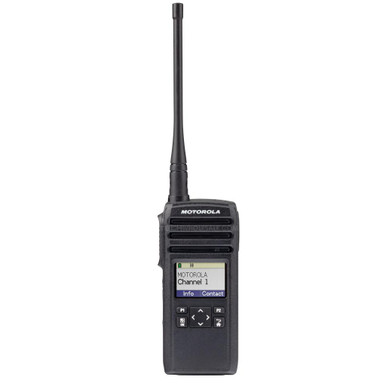
Quick Summary: Motorola DTR700
- Best For: Automated distribution centers, high-RF environments, e-commerce 3PLs, and large campuses (up to 350,000 sq ft).
- Key Specifications: 1 Watt Digital 900 MHz (FHSS) | 50 Channels / 200 Contacts | Up to 350,000 sq ft coverage | Up to 16.5-hour battery life.
- Pros: 900 MHz Frequency-Hopping Spread Spectrum (FHSS) sidesteps Wi-Fi, Bluetooth scanner, and RFID interference while providing encrypted audio. Digital encryption plus Profile ID PIN keeps a neighboring tenant's fleet out of your traffic, which matters in a multi-tenant industrial park. Direct Call, Call All, and Private Reply give a supervisor one-to-one and all-call options on the same radio
- Cons: Operates on a 900 MHz digital protocol and cannot interoperate with existing analog UHF radios.
Compare Warehouse Radio Models
| Feature | Motorola RMU2080 | Kenwood NX-P1300NUK | Motorola DTR700 |
|---|---|---|---|
| Frequency Band | UHF (450–470 MHz) | UHF (451–470 MHz) | 900 MHz FHSS Digital |
| Output Power | 2 W | 5 W / 4 W / 1 W | 1 W (equiv. to 4 W UHF) |
| Channels | 8 | 64 (4 zones × 16) | 50 / 200 contacts |
| Indoor Range | 250,000 sq ft / 20 floors | UHF penetration; 5 W output | 350,000 sq ft / 30 floors |
| Battery Life | 12 hours | 11 hours | Up to 16.5 hours |
| Durability | MIL-STD-810 C–G, IP54/55 | Rated −22°F to +140°F | MIL-SPEC 810G, IP54 |
| Digital Mode | Analog only | NXDN / Analog / Mixed | Digital FHSS (encrypted) |
| Interference Rejection | Standard analog | NXDN digital (improved) | Excellent (frequency hopping) |
| VOX / Hands-Free | Yes | Yes (10 sensitivity levels) | Yes |
| Display | Tricolor LED indicator | LED indicators | Full-graphic backlit LCD |
| Cold Storage Rated | MIL-STD-810 (temp range) | Yes (−22°F rated) | MIL-SPEC 810G (temp range) |
| Best Facility Size | Small–mid (up to ~175K sq ft) | Mid–large (complex layouts) | Large / high-RF environments |
| Warranty | 2 years | 2 years | 2 years |
| Buy this if | Your building is straightforward — moderate rack density, one shift or two, and audibility matters more than raw reach. | You're scaling a distribution center in stages, running cold storage, or your racking is beating a 2-watt radio. | Automation has degraded your analog audio, your building is over roughly 250,000 sq ft, or you're a 3PL or fulfillment operation with scanning infrastructure on every cart. |
| Skip it if | You're running narrow-aisle high-bay racking, more than about 175,000 sq ft, or enough Wi-Fi and RFID that analog is already sounding rough. Those are the NX-P1300NUK and the DTR700 respectively. | You're a single-shift operation under about 175,000 sq ft — the RMU2080 does that job lighter and for less — or if your problem is RF congestion from automation rather than physical penetration, which is the DTR700. | Your coverage problem is physical penetration through racking rather than interference — that's the NX-P1300NUK's five watts — or if you're expanding an analog fleet you want to keep. |
Why Warehouses Have Unique Communication Demands
Most operations arrive at radios after trying something cheaper — a handful of consumer walkie-talkies, or phones and a group text. Both fail in the same three places: a picker between two loaded racks, a receiver at a dock door during a delivery, and anyone trying to hear a transmission next to a running conveyor. A warehouse isn't a hard environment because it's big. It's hard because of what's in it.
Steel Racking Is the Real Coverage Problem
A loaded pallet rack is a grid of vertical steel holding metal-banded product, and it both absorbs and reflects UHF signal. The failures this produces aren't at the far wall where you'd expect them — they're in narrow picking aisles, at the back of a bay, and near metal roll-up doors, sometimes a hundred feet from the office.
A 40,000 sq ft facility racked to the ceiling is a harder RF environment than a 100,000 sq ft open floor, and the coverage number on the box assumes the open floor. UHF (400–512 MHz) handles it better than VHF because the shorter wavelength diffracts around obstructions more effectively, and the DTR700's 900 MHz frequency-hopping signal goes further still — it doesn't sit on one frequency long enough for a reflection pattern to take it out.
Noise That Beats a Small Speaker
Forklifts, conveyors, compactors, and dock activity routinely push a warehouse floor past 85 dB — the action level in OSHA 29 CFR 1910.95 at which a hearing conservation program is required. A radio that can't be understood over that isn't a radio anyone carries. That's a case for high-output audio — the RMU2080's 1,500 mW speaker is the benchmark here — and for a remote speaker mic mounted at the shoulder rather than a radio on the belt. It's also a case for noise-canceling mics on the transmitting side, since the operator is standing in the same noise.
Communication Is Part of the Safety Program
This is what separates a warehouse fleet from a retail or office one. OSHA's powered industrial truck standard (29 CFR 1910.178) requires operators to be able to coordinate with spotters and pedestrians in traffic zones, and a spotter who can't reach a driver is a hazard rather than an inconvenience. The same applies to a night receiver working a dock alone, or anyone in cold storage. Those are the cases a fleet is judged on — and they're the reason battery margin and lone-worker features matter more here than the spec-sheet difference suggests.
Five Departments, One Channel
Receiving, put-away, picking, packing, and shipping all run simultaneously and all have different urgency. On one shared channel, a dock door change or a quality hold lands in the middle of routine picking traffic and gets missed — not because anyone did anything wrong, but because the channel was full. The useful question isn't headcount, it's which two conversations can't afford to collide. In most warehouses that's shipping and safety.
A Shift Is Longer Than the Rating Suggests
Warehouse shifts run 8 to 12 hours, and charging discipline is never perfect — a radio that dies at hour seven of a ten-hour shift may as well not have been bought. Worth knowing how the numbers are produced: manufacturer battery ratings use the standard 5/5/90 duty cycle — 5% transmitting, 5% receiving, 90% standby. That describes a slow Tuesday and badly describes a peak-season shift with three departments on one channel. Treat the rating as a ceiling and buy margin, not exactly enough.
Dropped, Dusted, and Washed Down
Radios here get dropped from picking carts onto concrete, worn during physical work, coated in dust from product movement, and occasionally caught by a dock washdown. MIL-STD-810 covers the drop and vibration side; IP54 is the practical floor for dust and splashing. In a warehouse those aren't premium features — they're the difference between one purchase and an annual replacement line.
RF Congestion from Your Own Equipment
A modern facility runs Wi-Fi across the floor, Bluetooth scanners on every cart, RFID portals at the docks, and VFD motor drives on the conveyors. All of it adds noise that degrades analog performance, and it's the reason a radio that worked fine in 2019 can sound worse today in the same building with no other change. This hits 3PLs, e-commerce fulfillment, and automated distribution hardest. If audio has gotten choppy as automation went in, that's the problem a frequency-hopping digital radio like the DTR700 is built to solve.
What to Look for in a Warehouse Two-Way Radio
Six things decide a warehouse fleet.
Reading a Coverage Rating Honestly
Published indoor range is tested in open, unobstructed space. No warehouse is open, unobstructed space.
As a working correction, plan on 30 to 40% less than the published figure once loaded steel racking is in the path. A radio rated for 250,000 sq ft realistically covers a 150,000–175,000 sq ft facility at typical rack density — and less than that if you're running narrow-aisle or high-bay.
Channels: One Per Function You Need to Isolate
Four is the floor for most operations: receiving, shipping, floor supervisors, and management. Add from there as functions genuinely separate — picking teams, a quality-hold line, maintenance, security.
One thing to decide before you buy: whether anyone monitors all channels. Most warehouses put a supervisor or the office on a radio that can scan every line, so a safety call on the shipping channel doesn't sit unheard because everyone with authority is on management. That's more important than the channel count itself. The RMU2080's eight channels covers most operations up to about fifty staff. The NX-P1300NUK's 64 across four zones and the DTR700's 50 channels scale to multi-shift, multi-building operations where you're also separating by time — a night crew that shouldn't hear day-shift traffic.
Match the Battery to Your Longest Shift
Not your average one. If any crew runs 10 or 12 hours, that's the number the fleet has to clear — and peak season is when both the shifts and the transmit volume go up together.
If charging discipline is realistic in your operation, a multi-unit tray and a spare battery per radio is cheaper than buying up a tier. If it isn't — and in a three-shift building it usually isn't — buy the runtime instead. The DTR700's 16.5 hours is the most margin here, and margin is what survives a shift where nobody docked anything the night before.
Durability, Including Wet Zones
MIL-STD-810 covers drops, vibration, and temperature. IP ratings cover ingress: dust first digit, water second. IP54 is the practical floor for a warehouse floor.
The exception worth spec'ing separately is washdown areas — food-grade facilities, cold storage with condensation, any dock that gets hosed. IP54 is splash resistance, not water-jet resistance, and a radio that lives in that zone should be IP55 or better. You don't need it fleet-wide. Spec it by role and put the higher-rated units where the water is.
Hands-Free That Actually Works on a Lift
A forklift operator can't hold a radio, and a picker carrying a case can't either. Two things solve it.
A shoulder-mounted remote speaker mic is the more reliable answer and the one most operations end up on. The radio stays on the belt, the mic and speaker sit near the ear, and the operator presses a button they can find without looking.
VOX transmits on voice alone, which sounds like the better solution and sometimes is. The caveat: VOX keys on sound, and a warehouse has plenty that isn't speech. A conveyor cycling or a lift alarm can trip an open mic and tie up a channel. Sensitivity is adjustable and a noise-canceling headset helps considerably — but test it in your loudest zone before you spec it across a fleet.
Whether the Accessories Exist
This is the criterion people skip and regret. A radio platform is only as good as what you can hang off it and what you can still buy in three years.
For a warehouse fleet, plan on speaker mics for anyone on equipment, noise-canceling headsets for lift operators, multi-unit charging trays so a shift docks in one place, and high-capacity batteries for the longest crews. Confirm all four are available for the model before you commit — and confirm they're the manufacturer's, since third-party batteries are the most common cause of a fleet that stops holding charge in year two.
Frequently Asked Questions
Will radios work in cold storage and freezer areas?
Yes, with two caveats worth planning around. Lithium-ion batteries lose meaningful runtime below freezing, so a radio rated for 11 hours on the floor won't deliver that in a −10°F freezer — budget spares for anyone working cold. And condensation forms when a radio moves from freezer to dock repeatedly through a shift, which is a case for a higher IP rating on those specific units. The NX-P1300NUK is rated to −22°F and is the one we spec most often for cold-chain operations.
Can we use the same radios across two buildings on one site?
Depends on the distance and what's between them. Two buildings sharing a yard often work on UHF at 5 watts; anything past that, or with a road or a structure in between, usually needs a repeater rather than more handheld power. A repeater is a one-time install that lifts coverage for the whole fleet, and it's almost always cheaper than upgrading every radio. Send us a site layout and we'll tell you which one you're looking at.
How do we keep the facility next door off our channels?
Common in multi-tenant industrial parks, where two operations buy the same radios and land on the same default frequencies. Privacy codes — CTCSS or DCS — filter transmissions so your radios only open for your own traffic. They don't encrypt anything, but they stop your pickers hearing another tenant's dock. Tell us your park or address when you order and we'll program you clear of it.
How do we stop radios from disappearing?
Check-in and check-out at a numbered charging bank at shift change rather than assigning units to individuals. That makes a missing radio obvious at the end of a shift instead of three weeks later, and it guarantees everything starts charged. Radio attrition is the most common reason a fleet quietly shrinks, and in a three-shift building it's entirely preventable with a rack and a list.
What accessories does a warehouse fleet actually need?
Four, in order of impact. A remote speaker mic for anyone on a lift or handling product — this is the single highest-value accessory in a warehouse. Noise-canceling headsets for the loudest zones. Multi-unit charging trays so a shift docks in one place. A spare battery per radio for crews over ten hours. Use manufacturer batteries, not third-party — that's the most common cause of a fleet that stops holding charge in year two.
Can we add radios later or use ones we already own?
Within the same technology, yes. UHF radios and can share channels when programmed to matching frequencies and privacy codes. The DTR700 runs 900 MHz digital and won't talk to either. Send model numbers of what you're running and we'll confirm compatibility before you order.
Do these radios have monthly fees?
No. Radio-to-radio on all three — no airtime, no contract, no subscription.
What's the difference between the RMU2080 and RMU2080d?
Same 8-channel UHF hardware; the RMU2080d adds a display showing channel, battery, and status. Worth the difference for large teams where people change channels often or a supervisor needs to verify a setting at a glance. For a fixed channel structure, the non-display version is simpler and there's less to explain to a new hire.
Why Buy Warehouse Radios from TechWholesale.com
We've been an authorized Motorola and Kenwood dealer since 1997, and warehouse fleets are some of the largest we build. Every radio ships with the full manufacturer warranty and qualifies for manufacturer service and repair. No gray-market units, nothing refurbished sold as new.
Most warehouse calls start in one of three places: an operation that's outgrown a consumer radio system, one that had a communication failure serious enough to force the issue, or a new facility being outfitted from scratch. All three come down to the same thing — matching the radio to the building rather than to the price sheet.
What you get when you order from TechWholesale.com:
- Genuine manufacturer products with full warranty coverage — not gray-market or refurbished units
- Quick quotes — because most warehouse operations need a fleet, not a single radio
- Accessory inventory stocked alongside the radios — earpieces, speaker-mics, multi-unit charging trays, and batteries available at the same time as your radios
- Lifetime tech support — we're reachable after the sale for programming questions, accessory compatibility, and coverage troubleshooting
- 30-day return policy and free shipping on qualifying orders
Not sure which radio fits your facility? Contact us for a no-pressure product recommendation — or use our Find My Radio tool to narrow down options based on your specific requirements.
Related Reading
Related Warehouse Radio Guides & Industry Resources
Internal Product Pages & Accessories
- Motorola RMU2080 Business Two-Way Radio — 8-channel 2-watt UHF radio specs, user manuals, and multi-unit chargers.
- Motorola RMU2080d On-Site Radio with Display — Display version of the RMU2080 for instant channel and battery status verification.
- Kenwood NX-P1300NUK 5-Watt Digital/Analog Radio — 64-channel NXDN radio details for distribution centers and cold storage.
- Motorola DTR700 Digital 900 MHz Smart Radio — Frequency-hopping digital radio specs for high-tech fulfillment centers.
- Two-Way Radio Repeaters for Extended Range — Repeater installation guides for large-format industrial facilities and multi-building complexes.
- Motorola RMU Series Heavy-Duty Accessories — Remote speaker mics, noise-canceling headsets, and high-capacity battery packs.
- Motorola DTR Accessories — Full accessory lineup for the DTR700
Internal Technical & Selection Guides
- Find My Radio: Interactive Selection Tool — Calculate your warehouse radio coverage needs based on floor plan and rack density.
- Commercial Two-Way Radio FAQs — Guidance on FCC Part 90 licensing, battery maintenance, and fleet management.
- Radio Education Center: Frequency & Battery Guides — In-depth technical articles on matching radio wattage to industrial environments.
Official Technical & Regulatory Standards
- OSHA 29 CFR 1910.178 Powered Industrial Trucks Standard — Official safety guidelines for forklift operations, spotters, and traffic coordination.
- OSHA 29 CFR 1910.95 Occupational Noise Exposure Standards — Federal workplace noise thresholds and hearing protection requirements.
- FCC Industrial/Business Radio Pool Overview — Information on commercial UHF/VHF frequency licensing and compliance.