

Your officers patrol alone, often at night, and they need help to be one button away. Business-grade radios with discreet earpieces give every officer instant contact with posts, supervisors, and each other, so every incident is handled fast.
This is where your search ends! We’ve helped hundreds of security teams nationwide stay connected since 1997. Here’s how to choose the best radio for your team.
Which Walkie Talkie Fits Your Security Team?
The Quick Answer
- A single building or small-to-mid facility → Motorola RMU2040. Two watts with a loud speaker, four channels, and a build that holds up to a post worked outdoors in weather.
- Interference-prone buildings, or traffic that shouldn't be casually overheard → Motorola Curve. Digital 900 MHz frequency-hopping, which a scanner or a consumer FRS radio in the parking lot can't pick up.
- Guest-facing posts where a radio shouldn't read as equipment → Motorola SL300-U. Three watts in a slim profile that carries under a jacket — the pick for a lobby, a hotel, or a corporate environment.
- Multiple sites, lone officers, or encrypted traffic → Motorola TLK110. LTE and Wi-Fi, so range is virtually unlimited. AES-256 encryption, a dedicated emergency button, GPS, Lone Worker and Man Down.
Start with Team Size
How Many Radios Does a Security Team Need?
Count radios by post, not by officer. Every staffed post on a shift gets one radio, the shift supervisor gets one, dispatch or the control room gets one, and you add spares at roughly one per ten radios so a dead battery never takes a post offline. A team of 20 officers working three shifts does not need 20 radios — it needs enough for the largest single shift, plus supervision, plus spares.
| Your operation | Radios to order | How that breaks down |
|---|---|---|
| Single building, 1–5 officers per shift | 6 | 5 posts + 1 spare. Add a sixth post radio before you add a second spare. |
| Single building, 6–10 officers per shift | 12 | 10 posts + 1 supervisor + 1 spare. |
| Team of 20 officers across 3 shifts | 12 | 8 posts on the largest shift + 1 supervisor + 1 control room + 2 spares. Radios stay on the charger and hand off at shift change; you buy for the peak shift, not the headcount. |
| Large venue, 20–40 officers on the floor | 45 | 40 posts + 2 supervisors + 1 command + 4 spares. Above 30 radios, plan channel assignments by zone before you order. |
| 50+ officers, single large site | 60–70 | One per post plus 10% spares, with a dedicated supervisor channel. At this size a repeater or a digital system usually costs less than adding wattage. |
| Multi-site, 4 buildings, 3 officers each | 16 | 12 posts + 1 per site supervisor rotation + 3 spares. Use LTE radios so the sites share one talkgroup instead of four isolated fleets. |
| One-time event, 250–1,000 attendees | 10–15 | Gates, floor, medical, command, plus spares. For a single event, renting usually beats buying. |
Recommended Two-Way Radios for Security Teams
Motorola RMU2040 — Best for Small to Mid-Size Facilities
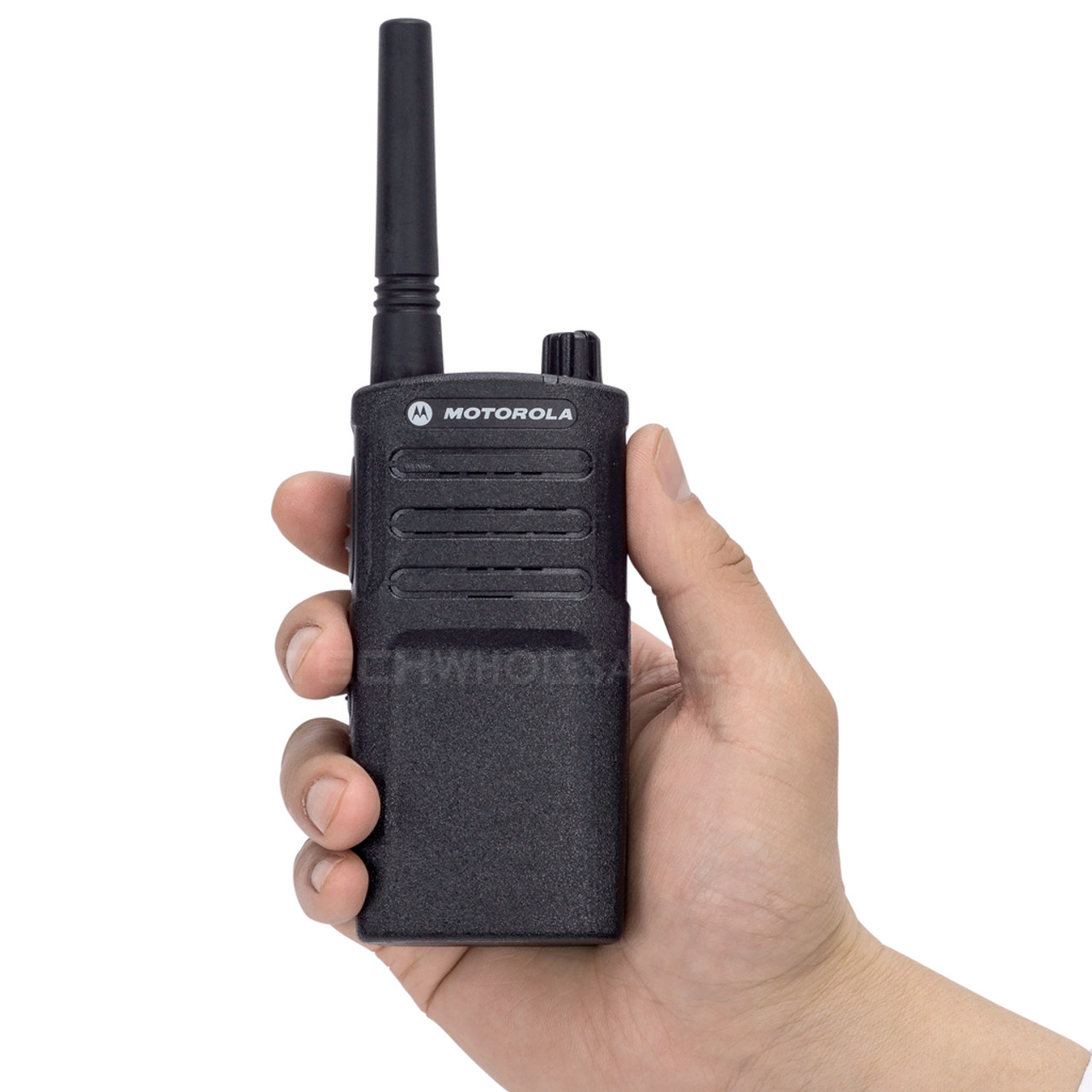
Key Specifications
- Frequency: UHF (450–470 MHz)
- Power: 2 watts
- Channels: 4
- Indoor coverage: Up to 250,000 sq ft / 20 floors
- Outdoor range: Up to 2 miles
- Durability: MIL-STD-810, IP55
- Privacy: 219 privacy codes
- Battery: Lithium-ion, all-day use
The RMU2040 is the workhorse for single-building security operations covering up to 250,000 square feet.
Its 2-watt UHF output cuts through concrete and steel-reinforced walls without requiring a repeater, making it reliable in parking garages, multi-floor office buildings, and retail centers.
The IP55 rating means the radio handles rain, humidity, and occasional direct water exposure — important for officers working outdoor posts or loading dock entry points.
MIL-STD-810 certification covers drop, vibration, and temperature extremes.
Its 219 privacy codes prevent neighboring businesses or outside users on the same UHF band from hearing your team's transmissions.
Four channels allow basic zone or function segmentation.
The charging tray design simplifies overnight charging for fleet deployments.
For security teams in hotels, retail, corporate campuses, or smaller office buildings that don't yet require full digital infrastructure, the RMU2040 delivers professional-grade reliability at a practical price point.
Motorola Curve — Best for Large Venues, Encrypted Digital Radio
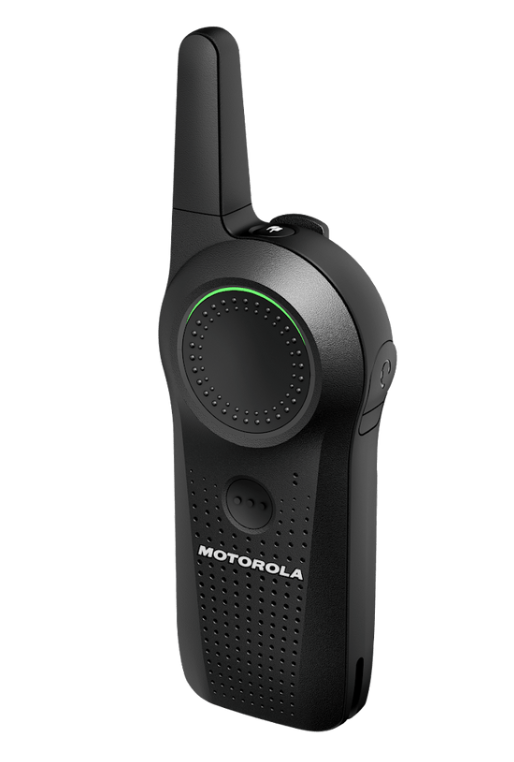
Key Specifications
- Frequency: Digital (900 MHz)
- Power: 1 watt digital (equivalent to ~4 watts analog)
- Channels: 10
- Indoor coverage: Up to 300,000 sq ft / 20 floors
- Privacy: Frequency Hopping Spread Spectrum (FHSS) + 10,000 privacy codes
- Battery life: Up to 14 hours
- Weight: 4.2 oz
The Motorola Curve operates on the 900 MHz digital band using Frequency Hopping Spread Spectrum technology — a communication method originally developed for military applications that makes transmissions extremely difficult to intercept by rapidly switching frequencies during a broadcast.
Combined with 10,000 unique privacy codes, the Curve provides the strongest over-the-air privacy of any radio in its class.
Despite its 1-watt digital output, the Curve's 900 MHz performance covers up to 300,000 square feet indoors — equivalent to a 4-watt analog radio.
Its 14-hour battery life covers full security shifts without mid-shift swaps.
The Page All and Call All Available group broadcast features let supervisors instantly reach the entire team — essential during emergency response activations.
At 4.2 ounces, it's one of the lightest professional radios on the market, which officers on 12-hour foot patrols notice and appreciate.
The Curve is particularly well-suited to security operations where communication privacy is a primary concern.
Motorola SL300-U Best for Discreet, Professional Environments
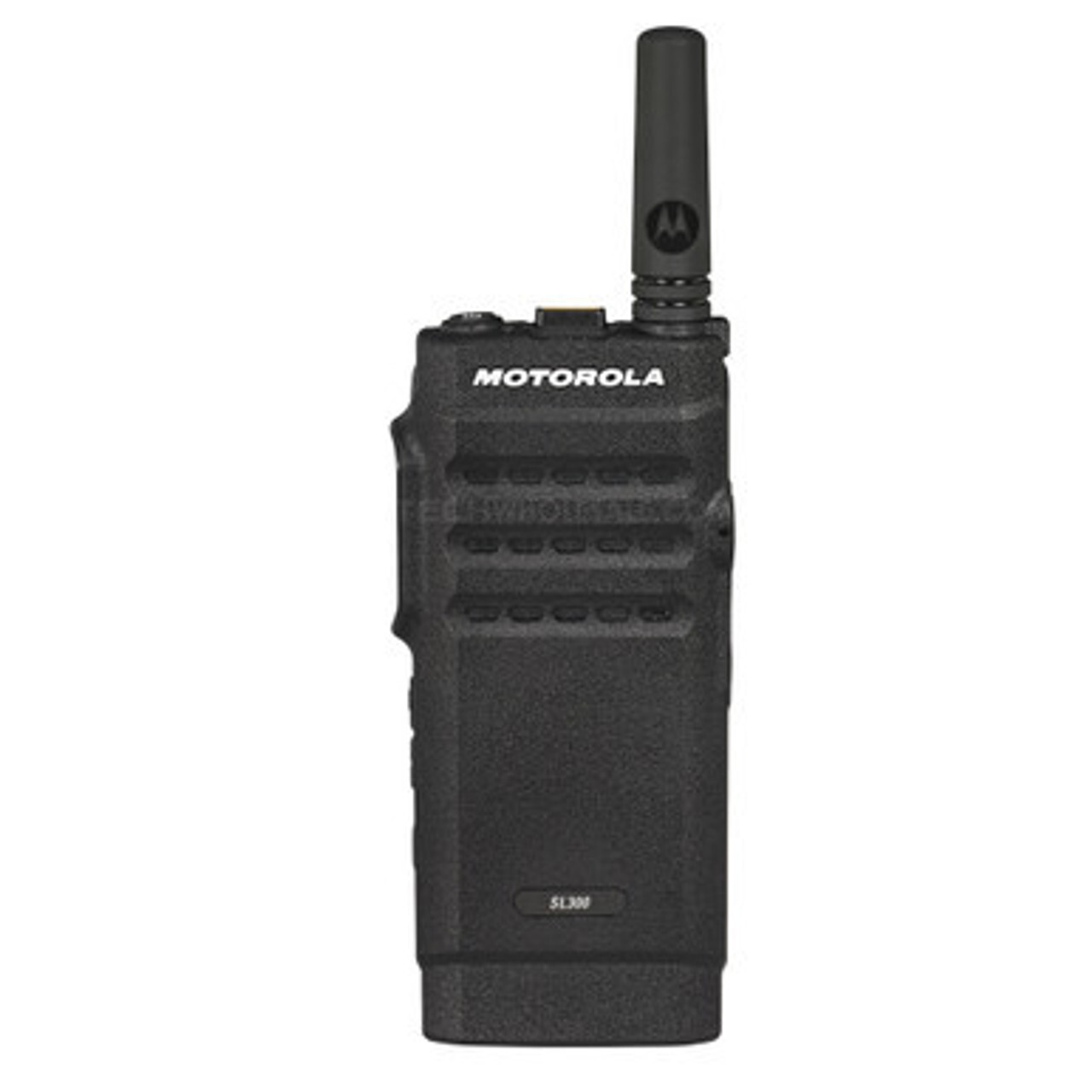
Key Specs:
- Power: 3 watts UHF (403–470 MHz)
- Channels: 2
- Indoor range: 300,000 sq ft / 30 floors
- Outdoor range: Up to 3–5 miles
- Battery life: 12+ hours
- Durability: Rugged (MIL-STD-810)
Why it fits security teams:
The SL300-U is an ultra-slim, professional-grade radio with digital noise cancellation and superior audio clarity — built for environments where communication quality is non-negotiable. It is the right choice for high-security events, VIP activations, and luxury productions where staff appearance and communication precision both matter. Its rugged MIL-STD-810 build rating makes it the most durable option on this list.
Best for: High-security events, luxury productions, political or diplomatic events, large venues requiring maximum vertical range
Motorola TLK110 — Best for Nationwide Coverage
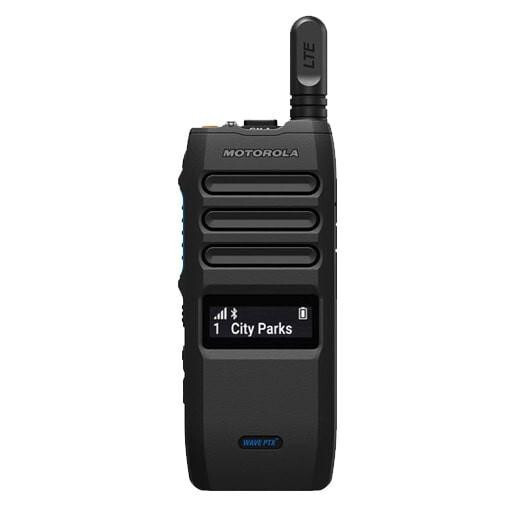
Key Specifications
- Network: 4G LTE (Motorola WAVE PTX platform)
- Channels: 96
- Contact list: Up to 1,000
- Battery life: 18 hours
- Display: Yes
- GPS: Yes, real-time location tracking
- Safety features: Emergency button, Lone Worker mode, fall alert
- Connectivity: Bluetooth compatible, VOX for hands-free use
- AI noise cancellation: Yes
- Durability: IP67 (dust-tight and submersion-resistant to 1 meter)
- Subscription: Required per device (monthly)
The Motorola TLK110 operates over 4G LTE cellular infrastructure through the Motorola WAVE PTX platform, providing unlimited communication range wherever cellular coverage exists.
For security operations spanning multiple buildings, large outdoor campuses, remote patrol zones, or geographically dispersed locations, the TLK110 eliminates the range ceiling that defines traditional UHF radio.
Its 96-channel capacity and 1,000-contact directory support large, complex teams with multiple functional groups.
The real-time GPS location tracking lets command centers monitor officer positions across an entire property or portfolio in real time.
The TLK110's safety feature set is specifically designed for security applications.
- One-touch emergency button broadcasts an immediate distress signal.
- Lone Worker mode automatically alerts the team if an officer does not respond.
- Fall Alert detects sudden impact and triggers an emergency notification.
AI-powered noise cancellation maintains audio clarity in high-noise environments.
VOX (voice-activated transmit) keeps hands free for physical response.
The IP67 rating is the most rigorous water resistance specification in this comparison.
Note that the TLK110 requires a monthly WAVE PTX subscription per device.
Security Radio Comparison
| Model | Coverage | Battery | Best For |
|---|---|---|---|
| Motorola RMU2040 | 250,000 sq ft / 2 mi outdoor | All-day | Small-to-mid buildings |
| Motorola Curve | 300,000 sq ft | 14 hours | Private |
| Motorola SL300-U | 325,000 sq ft / 30 floors | 12–15 hours | Discreet, guest-facing environments |
| Motorola TLK110 | Unlimited (4G LTE) | 18 hours | Multi-site, patrol, unlimited range |
Best Security Radios by Venue
The same team size behaves differently in a casino than in an office tower. These are the models we put in front of each kind of operation, and why.
Casino security radios
Gaming floors are loud, dense, and monitored by people who would very much like to hear your traffic. The Motorola Curve is the default here: 900 MHz frequency hopping is not something a scanner in the parking garage follows, and the digital audio holds up over slot noise. For a property with a hotel tower attached, use the SL300-U units for the guest-facing posts.
Stadium, arena, and event security radios
Large venues break UHF in two directions at once — concrete bowls kill vertical coverage, and parking and perimeter posts sit outside effective range. The Motorola TLK110 solves both by leaving the airwaves entirely, and its GPS lets a command post see where the perimeter team actually is.
Corporate campus and office tower security radios
The problem in a tower is vertical, not horizontal. Three watts of UHF in the SL300-U gets a lobby post to a control room several floors down without a repeater, and the slim profile suits a business-dress environment. Across several buildings on one campus, the TLK110 keeps every building on one talkgroup instead of four separate fleets that cannot hear each other.
Hotel and hospitality security radios
A radio that reads as police equipment changes how a lobby feels. The SL300-U carries under a jacket with a clear acoustic tube earpiece and nothing else visible. Hotel security usually shares a channel plan with housekeeping and engineering, which is worth designing before you order — see our hotel and hospitality radios guide for the full department breakdown.
Church and house of worship security radios
Volunteer safety teams need radios that a new volunteer can use correctly on their second Sunday. The Motorola RMU2040 is the one we send most often: four channels is enough for greeters, parking, children's ministry, and the team lead, and there is nothing on it to set wrong. Larger multi-building campuses move up to the Curve for coverage and for traffic that should not be audible in the lobby. Our church two-way radios guide covers the full ministry channel plan.
College and school campus security radios
Campus security spans outdoor grounds, residence halls, and detached buildings, which is a coverage problem before it is a radio problem. The RMU2080d gives eight channels for zoned patrol, and the TLK110 covers a campus with satellite properties. If you are equipping staff as well as security, see two-way radios for schools and campuses.
Nightclub and bar security radios
Door staff need one hand free and an earpiece that survives being knocked. Noise is the whole problem: the Curve's digital audio is more intelligible over a sound system than an analog radio at the same volume. Full venue setup, including door-to-floor channel structure, is in our bar and nightclub radios guide.
Bank and financial security radios
Branch security runs small, quiet, and highly discreet. The Kenwood PKT-300 is pocket-sized and earpiece-first, and the SL300-U covers a branch with multiple floors or a vault level. Where a duress alert matters more than range, the TLK110's dedicated emergency button and GPS are the reason to spend more.
Retail and loss prevention radios
LP officers work the floor alongside customers, so a visible radio undermines the job. The RMU2040 with a surveillance earpiece is the standard rig, and its 219 privacy codes keep the store next door off your channel. Multi-store districts should look at the TLK110 so a regional LP manager can reach every store.
Security Radio Earpieces and Surveillance Kits
For a security team the earpiece is not an accessory — it is half the deployment. Overt radio traffic tells a person of interest exactly what you know and when you knew it, and a radio held to the mouth marks an officer as security from across a room.
Which earpiece style for which post
- Two-wire surveillance kit. A separate earpiece and a lapel PTT microphone on two cables. The standard for plainclothes and covert work, and the most comfortable over a full 12-hour shift because the mic sits at the collar rather than pulling on the ear. This is the rig most people mean when they say "security earpiece".
- Single-wire earpiece with inline mic and PTT. One cable, mic and push-to-talk on the body of the wire. Simpler and cheaper, easier to hand to a volunteer or a new hire, and the right call for houses of worship, events, and uniformed posts where discretion matters less than speed.
- Acoustic tube earpiece. A clear coiled tube running from a behind-the-ear housing. The classic uniformed look, and the most hygienic choice for a shared fleet because the tube and tip are replaceable per officer.
- D-shell or C-shape earpiece. Hooks over the ear without an in-ear tip. Best in heat, over long shifts, and for officers who will not tolerate an in-ear fit.
- Remote speaker microphone. Shoulder-mounted, loud, no earpiece. For uniformed patrol, gates, parking structures, and anywhere being overheard is not a problem — and the only sensible choice in heavy rain.
Matching an earpiece to your radio
Earpiece connectors are not universal, and a kit that fits a Motorola RM series radio will not fit an SL300. Order the accessory for your specific model:
- RMU2040 and RMU2080d accessories
- Motorola Curve accessories
- Motorola SL300 accessories
- Motorola TLK110 accessories
- Motorola CP100d accessories
- Kenwood PKT-300 accessories
How many earpieces to order
One per officer, not one per radio. Earpieces are personal equipment on a shared radio fleet — officers keep their own tube and tip and hand the radio back at shift change. For a 12-radio fleet covering 20 officers, order 20 earpieces and replacement tips, not 12.
Encryption, Privacy Codes, and Whether Radios Can Be Hacked
This is where most security radio buying goes wrong. There are three different things sold as "privacy" and only one of them is encryption.
Privacy codes are not privacy
A privacy code — CTCSS, DPL, whatever your radio calls it — is a filter on your own speaker. It tells your radio which transmissions to play and which to ignore, so you do not hear the landscaping crew on the same frequency. It does nothing to the transmission itself. Anyone with a scanner tuned to your frequency hears every word, code or no code. The 219 codes on an RMU2040 are an interference prevention option.
Frequency hopping makes you hard to follow
Digital 900 MHz radios like the Motorola Curve use Frequency Hopping Spread Spectrum, changing frequency many times a second in a pattern shared by the fleet. A scanner cannot follow it, and a consumer radio cannot land on it. That is a genuine and meaningful step up from analog UHF — but it is obscurity rather than cryptography. It defeats a curious neighbour or an opportunist with a scanner. It is not designed to defeat a determined, equipped adversary.
True encryption
Encryption scrambles the audio itself, so intercepting the signal gets you noise. In this lineup, the Motorola TLK110 is the radio with AES-256 encryption built in. Digital DMR radios like the CP100d can support encryption in digital mode, but it has to be configured — it is not on by default, and a DMR radio running in analog mode is not encrypted at all.
If your operation handles cash movements, executive protection, investigations, or anything where an intercepted transmission creates real exposure, that is the line between the TLK110 and everything else on this page.
Lone Worker, Man Down, and Officer Duress
An officer working a night post alone is the risk case that radio features were actually designed for, and it is the part of a fleet specification most often left out.
Lone Worker
Lone Worker mode requires an officer to acknowledge a prompt at set intervals. If they do not, the radio escalates to dispatch automatically. It is the difference between finding out something is wrong at the next scheduled check-in and finding out within a few minutes.
Man Down and fall alert
Man Down uses the radio's motion sensor to detect a fall or a period of no movement and raise an alert without the officer touching anything. For an officer who has been knocked down or has collapsed, this is the only feature on the radio that works when they cannot.
Emergency and panic buttons
The TLK110 has a dedicated emergency button, plus GPS so the alert carries a location rather than just a call for help. The Curve's top button can be programmed as a Panic Alert, which is a configuration to set up and test during deployment, not a feature that arrives enabled. The analog radios on this page — RMU2040, RMU2080d, PKT-300 — do not have an emergency alert function.
If you are working to a panic-button requirement under a state retail or hotel worker safety law, the distinction between an emergency alert and a true silent response button matters, and the thresholds differ by state. Talk to us before you specify the fleet.
More on how these work: Lone Worker and Man Down functionality explained.
FCC Licensing, Handled Before Your Radios Ship
Most business UHF radios operate on frequencies that require an FCC Part 90 licence. A license is not required to purchase radios. The Motorola Curve and the TLK110 require no FCC licence at all.
Full detail on the process: FCC licensing for business radios.
What a Security Radio Fleet Actually Costs Per Shift
Security directors get asked to justify the line item.
An RMU2040 at $252 deployed on a post five days a week works about 780 shifts across a conservative three-year service life. That is roughly 32 cents per officer per shift. A 12-radio fleet covering a 20-officer operation runs about $3,000 up front and under $4 a day across the whole team.
Set that against what a communication gap costs once: an uncovered entrance during an incident, an officer who cannot call for help from a stairwell, or an insurance conversation about response times. Radios are not where a security budget is at risk of being overspent.
The place teams do overspend is on wattage and channel counts they will never use, and on replacing a fleet two years early because they bought consumer radios that were never rated for a 12-hour duty cycle.
Radio Protocol for Security Teams
Buying the right radio is half the job. Teams that communicate well on them share a few habits, and they are worth setting on day one rather than six months in.
- Assign call signs by post, not by person. "Lobby" and "Dock 2" survive staff turnover; "Mike" does not, and a new officer on their first shift should not have to learn twenty names before they can call for help.
- Agree on plain language or codes, and pick one. Numeric codes are compact and less intelligible to bystanders. Plain language is faster to learn and impossible to get wrong under stress. Mixing the two is how a message gets misread during the one incident where it matters.
- Keep one channel clear for emergencies. If routine traffic and urgent traffic share a channel, urgent traffic waits. Supervisors move non-urgent conversations off the main net.
- Pause before you transmit. Press, count one, then talk. The first syllable is the one most often clipped, and it is usually the post name.
- Confirm receipt, every time. An unacknowledged transmission is an unknown, and an unknown officer is the one you have to go and find.
Why Communication is a Security-Critical Decision
Security operations depend on split-second coordination. When a suspicious vehicle is spotted in the parking structure, when an unauthorized person is reported near a restricted access point, when a fire alarm triggers in a wing two floors up — your team's ability to respond is only as good as the communication tool in their hand.
Consumer-grade radios fail under these conditions. They drop out in concrete-heavy buildings, run out of battery mid-shift, and offer no privacy protection against outside listeners.
The wrong radio doesn't just frustrate your team. It creates gaps that threat actors and liability exposures can walk straight through.
Security-grade two-way radios solve these problems by design: all-day battery life rated for 12 to 18 hours, rugged housings certified to military drop and water resistance standards, encrypted or privacy-coded channels that keep transmissions from being intercepted, and compatibility with the surveillance earpieces and shoulder-mounted microphones that officers need to stay discreet and hands-free.
Security-Specific Use Cases and Pain Points
Multi-Floor Building Coverage
Parking structures, loading docks, stairwells, and mechanical rooms create radio dead zones that standard consumer devices cannot penetrate.
UHF frequencies (450–470 MHz) are specifically suited to dense materials like reinforced concrete and steel — the building materials common in commercial security environments.
Security teams in high-rise buildings or large facilities should look for radios with indoor ratings of 250,000 sq ft or more, or add a repeater to extend coverage into difficult zones.
Surveillance Earpiece Compatibility
Overt radio communication can alert persons of interest and compromise operational security.
Professional security radios support 2.5mm or 3.5mm surveillance earpiece jacks, letting officers communicate without raising the device to their mouth.
The Motorola SL300-U and RMU2040 both support this accessory configuration.
Shift Length and Battery Drain
Security shifts commonly run 10 to 12 hours.
A radio that dies at hour nine is a liability.
Battery life should be evaluated in active use, not standby mode — look for models rated at 12 hours or more under moderate use conditions.
Channel Segmentation and Team Coordination
Large security operations benefit from dedicated channels per zone or function: one channel for patrol, one for dispatch, one for supervisor-only communications.
Radios with 4 or more channels allow supervisors to redirect officers to private conversations without cluttering the main net.
Covert Operation in High-Profile Environments
Hotels, casinos, hospitals, and luxury retail require security personnel who blend with the environment.
Bulky radios clip to a belt and broadcast the officer's function to everyone in the room.
Slim-profile radios like the Motorola SL300-U change this equation: the unit measures under an inch thick and weighs under six ounces.
Multi-Site and Patrol Coverage
Security operations covering multiple buildings, large outdoor campuses, or geographically dispersed locations run into the hard limits of traditional UHF radio range (typically 1 to 3 miles outdoors).
LTE-enabled radios like the Motorola TLK110 remove the range ceiling entirely, operating over cellular infrastructure with no distance restriction.
Frequently Asked Questions: Two-Way Radios for Security
What range do security radios need?
Range requirements depend entirely on the deployment.
For a single commercial building under 250,000 square feet, a 2-watt UHF radio like the RMU2040 is typically sufficient.
Multi-site, campus, or outdoor patrol operations with no defined perimeter are best served by LTE-based radios like the TLK110.
How long do security radio batteries last?
- Motorola TLK110: 18 hours
- Motorola SL300-U: 12.5–15 hours
- Motorola Curve: 14 hours
- Motorola RMU2040: All-day use
Do security radios need an FCC license?
Most business UHF radios do, under FCC Part 90. The Motorola Curve and the TLK110 do not. A license is not required to purchase radios.
Can walkie talkies be hacked?
Unencrypted analog radio traffic can be heard by anyone with a scanner, which is legal to own — that is tuning in rather than hacking. Privacy codes do not prevent it; they only filter your own speaker. Digital 900 MHz frequency hopping, as on the Motorola Curve, cannot be followed by a scanner. For traffic that genuinely must not be intercepted, you need AES-256 encryption, which in this lineup means the TLK110.
Which security radios have encryption?
The Motorola TLK110 has AES-256 encryption built in. Digital DMR radios such as the Motorola CP100d can support encryption in digital mode, but it has to be configured and does not apply when the radio runs in analog mode. The analog radios on this page do not have encryption — they have privacy codes, which are a different thing.
What earpiece should security officers use?
For plainclothes and covert work, a two-wire surveillance kit with a lapel microphone. For uniformed posts and volunteer teams, a single-wire earpiece with an inline mic and PTT. For shared fleets, an acoustic tube earpiece, because the tube and tip are replaceable per officer. Order one earpiece per officer, not one per radio.
Do security radios have a panic or emergency button?
The TLK110 has a dedicated emergency button plus GPS, so the alert carries a location. The Curve's top button can be programmed as a Panic Alert during deployment. The analog radios here — RMU2040, RMU2080d, PKT-300 — do not have an emergency alert function.
Will these radios work through a parking structure or stairwell?
UHF at 450–470 MHz is the right band for reinforced concrete and steel, which is why it is the default for commercial security. Below-grade parking levels and enclosed stairwells are still the hardest environment in any building. If you have a known dead zone, a repeater or a move to digital usually solves it where adding wattage does not.
Can we add radios to our fleet later?
Yes, as long as you stay on the same platform. New radios are programmed to match your existing channel plan and privacy codes before they ship. Mixing platforms is where it goes wrong — a 900 MHz Curve and a UHF RMU2040 cannot talk to each other regardless of settings, so plan the fleet you will have in three years, not just the one you need now.
What range do security radios need?
It depends entirely on the site. A single commercial building under 250,000 square feet is covered by a 2-watt UHF radio like the RMU2040. Multi-site operations, outdoor patrol routes, or campuses with no defined perimeter are better served by LTE radios like the TLK110, which have no range ceiling where there is cellular coverage.
Why Security Teams Source Radios from TechWholesale.com
TechWholesale.com has been an authorized Motorola dealer since 1997, with nearly three decades of experience equipping security teams across commercial real estate, healthcare, hospitality, retail, and corporate environments.
Buying from an authorized dealer matters for security operations specifically: it ensures the radios are genuine Motorola products, that manufacturer warranties remain valid, and that post-purchase technical support is available.
TechWholesale.com offers:
- Lifetime technical support
- Optional custom programming
- Free shipping on qualifying orders
- 30-day return policy
Request a quote for fleet pricing
Phone: 1-888-925-5982
Email: service@techwholesale.com
Related Reading
- Privacy Codes – Eliminate Outside Interference
- Frequency Hopping Spread Spectrum
- Lone Worker / Man Down Functionality
- VOX Explained
- The difference between VHF and UHF
- FCC licensing for business radios
- Two-way radios for schools and campuses
Article by Kristin Wood, a two-way radio consultant @ Tech Wholesale | Authorized Motorola & Kenwood Dealer Since 1997 | Last Updated: May 2026