
The Best Two-Way Radios for Food Processing Plants (2026 Guide)
What Are the Best Two-Way Radios for Food Processing Plants?
The Short Answer
The best two-way radios for food processing plants are the Motorola RMU2080d, the Motorola CP100d-UD, and the Motorola DTR700. The RMU2080d is the top choice for most small-to-mid-size plants: it carries an antimicrobial housing, MIL-STD-810 and IP54/55 ratings, and 8 channels for role-based team segmentation. The CP100d-UD covers large, multi-building operations with 4 watts, 160 programmable channels, and up to 20-hour battery life in digital mode. The DTR700 is the strongest digital option for facilities dealing with interference or needing private call capability across 50 channels.
Not every radio survives a food processing environment. Steam, washdowns, temperature swings, concrete walls, and 95+ dB machinery noise eliminate most consumer-grade and mid-tier radios within months. The radios on this page have been selected specifically for those conditions.
We've been selling two-way radios to food manufacturers, processors, and distributors since 1997. This guide covers the exact specifications, compliance considerations, and operational factors your team needs to make the right call.
Why Food Processing Plants Need Purpose-Built Two-Way Radios
Food processing facilities combine industrial-scale noise, strict hygiene requirements, large square footage, and time-sensitive operations in ways that eliminate most off-the-shelf radio options. A radio that works at a retail store or a hotel will fail here — sometimes immediately, sometimes within a season.
Here are the specific pain points that define radio requirements in this industry:
Extreme machinery noise. Conveyors, grinders, mixers, blenders, choppers, and packaging lines regularly push ambient noise above 95 dB in food processing environments. According to the Bureau of Labor Statistics, hearing loss rates are nearly twice as high in food production as in manufacturing overall. Radios without high-output speakers (1,000 mW or greater) and noise-canceling microphones produce transmissions that are simply unintelligible on the production floor.
Wet and washdown environments. Daily wet-area cleaning, steam cleaning, and mandatory sanitation cycles mean radios are exposed to water continuously — not occasionally. A radio rated only for splash resistance (IP53 or lower) will fail in this environment. Facilities operating under USDA or FDA Good Manufacturing Practice (GMP) guidelines require regular equipment sanitation, which extends to communications devices.
Time-critical coordination across departments. When a line jams, maintenance needs to be reached in seconds, not minutes. When QC pulls a batch for inspection, shipping needs to know before pallets are staged at the dock. A breakdown in radio communication between production, quality control, maintenance, sanitation, and logistics directly translates to downtime, spoilage, and compliance risk.
Large, signal-hostile facilities. Food processing plants are built with concrete, steel, and insulated cold-storage panels — all of which absorb or reflect radio signals. Facilities that span 200,000 to 500,000 square feet, include refrigerated storage, freezer tunnels, and multi-floor production areas create dead zones that consumer radios cannot overcome.
Multi-shift radio sharing. Radios in 24/7 operations are passed between shift workers, increasing both hygiene exposure and physical wear. Antimicrobial-treated housings and MIL-SPEC durability ratings are not optional features here — they're requirements for a multi-year useful life.
Worker safety in isolated zones. Cold storage rooms, walk-in freezers, and machine rooms are areas where a worker can be incapacitated without nearby colleagues knowing. Radios with emergency/panic button features and sufficient range to reach these isolated zones are a meaningful safety layer, particularly under OSHA's General Duty Clause (Section 5(a)(1)), which requires employers to provide a workplace free from recognized hazards.
What to Look for in a Food Processing Plant Radio
Durability Rating: IP and MIL-STD-810
Two rating systems define radio durability for industrial environments. The IP (Ingress Protection) rating describes resistance to dust and water: IP54 means full dust protection and resistance to water splashed from any direction; IP55 adds resistance to low-pressure water jets. For most food processing environments, IP54 or IP55 is the baseline minimum.
MIL-STD-810 (U.S. Military Standard 810) certifies that a radio has been tested under conditions including shock, vibration, temperature extremes, humidity, salt fog, dust, and sand. Radios meeting MIL-STD-810 C through G have passed a comprehensive battery of abuse tests that translate directly to longer useful life in industrial environments.
Antimicrobial Housing
Several Motorola RM Series radios include factory-applied antimicrobial housing that inhibits the growth of mold and bacteria on the radio's surface. This is a meaningful feature in a food production environment where radios are handled by multiple workers per shift and where hygiene is operationally and regulatorily significant under FDA Current Good Manufacturing Practice (cGMP) regulations (21 CFR Part 110).
Audio Performance
Look for a minimum speaker output of 1,000 mW. Radios in the 1,500 mW range (like the Motorola RMU2080d) produce noticeably clearer audio on loud production floors. Noise-canceling microphones that filter ambient frequencies improve transmission clarity for recipients on the same channel.
Battery Life
Food processing operations frequently run 24 hours across multiple shifts. Radios should support a minimum of 10 hours of operation on standard battery; 14 to 20 hours with high-capacity batteries or digital-mode efficiency. For multi-shift operations, select radios with compatible multi-unit charging trays to ensure fleet-wide overnight charging is practical.
Coverage and Wattage
Building materials in food processing facilities — concrete, steel, insulated cold-storage panels — are among the most signal-absorbing in commercial construction. As a general guideline:
- Facilities up to 250,000 sq ft (single building): 2 watts UHF is typically sufficient with clear line-of-sight or modest wall penetration requirements.
- Facilities up to 400,000 sq ft or multi-building campuses: 4 watts UHF analog or 1 watt digital (equivalent to ~4 watts analog) provides the additional margin needed.
- Multi-site operations across different facilities or cities: LTE/Wi-Fi-connected radios eliminate traditional range limits entirely.
UHF frequencies (400–512 MHz) outperform VHF (136–174 MHz) in indoor, metal-heavy environments. UHF waves are shorter and penetrate walls and equipment more effectively than VHF in dense industrial settings.
Channel Capacity
A food processing plant typically requires at minimum five dedicated channels: production/line, maintenance, quality control, sanitation, and shipping/receiving. Management and security add two more. Plan for at least 8 channels for most mid-size operations; 16 to 160 channels for large or complex facilities.
Compliance and Regulatory Considerations
OSHA Noise Standards (29 CFR 1910.95)
OSHA's Hearing Conservation Standard (29 CFR 1910.95) requires employers to implement a hearing conservation program when workers are exposed to noise at or above an 8-hour time-weighted average (TWA) of 85 dB(A). The permissible exposure limit (PEL) is 90 dB(A) over an 8-hour shift. Many food processing environments — particularly those with active grinding, mixing, and packaging equipment — exceed 90 dB, making hearing protection mandatory for workers in those zones.
Two-way radios used in these environments must be compatible with hearing protection. Speaker-mic accessories allow workers to keep earplug or earmuff protection in place while receiving and transmitting — a critical operational consideration for compliance. Most Motorola RM and CP100d radios are compatible with a range of speaker-mic and earpiece accessories designed for use with hearing protection.
FDA Current Good Manufacturing Practice (21 CFR Part 110)
FDA cGMP regulations require that equipment, including communications devices used in food production zones, be cleanable and maintained in a sanitary condition. Radios used in or near production areas should have smooth, crevice-free surfaces that can be wiped down with approved cleaning agents. Antimicrobial housing, as found on Motorola RM Series radios, supports compliance with these requirements. Avoid radios with deep seams, external ports without covers, or rubber gaskets that trap debris and are difficult to sanitize.
Food Safety Modernization Act (FSMA)
The FDA's Food Safety Modernization Act (FSMA), signed into law in 2011, shifted the regulatory focus in food manufacturing from response to prevention. FSMA's Preventive Controls for Human Food rule (21 CFR Part 117) requires food facilities to implement and document preventive controls, corrective actions, and supply chain verification processes. Real-time, reliable internal communication is a practical prerequisite for executing these controls quickly and consistently — particularly for line shutdowns, product holds, and recall response coordination.
OSHA General Duty Clause (Section 5(a)(1))
Under OSHA's General Duty Clause, employers are required to provide a workplace free from recognized hazards likely to cause serious injury or death. For food processing facilities with workers in isolated zones (walk-in freezers, cold storage, machine rooms), the inability to quickly call for help in an emergency is a recognized hazard. Two-way radios with emergency/panic features — or at minimum, reliable coverage into all occupied areas of a facility — directly support compliance with this obligation.
Recommended Two-Way Radios for Food Processing Plants
Best for Small to Mid-Size Plants (Up to 250,000 sq ft)
1. Motorola RMU2080d — Top Pick for Most Food Processing Plants

| Specification | Detail |
|---|---|
| Frequency | UHF (450–470 MHz) |
| Power | 2 watts |
| Channels | 8 (99 selectable UHF frequencies) |
| Indoor Coverage | 250,000 sq ft / up to 20 floors |
| Outdoor Range | Up to 2 miles |
| Durability | MIL-STD-810 C/D/E/F/G; IP54/55 |
| Speaker Output | 1,500 mW |
| Antimicrobial | Yes — factory-applied housing |
| Battery Life | Up to 15 hours |
| Privacy Codes | 219 PL/DPL codes |
| Warranty | 2 years |
The RMU2080d is the most food-processing-appropriate radio in the Motorola RM Series, and it earns that position through a combination of features that directly address the conditions in this industry.
Why it fits food processing specifically
- Antimicrobial housing. Motorola applies an antimicrobial treatment to the RM Series chassis that inhibits bacterial and mold growth on the radio surface. In a facility where radios pass between shift workers and are used in proximity to food production areas, this is a functional hygiene feature — not a marketing claim.
- 1,500 mW speaker. On a floor with 90+ dB ambient noise, speaker output matters. The RMU2080d's 1,500 mW speaker is among the loudest in its class and is audible over most production-floor noise without requiring the receiver to stop work and focus.
- IP54/55 and MIL-STD-810. Tested for dust, water jets, humidity, salt fog, vibration, shock, and temperature extremes. The IP55 rating means the radio withstands low-pressure water from any direction — relevant for facilities that hose down work areas during sanitation cycles.
- 219 privacy/interference codes. In large facilities with multiple radio systems, interference codes prevent cross-channel bleed from other radio users sharing nearby frequencies.
- VOX (voice-activated transmission). Keeps both hands free for line work. Compatible with remote speaker-mic accessories, including those compatible with hearing protection.
- NOAA weather alerts. Relevant for facilities with outdoor receiving docks, loading areas, or agricultural adjacency where severe weather awareness is operationally important.
- Easy fleet cloning. Programming identical settings across a large fleet is done via cable or multi-unit charger, simplifying deployment for operations outfitting 10, 20, or 50+ units.
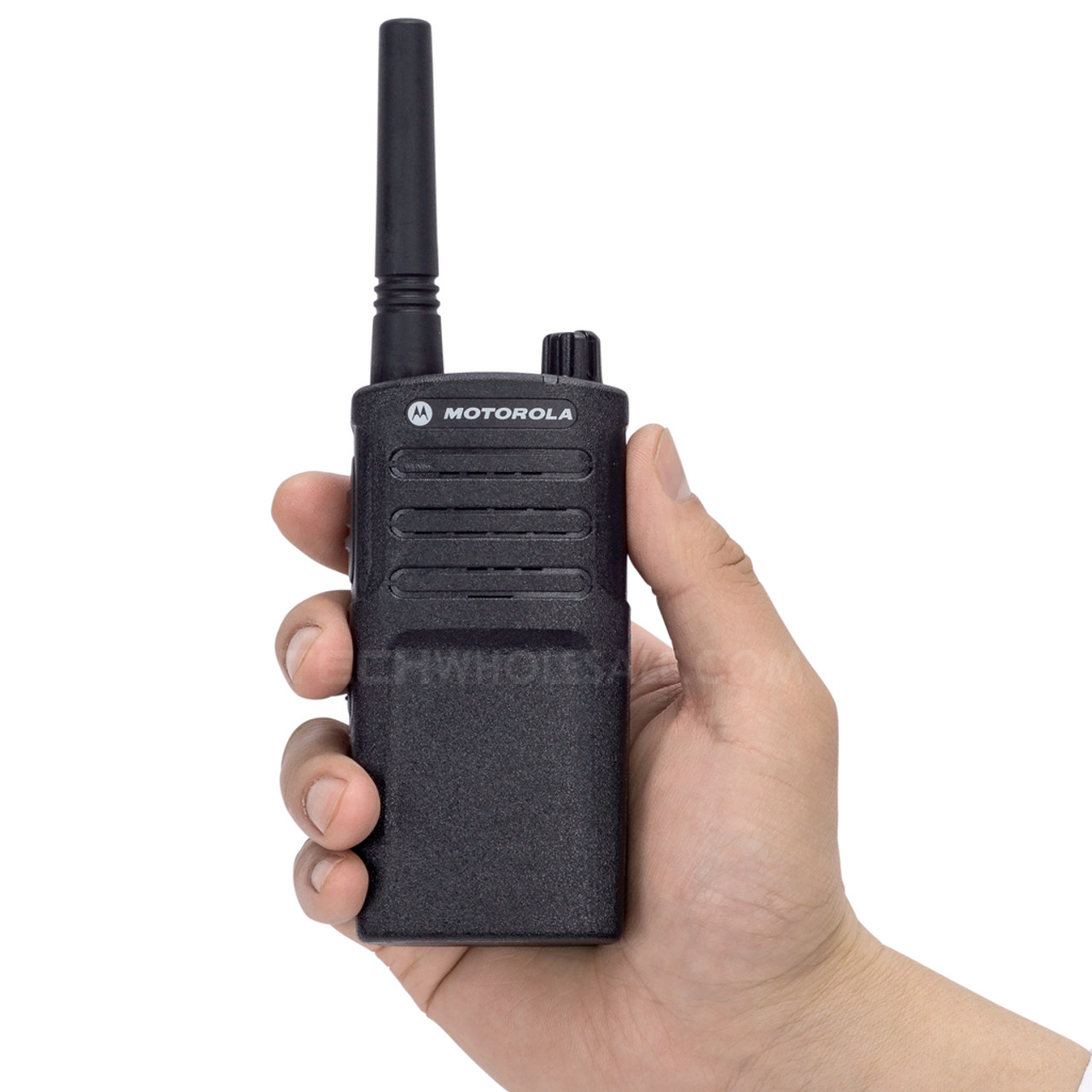
2. Motorola RMU2040 — Streamlined Option for Smaller Teams
| Specification | Detail |
|---|---|
| Frequency | UHF (450–470 MHz) |
| Power | 2 watts |
| Channels | 4 |
| Indoor Coverage | 250,000 sq ft |
| Durability | MIL-STD-810; IP54/55 |
| Antimicrobial | Yes — factory-applied housing |
The RMU2040 is a simpler, lower-cost entry point from the same RM Series platform. It carries the same antimicrobial housing, MIL-STD-810 durability, and IP54/55 ratings as the RMU2080d, with 4 channels instead of 8. For small plants with straightforward team segmentation needs (production and maintenance, for example), it covers the basics without the cost of the display-equipped, 8-channel model.
Best for Large Plants and Multi-Building Facilities
3. Motorola CP100d-UD — Top Pick for Large-Scale Operations

| Specification | Detail |
|---|---|
| Frequency | UHF (403–480 MHz) |
| Power | 4 watts |
| Channels | 160 programmable |
| Indoor Coverage | Up to 400,000 sq ft |
| Outdoor Range | Up to 4–5 miles |
| Mode | Analog and Digital (DMR) |
| Battery Life | ~10.7 hours analog; ~14.4 hours digital (standard battery); up to 20 hours (hi-cap battery) |
| Durability | MIL-STD-810 C/D/E/F/G; IP54 |
| Repeater Ready | Yes |
| Warranty | 2 years |
The CP100d-UD is a MOTOTRBO commercial-grade radio designed for organizations that have outgrown the coverage and channel limits of entry-level business radios. At 4 watts, it pushes through the concrete, steel, and cold-storage insulation that define large food processing facilities. The 160-channel capacity allows precise team segmentation across every department in a large operation.
Why it fits large food processing operations
- 4 watts of UHF power provides meaningful range extension over 2-watt models in signal-hostile environments. In a facility with concrete walls, freezer panels, and metal equipment, this wattage difference is the gap between reliable coverage and dead zones.
- Dual analog/digital mode allows a facility to operate mixed fleets. Teams still on analog radios can communicate with CP100d-UD units in analog mode; as the fleet upgrades, digital mode is available without hardware replacement.
- Digital mode extends battery by approximately 35% over analog operation, enabling the standard battery to reach 14.4 hours and the high-capacity battery to reach 20 hours — covering double-shift operations without charging.
- Repeater-compatible design allows the CP100d-UD to be extended with repeater infrastructure to eliminate dead zones in cold storage areas, underground loading docks, or multi-building campuses where line-of-sight radio propagation is interrupted.
- Programmable via Motorola's free Customer Programming Software (CPS), allowing IT or operations staff to configure channels, privacy codes, and button assignments in-house.
Honorable Mention: Motorola DTR700 — Best Digital Option for RF-Challenged Environments

| Specification | Detail |
|---|---|
| Frequency | Digital FHSS (900 MHz) |
| Power | 1 watt digital (equivalent to ~4 watts analog) |
| Channels | 50 |
| Indoor Coverage | 350,000 sq ft |
| Special Features | Private call, group call, interference-resistant FHSS |
The DTR700 uses Frequency Hopping Spread Spectrum (FHSS) technology on the 900 MHz band, which makes it highly resistant to interference. Its 1-watt digital signal delivers coverage comparable to a 4-watt analog radio.
Recommended Channel Setup for Food Processing Plants
Proper channel assignment prevents the communication overload that happens when every department talks on the same frequency. Here is a practical starting point for most food processing operations:
| Channel | Assigned Team | Primary Use |
|---|---|---|
| Ch 1 | Production / Line Operations | Line slowdowns, supply shortages, equipment status |
| Ch 2 | Maintenance | Breakdown response, preventive task coordination |
| Ch 3 | Quality Control | Inspection coordination, product holds, batch checks |
| Ch 4 | Sanitation | Cleaning schedules, changeover readiness, zone clearance |
| Ch 5 | Shipping & Receiving | Dock assignments, truck arrival, inventory movement |
| Ch 6 | Management / Supervisors | Cross-department escalation, shift coordination |
| Ch 7 | Security / Safety | Emergency alerts, access control, incident response |
| Ch 8 | Emergency / All-Call | Plant-wide announcements, evacuation coordination |
This structure allows supervisors to monitor their department channel and escalate to the management channel when cross-functional response is needed. The all-call/emergency channel remains clear of routine traffic so urgent transmissions are always heard.
Frequently Asked Questions
Do two-way radios used in food production areas require any special certifications?
No federal regulation specifically mandates a radio certification for food production environments, but FDA Current Good Manufacturing Practice regulations (21 CFR Part 110) require that equipment in contact with or near food production areas be maintained in a sanitary condition and be cleanable. Radios with antimicrobial housings, smooth surfaces, and covered ports are better suited for this requirement. If your facility handles flammable gases, solvents, or grain dust at concentrations that create explosion risk, intrinsically safe (IS-rated) radios are required in those specific hazardous locations under OSHA 29 CFR 1910.307.
What IP rating do I need for food processing environments?
IP54 is the practical minimum for most food processing environments, providing full dust protection and resistance to water splashed from any direction. IP55 adds resistance to low-pressure water jets, which is more appropriate for facilities that use hose-down sanitation in the radio-use areas. If radios may be briefly submerged (not typical in most food plants), IP67 provides immersion protection to 1 meter for 30 minutes. The Motorola RMU2080d is rated IP54/55; most environments in food processing will be adequately covered by this rating.
How much range do I need for a food processing plant radio?
Indoor range is the relevant metric for most food processing facilities — outdoor range figures from manufacturers are measured in open-air conditions and do not reflect indoor performance. Motorola's indoor coverage ratings for the RMU2080d (250,000 sq ft / 20 floors) and CP100d-UD (up to 400,000 sq ft) are measured in typical commercial buildings. Food processing facilities with heavy concrete construction, metal equipment, and cold-storage insulation should treat these figures conservatively and plan for a site survey or trial deployment before committing to a large fleet purchase. If dead zones are discovered, repeater-capable radios like the CP100d-UD can extend coverage without replacing the fleet.
How long do two-way radios last in a food processing environment?
Motorola and Kenwood commercial-grade radios are tested to five years of field use. In food processing environments with proper handling and sanitation practices, most facilities get three to seven years of useful life per unit. Fleet life depends heavily on whether radios are dropped frequently, exposed to moisture beyond their IP rating, or used in chemical-heavy cleaning environments incompatible with the radio's housing. MIL-STD-810-rated radios hold up significantly longer than non-rated models in demanding industrial conditions. All Motorola RM Series radios carry a 2-year replacement warranty.
What is the difference between analog and digital radios for food processing?
Analog radios are simpler to deploy, interoperable with most existing radio fleets, and cost less upfront. Digital radios offer clearer audio at the limits of their coverage range (analog signals degrade to static at range edges; digital maintains clarity until the signal drops), greater channel capacity, longer battery life per charge (approximately 35% longer in digital mode on the CP100d), and additional features like private call, GPS, and text messaging on higher-end models. For most small-to-mid-size food plants, analog radios like the RMU2080d are sufficient. Large or complex operations benefit from digital's range efficiency and battery performance.
Can food processing plant workers use two-way radios with hearing protection?
Yes. Speaker-mic accessories allow workers to clip a speaker near their ear or shoulder while wearing earplugs or earmuffs, eliminating the need to remove hearing protection to hear a radio transmission. Most Motorola RM Series and CP100d radios are compatible with a range of speaker-mic and surveillance earpiece accessories. This is an important consideration for workers in zones covered by OSHA's Hearing Conservation Standard (29 CFR 1910.95), where hearing protection is required during operation.
How many radios does a food processing plant typically need?
A practical starting point: one radio per team lead or supervisor in each department, plus additional units for roles requiring real-time coordination (maintenance technicians, QC inspectors, dock supervisors). For a plant with production, maintenance, QC, sanitation, shipping, and a management layer, 15 to 30 radios is common for a mid-size operation. Multi-shift plants need enough units to cover concurrent shifts or must implement a check-out/check-in system with consistent battery management. Contact our team for a deployment recommendation based on your specific facility layout and headcount.
Why Buy from Tech Wholesale
Tech Wholesale has been an authorized dealer of Motorola and Kenwood two-way radios since 1997. Every radio we sell is factory-new, covered by the full manufacturer warranty, and backed by our own lifetime technical support — included at no additional cost with every purchase.
For food processing operations outfitting a full team, we offer volume pricing on multi-unit orders and can assist with channel programming, fleet configuration, and accessory matching before your radios ship. Our staff has hands-on experience with the exact environments and workflows described on this page.
If you're not certain which model is right for your facility, request a quote and describe your plant size, team structure, and operational needs. We'll recommend the right radio, the right quantity, and the right accessories — and we stand behind that recommendation after the sale.
- Authorized dealer since 1997 — factory-new inventory with full manufacturer warranty
- Lifetime technical support included with every purchase
- Volume pricing available for multi-unit fleet orders
- Pre-ship channel programming available on most models
- Radio rentals available for seasonal peaks, audits, or trial deployments
Related Reading
On TechWholesale.com
- Two-Way Radios for Warehouses and Distribution Centers
- Motorola RMU2080d Full Specifications and Accessories
- Motorola CP100d-UD Full Specifications and Accessories
- Motorola DTR700 Digital Radio — Full Details
- Frequently Asked Questions About Two-Way Radios
- Radio Education and Reviews
- Find My Radio Tool