

Every shot depends on clear communication between the instrument and the rod. Business-grade two-way radios with hands-free headsets give your crew instant contact over long distances, so every measurement is accurate and every job stays on schedule.
Let’s take the guesswork out of it! Since 1997, we’ve kept hundreds of surveying teams nationwide connected. Here’s how to pick the right radio for your crew.
Which Walkie Talkie Fits Your Surveying Crew?
The Quick Answer
- A two- or three-person crew on a tighter site → Motorola RMU2040. Two watts, four channels, and a build that takes a season of tailgate-to-treeline work. Nothing to program, and the loud speaker carries when the instrument operator is a few hundred feet out.
- Medium-to-large sites where reach is the whole problem → Motorola CP100d-UA. Four watts is the most output here — for a rodman past a treeline, across a section, or on the far side of a grade change. Sixteen channels, MIL-STD-810, and analog now with a path to digital.
- Large or complex sites, or multiple crews → Kenwood NX-P1300AUK. Sixty-four channels across four zones, so several crews work the same site without sharing a line — and it runs analog now with digital available when you're ready.
Quick Links
Why Two-Way Radios Are Essential for Surveying Teams
Surveying is an inherently dispersed profession. A crew of four might be covering hundreds of acres simultaneously — one person on the total station, another on the rod hundreds of feet away, a third at a property corner out of sight, and a crew chief coordinating from a vehicle. Mobile phones are often unreliable in rural, low-signal environments, and the delay and distraction of texting or calling is incompatible with the rhythm of precise fieldwork.
Two-way radios solve this problem with instant, push-to-talk communication that requires no network infrastructure, no per-device monthly fees, and no fumbling with a touchscreen while wearing gloves.
Surveying-Specific Pain Points Radios Must Address
Distance across open terrain. Surveyors frequently work across multiple acres of open farmland, wooded lots, or road corridors. A radio that performs adequately indoors may fall short when the signal must travel hundreds of meters across undulating terrain or through dense tree cover.
Working in noisy, active environments. Surveys adjacent to construction zones, highways, or heavy equipment operations produce constant background noise. Radios must deliver loud, clear audio and, ideally, VOX (voice-activated) capability so surveyors can communicate without stopping to press a PTT button.
Weather and field conditions. Surveyors work in rain, mud, dust, and heat. Radios must be water- and dust-resistant at minimum. Dropped radios on rocky terrain are routine — MIL-SPEC ratings are not a luxury.
All-day battery demands. A full field day often runs 8–12 hours without reliable access to power. A radio that dies at 3:00 PM is a liability.
Coordinating across multiple sub-crews. On larger boundary surveys or ALTA/NSPS surveys, different teams may be working separate tasks simultaneously. Multiple channels allow crew chiefs to segment conversations — field crew on one channel, office on another — without cross-talk.
How to Match a Radio to Your Survey Site
Before selecting a model, match the radio's output power and frequency to the operating environment:
- Compact sites (under 5 acres, open terrain, small crews of 2–3): A 2-watt UHF radio delivers 1–2 miles of outdoor range in most conditions, sufficient for subdivision lot surveys or small commercial parcels.
- Medium-to-large sites (5–50+ acres, mixed terrain, crews of 3–6): A 4-watt UHF radio provides 3–5 miles of outdoor range in favorable conditions and penetrates tree cover, rolling terrain, and temporary structures more reliably.
- Multi-site or multi-state operations: LTE-enabled push-to-talk radios eliminate range limitations entirely, though they require monthly per-device service plans.
UHF frequencies (400–512 MHz) are generally preferable to VHF for surveying because of their superior penetration through vegetation and mixed terrain. Most professional surveying radios on the market operate in the UHF band.
Our Top Recommended Radios for Surveyors
1. Motorola RMU2040 — Best for Compact Crews and Smaller Sites
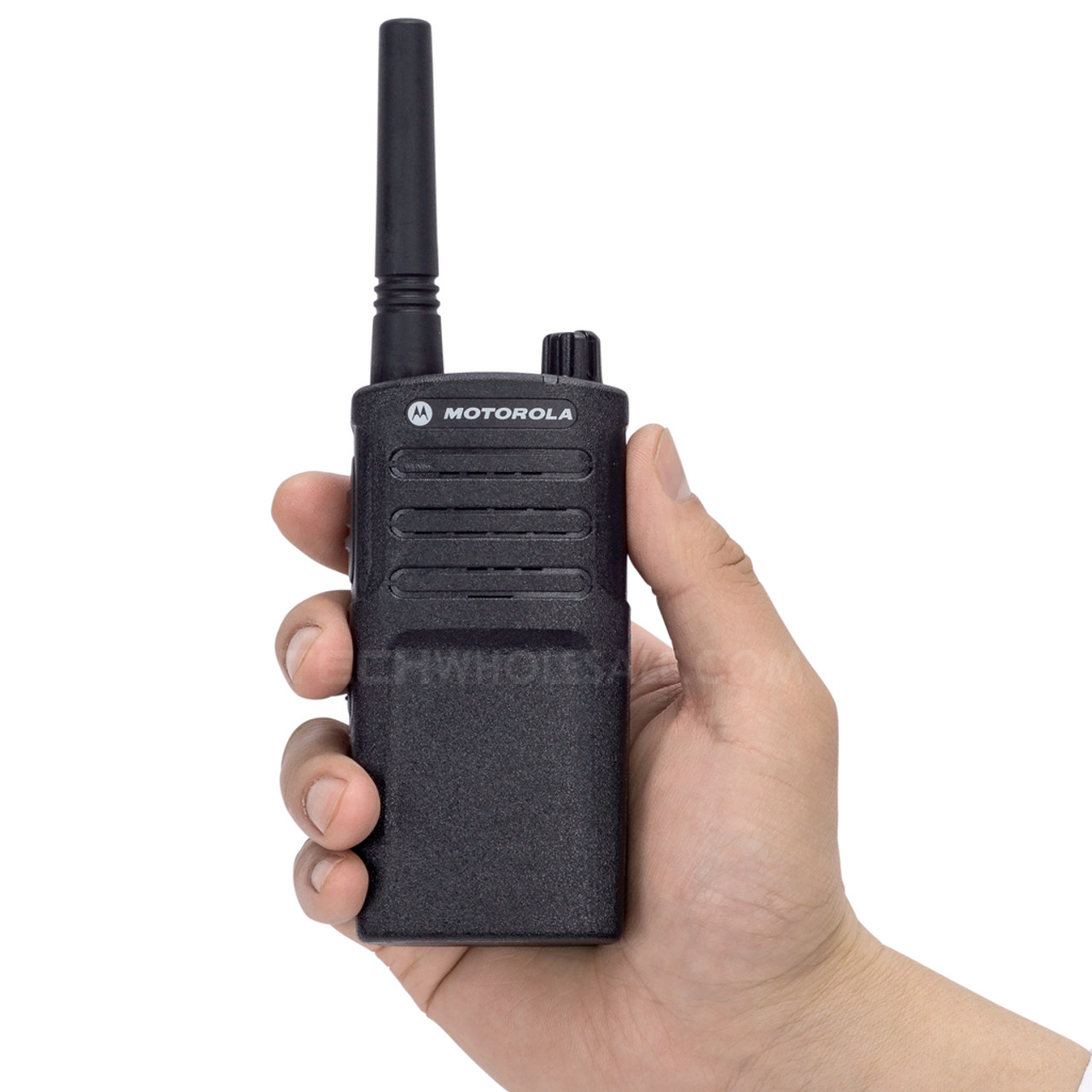
Best for: Small surveying crews (2–4 people), subdivision lots, urban surveys.
The Motorola RMU2040 is a 2-watt UHF analog radio operating on 99 business-exclusive frequencies in the 450–470 MHz band. It delivers reliable coverage across 1–2 miles outdoors and up to 250,000 square feet (20 floors) indoors. For surveyors working smaller residential or commercial parcels, it provides more than adequate range without the cost of a higher-wattage radio.
Key Specifications
- Power output: 2 watts
- Frequency: UHF (450–470 MHz), 99 business-exclusive frequencies
- Channels: 4
- Battery life: 12 hours (standard Li-Ion)
- Indoor coverage: 250,000 sq ft / 20 floors
- Outdoor range: 1–2 miles
- Durability: IP54/55 rated; MIL-STD 810C/D/E/F/G certified
- Weight: 8.6 oz
- Dimensions: 4.5 x 2.2 x 1.6 inches
- Interference protection: 39 analog + 84 digital interference eliminator codes
- VOX: Yes (Advanced Voice Activation, hands-free)
- NOAA weather alerts: Yes
- Warranty: 2 years
Why it works for surveyors: The RMU2040's IP54/55 rating means it handles driven rain and blowing dust — conditions surveyors encounter routinely. Motorola's Accelerated Life Testing (ALT) subjects every unit to the equivalent of five years of real-world field use before it ships, including 30 minutes of blowing rain exposure, 9 hours of continuous vibration, and temperature extremes from −67°F to 160°F. The 12-hour battery covers a full field day on a single charge. The VOX capability is particularly valuable: surveyors operating a total station or rod can communicate hands-free without interrupting their workflow. The antimicrobial coating is a minor bonus in shared-equipment environments.
2. Motorola CP100d-UA — Best Overall for Field Reliability and Coverage
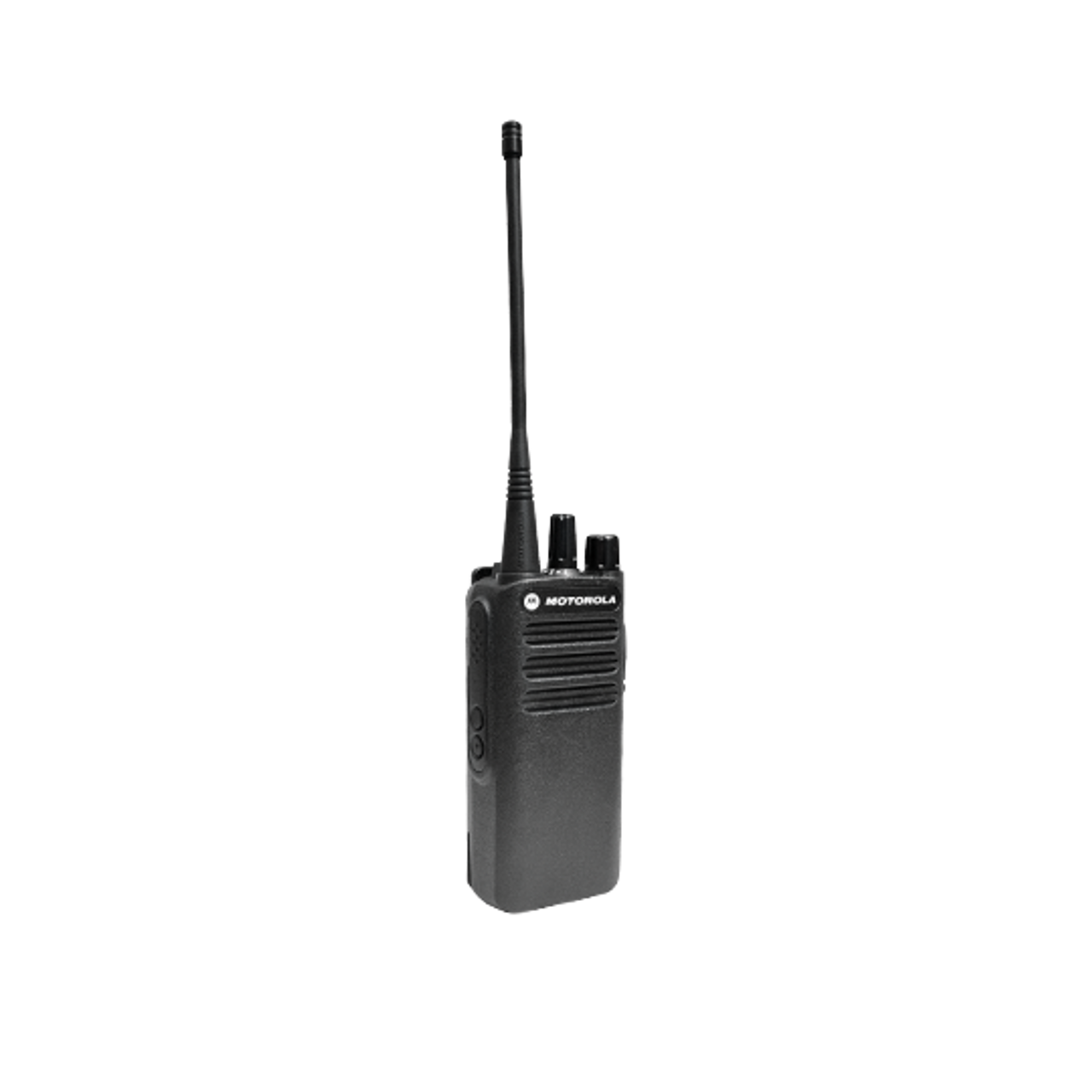
Best for: Medium-to-large survey sites, crews of 3–8, boundary surveys covering multiple acres, or any operation requiring maximum outdoor range and proven commercial durability.
The Motorola CP100d-UA is a 4-watt UHF analog radio operating in the 403–480 MHz band with 16 channels. It provides indoor coverage up to 375,000 square feet and outdoor range of 3–4 miles in favorable terrain — significantly more than lower-wattage options. For surveyors working larger rural tracts, highway corridors, or industrial sites, that extended range is a meaningful operational advantage.
Key Specifications
- Power output: 4 watts
- Frequency: UHF (403–480 MHz)
- Channels: 16
- Battery life: Up to 10.7 hours (standard Li-Ion, analog); up to 15 hours (high-capacity Li-Ion, analog)
- Indoor coverage: Up to 375,000 sq ft
- Outdoor range: 3-5 miles
- Durability: IP54 rated; MIL-STD 810C/D/E/F/G certified
- Weight: 9.7 oz
- Dimensions: 4.7 x 2.2 x 1.4 inches
- Warranty: 3 years
Why it works for surveyors: The 4-watt output is the key differentiator for surveying applications. When a rod person is 400 meters away on the far end of a large parcel and screened by a tree line, the additional power matters. The 16-channel capacity allows structured team segmentation — crew chief to rod crew on one channel, office communications on another, emergency channel reserved on a third. The Transmit Interrupt feature lets a crew chief break through an ongoing transmission immediately for urgent communication. Voice announcement confirms channel changes audibly, so surveyors don't need to glance at the radio while working at grade. The 3-year manufacturer warranty is among the longest available in this class.
3. Kenwood NX-P1300AUK — Best for Large Sites and Future-Proof Digital Capability
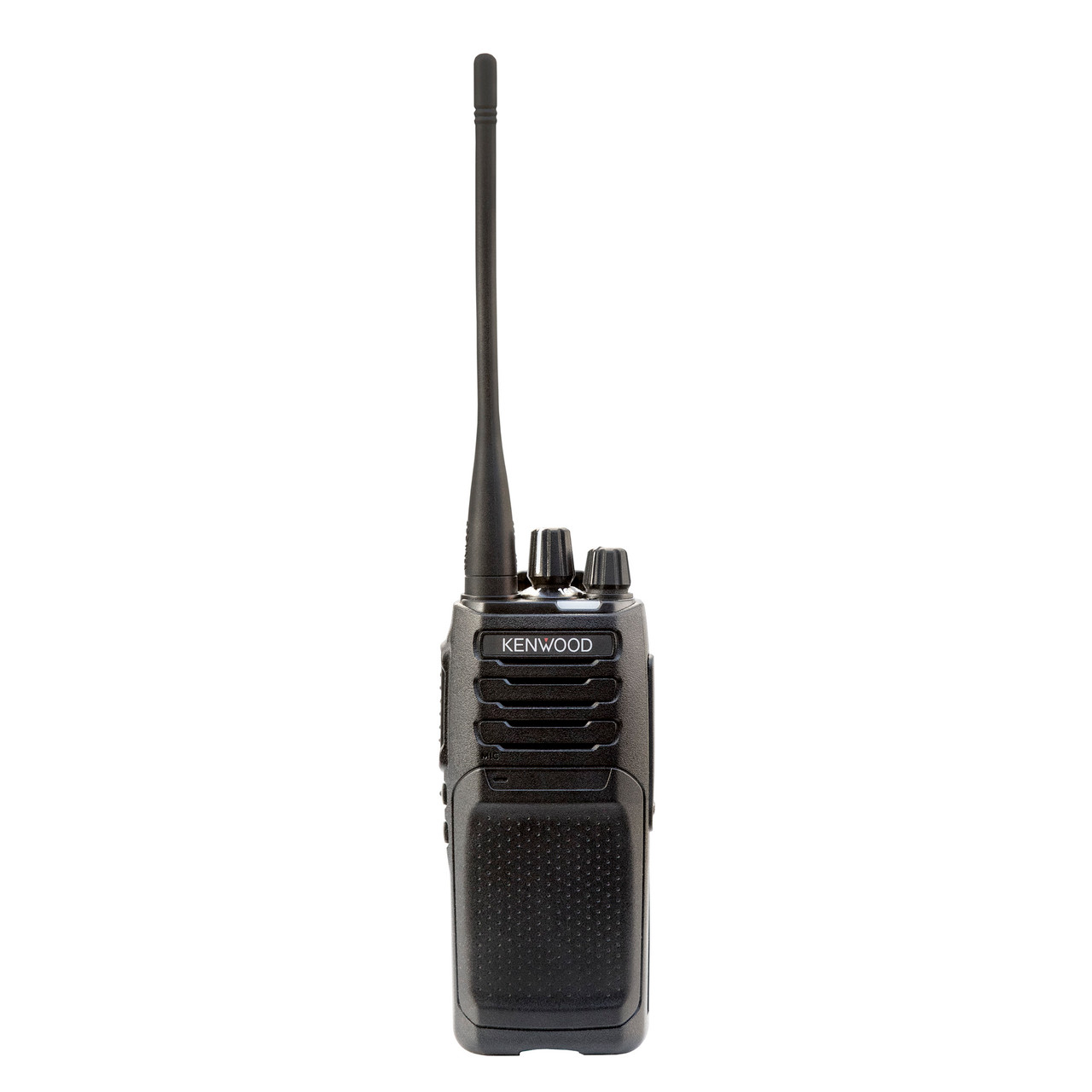
Best for: Large survey operations, multi-crew coordination, firms that need maximum channel depth, or teams anticipating a future transition from analog to digital.
The Kenwood NX-P1300AUK is a 4-watt UHF analog radio with 64 channels (organized into 4 zones of 16 channels each), operating in the 451–470 MHz band. It provides coverage up to 450,000 square feet indoors and 3–5 miles outdoors — the highest range figure of the three radios covered here. Its standout feature is an optional digital license key upgrade that enables NXDN or DMR digital operation without requiring new hardware, making it a genuinely future-proof investment.
Key Specifications
- Power output: 4 watts
- Frequency: UHF (451–470 MHz), 90 preset + 27 pre-programmed UHF frequencies
- Channels: 64 (4 zones / 16 channels per zone)
- Battery life: 12 hours (standard); up to 15 hours (KNB-45L battery)
- Indoor coverage: Up to 450,000 sq ft / 42 floors
- Outdoor range: 3–5 miles
- Durability: IP54/55 rated; MIL-STD 810C/D/E/F/G certified
- Audio: 1-watt BTL amplifier; AMBE+2™ vocoder
- Features: VOX, 16-code voice inversion scrambler, wireless cloning, 7-color LED indicator, Second PTT, digital upgrade via license key
- Weight: 9.9 oz
- Dimensions: 2.13 x 4.84 x 1.32 inches
- Warranty: 3 years
Why it works for surveyors: The 64-channel depth with zone organization is overkill for a crew of three — and exactly right for a larger firm running multiple simultaneous survey parties on different projects. Zone 1 might be assigned to Project A's field crew, Zone 2 to Project B, Zone 3 to the office, and Zone 4 reserved for emergency or supervisory use. The wireless cloning feature allows a fleet of radios to be programmed from a single configured unit — a significant time saver when setting up 10+ radios for a large project.
The digital upgrade path is strategically important. Many survey firms are currently operating on analog infrastructure and will need to transition to digital eventually to remain compatible with FCC narrowbanding requirements and modern radio ecosystems. The NX-P1300AUK allows that transition without a full hardware replacement cycle. In digital mode, NEXEDGE digital modulation recovers audio in fringe coverage areas, effectively extending usable range beyond what analog alone can achieve.
The Second PTT feature lets a crew chief assign a secondary channel to the same radio, enabling direct communication with a second crew group without changing devices or creating channel confusion.
Quick Comparison: Surveying Radio Models
| Feature | Motorola RMU2040 | Motorola CP100d-UA | Kenwood NX-P1300AUK |
|---|---|---|---|
| Power | 2 watts | 4 watts | 4 watts |
| Frequency | UHF 450–470 MHz | UHF 403–480 MHz | UHF 451–470 MHz |
| Channels | 4 | 16 | 64 |
| Outdoor Range | 1–2 miles | 3–4 miles | 3–5 miles |
| Indoor Coverage | 250,000 sq ft | 375,000 sq ft | 450,000 sq ft |
| Battery Life | 12 hours | 10.7–15 hours | 12–15 hours |
| Durability | MIL-STD 810, IP54/55 | MIL-STD 810, IP54 | MIL-STD 810, IP54/55 |
| VOX | Yes | No | Yes |
| Digital Capable | No | No | Yes (license key) |
| Warranty | 2 years | 3 years | 3 years |
| Best For | Small crews, compact sites | Mid-to-large sites, field reliability | Large operations, multi-crew, future digital |
Frequently Asked Questions
What range do surveying radios need?
For most surveying applications, a 4-watt UHF radio with 3–5 miles of rated outdoor range is the appropriate choice. In practice, real-world range in the field is always lower than theoretical maximums due to terrain, vegetation, and atmospheric conditions. A radio rated for 3–4 miles outdoors will typically maintain reliable communication at 1–2 miles in wooded terrain or rolling topography. If your crews regularly work in heavily forested areas or across significant elevation changes, lean toward the higher-output models. For open, flat agricultural surveys, a 2-watt radio with 1–2 miles of range may be entirely sufficient.
How long should a surveying radio's battery last?
A surveying radio should deliver a minimum of 10 hours of battery life under normal field conditions (a mix of transmitting, receiving, and standby). A full field day runs 8–12 hours in most surveying contexts, and crew chiefs want no margin of doubt. The Motorola CP100d-UA delivers up to 10.7 hours on a standard Li-Ion battery and up to 15 hours with the high-capacity option. The Kenwood NX-P1300AUK and Motorola RMU2040 both deliver 12 hours standard. For operations running longer shifts or multi-day remote projects, carrying a spare battery is advisable. Multi-unit charging trays allow an entire fleet to be charged overnight.
What IP and durability ratings should a surveying radio have?
At minimum, a surveying radio should be rated IP54 for water and dust resistance and carry MIL-STD 810 certification (revisions C through G). IP54 means the radio can withstand water spray from any direction and resist dust ingress — both routine conditions in the field. MIL-STD 810 certification confirms the radio has been tested against temperature extremes, shock, vibration, humidity, and salt fog. All three recommended models on this page meet these standards. Some surveys are conducted in particularly harsh conditions (high desert, coastal environments with salt exposure, extreme cold); for those applications, the additional protection of IP55 is available on the RMU2040 and NX-P1300AUK.
Can surveying radios be used hands-free?
Yes. Both the Motorola RMU2040 and Kenwood NX-P1300AUK support VOX (voice-activated transmission), which allows completely hands-free operation when paired with a compatible earpiece or headset. This is a significant workflow advantage for surveyors who need both hands for instrument operation, data collection, or staking work. The Motorola CP100d-UA does not include native VOX but supports remote speaker microphone accessories that allow single-button PTT from a shoulder mic, reducing the need to reach for the radio body.
Are these radios compatible with existing radios on a jobsite?
All three radios operate on programmable UHF frequencies, which means they can be configured to communicate with other UHF business radios operating on the same frequencies. The Motorola CP100d-UA is directly compatible with several legacy Motorola UHF models including the RDU4100. The Kenwood NX-P1300AUK supports wireless cloning, allowing it to be quickly programmed to match an existing fleet. TechWholesale offers optional custom programming at the time of purchase to ensure new radios communicate seamlessly with your existing equipment from day one.
What is the difference between analog and digital surveying radios?
Analog radios — including all three models on this page in their base configuration — transmit audio as a continuous radio wave. They are fully compatible with most existing radio infrastructure and are the industry standard for most field surveying operations today. Digital radios convert audio to a digital signal before transmission, which produces cleaner audio at distance, improved resistance to interference, and in some cases extended battery life. The Kenwood NX-P1300AUK can be upgraded from analog to digital (NXDN or DMR) via a software license key without replacing the hardware, making it the recommended choice for firms planning a future digital transition.
Is UHF or VHF better for surveying?
UHF (400–512 MHz) is generally preferable for surveying over VHF (136–174 MHz) in most conditions. UHF signals penetrate vegetation, mixed terrain, and structures more effectively than VHF, which performs better in open flat terrain. Since surveying crews often work in wooded lots, near structures, or in mixed rural/suburban environments, UHF provides more consistent coverage. VHF can outperform UHF in very long-range open terrain applications, but for typical surveying site conditions, UHF is the more versatile and commonly deployed choice.
Why Buy from TechWholesale.com
TechWholesale has been an authorized dealer of Motorola and Kenwood professional two-way radios since 1997. That means every radio sold through techwholesale.com comes with full manufacturer warranty coverage, genuine manufacturer accessories, and the backing of a team with nearly three decades of experience in the professional radio industry.
What makes TechWholesale different from general electronics retailers:
Lifetime technical support. Every purchase includes lifetime tech support from our team. If you have a question about range, accessories, programming, or compatibility two years after your purchase, we're still here to help.
Free shipping on all orders, with 30-day returns.
Rated 5 stars on Trustpilot by verified customers.
Surveying is a precision profession. The tools your crew relies on should be selected with the same rigor you apply to your instruments. TechWholesale helps you match the right radio to your specific operation — and backs that purchase with the support to keep your team connected for years.
Shop surveying radios at techwholesale.com or call 1-888-925-5982 to speak with a radio specialist.
Related Reading
- Privacy Codes – Eliminate Outside Interference
- Frequency Hopping Spread Spectrum
- Lone Worker / Man Down Functionality
- VOX Explained
- UHF vs VHF – Frequencies Explained
Article by Kristin Wood, a two-way radio consultant @ Tech Wholesale | Authorized Motorola & Kenwood Dealer Since 1997 | Last Updated: May 2026