
The Best Two-Way Radios for Security Teams
What is the best two-way radio for security?
The Short Answer
The best two-way radios for security teams are purpose-built UHF or digital radios with 12+ hour battery life, MIL-STD-810 durability ratings, and support for surveillance earpieces and hands-free operation.
For most security deployments — including commercial buildings, campuses, hotels, and multi-site operations — the top models are the Motorola RMU2040 (small to mid-size facilities), the Motorola Curve (license-free, encrypted digital communication), the Motorola SL300-U (discreet, slim-profile for high-end environments), and the Motorola TLK110 (unlimited-range LTE coverage for multi-location teams).
Each is an authorized Motorola product available from techwholesale.com, an authorized dealer since 1997.
Buy the wrong one and you'll deal with static, dead zones, and batteries that give out halfway through a 12-hour shift.
Buy the right one and your entire team stays connected, coordinated, and ready to respond—no matter the environment.
We've sold thousands of radios to security teams across the country. This guide draws on that experience to help you make an informed decision. Not just any radio, but the right one for your building, your team size, and your operational needs.
Why Communication Technology Is a Security-Critical Decision
Security operations depend on split-second coordination. When a suspicious vehicle is spotted in the parking structure, when an unauthorized person is reported near a restricted access point, when a fire alarm triggers in a wing two floors up — your team's ability to respond is only as good as the communication tool in their hand.
Consumer-grade radios fail under these conditions. They drop out in concrete-heavy buildings, run out of battery mid-shift, and offer no privacy protection against outside listeners.
The wrong radio doesn't just frustrate your team. It creates gaps that threat actors and liability exposures can walk straight through.
Security-grade two-way radios solve these problems by design: all-day battery life rated for 12 to 18 hours, rugged housings certified to military drop and water resistance standards, encrypted or privacy-coded channels that keep transmissions from being intercepted, and compatibility with the surveillance earpieces and shoulder-mounted microphones that officers need to stay discreet and hands-free.
Security-Specific Use Cases and Pain Points
Multi-Floor Building Coverage
Parking structures, loading docks, stairwells, and mechanical rooms create radio dead zones that standard consumer devices cannot penetrate.
UHF frequencies (450–470 MHz) are specifically suited to dense materials like reinforced concrete and steel — the building materials common in commercial security environments.
Security teams in high-rise buildings or large facilities should look for radios with indoor ratings of 250,000 sq ft or more, or add a repeater to extend coverage into difficult zones.
Surveillance Earpiece Compatibility
Overt radio communication can alert persons of interest and compromise operational security.
Professional security radios support 2.5mm or 3.5mm surveillance earpiece jacks, letting officers communicate without raising the device to their mouth.
The Motorola SL300-U and RMU2040 both support this accessory configuration.
Shift Length and Battery Drain
Security shifts commonly run 10 to 12 hours.
A radio that dies at hour nine is a liability.
Battery life should be evaluated in active use, not standby mode — look for models rated at 12 hours or more under moderate use conditions.
Channel Segmentation and Team Coordination
Large security operations benefit from dedicated channels per zone or function: one channel for patrol, one for dispatch, one for supervisor-only communications.
Radios with 4 or more channels allow supervisors to redirect officers to private conversations without cluttering the main net.
Covert Operation in High-Profile Environments
Hotels, casinos, hospitals, and luxury retail require security personnel who blend with the environment.
Bulky radios clip to a belt and broadcast the officer's function to everyone in the room.
Slim-profile radios like the Motorola SL300-U change this equation: the unit measures under an inch thick and weighs under six ounces.
Multi-Site and Patrol Coverage
Security operations covering multiple buildings, large outdoor campuses, or geographically dispersed locations run into the hard limits of traditional UHF radio range (typically 1 to 3 miles outdoors).
LTE-enabled radios like the Motorola TLK110 remove the range ceiling entirely, operating over cellular infrastructure with no distance restriction.
Recommended Two-Way Radios for Security Teams
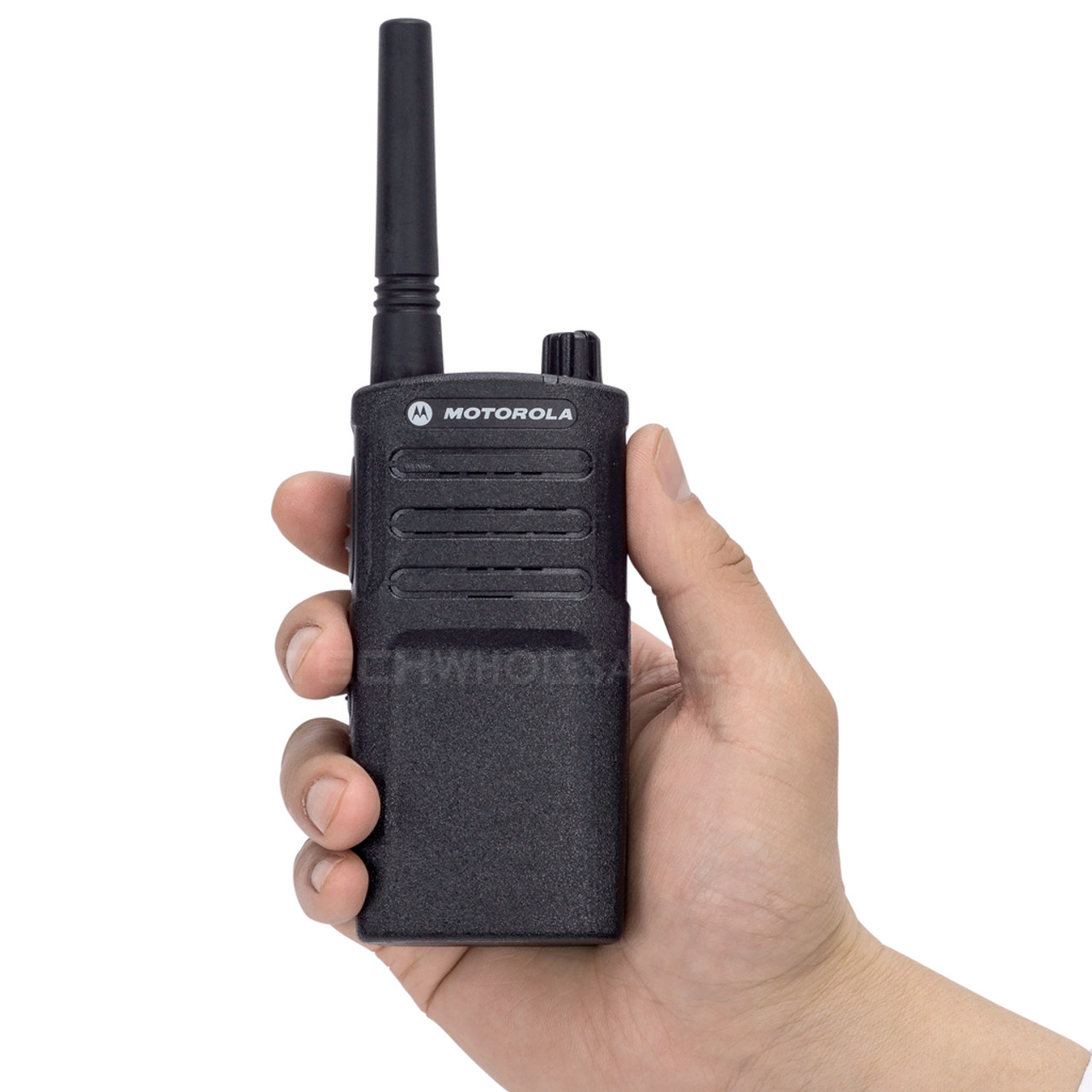
Motorola RMU2040 — Best for Small to Mid-Size Facilities
Key Specifications
- Frequency: UHF (450–470 MHz)
- Power: 2 watts
- Channels: 4
- Indoor coverage: Up to 250,000 sq ft / 20 floors
- Outdoor range: Up to 2 miles
- Durability: MIL-STD-810, IP55
- Privacy: 219 privacy codes
- FCC license: Yes
- Battery: Lithium-ion, all-day use
The RMU2040 is the workhorse for single-building security operations covering up to 250,000 square feet.
Its 2-watt UHF output cuts through concrete and steel-reinforced walls without requiring a repeater, making it reliable in parking garages, multi-floor office buildings, and retail centers.
The IP55 rating means the radio handles rain, humidity, and occasional direct water exposure — important for officers working outdoor posts or loading dock entry points.
MIL-STD-810 certification covers drop, vibration, and temperature extremes.
Its 219 privacy codes prevent neighboring businesses or outside users on the same UHF band from hearing your team's transmissions.
Four channels allow basic zone or function segmentation.
The charging tray design simplifies overnight charging for fleet deployments.
For security teams in hotels, retail, corporate campuses, or smaller office buildings that don't yet require full digital infrastructure, the RMU2040 delivers professional-grade reliability at a practical price point.
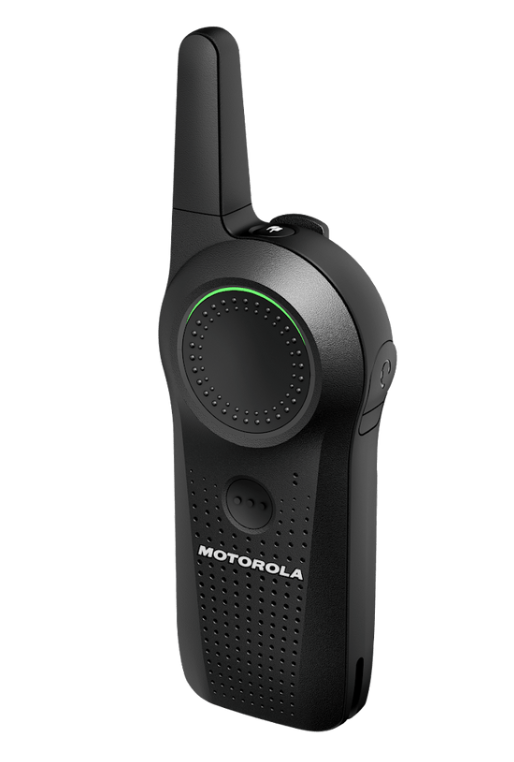
Motorola Curve — Best License-Free, Encrypted Digital Radio
Key Specifications
- Frequency: Digital (902–928 MHz)
- Power: 1 watt digital (equivalent to ~4 watts analog)
- Channels: 10
- Indoor coverage: Up to 300,000 sq ft / 20 floors
- Privacy: Frequency Hopping Spread Spectrum (FHSS) + 10,000 privacy codes
- FCC license: Not required
- Battery life: Up to 14 hours
- Weight: 4.2 oz
The Motorola Curve operates on the 900 MHz digital band using Frequency Hopping Spread Spectrum technology — a communication method originally developed for military applications that makes transmissions extremely difficult to intercept by rapidly switching frequencies during a broadcast.
Combined with 10,000 unique privacy codes, the Curve provides the strongest over-the-air privacy of any unlicensed radio in its class.
The practical significance for security teams: no FCC Part 90 business radio license is required, which eliminates annual licensing fees and simplifies compliance for smaller operations.
Despite its 1-watt digital output, the Curve's 900 MHz performance covers up to 300,000 square feet indoors — equivalent to a 4-watt analog radio.
Its 14-hour battery life covers full security shifts without mid-shift swaps.
The Page All and Call All Available group broadcast features let supervisors instantly reach the entire team — essential during emergency response activations.
At 4.2 ounces, it's one of the lightest professional radios on the market, which officers on 12-hour foot patrols notice and appreciate.
The Curve is particularly well-suited to security operations in environments where FCC licensing overhead is undesirable and communication privacy is a primary concern.
Motorola SL300-U — Best for Discreet, Professional Environments
Key Specifications
- Network: 4G LTE (Motorola WAVE PTX platform)
- Channels: 96
- Contact list: Up to 1,000
- Battery life: 18 hours
- Display: Yes
- GPS: Yes, real-time location tracking
- Safety features: Emergency button, Lone Worker mode, fall alert
- Connectivity: Bluetooth compatible, VOX for hands-free use
- AI noise cancellation: Yes
- Durability: IP67 (dust-tight and submersion-resistant to 1 meter)
- FCC license: Not required
- Subscription: Required per device (monthly)
The Motorola TLK110 operates over 4G LTE cellular infrastructure through the Motorola WAVE PTX platform, providing unlimited communication range wherever cellular coverage exists.
For security operations spanning multiple buildings, large outdoor campuses, remote patrol zones, or geographically dispersed locations, the TLK110 eliminates the range ceiling that defines traditional UHF radio.
Its 96-channel capacity and 1,000-contact directory support large, complex teams with multiple functional groups.
The real-time GPS location tracking lets command centers monitor officer positions across an entire property or portfolio in real time.
The TLK110's safety feature set is specifically designed for security applications.
- One-touch emergency button broadcasts an immediate distress signal.
- Lone Worker mode automatically alerts the team if an officer does not respond.
- Fall Alert detects sudden impact and triggers an emergency notification.
AI-powered noise cancellation maintains audio clarity in high-noise environments.
VOX (voice-activated transmit) keeps hands free for physical response.
The IP67 rating is the most rigorous water resistance specification in this comparison.
Note that the TLK110 requires a monthly WAVE PTX subscription per device.
Radio Comparison: Security Use Case Matrix
| Model | Coverage | Battery | FCC License | Best For |
|---|---|---|---|---|
| Motorola RMU2040 | 250,000 sq ft / 2 mi outdoor | All-day | Required | Small-to-mid buildings |
| Motorola Curve | 300,000 sq ft | 14 hours | Not required | Private, license-free deployments |
| Motorola SL300-U | 325,000 sq ft / 30 floors | 12–15 hours | Required | Discreet, guest-facing environments |
| Motorola TLK110 | Unlimited (4G LTE) | 18 hours | Not required | Multi-site, patrol, unlimited range |
FCC Licensing and Compliance for Security Radios
Which Security Radios Require an FCC License?
Under FCC Part 90 (Private Land Mobile Radio Services), any radio transmitting on licensed UHF or VHF business frequencies technically requires an FCC Part 90 business radio license.
This applies to the Motorola RMU2040 and Motorola SL300-U.
A license is not required to purchase radios.
The Motorola Curve and Motorola TLK110 do not require an FCC Part 90 license.
Frequently Asked Questions: Two-Way Radios for Security
What range do security radios need?
Range requirements depend entirely on the deployment.
For a single commercial building under 250,000 square feet, a 2-watt UHF radio like the RMU2040 is typically sufficient.
Multi-site, campus, or outdoor patrol operations with no defined perimeter are best served by LTE-based radios like the TLK110.
How long do security radio batteries last?
- Motorola TLK110: 18 hours
- Motorola SL300-U: 12.5–15 hours
- Motorola Curve: 14 hours
- Motorola RMU2040: All-day use
Do security radios need to be licensed with the FCC?
It depends on the model.
Licensed UHF/VHF radios like the RMU2040 and SL300-U require an FCC Part 90 business radio license.
Unlicensed radios like the Motorola Curve and TLK110 do not require an FCC license.
Why Security Teams Source Radios from TechWholesale.com
TechWholesale.com has been an authorized Motorola dealer since 1997, with nearly three decades of experience equipping security teams across commercial real estate, healthcare, hospitality, retail, and corporate environments.
Buying from an authorized dealer matters for security operations specifically: it ensures the radios are genuine Motorola products, that manufacturer warranties remain valid, and that post-purchase technical support is available.
TechWholesale.com offers:
- Lifetime technical support
- Bulk pricing for fleet deployments
- Optional custom programming
- Free shipping on qualifying orders
- 30-day return policy
Request a quote for fleet pricing
Phone: 1-888-925-5982
Email: service@techwholesale.com
Related Reading
- FCC Website – Obtain an FCC License
- FCC Licensing - Blog
- Privacy Codes – Eliminate Outside Interference
- Frequency Hopping Spread Spectrum
- Lone Worker / Man Down Functionality
- VOX Explained
- UHF vs VHF – Frequencies Explained
Article by Kristin Wood, a two-way radio consultant @ Tech Wholesale | Authorized Motorola & Kenwood Dealer Since 1997 | Last Updated: May 2026