

Most daycares rely on a phone in the office and a teacher calling down the hall, until the day they need to reach the playground, the front door, and every classroom at once.
Business-grade UHF or 900MHz radios give your whole staff instant, one-to-many contact for pickups, ratio coverage, and emergencies, with earpieces that keep calls quiet around the kids.
You’ve come to the right place! We’ve worked alongside hundreds of childcare centers around the country since 1997. Here’s how to pick the right radio for your center.
Which Walkie Talkie Fits Your Child Care Center?
The Quick Answer
- A single-floor center where everyone can see everyone → Motorola CLS1110. One channel, nothing to program, and a new hire is operating it the minute you hand it over.
- A larger center, a second floor, or a separate infant building → Kenwood ProTalk PKT-300. Two watts of UHF gets a signal from the playground back to the front office.
- A large campus, or a building of concrete and block → Motorola Curve. Digital 900 MHz and ten channels. Digital audio either arrives clean or not at all — it doesn't degrade into static.
Why Day Cares Need Professional Two-Way Radios
Child care facilities operate under a unique set of communication demands that consumer grade walkie-talkies and smartphones cannot reliably meet. Staff move constantly between classrooms, hallways, playgrounds, and restrooms—often with their hands occupied and unable to unlock a phone. Response speed is not a preference; in an environment responsible for the safety of children, it is a requirement.
Day care centers face several specific communication pain points:
Hands-free operation. Caregivers changing diapers, supporting a child on playground equipment, or managing a group activity cannot stop to dial a phone. Push-to-talk (PTT) radios with VOX (voice-activated transmission) allow staff to communicate without removing their hands from the task at hand.
Indoor-to-outdoor coverage. Most day care radio failures happen between communicating indoors and outdoors. Consumer-grade radios lose signal penetrating exterior walls and across a playground. UHF-frequency professional radios are specifically engineered to maintain signal through commercial building materials, including block, brick, and glass.
Quiet, discreet communication. Loud radio chatter disrupts nap time, story time, and focused learning. Professional radios support private call options and adjustable volume, allowing staff to communicate without disturbing groups of children.
Emergency response. Whether the situation is a medical incident, a missing child, or a lockdown, staff need immediate, reliable contact across the entire facility. Consumer devices introduce latency and reliability gaps that are unacceptable in emergency scenarios.
Parent pickup coordination. Staggered pickup windows require rapid communication between front desk staff, playground staff, and classroom teachers. Without a reliable radio system, pickup delays and confusion are common.
Physical durability. Radios in child care settings are dropped, bumped, and occasionally exposed to moisture. Units without a commercial-grade build quality become replacement costs within months.
What to Look for in a Day Care Radio
Coverage for Your Building Size
Matching radio power to your facility footprint is the single most important decision. Too little power creates dead zones. Too much means you are paying for coverage your staff will never use.
- Small centers (under 10,000 sq ft, single floor): 1 watt UHF covers up to 200,000 sq ft indoors and is more than adequate for most single-building day cares.
- Mid-size or multi-floor facilities: 2 watts UHF extends coverage to approximately 275,000 sq ft with better penetration through walls and stairwells.
- Large campuses or facilities with concrete/block construction: A digital radio like the Motorola Curve delivers the equivalent of 4 watts analog through 1 watt of digital output, covering up to 300,000 sq ft with cleaner signal in RF-dense environments.
- Multi-building or unlimited-range needs: LTE/Wi-Fi radios like the Motorola WAVE PTX series remove coverage limits entirely.
Battery Life
A typical day care shift runs 8 to 10 hours, and many centers operate double shifts. Professional radios in this guide carry 10 to 18-hour battery ratings under typical transmission loads. Motorola and Kenwood commercial batteries are independently tested to five years of regular field use. Look for Li-ion over NiMH where possible; Li-ion holds a charge longer under partial-discharge cycling.
Channel Capacity
Most day care operations run effectively on one shared channel. For larger facilities, multi-channel radios allow segmentation by room, floor, or role (classroom staff, playground staff, administration). Six channels is more than sufficient for most child care configurations. Single-channel radios like the CLS1110 are appropriate for smaller centers where all staff benefit from hearing all transmissions.
Durability Rating
Look for radios rated for at least moderate commercial use. MIL-STD-810 compliance indicates the radio has been tested for drop, shock, and vibration resistance under U.S. military environmental standards. An IP54 or better ingress protection rating ensures resistance to dust and splash water—a reasonable baseline for a child care environment where spills and outdoor exposure are common.
Ease of Use
Staff turnover is a reality in child care. Radios with minimal button complexity and clear channel indicators reduce training time. The Motorola CLS and CLP series are specifically designed to be operational with no training beyond a brief orientation.
Recommended Two-Way Radios for Day Cares
1. Motorola CLS1110 — Best for Small Day Cares

| Specification | Detail |
|---|---|
| Frequency | UHF (460–469 MHz) |
| Power | 1 watt |
| Channels | 1 |
| Indoor Coverage | Up to 200,000 sq ft / up to 15 floors |
| Battery Life | ~18 hours (Li-ion) |
| Interference Eliminator Codes | 121 (83 digital, 38 analog) |
The Motorola CLS1110 is a single-channel UHF radio purpose-built for small commercial operations. It is one of the most commonly deployed radios in child care, preschool, and after-school program environments because it requires virtually no training, operates reliably both indoors and on the playground, and carries an 18-hour battery rating that outlasts most full-day shifts by a comfortable margin.
Why it fits day cares specifically
- Single-channel design keeps all staff on the same communication line—ideal for smaller teams where everyone benefits from shared awareness
- Vibracall technology and audible call alerts ensure staff receive messages without raising volume in a nap room or quiet classroom
- VOX (hands-free voice-activated transmission) allows caregivers to communicate without setting down a child or task
- 121 interference eliminator codes reduce the chance of outside radio traffic bleeding into your facility's channel
- Keypad lockout prevents accidental channel changes by children or distracted staff
- UHF frequency penetrates standard commercial construction reliably, including interior block walls common in child care facilities built to NFPA 101 Life Safety Code standards
Limitation to know: Single-channel configuration means all staff hear all transmissions. For larger facilities where segmentation by room or role is a priority, step up to the Motorola CLS1410 (4 channels) or the Kenwood PKT-300.
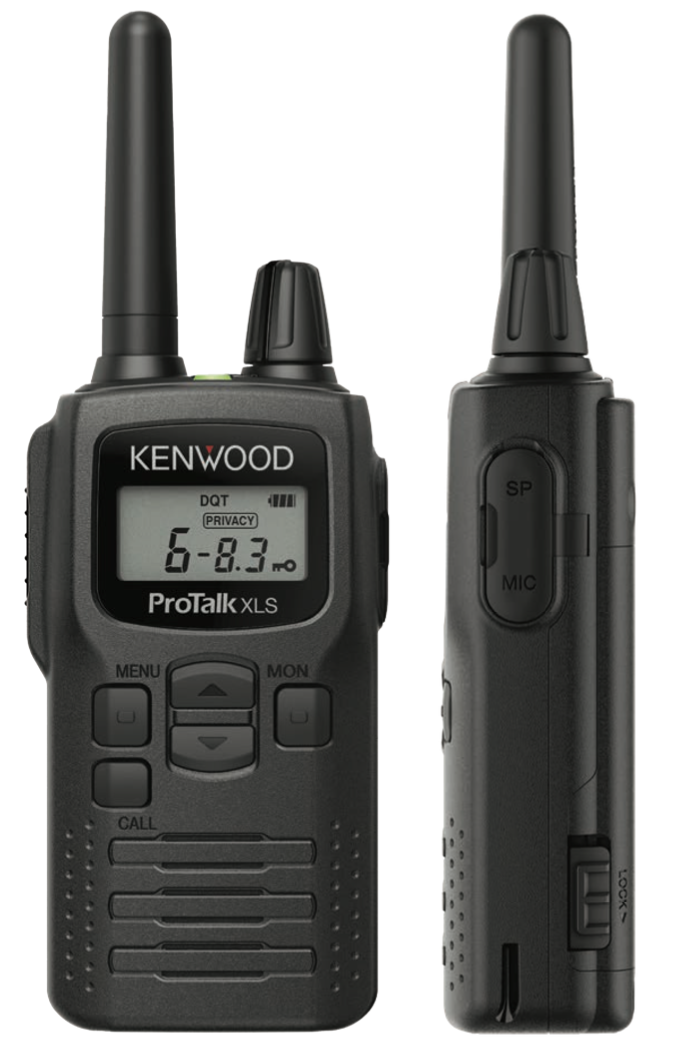
2. Kenwood ProTalk PKT-300 — Best for Larger or Multi-Building Facilities
| Specification | Detail |
|---|---|
| Frequency | UHF (450–470 MHz) |
| Power | 2 watts |
| Channels | 6 |
| Indoor Coverage | Up to 275,000 sq ft |
| Outdoor Range | Up to 2 miles |
| Battery Life | ~10 hours |
| Includes | Standing charging tray, wall charger, belt clip |
The Kenwood ProTalk PKT-300 is the right choice when a facility's square footage, wall construction, or multi-building layout exceeds what a 1-watt UHF radio can reliably serve. Its 2-watt output provides measurably better penetration through concrete block, steel doors, and multi-floor stairwells.
Why it fits larger day cares specifically
- 2 watts of UHF output reliably bridges indoor-to-outdoor gaps between classrooms and the playground
- 6 channels allow segmentation by room, floor, or role—for example: Channel 1 (all staff), Channel 2 (playground), Channel 3 (administration)
- VOX supports hands-free operation for staff actively working with children
- Compact form factor—one of the smallest professional radios on the market—clips to a lanyard or waistband without bulk
- Includes a standing charging tray and wall charger, so radios charge in a central location and are always ready at shift start
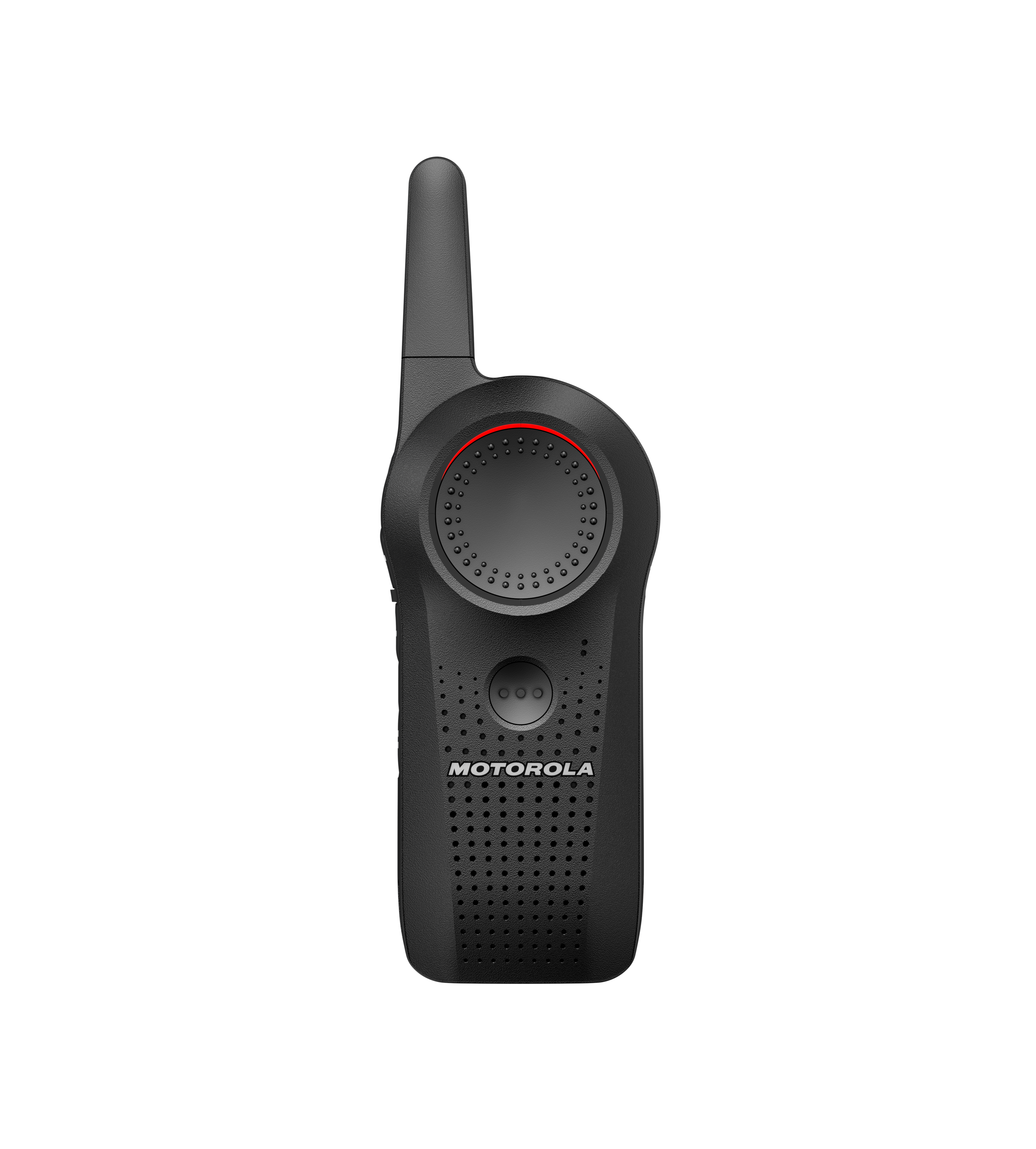
3. Motorola Curve — Best for Large Campuses and Facilities with Dense Construction
| Specification | Detail |
|---|---|
| Frequency | Digital 900 MHz (902–928 MHz) |
| Power | 1 watt digital (equivalent to ~4 watts analog) |
| Channels | 10 |
| Indoor Coverage | Up to 300,000 sq ft / up to 20 floors |
| Battery Life | ~10–12 hours |
| Durability | MIL-STD-810 compliant, water-resistant |
The Motorola Curve is the right choice when a facility's footprint pushes beyond what UHF analog radios can reliably serve. Its 900 MHz digital signal penetrates concrete, masonry, and steel-reinforced walls more effectively than comparable analog wattage, and its digital-to-analog power equivalency of approximately 4 watts means it covers nearly 50% more floor area than a 2-watt analog radio under similar conditions.
Why it fits large or challenging facilities specifically
- 10 channels accommodate full team segmentation across classrooms, playground, front desk, administration, and after-care staff
- MIL-STD-810 compliant construction handles daily drops in a fast-moving child care environment
- Digital technology delivers cleaner audio with less static than analog at equivalent coverage distances
- Private call and group call options allow staff to communicate without broadcasting to all channels simultaneously
Coverage by Facility Size: Matching Radio to Your Layout
| Facility Type | Recommended Radio | Coverage Capacity |
|---|---|---|
| Small center, single floor, under 10,000 sq ft | Motorola CLS1110 | Up to 200,000 sq ft |
| Mid-size or multi-floor facility | Kenwood PKT-300 | Up to 275,000 sq ft |
| Large campus or concrete/block construction | Motorola Curve | Up to 300,000 sq ft / 20 floors |
| Multi-building or unlimited range | Motorola WAVE PTX | Unlimited (LTE/Wi-Fi) |
Construction tip: Facilities built with poured concrete or concrete block walls—common in buildings constructed to NFPA 101 Life Safety Code occupancy requirements—attenuate RF signal more aggressively than wood-frame construction. If your facility has dense masonry walls, plan one coverage tier above what your square footage alone would suggest.
Operational Questions
How Many Radios Does a Day Care Need?
A practical starting point is one radio per active staff member per shift. This ensures every caregiver can communicate in real time without passing a device between rooms. A typical day care with eight staff members on the floor at once operates well with eight to ten radios—eight in active use and one or two charged and ready as backups.
For facilities with an office coordinator or director who needs to stay reachable without being on the floor, include a dedicated unit for that role. Tech Wholesale offers quantity pricing for orders of five or more units; request a custom quote for fleet pricing.
How Do Radios Support Child Drop-Off and Pickup Procedures?
Parent pickup is one of the highest-risk operational moments in a child care day. A radio system allows the front desk to notify the child's classroom teacher immediately upon parent arrival, confirm the child is released to an authorized adult, and communicate any pickup-related notes (early pickup, alternate authorized pickup person) in real time without leaving a post unmanned. This workflow eliminates the delay of walking the message to a classroom and reduces the window during which a child could be released to an unauthorized person.
How Do Radios Support Emergency Protocols?
Most state child care licensing regulations and NFPA 101 Life Safety Code requirements for educational facilities implicitly depend on real-time internal communication for emergency drills and evacuations. A professional radio system supports staff coordination during fire drills, lockdown procedures, and medical incidents. Assigning a dedicated channel for emergency-only use—separate from routine operational communication—allows staff to escalate quickly without cluttering daily traffic. The Kenwood PKT-300 and Motorola Curve both support dedicated emergency channel assignments.
Can Radios Work Alongside an Existing Phone System?
Yes. Two-way radios and phone systems serve different functions and complement each other well. Phones are appropriate for extended conversations, parent communication, and external calls. Radios are the correct tool for internal, real-time coordination that requires immediate response. Most child care operators use both: phones for parent-facing communication, radios for staff-to-staff operational coordination throughout the day.
Can Children Accidentally Activate Radios?
The Motorola CLS1110 includes keypad lockout, which prevents accidental channel changes or transmissions. Professional radio designs with minimal exposed controls—like the CLS and CLP series—are specifically less susceptible to accidental activation than consumer walkie-talkies with exposed buttons. For added security, VOX-only units (where transmission requires voice rather than a button press) further reduce the risk of accidental transmission.
Frequently Asked Questions
What is the best two-way radio for a day care center?
For most day cares, the Motorola CLS1110 is the strongest all-around choice: a single channel, 200,000 sq ft indoor coverage, an 18-hour battery, and VOX hands-free capability. For facilities over 200,000 sq ft or with multi-floor layouts, the Kenwood PKT-300 adds 2-watt power and six channels. For large campuses or facilities with dense construction, the Motorola Curve provides 300,000 sq ft of coverage.
How much range do I need for a day care?
For a single-floor day care under 10,000 sq ft, a 1-watt UHF radio provides adequate coverage with signal to spare. For multi-floor facilities or buildings with masonry construction, plan for 2 watts UHF (Kenwood PKT-300) or upgrade to a digital radio like the Motorola Curve, which delivers the equivalent of approximately 4 watts analog. Outdoor coverage to a standard playground is well within the range of all three recommended models.
How long does the battery last on a day care radio?
The Motorola CLS1110 carries an 18-hour Li-ion battery rating—the longest of any radio in this guide. The Kenwood PKT-300 and Motorola Curve are rated for approximately 10 to 12 hours. All three meet or exceed a standard 8- to 10-hour child care shift. For double shifts or multi-day events, multi-unit charging cradles allow hot-swapping depleted batteries without downtime.
Are day care radios durable enough to survive drops?
The Motorola Curve meets MIL-STD-810 standards for drop, shock, and vibration resistance. The CLS1110 and PKT-300 are rated for moderate commercial use and are significantly more durable than consumer-grade walkie-talkies. All three radios listed carry water resistance ratings appropriate for splash and light moisture exposure common in child care environments. None are rated for submersion.
Can outside radio users pick up our transmissions?
UHF radios like the CLS1110 and PKT-300 support interference eliminator codes (also called CTCSS/DCS tones). These codes filter out transmissions from other users on the same frequency, significantly reducing the risk of outside radio traffic interrupting your staff channel. They do not encrypt transmissions, however. For environments requiring true communication privacy, digital radios like the Motorola Curve use proprietary digital protocols that are not readable by standard analog scanners.
How many channels does a day care need?
Most day cares operate effectively on one shared channel—it keeps all staff on the same communication loop without added complexity. For facilities with distinct operational zones (classroom wing, playground, front office, after-care), two to four channels allow clean segmentation. A single-channel radio like the CLS1110 is appropriate for smaller centers; a 6-channel radio like the PKT-300 provides enough flexibility for nearly any child care configuration.
Can two-way radios help with emergency drills and lockdown procedures?
Yes. This is one of the primary use cases for professional radios in child care. A dedicated emergency channel allows staff to escalate immediately to all available personnel without cluttering routine operational traffic. For facilities subject to state licensing safety requirements or those following NFPA 101 Life Safety Code guidelines for educational occupancies, an internal radio communication system directly supports the real-time coordination that emergency evacuation procedures depend on.
Why Buy from TechWholesale.com
Tech Wholesale has been selling professional two-way radios to child care centers, preschools, and educational facilities since 1997. We are an authorized dealer for Motorola and Kenwood, which means every radio we sell carries the full manufacturer warranty and qualifies for manufacturer service and repair. There is no gray market inventory and no voided warranties.
What sets us apart
- Lifetime technical support included with every purchase—call or email our team for the life of your radio fleet, not just through the warranty period
- Quotes for larger teams—request a custom quote
- No-pressure consultation—our team will tell you when a less expensive radio is the right answer for your facility
- Free shipping on qualifying orders
- FCC licensing guidance included with every applicable purchase
- Authorized dealer status—no gray market inventory, no voided warranties
If you're not sure which radio fits your day care, use our Find My Radio tool or request a quote. We'll ask a few questions about your facility and come back with a specific recommendation—no sales pressure, no obligation.
1-888-925-5982 Service@TechWholesale.com
Related Reading
From TechWholesale.com
- Find My Radio – Guided Radio Selector
- VOX Explained – How Hands-Free Radio Transmission Works
- UHF vs VHF – Frequencies Explained
- Privacy Codes – Eliminate Outside Interference
- Frequency Hopping Spread Spectrum (FHSS) Explained
- Walkie-Talkie FAQs
- Radio Education & Reviews
External Resources
- NFPA 101: Life Safety Code (Educational Occupancies) – NFPA.org
- OSHA Standard 29 CFR 1910.95: Occupational Noise Exposure – OSHA.gov
- National Association for the Education of Young Children (NAEYC) – naeyc.org
Article by Kristin Wood, a two-way radio consultant @ Tech Wholesale | Authorized Motorola & Kenwood Dealer Since 1997 | Last Updated: May 2026