

Most car washes start with cheap walkie-talkies and replace them within a season. Water gets inside, soap and chemicals wear down the housings, and nobody can hear a call over the dryers anyway.
Business-grade UHF radios fix all three: waterproof construction that survives spray and drops on wet concrete, and earpieces that cut through the blower noise.
Let’s make this decision easy! We’ve worked alongside hundreds of car washes across the US since 1997. Here’s how to pick the right radio for your site.
Which Walkie Talkie Fits Your Car Wash?
The Quick Answer
- A tunnel — wet, loud, and running all day → Motorola RMU2040. Two watts, a 1,500 mW speaker that cuts through blowers and vacuums, and an IP54/55 rating on a radio that's going to get hit by overspray every shift.
- A small single-line or self-serve site → Motorola CLS1110. One channel, nothing to program, and everyone hears everything — which is right when the whole crew is three people who can already see each other.
- Multiple bays, a detail shop, or a c-store attached → Motorola Curve. Digital 900 MHz and ten channels. Digital audio stays clean at the edge of coverage instead of degrading into static you can't parse over a dryer.
Why Car Washes Need Purpose-Built Two-Way Radios
Cell phones and bargain walkie-talkies fail in a car wash for the same reasons: wet hands can't operate a touchscreen, batteries die before the shift ends, and cheap speakers disappear under the blowers. Professional business radios solve each of these with hardware built for high-moisture, high-noise commercial sites.
Car washes combine a set of pain points that few other industries share all at once:
Constant water and moisture. Pre-soak arches, tire applicators, rinse spray, and customers walking radios through the tunnel mean every unit gets wet. A radio without at least an IP54 ingress-protection rating is a replacement cost waiting to happen.
Extreme ambient noise. Dryers, blowers, vacuums, and pump rooms routinely push sound levels past 85 dB—the OSHA threshold (29 CFR 1910.95) at which a hearing conservation program is required. Standard speakers and microphones turn that into unintelligible static. Professional radios compensate with high-output speakers and noise-canceling microphones.
Wet, gloved hands. Greeters and tunnel crew can't fumble with tiny buttons. Large push-to-talk buttons and hands-free VOX let staff transmit without breaking from loading a car or wiping down a panel.
Mixed indoor and outdoor coverage. A typical wash spans an enclosed tunnel, an open vacuum lot, a pay station, and a back office. UHF and 900 MHz digital signals penetrate the concrete and steel that block consumer radios while still reaching the far end of the lot.
Lost time and lost revenue. A car stacked at the entrance with no greeter, a paid interior detail with no one assigned, a clear tunnel nobody knows is clear—each gap costs minutes and money. Instant push-to-talk closes those gaps faster than any phone call or text.
Drops and physical wear. Radios hit wet concrete daily. MIL-STD-810 shock resistance is the difference between a unit that shrugs off a fall and one that cracks on the third drop.
What to Look For in a Car Wash Radio
Water Resistance (IP Rating)
This is the single most important spec for a wash. Look for a minimum IP54 rating, which protects against dust and water spray from any direction. The Motorola RMU2040 is rated IP54/55, meaning it withstands low-pressure water jets—the right baseline for tunnel and bay exposure. No business radio on this page is rated for submersion, and none needs to be.
Audio Performance in High Noise
Prioritize a loud, clear speaker (the RMU2040 outputs 1,500 mW) paired with a noise-canceling microphone. For staff working directly under dryers or beside vacuums, add a remote speaker microphone or earpiece so they can hear over the equipment.
Battery Life
A wash runs 8 to 14 hours from open to close. Choose radios rated for a full shift on a single charge. Motorola and Kenwood commercial batteries are tested to roughly five years of regular field use, and a multi-unit charger lets you hot-swap packs across double shifts.
Durable, Simple Controls
Large buttons that work with gloves, a rugged housing rated to MIL-STD-810 for shock and vibration, and a simple interface that a new seasonal hire can learn in minutes all matter more in a wash than feature count.
Channel Capacity
Small single-line washes run fine on one shared channel. Multi-zone operations—greeters, tunnel crew, detail, maintenance, management—benefit from four to ten channels so teams aren't talking over each other.
Recommended Two-Way Radios for Car Washes
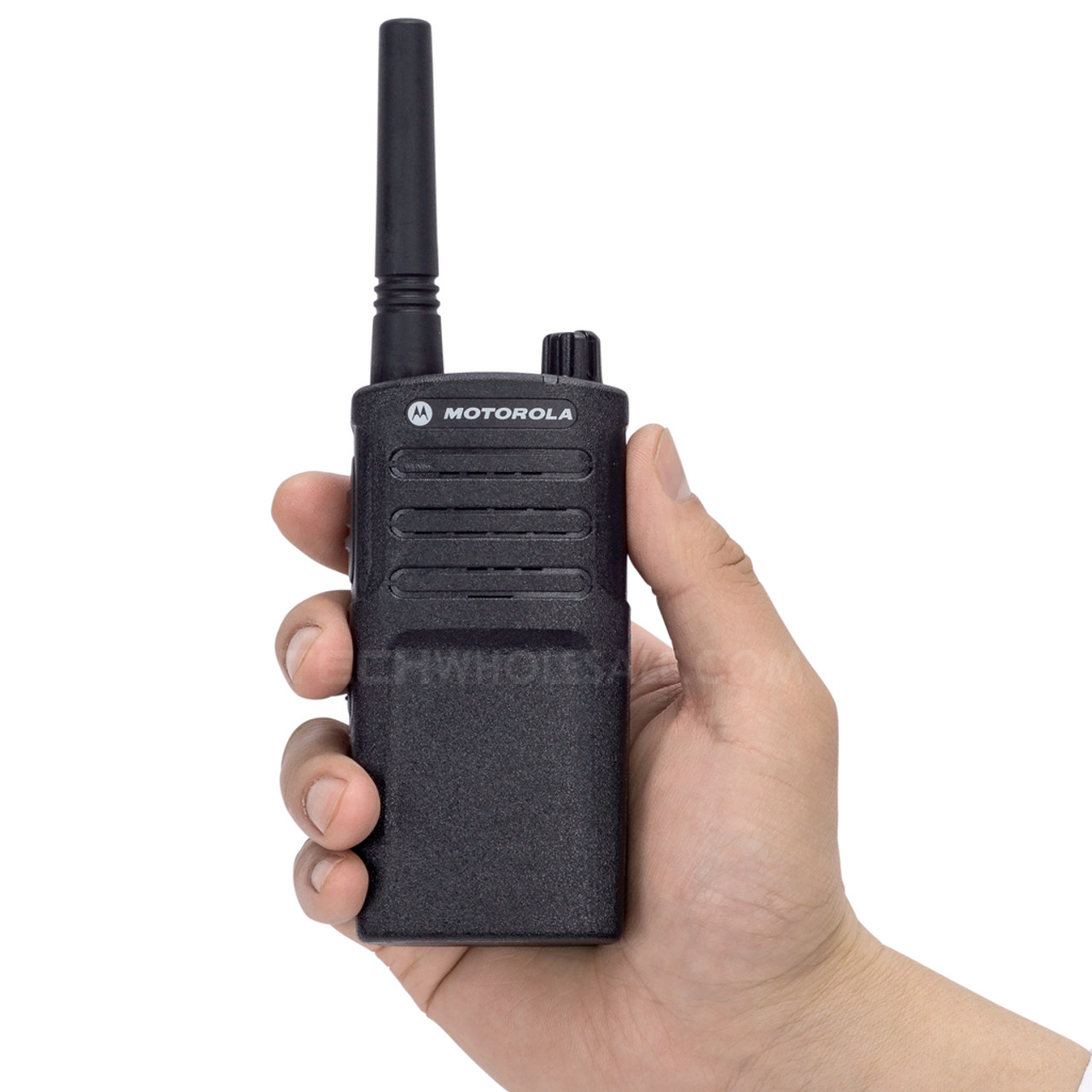
1. Motorola RMU2040 — Best Overall for Car Washes
| Specification | Detail |
|---|---|
| Frequency | UHF (450–470 MHz), analog |
| Power | 2 watts |
| Channels | 4 |
| Indoor Coverage | Up to 250,000 sq ft / 20 floors |
| Outdoor Range | 1–2 miles (terrain-dependent) |
| Speaker Output | 1,500 mW |
| Battery Life | Up to 12 hours (up to 15 with battery save) |
| Water / Durability | IP54/55 water resistant; MIL-STD-810C–G |
If we had to put one radio in every car wash, this is it. The RMU2040 is the only model on this page rated IP54/55, so it handles direct spray, rain, and the constant damp of a tunnel without flinching. Its 1,500 mW speaker cuts through dryers and vacuums, and the MIL-STD-810 housing survives the drops that happen daily on wet concrete.
Why it fits car washes specifically
- IP54/55 rating protects against water spray from any direction—built for the wettest part of the operation.
- 1,500 mW speaker and noise-canceling audio stay intelligible under blowers and pressure equipment.
- 2 watts of UHF power and 250,000 sq ft of indoor coverage reach from the pay station to the far end of the vacuum lot.
- Four channels let you separate greeters, tunnel, detail, and management.
- VOX enables hands-free transmission for crew loading cars or drying with both hands busy.
- NOAA weather alerts and an antimicrobial coating add practical value for an outdoor-adjacent, shared-equipment environment.
2. Motorola CLS1110 — Best for Small, Single-Line Car Washes

| Specification | Detail |
|---|---|
| Frequency | UHF, analog |
| Power | 1 watt |
| Channels | 1 |
| Indoor Coverage | Up to 200,000 sq ft / 15 floors |
| Battery Life | Full-shift (all-day) battery life |
| Key Features | Display, VOX, Audible Call Alerts with Vibracall |
The CLS1110 has been a proven performer for over fifteen years and is the most economical model in its class. For a small express wash where the whole crew runs on one line, it's hard to beat: lightweight, simple, and reliable, with UHF coverage that easily blankets a single-bay footprint and outdoor vacuum area.
Why it fits small washes specifically
- UHF frequency works across the mixed indoor tunnel and outdoor lot of a typical small site.
- One shared channel keeps a tight crew coordinated without overcomplicating things.
- VOX allows hands-free use for greeters and prep staff.
- Audible Call Alerts with Vibracall let staff get a message without interrupting a customer interaction.
What to know: the CLS1110 is splash- and light-moisture resistant rather than IP-rated, so it suits crews working at the drier vacuum and pay-station end of the operation. If your staff stand in direct tunnel spray all day, step up to the IP54/55-rated RMU2040. And because the CLS1110 is a single-channel radio, teams that need role-based channels should choose the RMU2040 (4 channels) or the Curve (10 channels).
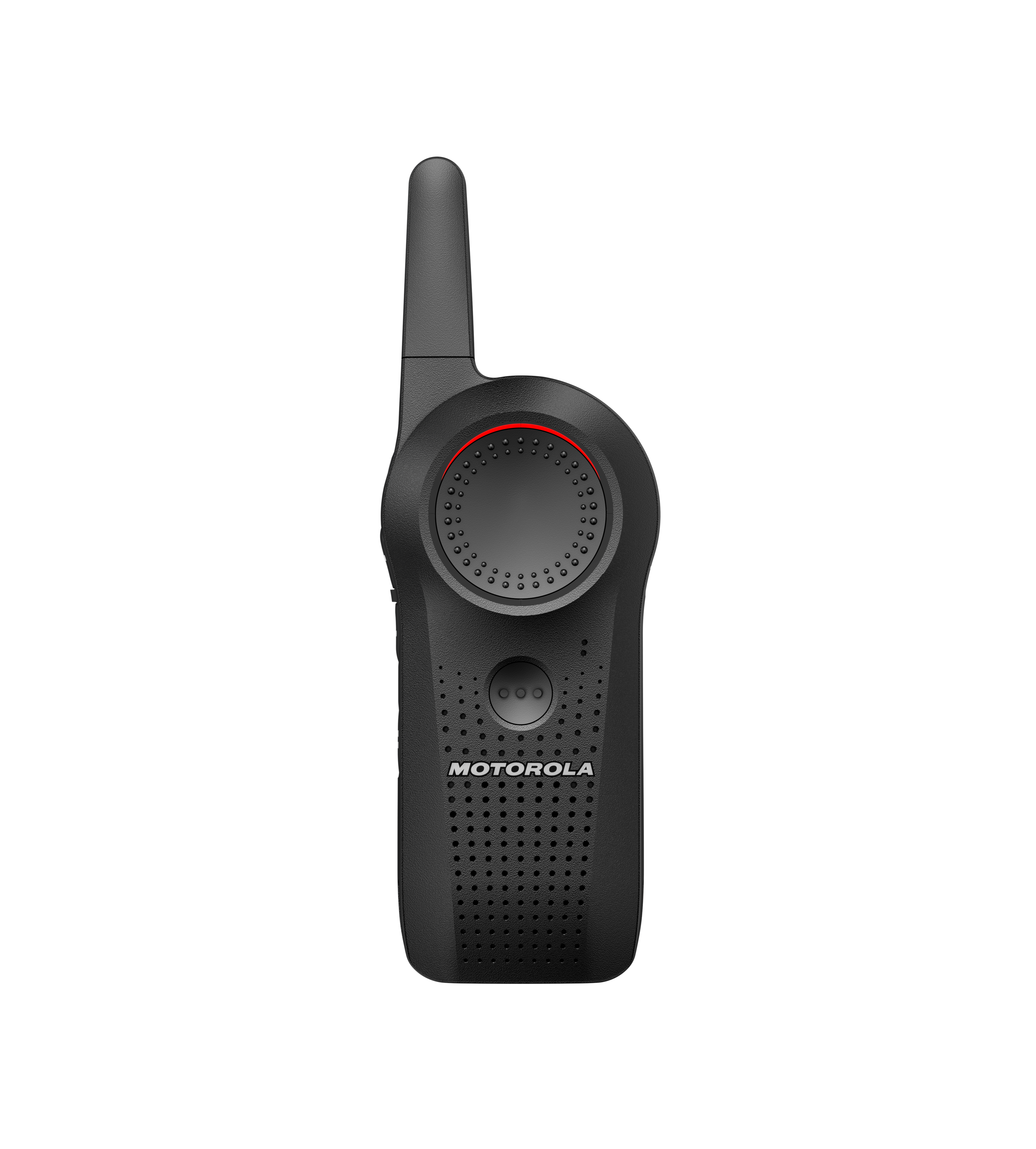
3. Motorola Curve — Best for Large & Multi-Building Operations
| Specification | Detail |
|---|---|
| Frequency | Digital 900 MHz (902–928 MHz) |
| Power | 1 watt digital (equivalent to ~4 watts analog) |
| Channels | 10 |
| Indoor Coverage | Up to 300,000 sq ft / 20 floors |
| Battery Life | ~10–12 hours |
| Water / Durability | Water resistant; MIL-STD-810 compliant |
When a site's square footage, wall construction, or multiple buildings exceed what a 1–2 watt analog radio can reliably serve, the Motorola Curve is the answer. Its 900 MHz digital signal delivers cleaner audio than analog in crowded radio environments and penetrates concrete and steel more effectively at comparable wattage. The roughly 4-watt analog equivalent covers nearly three times the floor area of the CLS1110.
Why it fits large washes specifically
- 10 channels support full team segmentation—greeters, tunnel, detail, maintenance, and management on separate lines.
- Digital audio stays clear in RF-dense sites where radios, payment systems, and Bluetooth devices compete.
- Up to 300,000 sq ft of coverage reaches across large lots and multiple buildings.
- MIL-STD-810 compliant and water resistant for the physical demands of a high-volume site.
Also Worth Considering
Kenwood ProTalk PKT-300 — 2 watts, 6 channels, UHF (450–470 MHz), indoor coverage up to 275,000 sq ft. A compact, lightweight alternative for washes that want six channels and Kenwood build quality.
Motorola CLP1010e — 1 watt, UHF, single channel (upgrade to the CLP1080e for 8 channels), indoor coverage up to 100,000 sq ft. The discreet, earpiece-only choice for upscale full-service washes that want staff to look polished with no visible radio.
Motorola WAVE PTX (TLK series) — LTE/Wi-Fi push-to-talk with effectively unlimited range. The right tool for multi-location operators who need to connect sites across a city or region on one network.
Car Wash Radio Comparison
| Model | Best For | Power | Channels | Indoor Coverage | Water / Durability | Battery |
|---|---|---|---|---|---|---|
| Motorola RMU2040 | Best overall (wet, high-noise) | 2 W UHF | 4 | Up to 250,000 sq ft | IP54/55, MIL-STD-810 | Up to 12–15 hrs |
| Motorola CLS1110 | Small, single-line washes | 1 W UHF | 1 | Up to 200,000 sq ft | Splash/light-moisture resistant | Full shift |
| Motorola Curve | Large & multi-building sites | 1 W digital (~4 W analog) | 10 | Up to 300,000 sq ft | Water resistant, MIL-STD-810 | ~10–12 hrs |
| Kenwood PKT-300 | Six-channel compact alternative | 2 W UHF | 6 | Up to 275,000 sq ft | Light-duty, water resistant | Full shift |
Match the Radio to Your Facility
Power and coverage should match your footprint. Too little and you get dead zones at the worst moments; too much and you're overpaying. Use this as a starting point, then account for your building materials—thick poured-concrete walls can cut effective range, so it's worth going one tier stronger than your square footage alone suggests.
| Facility Type | Recommended Radio | Coverage Capacity |
|---|---|---|
| Small express / single tunnel under 5,000 sq ft | Motorola CLS1110 | Up to 200,000 sq ft |
| Standard full-service wash with detail bays | Motorola RMU2040 or Kenwood PKT-300 | 250,000–275,000 sq ft |
| Large wash / multi-bay / multi-building site | Motorola Curve | Up to 300,000 sq ft / 20 floors |
| Multi-location operation across a city or region | Motorola WAVE PTX (LTE/Wi-Fi) | Unlimited range |
Setting Up Radios at Your Wash
How many radios do I need?
A practical starting point is one radio per key role per shift: one per greeter, one per tunnel lead, one for the detail/drying station, one for maintenance, and one for the manager on duty. A small express wash runs well on three to five radios; a busy full-service site with detail and security typically needs six to ten. Quantity pricing kicks in at five or more units—request a quote for your headcount.
How should I set up channels?
A simple, proven channel plan for a multi-zone wash:
- All-staff / general ops — quick updates and emergencies.
- Greeters / front line — vehicle entry, queue management, and upsells.
- Tunnel crew — loading, conveyor, and prep coordination.
- Detail / drying — finishing, vacuuming, and quality control.
- Maintenance — equipment faults and chemical/supply restocking.
- Management — a private line for staffing and escalations.
Channels also enable private side conversations: “Sarah, switch to channel two” lets two people talk without tying up the whole crew.
How do I keep radios charged across shifts?
For double shifts or back-to-back busy days, a multi-unit charging tray lets you hot-swap batteries with zero downtime and clone settings across the fleet at the same time.
What accessories matter most in a wash?
For staff stationed under dryers or beside vacuums, a remote speaker microphone or earpiece dramatically improves intelligibility in high noise. Belt clips and holsters keep radios off wet surfaces between transmissions.
How do I maintain radios in a wet, chemical environment?
Even IP-rated radios are water resistant, not chemical-proof. Wipe units down at the end of each shift if they've been exposed to detergents or wax, keep contacts clean and dry before charging, and never submerge a non-submersion-rated radio. If a radio does get soaked internally, power it off and let it dry fully before use.
OSHA Noise Considerations
Under OSHA Standard 29 CFR 1910.95, employers must implement a hearing conservation program when workers are exposed to 85 dB or above as an eight-hour time-weighted average. Dryers, blowers, vacuums, and pump rooms routinely push car wash noise levels into that range, so radio audio accessories used in these areas should be paired with appropriate hearing protection. Earpieces and remote speaker microphones help staff communicate clearly without raising radio volume to unsafe levels.
Reliable internal communication also supports emergency preparedness. OSHA's Emergency Action Plan standard (29 CFR 1910.38) requires an effective means of alerting employees and coordinating response—something a professional radio fleet provides far more dependably than personal cell phones.
Frequently Asked Questions
What water-resistance (IP) rating do I need for a car wash?
Aim for a minimum of IP54, which protects against dust and water spray from any direction—enough for splashes, overspray, and general tunnel moisture. The Motorola RMU2040 is rated IP54/55, meaning it can take low-pressure water jets from any direction. None of the business radios recommended here are rated for submersion, and a car wash doesn't require it; if a radio is ever submerged, power it off and dry it completely before use.
How much range do I need for a car wash?
More than you'd expect—thick concrete walls and heavy equipment weaken signal. For most single-location washes, a 1–2 watt UHF radio like the CLS1110 or RMU2040 covers the tunnel and vacuum lot comfortably. Large or multi-building sites should move to a digital radio like the Motorola Curve, which delivers roughly the equivalent of 4 watts analog and up to 300,000 sq ft of coverage. When in doubt, go one tier stronger than your square footage suggests.
How long does the battery last on a car wash radio?
Professional radios are built to run a full shift on one charge. The Motorola RMU2040 is rated for up to 12 hours (up to 15 with battery save enabled), and the Curve runs roughly 10 to 12 hours. Motorola and Kenwood commercial batteries are tested to about five years of regular field use. For double shifts, keep spare batteries on a multi-unit charger so crews can hot-swap without downtime.
Are car wash radios durable enough for daily drops and chemical exposure?
The recommended business radios are tested to MIL-STD-810 standards for drops, vibration, temperature swings, and humidity, so they survive the realities of a wet concrete floor. They are water resistant but not chemical-proof—rinse or wipe radios down regularly if they're exposed to detergents or wax, and avoid submerging any model that isn't submersion-rated.
Can two-way radios handle car wash noise levels?
Yes, when you choose professional-grade models. The RMU2040's 1,500 mW speaker and noise-canceling microphone are designed for high-noise commercial environments. For staff working directly under dryers or beside vacuums, pairing the radio with a remote speaker microphone or earpiece isolates incoming audio from ambient noise so messages stay clear.
How many channels does a car wash need?
A small express wash runs fine on a single shared channel (the CLS1110). Multi-zone operations benefit from separating greeters, tunnel crew, detail, maintenance, and management—four channels (RMU2040) cover most full-service washes, and ten channels (Curve) suit large or multi-building sites that also run dedicated maintenance or security lines.
How many radios should I buy for my team?
Plan on one radio per key operational role per shift—greeter, tunnel lead, detail station, maintenance, and manager. Small washes typically run three to five radios; busy full-service sites usually need six to ten. Tech Wholesale offers quantity pricing on orders of five or more units, so request a quote with your headcount for the best configuration.
Why Buy from TechWholesale.com
Tech Wholesale has been selling professional two-way radios to car washes and commercial businesses since 1997. We are an authorized dealer for Motorola and Kenwood, which means every radio we sell carries the full manufacturer warranty—typically two years on commercial-grade models—and qualifies for genuine manufacturer service and repair. No gray-market inventory, no voided warranties.
What sets us apart
- Lifetime technical support included with every purchase — call or email our team for the life of your radio fleet, not just through the warranty period.
- No-pressure consultation — we'll tell you when a less expensive radio is the right answer for your wash rather than push a higher-margin model.
- Quick Quotes — request a custom quote for orders of five or more.
- Free shipping on qualifying orders.
- 25+ years of two-way radio expertise—from coverage planning to channel setup.
Not sure which radio fits your wash? Use our Find My Radio tool or request a quote. We'll ask a few questions about your facility, team size, and layout, then come back with a specific recommendation—the first time, with no obligation.
1-888-925-5982 | Service@TechWholesale.com
Related Reading
- VOX Explained – Hands-Free Two-Way Radio Use
- UHF vs VHF – Frequencies Explained
- Privacy Codes – Eliminate Outside Interference
- Find My Radio – Radio Finder Tool
- OSHA 29 CFR 1910.95 – Occupational Noise Exposure
- OSHA – Occupational Noise Exposure Overview
- International Carwash Association
Article by Kristin Wood, a two-way radio consultant @ Tech Wholesale | Authorized Motorola & Kenwood Dealer Since 1997 | Last Updated: June 2026