

Many bars pick radios by price and find out on a busy Saturday that they can’t hear a call over the speakers, or that the signal dies in the basement cooler. Cheap walkie-talkies rarely last either, between spilled drinks, drops behind the bar, and long nights.
Business-grade UHF radios with earpieces cut through the noise, and their rugged build holds up night after night, protecting your investment for years.
You've landed on the perfect page to help make your decision! We’ve supplied radios to hundreds of bars and nightclubs nationwide since 1997. Here’s how to choose the right one for your venue.
Which Walkie Talkie Fits Your Bar or Nightclub?
The Quick Answer
- Small Bar → Motorola CLS1110. Single channel, nothing to program, everyone hears everything. For a neighborhood bar with four people on a Friday.
- Looking for Something Discreet → Motorola CLP1010e. Earpiece-only, no external speaker. In a cocktail room where the atmosphere is part of what people paid for.
- A Large Bar or Venue → Kenwood ProTalk PKT-300. Two watts of strong signal. This is the radio for a sports bar or gastropub where the problem isn't distance, it's barriers.
- Bartenders, barbacks, security and management all talking at once → Motorola CLS1410. Four channels, so the door isn't listening to a garnish restock.
Article by Kristin Wood, a two-way radio consultant @ Tech Wholesale | Authorized Motorola & Kenwood Dealer Since 1997 | Last Updated: July 2026
Bar Walkie Talkies - Model Comparison
| Spec | Motorola CLS1110 | Motorola CLP1010e | Kenwood ProTalk PKT-300 | Motorola CLS1410 |
|---|---|---|---|---|
| Best For | Small neighborhood bars | Upscale cocktail lounges | Sports bars & gastropubs | Larger bars & nightclub teams |
| Frequency / Power | UHF 460–469 MHz 1W |
UHF 450–470 MHz 1W |
UHF 450–470 MHz 2W |
UHF 460–469 MHz 1W |
| Channels | 1 | 1 (8 with CLP1080e) |
6 channels (16 with dealer programming) |
4 |
| Indoor Coverage | 200,000 sq ft | 100,000 sq ft | 275,000 sq ft | 200,000 sq ft |
| Battery Life | 14 hrs | 18 hrs | 14 hrs | 14 hrs |
| Water/Dust Rating | IP55 | IP54 | IP52 | IP55 |
| Price | $197 | $252 | $185 | $219 |
Request a quote for your venue Try the Find My Radio tool
Jump To
Why Nightlife Venues Need Purpose-Built Two-Way Radios
Nobody hears a phone in a bar after 10pm. A ringtone is basically a vibration in a back pocket that gets noticed twenty minutes later, if at all. And even when someone does feel it, a phone takes both hands to answer, which is two things a bartender mid-pour doesn't have.
The gap this creates disrupts smooth operations. It's the barback who doesn't know the well is out of Tito's until a ticket is already sitting. It's the door not knowing the room is at capacity. It's a manager getting pulled off the floor because there was no faster way to reach them. All of these delays add up to minutes, and on a Saturday minutes cost money.
A few things about a bar make it a genuinely hard environment for communication:
Extreme ambient noise. Music, crowds, and bar equipment regularly push ambient noise above 85 dB — the OSHA threshold at which sustained hearing protection is recommended (29 CFR 1910.95). Professional radios compensate with high-gain speakers and noise-canceling microphone arrays that isolate voice from background sound.
Speed-critical coordination. Based on what operators tell us on sales calls, a bartender who can't hear a restock alert loses two to four minutes per incident. Across a full Friday shift, that compounds into real revenue loss and guest dissatisfaction. Push-to-talk (PTT) radios eliminate the latency of dialing, unlocking, and texting a smartphone.
Multi-role team segmentation. Bartenders, barbacks, servers, floor managers, and security personnel all have different communication priorities. Without dedicated channels, everyone talks over everyone. The radios in this guide range from 1 to 16 channels, letting teams segment by role and escalate only when necessary.
Security response time. Whether it's an altercation, a medical situation, or a capacity issue at the door, security staff need immediate, reliable contact with management. The National Fire Protection Association (NFPA 101: Life Safety Code) and most local fire marshal requirements for assembly occupancies implicitly depend on real-time internal communication for emergency evacuation coordination.
Spills and physical wear. Bar environments are wet, fast-moving, and hard on equipment. A radio without at minimum an IP54 water-resistance rating is a replacement cost waiting to happen.
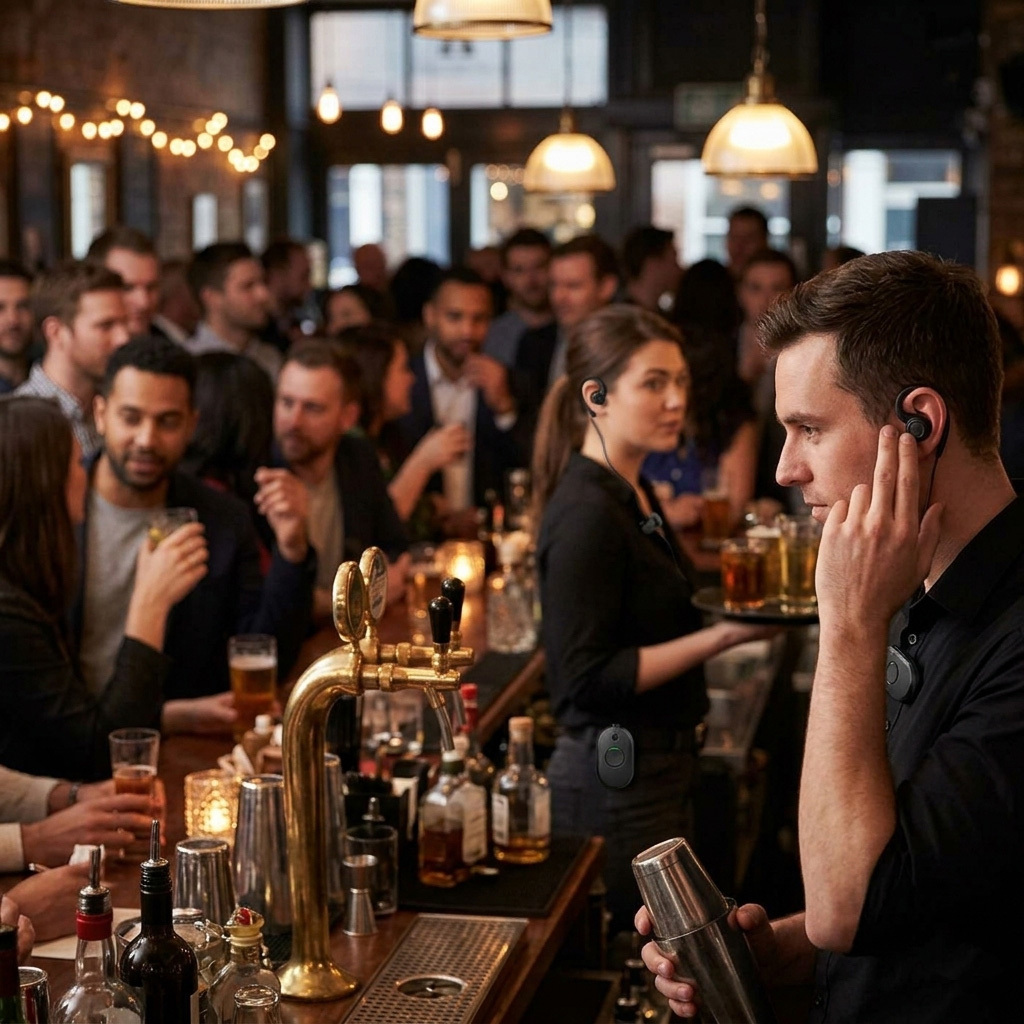
Key Features to Consider for Bar Walkie Talkies
This list of qualities decide whether a bar radio gets carried or gets left in the office.
UHF or VHF Frequencies for a bar?
UHF, always. UHF's shorter wavelength gets through standard obstacles in a bar: walls, equipment, patrons; VHF is built for open line-of-sight and gives most of its advantage back the moment a signal has to cross a cooler door. All four radios in this guide are UHF. (Why the wavelength matters →)
Will it survive close, and will it survive the year?
Bar shifts break the standard battery math. The 5/5/90 duty cycle every manufacturer rates against — 5% transmit, 5% receive, 90% standby — assumes a radio that mostly sits quiet.
A Saturday door shift is closer to constant transmissions, and a 14-hour rating gets you a comfortable weeknight and a tight Saturday. Plan a charging cradle behind the bar, not a single overnight charge. The four radios here rate at 14 hours (CLS1110, PKT-300, CLS1410) and 18 hours (CLP1010e — no display, no speaker, so nothing drawing power between transmissions).
On durability, the drop test matters less here than the liquid test. Bar radios don't usually die from being dropped once — they die from a slow accumulation: a soda gun misfire, a bar towel used to wipe one down, accidental drink spills. IP54 is the floor, and IP55 is worth the difference on radios assigned to bartenders and barbacks specifically, since that's where the wet exposure is constant rather than occasional.
Speaker or Earpiece — and Who Gets Which
This is the decision most bars get wrong, because it isn't one decision — it's by role.
Speaker radios (CLS1110, CLS1410) work where nobody's listening for atmosphere. A barback restocking the cellar can set one on a keg and hear it across the room. A dishwasher can leave one on a shelf. Neither of them needs to wear anything, and neither of them is standing in front of a guest. An earpiece can always be added on as an optional accessory.
Earpiece-only radios (CLP1010e, CLP1080e) are for guest-facing roles — a door host, a floor manager, a bartender in a room where the volume is deliberately low. The transmission goes to one ear and nowhere else, so a garnish restock never lands in the middle of a conversation at the bar top.
The Motorola CLS and CLPe radios can be programmed to 'talk' with one another, allowing for a mixed fleet based on role.
How Many Channels a Bar Really Uses
Fewer than most people buy. A single-room bar with everyone within sight of each other runs fine on one channel — and one channel means nobody has to remember which one they're on at 1am, which is worth more than it sounds.
The case for more channels shows up when a conversation needs to not be heard by the rest of the team. Security handling someone at the door shouldn't be broadcasting to four bartenders. A manager approving a comp doesn't need it on the open line. That's the real threshold — not headcount, but whether two conversations need to happen at once without colliding.
For most bars that's two to four channels: one for the floor, one for security, and a spare for management. Sixteen channels is worth paying for when you're running a multi-floor venue or a rotating event calendar where a promoter's crew needs their own lane for a night, not because the number is bigger.
Best Two-Way Radio for Neighborhood Bars: Motorola CLS1110
Quick Summary
- Best For: Small neighborhood bars, single-room pubs, and small teams where everyone works on one floor.
- Key Specifications: 1 Watt UHF (460–469 MHz) | 1 Channel | 200,000 sq ft coverage | Up to 14-hour battery life | IP55 rating.
- Primary Advantage: Simple single-channel operation requires zero setup or shift training, while the IP55 water rating protects against bar spills.
- Main Trade-off: Single channel prevents private conversations between door security and management without everyone hearing.

In a bar where everyone can already see everyone, the single channel is a perfect fit. Nobody has to remember which channel they're on, nobody gets stranded on channel 3 during a rush, and a new hire is operational in the time it takes to hand them the radio. The CLS1110 is 1 watt of UHF with a built-in speaker and display.
Pros
- Same 200,000 sq ft coverage and IP55 rating as the 4-channel CLS1410.
- Built-in speaker lets a barback set it on the back counter and hear it while restocking — no earpiece required, but can be added on if needed
- IP55 is the higher of the two wet ratings here, which matters most on the exact staff who carry this radio
- Nothing to program before a shift and nothing to explain to a new hire
Cons
- One channel means bartenders, barbacks, and management all share the same line — no way to separate a security or management conversation
- No included earpiece for staff who want more discreet audio (available as an accessory)
Buy this if your bar runs 2–5 people in one room on a busy night and no conversation needs to be private. Skip it if you have a door position — the moment security needs its own line, you want the CLS1410 instead.
Best Two-Way Radio for Upscale Lounges: Motorola CLP1010e
Quick Summary
- Best For: Boutique cocktail lounges, upscale speakeasies, and floor managers needing total guest-side discretion.
- Key Specifications: 1 Watt UHF (450–470 MHz) | 1 Channel (8 with CLP1080e) | 100,000 sq ft coverage | Up to 18-hour battery life | 3.35 oz | IP54 rating.
- Primary Advantage: Earpiece-only design (no speaker) guarantees zero loud radio squelches near guests; lightweight 3.35 oz body clips under jackets.
- Main Trade-off: Base model is limited to 1 channel; staff working behind the well may need a higher IP55 water rating.

In a room where the volume is deliberately low, a radio that makes noise is a liability. The CLP1010e doesn't have a speaker to make noise with — every transmission routes to an earpiece, so a bartender can confirm a table's ready without the couple at the bar top hearing it. At 3.35 oz it disappears under a jacket, and there's no lit screen catching the light in a dim room.
The 18-hour battery is the longest here, which matters less for the shift length than for the charging routine: a lounge that opens at 5 and closes at 2 can run a single overnight charge and skip the mid-service swap entirely.
Pros
- Earpiece-only audio — the only radio here that can't be overheard by a guest
- Lightest and smallest in this guide at 3.35 oz, and nothing visible on the belt line
- 18-hour battery covers open-to-close plus prep on one charge, no cradle rotation
- Antimicrobial housing, which is worth something on a radio handed between shifts
Cons
- Single channel on the base model — if security or management needs a private line, upgrade to the 8-channel CLP1080e instead
- IP54, not IP55, so this is the wrong radio for whoever's working the wettest station
- 100,000 sq ft is the smallest footprint here; a lounge on two floors or with a below-grade cellar may need a repeater
Buy this if the room is quiet enough that guests would hear a radio, and the team is small enough to share one line. Skip it if you have a door position that needs its own channel — go to the CLP1080e — or if the person carrying it is behind the well all night, where IP54 is thin.
Best Two-Way Radio for Sports Bars & Multi-Room Venues: Kenwood PKT-300
Quick Summary
- Best For: Sports bars, gastropubs, and multi-room venues with heavy physical barriers like walk-in coolers, basements, or patios.
- Key Specifications: 2 Watts UHF (450–470 MHz) | 6 channels (16 with dealer programming) | 275,000 sq ft coverage | 14-hour battery life.
- Primary Advantage: High 2-Watt output doubles standard power to penetrate stainless walk-ins, keg cellars, and concrete walls; includes Privacy Talk voice scrambling.
- Main Trade-off: Hands-free VOX requires a headset accessory.

A sports bar is the hardest room on this page for a radio. Not because of size — because of everything between the rooms. A kitchen pass, a walk-in, a patio door, a second dining room, and on a game day a crowd dense enough to eat signal on its own. Two watts is the answer to that. The extra power buys you the kitchen and the patio, not more distance. Busy Channel Lockout is the underrated feature for this room specifically: on a full Saturday with a kitchen, a floor, and a door all talking, it stops two people transmitting over each other and turning a channel into noise.
| Specification | Detail |
|---|---|
| Frequency | UHF (450–470 MHz) |
| Power | 2W high / 0.5W low |
| Channels |
6 channels (16 with dealer programming) |
| Indoor Coverage | Up to 275,000 sq ft |
| Battery Life | 14 hrs (5/5/90 duty cycle) |
| Weight | 4.9 oz. |
| Durability | MIL-STD-810 |
Pros
- 2 watts and 275,000 sq ft — enough headroom to reach through a kitchen wall or out to a patio
- Busy Channel Lockout keeps a busy channel usable when three departments share it
- Privacy Talk scrambling on a management or security channel, so a comp or an incident isn't casually overheard
- Expands to 16 channels as the venue adds a patio, a private room, or an event calendar
Cons
- Ships with 6 channels; unlocking the full 16 requires dealer programming
- VOX needs a separate headset; it won't trigger from the built-in mic
- 2 watts draws harder than the 14-hour headline suggests under heavy transmit — plan a cradle behind the bar
Buy this if staff have to talk through multiple steel walls or a walk-in refrigerator. Skip it if everyone's in one room — you're paying for penetration you won't use.
Best Two-Way Radio for Nightclub Security & Multi-Department Teams: Motorola CLS1410
Quick Summary
- Best For: High-volume nightclubs and multi-department teams needing dedicated lines for door security, bartenders, barbacks, and VIP managers.
- Key Specifications: 1 Watt UHF (460–469 MHz) | 4 Channels | 200,000 sq ft coverage | Up to 14-hour battery life | IP55 rating | VibraCall alerts.
- Primary Advantage: VibraCall silent vibrating alerts cut through 100+ dB music; 4 dedicated channels isolate door/security chatter from bar restocking.
- Main Trade-off: 1-Watt output may struggle through heavy below-grade basements or multi-floor masonry where 2-Watt power is needed.

By the time a room has a door position, a security lead, bartenders across two wells, and a manager who needs to be reachable without being on every transmission, the problem stops being coverage and starts being traffic. Four channels solves that: the door gets its own line, security gets its own line, and a barback asking about ice isn't landing in the middle of an incident at the entrance.
The CLS1410 is the same hardware as the CLS1110 — same coverage, same 14-hour battery, same IP55 — with three more channels and VOX. If you've already got CLS1110s in the building, these drop straight into the fleet. VibraCall is the feature that earns its place in a nightclub specifically. At 100 dB nobody hears a call tone, but everybody feels one.
Pros
- Four channels: floor, door, security, management — the four conversations a busy nightclub actually runs in parallel
- VibraCall alerts land when the room is too loud for audio to be heard
- IP55, the higher wet rating on this page, on the radio most likely to live behind a well
- Same platform as the CLS1110, so mixed fleets share accessories, chargers, and cloning
Cons
- 1 watt — if the room has a below-grade cellar, a second floor, or heavy masonry, the PKT-300's 2 watts will hold up better
- Four channels is the ceiling; a venue running promoter crews or an event calendar will outgrow it
Buy this if you need conversations separated more than you need range. Skip it if the challenge is getting a signal through a wall or down a stairwell — that's a power problem, and power is the PKT-300's answer.
Other Radio Models to Consider
The four radios above cover most bars. These three are also in this category, and each solves a problem the main four don't.
Motorola Curve — No FCC License Required
The Curve runs on 900 MHz digital instead of UHF, which means no FCC license to file and no frequency coordination to think about. It's also Wi-Fi enabled, so a manager can be reached from off-site through the app while the on-site team talks radio-to-radio as usual. Ten channels, 1 watt.
Buy this if you own more than one location. Skip it if you already run UHF radios — the Curve won't talk to them. See the Curve →
Motorola RMU2040 — Four Channels With Real Power
This is the CLS1410's channel count with the PKT-300's 2 watts, in a heavier body. If you liked the idea of separating the door from the floor but your building is the reason you were looking at the PKT-300, the RMU2040 is the one radio here that does both. The trade-off is size — it's noticeably bigger on a belt than a CLS.
Buy this if you need four channels and you're fighting a walk-in or a cellar. Skip it if your staff are in guest-facing roles where a bulkier radio shows. See the RMU2040 →
Motorola SL300-U — The Upgrade Path to Digital
Three watts, the most power on this page, 2-channels, in a slim profile that carries more like a phone than a radio. It runs analog now and digital later, so a venue that expects to grow into a larger system can buy once. It's also the most expensive radio here by a wide margin. Has a Noise Cancellation feature for loud clubs.
Buy this if noise is a concern and the building is genuinely hard on signal. Skip it if two channels is a constraint — at this price the CLS1410 gives you four. See the SL300-U →
Why Avoid Cheap Consumer Radios (Retevis, Baofeng, FRS) in Nightlife Venues
This comes up on nearly every bar call that starts with a budget number, and the question is fair: a six-pack from a marketplace listing costs less than one business-grade radio. What does a bar actually give up?
We don't carry these brands, so treat what follows as a dealer's view rather than a neutral one. The reasoning isn't about brand loyalty — it's about three things specific to how a bar uses radios.
They Can't Be Heard After 10pm
This is the one that ends it for most bars. Consumer radios use small speakers with output well under what a commercial unit delivers, and no published figure at all in most cases. A radio that's perfectly audible during a slow Wednesday setup is useless at 95 dB on a Saturday with the DJ running.
It's also the spec you can't fix later. You can put a surveillance earpiece on a business-grade radio and get a working solution; a consumer unit's accessory ecosystem is usually one proprietary earbud that doesn't help in a loud room. And there's no consumer equivalent of the CLP1010e — a radio with no external speaker at all, which is what an upscale cocktail room actually needs.
Wet Hands Are What Actually Kill Them
Consumer radios generally carry no ingress rating, or an unpublished one. "Water resistant" on a listing with no IP number behind it is a marketing phrase, not a tested specification.
In a bar the failure mode isn't a dramatic spill — it's a bartender handling the same radio with wet hands forty times a shift, plus condensation, soda gun overspray, and a bar towel used to wipe it down. A business-grade IP55 rating means the unit was tested against low-pressure water jets. An untested consumer radio in the same environment typically fails at the battery seal within a year, and it fails quietly: holding less charge each week until someone notices it dies at 11pm.
The Band Is Shared, and You're in an Entertainment District
Most cheap multi-packs are FRS — the license-free consumer band, 22 channels, no exclusivity. On a downtown block where four bars, a restaurant, and a valet stand all bought the same six-pack, you will hear their traffic and they will hear yours. For a bar that means comps, cash handling, an ejection, and anything security says about a specific patron going out on a channel anyone with a $30 radio can monitor.
Privacy codes are available on business UHF radios and add a layer of privacy on your conversations.
Three Things Worth Checking on Any Brand, Ours Included
- Is the durability rating tested or claimed? MIL-STD-810 and IP ratings mean something when the manufacturer publishes the test range. "Military grade" with no standard named means nothing.
- Does the battery figure disclose a duty cycle? A number without 5/5/90 behind it isn't comparable to one that has it.
- Who honors the warranty, and for how long? A two-year manufacturer warranty with a domestic repair network is a different asset than a seller-fulfilled replacement policy from a marketplace account.
If Budget Is the Constraint
The honest answer isn't "buy the expensive one." Business-grade starts closer to consumer pricing than most operators expect — the single-channel CLS1110 carries IP55, published durability testing, licensed-frequency operation, and a real warranty.
The better move is buying fewer good radios than more cheap ones. Four business-grade units that last six years cost less than a dozen consumer radios replaced twice — and they work behind the walk-in on a Saturday, which is the part that actually matters.
Frequently Asked Questions
Will the radios interfere with our wireless mics, POS tablets, or the DJ's gear?
Potentially — and it's an easy fix. UHF radios can share nearby spectrums of other wireless technologies. If you experience any interference, fix it by updating the radios' frequencies and privacy codes. POS tablets and Wi-Fi sit in different bands and aren't usually a factor.
Can the bar or business next door hear us?
Yes, if you're both on the same frequency, and on a shared itinerant channel that's genuinely common in a dense entertainment district. Privacy codes (CTCSS/DCS) filter out other traffic on your channel — they don't encrypt anything, but they stop your staff hearing someone else's kitchen.
Radios walk out of a bar. What do we do about that?
It's a real cost, and the answer is check-in/check-out at the start and end of shift rather than assigned units. A numbered charging bank behind the bar makes a missing radio obvious at close rather than three days later. Ask about spare units when you quote — most bars run one or two above headcount for this reason.
Do we have to program them, or do they work out of the box?
The walkie talkies will work right out of the box. You may need to customize the radio's frequencies and privacy codes if you are experiencing nearby interference, or if you want to enable specific features like VOX or VibraCall.
Are there monthly fees?
No. Analog radios are radio-to-radio, no airtime, no contract, no app, no subscription fee.
Why Buy from TechWholesale.com
Tech Wholesale has been selling professional two-way radios to bars, nightclubs, and hospitality businesses since 1997. We are an authorized dealer for Motorola and Kenwood, which means every radio we sell carries the full manufacturer warranty — typically two years on commercial-grade models.
What sets us apart
- Lifetime technical support included with every purchase — call or email our team for the life of your radio fleet, not just through the warranty period
- Quick Quotes for large teams — request a custom quote
- Free shipping on qualifying orders
- Authorized dealer status — no gray market inventory, no voided warranties
If you're not sure which radio fits your bar, use our Find My Radio tool or request a quote. We'll ask a few questions about your venue and come back with a specific recommendation.
1-888-925-5982 | Service@TechWholesale.com
Related Hospitality Radio Guides & Industry Resources
Internal Industry Communication Guides
- Best Two-Way Radios for Restaurants — Front-of-house, kitchen pass, and curbside pickup communication strategies.
- Two-Way Radio Systems for Commercial Security Teams — Equipping bouncers, venue security, and door hosts for emergency response.
- How to Program Radio Privacy Codes — Eliminating channel cross-talk and outside chatter in busy nightlife districts.
- Lone Worker and Man Down Safety Features — Automated emergency alerts for solo night staff, keg cellar workers, and closing crews.
- Voice-Operated Transmit (VOX) Setup for High-Noise Venues — Hands-free radio operation for bartenders and barbacks.
- UHF vs. VHF Frequency Guide for Commercial Buildings — Why UHF signals penetrate cooler doors, walls, and crowded venues better than VHF.
Official Technical & Regulatory Standards
- OSHA 29 CFR 1910.95 Occupational Noise Exposure Standards — Federal workplace noise limits and hearing conservation requirements for venue staff.
- NFPA 101 Life Safety Code (Assembly Occupancies) — National Fire Protection Association standards for emergency evacuation and crowd management in assembly venues.