

Many vet clinics rely on intercoms, phones, or staff calling down the hall, and none of it works well over barking or while a tech is holding a patient. Consumer radios don’t hold up to constant disinfectant wipes either.
Business-grade radios with earpieces keep every call clear and quiet, and their rugged, antimicrobial housings stand up to daily cleaning, protecting your investment for years.
Everything you need to decide is right here! We’ve supplied hundreds of veterinarian teams across the country since 1997. Here’s how to pick the right radio for your clinic.
Which Walkie Talkie Fits Your Animal Practice?
The Quick Answer
- A single-floor clinic or small animal hospital → Motorola CLS1410. Four channels and at 4.6 oz it clips to scrubs without getting in the way. IP55 — which matters in a building where runs get hosed down.
- A mid-size practice with a kennel ward, isolation, or a second floor → Kenwood ProTalk PKT-300. Two watts gets a signal from a back kennel or a basement run to the front, and six channels keep a boarding update off the line surgery is using.
- A large hospital or multi-building campus → Motorola Curve. Digital 900 MHz and ten channels, with more indoor reach per watt than analog UHF..
Quick Links
Why Veterinary Clinics Need Purpose-Built Two-Way Radios
Cell phones and consumer walkie-talkies fail in a clinic for the same reasons: they can't cut through animal noise, their batteries die mid-shift, and they slow the team down instead of speeding it up. When communication breaks down for even a few minutes, a patient waits longer, a procedure stalls, or a client walks out frustrated. Professional radios solve each of these problems with features built for fast-paced, high-noise medical environments — and with no monthly service plan, you own the equipment outright.
Veterinary practices face a specific combination of pain points that few other industries share:
Constant animal noise. Barking dogs, distressed cats, and busy treatment floors create unpredictable background noise that overwhelms a standard speaker and microphone. Professional radios compensate with higher-output speakers and noise-isolating audio so a restock or "doctor needed in room 3" call actually gets through.
Hands-full restraint and procedures. Technicians are frequently holding a patient, drawing blood, or assisting in surgery when they need to communicate. VOX (voice-activated transmission) and headset accessories let staff key up without freeing a hand — a meaningful safety advantage when an animal is on the table.
Disinfectant, moisture, and drops. Radios in a clinic are wiped down repeatedly, exposed to spray, and dropped onto hard floors. Equipment needs MIL-STD-810 durability and a sealed, water-resistant build to survive daily wear. Several models also carry an antimicrobial housing, which helps limit bacterial growth on a high-touch shared device.
Curbside and drop-off coordination. Many practices still run curbside check-ins and discharge. Front desk staff need reliable signal from the lobby out to the parking lot to move patients in and out without leaving their station or relying on a personal phone.
Emergency and aggressive-animal response. An escaped patient, an aggressive dog, or a sudden medical crash all require immediate, hands-free contact with the whole team. Instant push-to-talk and call-all functions reach everyone at once in a way that dialing a phone cannot.
Role segmentation. Front desk, technicians, doctors, and the surgical suite all have different communication priorities. Without dedicated channels, everyone talks over everyone. Most professional clinic radios support four to ten channels so teams can separate by role and keep the surgical line clear.
What to Look For in a Veterinary Clinic Radio
Audio Performance in a Noisy Clinic
Prioritize radios with strong speaker output and noise-isolating audio. For staff who can't hold a radio — in surgery, in the kennel ward, or while restraining a patient — pair the radio with a headset or earpiece so incoming audio is delivered directly to the ear and away from ambient barking.
Hands-Free Operation (VOX or Headsets)
Hands-free communication is the single most-requested feature in a veterinary setting. The Kenwood PKT-300 includes built-in VOX; the Motorola CLS1410 supports VOX with an optional headset accessory. Either approach keeps a technician's hands on the patient, not the radio.
Durability and Water Resistance
Look for radios that meet MIL-STD-810 standards for shock, vibration, dust, and temperature, plus a sealed build that tolerates spray and wipe-down. None of the radios on this page are rated for submersion, which is not a requirement in a standard clinic, but each is built to handle the splash, disinfectant, and drops of daily use.
Hygiene
Several Motorola models, including the CLS1410 and the Curve, ship with an antimicrobial housing that helps inhibit the growth of bacteria and mold on the surface of a shared radio. All of the models here can be cleaned with standard non-abrasive disinfectant wipes; avoid soaking the unit or spraying directly into the speaker or connector.
Compact, Lightweight Design
Bulky radios get in the way during a long shift. The radios recommended here weigh roughly 4.5 to 5.5 ounces with battery — light enough to clip to scrubs or a lab coat and forget.
Battery Life
A clinic runs eight to twelve hours from open prep to close, and many run longer on emergency or boarding days. Choose radios rated to carry a full shift, and plan a charging rotation or a multi-unit charger so units are ready for the next day.
Channel Capacity
Most practices operate cleanly on four dedicated channels (front desk, technicians, doctors, surgery). Larger hospitals with boarding, grooming, or multiple buildings benefit from six to ten channels. Avoid single-channel radios for any team larger than three people.
Recommended Two-Way Radios for Veterinary Clinics
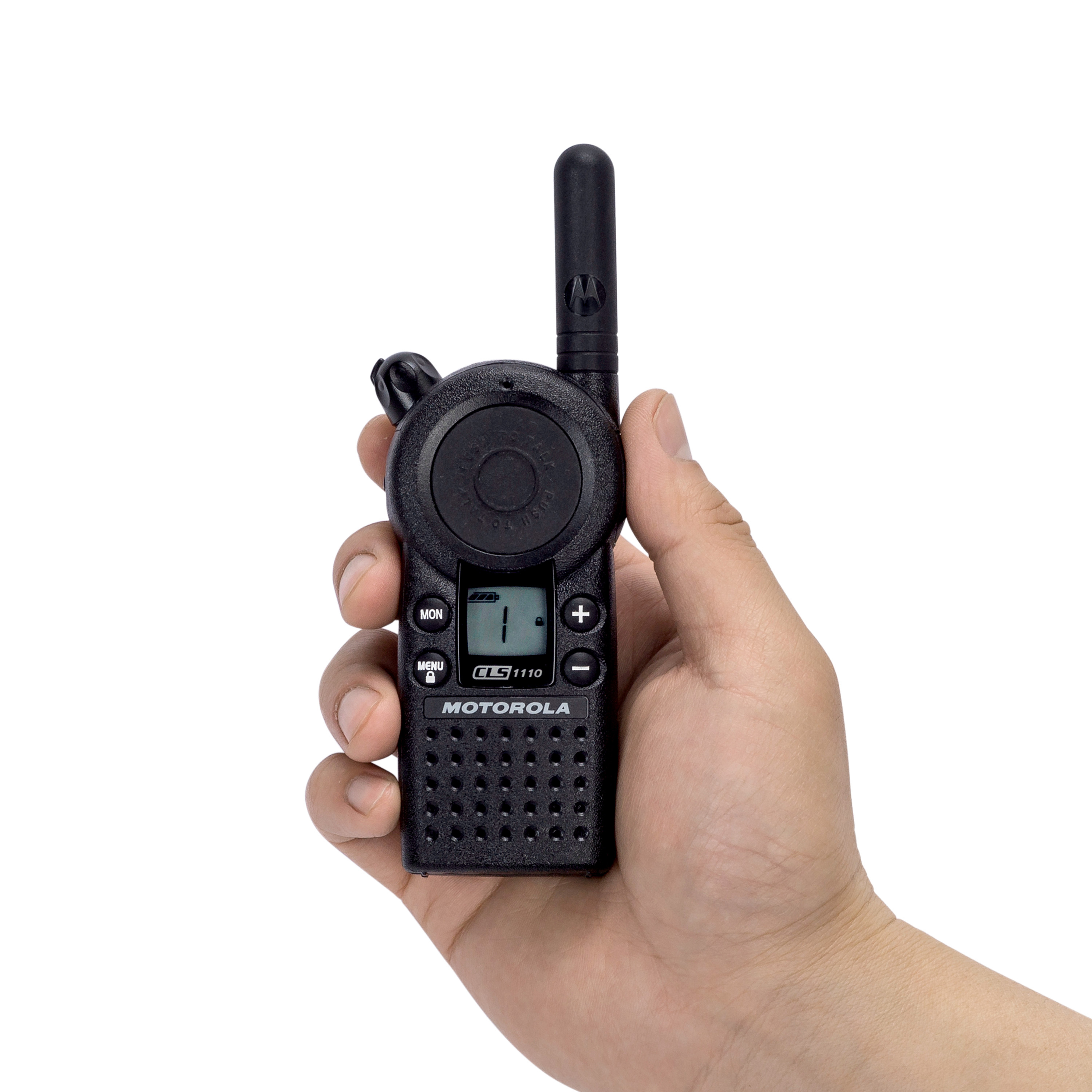
1. Motorola CLS1410 — Best for Small to Mid-Size Practices
| Specification | Detail |
|---|---|
| Frequency / Mode | Analog UHF (460–469 MHz) |
| Power | 1 watt |
| Channels | 4 (56 business-exclusive frequencies) |
| Indoor Coverage | Up to 200,000 sq ft / 15 floors |
| Battery Life | Up to 18 hours (Li-Ion) |
| Weight | 4.6 oz. with battery |
| Durability | MIL-STD-810 C/D/E/F/G; antimicrobial housing |
| Warranty | 2-year manufacturer warranty |
The CLS1410 is the radio we sell most often to small veterinary practices. CLS stands for Clear, Light, and Simple, and that is exactly what it delivers: a built-in external speaker, simple front-panel operation, and a four-channel layout that maps neatly onto front desk, techs, doctors, and surgery. Its antimicrobial housing and 4.6 oz. weight make it well suited to a shared, high-touch clinic environment.
Why it fits veterinary clinics specifically
- UHF frequency penetrates exam-room walls, treatment-area partitions, and metal kennel banks.
- Antimicrobial housing helps limit bacterial growth on a radio that passes between staff and rooms.
- VOX hands-free transmission (with an optional headset) keeps technicians' hands on the patient.
- VibraCall vibrating alert and Audible Call Alerts let staff receive a message discreetly during a client interaction.
- Simplified cloning copies settings from one radio to the rest of the fleet in minutes.
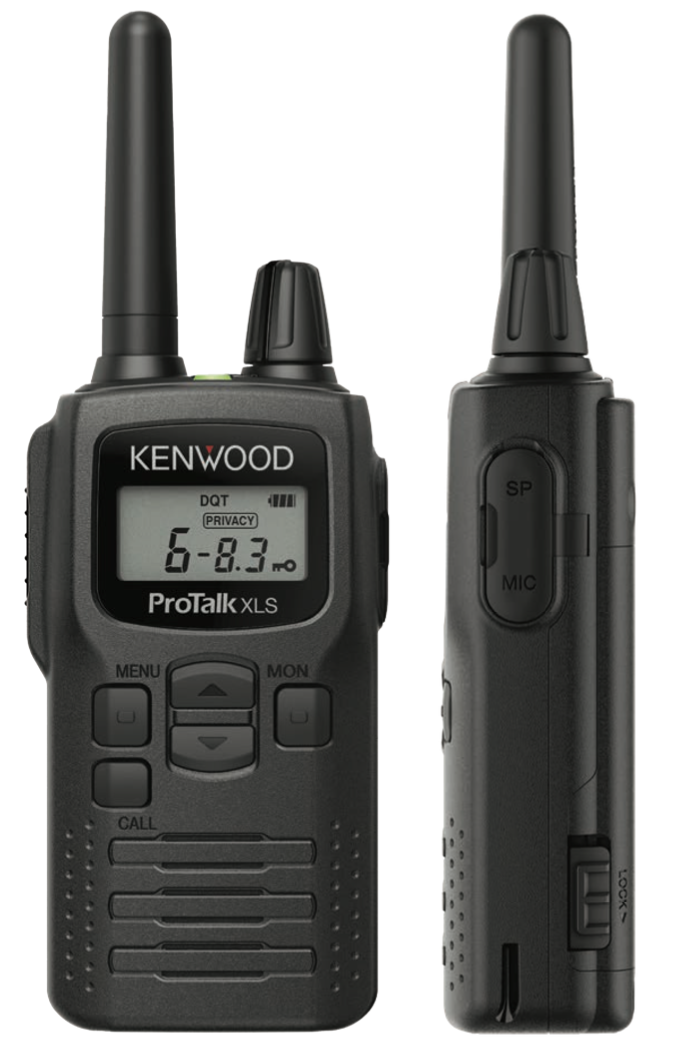
2. Kenwood ProTalk PKT-300 — Best for Hands-Free Coordination and Denser Buildings
| Specification | Detail |
|---|---|
| Frequency / Mode | Analog UHF (450–470 MHz) |
| Power | 2 watts |
| Channels | 6 (upgradeable to 16; 99 pre-stored frequencies) |
| Indoor Coverage | Up to 275,000 sq ft |
| Battery Life | Up to 18 hours with battery saver (2,200 mAh Li-Ion) |
| Weight | 4.87 oz. with battery |
| Durability | MIL-STD-810 C/D/E/F/G; IP54 dust and water resistance |
| Warranty | 2-year manufacturer warranty |
If your clinic is under 275,000 square feet and hands-free operation is a priority, the Kenwood PKT-300 is the strongest choice. The second watt of power pushes more reliably through dense block, concrete, and steel than a 1-watt radio, which matters in older buildings or practices with many internal rooms. Its built-in VOX means a technician can go fully hands-free without sourcing a separate accessory, and the six channels give you more room to segment teams as the practice grows.
Why it fits veterinary clinics specifically
- 2 watts of UHF power improves penetration through treatment-room walls and multi-room layouts.
- Built-in VOX delivers true hands-free communication during restraint and procedures, with no add-on required.
- Six channels (upgradeable to sixteen) support clean role separation plus a dedicated surgery line.
- IP54 rating and MIL-STD-810 build tolerate disinfectant spray and accidental drops.
- Ships ready to use with battery, rapid desktop charger, AC adapter, and belt clip.
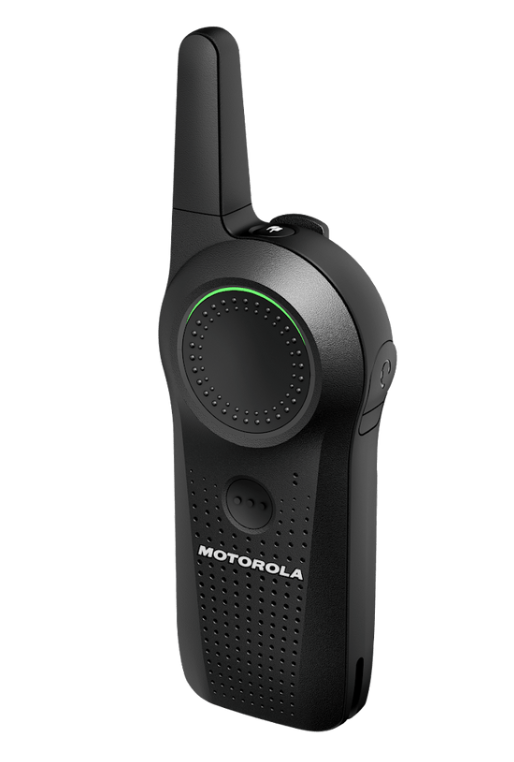
3. Motorola Curve — Best for Large Hospitals and Multi-Building Campuses
| Specification | Detail |
|---|---|
| Frequency / Mode | Digital 900 MHz (902–928 MHz), FHSS |
| Power | 1 watt digital (equivalent to ~4 watts analog) |
| Channels | 10 |
| Indoor Coverage | Up to 300,000 sq ft / 20 floors |
| Battery Life | Up to 11.5 hours standard battery (up to 16 hours with optional high-capacity BT110) |
| Weight | 5.11 oz. with standard battery |
| Durability | MIL-STD-810; IP5X dust resistance; antimicrobial housing |
| Warranty | 2-year manufacturer warranty |
The Motorola Curve is the right choice when a hospital's square footage, wall construction, or multi-building layout exceeds what a 1- to 2-watt analog radio can reliably serve. Its 900 MHz digital signal penetrates concrete and steel-reinforced walls more effectively than analog at comparable wattage, covering up to 300,000 square feet and 20 floors with clearer audio in radio-dense environments. Ten channels give a large team room for dedicated front desk, technician, doctor, surgery, boarding, and management lines simultaneously.
Why it fits larger practices specifically
- Digital 900 MHz coverage reaches across large hospitals and separate buildings where analog UHF runs out of signal.
- Call All Available reaches the entire staff at once — critical during an emergency — while Private Reply and Direct Call keep one-on-one conversations off the group channels.
- Frequency Hopping Spread Spectrum keeps sensitive conversations clear of interference from neighboring radios.
- Antimicrobial housing and MIL-STD-810 build hold up to a high-volume clinic, and the optional high-capacity battery extends runtime to a full long shift.
Also Worth Considering
Motorola CLP1080e — 1 watt, 8 channels, UHF, no external speaker (audio routes through an included earpiece). The discreet, ultra-light choice for front desk and reception staff who want private, earpiece-only communication that doesn't disrupt the lobby.
Motorola RMU2040 — 2 watts, 4 channels, UHF, indoor coverage up to 250,000 sq ft. A rugged, no-frills option for mid-to-large practices that need UHF power without stepping up to the digital Curve.
Side-by-Side Comparison
| Model | Best For | Mode / Frequency | Power | Channels | Indoor Coverage | Battery (mfr. rated) | Weight | Durability |
|---|---|---|---|---|---|---|---|---|
| Motorola CLS1410 | Small to mid-size practices | Analog UHF (460–469 MHz) | 1 W | 4 | Up to 200,000 sq ft / 15 floors | Up to 18 hrs | 4.6 oz | MIL-STD-810 C–G; antimicrobial |
| Kenwood PKT-300 | Hands-free; denser buildings | Analog UHF (450–470 MHz) | 2 W | 6 (to 16) | Up to 275,000 sq ft | Up to 18 hrs (battery saver) | 4.87 oz | MIL-STD-810 C–G; IP54 |
| Motorola Curve | Large hospitals / multi-building | Digital 900 MHz (902–928 MHz) | 1 W (~4 W analog) | 10 | Up to 300,000 sq ft / 20 floors | Up to 11.5 hrs (16 hrs high-cap) | 5.11 oz | MIL-STD-810; IP5X; antimicrobial |
Coverage and Channel Setup
Match the Radio to Your Square Footage
One of the most common purchasing mistakes is buying a radio that is either too powerful or not powerful enough for the space. For a single-floor clinic or small animal hospital, 1 to 2 watts of UHF power covering 100,000 to 200,000 square feet is more than adequate. For larger practices or multi-building campuses, the digital Curve delivers the equivalent of roughly four analog watts and clear coverage up to 300,000 square feet.
Building materials matter. Thick concrete walls, metal kennel banks, and lead-lined radiology rooms all weaken signal. If your facility is heavily built out, choose one tier larger than your square footage alone would suggest — a 4,000 sq ft clinic with poured-concrete walls and a shielded X-ray suite can behave like a much larger space for signal-penetration purposes.
How Many Channels to Set Up
Channels let you segment conversations so the whole team isn't talking over each other. For most practices we recommend at least four dedicated groups:
- Front Desk — check-ins, curbside arrivals, discharges, and client questions.
- Technician Team — room prep, restraint help, lab requests, and "doctor needed" calls.
- Doctors — quick updates on lab results, the next exam, or an urgent patient.
- Surgery — a dedicated line so the surgical team can coordinate anesthesia, prep, and recovery without interruption.
Channels also support private calls. "Maria, switch to channel two" lets two staff have a longer conversation without tying up the rest of the team.
OSHA Noise Considerations
Enclosed kennel and boarding wards are among the loudest spaces in a veterinary facility. Sustained barking in a hard-surfaced, enclosed room can approach or exceed 85 decibels — the eight-hour time-weighted action level at which OSHA requires employers to implement a hearing conservation program under 29 CFR 1910.95. Where staff spend extended time in high-noise areas, that obligation should be evaluated independently of your communications equipment.
Radios do not replace hearing protection, but they do help staff communicate reliably in noisy spaces. An earpiece or headset isolates incoming audio from ambient barking so messages are heard clearly, and noise-isolating microphones keep transmitted speech intelligible from inside a loud ward. Many professional earpieces distributed with these radios are designed for use in high-noise commercial environments.
Frequently Asked Questions
How much range do I need for a veterinary clinic?
For a single-floor clinic under roughly 10,000 sq ft, a 1-watt UHF radio such as the CLS1410 provides coverage with signal to spare. For larger footprints or buildings with heavy concrete and metal construction, step up to a 2-watt radio like the Kenwood PKT-300, or to the digital Motorola Curve, which delivers the equivalent of approximately 4 watts analog and covers up to 300,000 sq ft. If your facility has thick walls or a shielded radiology suite, plan for one tier more coverage than the square footage alone suggests.
How long do the batteries last on a full shift?
The CLS1410 and Kenwood PKT-300 are both manufacturer-rated up to 18 hours under normal use (the PKT-300 with its battery saver enabled), enough for a full open-to-close day. The Motorola Curve is rated up to 11.5 hours on its standard battery and up to 16 hours with the optional high-capacity battery. For double-coverage days, a multi-unit charging tray lets you rotate or swap batteries so units are always ready.
Are these radios durable and water-resistant enough for a clinic?
Yes. The CLS1410 and PKT-300 meet MIL-STD-810 C/D/E/F/G standards for shock, vibration, dust, and temperature, and the PKT-300 carries an IP54 dust and water-resistance rating. The Motorola Curve meets MIL-STD-810 and carries an IP5X dust rating. All three tolerate disinfectant spray, wipe-down, and accidental drops. None are rated for submersion (IPX7 or higher), which is not a requirement in a standard clinic.
Can the radios be cleaned and disinfected between uses?
Yes. All of the models on this page can be cleaned with standard non-abrasive disinfectant wipes. The Motorola CLS1410 and Curve also ship with an antimicrobial housing that helps inhibit the growth of bacteria and mold on the surface of a shared radio. When cleaning, avoid soaking the unit or spraying directly into the speaker grille or accessory connector.
Can staff use these radios hands-free while restraining an animal?
Yes. The Kenwood PKT-300 includes built-in VOX (voice-activated transmission), so a technician can speak without pressing a button. The Motorola CLS1410 supports VOX with an optional headset accessory, and the Curve pairs with single-pin earpieces for the same purpose. For surgery and kennel areas, an earpiece or headset also isolates incoming audio from background noise.
How many radios does a veterinary practice need?
A practical starting point is one radio per active staff member on a shift — front desk, each technician, each doctor, and surgery — plus one or two spares for the charging rotation. Most small to mid-size practices start with four to eight radios; larger hospitals or multi-building campuses often need ten or more. Tech Wholesale offers quantity pricing for orders of five or more units.
Can we use the same radios across multiple clinic locations?
Yes, as long as all radios operate on the same frequency band and are programmed to matching channels and codes. Analog UHF models like the CLS1410 and PKT-300 communicate with other UHF radios on the same settings, and digital Curve radios communicate with other Curve units. This makes it straightforward to run a main clinic and a satellite location on a consistent setup. If you're unsure about compatibility with radios you already own, our team can confirm before you buy.
Why Buy from TechWholesale.com
Tech Wholesale has been selling professional two-way radios to veterinary practices and other businesses since 1997. We are an authorized dealer for Motorola and Kenwood, which means every radio we sell carries the full manufacturer warranty — typically two years on commercial-grade models — and qualifies for manufacturer service and repair. No gray-market inventory, no voided warranties.
What sets us apart
- Lifetime technical support included with every purchase — reach our team for the life of your radio fleet, not just through the warranty period.
- Quick Quotes — request a custom quote.
- No-pressure consultation — we'll tell you when a less expensive radio is the right answer for your clinic rather than push a higher-margin product.
- Free shipping on qualifying orders.
- Authorized Motorola and Kenwood dealer since 1997.
If you're not sure which radio fits your practice, use our Find My Radio tool or request a quote. We'll ask a few questions about your facility — square footage, number of staff, building construction — and come back with a specific recommendation. No sales pressure, no obligation.
1-888-925-5982 | Service@TechWholesale.com
Related Reading
- VOX Explained — Hands-Free Two-Way Radio Operation
- UHF vs VHF – Frequencies Explained
- Privacy Codes – Eliminate Outside Interference
- Frequency Hopping Spread Spectrum (FHSS)
- Man Down / Lone Worker Functionality
- Find My Radio – Get a Recommendation
- OSHA 29 CFR 1910.95 – Occupational Noise Exposure
- AVMA – Workplace Wellbeing Resources for Veterinary Teams
Article by Kristin Wood, a two-way radio consultant @ Tech Wholesale | Authorized Motorola & Kenwood Dealer Since 1997 | Last Updated: June 2026