
The Best Two-Way Radios for Valet Teams (2026 Guide)
What Are the Best Two-Way Radios for Valets?
The Short Answer
The best two-way radios for valet teams are the Motorola RMU2040, Motorola CP100d-UA, and Motorola Curve. Each addresses a different scale of operation: the RMU2040 handles small-to-mid-size lots with solid UHF penetration and a compact form factor; the CP100d-UA provides 4 watts of UHF power and 16 channels for large multi-building operations; and the Motorola Curve delivers digital-grade clarity for teams that want premium audio.
But not every radio is built for the demands of outdoor parking environments. Valet operations span long distances, concrete structures, and high-traffic driveways — a combination that exposes the shortcomings of underpowered or consumer-grade radios quickly.
This guide covers what valet teams actually need in a radio, which models deliver it, and how to match hardware to your specific lot size and team structure.
Why Valet Teams Need Purpose-Built Two-Way Radios
A valet operation is a logistics problem. Vehicles enter, attendants disperse to retrieve or park them, and customers expect their car back in minutes. When a runner can't be reached, a ticket is misplaced, or a podium attendant can't confirm an ETA, the entire operation stalls in front of the customer.
Consumer walkie-talkies and personal cell phones fail in valet environments for predictable reasons: inconsistent outdoor range, poor audio in wind and traffic noise, and batteries that die mid-shift. Professional two-way radios solve these problems with hardware that is purpose-built for continuous, outdoor, multi-user operation.
Valet operations face a specific set of communication challenges that distinguish them from other industries:
Distance across open lots and structures. A runner retrieving a vehicle from an off-site garage or surface lot may be 500 feet to a quarter mile from the podium. That distance, compounded by concrete parking structures and signal-absorbing building materials, requires minimum 2-watt UHF power for reliable coverage. The Occupational Safety and Health Administration (OSHA 29 CFR 1910.151) requires that employers ensure prompt medical attention in the event of an employee injury — reliable radio contact with team members in remote areas of a parking structure supports that obligation.
Noise from traffic and driveways. Valet drop-off zones are high-traffic, high-noise environments. Engine noise, traffic, and wind regularly push ambient levels above 70–80 dB, degrading the intelligibility of audio from low-quality radios. Professional-grade radios use noise-filtering microphone technology to isolate voice transmission from background noise.
Physical demands on equipment. Radios get dropped, rained on, and cycled between staff members throughout a shift. A radio that can't survive a 5-foot drop onto pavement or an unexpected rain shower is a replacement cost, not a communication tool. Business-grade radios from Motorola and Kenwood are built to MIL-STD-810 standards for shock, dust, and water resistance.
Multi-role team coordination. A functioning valet operation typically needs at minimum three distinct communication groups: podium attendants managing arrivals and departures, runners retrieving vehicles, and a supervisor coordinating between them. Radios with four to six channels support this segmentation cleanly.
Speed of response. Every second a valet can't reach a colleague delays a vehicle retrieval. Push-to-talk (PTT) radio communication is instantaneous — no dialing, no unlocking, no texting. That speed advantage compounds across hundreds of transactions per shift at a busy venue.
What to Look for in a Valet Radio
Coverage That Matches Your Lot
Radio power must be matched to the physical environment. Underspecifying wattage leads to dead zones in parking structures; overspecifying wastes budget on range that will never be used.
A practical guide by lot type:
- Surface lots under 250,000 sq ft: 2 watts UHF analog is sufficient for reliable coverage across the lot and into an adjacent indoor lobby or hotel entrance.
- Multi-story parking structures or lots with concrete walls: Plan for 3–4 watts UHF analog, or 1 watt digital (which delivers coverage comparable to approximately 4 watts analog through more efficient signal modulation). Concrete and steel absorb UHF signal; structures that are 3+ stories require the higher power tier.
- Multi-building or off-site lot operations: 4 watts UHF analog (Motorola CP100d-UA) or LTE/Wi-Fi-based radios (Motorola WAVE PTX) for operations spanning multiple city blocks or campuses.
Building materials matter as much as square footage. An underground garage at 50,000 sq ft will attenuate signal more aggressively than an open surface lot at 250,000 sq ft. When in doubt, size up one watt.
Channel Count and Team Segmentation
For most valet operations, a minimum of three channels covers full operational segmentation:
- Channel 1 — Podium: Front-of-house attendants managing drop-offs, customer tickets, and incoming vehicle queues.
- Channel 2 — Runners: Valets retrieving or parking vehicles, coordinating between the lot and the podium.
- Channel 3 — Supervisor: Team leads managing escalations, overflow coordination, and inter-department communication with the venue.
Larger operations — those serving hotels, stadiums, or multi-venue events — benefit from four to six channels, which allows parking structure staff, valet supervisors, and hotel bell staff to operate on distinct lines without cross-channel congestion.
Durability and Weather Resistance
Valet radios operate outdoors through rain, heat, and cold. Look for radios that meet at minimum IP54 ingress protection (dust-protected, splash-resistant from any direction) or MIL-STD-810 certification for shock, humidity, and temperature extremes. Radios below this threshold are not appropriate for year-round outdoor professional use.
Battery Life Across Full Shifts
Valet shifts — particularly at hotels, restaurants, and event venues — routinely run 8 to 12 hours, and sometimes back-to-back for evening events. Radios with less than 10-hour battery ratings under typical transmission loads will require mid-shift battery swaps, which adds operational complexity. Multi-unit charging cradles allow teams to hot-swap depleted batteries without downtime.
Form Factor and Weight
Valets move constantly — running to retrieve vehicles, managing keys, and directing traffic. A radio over 8–9 oz. becomes physically burdensome over a full shift. Compact UHF models like the Motorola RMU2040 and Kenwood PKT-300 weigh under 6 oz. with battery, clip cleanly to a belt, and do not impede movement.
Hands-Free Capability
Valets frequently handle keys, tickets, or are driving a customer's vehicle. VOX (voice-activated transmission) and compatible speaker-microphones or earpieces allow staff to communicate without reaching for the radio. Most professional valet radios support VOX; confirm accessory compatibility before purchasing earpieces or speaker-mics for your specific model.
Recommended Two-Way Radios for Valet Teams
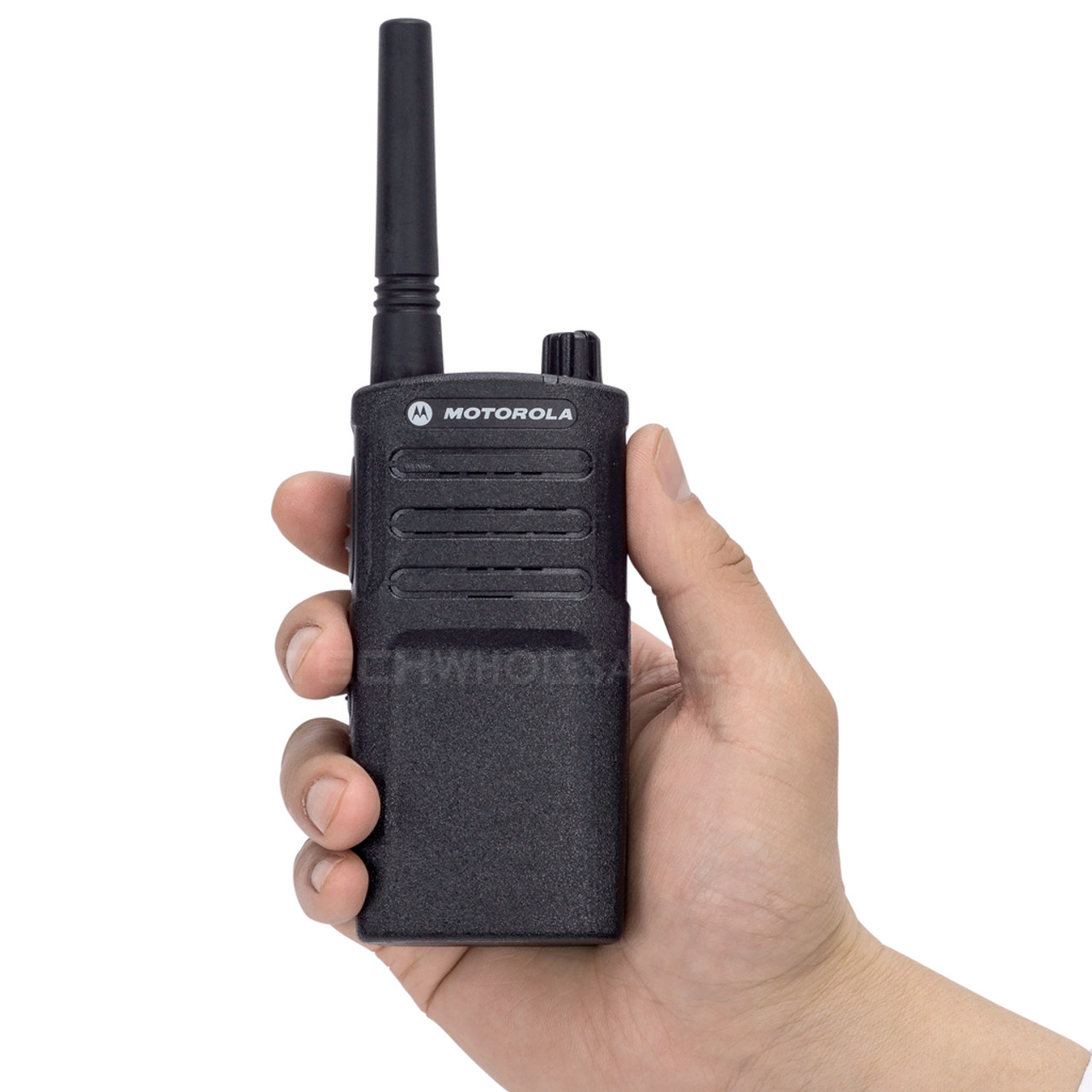
1. Motorola RMU2040 — Best for Small-to-Mid-Size Lots
| Specification | Detail |
|---|---|
| Frequency | UHF (450–470 MHz) |
| Power | 2 watts |
| Channels | 4 |
| Indoor Coverage | Up to 250,000 sq ft / 20 floors |
| Outdoor Range | Up to 2 miles |
| Durability | MIL-STD-810 C–G compliant |
| Privacy Codes | 219 |
The Motorola RMU2040 is a compact, 2-watt UHF radio that covers both the indoor and outdoor dimensions of a typical valet operation — from a surface parking lot into the hotel lobby, restaurant entrance, or event space beyond. Its 250,000 sq ft indoor coverage rating provides substantial headroom for most single-location valet setups.
Why it fits valet operations specifically
- 2-watt UHF power reliably penetrates parking structure walls and vehicle obstructions that attenuate weaker signals.
- 219 privacy codes eliminate crosstalk from other radio users in shared venues or adjacent businesses.
- MIL-STD-810 C–G certification covers shock, humidity, salt fog, and temperature extremes — appropriate for year-round outdoor use.
- Antimicrobial housing is a practical feature for any radio shared among team members across shifts.
- Four channels support clean podium/runner/supervisor segmentation for teams of 4 to 20.
- Compatible with speaker-microphone accessories for hands-free operation while driving customer vehicles.
Limitation to know: At 4 channels, the RMU2040 is adequate for most single-location operations but may feel constrained for large teams requiring additional segmentation. Teams needing six or more channels should consider the Kenwood PKT-300 or Motorola CP100d-UA.
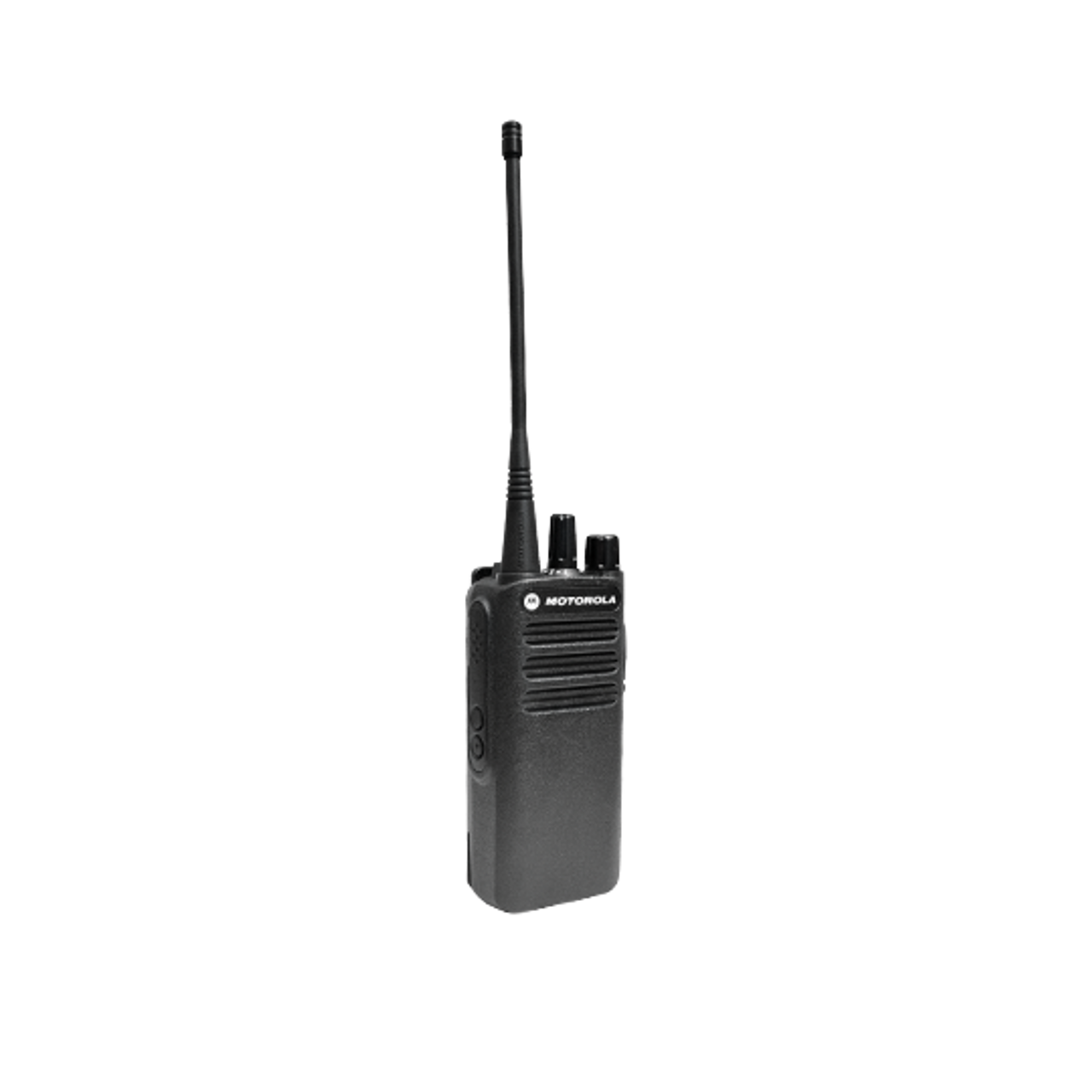
2. Motorola CP100d-UA — Best for Large Lots and Multi-Building Operations
| Specification | Detail |
|---|---|
| Frequency | UHF (403–480 MHz) |
| Power | 4 watts |
| Channels | 16 |
| Indoor Coverage | Up to 400,000 sq ft / 30 floors |
| Outdoor Range | Up to 3 miles |
| Durability | MIL-STD-810 C–F, IP54 rated |
The Motorola CP100d-UA is the correct choice when a valet operation spans multiple buildings, large parking structures, or off-site lots separated by city blocks. At 4 watts UHF and 400,000 sq ft indoor coverage, it has the signal strength to maintain reliable contact through the heaviest concrete and steel construction environments typical of urban parking garages.
Why it fits large valet operations specifically
- 4 watts of UHF power provides the highest analog output available in the standard business radio category — suitable for parking structures with multiple sublevels or off-site lot runners.
- 16 channels accommodate full team segmentation: podium, runners, supervisors, bell staff, security, and management on separate lines.
- IP54 rating confirms protection against dust ingress and water splash from any direction — appropriate for outdoor professional use year-round.
- Pre-programmed text message and voice announcement capability supports non-verbal dispatching in high-noise driveway environments.
- 3-mile outdoor range covers even the most dispersed multi-lot hotel or stadium valet configurations.
Limitation to know: The CP100d-UA is heavier than compact models like the RMU2040. For operations that do not require its extended range or channel count, the RMU2040 is a more practical daily-use radio.
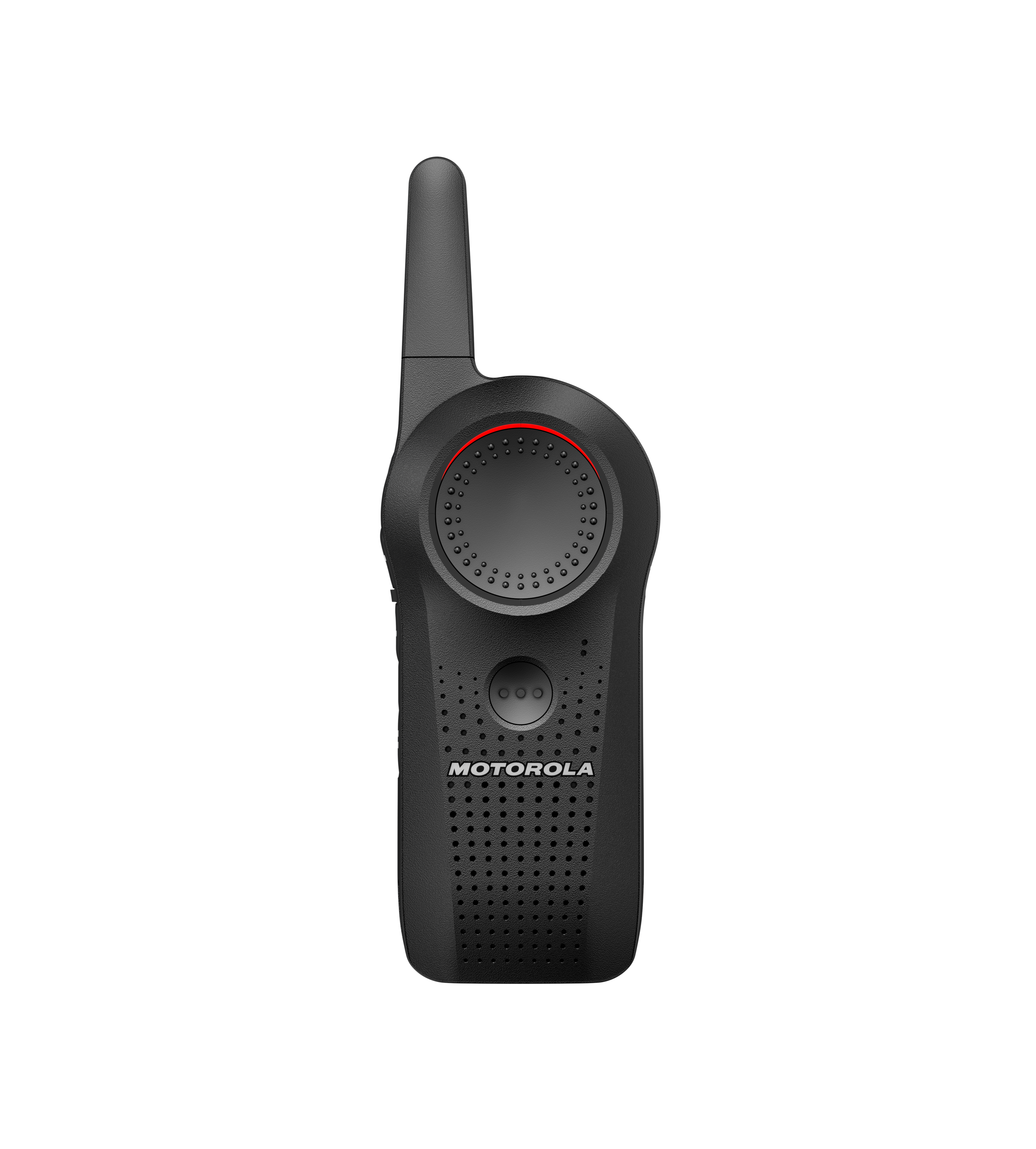
3. Motorola Curve — Best for Crystal Clear Audio
| Specification | Detail |
|---|---|
| Frequency | Digital 900 MHz (902–928 MHz) |
| Power | 1 watt digital (equivalent to ~4 watts analog) |
| Channels | 10 |
| Indoor Coverage | Up to 300,000 sq ft / 20 floors |
| Outdoor Range | Up to 3 miles |
| Durability | MIL-STD-810 compliant, water-resistant |
The Motorola Curve operates on the 900 MHz digital band. Its 1-watt digital signal delivers coverage comparable to a 4-watt analog radio through more efficient signal processing, making it the strongest option available for valet use.
Why it fits valet operations specifically
- Digital audio quality is measurably cleaner than analog in high-interference environments — outdoor lots with vehicle traffic generate RF noise that degrades analog transmission more than digital.
- 10 channels support full team segmentation for mid-to-large operations.
- Call features include private reply and call-all-available, which are useful for dispatching a specific runner without broadcasting to the full team.
- MIL-STD-810 compliant construction handles the drop and weather exposure inherent in outdoor valet work.
Limitation to know: The Curve's 900 MHz frequency is less common than UHF, which means it cannot communicate with radios outside the Curve series. Operations that need to interoperate with hotel security, bell staff, or other existing UHF radio fleets at the venue will need to account for this incompatibility.
Also Worth Considering
Kenwood ProTalk PKT-300 — 2 watts, 6 channels, UHF (450–470 MHz), indoor coverage up to 275,000 sq ft / 20 floors, outdoor range up to 2 miles. An excellent alternative to the RMU2040 for operations that need six dedicated channels or prefer Kenwood's build quality. Includes VOX for hands-free operation.
Motorola CLP1080e — 1 watt, 8 channels, UHF (450–470 MHz), indoor coverage up to 100,000 sq ft / 10 floors. The earpiece-only design makes it appropriate for upscale hotel valet operations where a visible radio or audible speaker would be inconsistent with the guest experience. Not recommended for large outdoor lots due to its 1-watt power output.
Motorola WAVE PTX Series — LTE/Wi-Fi, unlimited range, GPS tracking, emergency button. The correct choice for multi-location valet companies or parking operations spanning multiple city blocks, campuses, or venues. Requires a monthly subscription per device.
Coverage by Lot Type: Matching Radio to Operation
| Operation Type | Recommended Radio | Coverage Capacity |
|---|---|---|
| Restaurant or small hotel valet, single surface lot | Motorola RMU2040 or Kenwood PKT-300 | 250,000–275,000 sq ft / up to 2 miles |
| Mid-size hotel, event venue, or parking structure | Motorola Curve | 300,000 sq ft / up to 3 miles |
| Large hotel, stadium, or multi-building operation | Motorola CP100d-UA | 400,000 sq ft / up to 3 miles |
| Multi-location or city-wide valet company | Motorola WAVE PTX | Unlimited (LTE/Wi-Fi) |
For lots with underground levels or heavy concrete construction, size up one tier above what your square footage would suggest. Signal attenuation through reinforced concrete can reduce effective coverage by 30–50% compared to open-air performance ratings.
Frequently Asked Questions
What is the best two-way radio for valet parking?
For most valet operations, the Motorola RMU2040 is the strongest all-around choice: 2 watts, 4 channels, 250,000 sq ft indoor coverage, MIL-STD-810 durability, and a compact form factor appropriate for daily wear. For large or multi-building operations, the Motorola CP100d-UA at 4 watts and 16 channels provides the range and team capacity needed. For teams that want digital clarity, the Motorola Curve is the best available option.
How much range do I need for a valet radio?
For a single surface lot under 250,000 sq ft, 2 watts UHF provides reliable coverage. For multi-story parking structures, plan for 4 watts UHF analog or the equivalent in digital (1 watt on the Motorola Curve). Concrete and steel attenuate UHF signals — a three-level parking structure may require more power than its physical footprint suggests. For operations spanning multiple buildings or off-site lots, 4 watts UHF (up to 3 miles outdoor range) or LTE-based radios (unlimited range) are the appropriate options.
How long does a valet radio battery last?
Professional-grade radios recommended for valet use carry 10–12 hour battery ratings under normal transmission loads. Motorola and Kenwood commercial-grade batteries are designed for five years of regular field use. For operations running double shifts or back-to-back event nights, multi-unit desktop charging cradles allow batteries to be hot-swapped between shifts without downtime. Battery life decreases with frequent transmission; operations with high communication volume should plan for spare battery packs.
Do valet radios need to be weather-resistant?
Yes. Valet operations are outdoor by nature and radios will be exposed to rain, humidity, and temperature variation year-round. At minimum, look for radios rated IP54 (protected against dust and water splash from any direction) or MIL-STD-810 certified for weather and shock resistance. The Motorola CP100d-UA carries IP54 and MIL-STD-810 C–F ratings; the Motorola RMU2040 and Curve both carry MIL-STD-810 compliance. None of the radios recommended on this page are rated for submersion, which is not required for standard outdoor valet use.
How many radios does a valet team need?
A practical starting point is one radio per active team member per shift, plus one or two spares to rotate through charging. For a five-person team operating podium, runners, and a supervisor, six to seven radios provides full coverage with a charging buffer. Larger operations running multiple shifts should maintain enough spare units to keep a full set charging while another set is in the field. Tech Wholesale offers quantity pricing on orders of five or more units — contact us for a custom quote.
Can valets use consumer walkie-talkies instead of business radios?
Consumer FRS/GMRS walkie-talkies are not recommended for professional valet use. FRS radios are legally limited to 0.5 watts on most channels and 2 watts on GMRS channels, which is insufficient for reliable coverage across a parking structure or large surface lot with vehicle obstructions. Consumer radios also lack the durability ratings, noise-filtering microphones, and multi-channel capacity that commercial valet operations require. Business-grade UHF radios from Motorola and Kenwood are purpose-built for this environment.
What is the difference between analog and digital radios for valet use?
Analog radios are the conventional standard for business radio use — reliable, widely compatible, and cost-effective for most operations. Digital radios (such as the Motorola Curve) offer cleaner audio quality through more efficient signal processing, which is particularly useful in environments with high radio frequency interference. Digital radios also consume battery power more efficiently, which extends effective runtime. For most valet operations, analog is fully adequate. Digital becomes worth the additional investment for operations needing premium audio clarity, or advanced call features like private reply.
Can valet radios communicate with hotel or venue staff on existing radios?
Yes, if both radio fleets use compatible frequencies and channel programming. Most professional UHF radios (450–470 MHz) can communicate with each other if programmed to the same frequency and privacy codes, regardless of brand. The Motorola Curve operates on 900 MHz digital and cannot interoperate with standard UHF radios — it is a closed system within the Curve product family. If interoperability with an existing hotel or venue radio fleet is required, select a UHF analog radio and coordinate frequency programming with the venue's radio administrator or contact Tech Wholesale for assistance.
Are there OSHA requirements that apply to valet radio communication?
OSHA does not specify a radio communication standard for valet operations directly. However, OSHA 29 CFR 1910.151 requires that employers provide prompt medical attention to injured employees and maintain access to communication capable of summoning emergency services. In a large parking structure or off-site lot context, this obligation practically requires that employees in remote areas of the operation remain reachable at all times — which supports the use of adequately powered radios rather than cell phones, which may have poor coverage inside concrete structures.
Why Buy from TechWholesale.com
Tech Wholesale has sold professional two-way radios to valet companies, parking operators, hotels, and event venues since 1997. We are an authorized dealer for Motorola and Kenwood, which means every radio we sell carries the full manufacturer warranty — typically two years on commercial-grade models — and qualifies for manufacturer service and repair. No gray market inventory, no voided warranties.
What sets us apart
- Lifetime technical support included with every purchase — call or email our team for the life of your radio fleet, not just through the warranty period
- Free quotes — request a custom quote
- Pre-sale consultation — we will tell you when a less expensive radio is the correct answer for your operation, not direct you toward a higher-margin product
- Free shipping on qualifying orders
- Authorized dealer status ensures your warranty is valid and manufacturer support is available
Not sure which radio fits your lot size and team structure? Use our Find My Radio tool or request a quote. We'll ask a few questions about your operation and come back with a specific recommendation — no obligation.
1-888-925-5982 | Service@TechWholesale.com
Related Reading
From TechWholesale.com
- Find My Radio — Interactive Radio Selector
- UHF vs VHF — Frequencies Explained
- Privacy Codes — Eliminate Outside Interference
- VOX Explained — Hands-Free Radio Operation
- Frequency Hopping Spread Spectrum (FHSS)
- Frequently Asked Questions About Two-Way Radios
- Motorola RMU2040 Product Page
- Motorola CP100d-UA Product Page
- Motorola Curve Product Page
External Resources
- OSHA 29 CFR 1910.151 — Medical Services and First Aid
- OSHA — Noise and Hearing Conservation
- Motorola Solutions — Business Two-Way Radios
Article by Kristin Wood, content strategist & two-way radio consultant @ Tech Wholesale | Authorized Motorola & Kenwood Dealer Since 1997 | Last Updated: May 2026