

The best two-way radio for grocery stores is a UHF or 900 MHz business-grade radio. Look for multiple channels to segment deli conversations from cashiers. A rugged build is a requirement to protect your invenstment from accidental drops. The right radio model depends on your team size and store layout.
Which Walkie Talkie Fits Your Grocery Store?
- A small-to-mid store coordinating the front end and the floor → Motorola CLS1410. Four channels covers the departments a store actually runs: front end, floor, receiving, and management.
- Walk-in coolers, a freezer, and a back room full of steel racking → Kenwood ProTalk PKT-300. Two watts is the answer to a building where the problem isn't distance, it's what's in the way.
- A large-format supermarket or a multi-department operation → Motorola Curve. Digital 900 MHz, 300,000 sq ft, and ten channels — enough to give deli, bakery, meat, front end, and receiving their own lines.
We've sold thousands of radios to grocery stores across the country, and we've seen what holds up on the floor. Here's everything you need to know to make the right call.
Why Grocery Stores Need Purpose-Built Two-Way Radios
Consumer walkie-talkies and cell phones fail on a grocery floor for the same reasons: they can't push a clean signal through coolers and concrete, their batteries quit mid-shift, and they slow staff down instead of speeding them up. Professional radios are built for the specific combination of pressures a store faces every day.
Checkout speed. A cashier who has to leave the register or page over the PA for a price check stalls the line. Push-to-talk puts the answer in their ear in seconds, on a dedicated front-end channel, without ever stepping away.
Spill and safety response. A spill in an aisle is a slip hazard the moment it happens. A radio lets the first associate who spots it alert the nearest team member and a manager instantly, instead of walking the floor to find help. This directly supports the housekeeping expectations OSHA sets for walking-working surfaces (29 CFR 1910.22).
Receiving and the cold chain. Perishables that sit on a warm dock lose shelf life and money. Radios let the dock crew tell floor and cooler staff a delivery has landed the moment it arrives, so refrigerated and frozen product moves to temperature fast.
Multi-department coordination. Front-end, produce, deli, bakery, meat, stockroom, and management all have different priorities. Without dedicated channels everyone talks over everyone. Most professional store radios support four to ten discrete channels, so each team gets its own line and escalates only when it needs to.
Loss prevention. Suspected theft has to be communicated quietly and quickly. A dedicated channel and a discreet earpiece let associates and loss-prevention staff coordinate without broadcasting to the floor or alerting the subject.
RF dead zones. Walk-in coolers, freezers, steel shelving, and poured-concrete back rooms all absorb signal. A radio matched to the building eliminates the dead spots that consumer-grade units leave behind in exactly the places a store needs coverage most.
What to Look for in a Grocery Store Two-Way Radio
Coverage and Power
Match the radio's output to the building. Too little power leaves dead zones; too much means paying for coverage you don't need. As a working guide: stores up to roughly 200,000 sq ft are well served by 1 to 2 watts of UHF power, while large-format supermarkets up to about 300,000 sq ft benefit from a 1-watt digital radio, which performs comparably to a 4-watt analog unit. If your store has thick masonry walls, heavy refrigeration, or steel racking, step up one tier — those materials behave like a much larger building for signal purposes.
Number of Channels
Channels keep the team organized instead of crowding one frequency. Most stores run cleanly on at least four: front-end (cashiers, customer service, supervisors), stock and receiving, floor associates (produce, deli, bakery, meat), and a private management channel for escalations. Larger stores with loss-prevention staff benefit from six to ten channels. Channels also enable quiet one-to-one conversations — "switch to channel two" keeps sensitive talk off the main line.
Battery Life
A grocery shift runs eight hours or more, and the radio has to keep pace from open to close. Look for models rated for a full shift on a single charge. Motorola and Kenwood commercial batteries are tested to roughly five years of regular field use, and multi-unit charging trays let you hot-swap units between shifts so nothing goes dark mid-day.
Durability and Water Resistance
Stores are hard on hardware. Radios get dropped on tile, bumped on racking, and carried between a warm dock and a sub-zero freezer. Choose commercial-grade models built for daily handling, and favor units with at least basic water and splash resistance for produce misting, wash-downs, and the occasional spill. None of the radios on this page require submersion-grade sealing, which isn't a normal store requirement.
Audio in a Noisy Aisle
Between refrigeration hum, floor scrubbers, music, and customer traffic, a store is never quiet. Professional radios use noise-reducing microphones and clear high-output speakers so transmissions stay intelligible. Pairing a radio with an earpiece isolates incoming audio further — useful for cashiers and customer-facing staff.
Ease of Use
Grocery turnover is high, so a radio a new hire can learn in minutes matters. Simple channel selection, audible call alerts, and one-button push-to-talk keep training short and keep the team using the equipment instead of working around it.
Recommended Two-Way Radios for Grocery Stores
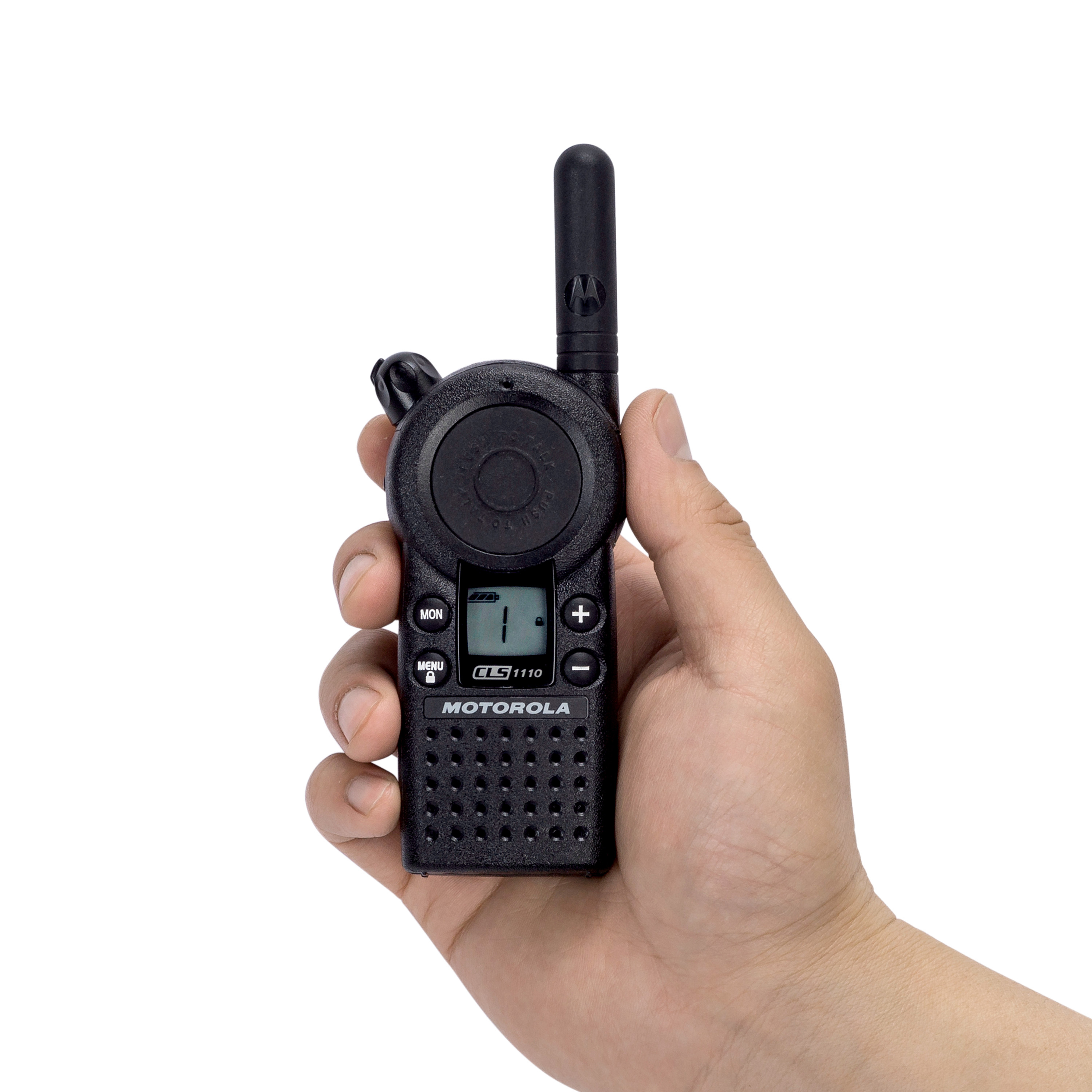
1. Motorola CLS1410 — Best for Small to Mid-Size Stores
| Specification | Detail |
|---|---|
| Frequency | UHF (460–469 MHz) |
| Mode | Analog |
| Power | 1 watt |
| Channels | 4 |
| Indoor Coverage | Up to 200,000 sq ft / 15 floors |
| Outdoor Range | Up to ~2 miles |
| Battery Life | Rated for a full shift on a single charge |
| Durability | Commercial-grade, water-resistant |
The CLS1410 lives up to its name — CLS stands for Clear, Light, and Simple — and it has been the workhorse of light-duty commercial radio for years. Its four channels give a typical store enough segmentation to keep front-end, floor, stockroom, and management on separate lines, and its built-in speaker makes it practical for back-of-house staff who set a radio down on a counter rather than wear an earpiece all shift.
Why it fits grocery stores specifically
- UHF frequency penetrates the walk-in coolers, back-room walls, and steel racking that defeat consumer radios.
- Audible Call Alerts with Vibracall ensure staff catch a message without interrupting a customer.
- VOX hands-free transmission keeps cashiers' and stockers' hands on the job, not the radio.
- Simplified cloning gets a fleet of new units configured identically in minutes — valuable where turnover is high.
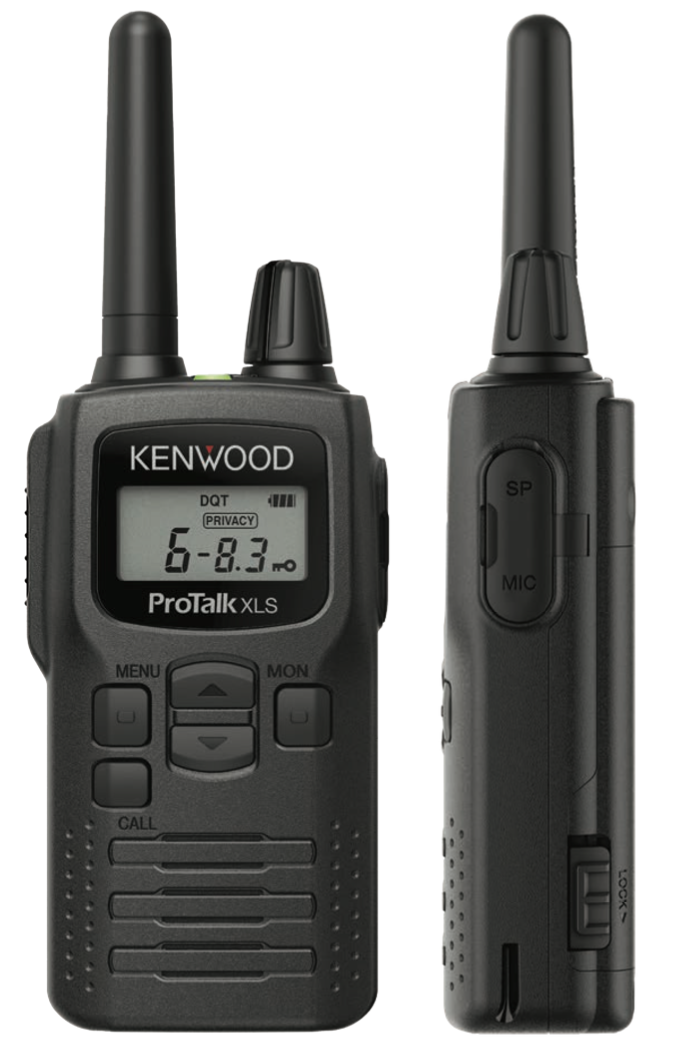
2. Kenwood ProTalk PKT-300 — Best for Stores with Tough Building Materials
| Specification | Detail |
|---|---|
| Frequency | UHF (450–470 MHz) |
| Mode | Analog |
| Power | 2 watts |
| Channels | 6 |
| Indoor Coverage | Up to 275,000 sq ft / 20 floors |
| Battery Life | Rated for a full shift on a single charge |
| Includes | Standing charging tray and belt clip |
If your store fights its own structure — steel beams, poured concrete, banks of refrigeration units — the PKT-300 is built to push through it. Its 2 watts of UHF power and six channels deliver more reach and more room to organize the team than a 1-watt radio, while staying light enough for all-day wear.
Why it fits grocery stores specifically
- 2 watts of UHF power covers up to 275,000 sq ft and cuts through dense building materials and cold-storage walls.
- Six channels support full department separation plus a dedicated receiving or loss-prevention line.
- VOX enables fully hands-free operation for produce, deli, and stocking staff whose hands are always full.
- The standing charging tray makes end-of-shift docking simple and keeps the fleet ready for open.
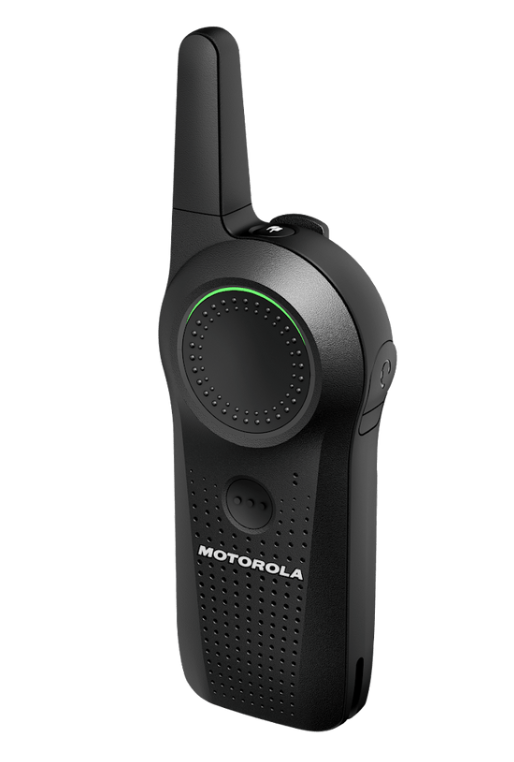
3. Motorola Curve — Best for Large-Format Supermarkets
| Specification | Detail |
|---|---|
| Frequency | Digital 900 MHz (902–928 MHz) |
| Mode | Digital |
| Power | 1 watt digital (comparable to ~4 watts analog) |
| Channels | 10 |
| Indoor Coverage | Up to 300,000 sq ft / 20 floors |
| Battery Life | Up to 14 hours |
| Weight | 5.11 oz |
| Durability | Water-resistant; anti-microbial coating |
The Curve is the right choice when a store's square footage or construction outruns what a 1-watt analog radio can reliably serve. Its 900 MHz digital signal penetrates concrete and steel-reinforced walls more effectively than UHF analog at comparable power, covering nearly three times the floor area of the CLS1410 with cleaner audio in crowded radio environments. Ten channels give a large supermarket full departmental separation with room for sub-teams.
Why it fits grocery stores specifically
- 10 channels support every department plus dedicated receiving, loss-prevention, and management lines.
- Page All / Call All reaches the whole team at once — useful for store-wide announcements and emergencies.
- Direct Call contacts a single person privately without broadcasting to the floor.
- Frequency Hopping Spread Spectrum with up to 10,000 privacy codes keeps communication clear in busy retail RF environments.
- An anti-microbial coating is a practical touch for shared devices in a food-retail setting, and at 4.2 oz staff forget they're wearing it.
Also Worth Considering
Motorola CLP1080e — 1 watt, 8 channels, UHF (450–470 MHz). An earpiece-driven, ultra-compact radio (under 3 oz.) for specialty and customer-facing markets where a discreet profile matters at the counter.
Motorola WAVE PTX Series — LTE/Wi-Fi push-to-talk with effectively unlimited range, GPS location, and an emergency button. Built for grocery chains coordinating across multiple stores, cities, or states. Operates on a per-device monthly subscription, with lease-to-own options available.
Model Comparison
| Feature | Motorola CLS1410 | Kenwood PKT-300 | Motorola Curve |
|---|---|---|---|
| Best for | Small to mid-size stores | Stores with tough materials | Large-format supermarkets |
| Frequency / Mode | UHF analog (460–469 MHz) | UHF analog (450–470 MHz) | Digital 900 MHz (902–928 MHz) |
| Power | 1 watt | 2 watts | 1 watt digital (~4 W analog equiv.) |
| Channels | 4 | 6 | 10 |
| Indoor Coverage | Up to 200,000 sq ft | Up to 275,000 sq ft | Up to 300,000 sq ft |
| Battery Life | Full shift | Full shift | Up to 14 hours |
| Standout Feature | Simple, fast to deploy | Power through dense walls | Page All, Direct Call, FHSS privacy |
Coverage by Store Size: Matching the Radio to Your Square Footage
| Store Type | Recommended Radio | Coverage Capacity |
|---|---|---|
| Convenience / specialty store under 10,000 sq ft | Motorola CLS1410 or CLP1080e | Up to 200,000 sq ft |
| Mid-size grocery with refrigeration and back rooms | Kenwood PKT-300 | Up to 275,000 sq ft |
| Large-format supermarket / multi-department | Motorola Curve | Up to 300,000 sq ft / 20 floors |
| Multi-store chain / regional operation | Motorola WAVE PTX (LTE/Wi-Fi) | Unlimited range |
For stores with thick masonry, large freezer rooms, or heavy steel racking, drop one tier larger than your square footage suggests. A 30,000 sq ft store packed with refrigeration can behave like a much larger building for signal-penetration purposes.
Grocery Store Safety and OSHA Considerations
Grocery operations fall under OSHA's general industry standards (29 CFR 1910). A radio system doesn't create compliance on its own, but reliable internal communication directly supports several requirements that apply on a store floor.
Emergency reporting and evacuation. OSHA's emergency action plan standard (29 CFR 1910.38) requires procedures for reporting a fire or other emergency and for coordinating evacuation. A two-way radio fleet gives staff an immediate way to report an incident and to organize a safe, orderly response — the kind of real-time coordination an emergency action plan depends on.
Spill and hazard response. OSHA's walking-working surfaces standard (29 CFR 1910.22) requires that floors be kept clean, orderly, and, where feasible, dry, and that hazards be corrected. Radios shorten the time between an associate spotting a spill and the right person arriving to handle it.
Receiving and powered equipment. Stores that run forklifts or powered pallet jacks at the dock operate under OSHA's powered industrial trucks standard (29 CFR 1910.178). Clear communication between dock and floor staff helps keep that equipment moving safely around people and product.
Frequently Asked Questions
How much range or power do I need for my grocery store?
For a store up to roughly 200,000 sq ft, a 1- to 2-watt UHF radio provides reliable coverage with signal to spare. For larger supermarkets or buildings with heavy masonry and refrigeration, choose a 2-watt UHF radio like the PKT-300 or step up to a digital radio like the Motorola Curve, whose 900 MHz signal performs comparably to about 4 watts of analog power. When in doubt, size up a tier — coolers and concrete absorb more signal than open floor space.
How long does the battery last on a grocery store radio?
The professional models recommended here are rated to run a full shift on a single charge, and the Motorola Curve is rated for up to 14 hours. Motorola and Kenwood commercial batteries are tested to roughly five years of regular field use. For stores running back-to-back shifts, multi-unit charging trays let you hot-swap radios so a unit is always ready without downtime.
Are grocery store radios durable and water-resistant?
Yes. The radios on this page are commercial-grade units built for daily handling — drops on tile, knocks against racking, and moves between a warm dock and a cold freezer. They carry water and splash resistance suitable for produce misting and the occasional spill. None require submersion-grade sealing, which isn't a normal store requirement.
How many two-way radios does a grocery store need?
A practical starting point is one radio per active department lead or key role per shift — front-end supervisor, stockroom lead, floor associate, and a manager — plus a few spares for high-turnover positions. Most stores operate comfortably with 8 to 20 units depending on size and layout. Larger stores with loss-prevention staff should add a radio per security position. Quantity pricing is available for orders of five or more.
Can radios help with spills, safety, and emergencies?
Yes — this is one of the strongest reasons to put radios on a store floor. Instant push-to-talk lets the first associate to spot a spill or hazard alert the right person immediately, supporting the housekeeping expectations under OSHA 29 CFR 1910.22. For emergencies, a radio fleet provides the real-time reporting and coordination that an emergency action plan under 29 CFR 1910.38 relies on.
Will my radios interfere with the store next door?
They can if you share a frequency, but privacy codes (CTCSS/DCS tones) prevent it by filtering out transmissions that don't match your assigned code. The Motorola Curve goes further with Frequency Hopping Spread Spectrum and up to 10,000 privacy codes, which keeps communication clean in dense retail RF environments.
Can staff use earpieces for discreet communication?
Yes. Earpieces isolate incoming audio from store noise and keep conversations private — ideal for cashiers, customer service, and loss-prevention staff who need to hear clearly and respond quietly. Compact models like the Motorola CLP1080e are designed around earpiece-driven, low-profile operation for customer-facing roles.
What's the difference between analog and digital radios for a store?
Analog radios like the CLS1410 and PKT-300 are straightforward, reliable, and cost-effective. Digital radios like the Motorola Curve deliver cleaner audio, stronger penetration through walls and refrigeration, and features such as private calling and frequency hopping. For large or RF-busy stores, digital is usually worth the modest difference; for smaller stores, analog is often all you need.
Why Buy from TechWholesale.com
Tech Wholesale has been selling professional two-way radios to grocery stores and retailers since 1997. We're an authorized dealer for Motorola and Kenwood, so every radio carries the full manufacturer warranty — typically two years on commercial-grade models — and qualifies for manufacturer service and repair. No gray-market inventory, no voided warranties.
What sets us apart
- Lifetime technical support with every purchase — call or email our team for the life of your fleet, not just through the warranty period.
- No-pressure consultation — we'll tell you when a less expensive radio is the right answer for your store rather than push a higher-margin model.
- Quick Quotes.
- Free shipping on qualifying orders.
- Over 25 years of experience matching radios to real store layouts.
Not sure which radio fits your store? Use our Find My Radio tool or request a quote. We'll ask a few questions about your square footage, construction, and team, and come back with a specific recommendation — no obligation.
1-888-925-5982 | Service@TechWholesale.com
Related Reading
- Privacy Codes – Eliminate Outside Interference
- VOX Explained – Hands-Free Operation
- UHF vs VHF – Frequencies Explained
- Frequency Hopping Spread Spectrum (FHSS)
- Lone Worker / Man Down Functionality
- Find My Radio – Get a Tailored Recommendation
- OSHA 29 CFR 1910.38 – Emergency Action Plans
- OSHA 29 CFR 1910.22 – Walking-Working Surfaces
Article by Kristin Wood, a two-way radio consultant @ Tech Wholesale | Authorized Motorola & Kenwood Dealer Since 1997 | Last Updated: May 2026