

When the AD calls “rolling,” every PA locking up the street, every grip on set, and every department at base camp has to hear it in the same second, and one missed call can ruin a take.
Business-grade radios with surveillance earpieces keep production, camera, grip and electric, art, and locations on their own channels, from set to base camp, through 14-hour days.
Let’s make this decision easy! We’ve kept hundreds of film prodution crews connected across the country since 1997. Here’s how to find the right radio for your team.
Which Walkie Talkie Fits Your Film Crew?
The Quick Answer
- A small crew or a single-unit shoot → Motorola CLS1410. Four channels, 4.6 oz, and a speaker that takes a surveillance earpiece. Enough to separate production, camera, and G&E on a crew that isn't running six departments at once.
- An indie or single-location shoot that needs to be running today → Motorola Curve. Ten channels on license-free 900 MHz — no FCC filing for a production that's in a location for three weeks. Digital audio holds up on a stage crowded with wireless gear.
- A mid-size to large production running long days → Motorola Mag One BPR50dx-U. The workhorse pick — built for a 14-hour day with the durability to survive a location move, and channel capacity for a full department structure.
- A large multi-department or multi-unit production → Motorola SL300-UD. Slim enough to live on a belt for sixteen hours, with a display that confirms your channel before you key up and the capacity to give every department its own line.
Quick Links
Why Film Productions Have Unique Communication Demands
A film set is one of the most radio-hostile environments in professional use. You're coordinating departments that often run simultaneously — camera, grip, electric, sound, art, wardrobe, AD, and security — each on its own channel, each with different needs. The combination of pain points below is one no other industry shares in quite the same way.
Noise discipline and audio bleed. The sound department's nightmare is a radio transmission audible on a boom mic mid-take. Radios on set need adjustable output, single-finger operation, and support for covert earpieces and remote speaker mics so that radio audio stays off the set entirely.
Long, unpredictable shoot days. A standard shooting day runs 12 hours; documentary and non-union days can stretch to 14–18. A radio that dies at hour 10 becomes a coordination and safety problem, especially for set medics, stunt coordinators, and location security who cannot be unreachable.
Department-specific privacy. AD, producers, and security frequently need private channels. Any radio deployed on a professional production should support privacy codes (CTCSS/DCS on analog, color and group codes on digital) to keep departments from crosstalking.
Multi-location and multi-building shoots. Studio lots, urban high-rises, warehouse builds, and exteriors all present different signal-propagation challenges. UHF frequencies (roughly 400–470 MHz) penetrate walls and concrete more effectively than VHF, which is why they're the standard choice for film — effective indoors and outdoors without switching equipment.
Physical abuse. Radios on set get clipped to G-belts, dropped on concrete, rained on during exteriors, and handed from crew member to crew member all day. Military-standard durability is a baseline requirement here, not a premium add-on.
What to Look For in a Film Production Radio
Audio Performance and Noise Control
Look for radios with built-in noise cancellation on both transmit and receive, and strong rated audio output. Just as important on a quiet set is the ability to keep audio off the room entirely — through covert earpieces, surveillance kits, and remote speaker mics rather than the radio's own speaker.
Battery Life
Match rated talk time to your shooting day. A 12-hour day needs at least 12 hours of rated runtime; longer days or productions that can't pause for swaps benefit from radios rated 20+ hours, or from a multi-unit charger staged at the production office for rotation.
Channels and Privacy
Count your departments, then add a margin. Small shoots run comfortably on a handful of channels; large productions segment camera, grip/electric, sound, art, AD, transpo, and security onto separate channels and zones. Privacy codes block interference from nearby productions or building tenants sharing the same frequencies.
Durability Rating
Look for MIL-STD 810 environmental testing plus an ingress-protection (IP) rating appropriate to your conditions. IP54 handles dust and splash; IP55 adds resistance to low-pressure water jets from any direction — the practical minimum for exterior shoots in rain. None of the radios below are submersible, so plan accordingly around water work.
Form Factor and Accessories
A department head wears a radio for 12+ hours, so weight matters. Equally important is the accessory ecosystem: confirm the radio supports the surveillance kits, earpieces, and speaker mics your crew actually uses before you commit to a fleet.
Recommended Two-Way Radios for Film Production
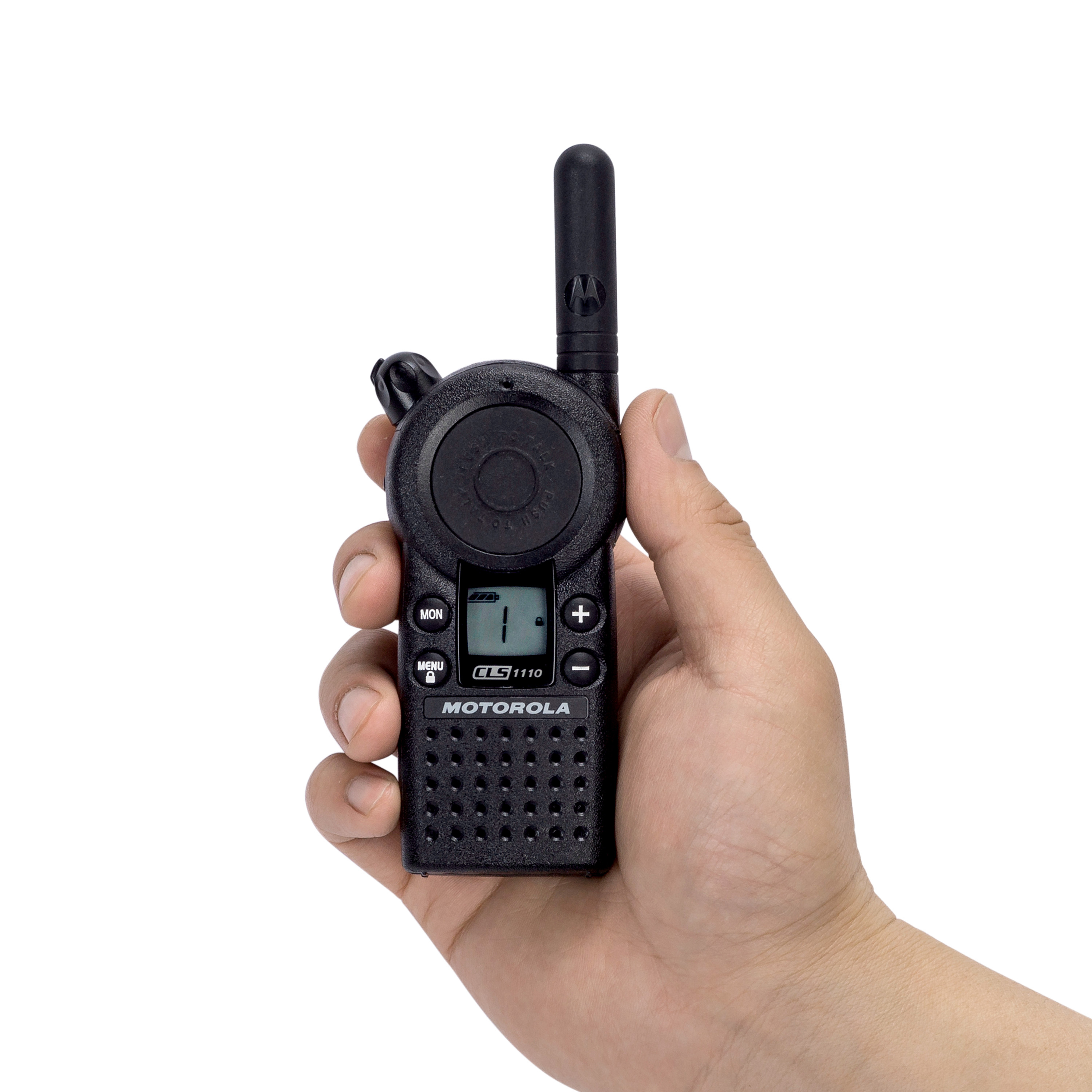
1. Motorola CLS1410 — Best for Small Crews and Back-of-House Coordination
| Specification | Detail |
|---|---|
| Frequency | UHF analog (460–469 MHz) |
| Output | 1 watt |
| Channels | 4 (56 business-exclusive frequencies) |
| Indoor Coverage | Up to 200,000 sq ft / ~15 floors (up to 1 mile outdoors) |
| Battery Life | Up to 14 hours |
| Weight | 4.6 oz with battery |
| Durability | MIL-SPEC 810 (C–G), IP55 water resistance |
The CLS1410 is the radio we hand to crew who need to wear something light all day and never think about it — PAs, locations staff, background wranglers, and parking coordinators. At 4.6 ounces it clips to a belt and disappears, and its dead-simple push-to-talk needs no training, which matters when day-players and rotating crew pick one up cold.
Why it fits film production specifically
- Four channels let a small team segment by role without cross-talk — managers on one channel, floor crew on another.
- VibraCall vibrate alert delivers a discreet notification near a quiet set, without an audible chirp.
- 121 interference-eliminator privacy codes (83 digital, 38 analog) keep your net clear of nearby productions.
- MIL-SPEC 810 and an IP55 rating handle the drops and spills of a working set.
What to know: the CLS1410 is analog-only at 1 watt, so it's best for smaller sets or as economical units for non-technical roles on a larger production. Compatible add-ons are on the CLS accessories page.
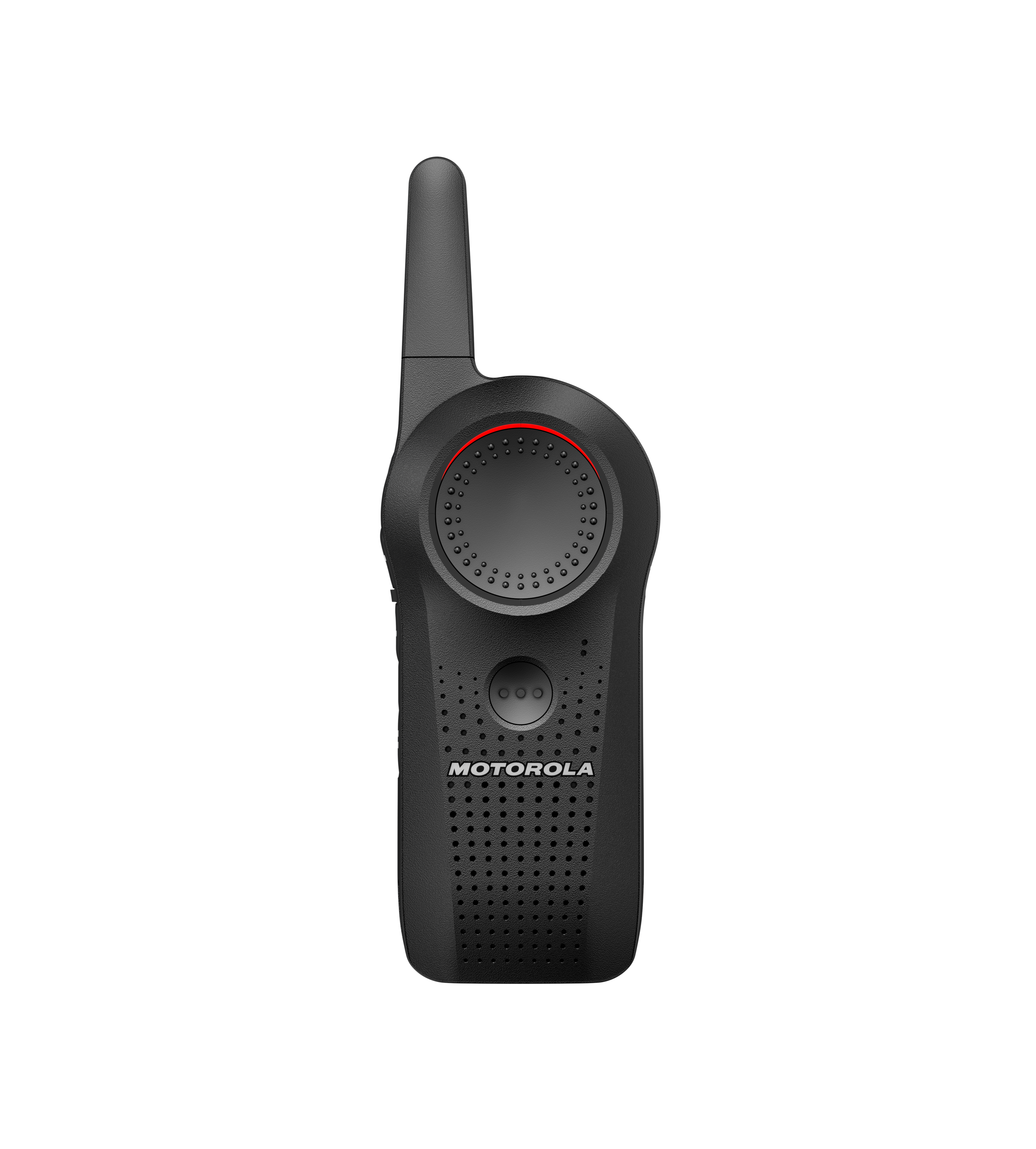
2. Motorola Curve — Best for Indie and Smaller Productions
| Specification | Detail |
|---|---|
| Frequency | Digital 900 MHz (902–928 MHz) |
| Output | 1 watt digital (effective coverage comparable to a 4-watt analog radio) |
| Channels | 10 |
| Indoor Coverage | Up to 300,000 sq ft / 20 floors |
| Battery Life | Up to 12 hours (optional high-capacity battery extends further) |
| Weight | 5.11 oz |
| Durability | MIL-SPEC 810, IP5X (dust and humidity) |
The Curve is the radio we point indie and small crews to when they want communication working in minutes, with nothing to configure before the first setup. At 5.11 ounces with an antimicrobial polycarbonate housing, it holds up to constant hand-offs through a shoot day, and its 10 channels are enough to separate the core departments on a single-location set.
Why it fits film production specifically
- Frequency Hopping Spread Spectrum and 10,000 privacy codes make it one of the more secure options when you're shooting near other productions — learn how FHSS works.
- Page All and Call All reach the entire crew instantly in an emergency; Direct Call keeps a one-on-one conversation private.
- The heavy-duty audio port and headset with inline microphone and PTT support discreet comms — important for ADs and producers staying on the net without disturbing a quiet set.
- An optional Voice Assistant button allows hands-free operation for grips, riggers, and anyone whose hands are full.
Best fit for: student films, documentary crews, commercial shoots, and small narrative productions on a single location. Compatible add-ons are listed on the Curve accessories page.
3. Motorola Mag One BPR50dx-U — Best All-Around Radio for Mid-Size and Large Productions

| Specification | Detail |
|---|---|
| Frequency | UHF (400–470 MHz) |
| Mode | Analog and digital (DMR Tier II) |
| Output | Up to 4 watts |
| Channels | 64 across 4 zones (up to 16 per zone) |
| Battery Life | 23 hours digital / 16 hours analog (2,200 mAh Li-Ion) |
| Charging | Built-in USB-C plus desktop charger |
| Weight | 10.6 oz |
| Durability | IP55 dust and water resistance, MIL-STD 810 (C–H) |
The BPR50dx-U is the radio we recommend most often for productions that wear their radios all day. Its 23-hour digital runtime is the standout for set use — it covers a full shooting day plus turnaround without a battery swap. With a 3-watt maximum audio output (the loudest in the Mag One family) and noise cancellation on both transmit and receive, transmissions stay intelligible next to generators, sound-stage construction, or practical effects.
Why it fits film production specifically
- Built-in VOX delivers true hands-free communication for grips, riggers, gaffers, and wardrobe — see how VOX works.
- A dedicated Emergency Alert button (configurable to redirect traffic to a priority channel) plus Lone Worker and Remote Monitor make it well-suited to stunt days and isolated location posts.
- Dual analog/digital operation lets a production transition a fleet gradually and communicate with existing analog units rather than replacing everything at once.
- USB-C charging means a dead radio can be topped up from any standard USB charger on a cart or at video village.
- Verified compatible accessories on our site include the PMLN6536 2-wire surveillance kit, PMLN6532 swivel earpiece, and PMMN4092 remote speaker mic.
Best fit for: feature films, episodic television, large commercial productions, and stunt-heavy shoots that need emergency-alert functionality.
4. Motorola SL300-UD — Best Premium Radio for Large, Multi-Department Productions

| Specification | Detail |
|---|---|
| Frequency | UHF (403–470 MHz) |
| Mode | Analog and digital (MOTOTRBO / DMR) |
| Output | 3 watts digital (Range Max performs comparably to many 4-watt digital radios) |
| Channels | 99 |
| Indoor Coverage | Up to 350,000 sq ft / ~35 floors (1–2 miles outdoors) |
| Battery Life | 12–15 hours |
| Weight | 5.96 oz, under 1 inch thick |
| Durability | IP54 dust and water resistance, MIL-STD 810 (C–G) |
The SL300-UD is the radio we recommend when a production wants a professional, low-profile unit that still carries the widest channel plan and the most coverage on this page. Its ultra-slim body slips into a uniform pocket without bulging — useful for crew working close to camera — while Range Max technology lets its 3-watt digital output cover up to 350,000 square feet, the largest indoor footprint here.
Why it fits film production specifically
- 99 channels give even the largest, most segmented productions room to put every department on its own channel.
- The Transmit Interrupt feature lets a 1st AD or producer cut through chatter with an urgent instruction — valuable when a set needs to be locked up fast.
- An Active View LED display surfaces channel and status information without a bulky screen, keeping the slim profile.
- Digital encryption is available for productions that need to keep sensitive set traffic private.
- Dual analog/digital operation and repeater capability make it the strongest choice for large or multi-building shoots. Compatible add-ons are on the SL accessories page.
Best fit for: studio features, network episodic television, and large commercial or music-video productions that want a premium slim radio with maximum coverage, channels, and secure communication.
Quick Comparison: Which Radio Fits Your Production?
| Specification | Motorola CLS1410 | Motorola Curve | Motorola BPR50dx-U | Motorola SL300-UD |
|---|---|---|---|---|
| Output Power | 1W UHF | 1W digital | Up to 4W UHF | 3W digital |
| Indoor Coverage | Up to 200,000 sq ft | Up to 300,000 sq ft | Up to 375,000 sq ft | Up to 350,000 sq ft |
| Battery Life | Up to 14 hours | Up to 12 hours | Up to 23 hours (digital) | 12–15 hours |
| Channels | 4 | 10 | 64 (4 zones) | 99 |
| Durability | MIL-SPEC 810, IP55 | MIL-SPEC 810, IP5X | MIL-STD 810, IP55 | MIL-STD 810, IP54 |
| Hands-Free | VOX-capable | Voice Assistant button | Built-in VOX | VOX-equipped |
| Mode | Analog only | Digital only (900 MHz) | Analog + DMR | Analog + MOTOTRBO |
| Weight | 4.6 oz | 5.11 oz | 10.6 oz | 5.96 oz |
| Best For | Small crews / back-of-house | Indie / small shoots | Mid-to-large productions | Large / multi-department |
Matching Radio to Production Size
| Production Type | Recommended Radio | Why |
|---|---|---|
| Small crew, simple back-of-house, non-technical roles | Motorola CLS1410 | Lightest and simplest, 4 channels, no training required |
| Student film, documentary, single location, under 30 crew | Motorola Curve | Immediate deployment, 10 channels, compact and secure |
| Feature / episodic, 30–100 crew, multiple departments | Motorola BPR50dx-U | 23-hour battery, built-in VOX, emergency and lone-worker safety |
| Large studio production, many departments, secure comms | Motorola SL300-UD | 99 channels, 350,000 sq ft coverage, encryption, slim profile |
| Multi-block exteriors or base camp miles from set | SL300-UD or BPR50dx-U with a repeater | Repeater extends UHF coverage well beyond a single radio's range |
For locations with thick masonry or steel construction, drop one tier larger than your square footage would suggest — a 4,000 sq ft stage with poured-concrete walls can behave like a much larger space for signal-penetration purposes.
Operational Guidance: Outfitting Your Production
How Many Radios You Need
A practical starting point is one radio per key role per shift: each department head, the AD team, the gaffer and key grip, the sound mixer, the medic, transpo, and every security and locations position. A small set runs well on 8–12 radios; a studio feature can need 100 or more. Order a few spares beyond your headcount to cover dead batteries and last-minute additions.
Channel and Zone Planning
Assign each department its own channel so traffic doesn't collide, and reserve a dedicated channel for AD and another for security and emergencies. Productions with many departments benefit from the BPR50dx-U's zones or the SL300-UD's 99 channels, which keep large channel plans organized. Privacy codes keep your net clear of nearby productions sharing the same frequencies.
Accessories That Matter on Set
Surveillance kits and covert earpieces keep radio audio off the set — essential near a live boom. Remote speaker mics suit crew who keep the radio on a belt. We stock verified-compatible accessories for each model, including the PMLN6536 surveillance kit and PMMN4092 speaker mic for the BPR50dx-U.
Charging and Battery Logistics
For long days, stage a multi-unit charger at the production office or on a cart so batteries rotate through the day. The BPR50dx-U's USB-C port adds a convenient top-up option, and its 23-hour digital runtime is the longest on this page for productions that can't pause for swaps.
Programming and Renting
The BPR50dx-U and SL300-UD can be programmed to communicate with rented UHF radios — including other Motorola, Kenwood, and DMR-compatible units — as long as they share the same frequency, privacy codes, and digital settings. The Curve operates on a 900 MHz system and pairs only with other Motorola DLR and DTR series radios, and the CLS1410 runs on fixed business-exclusive frequencies, so both are best deployed as owned, standalone fleets. If you're mixing owned and rented inventory on one channel plan, the BPR50dx-U or SL300-UD is the better fit. Short runs can also draw on our radio rental program.
On-Set Safety and OSHA Considerations
Reliable communication is a safety system, not just a convenience. Under the OSHA General Duty Clause (Section 5(a)(1) of the Occupational Safety and Health Act), employers must provide a workplace free from recognized hazards — and dependable, real-time communication is central to coordinating emergencies, stunt work, and evacuations on a set. Choosing a radio with enough rated battery life to last the full day, plus dedicated emergency-alert and lone-worker features like those on the BPR50dx-U, directly supports that obligation.
Sound stages with running generators, practical effects, and amplified playback can push noise above the 85 dB eight-hour time-weighted average at which OSHA's occupational noise standard (29 CFR 1910.95) calls for a hearing conservation program. In those conditions, earpieces and remote speaker mics let crew keep listening volume controlled rather than running a radio speaker at full output beside their ear. Match earpiece selection to the noise environment your crew actually works in.
Frequently Asked Questions
How much range do I need for a film production?
It depends on set size and construction. For a small or single-building shoot, a 1-watt radio like the CLS1410 (up to 200,000 sq ft) or the Curve (up to 300,000 sq ft) is plenty. For larger or multi-building productions, a higher-power UHF radio such as the BPR50dx-U (up to 375,000 sq ft) or SL300-UD (up to 350,000 sq ft) covers more ground.
If your production spans multiple city blocks, several floors of a high-rise, or a base camp miles from set, pair a repeater-capable UHF radio with a repeater for expanded coverage. Both the SL300-UD and BPR50dx-U are repeater-capable.
How long do the batteries last on a film production day?
For a standard 12-hour shooting day, choose a radio rated for at least 12 hours of talk time. The BPR50dx-U leads the field at 23 hours in digital mode; the SL300-UD delivers 12–15 hours; the CLS1410 reaches up to 14 hours; and the Motorola Curve delivers up to 12 hours on a standard charge.
For very long days or productions that can't pause to swap batteries, stage a multi-unit charger at the production office so batteries rotate throughout the day.
Are these radios durable enough for outdoor shoots and bad weather?
Yes. All four meet U.S. Military Standard 810 specifications for shock, vibration, temperature extremes, and humidity. The CLS1410 and BPR50dx-U carry an IP55 rating (resistant to low-pressure water jets from any direction); the SL300-UD is rated IP54 (dust and splash); and the Curve carries an IP5X dust-and-humidity rating. IP55 is adequate for exterior shoots in rain.
None of the four are submersible, so take precautions around water-based stunts or underwater scenarios.
Can these radios use covert earpieces and surveillance kits?
Yes. All four support accessory connectors compatible with surveillance kits, covert earpieces, remote speaker mics, and headsets. The Curve includes a heavy-duty audio port and a compatible headset with inline microphone and PTT. For the BPR50dx-U, we stock verified-compatible options including the PMLN6536 2-wire surveillance kit and PMMN4092 remote speaker mic, and the SL300-UD and CLS1410 each have their own dedicated accessory lines.
Can I mix these radios with rented production radios on set?
The BPR50dx-U and SL300-UD can both be programmed to talk to rented UHF radios — including other Motorola, Kenwood, and DMR-compatible models — as long as they share the same frequency, privacy codes, and digital mode settings.
The Curve operates on a 900 MHz system and is interoperable only with other Motorola DLR and DTR series radios, and the CLS1410 runs on fixed business-exclusive frequencies. If you're combining owned and rented inventory on a single channel plan, choose the BPR50dx-U or SL300-UD.
What is VOX, and do I need it for film production?
VOX (voice-operated transmission) keys the radio automatically when the user speaks, so there's no push-to-talk button to press. For crew whose hands are occupied — grips, riggers, gaffers, wardrobe, makeup — it enables truly hands-free communication. The BPR50dx-U has built-in VOX and the SL300-UD is VOX-equipped; the CLS1410 is VOX-capable with a compatible accessory.
How many channels does a film production need?
Plan one channel per department, plus a dedicated AD channel and a separate security/emergency channel. A small shoot may use four to six channels (the CLS1410's four channels suit a small crew); a large studio production segments camera, grip/electric, sound, art, AD, transpo, and security separately. The BPR50dx-U (64 channels across 4 zones) and SL300-UD (99 channels) give large productions room to keep every department organized.
Why Buy Your Production Radios from Tech Wholesale
Production coordinators and UPMs have specific needs that general electronics retailers aren't built for. Tech Wholesale has sold professional two-way radios since 1997 and is an authorized dealer for Motorola and Kenwood — so every radio carries the full manufacturer warranty (two years on the CLS1410 and BPR50dx-U, three years on the SL300-UD) and qualifies for manufacturer service.
What sets us apart
- Pre-programming to your channel plan — order your BPR50dx-U or SL300-UD radios and we'll program them to your production's channel and privacy-code plan before they ship, so they work on day one of prep.
- Quick quotes for large teams — request a custom quote
- Lifetime technical support with every purchase — call or email our team for the life of your fleet, not just through the warranty period
- Fast, same-day shipping on in-stock orders, so radios are in hand before tech scout
- No-pressure consultation — we'll tell you when a less expensive radio is the right answer for your shoot
- Authorized dealer status — no gray-market inventory, no voided warranties
Not sure which radio fits your production? Use our Find My Radio tool or request a quote. We'll ask a few questions about your set and come back with a specific recommendation — no obligation.
1-888-925-5982 | Service@TechWholesale.com
Related Reading
- Privacy Codes – Eliminate Outside Interference
- What Is Frequency Hopping Spread Spectrum (FHSS)?
- VOX Explained
- UHF vs VHF – Frequencies Explained
- Lone Worker / Man Down Functionality
- Two-Way Radio Repeaters
- OSHA – Occupational Noise Exposure
- OSHA – General Duty Clause, Section 5(a)(1)
Article by Kristin Wood, a two-way radio consultant @ Tech Wholesale | Authorized Motorola & Kenwood Dealer Since 1997 | Last Updated: June 2026