

Many dispensaries rely on phones, intercoms, or staff stepping between secure areas, which slows down every check-in and leaves doors unattended. Consumer walkie-talkies rarely last either, between breaking after a drop and outside interference.
Business-grade radios with earpieces keep every update discreet between your lobby, sales floor, and vault, and their rugged build holds up shift after shift, protecting your investment for years.
You’re one page away from the right radio! We’ve kept hundreds of dispensaries connected nationwide since 1997. Here’s how to pick yours.
Which Walkie Talkie Fits Your Dispensary?
The Quick Answer
- A single-location shop coordinating the floor → Motorola CLS1410. Four channels. IP55, VibraCall for a silent page, and simple enough that a new budtender is operating it in a minute.
- Staff working directly in front of customers → Motorola CLP1080e. Earpiece-only with no external speaker — so a check on inventory or an ID problem at the door never carries across the counter. Eight channels, 3.35 oz.
- A large store, a cultivation site attached, or multiple locations → Motorola Curve. Digital 900 MHz with ten channels and a frequency-hopping signal that a consumer radio in the parking lot can't pick up.
Quick Links
Why Dispensaries Need Purpose-Built Two-Way Radios
Consumer walkie-talkies and cell phones fail in dispensary environments for reasons that directly affect security, patient experience, and operational efficiency. Professional two-way radios address each of these failure points.
Dispensaries face a specific combination of communication challenges that few other retail environments share:
Licensed product security. Cannabis dispensaries are high-value targets for theft — from both external actors and internal staff. Real-time radio communication between security personnel and the floor team is one of the few tools that allows a discreet, coordinated response before an incident escalates. A budtender who can quietly alert security without confronting a suspect reduces risk for staff, patients, and the business.
Cash handling. Most dispensaries remain cash-heavy operations due to federal banking restrictions. Coordinating vault access, cash drops, and shift-end procedures requires reliable, private communication between designated staff. Radio channels dedicated to cash handling reduce exposure and create an auditable operational pattern.
Patient discretion. Medical dispensaries in particular serve patients who may be managing chronic conditions, cancer treatment, or pain management. Visible, audible radio chatter in a consultation area disrupts the patient experience and may discourage repeat visits. Earpiece-only radio systems eliminate this problem entirely.
Inventory control and back-of-house coordination. Dispensaries are required to track licensed product in real time under state seed-to-sale tracking systems (Metrc is currently used in over 30 states). When a budtender needs to pull a product from the vault or verify availability, the radio is the fastest path to the back-of-house team without abandoning the patient.
Multi-zone layouts. Most dispensaries include a reception or check-in area, a sales floor, a vault or storage room, a manager's office, and often a loading area or parking lot. These zones require consistent radio coverage throughout — including through thick walls, vaults, and reinforced doors common in compliant dispensary construction.
Emergency and security response. Most state cannabis regulations require dispensaries to maintain a security alarm system and the ability to contact law enforcement. Many state-level regulations — including those in Connecticut and Pennsylvania — specifically reference radio or other communication systems as part of the emergency response infrastructure. A professional radio system supports the real-time team coordination that any emergency protocol depends on.
What to Look For in a Dispensary Radio
Audio Clarity in Mixed Environments
Dispensary environments are neither silent nor consistently loud. HVAC systems, background music, and patient conversations create an inconsistent noise floor. Professional radios include noise-canceling microphone arrays that isolate voice from ambient sound — a feature absent from consumer-grade radios. Look for a minimum speaker output of 500 mW for floor use.
Discretion and Form Factor
For patient-facing staff, a radio that is visible and audible disrupts the environment. The smallest professional business radios — like the Motorola CLPe series — weigh under 3 oz. and operate entirely through an earpiece. For back-of-house and security staff, a standard belt-clip radio with an external speaker is appropriate.
Channel Capacity
Most dispensaries operate effectively across four dedicated channels: floor/budtenders, security, inventory/back-of-house, and management. Facilities with outdoor areas, parking lots, or multiple buildings benefit from six to ten channels. Avoid single-channel radios for any team larger than two or three people.
Battery Life
Dispensary shifts commonly run 8 to 12 hours. Professional-grade radios are rated for 10 to 14 hours under typical transmission loads. Motorola and Kenwood commercial batteries are tested to five years of regular field use. For facilities with back-to-back shifts, multi-unit charging cradles allow battery hot-swapping.
Privacy and Signal Security
For dispensaries, privacy codes alone (CTCSS/DCS) do not encrypt transmissions — they only filter out unwanted reception. True signal security requires either digital radio technology with proprietary coding or Frequency Hopping Spread Spectrum (FHSS), which changes frequencies thousands of times per second and is effectively scanner-proof. The Motorola Curve uses FHSS and provides 10,000 privacy codes. The CLS1410 and CLP1080e use CTCSS/DCS privacy codes, which are appropriate for most dispensary environments but not equivalent to digital encryption.
Durability
Dispensary environments include vault doors, concrete walls, and hard floors. Look for radios that meet MIL-STD-810 standards for shock resistance and carry at minimum a commercial-grade water-resistance rating. Radios with antimicrobial housing — a feature on the CLP1080e and Motorola Curve — are a practical advantage in high-touch retail environments.
Recommended Two-Way Radios for Dispensaries
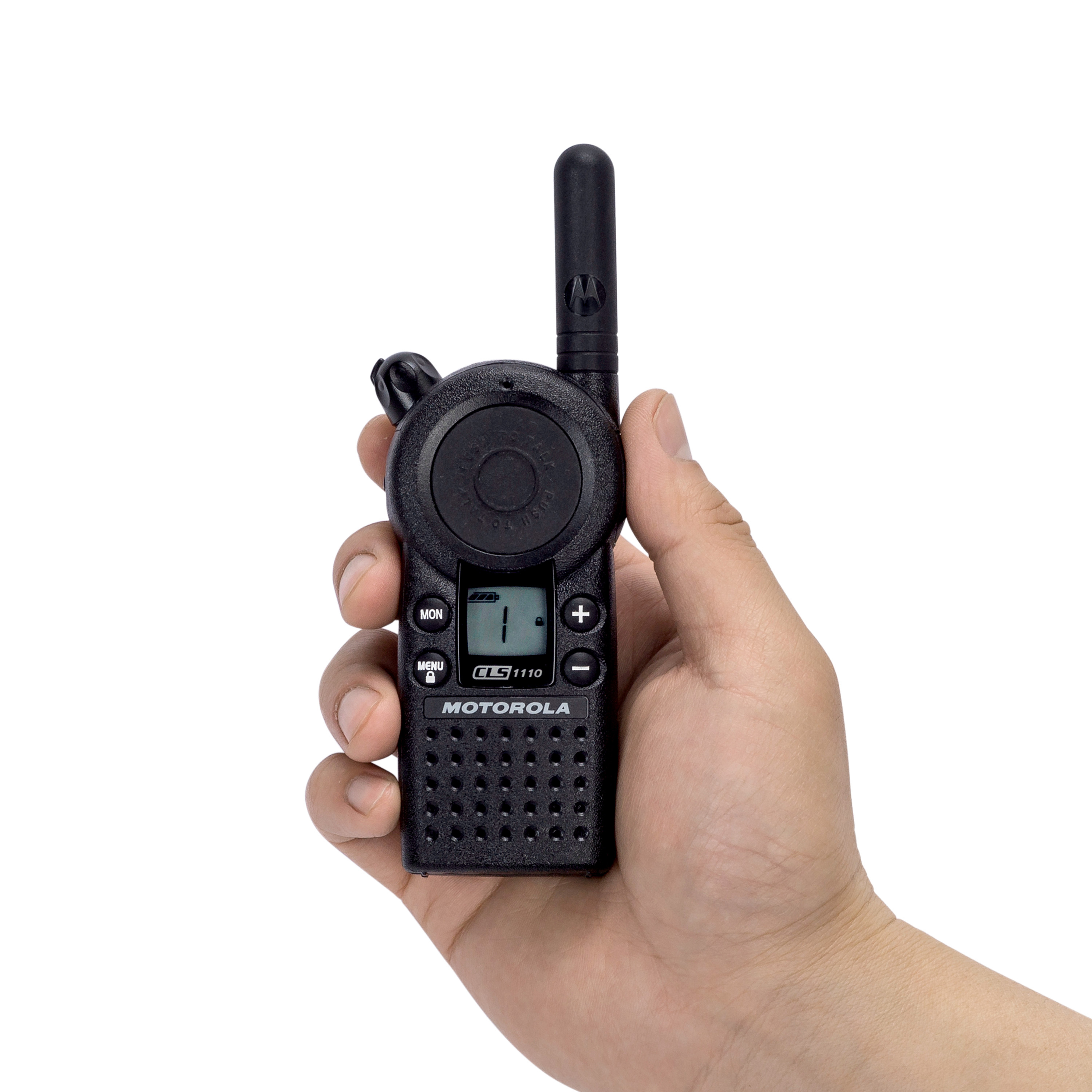
1. Motorola CLS1410 — Best for Small to Mid-Size Dispensaries
| Specification | Detail |
|---|---|
| Frequency | UHF (460–469 MHz) |
| Power | 1 watt |
| Channels | 4 |
| Indoor Coverage | 200,000 sq ft / up to 15 floors |
| Battery Life | ~10 hours |
| Durability | Commercial-grade, water-resistant |
| Weight | 5.6 oz. with battery |
The CLS1410 has been a reliable choice in commercial retail environments for well over a decade. Its UHF frequency penetrates concrete walls, reinforced doors, and the vault construction typical of dispensary builds. An external speaker makes it practical for back-of-house staff who need to set a radio on a counter rather than wear an earpiece throughout the shift — useful for inventory and fulfillment teams who aren't in patient-facing roles.
Why it fits dispensaries specifically
- UHF penetration handles the reinforced wall and vault door construction common in compliant dispensary facilities
- Four dedicated channels support clean role separation: budtenders, security, inventory, and management
- Audible Call Alerts with Vibracall technology ensure staff don't miss a message during a busy patient rush
- VOX (hands-free voice-activated transmission) keeps budtenders focused on the patient, not the radio
- 10-hour battery life covers standard retail shifts without mid-day charging
Limitation to know: The CLS1410 uses CTCSS/DCS privacy codes, not digital encryption or FHSS. Transmissions can technically be intercepted by a scanner. For facilities with elevated security sensitivity, consider upgrading to the Motorola Curve.
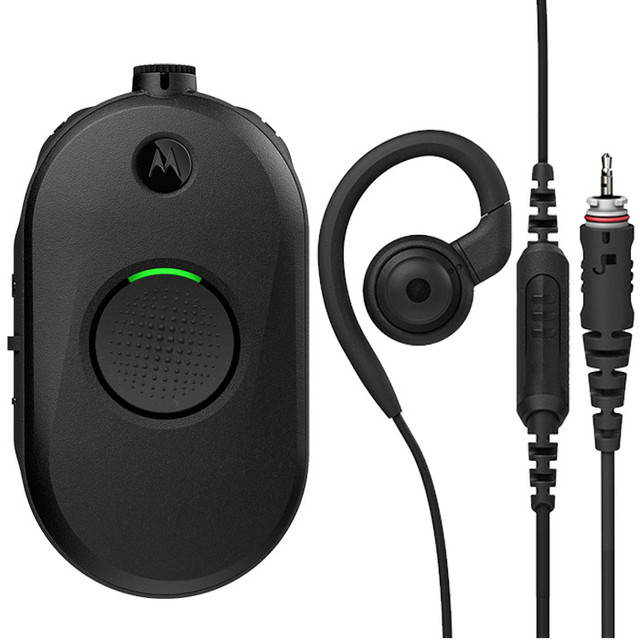
2. Motorola CLP1080e — Best for Patient-Facing Staff
| Specification | Detail |
|---|---|
| Frequency | UHF (450–470 MHz) |
| Power | 1 watt |
| Channels | 8 |
| Indoor Coverage | 100,000 sq ft / up to 10 floors |
| Battery Life | ~12 hours |
| Weight | 3.35 oz. — lightest professional radio on the market |
| Includes | Swivel belt holster and discreet earpiece |
| Special Features | Antimicrobial casing, repeater-capable |
The CLP1080e operates entirely through its included earpiece — there is no external speaker. For budtenders conducting patient consultations, this is the correct design. Staff communicate privately; patients see nothing unusual and hear nothing disruptive. At 3.35 oz., it is the smallest and lightest professional radio on the market, small enough to clip to a waistband and forget.
Eight channels make it well-suited for dispensaries with multiple departments. At 100,000 sq ft of indoor coverage across 10 floors, it handles most single-building dispensary footprints without issue. If your facility requires additional range, the CLP1080e is repeater-capable, which can extend coverage significantly without purchasing a higher-wattage radio.
Why it fits dispensaries specifically
- Earpiece-only operation is the correct design for patient consultation areas — no audible transmissions on the sales floor
- Antimicrobial casing is a practical advantage in a high-touch retail environment handling licensed product
- 8 channels allow full departmental segmentation plus dedicated channels for security escalation and management
- 12-hour battery life exceeds standard shift length without mid-day charging
- Repeater-compatible: facilities with dead zones or multi-building layouts can extend coverage without upgrading the radio
Limitation to know: At 100,000 sq ft, the CLP1080e covers smaller dispensary footprints comfortably. Very large operations or multi-building campuses should consider the Motorola Curve. If your team is three people or fewer on a single floor, the CLP1010e (1 channel) is a cost-effective entry point.
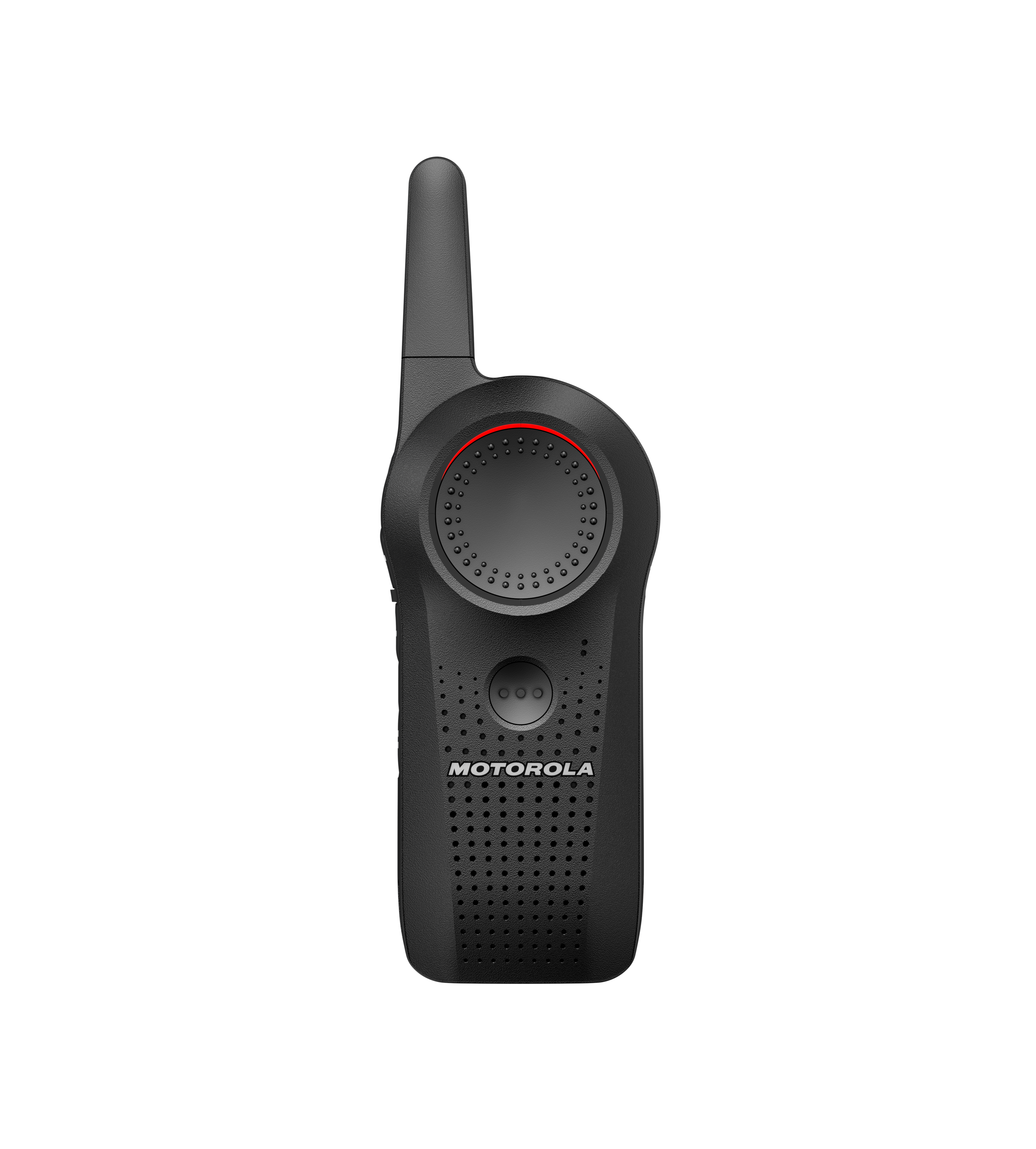
3. Motorola Curve — Best for Large Dispensaries and Multi-Building Operations
| Specification | Detail |
|---|---|
| Frequency | Digital 900 MHz (902–928 MHz) |
| Power | 1 watt digital (equivalent to ~4 watts analog) |
| Channels | 10 |
| Indoor Coverage | 300,000 sq ft / up to 20 floors |
| Battery Life | ~14 hours |
| Durability | MIL-STD-810 compliant, water-resistant |
| Weight | under 6 oz. |
| Signal Security | FHSS + 10,000 privacy codes |
| Special Features | Antimicrobial casing, Direct Call, Page All, Call All Available |
The Motorola Curve is the right choice when a dispensary's square footage, wall construction, or multi-building layout exceeds what UHF analog radios can reliably serve — and when signal security is a priority. Its 900 MHz digital signal penetrates concrete and steel-reinforced construction more effectively than UHF analog at comparable wattage, with the equivalent analog output of approximately 4 watts covering nearly three times the floor area of the CLS1410.
For dispensaries, the Curve's security features are particularly relevant. Frequency Hopping Spread Spectrum (FHSS) technology changes operating frequencies thousands of times per second, making the signal effectively impossible to intercept with a consumer scanner. This matters when security teams are coordinating a response to a theft in progress or discussing a cash handling procedure. The Direct Call feature allows one-to-one private communication between any two radios on the system, while Page All and Call All Available let management or security reach the entire team simultaneously in an emergency.
Why it fits large dispensaries specifically
- FHSS signal security keeps sensitive security and cash-handling communications off scanners
- 10 channels support full departmental segmentation including dedicated lines for parking lot or external security
- MIL-STD-810 compliant construction handles the physical demands of a high-volume dispensary with hard floors and heavy use
- 14-hour battery exceeds even double-shift operations without charging
- Direct Call function allows discreet one-to-one communication between security and management during sensitive situations
Also Worth Considering
Kenwood ProTalk PKT-300 — 2 watts, 6 channels, UHF (450–470 MHz), indoor coverage up to 275,000 sq ft. A strong alternative to the CLS1410 for dispensaries that need six dedicated channels or slightly more coverage. Includes VOX and scan capability.
Motorola CLP1010e — 1 watt, 1 channel, UHF. The smallest and lightest entry point for dispensaries with very small teams (two to three people). Earpiece-only, discreet, and appropriate for boutique operations that don't need channel segmentation.
Coverage by Facility Size: Matching Radio to Dispensary Layout
| Facility Type | Recommended Radio | Coverage Capacity |
|---|---|---|
| Boutique dispensary / single room under 5,000 sq ft | Motorola CLP1010e or CLP1080e | 100,000 sq ft |
| Single-floor retail dispensary up to 15,000 sq ft | Motorola CLS1410 or Kenwood PKT-300 | 200,000–275,000 sq ft |
| Large dispensary / multi-zone layout | Motorola Curve | 300,000 sq ft / 20 floors |
| Multi-building campus or delivery operation | Motorola WAVE PTX (LTE/Wi-Fi PTT) | Unlimited range |
For dispensaries with concrete vault construction or reinforced perimeter walls, plan for additional signal attenuation. A 5,000 sq ft dispensary with a thick concrete vault and reinforced interior walls may perform more like a 15,000 sq ft open-plan retail space for RF penetration purposes. When in doubt, size up by one tier or add a repeater.
Compliance for Dispensary Radios
Two-way radio compliance for dispensaries involves state cannabis regulatory agencies, which govern security communication systems.
State Cannabis Security Communication Requirements
Most state cannabis regulatory frameworks require dispensaries to maintain a security alarm system capable of alerting law enforcement via telephone, radio, or other communication system. Some states — including Connecticut (Conn. Agencies Regs. § 21a-408-64) and Pennsylvania — explicitly reference radio-based communication systems as part of compliant security infrastructure. Dispensary operators should review their state's specific cannabis security regulations to confirm whether their radio system satisfies the internal communication requirements of their license conditions.
Operational Questions: How Dispensaries Actually Use Radios
How to Set Up Channels for a Dispensary Team
A practical four-channel setup that works for most dispensaries:
- Channel 1 — Floor/Budtenders: Primary communication between sales floor staff, patient check-in, and cashiers
- Channel 2 — Security: Dedicated channel for security staff; alerts and incident coordination without broadcasting on the floor channel
- Channel 3 — Inventory/Back-of-House: Vault access requests, restock coordination, and receiving
- Channel 4 — Management: Supervisor oversight; managers can monitor other channels and escalate as needed
For facilities with outdoor areas, a dedicated external channel (parking lot, delivery area) is worth adding if your radio supports it. The Motorola Curve's 10-channel capacity covers all of these plus dedicated emergency and expansion channels.
How to Handle Security Escalation on Radio
The most effective dispensary radio setups use a two-step escalation model. Security staff monitor the security channel continuously. When a floor employee observes a concern, they contact security directly on the security channel without alarming other staff or patients. Security then escalates to management on the management channel if needed. This structure prevents public announcements and maintains a calm patient environment during an incident response.
How Many Radios Does a Dispensary Need?
A practical starting point is one radio per active staff member per shift. Minimum recommended by role:
- One per budtender
- One per security officer on duty
- One per manager or shift lead
- One per reception/check-in position
- One per back-of-house or inventory staff member
For facilities with shift rotations, plan for a 10 to 20 percent spare inventory so radios on charge don't create coverage gaps. Tech Wholesale offers volume pricing for orders of five or more units — request a custom quote.
Repeaters: When and Why Dispensaries Need Them
A repeater receives a radio signal and retransmits it at higher power or from a better location, extending effective range beyond what the radios alone can achieve. Dispensaries that benefit from repeaters typically include facilities with multiple floors, buildings separated by outdoor space, thick concrete vault walls creating dead zones, or basement-level storage areas. The CLP1080e is repeater-compatible; the Motorola Curve does not use a traditional repeater system due to its FHSS digital architecture.
Frequently Asked Questions
What is the best two-way radio for a dispensary?
For most dispensaries, the answer depends on facility size. Small to mid-size operations typically use the Motorola CLS1410 (external speaker, 4 channels, 200,000 sq ft) for back-of-house staff and the Motorola CLP1080e (earpiece-only, 8 channels, 12 hours) for patient-facing budtenders. Large dispensaries and multi-building operations should start with the Motorola Curve, which adds FHSS signal security, 10 channels, and 300,000 sq ft of coverage.
Are two-way radio communications private in a dispensary?
Privacy codes (CTCSS/DCS) used by analog radios like the CLS1410 and CLP1080e prevent casual reception by other radios set to different codes, but they do not encrypt the transmission. Someone with a scanner and knowledge of the frequency can technically intercept the signal. For dispensaries with elevated security sensitivity — particularly those discussing cash handling, security responses, or vault access on radio — the Motorola Curve's FHSS technology provides substantially stronger signal security. FHSS changes operating frequencies thousands of times per second, making the signal effectively impossible to intercept with standard equipment.
How much range do I need for a dispensary?
For a single-floor dispensary under 10,000 sq ft with standard construction, a 1-watt UHF radio provides adequate coverage with headroom to spare. For multi-floor operations, buildings with concrete vault construction, or facilities where the signal must pass through reinforced walls, plan for either 2-watt UHF or a digital radio like the Motorola Curve, which delivers the equivalent of approximately 4 watts analog at 1 watt digital. Always size up by one tier when dispensary construction includes poured concrete vaults or reinforced perimeter walls, as these significantly attenuate radio signal.
How long does the battery last on a dispensary radio?
Professional radios recommended for dispensary use are rated for 10 to 14 hours under normal transmission loads. The Motorola CLS1410 is rated for approximately 10 hours; the CLP1080e for approximately 12 hours; and the Motorola Curve for approximately 14 hours. Motorola and Kenwood commercial batteries are tested to five years of regular field use. For facilities with back-to-back shifts or 24-hour operations, multi-unit charging cradles allow battery hot-swapping without radio downtime.
What is the durability rating on dispensary radios?
The Motorola CLS1410 and CLP1080e carry commercial-grade durability ratings appropriate for everyday indoor business use, including water resistance for splash and spill exposure. The Motorola Curve meets MIL-STD-810 standards, which test for shock, vibration, and environmental resistance across a defined set of conditions. None of the radios recommended on this page are rated for submersion (IPX7 or higher), which is not a requirement in a standard dispensary environment.
Can dispensary radios work across multiple locations?
Standard two-way radios are designed for single-site communication within their rated coverage range. For coordination across separate dispensary locations — multi-site operators, delivery dispatch, or regional management — a push-to-talk over cellular (PoC) solution like the Motorola WAVE PTX is the appropriate tool. WAVE PTX operates over LTE and Wi-Fi networks with unlimited range.
Can two-way radios support emergency and security coordination in a dispensary?
Yes, and this is one of the primary use cases for professional radios in dispensary environments. Dedicated channel assignments allow security to communicate internally without cluttering patient-facing channels and to escalate directly to management when needed. The Motorola Curve's Direct Call feature enables one-to-one private communication between any two radios, while the Page All function alerts the entire team simultaneously. Many state cannabis regulations reference radio communication systems as part of required security infrastructure; a professional radio system supports the real-time coordination that any emergency protocol depends on.
Do two-way radios work with earpieces for discreet dispensary use?
Yes. The Motorola CLP1080e ships with a discreet earpiece and belt holster and operates exclusively through earpiece — there is no external speaker. For the CLS1410 and Motorola Curve, optional surveillance-style earpieces are available separately. Earpiece communication keeps audio private and eliminates audible transmissions on the patient floor, which is the standard configuration for budtenders in medical dispensaries.
Why Buy from TechWholesale.com
Tech Wholesale has been selling professional two-way radios to retail operations, security teams, and regulated businesses since 1997. We are an authorized dealer for Motorola and Kenwood, which means every radio we sell carries the full manufacturer warranty — typically two years on commercial-grade models — and qualifies for manufacturer service and repair. No gray market inventory, no voided warranties.
What sets us apart for dispensary operators
- Lifetime technical support included with every purchase — call or email our team for the life of your radio fleet, not just through the warranty period
- Volume pricing for fleet orders — request a custom quote for five or more units
- No-pressure consultation — our team will tell you when a less expensive radio is the right answer, not push you toward a higher-margin product
- Free shipping on qualifying orders
- Authorized dealer status — full manufacturer warranty on every unit
- Experienced with regulated industries — we understand that dispensary operators need radio systems that are reliable, compliant, and simple to manage
If you're not sure which radio fits your dispensary, use our Find My Radio tool or request a quote. We'll ask a few questions about your facility and come back with a specific recommendation — no sales pressure, no obligation.
1-888-925-5982 Service@TechWholesale.com
Related Reading
From TechWholesale.com
- Two-Way Radios for Dispensaries — Product Listings
- Motorola Curve Digital Two-Way Radio
- Motorola CLP1080e Walkie Talkie
- Motorola CLS1410 Two-Way Radio
- Two-Way Radio Repeaters
- Privacy Codes – Eliminate Outside Interference
- Frequency Hopping Spread Spectrum (FHSS) Explained
- VOX Explained
- UHF vs VHF – Frequencies Explained
- Motorola WAVE PTX — Unlimited Range Push-to-Talk
External Resources
- MJBizDaily — Cannabis Dispensary Security Best Practices
- Marijuana Policy Project — State Cannabis Regulations by State
- OSHA 29 CFR 1910.95 — Occupational Noise Exposure
Article by Kristin Wood, a two-way radio consultant @ Tech Wholesale | Authorized Motorola & Kenwood Dealer Since 1997 | Last Updated: May 2026