

Many churches start with consumer walkie-talkies and find out on Easter Sunday that they don’t reach the parking lot, breaks after one drop, or that a crackle from an usher’s belt echoes through a silent sanctuary.
Business-grade UHF or 900MHz radios fix all three: coverage across your whole campus, rugged build to protect your investment, and earpieces that keep every call silent during worship.
You’re in the right place to find your perfect radio! We’ve served hundreds of churches across the country since 1997. Here’s how to pick the right radio for your ministry.
Which walkie talkie fits your church?
The Quick Answer
- One team, one line → Motorola CLP1010e. Earpiece-only, so nothing is audible in the sanctuary. For a congregation where the same handful of people handle greeting, nursery, and the door, one channel is the right answer.
- Separate ministries running at the same time → Motorola CLS1410. Four channels puts ushers, nursery, security, and facilities on their own lines, so a diaper change doesn't interrupt a parking-lot handoff.
- A dedicated security team → Kenwood PKT-300. Two watts for reach into stairwells and lower-level classrooms, plus Privacy Talk so a security conversation isn't casually overheard on a shared channel.
- More than one building → Motorola Curve. Digital 900 MHz, up to 300,000 sq ft, and unaffected by the wireless mics and in-ear monitors that crowd UHF in a sanctuary running a full sound system.
Article by Kristin Wood, Two-Way Radio Consultant — Tech Wholesale | Authorized Motorola & Kenwood Dealer Since 1997 | Last Updated: August 2026
Church Two-Way Radio Comparison
| Model | Best For | Frequency / Power | Channels | Indoor Coverage | Battery Life |
|---|---|---|---|---|---|
| Motorola CLP1010e | Small congregations, single-team ushers/greeters | UHF 450–470 MHz 1W |
1 | 100,000 sq ft | Up to 18 hrs |
| Motorola CLS1410 | Mid-size churches, multiple ministries/departments | UHF 460–469 MHz 1W |
4 | 200,000 sq ft | Up to 14 hrs |
| Kenwood PKT-300 | Security teams, large single-building facilities | UHF 450–470 MHz 2W |
6 (expandable to 16) |
275,000 sq ft | 14–18 hrs |
| Motorola Curve | Multi-building campuses, RF-dense sanctuaries | 900 MHz FHSS digital 1W |
10 | 300,000 sq ft | 11.5–16 hrs |
Why Houses of Worship Need Purpose-Built Two-Way Radios
Every church we talk to eventually asks some version of the same question: "our ushers already have cell phones — why do we need radios too?" The honest answer is that a Sunday morning throws problems at your team that a text thread can't solve fast enough.
The Sanctuary Has to Stay Quiet
This is the constraint that makes church radios different from every other environment we sell into. A squelch break during a prayer is worse than no radio at all. Most industries want communication to be heard; a church needs it to work and be inaudible at the same time, which is why earpiece routing and a speaker that drops to zero matter more here than raw power or channel count.
Most of These Radios Are Carried by Volunteers
Somebody new is holding a radio most weeks. There's no onboarding, no shift training, and often no one to ask when a radio ends up on the wrong channel. That pushes the decision toward radios that need no explanation — and away from the model with the most features. A 16-channel radio that nobody remembers how to reset is worse than a one-channel radio that always works.
Six Roles, One Sunday Morning
Without a dedicated communication system, coordination on Sunday looks like someone walking to track people down. Down the aisle to the sound booth, out to the lot, back to the nursery. It works, and it's also the reason a volunteer misses half the service they showed up to be part of.
A Campus, Not a Room
Sanctuary, children's wing, fellowship hall, parking lot — and in older buildings, masonry and concrete block between all of them. The distance is rarely the problem. The materials are.
When Something Actually Goes Wrong
Most churches are assembly occupancies under local fire code, and an evacuation or lockdown plan only works if staff can reach each other in real time. The more common case is medical: an aging congregation means a real chance of an incident on any given Sunday, and an AED responder needs to reach the front office and whoever can direct EMS to the correct door — often two different people, at the same moment.
Key Features to Consider for Church Walkie Talkies
Most church fleets are carried by volunteers who won't be trained, so the right radio is usually the one that needs the least explaining — not the one with the longest feature list. Here's what to weigh when making your decision:
UHF, VHF or 900 MHz Digital Frequencies?
All four radios here are UHF or digital rather than VHF, because church buildings are made of exactly the materials VHF struggles with — brick, concrete block, steel. Learn more about how radio frequencies travel through masonry and concrete in our detailed guide on UHF vs. VHF frequency performance indoors.
The one church-specific wrinkle: a sanctuary running wireless mics, in-ear monitors, and Wi-Fi at once is crowded RF space, and analog UHF can go choppy in heavy frequency traffic. The Curve's 900 MHz FHSS signal hops across channels and sidesteps that entirely — which is the real argument for it in a production-heavy sanctuary, more than the coverage number.
Will It Last a Three-Service Sunday?
Setup through cleanup runs seven to nine hours on a multi-service Sunday, and no one is walking back to a charger between services. Look for 12 to 16 hours of rated lithium-ion life; anything under 10 will need a mid-day swap.
Of the four here: the CLP1010e rates 18 hours, the PKT-300 rates 14 and stretches to 18 with battery saver on, the CLS1410 rates 14, and the Curve runs 11.5 on its standard battery or up to 16 with the high-capacity pack.
All four figures are manufacturer ratings under the standard 5/5/90 duty cycle, which assumes a radio that mostly sits on standby — a real Sunday transmits more than that, so treat the headline number as a ceiling rather than a promise.
Durability Ratings, and What They Actually Guarantee
Two standards, and they measure different things. MIL-STD-810 is a U.S. military test protocol for drops, vibration, and temperature swings; all four radios here are tested somewhere in the C-through-H range. IP ratings cover dust and water separately: the first digit is solids, the second is liquids.
Here's where it matters for a church. The CLP1010e is IP54 and the CLS1410 is IP55 — both handle splashing water from any direction, with IP55 adding low-pressure jets. The PKT-300 is IP52 and the Curve is IP5X: solid dust protection, but a much lighter water guarantee. That's fine for a lobby or a sanctuary but not great for extreme weather in the parking lot.
One Channel, or One Per Ministry?
Assuming you've decided you need more than one, the useful question is which conversations get their own line. Four covers most churches:
- Ushers and greeters — seating, late arrivals, offering handoff
- Nursery and children's ministry — parent pages, pickup, medical
- Security and parking — doors, lot, anything escalating
- Facilities and AV — spills, temperature, sound and lighting cues
That maps onto the CLS1410's four channels exactly, which is why it's the most common church fleet we ship. Above four, the PKT-300's six-to-sixteen gives you room to split security from parking, or hand a visiting ministry its own line for a week.
One thing worth deciding before you buy: whether anyone monitors all channels. Most churches put the head usher or an operations lead on a radio that can scan every line, so nothing gets missed when a volunteer calls the wrong channel — which they will, and which matters more than the channel count itself. And whatever you land on, write it on a card and tape it inside the charging dock. A volunteer who's never held a radio shouldn't have to ask which channel the nursery is on.
What's the Best Two-Way Radio for a Small Church or Volunteer Team?
Motorola CLP1010e
Quick Summary: Motorola CLP1010e
- Best For: Small congregations, volunteer greeters, and sanctuary environments requiring 100% silent operation.
- Key Specifications: 1 Watt UHF (450–470 MHz) | 1 Channel | 100,000 sq ft coverage | Up to 18-hour battery life | 3.35 oz | IP54 rating.
- Primary Advantage: Earpiece-only design (no speaker) prevents loud squelch or audio bursts from disrupting worship services or sermons.
- Main Trade-off: Single-channel operation means all teams (nursery, ushers, facilities) share one line.

The CLP1010e is the radio for a church that wants communication nobody in the pews ever knows about. It's the only model here with no external speaker — audio goes to the earpiece or nowhere — and at 3.35 oz there's nothing on a belt or lapel to notice. What that buys in practice is a fleet you can hand out at 8:15 and collect at noon without thinking about it again. The 18-hour battery means Saturday night on the dock covers a three-service Sunday and evening programming with room left. Operating on 1-watt of power, it will provide reliable coverage for small congregations in or under a 100,000 sq ft footprint.
| Specification | Detail |
|---|---|
| Frequency | UHF 450–470 MHz, 90 business-exclusive frequencies |
| Power | 1 watt |
| Channels | 1 |
| Indoor Coverage | 100,000 sq ft / 10 floors (up to 250,000 sq ft with an optional repeater) |
| Battery Life | Up to 18 hours |
| Weight | 3.35 oz |
| Audio | Earpiece-only, no external speaker; VOX hands-free |
| Durability | IP54, MIL-STD-810H, antimicrobial housing |
Pros:
- No speaker to accidentally leave up — silence is designed in, not managed
- Battery runs 18 hours, so a three-service Sunday plus evening programming runs on one overnight charge
- Lightest and least visible of the four at 3.35 oz
- Antimicrobial housing, which earns its place on a radio handed to a different volunteer most weeks
Cons:
- One channel, so a nursery page and a parking-lot handoff share the same line
- Earpiece-only means every volunteer has to wear one — some won't, and there's no speaker to fall back on (you can pair the CLPe radio with a CLS radio for a mixed fleet)
- 100,000 sq ft is the smallest footprint here; a below-grade fellowship hall or a detached building will need a repeater for extended coverage without switching radio models
Buy this if your whole team can hear everything without it becoming noise, and quiet in the sanctuary matters more than channel separation. Skip it if you have a security volunteer who needs a private line — that's the CLS1410 — or classrooms below grade, where 1 watt is thin.
Buy the Motorola CLP1010e On-Site Business Radio — View specifications, pricing, and multi-unit charging accessories.
What's the Best Two-Way Radio for Mid-Size Churches with Multiple Ministries?
Motorola CLS1410
Quick Summary: Motorola CLS1410
- Best For: Mid-size churches running multiple concurrent ministries (ushers, nursery, security, facilities).
- Key Specifications: 1 Watt UHF (460–469 MHz) | 4 Channels | 200,000 sq ft coverage | Up to 14-hour battery life | IP55 water-resistant | VibraCall alerts.
- Primary Advantage: 4 distinct channels allow role separation, while VibraCall vibration alerts notify volunteers silently during quiet services.
- Main Trade-off: Earpieces are an optional accessory and must be budgeted separately for sanctuary staff.
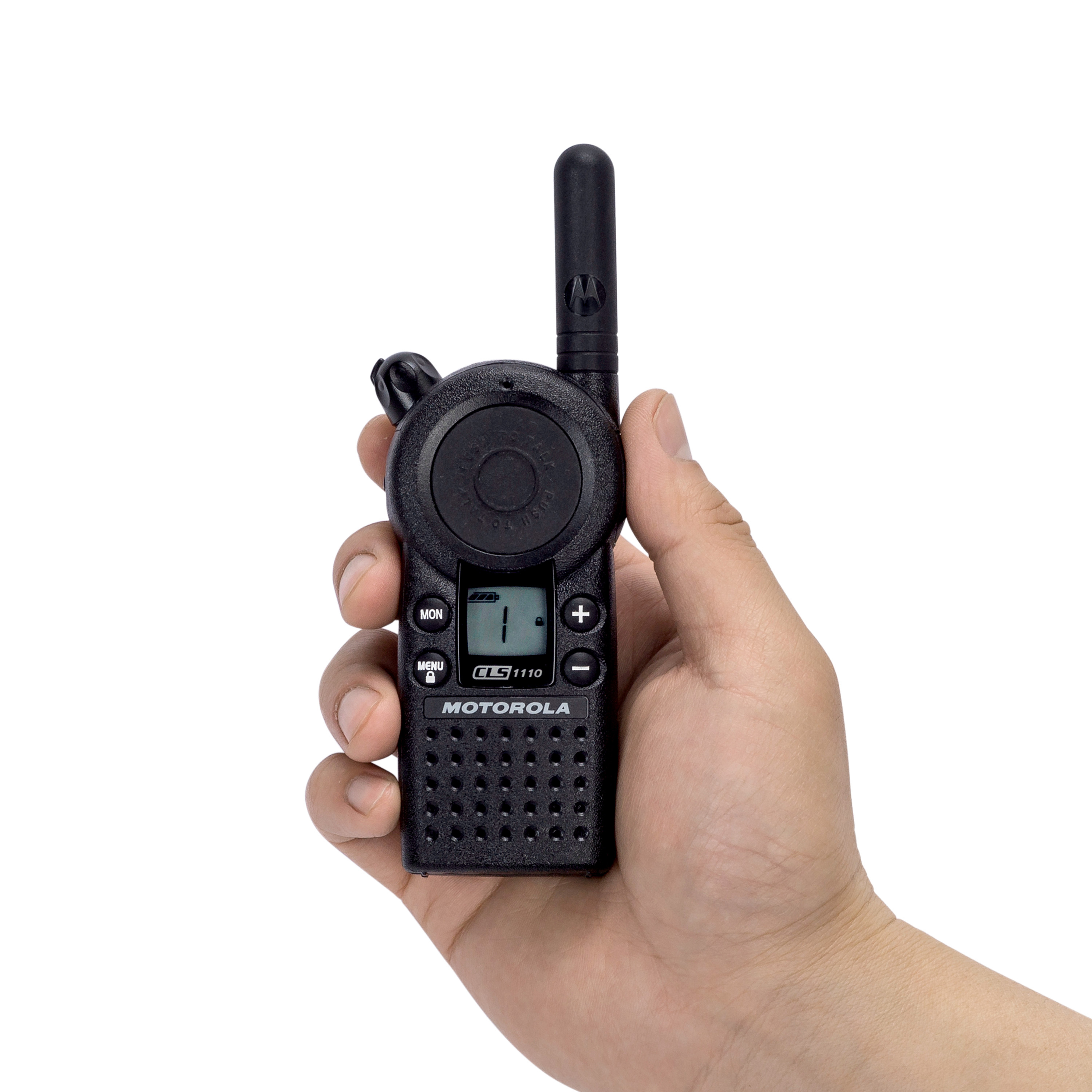
The Motorola CLS1410 is the best radio for churches running multiple departments. 200,000 sq ft of reliable coverage across multi-floor buildings and rated IP55 — the highest wet rating on this page so it will perform in rainy parking lots. The CLS1410 is the most common church fleet we ship, because four channels is the number most churches actually need and the speaker gives you the flexibility the CLP1010e doesn't.
| Specification | Detail |
|---|---|
| Frequency | UHF 460–469 MHz |
| Power | 1 watt |
| Channels | 4 |
| Indoor Coverage | Up to 200,000 sq ft / 15 floors |
| Battery Life | Up to 14 hours |
| Weight | Under 5 oz |
| Audio | External speaker + VOX; VibraCall silent alert |
| Durability | IP55, MIL-SPEC 810 |
Pros:
- Four channels map onto the standard church plan — ushers, nursery, security, facilities — with no channel left over and none missing
- Speaker or earpiece by role: back-of-house hears it on the belt, front-of-house wears one
- VibraCall pages a volunteer silently mid-service, which the earpiece-only models can't do without audio
- IP55 handles a parking-lot volunteer in the rain better than anything else here
Cons:
- Earpieces are an accessory, not included, and someone has to make sure they're worn
- Bulkier than the CLP1010e on a lapel carry
Buy this if more than one ministry is live during the same service and you want the option of speaker or earpiece by role. Skip it if every radio is going to a volunteer seated in the sanctuary — the CLP1010e removes the earpiece problem entirely — or if you have classrooms below grade, where the PKT-300's 2 watts holds up better.
Buy the Motorola CLS1410 Four-Channel Business Radio — View specifications, pricing, and multi-unit charging accessories.
What's the Best Two-Way Radio for Church Security Teams?
Kenwood ProTalk PKT-300
Quick Summary: Kenwood ProTalk PKT-300
- Best For: Church security teams, parking attendants, and facilities with stairwells, masonry, or basement classrooms.
- Key Specifications: 2 Watts UHF (450–470 MHz) | 6 Channels (expandable to 16) | 275,000 sq ft coverage | Up to 18-hour battery life (with battery saver).
- Primary Advantage: 2-Watt power output penetrates thick masonry, concrete basements, and extended parking areas where 1-Watt radios drop signal.
- Main Trade-off: IP52 water rating is lighter than the CLS1410; VOX hands-free mode requires an optional headset accessory.

The Kenwood PKT-300 is the best two-way radio for church security teams. Security is the one role that has to work where coverage is worst — a stairwell, a below-grade classroom corridor, the far end of the lot — and it's the role where a dead spot isn't an inconvenience, it's the whole point of the radio failing. Privacy Talk is another important reason, and it's narrower than it sounds. It scrambles voice so a conversation isn't casually intelligible to someone scanning the same frequency — useful when a security volunteer is describing a person or a situation and the usher channel doesn't need to hear it. Treat it as discretion, not encryption.
| Specification | Detail |
|---|---|
| Frequency | UHF 450–470 MHz, 99 preset frequencies |
| Power | 2 watts (high) / 0.5 watts (low, selectable) |
| Channels | 6 standard, expandable to 16 |
| Indoor Coverage | ~275,000 sq ft |
| Battery Life | ~14 hrs (battery saver off) / ~18 hrs (battery saver on); 2,200 mAh lithium-ion |
| Weight | 4.87 oz |
| Audio | External speaker; VOX requires an optional headset; Privacy Talk voice scrambling |
| Durability | IP52, MIL-STD-810 C–H |
Pros:
- 2 watts — the only radio here with real reach into stairwells, basements, and across a parking lot
- Privacy Talk keeps a security conversation from being casually overheard on a shared frequency
- Ships with 6 channels and opens to 16, so security and parking can split as the team grows
- 18 hours with battery saver enabled
Cons:
- VOX hands-free operation requires an optional headset — it won't activate off the built-in mic
- Slightly heavier than the CLP1010e
Buy this if your security or parking volunteers work stairwells, basements, or the lot. Skip it if security is one person standing in the lobby.
Buy the Kenwood ProTalk PKT300 Radio — View specifications, pricing, and multi-unit charging accessories.
What's the Best Two-Way Radio for a Multi-Building Church Campus?
Motorola Curve
Quick Summary: Motorola Curve
- Best For: Multi-building church campuses, large ministries, and sanctuaries with heavy wireless AV/production gear.
- Key Specifications: 1 Watt Digital 900 MHz (FHSS) | 10 Channels | 300,000 sq ft coverage | 11.5–16 hour battery life | License-free operation.
- Primary Advantage: Frequency-Hopping Spread Spectrum (FHSS) technology avoids interference from sanctuary wireless mics, in-ear monitors, and Wi-Fi networks.
- Main Trade-off: Uses a 900 MHz digital protocol and cannot communicate with existing analog UHF radios.
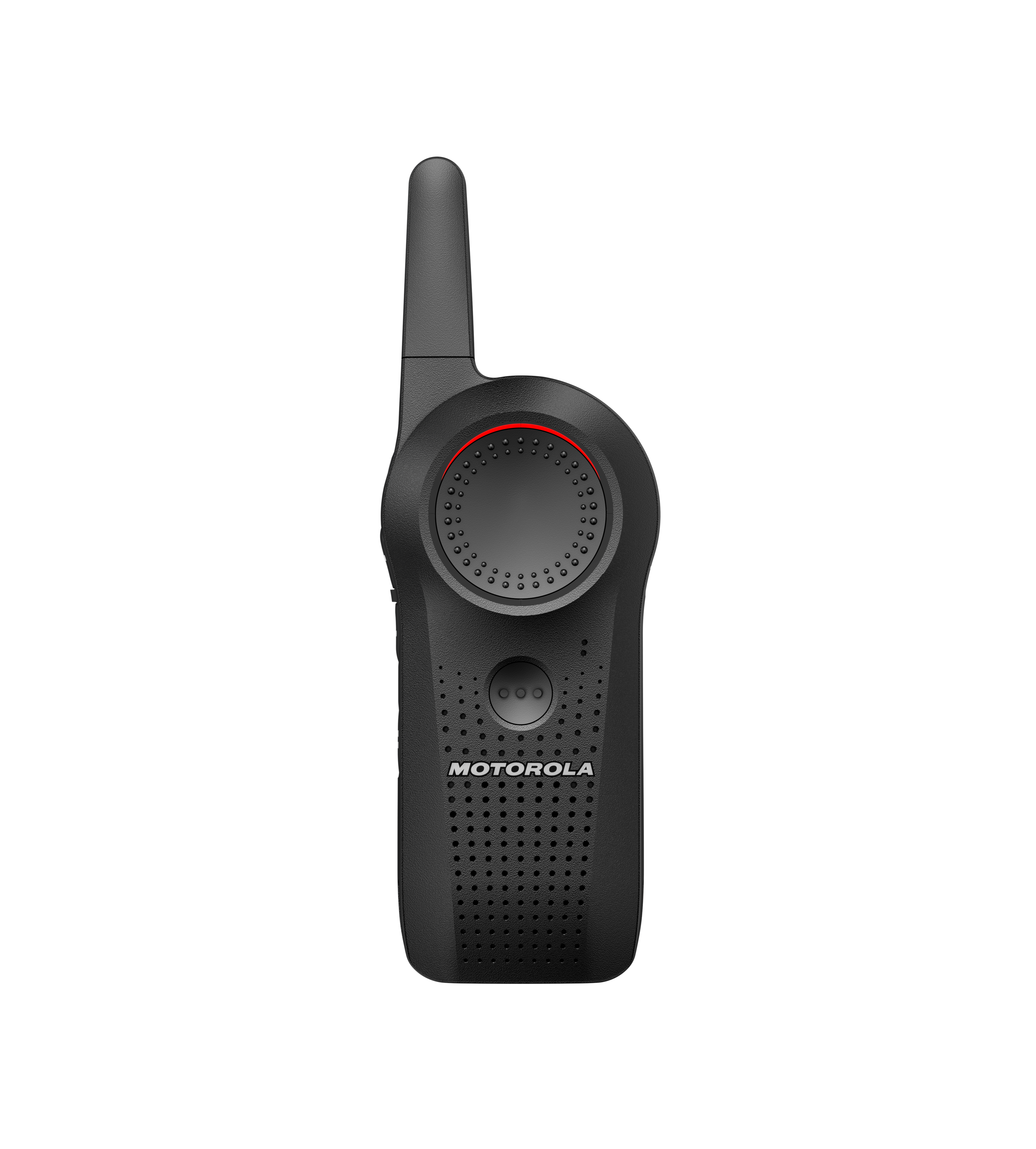
The Motorola Curve is the best radio for large churches. Its 300,000 sq ft / 20-floor digital coverage offers enough dependable coverage for multiple buildings. The Curve is a different kind of radio, not a bigger one — 900 MHz digital instead of analog UHF, which is why it does two things the other three can't. It holds a signal across separate buildings where 1 watt of UHF gives out, and it stays clear in a sanctuary running wireless mics and in-ear monitors, because it's hopping across a band that production gear doesn't use. If your radios have ever gone choppy during a service and nobody could explain why, that's the problem this solves.
| Specification | Detail |
|---|---|
| Frequency | 900 MHz, FHSS digital, license-free |
| Power | 1 watt |
| Channels | 10 |
| Indoor Coverage | Up to 300,000 sq ft / 20 floors |
| Battery Life | 11.5 hrs standard (1,800 mAh); up to 16 hrs with optional high-capacity battery (2,500 mAh) |
| Weight | 5.11 oz (standard battery) |
| Audio | Built-in speaker; optional Wi-Fi hub adds voice assistant and voicemail |
| Durability | IP5X, MIL-STD-810 C–H, antimicrobial housing |
Pros:
- The only radio here built for genuinely separate buildings — 300,000 sq ft / 20 floors
- FHSS digital sidesteps the wireless-mic and Wi-Fi congestion that makes analog UHF unreliable in a production-heavy sanctuary
- License-free on 900 MHz, so no FCC paperwork on a large fleet
- Ten channels, enough to give parking, security, and an event team their own lines
Cons:
- Not communication compatible with analog radios. Won't talk to your CLP1010e, CLS1410 or PKT-300 — different protocol, not just a different frequency.
- 11.5 hours on the standard battery is the shortest on this page; budget for the high-capacity pack if you run three services plus evening programming
- Highest price of the four
Buy this if you're covering more than one building, or your sanctuary's RF environment is already causing problems. Skip it if everything happens under one roof — you'd be paying a premium for coverage and interference resistance you don't need, and the PKT-300's 2 watts is the more cost effective answer for a single building.
Buy the Motorola Curve Handheld Digital Radio — View specifications, pricing, and multi-unit charging accessories.
Other Church Radio Models to Consider
If your worship facility requires additional channel capacity, ultra-discreet form factors for formal attire, or heavy-duty hardware for outdoor parking detail, these three models are exceptional alternatives worth considering:
1. Motorola RMU2040 — Heavy-Duty Security & Outdoor Parking Detail
Quick Summary: Motorola RMU2040
- Best For: Church parking ministries, physical security teams, and facilities maintenance staff operating outdoors or in harsh weather.
- Key Specifications: 2 Watts UHF (450–470 MHz) | 4 Channels | Up to 250,000 sq ft / 20 floors coverage | 12–15 hour battery life | IP55 dust & water-jet rated.
- Primary Advantage: 2-Watt output power penetrates heavy brick, stone, and steel sanctuary structures; IP55 housing handles heavy rain on parking detail.
- Main Trade-off: Bulkier chassis (8.6 oz) compared to slim earpiece models; larger footprint on formal Sunday attire.
2. Motorola RMU2080d — Multi-Department Staff & Display Simplicity
Quick Summary: Motorola RMU2080d
- Best For: Multi-department church staff (Nursery, AV/Tech, Security, Ushering) needing an easy-to-read display to confirm channel selection.
- Key Specifications: 2 Watts UHF (450–470 MHz) | 8 Channels | Front Digital LCD Display | Up to 250,000 sq ft / 20 floors coverage | IP55 rating.
- Primary Advantage: Clear LCD screen eliminates channel confusion for Sunday volunteers; 8 dedicated channels keep departments separated.
- Main Trade-off: Slightly higher price point than non-display 2-watt models; requires earpieces for quiet sanctuary environments.
3. Motorola SL300-U — Ultra-Slim Digital Discretion for Ministry Leaders
Quick Summary: Motorola SL300-U
- Best For: Executive pastors, sanctuary coordinators, and greeters who need an ultra-thin, suit-pocket radio with digital clarity.
- Key Specifications: 3 Watts Digital (DMR) / Analog UHF | 2 Channels | Under 1 inch thin | Up to 15-hour battery life | Micro-USB charging | IP54 rating.
- Primary Advantage: Ultra-slim profile slips invisibly into suit jackets or formal attire; 3 watts of digital power clears massive worship halls without static.
- Main Trade-off: 2-channel entry model; 99-channel display variant (SL300-UD) required if managing more than two departments.
Why Avoid Budget Consumer Radios (Retevis, Baofeng, FRS)
This comes up on nearly every church call, and more often here than in most industries — a church budget is money the congregation gave, and spending it carefully is the right instinct, not a problem to talk someone out of. A six-pack from a marketplace listing costs less than one business-grade radio. What does a church actually give up? We don't carry these brands, so treat what follows as a dealer's view rather than a neutral one. But the reasoning isn't about brand loyalty — it's about three things specific to how a church uses radios.
There Is No Earpiece-Only Option
This is the one that ends it for most churches. Cheap multi-packs are built around a speaker, and the accessory ecosystem is usually a single proprietary earbud. There is no consumer equivalent of the CLP1010e — a radio with no external speaker at all, where silence is designed in rather than depending on someone remembering to turn the volume down.
In a sanctuary that matters more than any durability spec. A squelch break during a prayer is the failure this whole category exists to prevent, and a consumer radio can't structurally prevent it.
The Band Is Shared With the Public
Most cheap radios are FRS — the license-free consumer band, 22 channels, no exclusivity. In a town where the church next door, a landscaping crew, and a construction site all bought the same multi-pack, you'll hear them and they'll hear you.
For a church that means conversations about a family in crisis, a security concern, or a child in the nursery going out on a channel anyone with a $30 radio can listen to. Privacy codes reduce what your radios play; they don't stop anyone from hearing you.
Power Is Capped by Regulation, Not Build Quality
FRS is limited to 2 watts on most channels with fixed antennas by rule. That's why a consumer radio that works in the sanctuary still drops in the basement fellowship hall or the far end of the lot — the ceiling is legal, and paying more within the category doesn't move it.
Older church buildings make this worse. Masonry and block are exactly what a low-power fixed-antenna radio handles worst.
Three Things Worth Checking on Any Brand, Ours Included
- Is the durability rating tested or claimed? MIL-STD-810 and IP ratings mean something when the manufacturer publishes the test range. "Military grade" with no standard named means nothing.
- Does the battery figure disclose a duty cycle? A number without 5/5/90 behind it isn't comparable to one that has it.
- Who honors the warranty, and for how long? A two-year manufacturer warranty with a domestic repair network is a different asset than a seller-fulfilled replacement policy from a marketplace account.
If Budget Is the Constraint
The honest answer isn't "buy the expensive one." Two better paths exist. Buy fewer, and add later. Four business-grade radios that cover the roles that genuinely need them — ushers lead, nursery, security, facilities — work better than twelve consumer radios covering everyone. All the analog UHF models here share channels, so you can add units next budget cycle without replacing anything.
Start at the entry point. Business-grade sits closer to consumer pricing than most churches expect. The single-channel CLP1010e includes its earpiece in the box, carries published durability testing, and comes with a real warranty — and for a congregation where one team shares one line, it's the right radio regardless of budget. One more consideration specific to churches: a radio replaced every eighteen months is a recurring line in a budget that has to be justified annually. A fleet bought once and supported for six years isn't just cheaper — it's a decision nobody has to revisit.
Frequently Asked Questions About Church Radios
Can we just use consumer walkie talkies from a big-box store?
You could, and for a very small church it sometimes works. The two things that go wrong: consumer FRS radios have a fixed low power output that struggles the moment a signal has to cross a masonry wall or reach a basement classroom, and there's no earpiece ecosystem, so sanctuary silence becomes difficult. There's also no channel privacy — a nearby business or another church on the same frequency will come through your radios and hear yours. Business-grade radios cost more once instead of less repeatedly.
Do the radios arrive ready to use, or do we have to program them?
Yes, the radios come ready to use right out of the box. Additional programming may be required if you need to eliminate outside interference (by updating the frequencies and privacy codes) or if you need to unlock specific features like VOX or VibraCall. (The Kenwood PKT300 does require dealer programming if you want to upgrade from 6 to 16 channels)
Can we add radios later or mix in ones we already own?
Usually yes, within the same technology. The CLP1010e, CLS1410 and PKT-300 are all analog UHF and can share a channel when programmed to matching frequencies and privacy codes. The Curve cannot: it's 900 MHz digital, a different protocol entirely, so it won't talk to any of the other three. Send us model numbers of anything you already have and we'll confirm before you order.
What's the best radio for nursery and children's ministry?
The CLS1410, in most churches. A dedicated nursery channel lets a worker reach a parent in the sanctuary without leaving the room — the difference between a discreet page and walking a crying child down the aisle mid-sermon. For a small nursery sharing one team channel, the CLP1010e's earpiece-only audio keeps things quiet around sleeping infants.
Are there monthly fees to use walkie talkies?
No, for standard radio-to-radio use on all four models. No airtime, no contract, no app required. The only exception is the Curve's optional Wi-Fi features — voice assistant, voicemail, and direct call — which need a Curve Portal subscription. Basic push-to-talk on the Curve does not.
Do the radios work if the power goes out?
Yes, all four run entirely on battery, independent of the building's electrical system. This is the practical advantage over an intercom or a Wi-Fi-dependent system during a storm or outage. The Curve is the one caveat: its optional Wi-Fi features depend on your network staying up, though radio-to-radio push-to-talk keeps working regardless.
Why Buy Church Radios from Tech Wholesale
We've been an authorized Motorola and Kenwood dealer since 1997, and church fleets are some of the most common we build — small rural congregations through multi-campus operations.
Every radio carries the full manufacturer warranty — two years on the commercial-grade models here. No gray-market units, nothing refurbished sold as new.
What sets us apart:
- Lifetime technical support included with every purchase — call or email our team for the life of your radio fleet, not just during the warranty period.
- Quick Quotes — request a quote sized to your congregation's specific departments and building layout.
- Authorized dealer status — buying from an authorized dealer keeps your warranty valid and your radios covered under Motorola's and Kenwood's guarantee.
- Accessory expertise — we carry the full range of compatible earpieces, speaker-mic combinations, multi-unit chargers, and carry solutions for every model in this guide.
- Every spec in this guide is pulled directly from Motorola's and Kenwood's own published documentation rather than reseller copy
Request a Church Radio Quote Find My Radio Tool
Related Reading
Related Industry Communication Guides
- Motorola CLP1010e On-Site Business Radio — Single-channel, earpiece-only ultra-compact walkie talkie for sanctuary discretional use.
- Motorola CLS1410 Four-Channel Business Radio — Multi-department 1-watt UHF radio featuring VibraCall silent alerts and IP55 water resistance.
- Kenwood ProTalk PKT-300 Heavy-Duty Radio — 2-watt high-power UHF radio designed for church security teams, stairwells, and parking lots.
- Motorola Curve 900 MHz Digital Smart Radio — License-free frequency-hopping digital radio built for multi-building church campuses.
- Find My Radio: Interactive Two-Way Radio Selection Tool — Get a customized radio recommendation based on your building square footage, wall materials, and team size.
Official Technical & Regulatory Resources
- NFPA 101: Life Safety Code (Assembly Occupancies) — Official National Fire Protection Association standards for emergency communications in houses of worship.
- FCC Consumer Guide: Two-Way Radios & Walkie-Talkies — Federal Communications Commission guide on business frequencies, power limits, and licensing requirements.
- Motorola Solutions Commercial Business Radios — Official manufacturer documentation and technical specification sheets.
- Kenwood USA ProTalk PKT-300 Official Specification Sheet — Technical specifications for Kenwood business radio hardware.