
The Best Two-Way Radios for Stadiums and Arenas (2026 Guide)
What Are the Best Two-Way Radios for Stadiums and Arenas?
The Short Answer
The best two-way radios for stadiums and arenas are the Motorola CP100d-UD, the Motorola DTR700, and the Motorola Mag One BPR50dx. Each addresses a different stadium communication challenge: the CP100d-UD handles large multi-department venues with 160 channels and 4-watt UHF output; the DTR700 delivers digital communication with FHSS encryption and coverage up to 350,000 sq ft; and the BPR50dx provides 5-watt UHF output in a durable, field-tested form factor well-suited to outdoor stadium environments. For operations spanning multiple venues or cities, the Motorola WAVE PTX series removes range as a constraint entirely via LTE and Wi-Fi.
Stadium communication environments combine some of the most demanding RF conditions of any commercial setting: dense concrete and steel construction, 10,000 to 100,000+ occupants generating crowd noise above 120 dB, multi-level and underground zones, and staff roles spanning security, concessions, operations, and guest services all running simultaneously.
A radio that works reliably in a warehouse or hotel will frequently underperform in a large venue. This guide covers what makes stadium communication uniquely difficult, what specifications actually matter, and which radios are suited to the environment.
Why Stadiums and Arenas Present Unique Radio Challenges
Most commercial radio deployments deal with one or two obstacles: building penetration, noise, or range. Stadium environments stack all of these simultaneously, and then add a few more unique to large-assembly venues.
Extreme crowd noise. Crowd noise in major stadiums has been measured above 130 dB during peak play—a level comparable to a jet engine at close range. Under OSHA Standard 29 CFR 1910.95, employers must implement a hearing conservation program when workers are exposed to an 85 dB eight-hour time-weighted average. In a stadium environment, staff working security perimeter, field operations, or concourse positions regularly exceed this threshold during events. Radios deployed here require high-gain noise-canceling microphone arrays capable of isolating voice signal from ambient noise, and earpieces that seal against ambient sound on the receiving end.
Dense RF interference. A sold-out arena can contain tens of thousands of smartphones, Bluetooth devices, and active Wi-Fi connections competing for radio frequency spectrum. This RF congestion degrades analog radio performance noticeably. Digital radios—particularly those using Frequency Hopping Spread Spectrum (FHSS) technology like the Motorola DTR series—are significantly more resistant to interference in these environments because the signal hops frequencies dozens of times per second rather than occupying a fixed channel.
Complex building geometry. Stadiums contain underground tunnels, multi-level seating structures, reinforced concrete concourses, press boxes, locker rooms, and parking structures. Each of these presents a distinct RF challenge. Underground and below-grade areas absorb signal and may require repeater infrastructure to maintain reliable coverage. UHF frequencies (400–470 MHz) penetrate concrete and masonry better than VHF (136–174 MHz), making UHF the standard choice for stadium deployments.
Multi-department operational complexity. A major stadium event may coordinate security, crowd management, concessions, facility maintenance, field operations, medical response, parking, media relations, and executive management—all simultaneously. Each group has different communication priorities, and cross-talk between departments reduces operational efficiency and creates confusion during critical incidents. Radios supporting 64–160+ channels allow administrators to assign dedicated channels by department and create escalation paths for emergencies.
Extended shift duration. Stadium staff work shifts from pre-event setup through post-event cleanup, often 10 to 14 hours. Battery life is a mission-critical specification, not a convenience feature. A radio that dies at halftime is not a minor inconvenience—it is a gap in emergency communication coverage.
Emergency coordination obligations. The National Fire Protection Association's NFPA 101 Life Safety Code sets requirements for emergency egress in assembly occupancies. Local fire marshal requirements for venues over specific occupancy thresholds frequently mandate internal radio communication systems that can support emergency evacuation coordination. A professional radio system meets this functional requirement; consumer-grade walkie-talkies typically do not.
What to Look for in a Stadium or Arena Two-Way Radio
Output Power and Frequency
Output power determines how far a radio's signal can penetrate building materials and travel before degrading. For stadium environments, the baseline recommendation is 3–5 watts on UHF analog, or 1 watt digital (equivalent to approximately 4 watts analog in effective range). UHF frequencies (400–480 MHz) are the correct choice for venues with thick concrete and steel construction.
Digital radios require a separate calculation. A 1-watt digital signal using FHSS technology covers comparable or greater area than a 4-watt analog signal in many conditions, due to the efficiency of digital modulation and the interference resistance of frequency hopping.
Indoor Coverage Rating
Manufacturer indoor coverage ratings are measured under controlled conditions in typical commercial construction. Stadium environments frequently perform below this rating due to exceptional wall thickness and RF congestion. When selecting a radio, look for a rated indoor coverage meaningfully above your venue's square footage—generally at least 1.5 to 2x your actual floor area—to account for signal degradation in heavy-construction environments.
Channel Capacity
Multi-department stadium operations typically require a minimum of 8–10 dedicated channels to cleanly separate communication streams. Venues with large security teams, field operations staff, and management escalation requirements should target 64–160 channels to accommodate future growth and event-specific channel plans. Single-digit channel counts are insufficient for any venue with more than two or three operational departments.
Battery Life
A minimum 10-hour rated battery life is required for single-shift stadium operations. For venues running double shifts, double-header events, or overnight facilities management, plan for either extended-capacity batteries or dedicated mid-shift charging infrastructure. Multi-unit charging cradles that can charge 6 to 12 radios simultaneously are standard equipment in large stadium deployments.
Durability Rating
Stadium environments expose radios to outdoor weather (for open-air venues and parking operations), physical impact from drops, and in concessions areas, water and food exposure. Radios meeting MIL-STD-810 environmental testing standards and carrying IP54 or higher ingress protection ratings are appropriate for this use. MIL-STD-810 tests devices for shock resistance, vibration, humidity, temperature extremes, and other physical stressors relevant to commercial field use.
Recommended Two-Way Radios for Stadiums and Arenas
1. Motorola CP100d-UD — Best for Large Multi-Department Venues
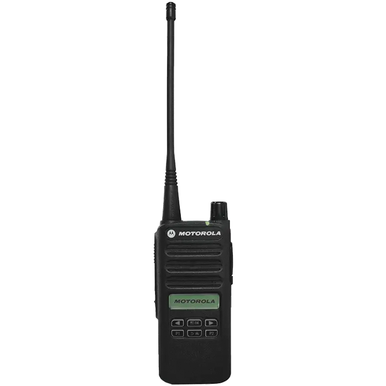
| Specification | Detail |
|---|---|
| Frequency | UHF (403–480 MHz) |
| Power | 4 watts |
| Channels | 160 |
| Mode | Analog & Digital |
| Indoor Coverage | Up to 400,000 sq ft / 40 floors |
| Durability | Rugged, water-resistant |
| Display | Yes (with partial keyboard) |
The CP100d-UD is the strongest general-purpose choice for large stadium and arena deployments. Its 160-channel capacity supports full department segmentation across every operational group a major venue requires, with room for event-specific channel plans and future growth. At 4 watts UHF, it delivers reliable penetration through the concrete and steel construction typical of large sports facilities.
Why it fits stadium environments specifically
- 160 channels accommodate security, concessions, maintenance, guest services, field operations, medical, parking, and management on dedicated frequencies simultaneously
- Dual analog/digital mode means it can integrate into existing analog radio infrastructure while allowing departments to operate in digital mode for improved audio quality and battery efficiency
- 4-watt UHF output with rated indoor coverage of 400,000 sq ft provides signal depth appropriate for large stadium structures
- Display screen allows staff to visually confirm active channel without audible feedback—useful in loud environments
- Rugged, water-resistant build handles outdoor and concourse conditions
Consideration: The CP100d-UDK variant adds a full keyboard for alphanumeric messaging if your deployment requires it.
2. Motorola DTR700 — Best Digital Option

| Specification | Detail |
|---|---|
| Frequency | Digital 900 MHz (902–928 MHz), FHSS |
| Power | 1 watt digital (equivalent to ~4 watts analog) |
| Channels | 50 |
| Indoor Coverage | Up to 350,000 sq ft |
| Key Features | Private reply, Call All, FHSS encryption |
The DTR700 operates on Frequency Hopping Spread Spectrum (FHSS) digital technology in the 900 MHz band, which makes it uniquely suited to the high-RF-interference environment inside a large arena or stadium. Because its signal hops frequencies dozens of times per second, it is significantly less vulnerable to the congestion caused by dense crowds of smartphones and Wi-Fi devices than fixed-channel analog radios. Its 1-watt digital output provides effective coverage comparable to a 4-watt analog radio, with cleaner audio and built-in FHSS encryption that protects security and management communications from interception by consumer scanning equipment.
Why it fits stadium environments specifically
- FHSS technology resists the RF interference generated by large crowds of smartphones and wireless devices—a direct match to the stadium use case
- Built-in encryption protects sensitive security and management communications without additional hardware or configuration
- Private reply and Call All features support both one-to-one coordination and mass emergency notifications from a single device
- 50-channel capacity handles department segmentation for mid-size venues and event-specific channel assignments
Consideration: 50-channel capacity, while sufficient for most arenas, may be limiting for the largest multi-department stadium operations. For venues requiring 100+ channels, the CP100d-UD is the better fit. The DTR700 is particularly well-suited to indoor arenas, theaters, and convention center-scale sports facilities.
3. Motorola Mag One BPR50dx-U — Best for Field and Outdoor Stadium Operations

| Specification | Detail |
|---|---|
| Frequency | UHF (400–470 MHz) |
| Power | 5 watts |
| Channels | 64 |
| Mode | Analog & Digital |
| Indoor Coverage | Up to 375,000 sq ft / 35 floors |
| Durability | Rugged use, water-resistant |
The BPR50dx-U delivers the highest output power of the three recommended radios at 5 watts UHF, making it the strongest choice for outdoor stadium environments, parking operations, open-air venues, and field-level staff who operate at the outer range limits of a stadium's footprint. Its 64-channel capacity handles full department segmentation for mid-to-large venues, and its dual analog/digital mode allows it to interoperate with existing radio infrastructure during the transition to digital.
Why it fits stadium environments specifically
- 5-watt UHF output provides the deepest penetration of any radio in this guide—appropriate for open-air stadium structures and parking lot perimeter operations
- 64 channels support comprehensive department segmentation while remaining manageable for staff to navigate
- Dual analog/digital mode enables interoperability with legacy radio systems already deployed at many established venues
- Rugged build rated for field-use conditions, including water resistance for outdoor event weather exposure
Also Worth Considering
Motorola SL300-UD — 3 watts, 99 channels, UHF (403–470 MHz), dual analog/digital, slim form factor. A strong choice for management and guest services staff who need professional capability with a lower-profile radio design.
Motorola R2-UA — 4 watts, 64 channels, UHF (400–480 MHz), analog/digital. A durable mid-tier option for venues that need higher wattage UHF without the full channel count of the CP100d series.
Kenwood NX-P1300AUK — 4 watts, 64 channels, UHF (451–470 MHz), analog (upgradeable to digital). A solid alternative for venues that prefer Kenwood's build quality or need compatibility with existing Kenwood infrastructure.
Motorola WAVE PTX — Unlimited range via LTE and Wi-Fi, with failsafe antenna-to-antenna coverage up to 350,000 sq ft when cellular is unavailable. The correct choice for multi-venue operations, franchise stadium groups, or venues requiring communication across cities or regions.
Coverage by Venue Size: Matching Radio to Stadium Scale
| Venue Type | Approx. Square Footage | Recommended Radio | Notes |
|---|---|---|---|
| Small arena / community center | Under 100,000 sq ft | Motorola DTR700 | FHSS interference resistance |
| Mid-size arena / minor league venue | 100,000–250,000 sq ft | Motorola DTR700 or BPR50dx-U | DTR700 for indoor; BPR50dx for outdoor/open-air |
| Large arena / major indoor venue | 250,000–400,000 sq ft | Motorola CP100d-UD or BPR50dx-U | 160-channel capacity for full department segmentation |
| Major stadium / open-air / NFL/MLB scale | 400,000+ sq ft | Motorola CP100d-UD + repeater infrastructure | Repeater system recommended for underground zones |
| Multi-venue / multi-city operation | Unlimited | Motorola WAVE PTX | LTE/Wi-Fi, GPS tracking, smartphone integration |
For venues with exceptionally thick masonry construction or significant underground zones (locker rooms, tunnels, below-grade concourses), plan coverage as if the venue is 1.5x its actual square footage for radio selection purposes. A repeater system is the most reliable solution for persistent below-grade dead zones.
Channel Planning for Stadium Operations
Channel discipline is as important as radio selection in a large-venue deployment. Without a defined channel plan, departments talk over each other, critical transmissions get buried in routine chatter, and emergency escalation becomes unreliable.
A standard stadium channel structure for a major venue looks like this:
| Channel | Department | Use |
|---|---|---|
| 1 | Security | Internal security team coordination |
| 2 | Security → Command | Escalation to security command / venue management |
| 3 | Concessions | Inventory, restocking, staff coordination |
| 4 | Facility Maintenance | Spills, repairs, restroom upkeep |
| 5 | Guest Services | ADA assistance, lost and found, fan support |
| 6 | Field / Event Operations | Field crew, setup/teardown, event-specific staff |
| 7 | Parking / Perimeter | Parking staff, entry gate coordination |
| 8 | Medical Response | EMT and medical staff |
| 9 | Management | Cross-department coordination, executive communications |
| 10 | All-Call / Emergency | Venue-wide broadcast for emergency notifications |
The 160-channel capacity of the CP100d-UD allows this base structure to be replicated or expanded for different event types, visiting team operations, or broadcast media coordination without reusing or doubling up channels.
Hands-free accessories are standard equipment in stadium deployments. Remote speaker microphones (RSMs) allow staff to transmit and receive while keeping both hands engaged with their primary tasks. Earpieces reduce ambient noise reaching the receiver in loud concourse environments. Tech Wholesale carries a full range of CP100d accessories and DTR accessories for stadium configurations.
Compliance Considerations
OSHA Noise Exposure
Under OSHA Standard 29 CFR 1910.95, employers must implement a hearing conservation program when workers are exposed to 85 dB or higher as an 8-hour time-weighted average. Stadium staff working security perimeter, concourse, or field positions during events frequently exceed this threshold. Employers in these environments should ensure that radio earpieces used by staff comply with OSHA hearing protection guidance. Professional earpieces designed for commercial radio use—such as those available for the CP100d-UD and DTR700—are appropriate for this context.
NFPA 101 Life Safety Code
Assembly occupancies are subject to NFPA 101 Life Safety Code requirements covering emergency egress and occupant notification. While NFPA 101 does not specify radio technology, many local fire marshal implementations of the code for large-assembly venues require internal communication systems that can support real-time emergency evacuation coordination. A commercial radio system operating on dedicated channels meets this functional requirement. Consult your local authority having jurisdiction (AHJ) for specific requirements applicable to your facility.
Frequently Asked Questions
What is the best two-way radio for a stadium or arena?
For most large stadiums, the Motorola CP100d-UD is the strongest all-purpose choice: 160 channels, 4-watt UHF output, rated indoor coverage of 400,000 sq ft, and dual analog/digital mode. For venues where RF interference from crowd density is a primary concern, the Motorola DTR700 is the strongest digital option. For outdoor and open-air stadium environments, the 5-watt Mag One BPR50dx-U provides the deepest signal penetration.
How much radio range does a stadium or arena need?
A typical major-league stadium ranges from 400,000 to over 1,000,000 sq ft of total facility space including parking structures, tunnels, and support areas. For the primary occupied venue structure, a radio rated at 350,000–475,000 sq ft indoor coverage at 3–5 watts UHF will typically provide reliable main-floor coverage. Coverage in underground zones (tunnels, locker rooms, below-grade concourses) almost always requires repeater infrastructure regardless of radio output power, as buried concrete absorbs signal regardless of wattage. Plan your repeater deployment based on a site survey rather than rated specs alone.
How long does the battery last on a stadium radio during a full event day?
Professional commercial radios in the CP100d and DTR700 class carry battery ratings of 10–12 hours under normal transmission loads. A typical stadium event day—including setup, event, and post-event operations—runs 10 to 14 hours. For events at the longer end of this range, multi-unit charging cradles that allow mid-shift battery swaps are standard equipment. Tech Wholesale can advise on charging infrastructure appropriate to your fleet size.
Do two-way radios work in stadium tunnels and locker rooms?
Performance in below-grade and underground areas depends on construction materials and the output power of the radio. Most below-grade stadium environments have sufficient concrete mass to significantly reduce signal strength for any radio, regardless of wattage. For reliable below-grade coverage, the practical solution is a repeater system—a device that receives and retransmits radio signals to extend coverage into areas with limited direct signal penetration. Tech Wholesale carries commercial repeaters appropriate for stadium deployments and can assist with site-specific configuration guidance.
What is the durability rating I should look for in a stadium radio?
For stadium environments, look for radios rated for rugged or heavy-duty use, with at minimum IP54 ingress protection (dust and water splash resistance from any direction) and MIL-STD-810 compliance for shock and environmental resistance. The CP100d-UD and BPR50dx-U are both rated for rugged use and water resistance. MIL-STD-810 compliance means the radio has been tested against a standardized set of physical and environmental conditions including shock, vibration, humidity, and temperature extremes relevant to field use.
How many two-way radios does a stadium need?
A useful starting point is one radio per staff member in an operational role who needs real-time coordination: each security position, each concessions manager, each maintenance lead, each guest services station, and each management role on duty during an event. For a 20,000-seat arena, a typical deployment might range from 50 to 150 radios depending on staffing model and departmental structure. A small pool of spare radios—typically 10–15% of the active fleet—is standard practice to cover shift changes, equipment failures, and event-day additions. Tech Wholesale offers volume pricing for orders of five or more units; request a quote for fleet pricing.
Can two-way radios be used for emergency response coordination at stadiums?
Yes. Emergency coordination is one of the primary use cases for commercial radio systems in large-assembly venues. Dedicated emergency channels allow security command to issue venue-wide alerts without interrupting department-level communications on other channels. Radios with an emergency/panic button feature—available on many commercial models—allow individual staff members to trigger an immediate alert to a designated monitoring station. For venues subject to local fire marshal requirements or NFPA 101 Life Safety Code compliance obligations, a professional radio system supports the real-time coordination that emergency evacuation procedures depend on.
What accessories do stadium staff typically use with two-way radios?
The most common accessories in stadium deployments are remote speaker microphones (RSMs), which allow staff to transmit and receive with the radio clipped to a belt or vest without holding the radio; earpieces, which isolate received audio from ambient crowd noise; and multi-unit charging cradles for end-of-shift and mid-shift battery management. Security staff frequently use surveillance-style earpieces for discretion. Field operations staff in outdoor environments may use heavy-duty holsters and protective cases for impact resistance. Tech Wholesale carries accessories for all recommended models.
What is the difference between analog and digital two-way radios for stadiums?
Analog radios transmit a continuous signal on a fixed frequency. They are simpler and widely compatible with existing infrastructure but are more vulnerable to interference in RF-dense environments like crowded arenas, and their audio quality degrades progressively as signal weakens. Digital radios convert audio to a digital signal before transmission. They maintain clearer audio until signal drops below a threshold, are more resistant to interference, support features like encryption and private calling, and use power more efficiently (1 watt digital can cover comparable area to 4 watts analog). For new stadium deployments, dual-mode analog/digital radios like the CP100d-UD allow integration with existing analog systems while providing digital performance where it matters.
Why Buy from TechWholesale.com
Tech Wholesale has been selling professional two-way radios to stadiums, arenas, and large-venue operators since 1997. We are an authorized dealer for Motorola and Kenwood, which means every radio we sell carries the full manufacturer warranty—typically two years on commercial-grade models—and qualifies for manufacturer service and repair. Gray-market inventory does not.
What sets us apart for stadium buyers
- Lifetime technical support included with every purchase—call or email our team for the life of your radio fleet, not just during the warranty period. This matters more for stadium deployments than any other context, because fleet configurations, channel assignments, and staffing structures change.
- Quick quotes—request a custom quote
- Authorized dealer status—no gray-market inventory, no voided warranties, full manufacturer support eligibility
- Repeater and accessories inventory to support complete venue deployments, not just radio hardware
- Free shipping on qualifying orders
- No-pressure consultation—we will tell you when a less expensive configuration is the right answer for your venue
If you are not sure which radio and channel configuration fits your facility, use our Find My Radio tool or request a quote. We will ask a few questions about your venue size, department structure, and existing infrastructure and come back with a specific recommendation.
1-888-925-5982 Service@TechWholesale.com
Related Reading
On TechWholesale.com
- Commercial Repeaters for Extended Coverage
- Frequency Hopping Spread Spectrum (FHSS) Explained
- UHF vs. VHF – Frequencies Explained
- Privacy Codes – Eliminate Outside Interference
- VOX (Hands-Free) Explained
- Motorola WAVE PTX – Unlimited Range Radios
- Two-Way Radio Rentals for Events
- Lone Worker / Man Down Functionality
External Resources
- OSHA Occupational Noise Exposure Standard (29 CFR 1910.95)
- NFPA 101 Life Safety Code – Assembly Occupancies
- FCC Universal Licensing System (ULS)
Article by Kristin Wood, a two-way radio consultant @ Tech Wholesale | Authorized Motorola & Kenwood Dealer Since 1997 | Last Updated: May 2026