
The Best Two-Way Radios for Warehouses (2026 Guide)
What Are the Best Two-Way Radios for Warehouses?
The Short Answer
The best two-way radios for warehouses are the Motorola RMU2080, Motorola CP100d-UA, and Motorola DTR700. Each model addresses a different warehouse challenge: the RMU2080 delivers 2-watt UHF performance and 8 channels for mid-size operations; the CP100d-UA provides MIL-STD-810-rated rugged durability at 4 watts for budget-conscious teams; and the DTR700 uses 900 MHz digital frequency hopping to defeat the RF interference generated by RFID readers, Wi-Fi networks, and automated conveyor systems in large distribution centers. The right choice depends on your facility's square footage and RF environment.
Warehouses are one of the most signal-hostile environments in commercial real estate. Metal racking absorbs and scatters radio frequency energy. Forklifts and conveyor systems generate electrical noise. Concrete mezzanines block line-of-sight transmission. And workers spread across receiving, picking, packing, and shipping zones all need to communicate simultaneously without talking over each other.
Consumer walkie-talkies fail in these conditions. Professional two-way radios engineered for industrial environments do not. This guide covers what to look for, which models perform best, and how to match a radio to your facility's specific layout and operational requirements.
Why Warehouses Have Unique Communication Demands
Warehouses combine several RF-hostile conditions that no other commercial environment replicates in quite the same combination. Understanding the specific challenges helps you choose a radio that actually solves the problem rather than one that looks adequate on paper.
Metal racking and steel structure interference. Tall shelving units, steel mezzanines, and metal roof joists absorb and reflect radio frequency energy. UHF frequencies (400–512 MHz) navigate these obstacles better than VHF (136–174 MHz) in enclosed warehouse environments because their shorter wavelength diffracts around metallic obstructions more effectively.
RF interference from automation equipment. Modern warehouses run RFID scanners, Wi-Fi access points, automated conveyor systems, and Bluetooth-connected devices simultaneously. This electromagnetic noise floor can degrade standard analog radio transmission significantly. The Motorola DTR700's 900 MHz FHSS technology hops frequencies 50 times per second specifically to defeat this interference.
High ambient noise from machinery. Forklifts, pallet jacks, conveyor belts, and loading dock equipment routinely push ambient noise to 80–95 dB. Under OSHA Standard 29 CFR 1910.95, employers must implement a hearing conservation program when workers are exposed to 85 dB or higher as an eight-hour time-weighted average. Professional radios with noise-canceling microphones and high-output speakers are required to cut through this environment; consumer radios are not.
Multi-department coordination at scale. A warehouse operation typically runs receiving, picking, packing, shipping, floor supervision, and security as distinct communication groups. Without channel segmentation, every department hears every other department's traffic, creating coordination breakdown. Facilities running four or more distinct work groups need radios with at minimum 8 channels; larger operations benefit from 16 to 64 channels.
Physical abuse of equipment. Radios in warehouse environments get dropped on concrete, exposed to dust, and occasionally splashed with water from dock-level weather. A radio without IP54 ingress protection or MIL-STD-810 certification is a replacement cost waiting to happen.
Forklift safety communication. OSHA 29 CFR 1910.178 (Powered Industrial Trucks) establishes that forklift operators must be able to communicate hazards and coordinate traffic. Two-way radio communication is the accepted mechanism for this requirement in multi-aisle warehouse environments, particularly where line-of-sight is limited by racking height.
What to Look for in a Warehouse Two-Way Radio
UHF Frequency
For enclosed warehouse environments, UHF (400–512 MHz) consistently outperforms VHF in signal penetration through metal-dense structures. The shorter UHF wavelength diffracts around shelving and structural steel rather than reflecting off it. Most of the radios recommended on this page operate on UHF or 900 MHz digital frequencies for this reason.
Output Power: 2–4 Watts Minimum
1-watt radios are adequate for small retail floor plans but typically insufficient for warehouse distances. A 2-watt UHF radio covers most warehouses under 200,000 sq ft. For facilities with concrete mezzanines, multiple floors, or high racking above 30 feet, 4 watts provides meaningful headroom. The Motorola DTR700 operates at 1 watt on its 900 MHz digital signal but delivers equivalent coverage performance of a higher-power analog radio due to its FHSS digital technology.
Battery Life: 10 Hours Minimum
An 8-hour warehouse shift with active transmission depletes radios rated below 10 hours. For facilities running 10- or 12-hour shifts, or operations that cannot guarantee nightly charging, prioritize 12–16 hour ratings. The DTR700 leads the category at 16.5 hours; the RMU2080 and CP100d-UA both deliver approximately 12 hours under typical warehouse load.
Durability: IP54 and MIL-STD-810
IP54 is the minimum practical ingress protection rating for warehouse use: resistant to dust in quantities sufficient to harm equipment and to splash water from any direction. MIL-STD-810 certification (any revision: C/D/E/F/G) tests the radio for shock, vibration, humidity, altitude, and temperature extremes. Both standards are represented in the recommended models on this page.
Channel Count
Plan for one dedicated channel per distinct operational group. A baseline warehouse setup—receiving, shipping, floor supervisors, management—requires 4 channels minimum. Facilities with security staff, maintenance teams, or contractor crews benefit from 8 to 16 channels. Large 3PL operations or multi-building distribution centers should evaluate 50+ channel platforms like the DTR700 or the Kenwood NX-P1300AUK.
Hands-Free / VOX Capability
Forklift operators, pickers using both hands, and workers wearing gloves cannot hold a radio to transmit. VOX (voice-activated transmission) and compatible headset ports are essential features for any radio deployed in active picking or forklift zones. All four recommended radios support accessory ports for headsets and speaker-microphones.
Recommended Two-Way Radios for Warehouses
1. Motorola RMU2080 — Best Overall for Mid-Size Warehouse Operations
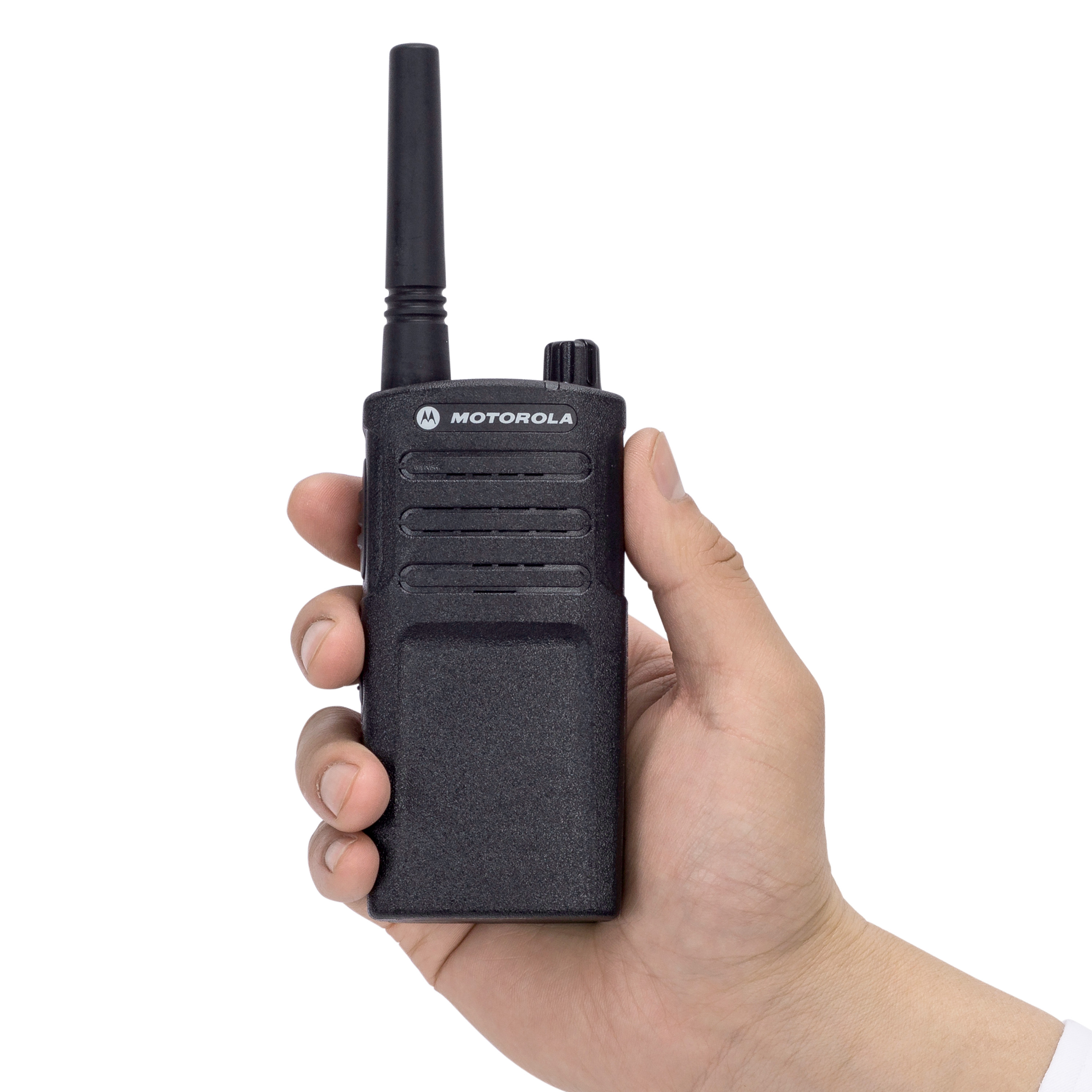
| Specification | Detail |
|---|---|
| Frequency | UHF (450–470 MHz) |
| Power | 2 watts |
| Channels | 8 |
| Indoor Coverage | Up to 250,000 sq ft / 20 floors |
| Battery Life | ~12 hours |
| Durability | IP54 water and dust resistance |
The RMU2080 is the strongest all-around choice for mid-size warehouse operations running 50,000 to 250,000 sq ft. Its 8-channel UHF design gives a warehouse team enough channel separation to isolate receiving, outbound shipping, floor supervisors, management, and a security line simultaneously. The IP54 rating handles the dust and splash conditions typical of receiving docks and warehouse floors. At 2 watts on UHF, it delivers reliable penetration through standard steel racking without the cost premium of a full 4-watt radio.
Why it fits warehouses specifically
- UHF frequency penetrates metal shelving, concrete mezzanines, and loading dock walls more reliably than VHF in enclosed environments
- 8 channels support full departmental segmentation for teams of 10–40
- 12-hour battery life comfortably covers a standard warehouse shift with active transmission
- IP54 rating meets the minimum practical standard for warehouse dust and splash exposure
- Compatible with speaker-microphone and headset accessories for forklift and picking zone use
2. Motorola CP100d-UA — Best Budget-Rugged Option for Demanding Environments
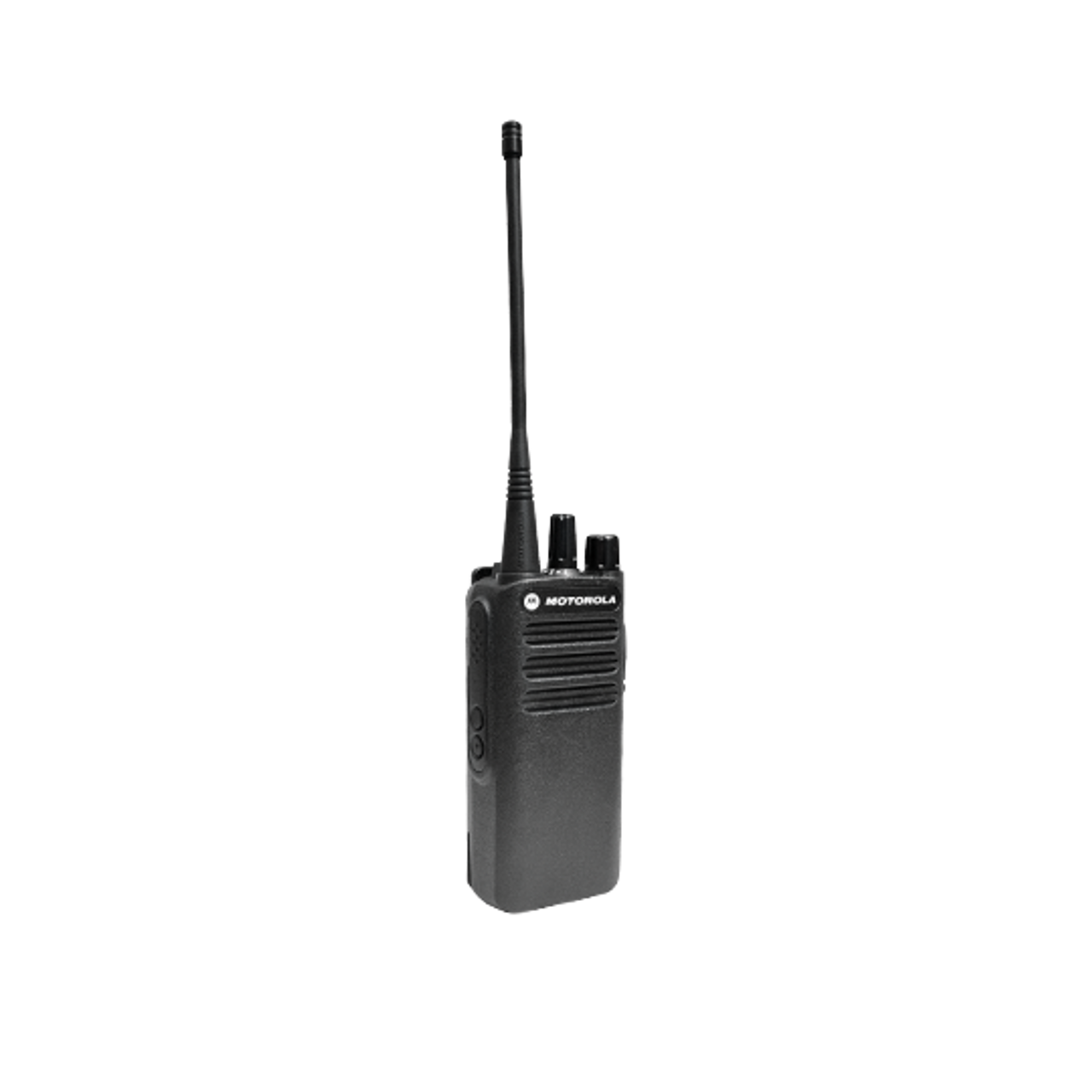
| Specification | Detail |
|---|---|
| Frequency | UHF (403–480 MHz) |
| Power | 4 watts |
| Channels | 16 |
| Battery Life | ~12 hours |
| Durability | MIL-STD-810 C/D/E/F (shock, vibration, humidity, temperature) |
The CP100d-UA is a professional-grade UHF radio built to MIL-STD-810 C/D/E/F standards, meaning it has been tested for shock, vibration, altitude, humidity, and temperature extremes. At 4 watts, it delivers more output power than any other radio on this list, giving it practical headroom in large-footprint or structurally complex warehouse environments. With 16 programmable channels, it scales to operations with multiple departments, shift supervisors, and contractor teams.
Why it fits warehouses specifically
- 4-watt UHF output provides the greatest signal penetration through heavy structural obstruction
- MIL-STD-810 C/D/E/F certification means the radio is tested for the physical punishment of daily warehouse use, including drops and temperature extremes
- 16 channels accommodate complex multi-department operations without frequency congestion
- No display model keeps the form factor compact and reduces UI complexity for line-level workers
Note: The CP100d-UDK variant adds a full keypad display and extends channel capacity to 160 for operations requiring advanced programmability.
3. Motorola DTR700 — Best for Large Distribution Centers and High-Interference Environments
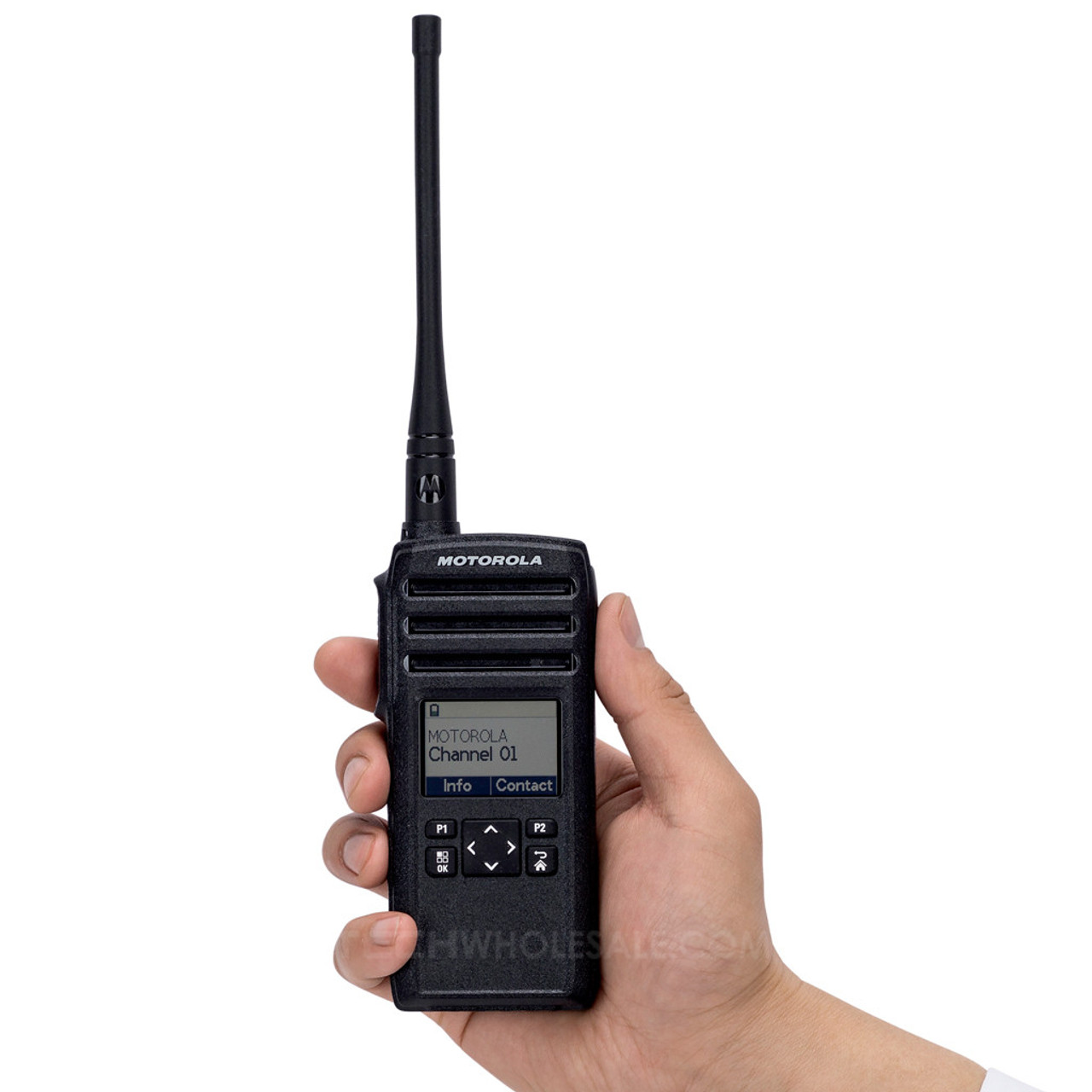
| Specification | Detail |
|---|---|
| Frequency | 900 MHz ISM Band (902–928 MHz) |
| Technology | Digital FHSS (Frequency Hopping Spread Spectrum) |
| Power | 1 watt (digital equivalent of ~4W analog) |
| Channels / Contacts | 50 channels / 200 individual contacts |
| Indoor Coverage | Up to 300,000 sq ft / 20 floors |
| Battery Life | Up to 16.5 hours |
| Durability | IP54, MIL-STD-810G |
The DTR700 occupies a category of its own for warehouses running significant automation technology. Its 900 MHz FHSS system hops across 75 frequencies 50 times per second, making it virtually immune to the interference generated by Wi-Fi networks, RFID scanners, Bluetooth devices, and conveyor motor systems—all standard in modern distribution centers. Transmissions are digitally encrypted, protecting logistics-sensitive communications from interception. At 16.5 hours of battery life, it runs through the longest shifts without requiring mid-shift swaps.
Why it fits large warehouses specifically
- FHSS technology makes it the most interference-resistant radio in its class—critical in RF-dense environments with RFID, Wi-Fi 6, and automation systems operating simultaneously
- Digital encryption protects sensitive logistics and inventory communications
- 16.5-hour battery life leads the category and eliminates mid-shift battery management
- 200-contact individual call capability supports direct worker-to-worker communication in addition to group channels
Side-by-Side Comparison
| Feature | RMU2080 | CP100d-UA | DTR700 |
|---|---|---|---|
| Output Power | 2W UHF | 4W UHF | 1W 900 MHz digital |
| Channels | 8 | 16 | 50 / 200 contacts |
| Indoor Coverage | 250,000 sq ft | Not rated (4W UHF) | 300,000 sq ft |
| Battery Life | ~12 hrs | ~12 hrs | 16.5 hrs |
| Durability Rating | IP54 | MIL-STD-810 C/D/E/F | IP54 + MIL-STD-810G |
| Interference Resistance | Standard analog | Standard analog | Excellent (FHSS digital) |
| Best Fit | Mid-size warehouses | Rugged / budget-sensitive | Large / high-interference |
Also Worth Considering
Kenwood NX-P1300AUK — 4 watts, 64 channels, UHF (451–470 MHz), IP54 + MIL-STD-810G, analog with optional digital upgrade path. A strong alternative for operations that may need to scale to digital in the future without replacing hardware.
Motorola RMU2080d — 2 watts, 8 channels, UHF (450–470 MHz). The display-equipped variant of the RMU2080 for operations where supervisors benefit from on-radio channel and contact visibility.
Motorola Mag One BPR50dx — 5 watts, 64 channels, UHF (400–470 MHz), analog and digital modes. The highest-wattage option in the warehouse category; suitable for very large facilities or those with unusually dense structural obstruction.
Coverage by Facility Size
| Facility Type | Recommended Radio | Rated Indoor Coverage |
|---|---|---|
| Small fulfillment center / retail back-of-house under 50,000 sq ft | Motorola RMU2080 or CP100d-UA | Up to 250,000 sq ft (ample headroom) |
| Mid-size warehouse / regional distribution, 50,000–200,000 sq ft | Motorola RMU2080 or Kenwood NX-P1300AUK | 250,000–350,000 sq ft |
| Large distribution center / 3PL, over 200,000 sq ft | Motorola DTR700 or Motorola BPR50dx | 300,000+ sq ft |
| Multi-building campus or outdoor yard operations | Motorola WAVE PTX (LTE/Wi-Fi) | Unlimited range |
For warehouses with tall racking above 30 feet, concrete mezzanines, or unusually dense steel construction, plan one tier larger than your square footage alone would suggest. A 120,000 sq ft facility with heavy pallet racking and concrete floors may present an RF environment comparable to a 200,000 sq ft open-floor facility.
OSHA and Safety Compliance
Two-way radio communication directly supports several OSHA General Industry standards relevant to warehouse operations:
OSHA 29 CFR 1910.95 — Occupational Noise Exposure. Employers must implement a hearing conservation program when workers are exposed to 85 dB or higher as an eight-hour time-weighted average. Many warehouse environments with forklifts and conveyor systems exceed this threshold. Radios should be used with OSHA-compliant earpieces or speaker-microphones appropriate for the noise level in each zone. Professional earpieces available for all four radios recommended here are designed for this use context.
OSHA 29 CFR 1910.178 — Powered Industrial Trucks (Forklifts). Forklift operators must be able to signal hazards and coordinate traffic in multi-aisle environments. Two-way radio communication is the accepted real-time mechanism for this coordination requirement. Hands-free operation via VOX or a speaker-microphone keeps forklift operators compliant with hands-on-equipment safety expectations while maintaining radio contact.
OSHA 29 CFR 1910.38 — Emergency Action Plans. Warehouses subject to emergency action plan requirements must be able to alert and coordinate all employees quickly in the event of fire, evacuation, or other emergencies. A radio system with dedicated management and safety channels provides this capability; a single-channel system or cell phone dependency does not.
Frequently Asked Questions
What are the best two-way radios for a warehouse?
For most warehouse environments, the Motorola RMU2080 is the strongest all-around choice: 2-watt UHF, 8 channels, 12-hour battery, and IP54 durability at a mid-range price. For operations with significant RF interference from RFID or Wi-Fi systems, the Motorola DTR700's 900 MHz FHSS digital technology provides the most reliable performance. For teams with tight budgets and the need for maximum physical ruggedness, the CP100d-UA at 4 watts and MIL-STD-810 certification is the most cost-effective professional option.
How much indoor range do I need for a warehouse radio?
Manufacturer-rated indoor range figures assume a typical commercial building with standard construction. In a warehouse with tall steel racking and concrete floors, expect real-world performance to be 50–70% of the rated figure in obstructed aisles. For a warehouse under 100,000 sq ft, any 2-watt UHF radio provides comfortable coverage. For 100,000–300,000 sq ft, prioritize radios rated for 250,000–350,000 sq ft and consider 4-watt output for facilities with particularly heavy structural obstruction.
How long should a warehouse radio battery last?
For an 8-hour warehouse shift with regular transmission activity, a radio should be rated for at least 10–12 hours to provide a comfortable margin. The RMU2080 and CP100d-UA are both rated for approximately 12 hours. The DTR700 leads the category at 16.5 hours, making it the best option for 10- or 12-hour shifts, or facilities that cannot guarantee nightly charging between shifts. Multi-unit charging cradles allow hot-swapping batteries for operations running continuous 24-hour coverage.
What durability rating do warehouse radios need?
At minimum, look for IP54 ingress protection (dust and splash resistance) and MIL-STD-810 certification for shock and vibration resistance. All three recommended models meet these thresholds. The DTR700 meets both IP54 and MIL-STD-810G. The CP100d-UA meets MIL-STD-810 C/D/E/F, which reflects older but rigorous physical resilience standards. For facilities where radios are regularly dropped from heights above 5 feet or exposed to standing water, the MIL-STD-810G rating is preferable.
Should I use VHF or UHF radios in a warehouse?
For enclosed warehouse environments, UHF (400–512 MHz) outperforms VHF (136–174 MHz) in most configurations. UHF's shorter wavelength navigates around metal racking, structural steel, and concrete partitions more effectively than VHF's longer wavelength, which tends to reflect off metallic surfaces in enclosed spaces. VHF performs better in open outdoor environments and across long distances. For a combined indoor warehouse and outdoor yard operation, a 900 MHz FHSS radio like the DTR700 provides the best balance.
Can forklift operators use two-way radios safely?
Yes, with the right accessories. Forklift operators should not hold a radio while operating equipment. All recommended warehouse radios support speaker-microphone accessories that clip to a shoulder strap and allow hands-free push-to-talk without removing hands from controls. VOX (voice-activated transmission) is a secondary option for environments where even PTT on a speaker-mic is impractical. OSHA 29 CFR 1910.178 supports hands-free communication in forklift operating zones as a best practice.
How many channels does a warehouse operation need?
Plan for one dedicated channel per distinct operational group you need to isolate. A baseline warehouse uses receiving, outbound shipping, floor supervisors, and management—a minimum of 4 channels. Facilities with security, maintenance, or contractor teams benefit from 8–16 channels. The RMU2080 (8 channels) handles most mid-size operations. The CP100d-UA (16 channels) and DTR700 (50 channels / 200 contacts) scale to larger or more complex facilities without frequency congestion.
Why does my radio have dead zones near the metal racking?
Metal surfaces absorb and reflect UHF and VHF energy, creating RF shadows—areas where signal strength drops significantly. This is most pronounced in narrow aisles between tall steel racking. Solutions include upgrading to a higher-wattage radio (4W vs. 2W), switching to a 900 MHz FHSS digital radio like the DTR700 which is less susceptible to metallic reflection patterns, or adding a repeater to boost signal in low-coverage zones. Tech Wholesale can help evaluate your facility layout and recommend the right approach.
Why Buy from TechWholesale.com
Tech Wholesale has been an authorized dealer of Motorola and Kenwood professional two-way radios since 1997. Every radio sold through TechWholesale.com carries a full manufacturer warranty—typically two years on commercial-grade models—and qualifies for manufacturer service and repair. We are not a gray market reseller; every unit is genuine, warranted, and manufacturer-supported.
What sets us apart for warehouse buyers
- Lifetime technical support included with every purchase — call or email our team for the life of your radio fleet, not just through the warranty period
- Free quotes— most warehouse operations need 5–30+ radios; request a custom quote
- Accessory stocking — speaker-microphones, headsets, multi-unit charging cradles, and replacement batteries are stocked alongside the radios themselves
- No-pressure consultation — our team will tell you when a less expensive radio is the right answer for your facility size, not push you toward a higher-margin product
- Free shipping on qualifying orders
If you're not sure which radio fits your warehouse layout, use our Find My Radio tool or request a quote. We'll ask a few questions about your facility and come back with a specific recommendation.
1-888-925-5982 Service@TechWholesale.com
Related Reading
On TechWholesale.com
- UHF vs. VHF — Frequencies Explained
- Frequency Hopping Spread Spectrum (FHSS) Explained
- VOX Feature Explained
- Privacy Codes — How to Eliminate Outside Interference
- Lone Worker / Man Down Functionality
- Two-Way Radio FAQ
- Find My Radio Tool
External Resources
- OSHA 29 CFR 1910.95 — Occupational Noise Exposure
- OSHA 29 CFR 1910.178 — Powered Industrial Trucks
- OSHA 29 CFR 1910.38 — Emergency Action Plans
- FCC Part 90 — Industrial/Business Radio Licensing
Article by Kristin Wood, a two-way radio consultant @ Tech Wholesale | Authorized Motorola & Kenwood Dealer Since 1997 | Last Updated: May 2026