
The Best Two-Way Radios for Warehouses (2026 Guide)
What Are the Best Two-Way Radios for Warehouses?
The Short Answer
The best two-way radios for warehouses are the Motorola RMU2080, Kenwood NX-P1300NUK, and Motorola DTR700. Each model solves a different warehouse challenge: the RMU2080 delivers 8-channel UHF coverage with MIL-SPEC durability for small-to-mid operations; the NX-P1300NUK offers 5-watt UHF power with 64-channel capacity and analog/digital flexibility for growing distribution centers; and the DTR700's 900 MHz FHSS technology cuts through the RF interference generated by modern warehouse automation equipment, for up to 16.5 hours per charge.
Warehouse communication failures don't just slow down a shift — they create safety hazards. A forklift operator who can't reach a dock coordinator, a receiving team that doesn't know a delivery arrived, a supervisor who can't call an all-stop: these aren't inconveniences, they're operational and safety risks.
We've been selling two-way radios to warehouse operations since 1997. In that time, we've seen what happens when teams pick the wrong radio — dead zones at the back dock, batteries that don't make it to the end of a 10-hour shift, radios that don't survive a drop from a picking shelf. This guide is built on that field experience.
Why Warehouses Have Unique Communication Demands
Warehouses aren't just large open spaces — they're signal-hostile environments. Steel racking acts as a partial Faraday cage, fragmenting radio signals. Concrete mezzanines and loading dock walls create structural dead zones. Forklifts, conveyor systems, and RFID equipment generate continuous RF interference. And unlike an office or a retail floor, warehouse workers are frequently in motion across 50,000 to 500,000+ square feet, often with both hands occupied.
Consumer walkie-talkies fail in this environment for predictable reasons: insufficient output power, batteries that don't survive an 8-hour shift, plastic housings that crack on concrete floors, and no meaningful interference rejection. Professional warehouse radios solve each of these problems by design.
Specific Warehouse Pain Points
Metal racking and structural steel. Dense metal shelving creates signal reflection and absorption patterns that eliminate coverage in predictable zones — usually at the back of a facility, in narrow picking aisles, and near loading docks with metal roll-up doors. UHF frequencies (400–512 MHz) navigate these environments better than VHF because the shorter wavelength diffracts around obstructions more effectively. The DTR700's 900 MHz FHSS takes this further by hopping frequencies 50 times per second, making it virtually immune to reflection-based interference.
High ambient noise from powered industrial trucks. OSHA's powered industrial truck standard (29 CFR 1910.178) requires that operators be able to communicate clearly with pedestrians and supervisors in forklift operating zones. Radios used in these environments need high-output speakers (the RMU2080 delivers 1,500 mW) and noise-canceling microphone configurations to cut through forklift motor noise and conveyor system output that routinely exceeds 85 dB — the threshold identified in OSHA 29 CFR 1910.95 at which sustained exposure requires hearing protection.
Multi-department coordination without cross-talk. A warehouse running simultaneous receiving, put-away, picking, packing, and shipping operations needs at least one dedicated channel per function. When all departments share a single channel, transmissions pile up during peak periods. The result is that critical messages — a dock door change, a product quality hold, a safety alert — get buried in routine chatter. Professional radios with 8 to 64 channels allow clean departmental segmentation.
Shift-length battery demands. Warehouse shifts often run 8 to 12 hours, and radio charging discipline is rarely perfect. A radio that drops to battery save mode at hour 7 of a 10-hour shift is effectively useless. All three recommended models here carry verified battery ratings of 11 hours (NX-P1300NUK) to 16.5 hours (DTR700).
Physical durability under daily punishment. Radios in warehouse environments get dropped from picking carts, clipped to belt loops during physical work, exposed to dust from product movement, and occasionally splashed by dock washdowns. IP54-rated and MIL-SPEC certified housings are the practical minimum for this environment — not a premium feature.
RF interference from automation and scanning equipment. Modern warehouses run Wi-Fi networks, Bluetooth scanners, RFID readers, and conveyor motor systems simultaneously. Each generates RF noise that degrades analog radio performance. Operations with dense scanning infrastructure — particularly 3PL facilities, e-commerce fulfillment centers, and automated distribution hubs — will see meaningfully better performance from a frequency-hopping digital radio like the DTR700 than from a conventional UHF analog radio.
What to Look for in a Warehouse Two-Way Radio
Frequency and Indoor Range
UHF (400–512 MHz) is the standard frequency band for enclosed warehouse environments. Its shorter wavelength penetrates denser structures and navigates metal racking more effectively than VHF (136–174 MHz) in most enclosed configurations. For facilities with heavy Wi-Fi and RFID infrastructure, 900 MHz FHSS digital (DTR700) provides interference rejection that UHF analog cannot match.
Indoor range figures on spec sheets are tested in open, unobstructed environments. In a real warehouse with loaded steel racking, apply a 30–40% reduction to published indoor range numbers when planning coverage. A radio rated for 250,000 sq ft should reliably cover a 150,000–175,000 sq ft facility with typical rack density.
Channel Capacity
Plan for one channel per department or operational function you need to isolate. A typical warehouse deployment needs at minimum: receiving, shipping, floor supervisors, and management — four channels. Larger operations add picking teams, quality hold channels, security, and maintenance. The RMU2080 (8 channels) covers most operations up to 50 staff. The NX-P1300NUK (64 channels across 4 zones) and DTR700 (50 channels, 200 contacts) scale to complex multi-shift, multi-department operations.
Battery Life
Match battery life to your longest shift, not your average shift. If any of your workers run 10- or 12-hour shifts, the radio needs a battery rating to match — or you need a charging plan that guarantees mid-shift swaps without gaps. For operations that can't guarantee consistent charging discipline, the DTR700's 16.5-hour rating provides the most operational margin.
Durability Rating
IP54 is the minimum practical ingress protection rating for a warehouse environment — it indicates protection against dust and splash water from any direction. MIL-STD-810 certification adds shock, vibration, and temperature extremes to the test matrix. All three recommended models here carry both ratings. Do not deploy IP54-only radios in environments with regular washdown exposure; look at IP55 or higher for wet zones.
Hands-Free Capability
Workers operating forklifts or manually handling large packages cannot safely hold a radio while transmitting. VOX (voice-activated transmission) capability, combined with a compatible headset or speaker-microphone, allows full hands-free operation. OSHA's powered industrial truck standard (29 CFR 1910.178) supports hands-free communication as a best practice in forklift operating zones. All three recommended radios support VOX with compatible accessories.
Accessories Ecosystem
A radio is only as useful as the accessories available for it. Warehouse-specific accessories to plan for include speaker-microphones (for workers who clip radios to belts and need to transmit at shoulder level), noise-canceling headsets for forklift operators, multi-unit charging trays for overnight fleet charging, and high-capacity batteries for extended shifts. Verify accessory availability before committing to a radio platform.
Recommended Two-Way Radios for Warehouses
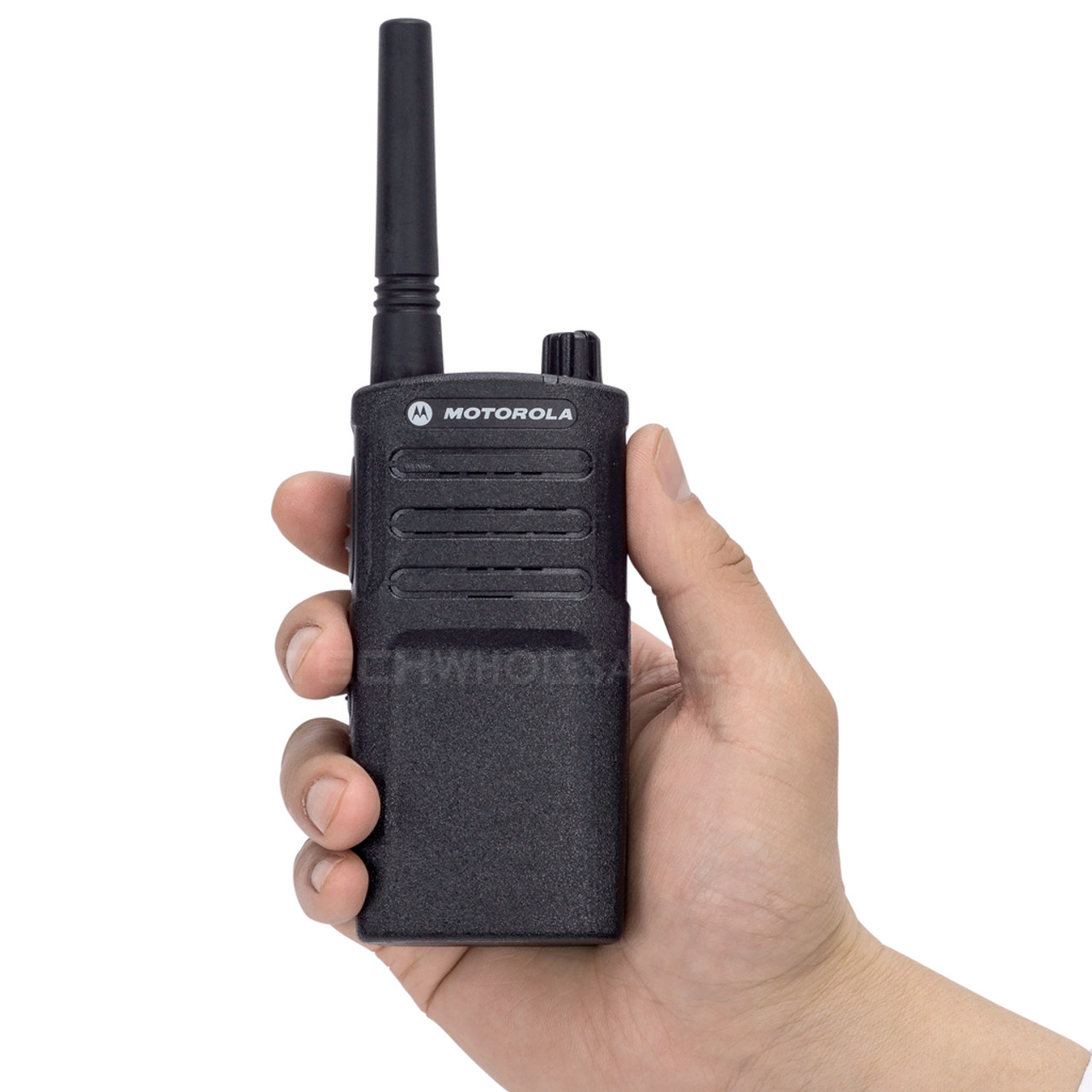
1. Motorola RMU2080 — Best for Small-to-Mid Warehouse Operations
| Specification | Detail |
|---|---|
| Frequency | UHF (450–470 MHz) |
| Output Power | 2 watts |
| Channels | 8 |
| Indoor Range | Up to 250,000 sq ft / 20 floors |
| Outdoor Range | 1–2 miles |
| Battery Life | 12 hours (standard 2,150 mAh Li-ion) |
| Weight | 8.6 oz (with standard battery) |
| Dimensions | 4.5 × 2.2 × 1.6 in. |
| Durability | MIL-STD-810 C/D/E/F/G, IP54/55 |
| Speaker Output | 1,500 mW |
| VOX | Yes (with compatible headset) |
| Warranty | 2 years |
The RMU2080 is the radio we've placed in more small-to-mid warehouse operations than any other model. Its 8-channel UHF design handles the core use case cleanly: separate channels for receiving, shipping, floor supervisors, and management, with room for a quality/hold channel and NOAA weather monitoring on Channel 8.
The 1,500 mW speaker cuts through typical warehouse background noise — the kind generated by conveyor systems and electric pallet jacks — without requiring a headset. Workers who need to set a radio on a shelf or clip it to a vest and hear it clearly across a 30-foot picking aisle will appreciate this. The RMU2080 also carries Motorola's Accelerated Life Testing (ALT) certification, which simulates 5 years of real-world field use beyond what MIL-STD-810 testing requires.
Why it fits warehouses specifically
- UHF frequency penetrates metal racking and concrete mezzanines reliably in facilities up to approximately 175,000 sq ft with typical rack density
- 8 channels allow department segmentation for teams of 4 to 30+ across receiving, shipping, picking, packing, and supervisory roles
- 12-hour battery comfortably covers a standard 8-hour shift with margin; a high-capacity 3,200 mAh upgrade is available separately for 10- and 12-hour shifts
- VOX capability supports hands-free operation in forklift zones when paired with a compatible headset or speaker-mic — directly supporting OSHA 29 CFR 1910.178 best practices for powered industrial truck communication
- 3 voice-inversion scramble settings limit eavesdropping from neighboring facility radio traffic
- NOAA Weather Alerts on Channel 8 keep outdoor loading dock and yard crews informed of severe weather conditions
Compatible accessories available at TechWholesale.com: Earpieces, speaker-microphones, 6-unit charging trays, and high-capacity batteries for the RMU2080 series.
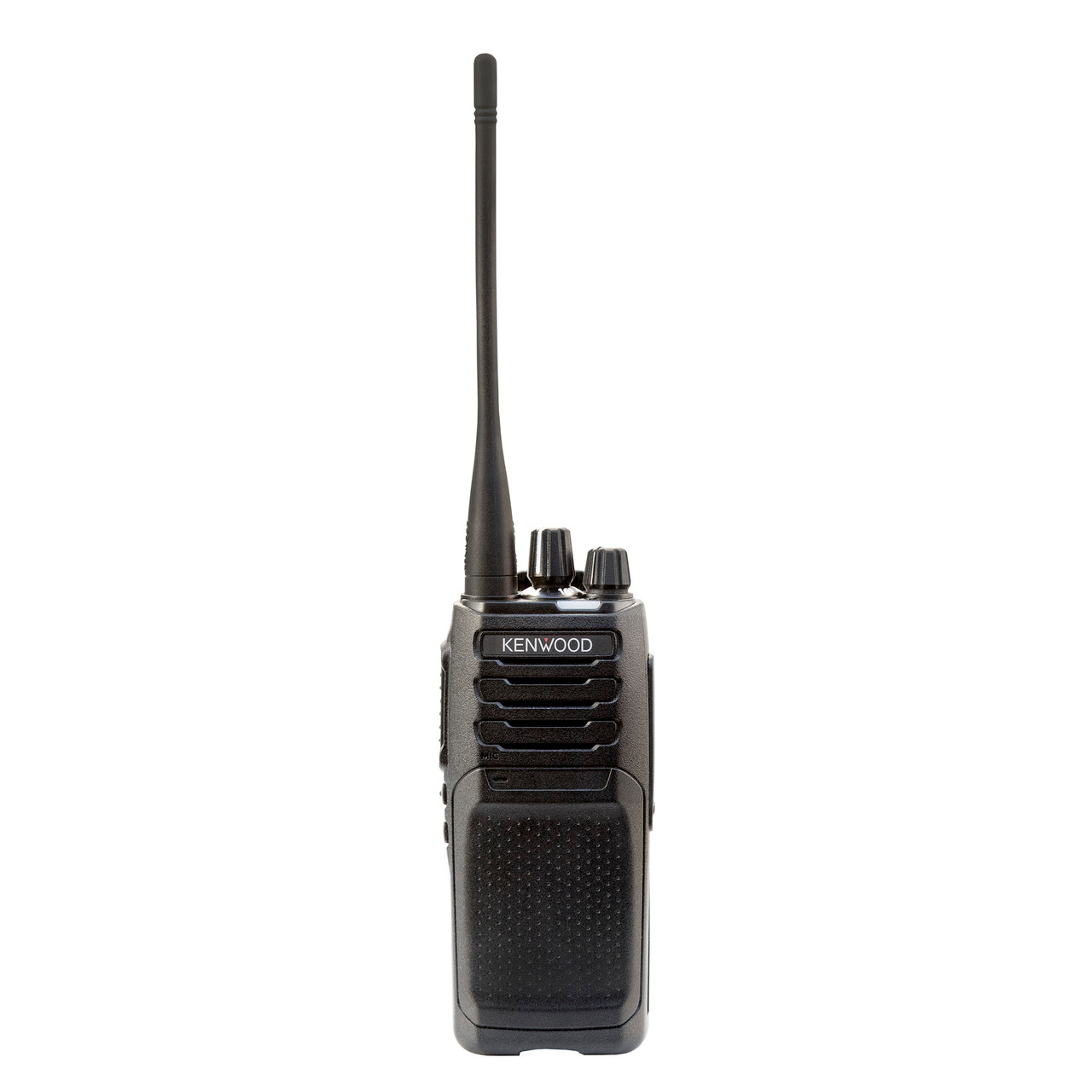
2. Kenwood NX-P1300NUK — Best for Mid-to-Large Distribution Centers
| Specification | Detail |
|---|---|
| Frequency | UHF (451–470 MHz) |
| Output Power | 5 W / 4 W / 1 W (selectable) |
| Channels | 16 per zone × 4 zones (64 total) |
| Digital Protocol | NXDN (analog/digital/mixed mode) |
| Battery Life | 11 hours (KNB-45L, 5/5/90 duty cycle) |
| Weight | 9.88 oz (with KNB-45L battery) |
| Operating Temperature | −22°F to +140°F |
| Speaker Output | 1 W internal / 500 mW external |
| VOX | Yes (adjustable, 10 sensitivity levels) |
| Self-Programming | Yes (no PC required) |
| Warranty | 2 years |
The NX-P1300NUK addresses a common challenge in growing distribution centers: a radio fleet that's outgrown its channel structure, but where replacing every radio at once isn't practical. Its NXDN digital protocol operates alongside analog in Mixed mode, which means you can introduce NX-P1300NUK radios into an existing analog fleet and have both systems communicate on the same channel. You upgrade incrementally, without a communication gap during the transition.
At 5 watts of UHF output power — versus 2 watts on the RMU2080 — the NX-P1300NUK provides meaningfully better penetration in facilities with dense structural materials or tall racking systems. The 4-zone / 16-channel structure (64 total configurations) gives large operations room to segment by department, contractor group, and shift supervisor without frequency congestion. Voice-guided operation means workers don't need to look at the radio to confirm their zone or channel — useful when hands are on inventory.
Why it fits warehouses specifically
- 5 watts of UHF output power provides stronger signal penetration through dense steel racking and concrete mezzanines than lower-power UHF radios
- 64-channel capacity (4 zones × 16 channels) supports large multi-department, multi-contractor operations without channel congestion
- NXDN Mixed mode allows simultaneous analog and digital fleet operation — critical for facilities upgrading gradually from an existing radio system
- Operating temperature rated to −22°F makes it suitable for cold storage areas and refrigerated dock environments
- On-radio self-programming requires no PC or software — supervisors can configure channels directly on the unit in the field
- VOX with 10 adjustable sensitivity levels supports hands-free operation in forklift zones; Semi-VOX mode reduces false triggers from ambient machinery noise
Compatible accessories available at TechWholesale.com: Kenwood earpieces, speaker-microphones, headsets, and nylon carry cases for the NX-P1300 series.
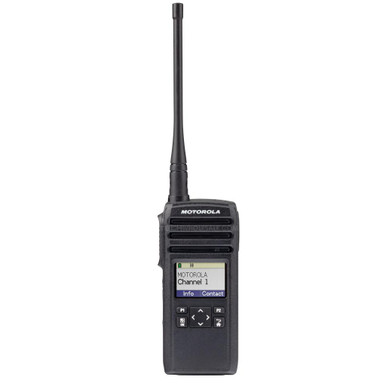
3. Motorola DTR700 — Best for High-Interference and Large-Scale Operations
| Specification | Detail |
|---|---|
| Frequency | 900 MHz ISM (Digital FHSS) |
| Output Power | 1 watt (equivalent range to 4W UHF) |
| Channels | 50 |
| Contacts | Up to 200 (public & private groups) |
| Indoor Range | 350,000 sq ft / 30 floors |
| Outdoor Range | 1–2 miles |
| Battery Life | Up to 16.5 hours |
| Weight | 7.9 oz |
| Dimensions | 5.1 × 2.3 × 1.4 in. |
| Display | Full-graphic backlit LCD |
| Durability | MIL-SPEC 810G, IP54 |
| Warranty | 2 years |
The DTR700 is in a different class from conventional UHF radios, and the reason is Frequency Hopping Spread Spectrum (FHSS) technology. Rather than transmitting on a fixed frequency, the DTR700 hops across the 900 MHz band 50 times per second. This makes it functionally immune to the RF interference generated by Wi-Fi access points, Bluetooth handheld scanners, RFID readers, and conveyor motor controllers — all of which are standard in modern warehouse environments.
In a conventional UHF radio, that interference manifests as static, dropped transmissions, and coverage gaps that vary based on network load. In the DTR700, it doesn't. For 3PL facilities, e-commerce fulfillment centers, and automated distribution hubs with dense scanning infrastructure, this is not a marginal improvement — it's the difference between a radio system that works reliably and one that creates uncertainty during peak periods.
The 16.5-hour battery life is the other standout specification. In operations running 12-hour shifts with workers who forget to charge radios overnight, that margin matters. The DTR700 can run through a 10-hour shift, a 2-hour gap, and still have capacity remaining.
Why it fits warehouses specifically
- 900 MHz FHSS technology eliminates interference from Wi-Fi, RFID, Bluetooth scanners, and motor controllers — the primary RF interference sources in modern fulfillment centers and automated distribution hubs
- Covers 350,000 sq ft indoors — appropriate for large-format distribution centers and multi-building campus operations
- 16.5-hour battery life covers the longest shifts with margin, and a high-capacity upgrade battery is available for operations with charging discipline challenges
- 50 channels and 200-contact storage support complex department and talkgroup structures across large teams
- Digital encryption and Profile ID PIN (10,000 available codes) prevent neighboring facility radio fleets from accessing your communications — relevant in multi-tenant industrial parks and shared logistics hubs
- Direct Call, Call All Available, Page All Available, and Private Reply modes give supervisors flexible broadcast options for normal operations and emergency all-call scenarios
Compatible accessories available at TechWholesale.com: DTR700 earpieces, speaker-microphones, high-capacity batteries, and 6-unit charging trays. The DTR700 is also compatible with the Motorola Curve and Motorola DLR1060 on the 900 MHz band.
Side-by-Side Comparison
| Feature | Motorola RMU2080 | Kenwood NX-P1300NUK | Motorola DTR700 |
|---|---|---|---|
| Frequency Band | UHF (450–470 MHz) | UHF (451–470 MHz) | 900 MHz FHSS Digital |
| Output Power | 2 W | 5 W / 4 W / 1 W | 1 W (equiv. to 4 W UHF) |
| Channels | 8 | 64 (4 zones × 16) | 50 / 200 contacts |
| Indoor Range | 250,000 sq ft / 20 floors | UHF penetration; 5 W output | 350,000 sq ft / 30 floors |
| Battery Life | 12 hours | 11 hours | Up to 16.5 hours |
| Durability | MIL-STD-810 C–G, IP54/55 | Rated −22°F to +140°F | MIL-SPEC 810G, IP54 |
| Digital Mode | Analog only | NXDN / Analog / Mixed | Digital FHSS (encrypted) |
| Interference Rejection | Standard analog | NXDN digital (improved) | Excellent (frequency hopping) |
| VOX / Hands-Free | Yes | Yes (10 sensitivity levels) | Yes |
| Display | Tricolor LED indicator | LED indicators | Full-graphic backlit LCD |
| Cold Storage Rated | MIL-STD-810 (temp range) | Yes (−22°F rated) | MIL-SPEC 810G (temp range) |
| Best Facility Size | Small–mid (up to ~175K sq ft) | Mid–large (complex layouts) | Large / high-RF environments |
| Warranty | 2 years | 2 years | 2 years |
Operational Questions
How should we set up channels for a warehouse operation?
The most practical baseline structure assigns one channel per team function that needs to operate without interrupting other teams. A common starting point for a mid-size warehouse:
- Channel 1: Receiving / Inbound Dock
- Channel 2: Put-Away / Inventory
- Channel 3: Picking / Outbound
- Channel 4: Shipping / Loading Dock
- Channel 5: Floor Supervisors
- Channel 6: Management / All-Hands
- Channel 7: Maintenance
- Channel 8: NOAA Weather (RMU2080) or Security
Operations with contractors, third-party carriers, or security teams benefit from additional channels to keep those communications separate from internal operations. The NX-P1300NUK's zone structure allows separate channel plans by building wing or shift, which is useful in large distribution centers where the receiving team in Building A doesn't need to hear the shipping team in Building C.
How do we handle radio charging for a fleet on rotating shifts?
The most reliable approach for operations with two or three shifts is to maintain a bank of fully charged radios on a multi-unit charging tray at the shift handoff point, rather than relying on workers to charge their own assigned radios. A 6-unit charging tray for the RMU2080 (PMLN6384) or DTR700 (PMPN4465) charges a set of radios overnight and provides a reliable handoff pool for incoming shift workers. This eliminates the dead-radio problem without requiring individual charging accountability.
Can warehouse workers use these radios with headsets while operating forklifts?
Yes, and it's the correct setup for forklift zones. All three recommended radios support VOX operation with compatible headsets or speaker-microphones, enabling workers to transmit and receive without removing hands from controls. Speaker-microphones clipped to a shoulder strap or vest allow audio at ear level without requiring an earpiece. For noise-canceling performance in high-ambient-noise environments, look at the Motorola HKLN4606 Remote Speaker Mic for RMU2080 users or the Kenwood KMC-21A for NX-P1300NUK deployments. Both are stocked at TechWholesale.com.
What happens to radio coverage when a warehouse adds new racking or changes its layout?
Coverage changes whenever you add structural mass — taller racking, new mezzanines, additional walls, or higher-density product storage. If coverage gaps appear after a facility change, the first step is a walk-test with the radios already in use to identify specific dead zones. Most small-to-mid warehouse dead zone problems are solved by relocating charging/staging areas so that users aren't starting transmissions from the most signal-challenged areas. Persistent coverage gaps across large facilities typically require a repeater system to extend effective range. Contact us for a coverage assessment if you're running into this situation.
How many radios does a typical warehouse operation need?
Plan for one radio per worker who needs to communicate during a shift, plus a 10–15% spare pool to cover damaged units, charging gaps, and new hires. A 20-person single-shift operation needs approximately 22–24 radios. A 20-person operation running two overlapping shifts needs 40–48 radios, since both shifts have workers on the floor simultaneously during the handoff window. For volume pricing on fleet orders, request a quote — fleet discounts apply to most multi-unit orders.
Frequently Asked Questions
How much indoor range do I actually need for a warehouse?
Indoor range figures on radio spec sheets are measured in open, unobstructed environments. In a real warehouse with steel racking, plan for 60–70% of the published indoor range figure. For a facility under 150,000 sq ft with standard 6–8 ft racking, the RMU2080 (rated 250,000 sq ft) provides reliable coverage. For facilities over 200,000 sq ft, or those with tall racking (20+ ft), concrete mezzanines, or multiple buildings, step up to the DTR700 (350,000 sq ft rated) or consider adding a repeater to extend UHF coverage. Walk-testing before committing to a radio platform is always worth the time.
What durability rating do warehouse radios need?
IP54 is the minimum practical rating — it indicates protection against dust and splash water from any direction. MIL-STD-810 certification adds shock, vibration, and temperature testing. All three recommended models carry both. For wet environments — facilities with regular floor washdowns, food-grade cold storage, or outdoor yard areas with weather exposure — look at IP55 (the RMU2080 carries IP55 as well as IP54) or higher. No radio in this guide is rated for submersion; if a radio is submerged, power it off and allow it to dry completely before use.
What battery life should I look for in a warehouse radio?
Match battery life to your longest shift plus a buffer. A standard 8-hour shift is covered comfortably by any of the recommended models (11–16.5 hours rated). For 10- or 12-hour shifts, or facilities where daily charging isn't reliably enforced, the DTR700's 16.5-hour rating provides the most operational margin. High-capacity battery upgrades are available for the RMU2080 (3,200 mAh, extending well past 12 hours) and DTR700 for operations running extended shifts. Battery life ratings are published at a 5/5/90 duty cycle (5% transmit, 5% receive, 90% standby); heavy-transmit environments will see shorter real-world runtime.
What is the difference between UHF and 900 MHz FHSS for warehouse use?
Both are appropriate for warehouse environments, but they solve different problems. UHF (400–512 MHz) provides reliable penetration through structural materials and metal racking. It's the standard for most warehouse deployments and works well in facilities without dense Wi-Fi and scanning infrastructure. 900 MHz FHSS (Motorola DTR700) adds interference rejection on top of coverage — it hops frequencies 50 times per second, making it functionally immune to interference from Wi-Fi networks, RFID readers, and Bluetooth scanners. For operations with heavy automation infrastructure — e-commerce fulfillment centers, 3PL facilities, automated sortation lines — the 900 MHz FHSS platform eliminates a class of reliability problems that UHF analog radios cannot address.
Can warehouse workers use these radios with headsets while operating forklifts?
Yes. All three recommended radios support VOX (voice-activated transmission) with compatible headsets and speaker-microphones, enabling fully hands-free operation. This is the correct configuration for forklift operators. OSHA's powered industrial truck standard (29 CFR 1910.178) supports hands-free communication as a safety best practice in forklift operating zones. Speaker-microphones clipped to a shoulder strap or vest allow audio at shoulder level without an in-ear device. Noise-canceling microphone accessories are available for all three platforms at TechWholesale.com.
How many channels does a warehouse operation need?
One channel per operational function you need to isolate. Small operations (10–20 workers, 2–3 departments) typically run effectively on 4–6 channels. Mid-size operations with separate receiving, picking, packing, shipping, supervisory, and maintenance functions need 6–10 channels. Large distribution centers with contractors, security, multiple building zones, and multi-shift supervision can use 20+ channels. The RMU2080 (8 channels) covers most small-to-mid deployments. The NX-P1300NUK (64 channels) and DTR700 (50 channels) scale to large, complex operations without frequency congestion.
Do warehouse radios need to be compatible with OSHA standards?
OSHA's General Industry standards (29 CFR Part 1910) don't mandate specific radio models, but several standards reference clear communication as a safety requirement. OSHA 29 CFR 1910.95 establishes noise exposure thresholds above which standard radio speakers may be insufficient without directional microphones or headsets. OSHA 29 CFR 1910.178 covers powered industrial truck safety, where clear real-time communication between operators and pedestrian zones is a recognized hazard-mitigation tool. Using professional-grade radios with noise-canceling accessories and VOX capability in forklift zones directly supports compliance with these standards.
What's the difference between the Motorola RMU2080 and RMU2080d?
The Motorola RMU2080d adds a full display to the RMU2080 platform — the same 8-channel UHF hardware with a digital readout showing channel number, battery level, and operational status. The display makes channel management easier for workers who need to verify their channel setting at a glance without using the voice channel announcement feature. Both models share the same accessories and chargers. For large teams where workers change channels frequently or supervisors need to verify radio settings remotely, the display version reduces errors. For smaller teams with a fixed channel structure, the RMU2080 without display is simpler and slightly more compact.
Why Buy Warehouse Radios from TechWholesale.com
TechWholesale.com has been an authorized Motorola and Kenwood dealer since 1997. We sell professional-grade communication equipment to commercial operations — not consumer electronics repurposed for business use. When warehouse managers and operations directors contact us, they're typically dealing with one of three situations: they've outgrown a consumer radio system and need a professional replacement, they've had a communication failure that created a safety or operational incident and need a more reliable platform, or they're outfitting a new facility and want to get the radio system right from the start.
In any of those cases, what matters is matching the right radio to the specific facility — not selling the most expensive option or defaulting to a generic recommendation. Our team has worked through enough warehouse deployments to ask the right questions: How large is the facility? What's the racking density? Does the facility have cold storage zones? How many shifts? Is there existing RF infrastructure that might interfere?
What you get when you order from TechWholesale.com:
- Genuine manufacturer products with full warranty coverage — not gray-market or refurbished units
- Quick quotes — because most warehouse operations need a fleet, not a single radio
- Accessory inventory stocked alongside the radios — earpieces, speaker-mics, multi-unit charging trays, and batteries available at the same time as your radios
- Lifetime tech support — we're reachable after the sale for programming questions, accessory compatibility, and coverage troubleshooting
- 30-day return policy and free shipping on qualifying orders
Not sure which radio fits your facility? Contact us for a no-pressure product recommendation — or use our Find My Radio tool to narrow down options based on your specific requirements.
Related Reading
On TechWholesale.com
- Motorola RMU2080 Product Page — Full specs, accessories, and user guides
- Motorola RMU2080d Product Page — Display version of the RMU2080
- Kenwood NX-P1300NUK Product Page — Full specs, accessories, and NXDN digital operation details
- Motorola DTR700 Product Page — FHSS technology, 900 MHz operation, and fleet calling modes
- Two-Way Radio Repeaters — For large-format facilities requiring extended coverage
- Motorola RMU Series Accessories — Earpieces, charging trays, and high-capacity batteries
- Motorola DTR Accessories — Full accessory lineup for the DTR700
- Find My Radio Tool — Guided recommendation based on your facility and team size
- Two-Way Radio FAQs — General questions about business radio selection and operation
- Radio Education Center — Technical guides on frequency, battery, and accessory selection
External Resources
- OSHA 29 CFR 1910.178 — Powered Industrial Trucks — OSHA standard covering forklift safety, communication, and operator requirements
- OSHA 29 CFR 1910.95 — Occupational Noise Exposure — OSHA standard establishing noise thresholds and hearing protection requirements
- FCC Industrial/Business Radio Pool — Information on UHF/VHF frequency licensing for commercial operations
- Motorola Solutions Two-Way Radio Overview — Manufacturer product information and technical documentation
- Kenwood USA Professional Radio Lineup — Kenwood manufacturer product pages and specifications
Page maintained by Kristin Wood, Two-Way Radio Consultant at TechWholesale.com. Specifications verified against manufacturer product data. Last updated June 2026.