
Two-Way Radios for Warehouses - 2026 Buying Guide
What is the best two-way radio for a warehouse?
The Short Answer
The best two-way radios for warehouses combine durable construction, hands-free capability, long battery life, and enough range to cover large floor plans and multi-level racking systems. For most warehouse environments — from small fulfillment centers to large distribution hubs — the Motorola RMU2040, Motorola CP100d-UA, Kenwood NX-P1300NUK, and Motorola DTR700 each solve distinct operational challenges.
But not all radios are built for the demands of a warehouse environment, and picking the wrong one means dealing with static, dead zones, and devices that don't survive a drop off a loading dock.
Based on thousands of radios sold, we've compiled everything you need in this guide to make the right call—from coverage requirements and channel setup to our top model recommendations for warehouses of every size.
Why Warehouses Have Unique Communication Demands
Warehouses aren't just large rooms — they're signal-challenging environments with metal shelving, concrete floors, loading dock interference, forklift noise, and workers spread across receiving, shipping, picking, and staging zones simultaneously. Standard consumer walkie-talkies fail here for several reasons:
- Metal racking and steel structures absorb and reflect RF signals, creating dead zones
- High ambient noise from machinery, forklifts, and conveyor systems requires radios with strong audio output and noise-canceling microphones
- Shift-length battery demands of 8–12 hours mean consumer-grade batteries fall short
- Multi-department coordination requires multiple channels so receiving, shipping, and management don't talk over each other
- Dropped radios and exposure to dust demand IP-rated or MIL-SPEC rugged housings
OSHA's General Industry standards emphasize that workers must be able to communicate clearly in noisy environments, and OSHA's forklift safety standards implicitly support real-time voice communication as a hazard-mitigation tool. Reliable radio communication directly supports compliance with those safety obligations.
Recommended Two-Way Radios for Warehouses
1. Motorola RMU2040 — Best Option for Small-to-Mid Warehouses
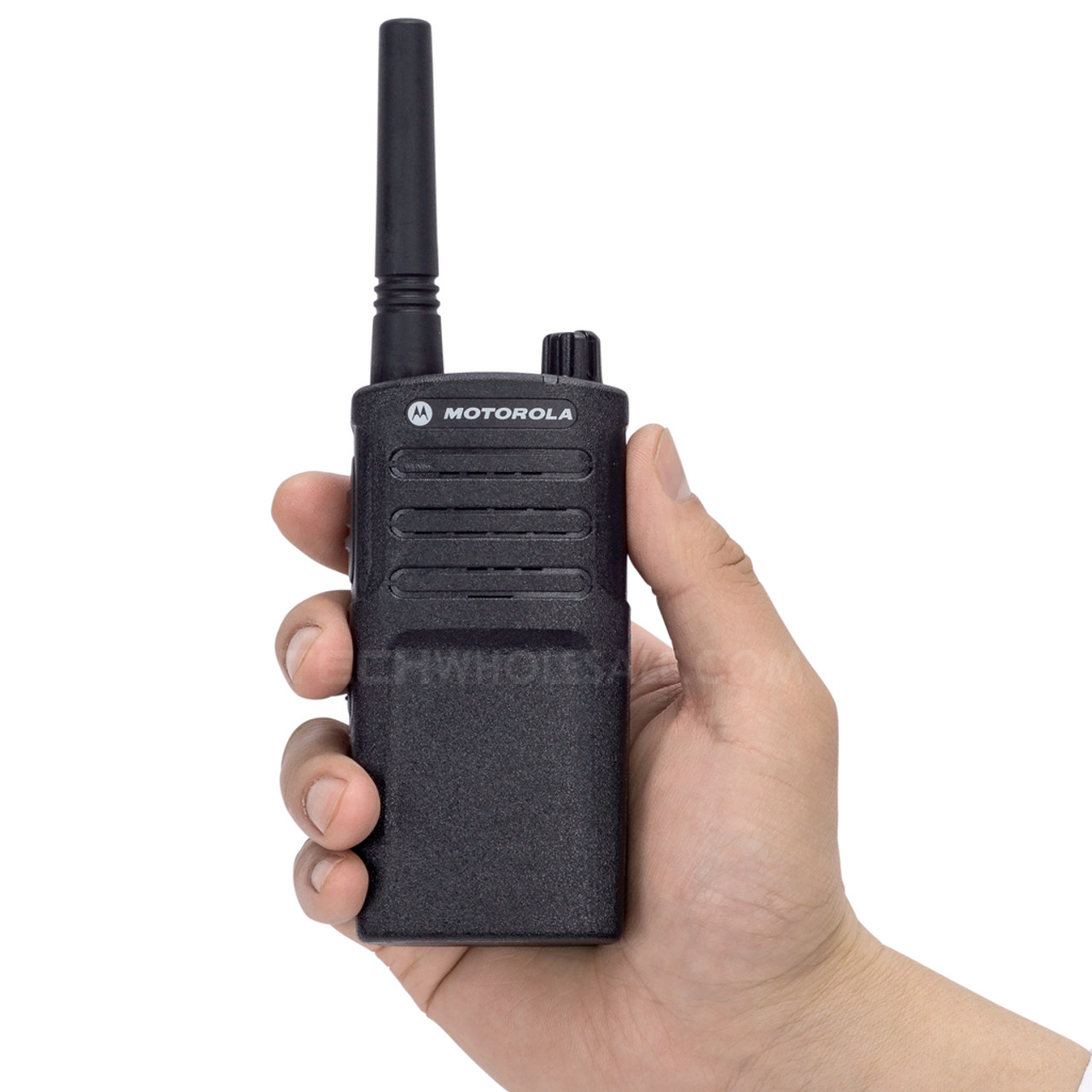
Key Specs:
- Frequency: UHF (450-470 MHz)
- Channels: 4
- Range: Up to 250,000 sq ft indoors
- Battery Life: Up to 12 hours
- Durability: IP54 dust and water resistance
- Weight: 8.6 oz
Why It Works in Warehouses:
The RMU2040 operates on UHF frequencies and is ideal for small warehouse operations or businesses scaling up quickly. Its 4-channel design lets you separate departments (receiving on Ch. 1, shipping on Ch. 2, supervisors on Ch. 3), and the 12-hour battery life comfortably covers a double shift. The IP54 rating handles the dust, occasional splashes, and the inevitable drops that come with warehouse floors.
Best For: Small fulfillment centers, retail distribution rooms, businesses wanting plug-and-play simplicity.
2. Motorola CP100d-UA — Best Budget UHF Radio for Warehouse Operations
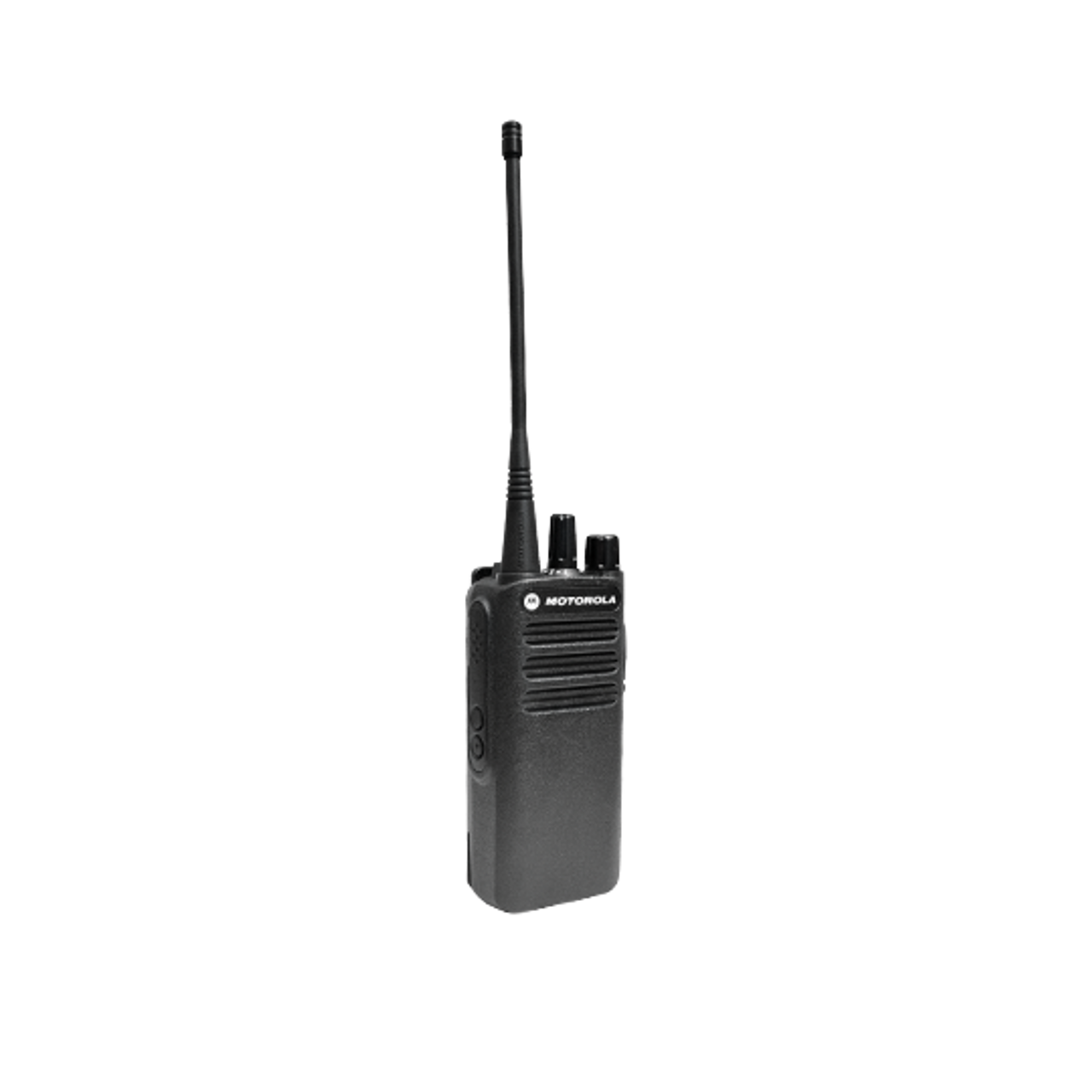
Key Specs:
- Frequency: UHF (403-480 MHz)
- Channels: 16
- Output Power: Up to 4W
- Battery Life: Up to 12 hours
- Durability: Military-grade MIL-STD-810 C/D/E/F
- Form Factor: Compact, lightweight
Why It Works in Warehouses:
The CP100d-UA is a workhorse entry-level professional radio built to MIL-STD-810 standards — meaning it's tested for shock, vibration, humidity, and temperature extremes. At 4W of output power on UHF, it punches through metal racking far better than VHF consumer radios in many open-layout warehouse configurations.
Best For: Warehouses with existing UHF infrastructure, operations that want professional-grade durability at an accessible price point.
3. Kenwood NX-P1300NUK — UHF and Digital Radio for Larger Warehouses
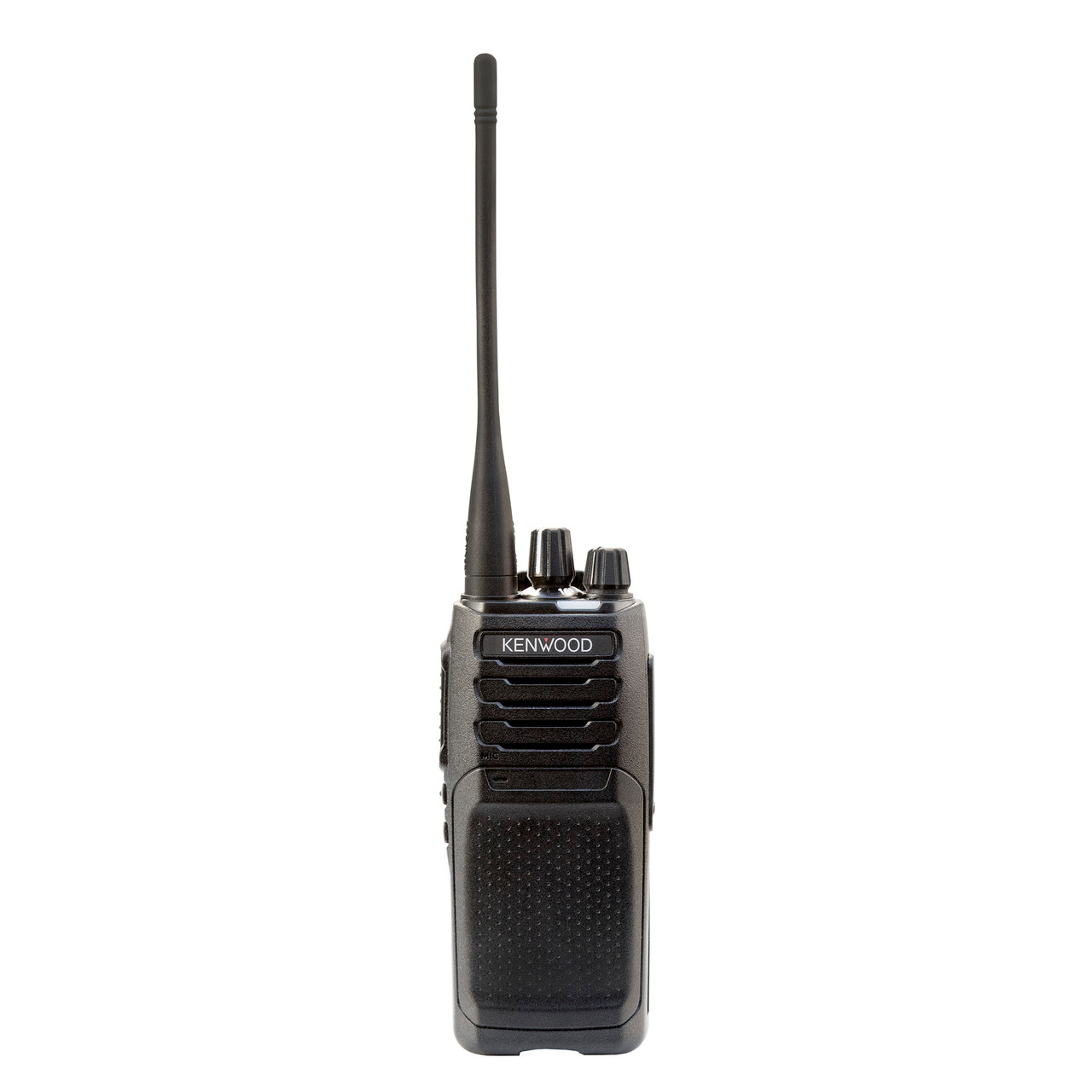
Key Specs:
- Frequency: UHF (451-470 MHz)
- Channels: 64
- Range: Up to 350,000 sq ft indoors
- Battery Life: Up to 12 hours
- Durability: IP54, MIL-STD-810G
Why It Works in Warehouses:
UHF frequencies penetrate dense shelving and building materials more effectively than VHF in most enclosed warehouse environments. The NX-P1300NUK's 64 channels give large operations room to separate departments, contractors, and management without frequency congestion. Meeting both IP54 and MIL-STD-810G ratings means it handles the physical punishment of daily warehouse use.
Best For: Mid-to-large distribution centers, multi-department operations.
4. Motorola DTR700 — Best for High-Density Warehouses and Secure Communication

Key Specs:
- Frequency: 900 MHz ISM
- Technology: Digital Frequency Hopping Spread Spectrum (FHSS)
- Channels: 50 / 200 contacts
- Range: Up to 300,000 sq ft indoors
- Battery Life: Up to 16.5 hours
- Durability: IP54, MIL-STD-810G
- Display: Backlit LCD
Why It Works in Warehouses:
The DTR700 is in a class of its own for high-interference or high-security warehouse environments. Its 900 MHz FHSS technology hops frequencies 50 times per second, making it virtually immune to the RF interference generated by Wi-Fi networks, Bluetooth scanners, RFID readers, and conveyor motor systems — all common in modern warehouses. Communication is digitally encrypted, protecting sensitive logistics discussions from interception. At 16.5 hours of battery life and programmable talkgroups, it's built for large teams running complex multi-zone operations.
Best For: Large distribution centers, 3PL facilities, operations with heavy RF interference from scanning and automation equipment, any warehouse handling sensitive shipments where communication privacy matters.
Side-by-Side Comparison
| Feature | RMU2040 | CP100d-UA | NX-P1300NUK | DTR700 |
|---|---|---|---|---|
| Battery Life | 12 hrs | 12 hrs | 12 hrs | 16.5 hrs |
| Channels | 4 | 16 | 64 | 50 |
| Durability | IP54 | MIL-STD-810 | IP54 + MIL-810G | IP54 + MIL-810G |
| Best Facility Size | Small–Mid | Small–Mid | Mid–Large | Large/Complex |
| Interference Resistance | Standard | Standard | Standard | Excellent (FHSS) |
Frequently Asked Questions
How much range do I actually need for a warehouse two-way radio?
Indoor range is always lower than the outdoor range figures on spec sheets. As a practical rule: for warehouses under 100,000 sq ft with standard steel racking, any of these radios will cover the space. For facilities 100,000–300,000 sq ft or those with tall racking, concrete mezzanines, or multiple floors, prioritize UHF radios (NX-P1300NUK) or the DTR700's 900 MHz FHSS, which navigate structural obstructions more reliably than VHF in enclosed environments.
What battery life should I look for in a warehouse radio?
A standard 8-hour warehouse shift needs a radio rated for at least 10–12 hours to account for heavy talk activity. For operations running 10- or 12-hour shifts, or facilities that can't guarantee daily charging, the DTR700's 16.5-hour rating provides the most comfortable margin. All four radios recommended here meet or exceed 12-hour battery life.
How durable do warehouse radios need to be?
At minimum, look for IP54 ingress protection — rated to resist dust and splash from any direction — and ideally MIL-STD-810 certification for shock and vibration resistance. All four recommended models meet these thresholds. For facilities with heavy forklifts where radios are frequently dropped or run over, the CP100d-UA's MIL-STD-810 C/D/E/F rating reflects older but rigorous standards for physical resilience.
What's the difference between VHF and UHF for warehouses?
VHF (136–174 MHz) travels farther in open outdoor environments and can penetrate some building materials well. UHF (400–512 MHz) generally performs better indoors because its shorter wavelength navigates around metal shelving, walls, and structural steel more effectively. For most enclosed warehouse environments, UHF or the DTR700's 900 MHz FHSS will outperform VHF — though the CP100d-UA at 4W VHF is a solid performer in open-floor layouts.
Can warehouse workers use these radios with headsets or earpieces?
Yes. All four radios support standard accessory ports for earpieces, speaker-microphones, and headsets — essential for workers operating forklifts or machinery where holding a radio isn't safe or practical. OSHA safety standards for powered industrial trucks support hands-free communication as a best practice in forklift operating zones.
How many channels do we need for a warehouse operation?
As a baseline: one channel per department or function you need to isolate. A common warehouse setup uses receiving, shipping, floor supervisors, and management — that's a minimum of 4 channels. The RMU2040 (4 channels) handles most small operations. The NX-P1300NUK (64 channels) and DTR700 (50 channels / 200 contacts) scale to larger or more complex facilities with contractors, security, or multiple shift supervisors.
Why Buy from TechWholesale.com
TechWholesale.com specializes in professional-grade communication and security technology for commercial operations — not consumer gadgets repurposed for business use. When you order warehouse radios from TechWholesale.com, you get:
- Genuine manufacturer products with full warranty support for Motorola and Kenwood lines
- Expert product matching — if you're unsure which radio fits your facility, our team can help you evaluate range and department structure before you buy
- Fast fulfillment so your operation isn't waiting on back-ordered equipment
- Accessory compatibility across headsets, charging racks, and speaker-mics stocked alongside the radios themselves
For warehouse managers who need reliable, durable, and compliant communication tools — without the guesswork — TechWholesale.com is the specialized source built for exactly that.
Have questions about which radio is right for your warehouse size or layout? Contact TechWholesale.com for a no-pressure product recommendation.
Related Reading
- Privacy Codes – Eliminate Outside Interference
- Frequency Hopping Spread Spectrum
- Lone Worker / Man Down Functionality
- VOX Explained
- UHF vs VHF – Frequencies Explained
Article by Kristin Wood, a two-way radio consultant @ Tech Wholesale | Authorized Motorola & Kenwood Dealer Since 1997 | Last Updated: May 2026
There are no products listed under this category.