

Many small businesses either buy cheap walkie-talkies that break within a year or overpay for high-powered radios built for buildings ten times their size.
The right fit is in between: compact business-grade radios with enough power for your space and a rugged build that survives daily drops and handling, protecting your investment for years.
Let’s make this decision easy! We’ve kept hundreds of small businesses connected across the country since 1997. Here’s how to find the right radio for your team.
Which Walkie Talkie Fits Your Small Building?
The Quick Answer
- A mixed team that needs one radio to cover everyone → Motorola CLS1410. One watt of UHF reaches 200,000 sq ft across roughly 15 floors, four channels and a speaker plus VibraCall means the same radio works for someone at a desk and someone in a back room.
- Staff who work in front of customers → Motorola CLP1080e. Earpiece-only with no external speaker and an internal antenna — nothing audible, nothing visible. Eight channels and antimicrobial housing. Rated to 100,000 sq ft and 10 floors.
- A building crowded with Wi-Fi and wireless equipment → Motorola Curve. Digital 900 MHz hops across frequencies instead of holding one, so it stays clear where analog UHF starts sounding choppy. Ten channels, and more indoor reach per watt than analog.
Quick Links
What Qualifies as a "Small Building"?
For radio selection purposes, a small building is typically defined as a structure up to 10–15 floors. This includes offices, clinics, retail stores, schools, houses of worship, small hotels, assisted living facilities, and light industrial spaces. Buildings with significant concrete-and-steel construction, lead-lined rooms (such as radiology suites), or underground floors may require 2 watts or a repeater to eliminate dead zones.
Common Communication Pain Points in Small Buildings
Dead Zones on Upper and Lower Floors
UHF signals (450–470 MHz) penetrate building materials better than VHF signals, but concrete-core floors and metal stairwells still attenuate signal between levels. A radio rated for 15 floors under open-air conditions may cover only 8–10 floors in a dense commercial build. If your building has more than 6 floors or reinforced concrete throughout, verify the rated indoor range against the actual floor count and consider a 2-watt option or a repeater.
Channel Conflicts and Cross-Talk
When an entire staff shares one channel, every transmission goes to every radio simultaneously. This creates noise fatigue, missed messages, and slowdowns during busy periods. Most small building operations benefit from at least three dedicated channels: one for general staff, one for maintenance or facilities, and one for management or security. A radio with 4–10 channels gives you room to grow without paying for enterprise-tier equipment.
Battery Failures Mid-Shift
A radio with a 6-hour battery life creates a real liability in an 8- or 10-hour shift environment. Staff either stop carrying the radio or leave it on a charger for hours—both of which defeat the purpose. Motorola's CLS and CLPe series are rated for 10–12 hours under typical use, which covers a standard commercial shift with margin to spare.
Radios That Break
Consumer-grade radios from big-box retailers are not built for daily commercial use. They fail faster, are harder to accessorize, and have no path to repair or replacement accessories. Professional-grade radios from Motorola and Kenwood are engineered for five or more years of field use, carry manufacturer warranties, and have an established accessory ecosystem for earpieces, remote speaker microphones, multi-unit chargers, and replacement batteries.
Training and Complexity
In small building environments—particularly retail, hospitality, and healthcare—staff turnover is high and training time is limited. Radios with complex menus, small buttons, or confusing channel displays slow adoption. The most effective radios for these environments are those with a single large PTT button, a simple channel dial, and no unnecessary features to configure.
What to Look For in a Small Building Two-Way Radio
Frequency: UHF vs. Digital
UHF (Ultra High Frequency, 450–512 MHz) is the standard choice for indoor environments because its shorter wavelength penetrates walls, floors, and obstructions more effectively than VHF. Digital radios operating in the 900 MHz FHSS (Frequency Hopping Spread Spectrum) band, like the Motorola Curve, add interference resistance and clearer audio at the cost of a higher per-unit price. For most small buildings without significant RF congestion, UHF analog is sufficient. In buildings with dense wireless device populations—medical facilities, co-working spaces, tech offices—digital FHSS is worth the upgrade.
Power Output: 1 Watt vs. 2 Watts
1-watt UHF radios cover 100,000–200,000 square feet indoors under standard conditions. 2-watt models extend that to 275,000 square feet or more. For buildings under 100,000 sq ft with standard construction, 1 watt is sufficient. For buildings on the upper end of the "small" range—larger retail spaces, multi-wing office complexes, schools—2 watts provides meaningful headroom and eliminates edge-case dead zones.
Battery Life
Target a minimum rated battery life of 10 hours for any commercial shift environment. The Motorola CLS1410 and CLP1080e are both rated at approximately 12 hours. The Motorola Curve is rated at approximately 14 hours. Battery life ratings are based on typical duty cycles (5% transmit, 5% receive, 90% standby); heavy-use environments with frequent transmissions will reduce actual life.
Channel Count
Four channels handle most small building needs. Eight or more channels are useful when you have multiple departments, a dedicated management or security channel, or a privacy channel for sensitive conversations. The Motorola CLP1080e offers 8 channels; the Motorola Curve offers 10.
Durability
Look for radios rated to MIL-STD-810 standards for shock resistance. Water resistance ratings (IP54 or higher) matter in facilities with cleaning protocols, food service, or outdoor coverage areas. The Motorola CLS1410 carries commercial-grade construction and water resistance suitable for light splashes and routine drops.
Form Factor
Radios carried all day need to be light. Anything over 7 oz. becomes burdensome during a full shift. The Motorola CLP1080e weighs 2.38 oz. with its battery—one of the lightest professional-grade radios available. The CLS1410 is heavier but includes a built-in external speaker, which is preferable in environments where earpieces aren't practical.
Recommended Two-Way Radios for Small Buildings
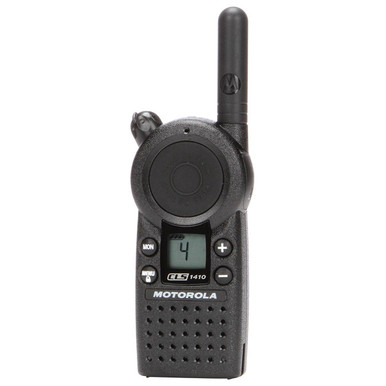
1. Motorola CLS1410 — Best All-Around for Small Buildings
| Specification | Detail |
|---|---|
| Frequency | UHF (460–469 MHz) |
| Power Output | 1 watt |
| Channels | 4 |
| Indoor Coverage | Up to 200,000 sq ft / 15 floors |
| Outdoor Range | Up to 2 miles (open area) |
| Battery Life | ~12 hours |
| Mode | Analog |
The CLS1410 has been the most widely deployed small-building radio in the Motorola commercial line for over a decade. Its 1-watt UHF signal covers most small building footprints without over-engineering the solution, and its 12-hour battery life handles a standard commercial shift. The built-in external speaker—absent from the earpiece-only CLPe series—makes it practical for maintenance, security, and back-of-house staff who need to set a radio on a surface rather than wear it constantly.
Why it fits small buildings
- UHF frequency penetrates concrete, drywall, and steel elevator shafts reliably
- 4 dedicated channels segment most small building teams (general staff, maintenance, management, security)
- Vibracall technology enables silent vibration alerts in noise-sensitive or patient-care environments
- Simplified radio cloning via the programming port speeds multi-unit deployment
- Audible call alerts allow single-staff contact without broadcasting to the full team
- Compact design (5.1 x 2.1 x 1.2 inches) fits standard belt clips and holsters
Best fit
Small offices, medical office buildings, schools, assisted living facilities, hotels under 15 floors, light retail, and facilities management teams.
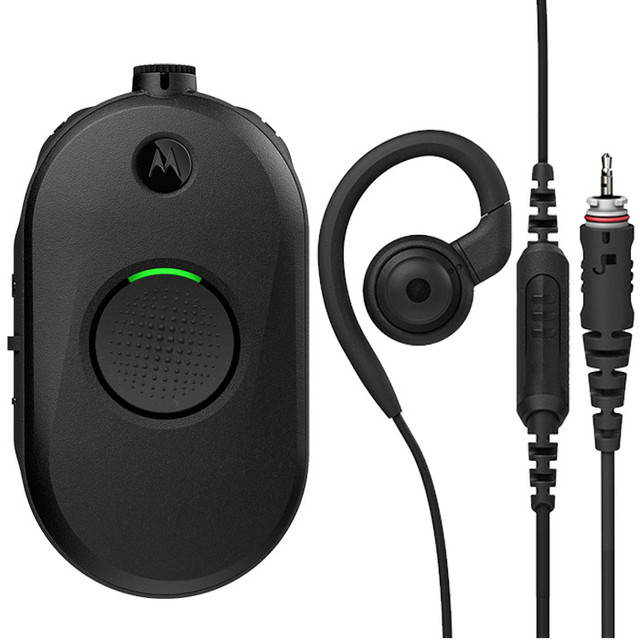
2. Motorola CLP1080e — Best for Discreet Use and Hospitality
| Specification | Detail |
|---|---|
| Frequency | UHF (460–469 MHz) |
| Power Output | 1 watt |
| Channels | 8 |
| Indoor Coverage | Up to 100,000 sq ft / 10 floors |
| Outdoor Range | Up to 1 mile (open area) |
| Battery Life | ~12 hours |
| Weight | 3.35 oz |
| Mode | Analog |
| Notable | Antimicrobial casing, repeater capable |
At 2.38 oz, the CLP1080e is among the lightest professional-grade radios available. It operates earpiece-only by design, which makes it appropriate for front-facing roles where visible radio equipment conflicts with guest experience standards: hotel front desk, boutique retail, fine dining, concierge services, and healthcare settings where patient discretion is a priority. The antimicrobial casing is a meaningful differentiator for medical offices, dental practices, and assisted living environments with infection control protocols.
Why it fits small buildings
- 8 channels support more granular team segmentation than the 4-channel CLS1410
- Repeater capability allows coverage expansion without purchasing additional infrastructure upfront
- Earpiece-only design maintains a professional appearance in guest-facing environments
- Antimicrobial casing meets hygiene requirements for healthcare and food service adjacency
- Large central PTT button is accessible without looking down at the radio
- Belt holster and integrated clip minimize bulk for staff in motion all day
Best fit
Boutique hotels, medical and dental offices, assisted living facilities, upscale retail, restaurants, and any environment where radio equipment should not be visible to customers or patients.
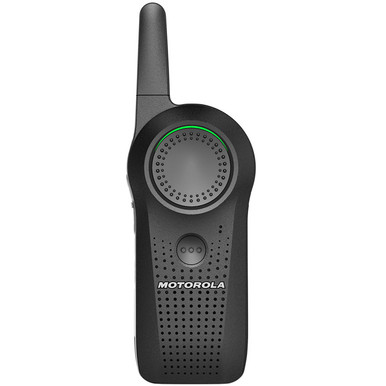
3. Motorola Curve — Best for Digital Audio and High-Channel Environments
| Specification | Detail |
|---|---|
| Frequency | Digital FHSS (902–928 MHz) |
| Power Output | 1 watt |
| Channels | 10 |
| Indoor Coverage | Up to 300,000 sq ft / 20 floors |
| Outdoor Range | Up to 2 miles (open area) |
| Battery Life | ~14 hours |
| Mode | Digital |
| Notable | Private Reply, Direct Call, Call All, digital encryption |
The Motorola Curve operates on 900 MHz Frequency Hopping Spread Spectrum (FHSS). This FHSS technology makes the Curve highly resistant to interference from other wireless devices—a meaningful advantage in buildings with dense Wi-Fi deployments, Bluetooth peripherals, or other 900 MHz equipment.
Why it fits small buildings
- 10 channels support larger or more complex team structures without tier-jumping to enterprise hardware
- Digital audio is perceptibly cleaner than analog UHF, particularly in concrete-heavy or acoustically noisy environments
- Private Reply and Direct Call features enable one-to-one communication without requiring everyone on the channel to listen
- Call All emergency broadcast reaches every radio simultaneously
- 300,000 sq ft indoor coverage handles buildings near the upper end of the small-building range
- 14-hour battery life is the longest of the three recommended models
Best fit
Tech offices, co-working spaces, schools, larger retail footprints, buildings near the upper end of the small-building range (100,000–300,000 sq ft).
Quick Comparison: Which Radio Is Right for Your Building?
| Model | Power | Indoor Coverage | Channels | Battery | Best For |
|---|---|---|---|---|---|
| Motorola CLS1410 | 1W UHF | 200,000 sq ft / 15 floors | 4 | ~12 hrs | All-around small building use |
| Motorola CLP1080e | 1W UHF | 100,000 sq ft / 10 floors | 8 | ~12 hrs | Discreet, hospitality, healthcare |
| Motorola Curve | 1W Digital FHSS | 300,000 sq ft / 20 floors | 10 | ~14 hrs | Digital audio |
Compliance Considerations
OSHA Workplace Communication
OSHA does not mandate the use of two-way radios specifically, but several standards create an implicit communication requirement. OSHA 29 CFR 1910.165 (Employee Alarm Systems) requires that alarm systems in general industry be capable of alerting all affected employees, which in practice means radio communication is often part of an emergency notification plan. In noisy environments where ambient sound exceeds 85 dB—the action level under 29 CFR 1910.95 (Occupational Noise Exposure)—radios with dedicated noise-canceling microphones and high-output speakers are necessary for intelligible transmission.
Industry-Specific Considerations
Healthcare facilities subject to HIPAA should note that standard analog UHF radios transmit without encryption. For communications that could include patient-identifiable information, consider the Motorola Curve's digital FHSS encryption or establish a protocol that avoids transmitting PHI (Protected Health Information) over radio. The FCC does not regulate the content of radio transmissions beyond basic conduct rules, but HIPAA's technical safeguard requirements (45 CFR § 164.312) apply to any medium used to transmit ePHI.
Operational Questions
How many radios do I need?
A practical rule is one radio per staff member who needs to stay in real-time contact during their shift. For a small building, this typically includes: front desk or reception (1–2), maintenance (1–2), security (1–2 per shift), and a supervisor or manager (1). A team of 6–10 is common. Purchasing one or two spares per team is standard practice to account for radios on charge, in repair, or issued to contractors.
How do I charge multiple radios overnight?
Motorola offers multi-unit charging trays for the CLS and CLPe series that charge up to 6 radios simultaneously in a single rack footprint. These are typically wall-mounted or shelf-mounted at a central location. For the Motorola Curve, individual single-unit chargers or multi-unit trays are available through Curve accessories.
Can I add an earpiece to these radios?
Yes. The CLS1410 and CLP1080e both support a standard 2.5mm audio jack for compatible earpieces and surveillance kits. The CLPe series is designed to operate with Motorola's integrated earpiece system. A full selection of compatible accessories is available at CLS accessories and CLPe accessories.
Can I use these radios in a building with a parking garage or basement?
Below-grade areas present the most challenging RF environment for any radio system. Concrete slabs above, rebar reinforcement, and the absence of line-of-sight all reduce effective range. In buildings where below-grade communication is operationally critical (parking garage, loading dock, basement mechanical rooms), a repeater installed at a central intermediate floor is the most reliable solution. A repeater receives a signal on one frequency and retransmits it on another, effectively doubling the usable range. Tech Wholesale carries a selection of repeaters compatible with the CLS and CLPe product families.
Do these radios work if one radio is in an elevator?
Elevator cabs are RF-attenuating environments due to the metal enclosure. Performance varies by building. In most commercial elevators, UHF signals are partially attenuated but not completely blocked. Transmission and reception are typically degraded but functional while the cab is between floors. Some buildings with elevator-specific RF requirements install bidirectional amplifiers (BDAs) to maintain radio coverage inside elevator shafts; this is a building infrastructure consideration separate from radio selection.
Frequently Asked Questions
How much range do I need for a small building?
For a building under 10 floors and 100,000 square feet, a 1-watt UHF radio rated at 100,000–200,000 sq ft of indoor coverage is sufficient under standard construction conditions. For buildings with dense concrete, metal cladding, or below-grade floors, target a radio rated at 200,000+ sq ft or consider a 2-watt option. Manufacturer coverage ratings are measured under ideal conditions; real-world coverage in commercial buildings is typically 50–70% of the rated figure in the most challenging zones.
How long do two-way radio batteries last per charge?
Professional-grade radios in the Motorola CLS and CLPe series are rated for approximately 10–12 hours per charge under a standard duty cycle (5% transmit, 5% receive, 90% standby). The Motorola Curve is rated at approximately 14 hours. Heavy-use environments with frequent transmissions—security dispatch, busy retail, event coordination—will reduce actual battery life. Most commercial radio batteries retain useful capacity for 18–24 months of daily use before performance degrades noticeably; replacement batteries are available for all models carried by Tech Wholesale.
What IP or MIL-STD durability rating should I look for?
For small building use, a radio rated to IP54 (dust-protected, splash-resistant from any direction) is the minimum practical threshold for commercial environments. The Motorola CLS1410 meets this standard. For environments with regular liquid exposure—cleaning protocols, food service, outdoor coverage areas—look for IP55 or IP67. MIL-STD-810 certification indicates testing against shock, vibration, temperature extremes, and humidity, and is the standard reference for commercial radio durability.
Can I use the same radios across multiple buildings?
Yes, if the buildings are in reasonable proximity to each other (same campus or adjacent properties), UHF radios on shared channels will communicate without any additional configuration. For buildings separated by significant distance—across town, across multiple sites—the Motorola Curve's range will not bridge that gap. For multi-site communication, the Motorola WAVE PTX series communicates over LTE and Wi-Fi with no effective range limitation.
Are these radios compatible with radios I already have?
UHF analog radios from different manufacturers can communicate on the same frequency if they share a compatible channel frequency and CTCSS/DCS code (also called a privacy code or tone squelch). The Motorola CLS1410 and CLP1080e can communicate with other UHF radios programmed to matching frequencies. The Motorola Curve uses a proprietary digital FHSS protocol and can only communicate with other Motorola Curve units. If cross-brand compatibility is a requirement, specify analog UHF and confirm channel frequency programming during purchase.
What is the difference between analog and digital two-way radios?
Analog radios transmit voice as a continuous FM signal on a fixed frequency. Digital radios encode voice as data before transmission and decode it on the receiving end. Digital radios generally produce cleaner audio (no static as signal fades; audio is either clear or absent), are more resistant to interference, and can carry additional data like GPS or text messaging. The tradeoff is that digital radios typically only communicate with other radios using the same digital protocol. For most small building applications, analog UHF is sufficient. Digital becomes meaningful in RF-congested environments or when audio clarity is operationally critical.
How do I set up multiple channels for different teams?
Channel programming on the CLS1410 and CLP1080e is done through Motorola's radio programming software (CLS Series Programming Software or CLPe Series Programming Software), which is available from Motorola's dealer network. Tech Wholesale can assist with pre-programming radios to your specified channel plan before shipment. The Motorola Curve allows channel selection directly on the radio without computer programming.
Why Buy from Tech Wholesale
Tech Wholesale has been an authorized dealer of Motorola and Kenwood two-way radios since 1997. Every radio sold carries the full manufacturer warranty—two years on most Motorola commercial models—and Tech Wholesale includes lifetime technical support on all purchases. There are no call centers or ticket queues; support is direct, from people who know the products.
For organizations purchasing five or more radios, volume pricing is available by request. Radios can be pre-programmed to your channel plan before shipment so your team can begin using them immediately. For organizations that aren't ready to commit to a purchase, radio rentals are available for events, temporary deployments, and evaluation periods.
If you need help selecting between models, the Find My Radio tool walks through your use case in a few questions and returns a specific recommendation. For complex deployments—multi-building, repeater-required, or high-headcount—reach out to the support team directly.
Related Reading
On TechWholesale.com
- Motorola CLS1410 Product Page — Full specifications, accessories, and ordering
- Motorola CLP1080e Product Page — Full specifications, accessories, and ordering
- Motorola Curve Product Page — Full specifications and ordering
- Two-Way Radio Repeaters — Extend coverage to below-grade floors and dead zones
- Motorola WAVE PTX Series — LTE/Wi-Fi radios for multi-building and unlimited-range operations
- Two-Way Radio FAQ — General questions about radio operation, licensing, and selection
- Radio Education Center — Guides on frequency types, accessories, and industry applications
- Shop by Industry — Radios recommended by vertical
External References
- FCC: Two-Way Radios and Frequencies for Commercial Use — Overview of FCC rules for business radio operation
- OSHA 29 CFR 1910.165 — Employee Alarm Systems standard for general industry
- OSHA 29 CFR 1910.95 — Occupational Noise Exposure standard
- HHS HIPAA Security Rule (45 CFR § 164.312) — Technical safeguard requirements applicable to healthcare radio use