
The Best Two-Way Radios for Schools (2026 Guide)
What Are the Best Two-Way Radios for Schools?
The Short Answer
The best two-way radios for schools are the Motorola Curve, Motorola CLS1410, and Motorola CP100d-UA. Each model addresses a different campus challenge: the Curve delivers digital-grade coverage up to 300,000 sq ft and 10-channel capacity for most K–12 campuses; the CLS1410 provides a lightweight, no-frills solution for smaller elementary schools; and the CP100d-UA covers large high schools and multi-building campuses with 4-watt UHF output and 16 channels. School districts managing communication across multiple campuses should also evaluate the Motorola WAVE PTX series, which operates over LTE with unlimited range and real-time GPS tracking.
But not all radios hold up in a school environment. Dead zones in portable classrooms, batteries that don’t last a full school day, and devices that break after one drop can leave staff disconnected at exactly the wrong moment.
We’ve equipped hundreds of K–12 schools and districts since 1997. Here’s everything you need to match the right radio to your campus.
Why Schools Need Dedicated Two-Way Radios
Cell phones are not a reliable substitute for campus-wide communication. During an active threat or lockdown, network congestion can make cell service unreliable precisely when it is most critical. School intercoms reach classrooms but leave out teachers supervising recess, custodians in utility areas, aides escorting students between buildings, and nurses making rounds. Two-way radios close every one of those gaps.
Schools face a specific set of communication challenge:
Distributed staff with no fixed workstation. Teachers, aides, security officers, and counselors move constantly throughout the day. A device that requires dialing, unlocking, or finding a Wi-Fi signal adds friction that costs seconds when seconds count.
Simultaneous one-to-many broadcasting. During a lockdown, fire drill, or medical emergency, administrators need to reach every staff member at once—not one at a time. Push-to-talk radios allow a single transmission to reach every radio on the network simultaneously. Smartphones cannot do this natively.
Outdoor coverage demands. Playgrounds, parking lots, athletic fields, portable classrooms, and bus drop-off areas are part of the campus. A radio that works well inside the main building but drops signal 50 feet from the door is a liability, not an asset.
Physical durability requirements. School environments are hard on equipment. Radios get dropped on pavement, left in rain, and handled by dozens of people with varying levels of care. Consumer-grade devices fail quickly under these conditions; business-grade radios are engineered to survive them.
Emergency alert capability. Federal and state school safety guidelines increasingly emphasize the need for rapid staff-to-staff and staff-to-administration emergency notification. FEMA’s Guide for Developing High-Quality School Emergency Operations Plans (2013) identifies reliable internal communication as a core function of any campus emergency response framework. Radios with dedicated emergency alert buttons satisfy this requirement in a way cell phones cannot guarantee.
How to Choose the Right Radio for Your School
Match Coverage to Campus Size
Radio coverage is the most important selection criterion. Underpowered radios create dead zones; overspec’d radios waste budget. Use indoor square footage as your primary benchmark—not outdoor range claims, which assume flat open terrain and do not reflect real-world building penetration.
- Single-story elementary schools under 100,000 sq ft: 1-watt UHF radios provide adequate coverage.
- Multi-story K–8 or standard high school buildings (200,000–300,000 sq ft): 1-watt digital radios or 2-watt analog UHF are the appropriate tier.
- Large high school campuses or multi-building complexes (300,000+ sq ft): 4-watt UHF radios are required for reliable coverage.
- Multi-campus districts: LTE-connected push-to-talk devices such as the Motorola WAVE PTX series eliminate range limitations entirely.
UHF (Ultra High Frequency, 400–512 MHz) is the preferred frequency band for schools because it penetrates concrete walls, metal doors, and multiple floors more effectively than VHF. All models recommended on this page operate on UHF or proprietary digital spectrum.
Structure Your Channels by Role
Most school environments operate effectively with three to four dedicated channels. A typical channel assignment structure:
- Channel 1 — Administration & Front Office: Student pickups, visitor management, attendance coordination, general announcements.
- Channel 2 — Teaching Staff & Aides: Recess supervision, student transitions, classroom support, nurse calls.
- Channel 3 — Facilities & Custodial: Spills, repairs, maintenance requests handled without interrupting instructional staff.
- Channel 4 — Security / Emergency: Reserved for lockdowns, medical emergencies, and perimeter monitoring.
Private one-to-one communication is available on most business-grade radios, allowing two staff members to speak without broadcasting to the full group.
Key Features to Prioritize
- Emergency alert button: Sends an immediate distress signal to all radios on the network. Critical for staff safety in classrooms, parking lots, and remote areas of campus.
- Battery life of 10+ hours: A radio that dies before the end of the school day is a liability. All models listed here deliver 10–14 hours per charge.
- MIL-STD-810 durability rating: The U.S. Military Standard 810 specification tests devices against shock, vibration, humidity, and temperature extremes. Radios meeting this standard are built to survive drops and rough daily handling.
- IP rating for water resistance: IP54 is the baseline for outdoor use; IP57 or higher for heavier rain exposure.
- Audio output of 500 mW or higher: School environments—crowded cafeterias, gymnasiums, outdoor areas—require radios that can be heard clearly over ambient noise.
- Lightweight form factor: Staff who carry radios across a full school day need devices that stay out of the way. Radios in the 4–7 oz range are practical for all-day wear.
Recommended Two-Way Radios for Schools
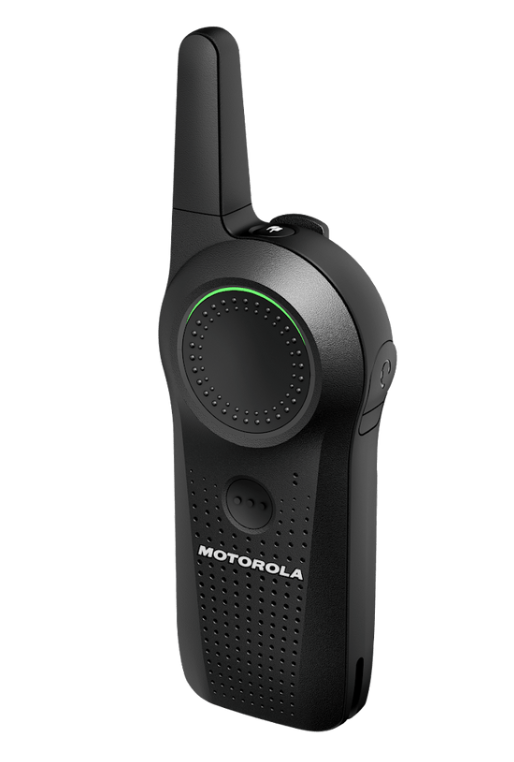
1. Motorola Curve — Best Overall for K–12 Schools
| Specification | Detail |
|---|---|
| Frequency | Digital 900 MHz (902–928 MHz) |
| Power | 1 watt digital (~4 watt analog equivalent) |
| Channels | 10 |
| Indoor Coverage | Up to 300,000 sq ft / approx. 20 floors |
| Battery Life | Up to 14 hours |
| Water Resistance | IP54 (splash-resistant) |
| Weight | Under 6 oz |
The Motorola Curve is the top recommendation for most K–12 schools. It operates on a proprietary 900 MHz digital FHSS spectrum. Despite its 1-watt output, digital signal processing delivers coverage equivalent to approximately 4 watts analog, meaning it reliably reaches portable classrooms, basement maintenance areas, and far corners of athletic fields that lower-powered radios miss.
Why it fits schools specifically
- 10 channels support full departmental segmentation: administration, teaching staff, custodial, security, and emergency.
- At under 6 oz, teachers and aides can carry it through a full school day without fatigue.
- 14-hour battery life covers the school day plus after-school activities on a single charge.
- Digital FHSS technology provides interference resistance in environments where multiple radios and Bluetooth devices compete for bandwidth.
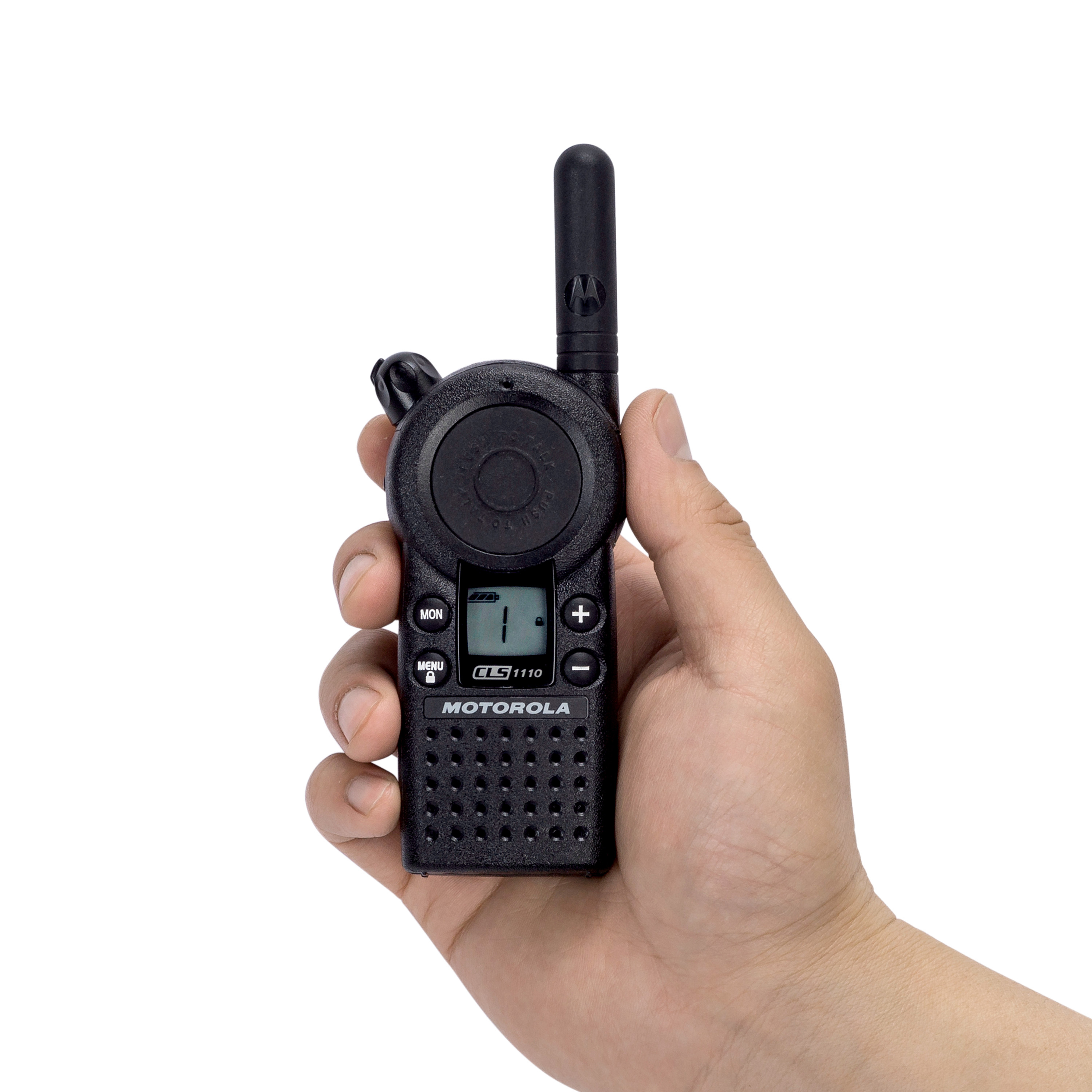
2. Motorola CLS1410 — Best for Smaller Elementary Schools
| Specification | Detail |
|---|---|
| Frequency | UHF (460–469 MHz) |
| Power | 1 watt |
| Channels | 4 |
| Indoor Coverage | Up to 200,000 sq ft / approx. 15 floors |
| Battery Life | Approximately 10 hours |
| Weight | Approximately 4.6 oz |
The CLS1410 is a proven, straightforward UHF radio well-suited to smaller elementary schools and single-building campuses. Its 4-channel layout maps directly to the four core school communication roles—admin, teaching staff, facilities, and emergency—which makes deployment and training fast. Staff are typically operational within minutes of receiving the radio.
Why it fits schools specifically
- UHF frequency penetrates concrete walls, metal doors, and multi-floor structures reliably.
- Vibracall technology and audible call alerts ensure staff receive messages without missing them in noisy areas.
- VOX (voice-activated transmission) capability allows hands-free use during recess supervision, student escorts, and cafeteria duty.
- Simple interface minimizes the training time required for non-technical staff.
- 10-hour battery covers a standard school day on a single charge.
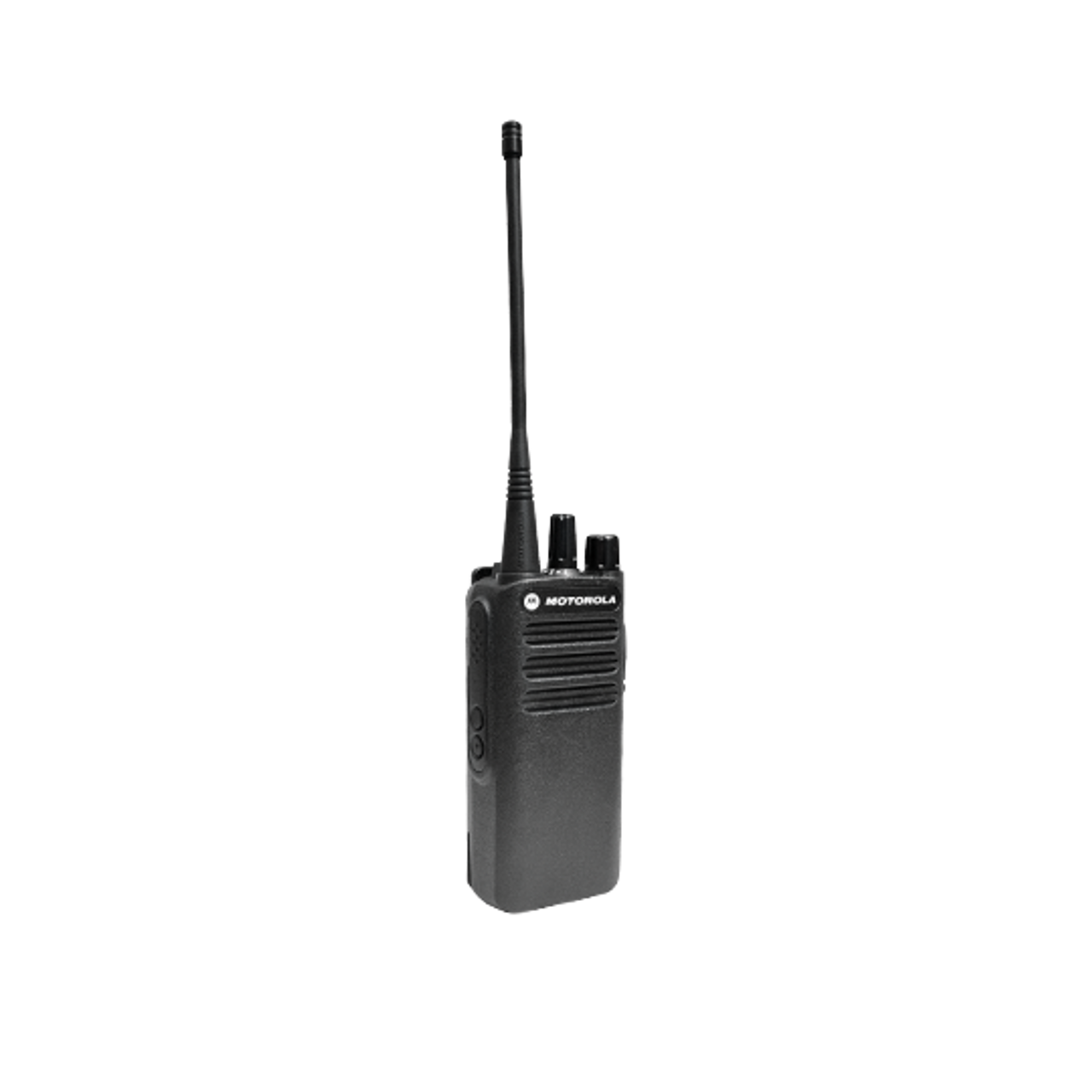
3. Motorola CP100d-UA — Best for Large High Schools and Multi-Building Campuses
| Specification | Detail |
|---|---|
| Frequency | UHF (403–480 MHz) |
| Power | 4 watts |
| Channels | 16 |
| Indoor Coverage | Up to 370,000 sq ft / approx. 20+ floors |
| Durability | MIL-STD-810 |
| Battery Life | Up to 12 hours |
| Weight | Approximately 9.7 oz |
The CP100d-UA is the correct choice for large high schools, K–12 campuses with multiple buildings, or schools with significant outdoor areas including athletic fields and portable classrooms. Its 4-watt UHF output consistently maintains clear audio in environments where 1-watt radios drop out—through cinder block construction, across open fields, and between detached buildings. MIL-STD-810 certification means it is tested to survive the shock, humidity, and temperature extremes of daily field use.
Why it fits large campuses specifically
- 4-watt output reaches outdoor athletic fields, portable classrooms, and remote parking areas that lower-powered radios cannot reliably cover.
- 16 channels support complex organizational communication structures: multiple departments, subteams, event-specific channels, and a dedicated emergency channel.
- MIL-STD-810 rating provides the durability margin needed for high-volume daily use across multiple staff members.
- 12-hour battery life handles full-day and after-school operations on a single charge.
Also Worth Considering: Motorola WAVE PTX — Best for Multi-Campus Districts
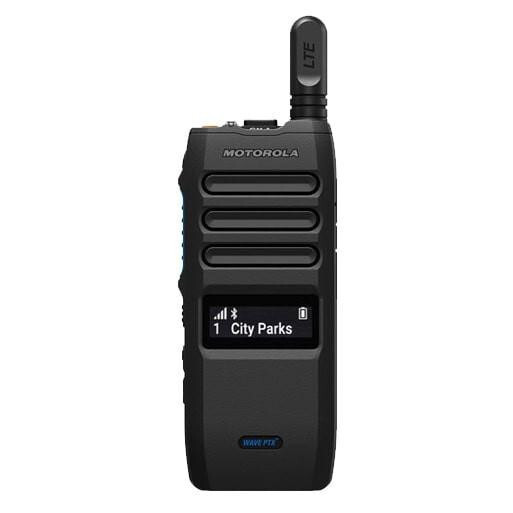
For school districts operating across multiple buildings, campuses, or cities, traditional radio range limitations make campus-to-campus communication impossible without repeater infrastructure. The WAVE PTX series routes communication over LTE cellular and Wi-Fi networks, providing unlimited range with no coverage gaps. Real-time GPS tracking gives district safety officers visibility into staff location across all campuses simultaneously. A monthly per-device service fee is required.
Model Comparison: Schools
| Model | Frequency | Power | Channels | Indoor Coverage | Battery Life | Durability | Best For |
|---|---|---|---|---|---|---|---|
| Motorola Curve | Digital 900 MHz | 1W (digital) | 10 | 300,000 sq ft / 20 floors | Up to 14 hrs | IP54, water-resistant | Most K–12 schools |
| Motorola CLS1410 | UHF | 1W | 4 | 200,000 sq ft / 15 floors | ~10 hrs | Commercial-grade, water-resistant | Smaller elementary schools, easy deployment |
| Motorola CP100d-UA | UHF | 4W | 16 | 370,000 sq ft / 20+ floors | Up to 12 hrs | MIL-STD-810 | Large high schools, multi-building campuses |
| Motorola WAVE PTX | LTE / Wi-Fi | N/A | Unlimited | Unlimited (LTE) | Varies by model | Varies by model | Multi-campus school districts, GPS tracking |
Frequently Asked Questions
What range do two-way radios need to cover a school campus?
For most single-building schools, a radio rated for 200,000–300,000 square feet of indoor coverage is sufficient. For large high schools or campuses with multiple detached buildings, 4-watt radios covering 370,000+ square feet are more appropriate. For multi-campus districts, LTE-connected radios such as the Motorola WAVE PTX eliminate range limitations entirely.
Always prioritize indoor square footage ratings over manufacturer-stated outdoor range figures. Outdoor range assumes flat open terrain with no obstructions and does not reflect real-world performance inside concrete or cinder block construction.
How long do school radio batteries last?
The business-grade models recommended here provide 10–14 hours of battery life per charge, sufficient to cover a standard school day plus after-school activities. The Motorola Curve leads at up to 14 hours; the CLS1410 and CP100d-UA provide 10–12 hours. Multi-unit charging cradles allow overnight simultaneous charging of the full fleet so radios are ready each morning.
Are two-way radios more reliable than cell phones for school emergencies?
Yes, for the specific functions of campus-wide emergency communication. Two-way radios operate on a dedicated radio frequency that does not depend on cellular towers or internet connectivity. During high-traffic emergency events, cell networks can become congested and calls may fail. Radios require no dialing, no signal bars, and no app—communication is instant at the push of a button.
Radios also allow one-to-many broadcasting: an administrator can reach all staff simultaneously in a single transmission. Smartphones cannot replicate this natively. FEMA’s Guide for Developing High-Quality School Emergency Operations Plans identifies reliable internal communication as a core component of any school emergency response framework.
How durable are two-way radios for daily school use?
The Motorola CP100d-UA meets MIL-STD-810 specifications for shock, vibration, humidity, and temperature resistance. The Motorola Curve and CLS1410 carry IP54 water-resistance ratings, suitable for outdoor use in light rain and splash exposure. All three models are rated for moderate to rugged daily use across multiple users. Consumer walkie-talkies typically carry no formal durability ratings and are not engineered for this level of daily wear.
How many radios does a school typically need?
A practical baseline: one radio per staff member with supervisory, safety, or operational responsibilities outside a fixed classroom. This typically includes the principal and assistant principal, front office staff, school nurse, security officer(s), all custodians, and teachers who supervise recess, transitions, or after-school activities.
Most elementary schools operate effectively with 10–20 radios. Larger high schools typically deploy 20–50. Tech Wholesale offers volume pricing and can assist with fleet sizing based on your campus layout and staff structure.
Can two-way radios be used during a lockdown if the power goes out?
Yes. Two-way radios operate on battery power entirely independent of building electrical infrastructure. Unlike intercoms, VoIP systems, or Wi-Fi-dependent devices, radios remain fully functional during power outages. This is one of the most important practical advantages of radio-based communication for school safety—the system works when the building doesn’t.
Can staff in portable classrooms use the same radios as staff inside the main building?
Yes, provided you select a radio with adequate outdoor coverage for your campus layout. For most portable classroom deployments, the Motorola Curve (300,000 sq ft indoor, equivalent outdoor coverage) and the CP100d-UA (370,000 sq ft indoor, 4-watt UHF output) both reach portable classrooms reliably. For extremely large campuses or portables at the far edges of the property, a repeater or WAVE PTX LTE solution may be warranted.
Why School Districts Buy from TechWholesale.com
Tech Wholesale has served K–12 schools and school districts since 1997 as an authorized dealer of Motorola and Kenwood business radios. Every radio sold through TechWholesale comes with the full manufacturer warranty—two years on most Motorola commercial-grade models—and lifetime technical support from our in-house radio specialists.
What sets us apart for school buyers
- Authorized dealer status — All radios are genuine manufacturer products with full warranty coverage. Purchasing from unauthorized resellers risks counterfeit inventory and voided warranties.
- Lifetime technical support included with every purchase — Call or email our team for the life of your radio fleet, not just through the warranty period.
- Fleet pre-configuration — We can pre-program channels and group assignments before shipment so radios arrive ready to deploy. No radio programming experience required on your end.
- Quick quotes — Request a custom quote .
- No-pressure consultation — Our team will tell you when a less expensive radio is the right answer for your campus, not push you toward a higher-margin product.
For most K–12 campuses, the Motorola Curve is the right starting point: license-free, 14-hour battery, and proven across hundreds of school deployments. Large campuses should evaluate the Motorola CP100d-UA. Multi-building districts should request a WAVE PTX consultation.
Request a Quote for volume pricing — or call us at 1-888-925-5982 to speak with a radio specialist who has equipped schools like yours for nearly three decades.
Related Reading
- On TechWholesale.com
- External Resources
Article by Kristin Wood, Two-Way Radio Consultant @ Tech Wholesale | Authorized Motorola & Kenwood Dealer Since 1997 | Last Updated: June 2026