
The Best Two-Way Radios for Long Range Outdoors
What is the best two-way radio for long range?
The Short Answer
The best long-range two-way radios for business use are licensed VHF or UHF portables rated at 4–5 watts — such as the Motorola CP100d-V, Motorola R2-VA, and the Motorola Mag One BPR50dx — delivering a realistic outdoor range of 1 to 5 miles depending on terrain and obstructions. For teams that need truly unlimited range across cities, states, or the entire country, the Motorola WAVE PTX series (TLK100, TLK110) uses LTE cellular networks to eliminate distance as a constraint entirely. Choosing the right radio comes down to understanding what “range” actually means in the real world — and why most of what you’ve been told about it is misleading.
But if you go out and buy the first radio that you see for your team without research, you might be in for a rude awakening. Static, poor battery life and cheap build... You need a quality radio tailored to your operations, and we’ve got you covered!
We don't want you to buy any radio just because you like the name or the price. We want you to make an educated decision and purchase the perfect radio gets reliable coverage over long distances.
We’ve sold thousands of radios and have compiled all that knowledge right here in this brief guide.
The Truth About Two-Way Radio Range Claims
Why “Up to 50 Miles” Is Almost Always False
Walk into any big-box store or search online, and you’ll find consumer radios advertising ranges of 20, 35, even 50 miles. These numbers are not lies in a legal sense — but they are functionally useless to any business buyer.
Those range figures are calculated under ideal conditions: two radios on tripods at elevation, pointed at each other, with zero obstructions, no atmospheric interference, and no competing RF signals. In the real world — across a construction site, a golf course, a theme park, or an open field with trees and rolling terrain — those same radios deliver a fraction of that claimed distance.
Here’s what you should actually expect:
- Consumer FRS/GMRS radios (the blister-pack kind claiming 35+ miles): 0.5 to 2 miles in real conditions
- Licensed business-band UHF/VHF portables at 4–5 watts: 1 to 5 miles outdoors in open or semi-open terrain
- VHF radios in heavily wooded or hilly terrain: 1 to 3 miles
- WAVE PTX (LTE-based) radios: Unlimited range — anywhere there is cellular or Wi-Fi coverage
This is not a flaw in business radios. It is the honest reality of radio physics. Buildings, hills, foliage, vehicles, and atmospheric conditions all attenuate RF signals. Any vendor quoting you a 20-mile range on a handheld portable without a repeater network is describing a scenario that does not exist in practice.
At TechWholesale.com, every range estimate we publish is based on real-world customer feedback collected over 25+ years. We do not inflate numbers to win a sale.
Who Needs a Long-Range Two-Way Radio?
Long-range radio requirements are not the same for every operation. Understanding your specific environment is the first step to choosing correctly.
Large Outdoor Venues and Open Properties
Golf courses, sports complexes, fairgrounds, outdoor festivals, and campuses need radios that can cover several acres or miles of open space. VHF business radios excel here because their signals propagate further over flat, open ground with minimal obstructions. A 5-watt VHF radio like the Motorola CP100d-V or R2-VA is the standard solution for this environment.
Construction Sites
Construction sites combine the worst of both worlds: large outdoor distances and RF-blocking obstructions like steel framing, concrete, and heavy equipment. Workers also need to hear and be heard over loud machinery. Licensed UHF or VHF radios in the 4–5 watt range, combined with noise-canceling audio and durable IP-rated housings, are the minimum viable solution. OSHA emphasizes communication as a core job site safety requirement — a radio that drops out mid-transmission is a safety liability, not just an inconvenience.
Transportation, Delivery, and Field Services
If your team operates across cities, counties, or state lines — trucking fleets, delivery services, field technicians — traditional portable radios cannot help you. There is no handheld radio that crosses a mountain range or follows a truck down an interstate. This use case requires a fundamentally different technology: the Motorola WAVE PTX platform, which operates over cellular LTE and Wi-Fi rather than traditional RF frequencies.
Large Multi-Floor Buildings
Tall buildings present a vertical range challenge. VHF signals struggle to penetrate multiple floors of concrete and steel. For this environment, UHF radios or 900 MHz digital radios (like the Motorola DTR series) are preferred. The DTR700, for example, is rated for indoor communication across up to 30 floors or 350,000 square feet.
Top Radio Recommendations for Long-Range Use
1. Motorola CP100d-V — Best VHF Business Radio for Outdoor Range
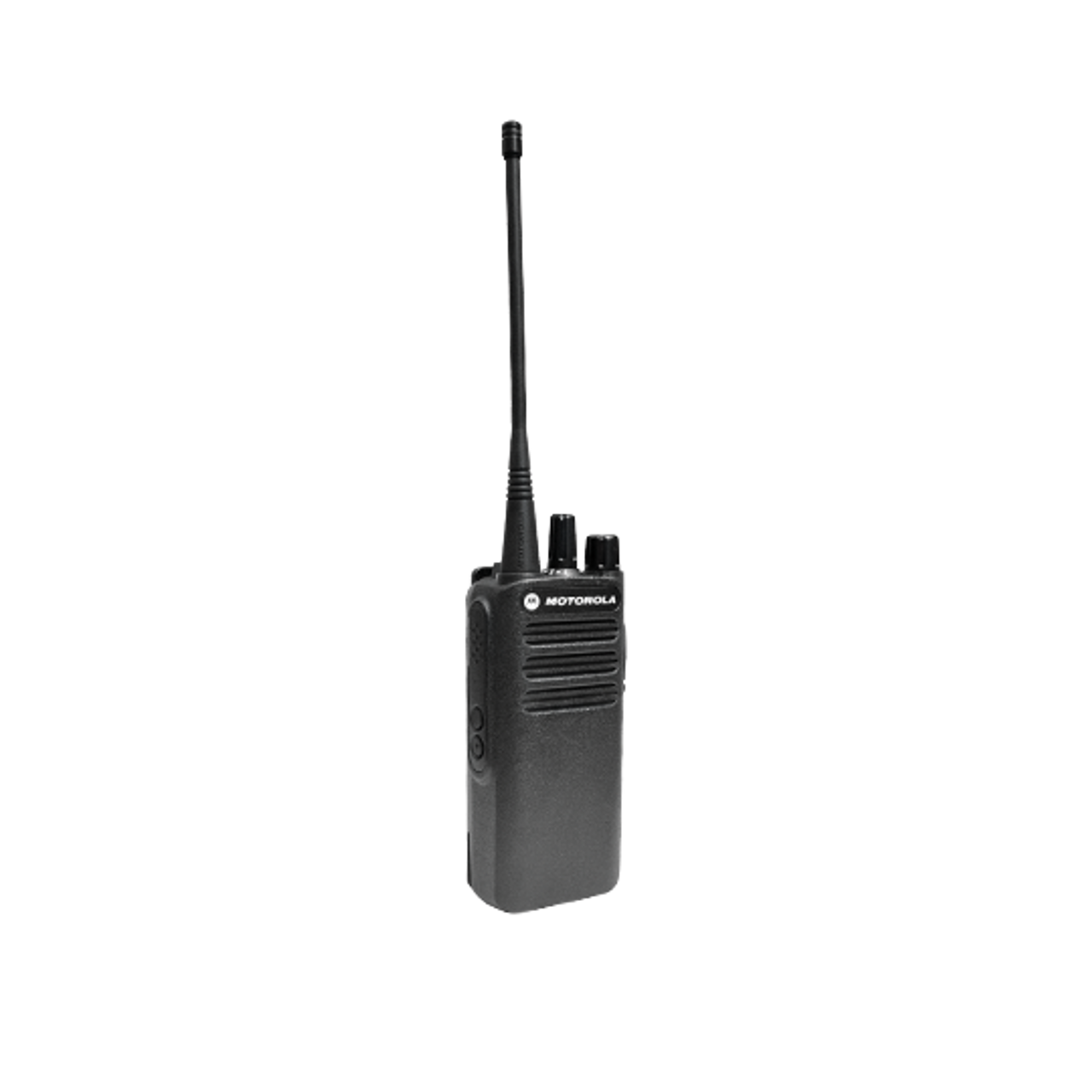
Best for: Golf courses, parks, campgrounds, outdoor security, agricultural operations
The CP100d-V is a 5-watt VHF analog/digital portable operating on the 136–174 MHz frequency band. VHF frequencies travel further over open ground than UHF, making this the preferred choice for large outdoor properties without significant vertical obstructions.
Key specs:
- Output power: 5 watts
- Frequency: VHF 136–174 MHz
- Channels: 160
- Mode: Analog and digital
- Durability: Rugged construction, water resistant
- Range: 3–5 miles in open outdoor terrain (real-world estimate)
- FCC license required: Yes (Part 90)
Why it fits: VHF signals propagate efficiently across flat, open outdoor terrain. At 5 watts with 160 programmable channels, this radio gives large-property operations the coverage and channel separation they need to keep communications organized and clear.
2. Motorola R2-VA — Best for Mixed Indoor/Outdoor Long-Range Environments
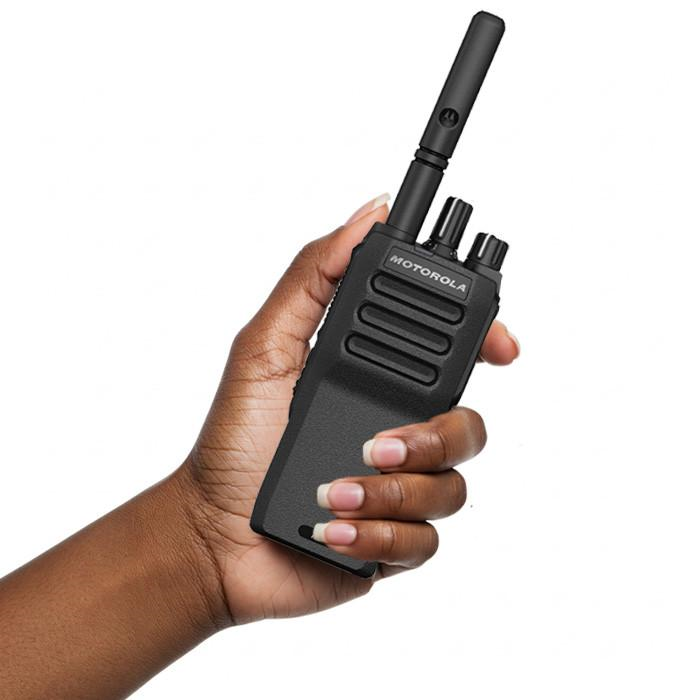
Best for: Construction, warehousing, large venues, campus security, manufacturing
The R2-VA is Motorola’s MOTOTRBO-platform VHF radio, offering both analog and digital operation on a single device. Its 5-watt output delivers strong outdoor range, while the digital mode (DMR Tier II) adds clearer audio, better battery efficiency, and basic digital features like digital noise suppression.
Key specs:
- Output power: 5 watts
- Frequency: VHF 136–174 MHz
- Channels: 64
- Mode: Analog and digital (DMR)
- Durability: IP54-rated, water and dust resistant
- Range: 3–5 miles outdoors; strong multi-floor indoor penetration in UHF variant
- FCC license required: Yes (Part 90)
Why it fits: The R2-VA bridges the gap between traditional analog jobsite radios and modern digital platforms. Construction crews in particular benefit from the DMR digital mode’s noise cancellation — critical when working near heavy equipment — while still maintaining the long outdoor range of a 5-watt VHF radio.
3. Motorola TLK100 (WAVE PTX) — Best for Unlimited Range Operations
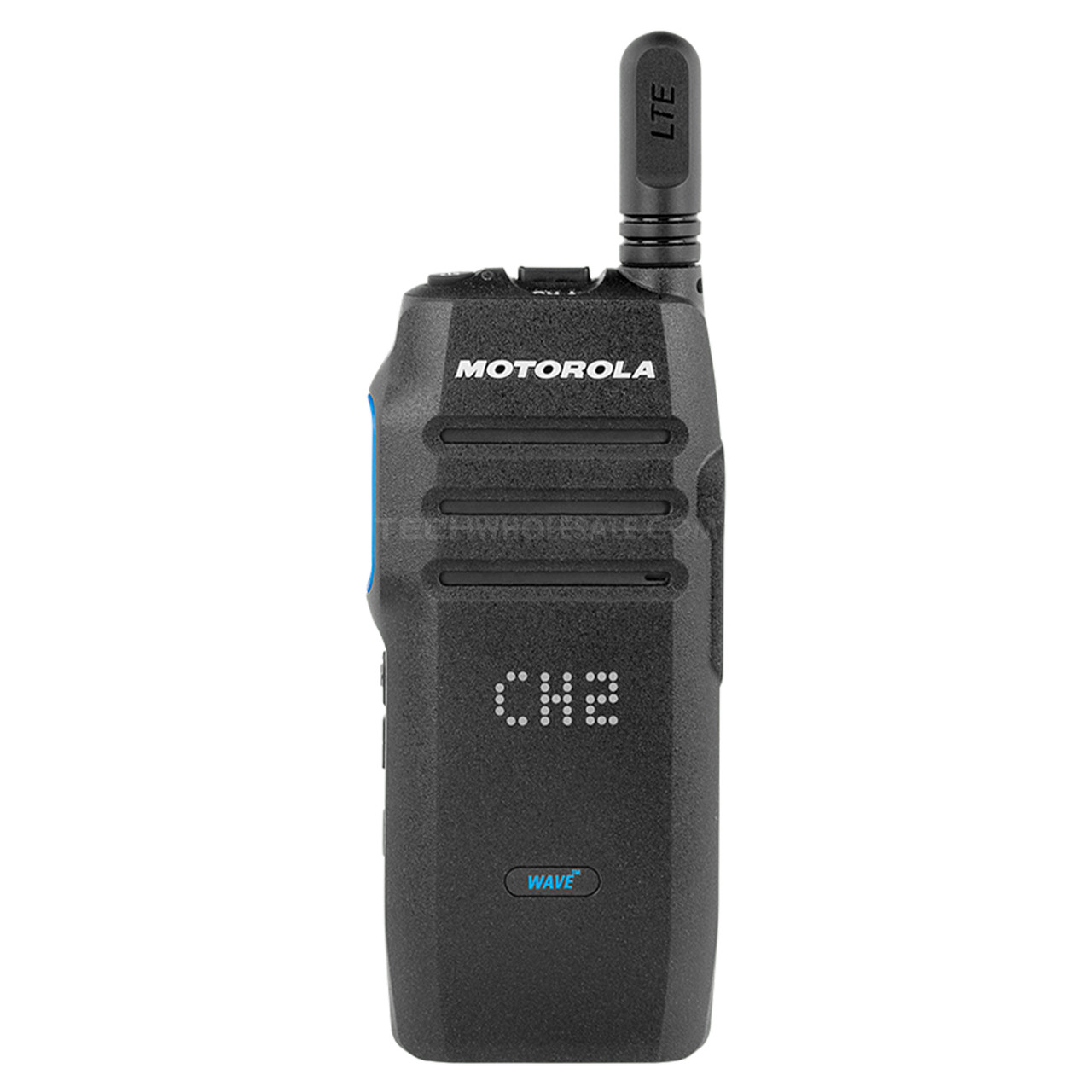
Best for: Trucking, delivery fleets, multi-site management, field service, any operation spanning more than 5 miles
The Motorola TLK100 is not a traditional two-way radio. It is a WAVE PTX push-to-talk over cellular (PoC) device that transmits over Verizon 4G LTE and Wi-Fi rather than traditional RF frequencies. This means its range is not measured in miles — it is measured in cellular coverage, which spans the entire continental United States.
Key specs:
- Technology: Push-to-talk over cellular (LTE/Wi-Fi)
- Channels: 8
- Battery: 18-hour lithium-ion
- Range: Unlimited — anywhere with LTE or Wi-Fi coverage
- GPS dispatch and tracking: Optional add-on
- FCC license required: No
- Monthly service fee: Required (Verizon WAVE PTX plan)
Why it fits: If your operation crosses city limits, state lines, or requires communication between a home office and a mobile team in the field, no traditional handheld radio can serve you. The TLK100 is the only tool for this job. TechWholesale programs each unit so your team can communicate out of the box, and can set up channel groups so departments only hear what’s relevant to them.
Important note on LTE radios: The WAVE PTX requires an active cellular subscription to function. Think of it less like a radio and more like a rugged walkie-talkie that runs on your cellular plan. The monthly service fee is the cost of unlimited range — and for operations that truly need it, that tradeoff is straightforward.
Frequently Asked Questions About Long-Range Two-Way Radios
What is the realistic range of a business two-way radio?
In real-world conditions, a licensed 4–5 watt business radio will cover between 1 and 5 miles outdoors depending on terrain, foliage, and obstructions. Flat, open ground with no trees or buildings yields the best results. Urban environments, hilly terrain, and dense vegetation will reduce that range significantly. Indoor range is measured differently — a quality UHF radio may communicate effectively across 15–30 floors of a building.
Why do some radios claim ranges of 35 or 50 miles?
Those figures are theoretical maximums calculated under conditions that virtually never exist in practice: line-of-sight between two elevated antennas with no terrain, weather, buildings, or interference. Consumer FRS/GMRS radios that make these claims are typically limited to 0.5–2 watts and perform far below their advertised ranges in any real-world setting. The FCC caps unlicensed FRS radios at 2 watts, which fundamentally limits their range regardless of what the box claims.
What is a WAVE radio, and how does it achieve unlimited range?
A Motorola WAVE PTX radio (such as the TLK100 or TLK110) operates over 4G LTE cellular networks and Wi-Fi rather than traditional radio frequencies. This means range is not a radio physics problem — it’s a cellular coverage problem. Wherever Verizon LTE or a Wi-Fi network is available, these radios work. A driver in Los Angeles can communicate instantly with dispatch in Chicago. No repeater, no infrastructure, no RF propagation issues.
Do I need an FCC license to use a long-range two-way radio?
It depends on the radio. Traditional business-band VHF and UHF radios (Part 90) require an FCC license. The application process through the FCC Universal Licensing System is straightforward, and licenses are typically issued for 10-year terms. WAVE PTX radios do not require an FCC license — they operate over licensed cellular spectrum managed by the carrier. FRS-band consumer radios are license-free but are not recommended for professional or extended-range use. TechWholesale can advise you on licensing requirements for any radio we sell.
How long do batteries last on long-range business radios?
Most licensed business portables use lithium-ion battery packs rated for 8–18 hours of typical use (a mix of transmitting, receiving, and standby). The Motorola TLK100 WAVE PTX is rated for 18 hours. The CP100d-V and R2-VA series are typically rated for 10–12 hours on the included battery, with extended-capacity packs available. Heavy transmit use will reduce those figures. For operations running longer than one shift, spare batteries or multi-unit charging docks are worth including in your budget.
How durable are long-range business radios for outdoor use?
The radios we recommend for outdoor long-range use meet IP54 or higher ingress protection ratings, meaning they are protected against dust and water splashing from any direction. For environments with heavier water exposure — outdoor events in rain, marine use, agriculture — look for IP67-rated models or higher, which are rated for temporary full submersion. All radios on our outdoor long-range page are rated for rugged use and carry manufacturer warranties.
Do I need a repeater to extend my radio range?
A repeater can significantly extend the effective range of a conventional VHF or UHF radio network by receiving a signal and re-transmitting it at higher power from an elevated location. For most business operations covering 1–5 miles, a quality 5-watt portable without a repeater is sufficient. Beyond that range, or in environments with heavy obstructions, a repeater system or a WAVE PTX LTE radio is the appropriate solution. TechWholesale carries the Ritron Liberty RLR-465-N repeater for operations that need infrastructure-based range extension.
What is VHF vs. UHF, and which is better for long range outdoors?
VHF (136–174 MHz) frequencies travel further over flat, open outdoor terrain and are generally preferred for outdoor-primary applications like golf courses, parks, farms, and open job sites. UHF (400–512 MHz) frequencies are shorter-wavelength and penetrate buildings, walls, and vertical structures more effectively, making them better for indoor environments or mixed indoor/outdoor use. For pure outdoor long-range applications, VHF is typically the correct choice.
Why Buy from TechWholesale.com?
TechWholesale has been an authorized two-way radio dealer since 1997. That’s nearly three decades of helping businesses across every industry — transportation, construction, hospitality, education, healthcare, and more — find the radio that actually fits their operation, not just the one that looks good on a spec sheet.
We sell Motorola, Kenwood, Ritron, and other top-tier brands as an authorized dealer, which means you receive full manufacturer warranties, factory-fresh inventory, and access to the complete accessory ecosystem for every radio we carry.
For WAVE PTX radios, we handle programming in-house before your order ships. Your radios arrive ready to use, with channels and groups already configured for your team.
We offer:
- Wholesale and volume pricing with quote support for fleet purchases
- Lifetime technical support on every radio we sell
- Free shipping on qualifying orders
- Two-year warranty coverage
- Expert guidance from staff with decades of hands-on radio experience — not a call center script
If you’re not sure which radio fits your range requirement, call us at 1-888-925-5982, use the live chat on this page, or submit a quote request. We’ll ask the right questions and give you a straight answer — the same way we’ve done it since 1997.
Article by Kristin Wood, a two-way radio consultant @ Tech Wholesale | Authorized Motorola & Kenwood Dealer Since 1997 | Last Updated: May 2026