

Why Choose Motorola Two-Way Radios?
Motorola business two-way radios deliver instant push-to-talk communication that keeps teams connected without relying on cellular networks, monthly contracts, or Wi-Fi. Businesses across retail, hospitality, construction, healthcare, and education depend on Motorola Solutions radios for their durability, long battery life, and proven range in demanding environments. Tech Wholesale has been an authorized Motorola dealer since 1997, giving our customers access to the full commercial radio lineup backed by real product expertise.
Why Motorola for Business
Motorola Solutions has been engineering professional-grade radios for decades, and their models consistently outperform consumer-grade radios in every metric. Motorola business radios operate on dedicated radio frequencies and function without any network infrastructure or monthly subscription fees. Your team stays connected during power outages, network failures, and in basements or warehouses where cell coverage is unreliable.
Battery performance is another significant advantage. Most Motorola commercial radios deliver 12 to 24 hours of use on a single charge, with many models supporting multi-unit charging trays so your entire fleet stays ready between shifts.
Consumer-grade walkie talkies rarely hold up under the daily abuse of a retail or hospitality environment, while Motorola's business line is engineered to survive drops, dust, and moisture across years of continuous use.
Range is where Motorola's commercial radios genuinely separate themselves from budget FRS or GMRS alternatives. Depending on the model and environment, Motorola business radios deliver reliable communication on UHF, VHF or Digital frequenies across several floors of a building, across a large warehouse, or across an outdoor campus — without the dead zones.
For full details on Motorola Solutions' commercial radio portfolio, visit the Motorola Solutions website.
Motorola Model Series Overview
Motorola offers multiple radio series, each engineered for specific business environments - from restaurants to construction.
| Model Series | Best For | Channels | Coverage |
|---|---|---|---|
| CLS Series | Retail, restaurants, medical offices | 1–4 | Up to 150,000 sq ft |
| CLPe Series | Bars, events, dental offices | 1–8 | Up to 150,000 sq ft |
| RM Series | Schools, hotels, security, warehouses | Up to 8 | Up to 250,000 sq ft |
| Curve Series | Retail, churches, restaurants, schools | Up to 10 | Up to 350,000 sq ft |
| Mag One BPR50dx | Security, stadiums, large venues | Up to 64 | Up to 350,000 sq ft |
| CP100d Series | Schools, stadiums, high-rises, golf courses | Up to 160 | Up to 35 floors |
| DTR700 Series | Schools, hotels, construction, museums | Up to 50 | Up to 350,000 sq ft |
| WAVE PTX / TLK Series | Unlimited range, multi-site operations | Varies | Nationwide |
Detailed Model Comparisons
Motorola Curve vs. DTR700 — Digital License-Free Options for Indoor Environments


The DTR700, operating on FHSS 900 MHz technology, supports up to 100 individual contacts and includes features like private calling, group calling, and programmable alerts — making it the better choice for larger operations where managing communication across departments is a daily requirement. Hotels, schools with multiple buildings, construction sites, and museums will find the DTR700's expanded channel capacity and stronger feature set worth the higher price point.
| Spec | Motorola Curve | Motorola DTR700 |
|---|---|---|
| Max Channels / Contacts | 10 channels | 100 contacts |
| Indoor Coverage | Up to 350,000 sq ft | Up to 350,000 sq ft |
| Private Calling | No | Yes |
| Best For | Retail, restaurants, churches, schools | Hotels, schools, construction, museums |
Motorola CLS vs. CLPe — Entry-Level UHF, When to Choose Each
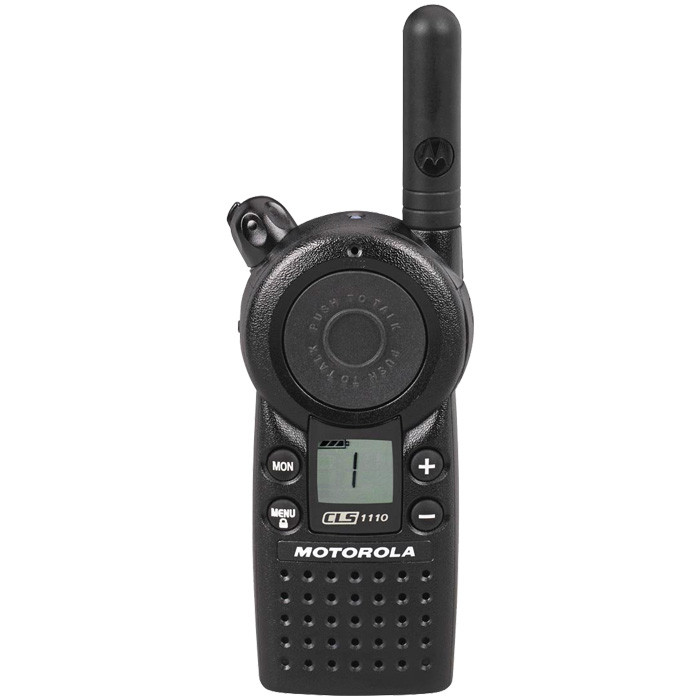
The CLS Series and CLPe Series are both compact, 1-watt UHF radios designed for busy indoor commercial environments. The CLS has been a staple of retail and restaurant operations for years, offering a slim profile that fits easily in an apron pocket and delivers reliable coverage across a typical store or restaurant floor. With up to 4 channels and coverage across 200,000 square feet, it handles the needs of most small to mid-size businesses without complexity.
The CLPe builds on the CLS foundation with a few meaningful upgrades: up to 8 channels, a more streamlined form factor, and improved audio performance in high-noise environments like bars, event venues, and dental offices. There is no external speaker - all communication is done through the included earpiece, so customers are not bothered with radio chatter. Coverage with the CLPe is up to 100,000 sq ft.
| Spec | Motorola CLS Series | Motorola CLPe Series |
|---|---|---|
| Frequency | UHF | UHF |
| Wattage | 1W | 1W |
| Max Channels | 4 | 6 |
| Best For | Retail, restaurants, medical offices | Bars, events, dental offices |
Motorola CP100d vs. Mag One BPR50dx — High-Power Options for Large Facilities

Both the CP100d and the Mag One BPR50dx are higher-power analog radios intended for large facilities where 1-watt indoor radios fall short in coverage. The CP100d delivers 4 to 5 watts of output power and is available in both VHF and UHF configurations, making it adaptable for facilities that span multiple floors or mix indoor and outdoor environments — schools, golf courses, stadiums, and high-rise properties all benefit from its extended range and straightforward multi-channel layout.
The BPR50dx is a 5-watt radio built with security operations and large venue deployments in mind. Its rugged construction meets military-grade durability standards, and its high output power makes it well-suited for stadiums, outdoor events, and large campuses where range and durability take priority over compact form. If your primary concern is maximum coverage and physical durability, the BPR50dx is the stronger choice. For operations that span both indoor and outdoor zones with mixed terrain, the CP100d's frequency flexibility gives it an edge.

| Spec | Motorola CP100d | Motorola Mag One BPR50dx |
|---|---|---|
| Frequency | VHF or UHF | UHF or VHF |
| Wattage | 4–5W | 5W |
| Max Channels | 160 | 64 |
| Best For | Schools, stadiums, golf courses, high-rises | Security, stadiums, large outdoor venues |
How to Choose the Right Motorola Radio
With so many models available, narrowing down the right radio for your business comes down to 5 practical questions.
- What is your environment and how much range do you need? A single-floor retail store under 20,000 square feet has very different needs than a multi-building campus or a 14-story hotel. Compact 1-watt UHF radios like the CLS and CLPe perform well in typical commercial indoor spaces. Larger facilities, outdoor environments, or properties that mix indoor and outdoor zones require higher-wattage radios like the CP100d or BPR50dx, or digital options like the Curve that penetrate walls and floors more effectively.
- How many users will be on the system? Small teams of 2 to 10 people can operate comfortably on a basic channel-based system with 1 to 4 channels. Larger organizations — hotels with multiple departments, schools coordinating staff across buildings, or event venues running separate security and operations teams — benefit from radios with more channels, private calling, or contact-based systems like the DTR700 that support up to 100 named contacts.
- Do you need analog or digital technology? Analog radios are simpler, more affordable, and interoperable with a wider range of accessories and third-party equipment. Digital radios like the Curve and DTR700 deliver clearer audio, support features like private calling, and often provide better performance in noisy environments. If audio clarity and feature depth matter to your operation, digital is worth the investment.
- Do you want license-free operation? Licensed radios operate on dedicated frequencies that give you greater range and less interference, but they require a frequency license. License-free options like the Curve, DTR700, and DLR Series use spread-spectrum technology that requires no license — making them faster to deploy and simpler to manage, at some cost to range and interoperability. For most small businesses, license-free is the easiest starting point.
- What is your budget, and are you outfitting a fleet? Per-unit price matters, but total cost of ownership — chargers, accessories, replacement batteries, and support — adds up quickly for large teams. Tech Wholesale offers quotes for organizations purchasing for their team. Getting the right advice before you buy prevents costly replacements later.
Motorola Radios by Industry
- Retail — Compact, lightweight radios like the CLS Series and Curve are built for retail floor staff, fitting in apron pockets and delivering reliable communication across a store without interfering with the customer experience.
- Restaurants — From quick-service counters to fine dining, restaurant teams rely on radios to coordinate front-of-house and back-of-house without shouting across the dining room. The CLS and CLPe are the most popular choices in food service environments.
- Hotels — Multi-department hotel operations — housekeeping, front desk, maintenance, security, and F&B — require radios that cover multiple floors and support separate communication groups. The DTR700 and RM Series are well-matched to full-service hotel properties.
- Schools — Safety and coordination across a school campus demand radios with strong range, clear audio, and ease of use for staff at all technical comfort levels. The CP100d, DTR700, and Curve are all popular in K-12 and higher education settings.
- Construction — Job sites need radios that survive drops, dust, and outdoor exposure. The BPR50dx and DTR700 handle outdoor construction environments, with the DTR700's license-free operation simplifying deployment on temporary or rotating job sites.
- Security and Events — High-power radios with long range are essential for security teams managing large venues, concerts, and outdoor events. The Mag One BPR50dx and CP100d provide the wattage and durability that security operations demand.
- Healthcare — Hospitals, assisted living facilities, and clinics need quiet, discreet radios that integrate with HIPAA-conscious workflows. Options like the DLR Series and Curve are popular in healthcare environments where simplicity and staff compliance are priorities.
Frequently Asked Questions
- What is the best Motorola radio for a small business?
- For most small businesses operating in a single building under 150,000 square feet, the Motorola CLS Series or Curve are the top choices. The CLS is a proven UHF radio for retail and food service, while the Curve offers license-free digital operation that is faster to set up and requires no frequency coordination. Both are compact, easy to use, and backed by Motorola's commercial-grade build quality.
- What is the difference between UHF and VHF radios?
- UHF (Ultra High Frequency) radios operate between 400–512 MHz and are better suited for indoor environments, buildings with concrete or steel construction, and locations where signals need to penetrate walls and floors. VHF (Very High Frequency) radios operate between 136–174 MHz and travel farther in open outdoor environments like golf courses, campuses, and construction sites with line-of-sight conditions. Most commercial buildings benefit from UHF, while outdoor-heavy operations often prefer VHF. Some Motorola models, like the CP100d, are available in both configurations.
- How far do Motorola business radios reach?
- Range varies significantly based on the model, environment, and any physical obstructions between radios. In open outdoor conditions, higher-power radios like the CP100d and BPR50dx can reach up to a mile or more. In typical commercial indoor environments — retail stores, hotels, warehouses — most Motorola business radios cover 150,000 to 350,000 square feet. Range claims from manufacturers typically reflect best-case outdoor conditions; real-world indoor range will be less depending on building materials and layout. Our team at Tech Wholesale can recommend the right model based on your specific facility.
- What is the difference between analog and digital two-way radios?
- Analog radios transmit voice as a continuous radio wave — simple, reliable, and compatible with a broad ecosystem of accessories and repeaters. Digital radios convert voice into data before transmitting, which produces clearer audio, reduces background noise, and supports additional features like private calling, contact lists, and data messaging. Digital radios also hold their audio quality at the edge of their coverage range better than analog, which tends to get noisy or staticky as signals weaken. For most businesses that communicate in noisy environments or need more structured team communication, digital is worth the additional investment.
- Can Motorola radios work across multiple locations?
- Standard UHF and VHF radios are limited to the range of their radio signal, which makes cross-location communication impractical without repeater infrastructure. The Motorola WAVE PTX / TLK Series is specifically designed for multi-site operations, using LTE cellular and Wi-Fi networks to connect users across unlimited distances — from different floors of a building to entirely different cities. This makes WAVE PTX the right solution for businesses with distributed locations, field teams, or remote site coordination needs.
Shop Motorola Business Radios at Tech Wholesale
Tech Wholesale has been an authorized Motorola dealer since 1997, serving businesses across every industry with the full commercial radio lineup and the expertise to match the right equipment to your specific operation. Whether you are outfitting a five-person retail team or deploying radios across a 500-employee facility, we offer lifetime product support, competitive pricing, and bulk fleet discounts for larger orders. Our team understands that buying the wrong radio means buying twice — we take the time to get it right the first time.
Ready to find the right Motorola radio for your business? Use our radio selector tool to get a personalized recommendation based on your environment and team size, or request a fleet quote. Our team is available to answer questions and help you configure the right solution for your operation.
If you know the model family you are seeking, click that family above. If you need help deciding which radio is right for you.