
Room 3 has been prepped for over 10 minutes, but no one's brought the patient in. The hygienist in Room 2 needs help with a nervous child but can't leave her post. The front desk is trying to confirm whether the doctor can squeeze in a walk-in emergency before lunch...
Sound familiar?
Two-way radios close that communication gap instantly, without disrupting the calm, professional atmosphere your patients expect.
But grab the wrong radio off the shelf, and you'll quickly run into problems: static, dead zones, poor battery life, and a build that won't survive daily dental office use.
That's why choosing the right radio matters.
We've sold thousands of two-way radios to dental offices across the country. This guide distills everything we've learned into one straightforward resource, so you can make an educated decision and choose a radio that's discreet, easy to use, and delivers reliable coverage.
The Best Two-Way Radios for Dental Offices - 2026
The Short Answer
The best two-way radios for dental offices are compact, low-profile UHF radios with clear audio, long battery life, and multi-channel capability. For most single-location practices, the Motorola CLP1010e or CLS1410 covers the space reliably without requiring complex setup.
Larger or multi-building practices benefit most from the Motorola Curve, which adds digital privacy features and does not require an FCC license.
All three are available at techwholesale.com with free shipping, a 2-year warranty, and lifetime tech support.
Why Dental Offices Need Two-Way Radios
Dental practices run on tight schedules. A single miscommunication — a room that isn't prepped, a patient held at the front desk while the hygienist waits, a walk-in emergency no one coordinated — can throw off an entire day of appointments.
Two-way radios solve this without requiring staff to stop what they're doing to check a phone or walk across the office. Communication is instant, hands-free when needed, and discreet enough that patients don't feel like they're in a warehouse.
The challenge is that dental offices have communication needs other workplaces don't:
- Lead-lined X-ray rooms can weaken radio signals if the radio isn't powerful enough.
- Clinical staff work with gloves on, so radios need large, easy-to-press push-to-talk buttons.
- Patient-facing environments require low-profile earpieces and no blaring external speaker that broadcasts sensitive information.
- HIPAA considerations apply when discussing patient scheduling or clinical status over the air.
- Sterilization and infection control protocols mean radios should have wipeable, antimicrobial casings.
- Staff span multiple rooms and floors, so coverage must reliably pass through walls, not just across open space.
What to Look for in a Dental Office Radio
Audio Quality
Background noise from handpieces, suction machines, and sterilizers is constant in a dental environment. Look for radios with noise-filtering audio that can deliver clear sound even in that environment.
Form Factor and Weight
Staff wear radios for eight or more hours. A radio over five ounces starts to feel heavy by mid-afternoon. The best dental office radios weigh between 2 and 4 ounces and clip flat against a uniform without bulk.
Earpiece Compatibility
Discreet communication in front of patients requires an earpiece. Look for radios that come bundled with one, or that are compatible with lightweight acoustic tube earpieces.
Battery Life
A dental office day runs 8 to 10 hours, sometimes longer. The radio should handle a full shift on a single charge. Look for 12 to 14 hours of battery life minimum.
Number of Channels
Channels let you separate team conversations. A three-channel setup — front desk, clinical staff, sterilization — eliminates cross-talk and keeps each team's communication relevant. Larger practices may want 6 to 10 channels.
VOX Capability
VOX lets staff communicate without pressing a button, which is especially useful mid-procedure or while wearing gloves.
Antimicrobial Casing
Dental offices are high-touch environments. Some radio models include casings treated with antimicrobial compounds, which helps meet sanitation standards between shifts.
Signal Penetration
A dental office isn't open floor space. Concrete walls, lead-lined rooms, and equipment-dense operatories all absorb signal. UHF frequencies between 450 and 470 MHz penetrate building materials better than VHF and are the correct choice for indoor dental environments.
Coverage Guide: Matching Radio Power to Your Office Size
| Practice Size | Square Footage | Recommended Wattage |
|---|---|---|
| Small: 1–4 operatories | Up to 100,000 sq ft | 1 watt UHF |
| Mid-sized: 5–10 operatories | Up to 200,000 sq ft | 1–2 watt UHF |
| Large or multi-building | 200,000–350,000+ sq ft | 2–4 watt analog, or 1 watt digital |
Note: If your office includes lead-lined X-ray rooms or thick concrete construction, step up one watt from the table above to compensate for signal loss.
Recommended Two-Way Radios for Dental Offices
1. Motorola CLP1010e — Best for Small Practices
Specs at a Glance
- Power: 1 watt, UHF 450–470 MHz
- Channels: 1
- Indoor Coverage: Up to 100,000 sq ft / 10 floors
- Outdoor Range: Up to 1 mile
- Weight: 2.38 oz
- Battery Life: 12 hours
- Durability: Light-duty use / occasional rain resistance
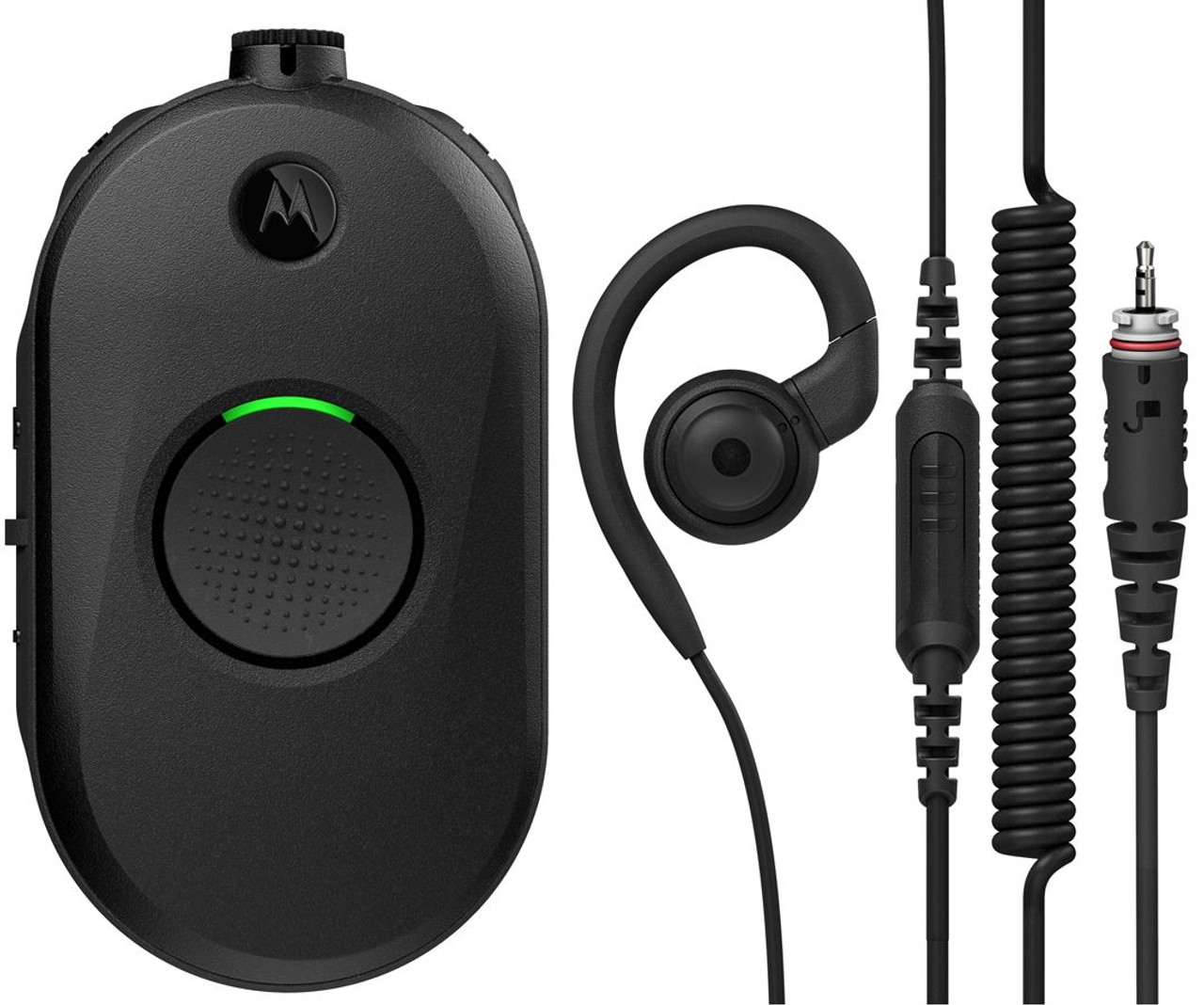
The CLP1010e is the most popular radio we sell into dental practices, and the reason is simple: it disappears. At 2.38 ounces, it's small enough to clip under a lab coat or against a scrub pocket without catching on anything. There is no external speaker — communication goes entirely through the included earpiece, so no patient overhears a staff conversation. The large central PTT button is easy to activate with gloved hands.
The antimicrobial casing is a practical feature in a sanitation-conscious setting. The radio is also repeater-capable, meaning a single repeater can extend its range if your office ever expands.
Best suited for: Practices with up to four operatories on a single floor.
2. Motorola CLS1410 — Best for Mid-Sized Practices
Specs at a Glance
- Power: 1 watt, UHF 460–469 MHz
- Channels: 4
- Indoor Coverage: Up to 200,000 sq ft / 15 floors
- Outdoor Range: Up to 1.5 miles
- Battery Life: 12+ hours
- Durability: Moderate use / water resistant
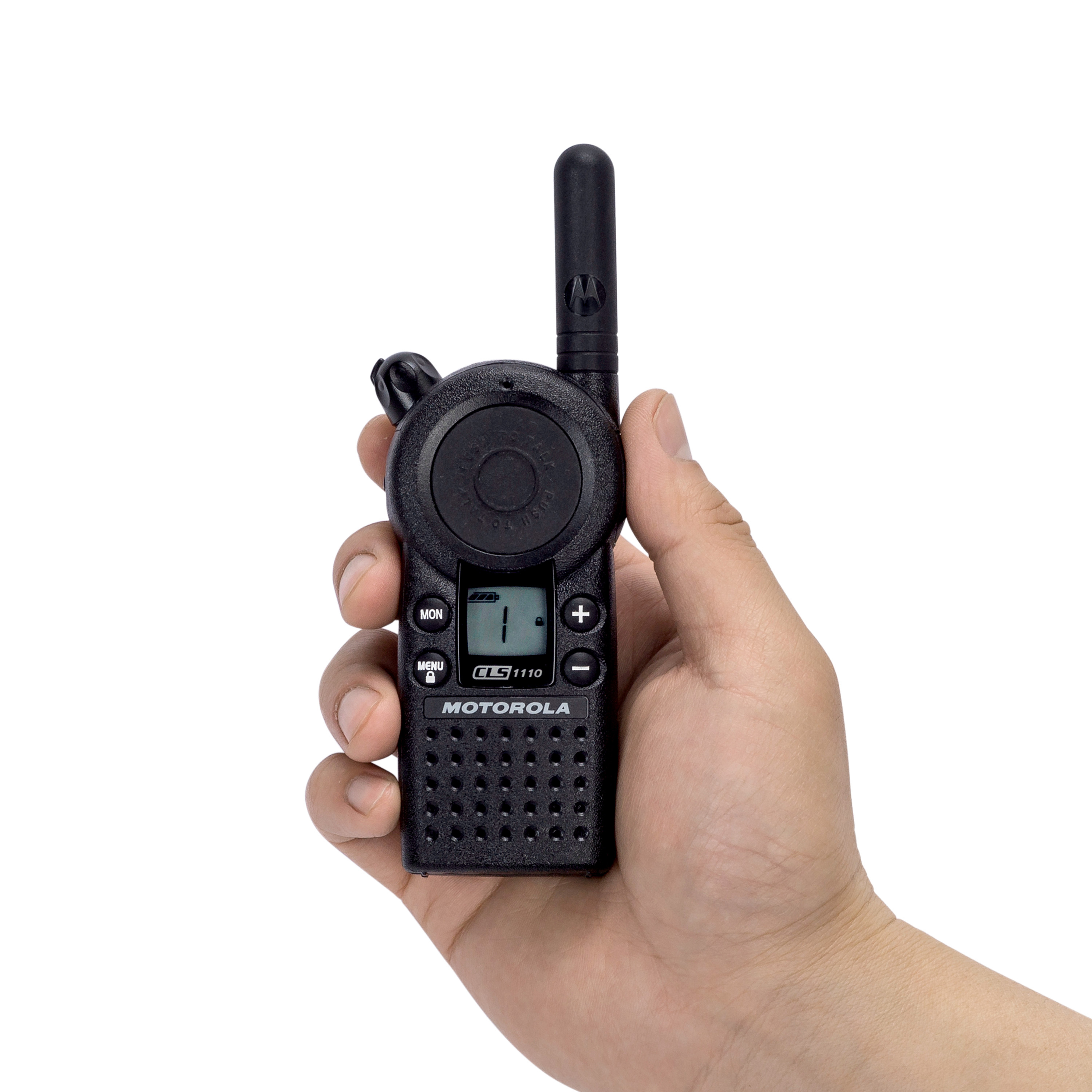
The CLS1410 is the right step up when your practice has grown beyond a four-person team and needs channel segmentation. Four channels allow you to separate front desk, clinical, and sterilization staff, with a spare channel available for management or emergencies.
The audible call alert feature is particularly useful in clinical settings: when a call comes in, the radio plays a tone to notify the user rather than broadcasting the audio immediately. Staff can step away from a patient before responding, protecting both privacy and professionalism.
Many practices pair this radio with a Ritron JBS447d base station at the front desk, which acts as a central communication hub and can interact with both CLPe and CLS series radios simultaneously.
Best suited for: Practices with 5 to 10 operatories, or those operating across three floors.
3. Motorola Curve — Best for Large or Multi-Building Practices
Specs at a Glance
- Power: 1 watt digital
- Channels: 10
- Indoor Coverage: Up to 300,000 sq ft / 20 floors
- Battery Life: 14 hours
- Weight: 4.2 oz
- FCC License: Not required
- Privacy: Frequency Hopping Spread Spectrum + 10,000 privacy codes
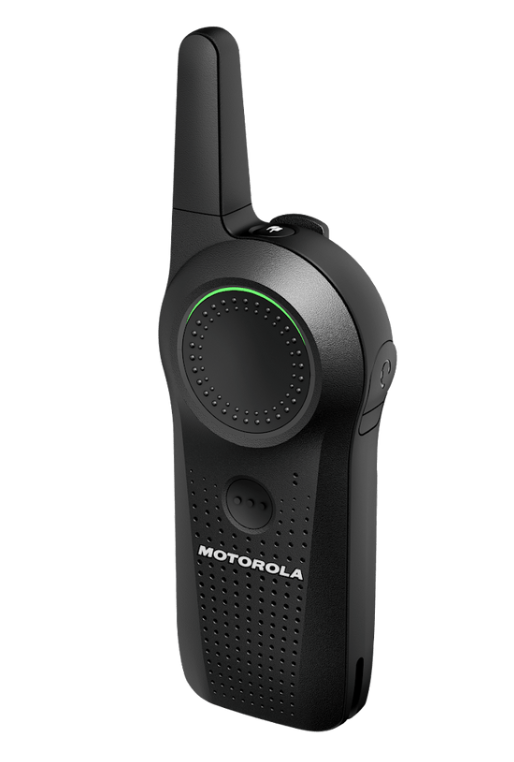
The Motorola Curve is the strongest option for larger group practices or dental organizations operating across multiple suites or buildings. Ten channels give large teams the segmentation they need without cross-talk. The digital transmission is also the most privacy-protective radio on this list — it uses Frequency Hopping Spread Spectrum technology combined with 10,000 private codes, meaning transmissions cannot be intercepted by outside parties.
That privacy architecture is relevant for dental offices because discussions over radio can involve patient scheduling, treatment status, or care coordination — all of which touch on Protected Health Information under HIPAA. While no radio is formally "HIPAA certified," the Curve's encryption approach significantly reduces the risk of unauthorized interception compared to standard analog radios.
The Curve also has no FCC licensing requirement, which eliminates an ongoing administrative obligation for practices that prefer to keep compliance overhead low.
Best suited for: Dental groups with 10+ operatories, multi-suite offices, or practices in multi-story medical buildings.
FCC Licensing: What Dental Offices Need to Know
Most business-grade UHF radios — including the Motorola CLS and CLPe series — operate on frequencies that require an FCC license.
- An FCC license is not required to purchase or receive a radio.
- The license is required to transmit on licensed frequencies.
- As of 2026, a standard FCC Part 90 business radio license costs between $75-600 and is valid for 10 years.
The Motorola Curve is the only radio on this list that does not require an FCC license, as it operates on the 900MHz digital band, which is license-exempt.
Tech Wholesale can walk you through FCC licensing requirements at the time of purchase. It is a straightforward process for most dental practices.
Frequently Asked Questions
Do dental offices need an FCC license for two-way radios?
Most UHF business radios require an FCC license to transmit legally. The license costs between $75-$600, lasts 10 years, and is filed through the FCC's Universal Licensing System. The Motorola Curve is an exception — it operates on the license-exempt 900MHz digital band.
How much range do I need for a typical dental office?
Most dental practices fall within the 10,000 to 30,000 square foot range. A 1-watt UHF radio covers up to 100,000 square feet indoors, which is more than sufficient for the majority of single-location practices.
How long do the batteries last on dental office radios?
The radios recommended on this page deliver 12 to 14 hours of battery life on a full charge, which covers a standard dental office shift without mid-day recharging.
Are two-way radios HIPAA compliant?
HIPAA's Security Rule requires covered entities to protect PHI from unauthorized disclosure. Standard analog radios transmit on open frequencies that can be monitored. The Motorola Curve addresses this risk through Frequency Hopping Spread Spectrum technology and 10,000 rotating privacy codes.
Can two-way radios work through lead-lined X-ray rooms?
Lead shielding does attenuate UHF radio signals. Most 1-watt radios will experience reduced signal quality through lead-lined walls. If your office has X-ray rooms that staff need to communicate through, step up to a 2-watt model, select a repeater-capable radio such as the CLP1010e, or install a repeater.
How many radios does a dental office typically need?
A practical starting point is one radio per active staff role: front desk coordinator, lead hygienist, dental assistant, office manager, and one or two spares for floaters or new hires.
Are these radios easy to clean and sanitize?
The Motorola CLP1010e and Motorola Curve both feature antimicrobial casings. All recommended models can be wiped down with standard clinical disinfecting wipes. Avoid submerging any radio in liquid.
Why Buy from Tech Wholesale
Tech Wholesale has specialized in two-way radio sales and support since 1997. We are not a general electronics retailer — radios are our entire business, and dental offices are one of the industries we serve most.
- Free shipping on all orders
- 2-year warranty on every radio
- Lifetime technical support
- Quantity discounts for practices purchasing four or more units
- Personalized guidance from radio specialists
- A free quote with no obligation
Request a Free Quote | Call us at 1-888-925-5982 | Live chat available during business hours