
The Best Two-Way Radios for Construction (2026 Guide)
What Are the Best Two-Way Radios for Construction?
The Short Answer
The best two-way radios for construction are rugged UHF business radios with high audio output, long battery life, and jobsite-ready durability ratings. For most contractors, the strongest choices are the Motorola RMU2040 for straightforward onsite communication at small to mid-size jobsites, the Motorola CP100d-UA for scalable analog-to-digital performance on growing commercial projects, and the Motorola BPR50dx-U for high-noise, large-scale, and safety-critical construction environments.
But not all radios survive a job site. Cheap build quality, constant static, and dead zones across a site are exactly the problems you don’t want when a concrete truck is pulling in and no one has cleared the path — or when a supervisor can’t reach the foreman on the other side of a reinforced concrete wall.
That’s why we’ve put together this guide—to help you make an educated decision and find the radio that actually holds up to the demands of construction work.
We’ve sold thousands of radios to construction crews and contractors, and we’ve seen what works. Here’s everything you need to know.
Why Construction Crews Need Purpose-Built Two-Way Radios
Cell phones fail on active jobsites for the same reasons consumer walkie-talkies do: they can’t cut through machinery noise, their batteries die mid-shift, they can’t be operated with gloves, and they lose signal inside steel and concrete structures. Delayed communication on a construction site isn’t just an inconvenience — it creates safety risk, slows the schedule, and increases downtime.
Professional two-way radios solve each of these problems with features purpose-built for harsh, high-noise, physically demanding environments. Construction sites present a specific combination of pain points that few other industries share:
Extreme ambient noise. Generators, compressors, saws, jackhammers, and heavy equipment regularly push jobsite noise above 90 dB — well past the 85 dB OSHA action level at which a hearing conservation program is required (29 CFR 1926.52). In that environment, a standard speaker produces unintelligible transmission. Professional radios compensate with high-output speakers (the RMU2040 delivers 1,500 mW) and noise-canceling or noise-suppression microphone technology.
Signal penetration through steel and concrete. Reinforced concrete walls, steel framing, elevator shafts, and below-grade levels block radio signal. UHF frequencies penetrate building materials far more effectively than VHF, which is why UHF business radios are the standard for construction. For very large or multi-floor projects, digital radios and repeater-capable models extend usable coverage further.
Glove-friendly operation. Workers wear gloves and operate equipment with both hands. Oversized push-to-talk buttons, rugged controls, and VOX (hands-free voice-activated transmission) let crews communicate without stopping work or fumbling a touchscreen.
Drops, dust, vibration, and rain. Radios get dropped from scaffolding, coated in concrete dust, and rained on. A radio without at minimum an IP54 ingress-protection rating and MIL-STD-810 durability testing is a replacement cost waiting to happen.
Long shifts. Construction days run 10 to 14 hours. A radio that dies at hour eight is a liability. Professional construction radios are rated for 12 or more hours, and high-capacity batteries extend that further for double shifts and overtime.
Safety and emergency coordination. Crane operations, confined spaces, and lone-worker situations all depend on immediate, reliable contact. Emergency buttons and Lone Worker features on radios like the BPR50dx-U support the hazard-coordination protocols that active jobsites depend on.
What to Look for in a Construction Radio
Frequency: Why UHF Wins on Jobsites
UHF radios are generally preferred on construction sites because UHF frequencies penetrate buildings, concrete, and steel structures more effectively than VHF. For projects that exceed standard radio range — multi-building sites or high-rise work — look for repeater-capable models or digital radios that deliver more effective coverage at comparable wattage.
Audio Performance in High-Noise Environments
Look for radios with a high-output speaker (1,000 mW or more) and noise-canceling or noise-suppression microphone technology. VOX is a valuable secondary feature for workers who need both hands free while still being able to transmit.
Battery Life
A full construction shift runs 10 to 14 hours. Analog radios should support a minimum 12-hour battery life under typical loads; digital radios often extend that to 14 hours or more. For double shifts, high-capacity batteries and multi-unit gang chargers allow hot-swapping without downtime.
Durability Rating
Construction radios should meet MIL-STD-810 standards for shock, vibration, temperature, and impact resistance, and carry at minimum an IP54 ingress-protection rating — with IP55 preferred for jobsites with heavy dust and water exposure. These ratings indicate resistance to dust ingress and low-pressure water jets from any direction.
Channel Capacity
Smaller crews operate effectively on four channels (general labor, supervisors, equipment operators, safety). Larger sites coordinating multiple trades and subcontractors benefit from 16 or more channels, allowing each trade to segment onto its own channel and escalate only when necessary.
Analog vs. Digital
Analog radios are simple, dependable, and well-suited to smaller crews. Digital radios add clearer audio, better noise suppression, longer usable battery life, and more efficient channel use — advantages that matter most on large commercial projects with multiple crews and high equipment noise. Dual-mode radios let a fleet transition from analog to digital gradually rather than replacing everything at once.
Recommended Two-Way Radios for Construction
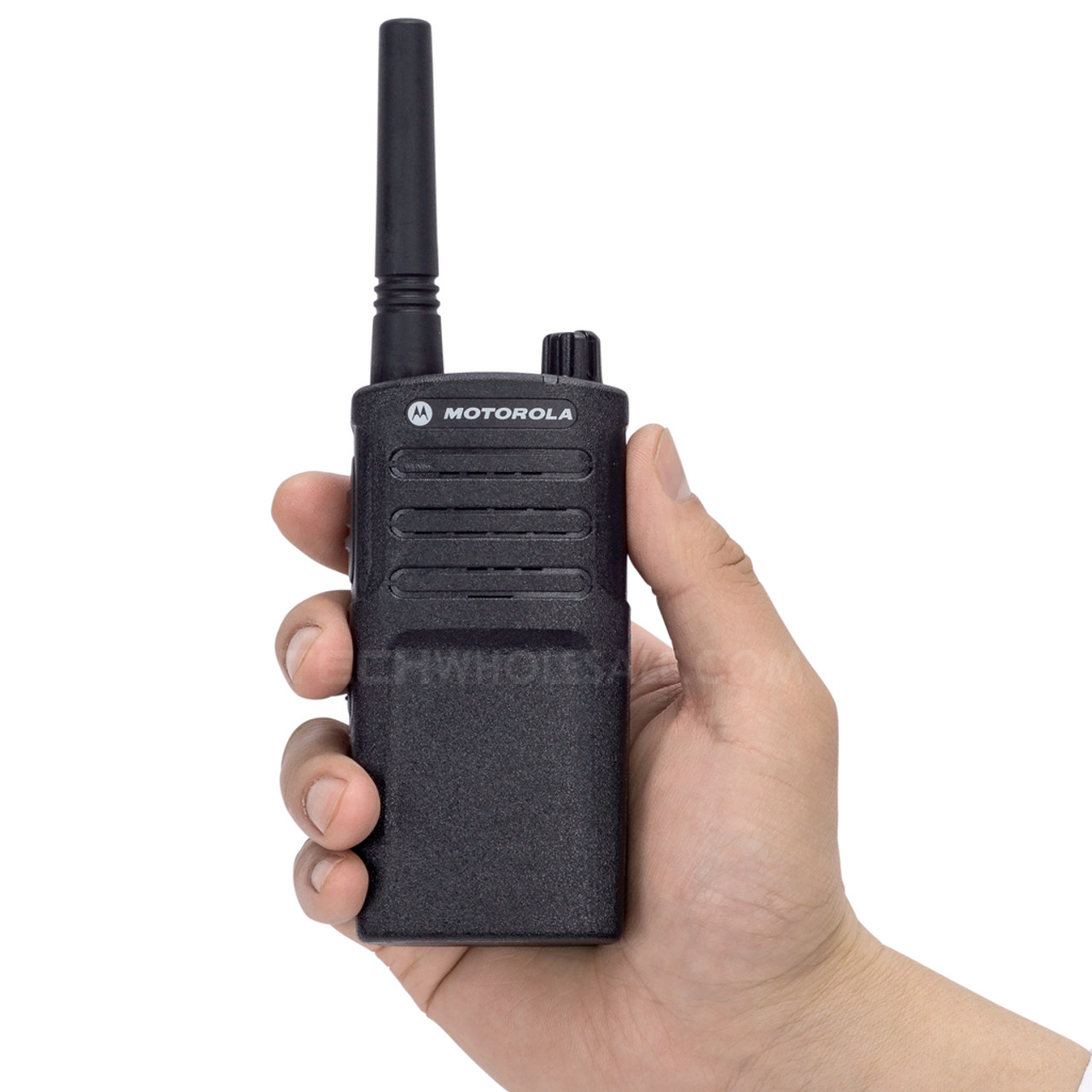
1. Motorola RMU2040 — Best for Small to Mid-Size Construction Sites
| Specification | Detail |
|---|---|
| Frequency | UHF (450–470 MHz), analog |
| Power | 2 watts |
| Channels | 4 |
| Indoor Coverage | 250,000 sq ft / up to 20 floors |
| Outdoor Range | 1–2 miles (terrain-dependent) |
| Speaker Output | 1,500 mW |
| Battery Life | Up to 12 hours (up to 15 with battery save) |
| Durability | IP54/55, MIL-STD-810C/D/E/F/G |
The RMU2040 is one of the most widely deployed construction radios for contractors who need dependable communication without the complexity of a digital system. Its 1,500 mW speaker cuts through generators, compressors, and saws, and the compact housing clips easily to a safety vest or tool belt. Because it ships pre-configured on two channels, supervisors can hand units out and put a crew to work the same day — no advanced programming required.
Why it fits construction specifically
- UHF frequency penetrates steel framing, concrete partitions, and multi-floor structures
- IP55 and MIL-STD-810 ratings handle the drops, dust, and rain a jobsite throws at equipment
- Oversized controls and VOX allow glove-on, hands-free operation
- NOAA weather alerts give outdoor crews advance warning of severe conditions
- Antimicrobial coating and simplified cloning make it practical for shared-fleet deployments of 10 to 50+ units
Best use cases: residential construction, remodeling and roofing crews, landscaping and outdoor trades, small commercial projects, and concrete and framing crews.
Recommended accessories
- Motorola HKLN4606 Spirit Remote Speaker Microphone — shoulder-mounted speaker/mic for high-noise areas
- Motorola PMLN6384 6-Unit Charging Tray — charges and clones up to six radios at once
- Motorola HKLN4601 Discreet Earpiece and Mic — for supervisors
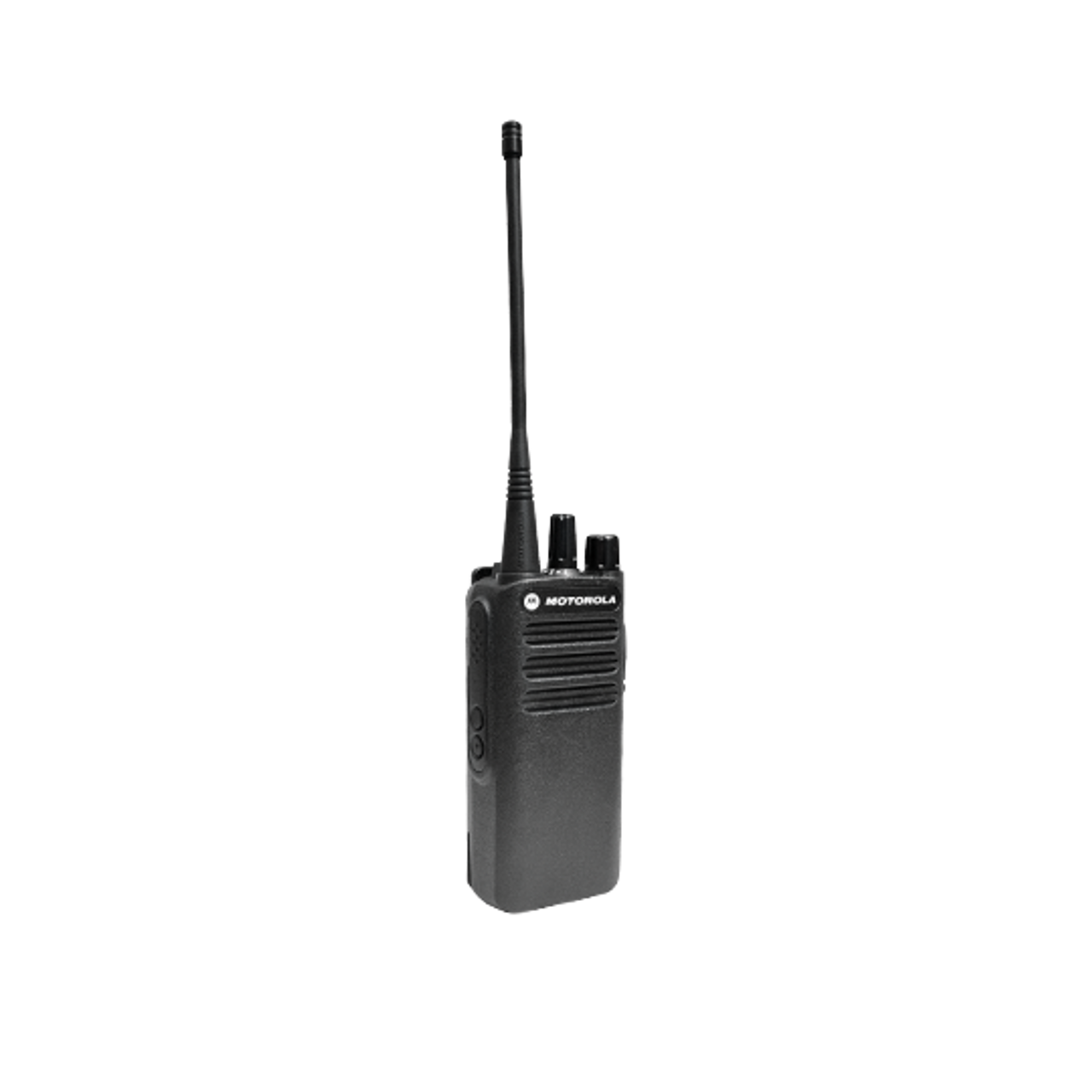
2. Motorola CP100d-UA — Best Digital Radio for Growing Construction Companies
| Specification | Detail |
|---|---|
| Frequency | UHF (403–480 MHz) |
| Mode | Analog and digital capable |
| Power | 4 watts |
| Channels | 16 |
| Battery Life | Up to 14.4 hours (digital mode) |
| Durability | IP54, MIL-STD-810 |
| Expandability | Repeater capable; noise suppression |
The CP100d-UA is one of the best construction radios for companies transitioning from analog to digital. Because it operates in both modes, contractors can upgrade gradually without replacing an entire fleet at once. Digital operation improves audio clarity, suppresses background noise, and extends usable battery life — advantages that matter most on large commercial projects with multiple subcontractors and constant equipment noise.
Why it fits construction specifically
- 4 watts of UHF power penetrates large commercial and multi-floor structures
- Dual analog/digital mode protects your investment during a fleet transition
- Digital noise suppression keeps transmissions clear in high-equipment-noise zones
- Repeater capable for expanded coverage when a project outgrows standard radio range
- 16 channels support multi-trade and multi-crew segmentation
Best use cases: commercial construction, multi-floor building projects, large subcontractor coordination, electrical and mechanical contractors, and steel erection projects.
Recommended accessories
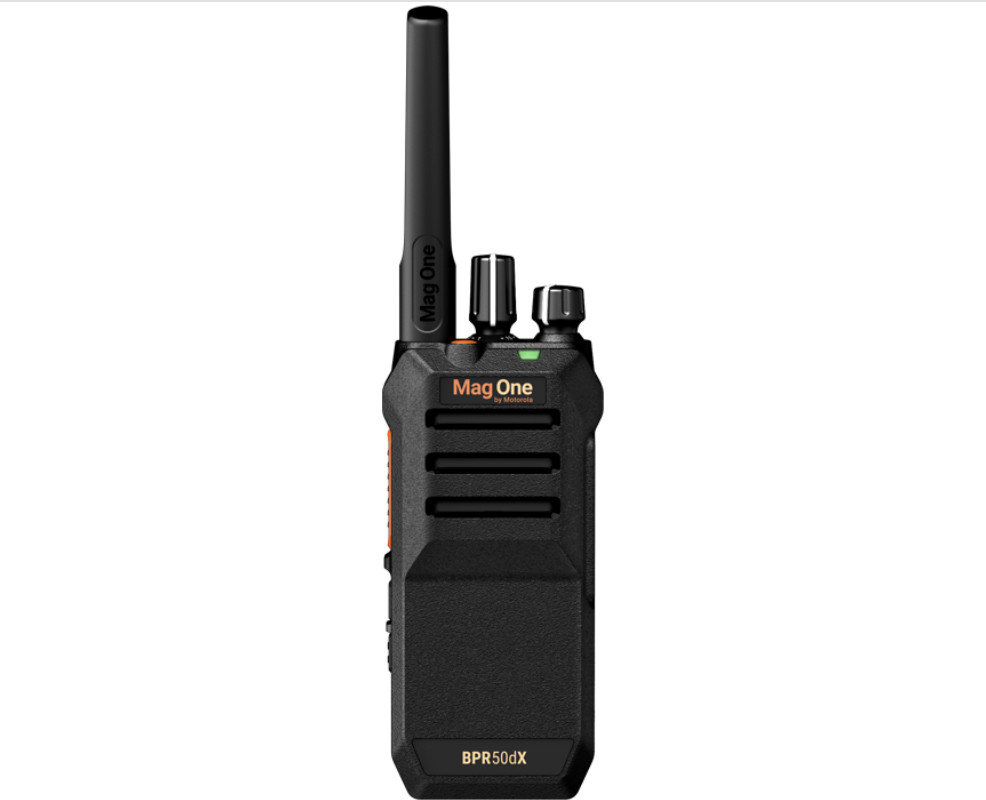
3. Motorola BPR50dx-U — Best for High-Noise and Large Construction Operations
| Specification | Detail |
|---|---|
| Frequency | UHF (400–470 MHz) |
| Mode | Analog and digital |
| Power | 5 watts |
| Channels | 64 |
| Durability | IP55, MIL-STD-810 |
| Charging | USB-C |
| Safety Features | Emergency button, Lone Worker, noise cancellation |
The BPR50dx-U combines modern digital capability with enhanced noise cancellation and louder audio output than most entry-level construction radios. At 5 watts with 64 channels, it is engineered for the largest and noisiest jobsites — the right choice when square footage, wall construction, and crew complexity exceed what a 2-watt analog radio can serve.
Why it fits construction specifically
- 5 watts of UHF power and 64 channels support large, multi-trade industrial operations
- Enhanced noise cancellation and loud audio output handle demolition, concrete cutting, and heavy equipment
- Emergency button and Lone Worker features support worker-safety protocols
- USB-C charging simplifies fleet management versus older proprietary chargers
- Analog/digital operation provides a path to scale without replacing the fleet
Best use cases: large commercial construction, highway and infrastructure projects, industrial contractors, steel fabrication, demolition crews, and utility contractors.
Recommended accessories
Also Worth Considering
Kenwood NX-P1300AUK — 4 watts, 64 channels, UHF (451–470 MHz), analog with a digital upgrade path. A strong alternative for contractors who prefer Kenwood’s build quality or want maximum channel capacity in an analog-first deployment.
Motorola DTR700 — 1 watt digital, 50 channels, 900 MHz. A digital option whose frequency-hopping signal penetrates dense structures effectively, well-suited to contractors who want clear digital audio in a compact, rugged unit.
Construction Radio Comparison
| Feature | Motorola RMU2040 | Motorola CP100d-UA | Motorola BPR50dx-U |
|---|---|---|---|
| Best For | Small to mid-size sites | Growing companies scaling to digital | Large, high-noise, safety-critical sites |
| Mode | Analog | Analog & digital | Analog & digital |
| Power | 2 watts | 4 watts | 5 watts |
| Channels | 4 | 16 | 64 |
| Frequency | UHF 450–470 MHz | UHF 403–480 MHz | UHF 400–470 MHz |
| Battery Life | Up to 12–15 hrs | Up to 14.4 hrs (digital) | Full-shift; USB-C charging |
| Durability | IP54/55, MIL-STD-810 | IP54, MIL-STD-810 | IP55, MIL-STD-810 |
| Repeater Capable | No | Yes | Yes |
| Safety Features | VOX, NOAA alerts | Noise suppression, VOX | Emergency button, Lone Worker |
For sites with thick masonry or heavy steel construction, plan one tier larger than square footage alone would suggest — reinforced structures cut effective RF range significantly.
OSHA Communication and Jobsite Safety
OSHA does not mandate specific radio models, but reliable communication is central to several construction safety standards. Under the OSHA construction noise standard (29 CFR 1926.52), employers must take action when worker noise exposure reaches an eight-hour time-weighted average of 85 dB — a threshold many jobsites exceed near heavy equipment, which is why noise-canceling radios and earpieces matter. Effective communication systems also support hazard coordination, crane and rigging signaling (29 CFR 1926.1419, which requires a means of communication between the operator and signal person), confined-space entry procedures, and emergency response. A professional radio fleet supports these obligations in a way consumer walkie-talkies and cell phones cannot. See the OSHA Construction Standards for full requirements.
MIL-STD and IP Ratings Explained
Two ratings tell you whether a radio can survive a jobsite. MIL-STD-810 is the U.S. military durability standard covering shock, vibration, temperature extremes, and impact resistance — the benchmark for a radio that will be dropped and knocked around. IP (Ingress Protection) ratings describe resistance to solids and liquids: the first digit covers dust, the second covers water. An IP54 rating indicates dust protection and splash resistance from any direction; IP55 adds resistance to low-pressure water jets. For construction, IP54 is the baseline and IP55 is preferred. None of the radios on this page are rated for submersion (IP67 or higher), which is not a typical construction requirement.
Frequently Asked Questions
What radio frequency works best for construction sites?
UHF radios are usually best for construction because UHF frequencies penetrate concrete, steel, and indoor structures more effectively than VHF. All three radios recommended on this page operate on UHF business frequencies for this reason.
How much range do I need for a construction site?
Most professional construction radios provide reliable onsite coverage across roughly 250,000 to 350,000 square feet, multiple floors, or large outdoor jobsites. A 2-watt UHF radio like the RMU2040 covers small to mid-size sites well; for large multi-building or high-rise projects, step up to a 4- or 5-watt radio like the CP100d-UA or BPR50dx-U, both of which are repeater capable for expanded coverage. Actual range depends on steel structures, terrain, interference, and building materials.
How long do construction radio batteries last?
Professional construction radios typically provide 10 to 15 hours in analog mode and up to roughly 14 to 20 hours in digital mode. The RMU2040 is rated up to 12 hours (15 with battery save), and the CP100d-UA reaches up to 14.4 hours in digital mode. High-capacity batteries extend runtime further for double shifts and overtime, and multi-unit gang chargers let crews hot-swap batteries without downtime.
What durability rating should a construction radio have?
Look for IP54 or IP55 ingress protection and MIL-STD-810 compliance at minimum. These standards indicate resistance to dust, vibration, shock, and water exposure — essential for outdoor jobsites where radios are dropped, rained on, and coated in debris. All three radios on this page meet both standards.
Are digital radios better for construction?
Digital radios provide clearer audio, better noise suppression, longer battery life, more efficient channel use, and easier scalability — advantages that matter most on large commercial sites with many crews and high equipment noise. Analog radios remain effective and cost-efficient for smaller crews and simpler operations. Dual-mode radios like the CP100d-UA and BPR50dx-U let you start analog and migrate to digital without replacing the fleet.
Can construction workers use these radios with gloves?
Yes. Professional Motorola construction radios feature oversized push-to-talk buttons and rugged controls designed for glove operation. VOX (hands-free voice-activated transmission) further allows workers to communicate without touching the radio while operating equipment.
How many radios does a construction crew need?
A practical starting point is one radio per key role per shift: each supervisor, foreman, equipment operator, and safety lead. A typical small crew operates well with four to six radios, while larger sites add units per trade and per subcontractor crew. Tech Wholesale offers quantity pricing for orders of five or more units — request a quote for a fleet recommendation.
Can these radios handle the noise on an active jobsite?
Yes, when you choose professional-grade models. The RMU2040 delivers 1,500 mW of speaker output, and the CP100d-UA and BPR50dx-U add digital noise suppression and noise cancellation. Pairing any of them with a shoulder-mounted remote speaker mic or a noise-canceling earpiece further improves intelligibility near demolition, concrete cutting, and heavy equipment.
Why Contractors Buy from TechWholesale.com
Tech Wholesale has been selling professional two-way radios to construction, industrial, and commercial operations since 1997. We are an authorized dealer for Motorola and Kenwood, which means every radio we sell carries the full manufacturer warranty — typically two years on commercial-grade models — and qualifies for manufacturer service and repair.
What sets us apart
- Lifetime technical support included with every purchase — call or email our team for the life of your radio fleet, not just through the warranty period
- Expert radio system recommendations and custom programming for your specific jobsite
- Quick quotes — request a custom quote
- No-pressure consultation — we’ll tell you when a less expensive radio is the right answer, not push you toward a higher-margin product
- Genuine Motorola and Kenwood accessories — no gray-market inventory, no voided warranties
- Free shipping on qualifying orders
Whether you need radios for a small framing crew or a multi-site commercial operation, our team can design a reliable communication system that improves safety, coordination, and productivity. If you’re not sure which radio fits your jobsite, use our Find My Radio tool or request a quote — we’ll ask a few questions about your site and come back with a specific recommendation, no obligation.
1-888-925-5982 | Service@TechWholesale.com
Related Reading
- Privacy Codes – Eliminate Outside Interference
- Frequency Hopping Spread Spectrum
- Lone Worker / Man Down Functionality
- VOX Explained
- UHF vs VHF – Frequencies Explained
- Two-Way Radio Repeaters
- OSHA Construction Safety Standards
- Motorola Solutions Commercial Radios
Article by Kristin Wood, a two-way radio consultant @ Tech Wholesale | Authorized Motorola & Kenwood Dealer Since 1997 | Last Updated: June 2026