
Two-Way Radios for Car Washes (2026 Buying Guide)
What is the best two-way radio for a car wash?
The Short Answer
The best two-way radios for car washes are the Motorola CLS1110, Motorola Curve, and the Kenwood PKT-300. These models are purpose-matched to the car wash environment: they offer IP54-rated water resistance, noise-cancelling audio to cut through tunnel and vacuum noise, UHF frequencies that penetrate concrete and metal structures, and battery life that outlasts the longest shifts.
But not all radios are built for the demands of a car wash. Static, poor battery life, and cheap builds can make a bad situation worse.
We don't want you to buy any radio just because you like the name or the price. We want you to make an educated decision and purchase the perfect radio for a high-noise, high-moisture environment with heavy-duty machinery.
We've sold thousands of radios to car wash operations of all sizes, and we've compiled everything we know into this guide. Let's get into it.
Why Car Washes Have Unique Radio Requirements
Car wash operations run on precision timing. A single missed communication — a greeter who didn’t hear the upsell, a tunnel crew that wasn’t told the belt stopped, a detail team waiting on a car that already left — can back up a line of 30 vehicles in minutes. That margin for error is zero at peak hours.
But the environment itself is hostile to standard radios. Car washes present a specific combination of challenges that most offices, warehouses, or retail stores never face:
- Constant moisture and spray. Whether you’re running a tunnel wash, self-serve bays, or an express exterior, radios are going to get wet. Splashback, pressure spray, and condensation will find every gap in a radio’s housing.
- Extreme ambient noise. Tunnel blowers, pressure washers, industrial vacuums, and vehicle engines create noise levels that can exceed 85 dB — the OSHA threshold at which hearing protection is recommended (29 CFR 1910.95). Radios without quality noise-cancellation make communication nearly impossible in this environment.
- Chemical exposure. Detergents, degreasers, and foaming agents used in car wash operations can degrade plastic housings and speakers over time. Business-grade radios with sealed housings handle this significantly better than consumer-grade walkie-talkies.
- Gloved, wet hands. Staff working wet cars need large, tactile controls they can operate without removing gloves.
- Concrete and metal signal absorption. Thick concrete block walls, metal equipment bays, and steel overhead doors attenuate radio signals. UHF frequencies (450–470 MHz) penetrate these materials more effectively than VHF.
- Fast staff turnover. Car washes often employ seasonal or part-time staff. Radios need to be simple enough to hand to a new employee with minimal training.
How Much Range Do Car Wash Radios Actually Need?
Range is one of the most misunderstood specs in two-way radios. Manufacturer-advertised outdoor ranges (often listed as “up to 250,000 sq ft”) are measured in open-field conditions with no obstacles. Real-world coverage in a car wash facility — with concrete block walls, metal equipment, and moving vehicles — is meaningfully lower.
Practical guidance by facility type:
| Facility Type | Recommended Wattage | Expected Indoor Coverage |
|---|---|---|
| Single-bay or small express wash | 1 watt UHF | 100,000–200,000 sq ft |
| Standard tunnel wash | 1–2 watt UHF | 200,000–275,000 sq ft |
| Full-service or multi-building facility | 2 watt UHF | 250,000–350,000 sq ft |
| Multi-location or unlimited range | LTE/Wi-Fi (Motorola WAVE PTX) | Unlimited |
Rule of thumb: When in doubt, go one watt stronger than your coverage estimate suggests. It costs little to upsize and prevents dead zones from forming in equipment bays, back offices, or detailing areas.
Recommended Channel Setup for Car Wash Teams
Multi-channel radios let you segment communication so staff aren’t competing for air time. A typical car wash operation benefits from the following channel structure:
- Channel 1 — All-Staff / General Operations: Announcements, emergencies, whole-team updates.
- Channel 2 — Greeter / Front Lane: Vehicle intake, service upsells, entry queue management.
- Channel 3 — Tunnel Crew: Conveyor belt operations, vehicle loading, wash cycle status.
- Channel 4 — Detail & Finishing: Drying, vacuuming, waxing, interior service.
- Channel 5 — Maintenance: Equipment issues, chemical restocking, breakdowns.
- Channel 6 — Management: Private escalations, staffing decisions, and shift handoffs.
Staff can switch to a secondary channel for a private side-conversation (“Sarah, meet me on channel 4”) without interrupting the main line. This structure keeps volume low and clarity high during peak hours.
Our Top Radio Recommendations for Car Washes
These recommendations are based on over 25 years of selling two-way radios to car wash operations of every size. Each model has a documented field track record, manufacturer-backed warranty, and specs that match the demands of a car wash environment.
Best Overall: Motorola CLS1110

Best for: Small express washes, single-bay operations, and entry-level deployments
| Specification | Detail |
|---|---|
| Power | 1 watt, UHF (460–469 MHz) |
| Channels | 1 |
| Indoor Coverage | Up to 200,000 sq ft |
| Water Resistance | Splash-resistant (occasional rain) |
| Battery Life | Up to 10 hours |
| Durability | Moderate use |
The CLS1110 has been a standard in business radio for over 15 years — and in small car wash operations, it remains one of the most cost-effective radios available. UHF frequency gives it better building penetration than FRS/GMRS consumer radios, and at 200,000 square feet of indoor coverage it handles the footprint of most single-tunnel or express-wash facilities without issue.
Vibracall technology provides an audible or vibrating alert, so staff can be paged without interrupting a customer conversation. Voice-Activated Transmission (VOX) enables hands-free operation — useful when an attendant is actively guiding a car into a bay.
Why it fits car washes: Proven reliability, simple controls for easy staff training, and UHF performance at a lower price point than higher-wattage alternatives. If your facility is under 200,000 square feet, this radio handles the job at a lower total cost.
Water resistance note: The CLS1110 is rated for occasional rain/splash only — not sustained spray. For positions working near pressure washers or spray arches, consider upgrading to the IP54-rated RMU2040.
Best for Rugged Use: Motorola RMU2040
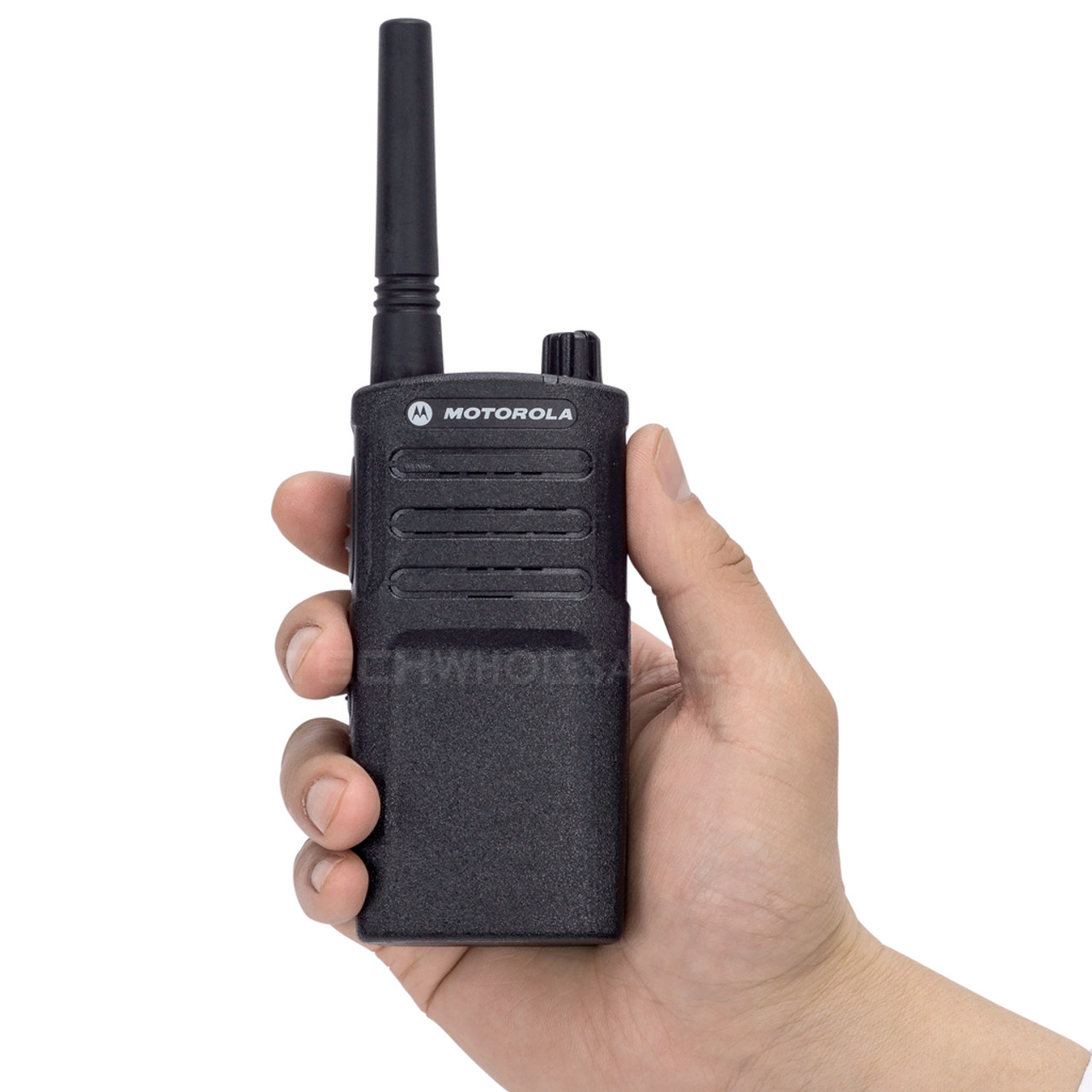
Best for: Standard tunnel washes, full-service facilities, and multi-building sites
| Specification | Detail |
|---|---|
| Power | 2 watts, UHF (450–470 MHz) |
| Channels | 4 |
| Indoor Coverage | Up to 250,000 sq ft |
| Outdoor Range | 2–3 miles |
| Water Resistance | IP54 (dust-protected, water spray from any angle) |
| Battery Life | Up to 14 hours |
| Durability | MIL-STD-810 tested |
The RMU2040 is the most complete radio for the typical car wash environment. Its IP54 rating — the same standard used in industrial and hospitality applications — provides genuine protection against the water spray, steam, and splash inherent to any wash operation. The two-watt UHF signal penetrates concrete block walls and metal structures without the dead zones that plague 1-watt consumer radios.
Voice announcement capability adds communication flexibility beyond basic push-to-talk, useful for broadcasting service alerts or managing queue updates without tying up a channel.
Why it fits car washes: IP54 water resistance, rugged MIL-STD-810 build, 250,000 sq ft indoor coverage, and extended battery life make this the most defensible choice for operations that can’t afford radio failures mid-shift.
Best Multi-Channel Option: Kenwood ProTalk PKT-300
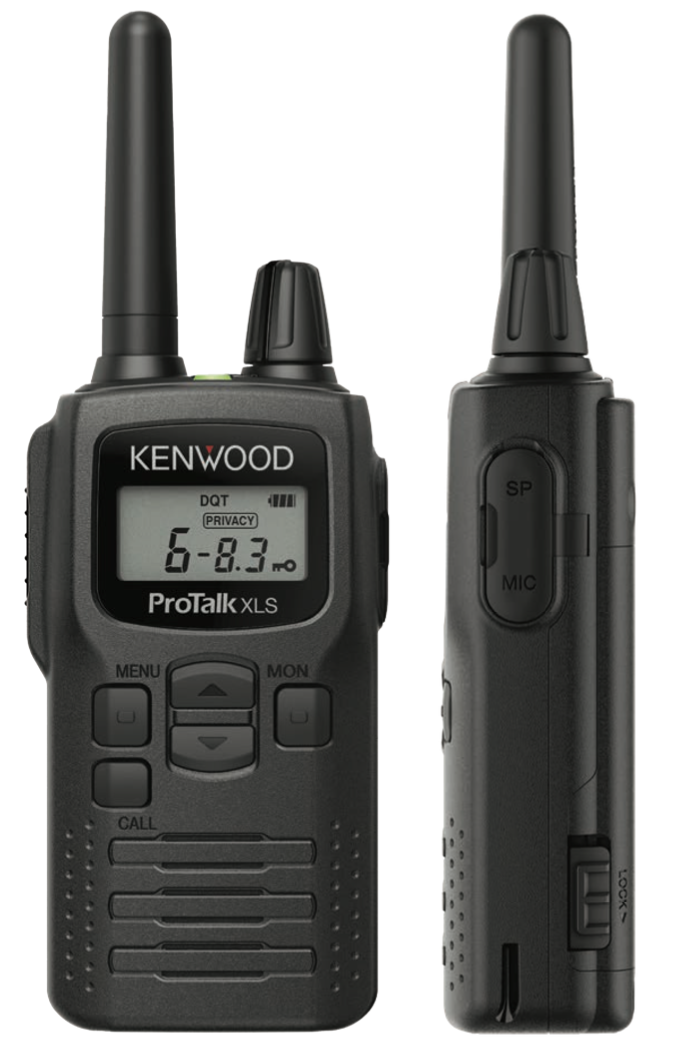
Best for: Operations needing 6 channels, compact form factor, and stronger range on a mid-tier budget
| Specification | Detail |
|---|---|
| Power | 2 watts, UHF (450–470 MHz) |
| Channels | 6 |
| Indoor Coverage | Up to 275,000 sq ft |
| Outdoor Range | Up to 1.5 miles |
| Battery Life | Up to 12 hours |
| Durability | Rugged use |
The PKT-300’s combination of 6 channels, 2-watt power, and compact size makes it an underrated option for mid-size car wash operations that want to run the full recommended channel structure (greeter, tunnel, detail, maintenance, management) without paying for a larger radio. Kenwood’s build quality is comparable to Motorola, with rugged-use durability ratings and a battery that reaches 12 hours at standard duty cycles.
Why it fits car washes: More channels per dollar than most alternatives in its class, with enough range and durability to handle complex multi-department operations.
Best for Larger or Digital-Forward Operations: Motorola Curve
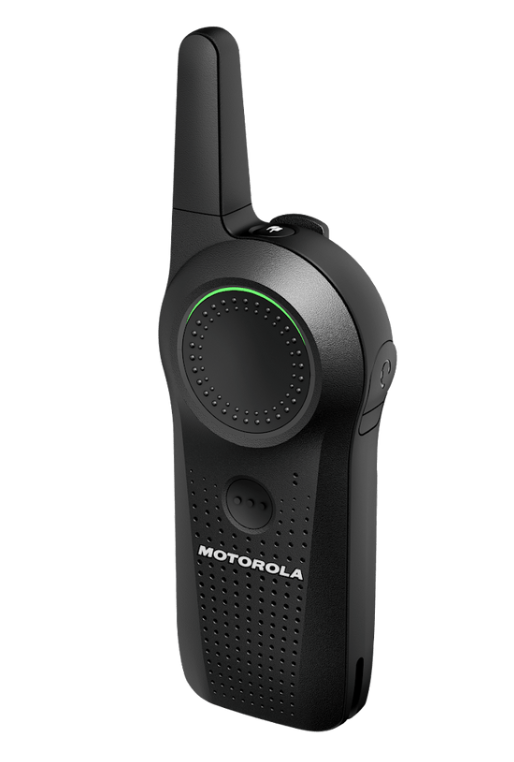
Best for: Larger facilities, and teams that want future-proof digital clarity
| Specification | Detail |
|---|---|
| Power | 1 watt digital (equivalent to ~4 watts analog) |
| Channels | 10 |
| Indoor Coverage | Up to 300,000 sq ft / 20 floors |
| Technology | 900 MHz digital |
| Battery Life | Up to 14 hours |
The Motorola Curve operates on 900 MHz DECT digital technology — a frequency band that is significantly less congested than traditional UHF/VHF bands. Audio quality is superior to analog because digital transmission eliminates the static, fading, and interference that degrade analog audio in noisy environments. In a car wash, where background noise is already high, that audio clarity difference is noticeable.
Ten channels give larger operations room to run the full channel structure — including dedicated supervisor and maintenance channels — without running out of capacity.
Why it fits car washes: Digital audio clarity is particularly valuable in high-noise environments. 300,000 sq ft of indoor range covers most large-format facilities comfortably.
Frequently Asked Questions
What IP rating do I need for a car wash?
At minimum, IP54 — which protects against dust and water spray from any direction, including overhead spray and splashback. If staff are working directly near pressure wash arches or high-pressure rinse equipment, an IP67 rating (submersible to 1 meter for 30 minutes) adds a meaningful safety margin. The Motorola RMU2040 meets IP54; if you need IP67, ask our team about available options.
How long does the battery last on a full shift?
Business-grade radios are engineered for full-shift operation. A standard 1800 mAh Li-Ion battery delivers 10–14 hours on a 5-5-90 duty cycle (5% transmit, 5% receive, 90% standby). Digital radios like the Motorola Curve typically reach the higher end of that range. For back-to-back shifts or high-volume operations, a multi-unit drop-in charger lets you hot-swap batteries without downtime.
How much range do I actually need for a car wash?
For most single-location tunnel or express washes, a 1–2 watt UHF radio with 200,000–275,000 square feet of indoor coverage is sufficient. However, concrete block construction and metal equipment can reduce effective range significantly. When in doubt, we recommend going one watt stronger than your baseline coverage requirement. Multi-building operations or facilities with significant RF interference should consider 2-watt models or a digital platform.
Are car wash radios durable enough for daily drops and chemical exposure?
Business-grade radios are tested to MIL-STD-810 standards for drop, vibration, humidity, and temperature. They are engineered to survive the working environment better than consumer walkie-talkies. That said, radios are not chemical-proof. Wipe down radios regularly if they’re exposed to detergents or degreasers, and avoid submerging any radio not rated for IP67. Periodic cleaning of speaker grilles also prevents soap residue buildup that can reduce audio output over time.
Can I use consumer walkie-talkies (FRS/GMRS) instead?
Technically, FRS/GMRS radios (the kind sold at consumer electronics stores) can be used at a car wash, but they come with meaningful drawbacks. FRS radios are limited to 0.5 watts by FCC rule — too low for reliable coverage in a concrete building. Consumer radios also lack the noise-cancelling microphones, business-grade durability, and long battery life of professional radios. For business use, professional-grade radios provide a better total cost of ownership.
How many radios do I need?
A general rule is one radio per active working position, not one per employee. For a standard tunnel wash with a greeter, 2 tunnel operators, a vacuumer, a detail attendant, and a cashier, that’s 6 radios minimum — plus 1–2 spares kept on charge. Supervisors should carry a radio capable of monitoring or switching to any channel. For exact guidance based on your operation size, contact Tech Wholesale for a consultation.
Why Buy Car Wash Radios from Tech Wholesale
Tech Wholesale has been supplying two-way radios to businesses across the U.S. since 1997. We are an authorized dealer for Motorola, Kenwood, and other leading brands — which means you receive genuine manufacturer warranty coverage, not gray-market units.
What sets us apart:
- Lifetime tech support on every radio purchase. Our support doesn’t end when the sale does.
- Custom quotes for multi-unit orders — common for car wash chains and franchises scaling across locations.
- Expert pre-sale consultation. Tell us your facility layout, staff size, and shift hours, and we’ll recommend the exact radio and channel configuration that fits.
- Free shipping on qualifying orders.
- 2-year warranty coverage included on every radio sold.
Whether you’re equipping a single-site express wash or standardizing communication across 10 franchise locations, Tech Wholesale has the inventory, expertise, and support infrastructure to get it right.
→ Request a Custom Quote
Call us: 1-888-925-5982
Related Reading
- Privacy Codes – Eliminate Outside Interference
- Frequency Hopping Spread Spectrum
- Lone Worker / Man Down Functionality
- HIPAA Compliance and Two-Way Radios
- VOX Explained
- UHF vs VHF – Frequencies Explained
Article by Kristin Wood, a two-way radio consultant @ Tech Wholesale | Authorized Motorola & Kenwood Dealer Since 1997 | Last Updated: May 2026