

Many communities rely on overhead pages, phones, or staff walking the halls, which disrupts the homelike atmosphere residents deserve and slows every response. Business-grade UHF radios with earpieces keep every call private, and their rugged, antimicrobial housings stand up to daily cleaning, protecting your investment for years.
You’re in the right place to find your perfect radio! We've sold thousands of radios to senior living communities & nursing homes and we've seen what holds up. Here's everything you need to know.
Which Walkie Talkie Fits Your Senior Living Facility?
The Quick Answer
- A smaller community, and staff who work in front of residents → Motorola CLP1080e. Earpiece-only with no external speaker - residents never hear transmissions. Antimicrobial housing on a radio that passes between three shifts a day.
- Long wings, fire doors, and a building that eats signal → Motorola RMU2040. Two watts of UHF to reach a memory care unit behind secured doors, a laundry at the far end of a service corridor, or a second floor.
- Multiple departments, or more than one building → Motorola Curve. Digital 900 MHz and ten channels — enough to give all departments their own lines so a linen request doesn't land in the middle of a call-light response.
Why Assisted Living Facilities Have Unique Communication Needs
Two-way radios are standard in many industries, but assisted living introduces a specific set of constraints that consumer-grade or job-site radios are not built to handle. A radio chosen for a warehouse or construction site is the wrong tool for a corridor full of residents.
These are the pain points we hear about most often from the communities we equip:
Resident dignity and a calm environment. A homelike atmosphere is central to resident wellbeing. A caregiver's radio blaring in a hallway or a resident's room is disruptive and can cause anxiety or agitation. Radios used in assisted living should communicate through an earpiece and be compact enough to carry discreetly on a uniform — not announce every transmission to the room.
Response time is a clinical issue. When a resident presses a call button and no one answers within minutes, that is not an inconvenience — it can be a safety event. A missed medication alert or an unacknowledged fall risk has real consequences. Radios that produce static, drop signal between floors, or run out of battery mid-shift contribute directly to delayed response.
Shared devices and infection control. Radios get passed between staff across shifts. Antimicrobial-coated housings are not a luxury in care settings — they help reduce the growth of bacteria and mold on a high-touch surface, which aligns with the routine infection-control practices expected in licensed care facilities.
Staff segmentation and channel discipline. A typical community coordinates at least four distinct teams: nursing and care staff, management, housekeeping and maintenance, and security. Without organized channel assignments, urgent alerts get buried under general chatter. Multiple channels let each department operate independently while still allowing facility-wide emergency broadcasts.
Durability in a busy building. Radios get dropped. They get sprayed with cleaning chemicals and exposed to moisture. A radio that cracks or fails after a single fall is both a communication gap and a replacement cost. Business-grade radios built to military durability standards (MIL-STD-810) survive daily wear in a care environment; consumer radios typically do not.
How to Match Radio Power to Your Facility Size
Choosing the right wattage is one of the most important decisions you'll make — and one of the most commonly overlooked. Too little power and you get dead zones; more than you need and you're overspending.
Small facilities (up to 100,000–200,000 sq ft)
A 1-watt UHF radio provides adequate coverage across multiple floors and through standard interior walls. This covers most small to mid-size assisted living communities.
Mid-to-large facilities (up to 250,000–300,000 sq ft)
Step up to 2 watts of UHF power for reliable signal penetration through dense concrete construction, multiple wings, or buildings with long interior corridors. A 2-watt radio such as the RMU2040 covers up to 250,000 square feet and 20 floors indoors.
Multi-building campuses
For operations spanning multiple buildings or separate locations, consider LTE/Wi-Fi-enabled radio solutions such as the Motorola WAVE PTX series, which operate over cellular and broadband networks for virtually unlimited range.
A note on building materials
Thick concrete and reinforced walls attenuate radio signal significantly. If your facility has older concrete construction or heavily reinforced walls, plan for one additional watt of power to compensate. UHF frequencies (450–470 MHz) penetrate walls and floors more effectively than VHF and are the correct choice for indoor use in multi-story buildings. For a deeper explanation, see our guide on UHF vs. VHF frequencies.
Recommended Channel Structure for Assisted Living
Assigning channels by department before deployment is critical. Without structure, a radio system becomes noisy and unreliable. We recommend a minimum of four channels:
- Channel 1 — Management: Administrative coordination, daily operations, and general oversight.
- Channel 2 — Nursing and Care Staff: Resident assistance, medication rounds, call-light response, and medical situations.
- Channel 3 — Housekeeping and Maintenance: Spill response, cleaning schedules, repair requests, and room readiness.
- Channel 4 — Security and Safety: Resident monitoring, elopement alerts, emergency response, and evacuation coordination.
Staff quickly internalize channel assignments ("Channel 3 is maintenance"), which reduces cognitive load and speeds up response. To keep neighboring businesses from bleeding onto your channels, set a privacy code on each one — see how privacy codes eliminate outside interference.
Recommended Assisted Living Radios
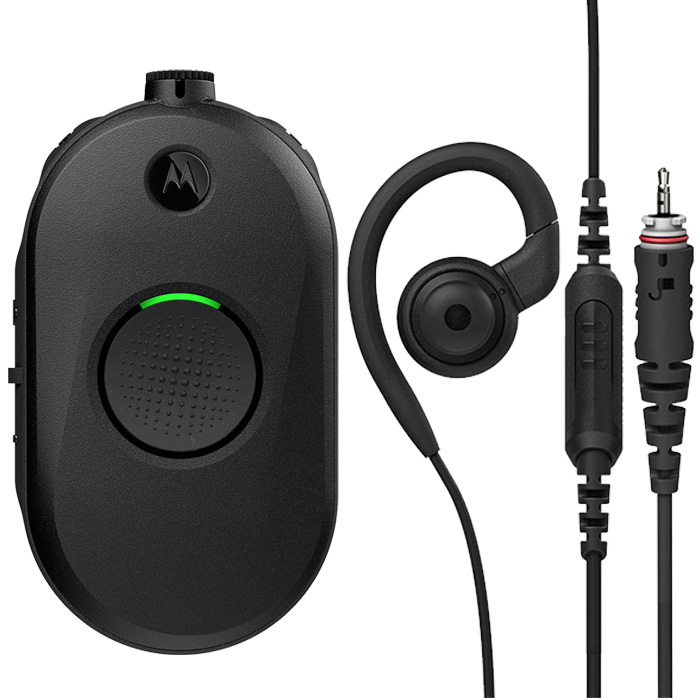
Best for Small to Mid-Size Facilities Prioritizing Discretion: Motorola CLP1080e
| Specification | Detail |
|---|---|
| Frequency | UHF (450–470 MHz) |
| Power | 1 watt |
| Channels | 8 |
| Indoor Coverage | Up to 100,000 sq ft / 10 floors (up to 250,000 sq ft / 20 floors with repeater) |
| Battery Life | Up to 18 hours (5/5/90 duty cycle) |
| Durability | IP54, MIL-STD-810H |
| Weight | 3.35 oz (with standard battery) |
| Audio | Earpiece-only (no external speaker) |
The CLP1080e is one of the most purpose-built radios for assisted living on the market. It communicates entirely through its included earpiece — there is no external speaker — so caregivers can receive a message in a resident's room without the room ever hearing it. At 3.35 ounces it clips to a waistband and disappears under a uniform.
Why it fits assisted living specifically
- The large, centrally located push-to-talk button and voice-assisted menus let staff operate the radio by feel, without looking down or taking attention off a resident.
- Antimicrobial polycarbonate housing is built into the casing to inhibit bacterial and mold growth on a device that moves between staff across shifts.
- Earpiece-only audio keeps resident-status conversations private, supporting the discretion expected in care settings.
- 8 channels give a smaller community clean role-based segmentation without overcomplicating training.
- Up to 18 hours of battery life comfortably covers a double shift.
Limitation to know: at 1 watt and 100,000 sq ft of unit-to-unit coverage, the CLP1080e is sized for smaller buildings. For a larger or more heavily constructed facility, step up to the RMU2040 or add a repeater.
Best for Mid-to-Large Facilities: Motorola RMU2040

| Specification | Detail |
|---|---|
| Frequency | UHF (450–470 MHz) |
| Power | 2 watts |
| Channels | 4 |
| Indoor Coverage | Up to 250,000 sq ft / 20 floors |
| Battery Life | Up to 12 hours (up to 15 with battery save) |
| Durability | IP54/55, MIL-STD-810 (C/D/E/F/G) |
| Speaker Output | 1,500 mW |
| Weight | 8.6 oz (with standard battery) |
The RMU2040 is the step-up choice when a building's square footage or wall construction outpaces what a 1-watt radio can reliably serve. Its 2 watts of UHF power and 1,500 mW speaker push signal and audio through dense concrete, multiple wings, and long corridors that would leave a lighter radio with dead zones.
Why it fits assisted living specifically
- 2 watts of UHF power covers up to 250,000 sq ft and 20 floors — enough for most mid-to-large communities in a single building.
- Channel Announcement with Voice Alias lets a caregiver confirm the selected channel by voice, without looking at the radio.
- VOX (voice-operated transmission) supports hands-free use when a staff member is assisting a resident.
- Antimicrobial coating helps prevent odor-causing bacteria and mold on a shared device.
- IP54/55 and MIL-STD-810 construction handle drops, cleaning sprays, and moisture without failing.
Note: the RMU2040 ships with channels 1 and 2 pre-programmed; channels 3 and 4 are activated during setup. We program all four to your channel plan before the radios ship.
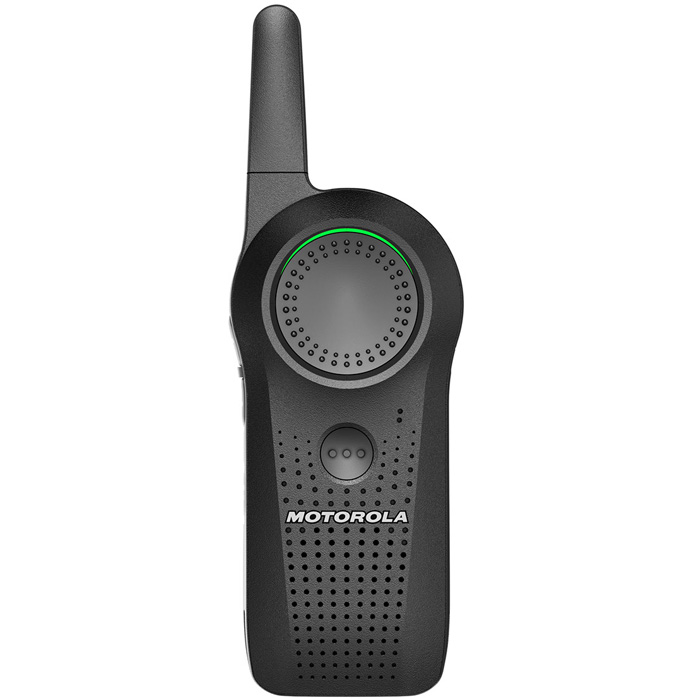
Best for Multi-Department Facilities and Paperwork-Free Setup: Motorola Curve
| Specification | Detail |
|---|---|
| Frequency | 900 MHz digital FHSS (902–928 MHz) |
| Power | 1 watt |
| Channels | 10 |
| Indoor Coverage | Up to 300,000 sq ft / 20 floors |
| Battery Life | Up to 11.5 hours standard (BT90); up to 16 hours with high-capacity BT110 |
| Durability | IP54, MIL-STD-810 (C through H) |
| Weight | 5.11 oz (with standard BT90 battery) |
| Privacy | 10 digital channels via frequency-hopping spread spectrum |
The Motorola Curve runs on the 900 MHz digital band, which the FCC has designated for unlicensed business use — meaning no licensing paperwork, fees, or renewals to manage. Its digital signal penetrates concrete and steel-reinforced walls more effectively than UHF analog at comparable power, and it works out of the box on 10 digital channels.
Why it fits assisted living specifically
- 10 channels support full department segmentation — nursing, management, housekeeping, security, and more — without channel conflicts.
- Call All Available and Page All Available let a staff member reach the entire team instantly during an emergency or urgent situation.
- Private Reply lets a caregiver answer one person directly without broadcasting to everyone, reducing unnecessary noise and ear fatigue.
- Frequency-hopping spread spectrum keeps conversations private and resistant to interference from nearby radios.
- No licensing process means a faster, simpler deployment for operators who don't want the administrative overhead.
The Curve is also compatible with existing Motorola DTR and DLR fleets on factory-default programming, which makes it a natural choice for communities expanding a 900 MHz system they already run.
Other Walkie Talkies Worth Considering
Kenwood ProTalk PKT-300 — 2 watts, 6 channels, UHF (450–470 MHz). A compact, durable alternative to the RMU2040 for communities that prefer Kenwood build quality or want six dedicated channels in a smaller body.
Motorola CP100d — up to 4 watts, 16 channels, UHF, analog/digital dual-mode. The premium option for large campuses needing maximum signal strength and a path to digital migration.
Assisted Living Radio Comparison
| Specification | Motorola CLP1080e | Motorola RMU2040 | Motorola Curve |
|---|---|---|---|
| Best for | Small facilities, discretion | Mid-to-large facilities | Multi-department, no paperwork |
| Power | 1 watt | 2 watts | 1 watt (900 MHz digital) |
| Frequency | UHF 450–470 MHz | UHF 450–470 MHz | 900 MHz FHSS (902–928) |
| Channels | 8 | 4 | 10 |
| Indoor Coverage | 100,000 sq ft / 10 floors | 250,000 sq ft / 20 floors | 300,000 sq ft / 20 floors |
| Battery Life | Up to 18 hours | Up to 12–15 hours | Up to 11.5–16 hours |
| Durability | IP54, MIL-STD-810H | IP54/55, MIL-STD-810 | IP54, MIL-STD-810 |
| Weight | 3.35 oz | 8.6 oz | 5.11 oz |
| Audio | Earpiece-only | Speaker (1,500 mW) | Speaker + earpiece option |
| Antimicrobial Housing | Yes | Yes | Yes |
| Licensing Paperwork | Standard business band | Standard business band | None required |
For a facility with thick masonry walls, drop one tier larger than your square footage would suggest. A building that measures 150,000 sq ft but is built from poured concrete may perform more like a 250,000 sq ft building for signal-penetration purposes.
A Note on Hearing Protection and Noise
Most assisted living corridors are quiet by design, but kitchens, laundry rooms, and maintenance areas can run loud. Under OSHA Standard 29 CFR 1910.95, employers must implement a hearing conservation program when staff are exposed to 85 dB or above as an eight-hour time-weighted average. Where staff work in those higher-noise support areas, radio earpieces and speaker volume should be selected with that exposure limit in mind. The earpiece-based audio on radios like the CLP1080e also helps keep incoming transmissions intelligible without raising volume in shared spaces.
Frequently Asked Questions
What range do two-way radios need to cover an assisted living facility?
It depends on square footage and construction. As a starting point: up to 100,000 sq ft / 10 floors, a 1-watt UHF radio like the CLP1080e is sufficient; up to 250,000 sq ft / 20 floors, step up to a 2-watt UHF radio like the RMU2040; up to 300,000 sq ft / 20 floors, the 900 MHz digital Curve provides the strongest building penetration. Heavy concrete or reinforced walls reduce effective range, so size up one tier if your building is densely constructed.
How long should a two-way radio battery last in a care environment?
Plan for at least 12 hours of rated battery life under a standard 5/5/90 duty cycle so a single charge covers a full shift with margin to spare. The CLP1080e is rated up to 18 hours, the RMU2040 up to 12–15 hours, and the Curve up to 11.5 hours on its standard battery (up to 16 with the high-capacity BT110). For facilities running back-to-back shifts, a multi-unit charging tray lets you rotate or hot-swap batteries without downtime.
What durability ratings should I look for?
Look for radios rated to at least IP54 for dust and splash resistance and certified to MIL-STD-810 for shock, vibration, and temperature. All three radios on this page meet or exceed those marks: the CLP1080e and RMU2040 are IP54 (the RMU2040 also IP55), and all three carry MIL-STD-810 certification. These ratings mean the radio survives an accidental drop, a cleaning-spray wipe-down, and daily handling without cracking or failing.
Can staff use these radios hands-free while assisting residents?
Yes. The CLP1080e, RMU2040, and Curve all support VOX (voice-operated transmission), which lets a caregiver transmit without pressing a button — useful when both hands are occupied with a resident. The CLP1080e and Curve also pair with earpiece accessories that keep audio private and hands free throughout a shift.
Are these radios discreet enough for resident areas?
The CLP1080e is the most discreet option — it has no external speaker and communicates entirely through an included earpiece, so transmissions are never broadcast into a hallway or resident room. At 3.35 ounces it clips out of sight on a uniform. The Curve and RMU2040 have speakers but also support earpiece accessories and adjustable volume for quieter areas.
Can the same radios be used for security and emergency coordination?
Yes. Assigning a dedicated security and safety channel lets staff coordinate elopement alerts, fall response, and evacuation without cluttering the nursing or housekeeping channels. The Curve's Call All Available and Page All Available functions let any staff member reach the entire team instantly during an emergency, and Private Reply allows a one-to-one response without broadcasting to everyone.
How many radios does an assisted living facility need?
A practical starting point is one radio per key role per shift: one for each charge nurse or care lead, one for the on-shift manager, one for housekeeping/maintenance, and one per security position. A small community often operates well with four to eight radios; larger multi-wing buildings scale up from there. Tech Wholesale offers quantity pricing on fleet orders — request a quote and we'll size the fleet to your floor plan.
Why not just use cell phones?
Cell phones require dialing, unlocking, and waiting for a connection — latency a caregiver doesn't have during a fall or medical event. Push-to-talk radios connect instantly, one-to-one or one-to-many, and they don't depend on cellular coverage that can be weak in stairwells and basements. Radios are also a shared, replaceable, antimicrobial-treated tool rather than a personal device, which simplifies hygiene and turnover between shifts.
Why Buy from TechWholesale.com
Tech Wholesale has been an authorized Motorola and Kenwood dealer since 1997, with thousands of radios sold to assisted living facilities, nursing homes, and healthcare organizations across the country. Because we're an authorized dealer, every radio carries the full manufacturer warranty — typically two years on commercial-grade models — and qualifies for manufacturer service and repair.
What sets us apart
- Lifetime technical support included with every purchase — call or email our team for the life of your radio fleet, not just through the warranty window.
- Radio programming included — we program your channel plan before the radios ship, so they work out of the box.
- Authorized dealer since 1997 — no gray-market inventory, no voided warranties.
- Free shipping on qualifying radio orders.
- Bulk and fleet pricing available for larger deployments.
- No-pressure consultation — we'll tell you when a less expensive radio is the right answer for your building rather than pushing a higher-margin product.
Not sure which radio fits your community? Use our Find My Radio tool or request a quote. Tell us your square footage, number of floors, and team size, and we'll come back with a specific recommendation — no obligation.
1-888-925-5982 · Service@TechWholesale.com
Related Reading
- UHF vs. VHF – Frequencies Explained
- Privacy Codes – Eliminate Outside Interference
- VOX (Hands-Free Operation) Explained
- HIPAA Compliance and Two-Way Radios
- Man Down / Lone Worker Functionality
- Find My Radio Tool
- OSHA 29 CFR 1910.95 – Occupational Noise Exposure
Article by Kristin Wood, a two-way radio consultant @ Tech Wholesale | Authorized Motorola & Kenwood Dealer Since 1997 | Last Updated: May 2026