

Many planners rely on group texts and cell calls until the first big event, when a missed message means a late cue in front of 500 guests.
Business-grade UHF or 900 MHz radios give every team instant contact, and their rugged build holds up event after event, protecting your investment.
Let’s make this decision easy! We’ve kept hundreds of events connected across the country since 1997. Here’s how to find the right radio for your team.
Which Walkie Talkie Fits Your Event or Venue?
The Quick Answer
- One team, one line → Motorola CLP1010e. Earpiece-only, nothing to program, nothing audible to guests. For a small ceremony or a single-room event where the whole crew works together, one channel is the right answer.
- A wedding or gala with multiple vendors → Motorola CLP1080e. Same earpiece-only silence, eight channels. Coordinator, catering, AV, and photography each get a lane, and nothing reaches the guests.
- A conference or mid-size venue → Motorola CLS1410. Built-in speaker for load-in and back-of-house crews who'd rather set a radio down than wear an earpiece, plus 200,000 sq ft and VibraCall for silent alerts during sessions.
- A large production or a security-heavy event → Kenwood PKT-300. Two watts, 275,000 sq ft, and Privacy Talk for a command or security channel. Ships with 6 channels, opens to 16.
Article by Kristin Wood, a two-way radio consultant @ Tech Wholesale | Authorized Motorola & Kenwood Dealer Since 1997 | Last Updated: May 2026
| Spec | Motorola CLP1010e | Motorola CLP1080e | Motorola CLS1410 | Kenwood PKT-300 |
|---|---|---|---|---|
| Best For | Small, single-team events | Weddings, galas & discretion-critical multi-vendor events | Conferences, mid-size venues, back-of-house crews | Large productions, security & multi-department coordination |
| Channels | 1 | 8 | 4 | 6 (expandable to 16) |
| Frequency / Power | UHF 450–470 MHz 1 W |
UHF 450–470 MHz 1 W |
UHF 460–469 MHz 1 W |
UHF 450–470 MHz 2 W high / 0.5 W low |
| Indoor Coverage | 100,000 sq ft / 10 floors | 100,000 sq ft / 10 floors | 200,000 sq ft / 15 floors | 275,000 sq ft / 15 floors |
| Battery Life | Up to 18 hrs | Up to 18 hrs | Up to 14 hrs | Up to 14 hrs |
| Weight | 3.35 oz | 3.35 oz | 4.6 oz | 4.87 oz |
| Audio | Earpiece-only | Earpiece-only | Built-in speaker, VOX, VibraCall | Built-in speaker, VOX (headset req.) |
| Warranty | 2 years | 2 years | 2 years | 2 years |
Why Event Coordinators Need Purpose-Built Two-Way Radios
Most coordinators arrive at this question having already tried the group text. It works right up until it doesn't — which is usually the moment the timeline compresses and three people need the same answer at once. A phone is one-to-one, it takes both hands, and it assumes the person you're reaching is looking at it. None of those hold during a room flip.
The Timeline Doesn't Pause
An event runs on cues, and a cue that lands ninety seconds late is a cue that was missed. A coordinator who can't reach the DJ, the banquet captain, and the front gate at the same instant loses the moment those three were supposed to produce together. Push-to-talk removes the dial-and-wait entirely: press, speak, done, and everyone on the channel hears it simultaneously.
Weddings Demand Silence
This is the requirement that rules out most consumer options immediately. A coordinator cueing the processional, a captain confirming the room flip, a photographer staging the grand entrance — none of it can reach a guest. Earpiece-only radios let an entire vendor team run a ceremony without one audible transmission in the room, which is why the CLPe series is the first thing we reach for when a call starts with "wedding."
Crowd Safety and Emergency Response
A medical call, an over-capacity entrance, a weather evacuation — all of them depend on security and management reaching each other in seconds. Events in assembly occupancies fall under NFPA 101: Life Safety Code and local fire-marshal occupancy rules. Those codes don't require radios, but they do require coordinated egress procedures, and a push-to-talk system is the most direct way a temporary team executes one.
Load-In and Load-Out Are Rough on Hardware
Radios get dropped off staging, rained on at outdoor setups, and dragged through dusty venues twice per event. For a fleet you own and run weekly, a real durability rating is the difference between one purchase and a recurring replacement line.
Key Features to Consider for Event Walkie Talkies
Start with who's carrying the radio and what the guests can hear. Venue size matters, but it's not the first question — a coordinator standing in a ceremony and a load-in crew working a truck bed need different hardware in the same building.
Earpiece-Only or Built-In Speaker?
This is the first decision on an event fleet, and it's not one decision — it's one per role. A radio guests can hear is a problem at a ceremony and irrelevant at a loading dock. Earpiece-only radios like the CLPe series route every transmission to one ear with no external speaker at all. That's what a coordinator, a banquet captain, or anyone standing in the room during a ceremony needs. Speaker radios are the right answer for the crew running cable, directing parking, or working a truck bed, where an earpiece is one more thing to lose and hands are already full.
Most events past a certain size run both. Budget for the mix rather than standardizing on one model, and put the earpieces where guests can see staff.
UHF or VHF for Events?
UHF, in nearly every case — shorter wavelengths move through walls, tent structures, and dense crowds far more effectively than VHF, which is built for open line-of-sight outdoors. All four radios here are UHF. (Why the wavelength matters →)
How Many Channels an Event Actually Uses
Four lanes cover most events: Planning Core, Operations, AV/Production, and Security/Gates. The useful question isn't how many people you have — it's which two conversations can't afford to collide.
The one that catches people out is catering and the ceremony sharing a line. A room-flip conversation is loud, constant, and completely fine right up until it's happening during the processional. If two crews have overlapping timelines and different priorities, they need different channels regardless of headcount.
Above four lanes, the CLP1080e's eight and the PKT-300's sixteen give leads somewhere to peel off for a side conversation without tying up a main channel — and give a visiting vendor their own line for a single event.
Sizing Coverage to the Venue
Square footage is the number people shop by and it's rarely the one that fails. What breaks coverage at an event is what's between people, and events have three specific offenders: stone and poured concrete at historic venues and estates, separate structures — a tent backed against a building, a carriage house, a detached kitchen — and crowds, since bodies absorb UHF.
Battery Life Across a Production Day
Load-in to teardown runs 12 to 14 hours, and multi-day productions run it back to back. Look for 12 to 16 hours rated, and note that the radios here carry manufacturer ratings of 14 to 18 under the standard 5/5/90 duty cycle — 5% transmitting, 5% receiving, 90% standby.
That duty cycle describes an average hour and badly describes a load-in, a weather call, or the ninety minutes around a grand entrance. Treat the headline number as a ceiling rather than a promise. For anything multi-day, a multi-unit charger and a spare battery per radio costs less than a dead unit at hour ten.
Durability and Water Resistance
Two standards doing different jobs. MIL-STD-810 covers drop shock, vibration, and temperature — the relevant one for a radio that gets dropped off staging twice per event. IP ratings cover ingress: first digit dust, second water. For events, IP52 is the floor and IP54 is what you want on anything going outdoors.
IP54 handles splashing from any direction — rain, a spilled drink, wet hands — while IP52 only covers light dripping moisture, so those units need a tent or an overhang in sustained rain. If your calendar includes outdoor ceremonies or festival work, spec IP54 for the crew that's actually outside rather than for the whole fleet.
Recommended Event Radios
Best Radio for Small Single-Team Events: Motorola CLP1010e
Quick Summary: Motorola CLP1010e
- Best For: Small single-team events, intimate ceremonies, and single-room setups requiring complete discretion.
- Key Specifications: 1 Watt UHF (450–470 MHz) | 1 Channel | 100,000 sq ft coverage | Up to 18-hour battery life | 3.35 oz | IP54 rating.
- Primary Advantage: Earpiece-only design prevents audible chatter near guests; 18-hour battery easily covers load-in through teardown on a single charge.
- Main Trade-off: Single-channel limit means all staff and vendors (catering, AV, photo) share one line.

One channel, no external speaker, 3.35 oz. The CLP1010e is the lightest and quietest radio here, and for a crew that's already working as one unit, the single channel is the reason to buy it rather than the compromise you accept — nobody's on the wrong channel because there isn't one. Hand it to a vendor who's never held a radio and they're using it correctly on the first press. The 18-hour battery is the longest in this lineup, which for a small event means the whole thing runs on one overnight charge — ceremony through send-off, no swap, no cradle to manage on site.
| Specification | Detail |
|---|---|
| Frequency | UHF (450–470 MHz), 90 business-exclusive frequencies |
| Power | 1 watt |
| Channels | 1 |
| Indoor Coverage | Up to 100,000 sq ft / 10 floors (250,000 sq ft / 20 floors with repeater) |
| Battery Life | Up to 18 hours (1800 mAh Li-ion) |
| Weight | 3.35 oz |
| Durability | IP54, MIL-STD-810 C/D/E/F/G/H, antimicrobial housing |
| Audio | Earpiece-only (no external speaker), VOX-capable |
Pros:
- No speaker to leave up at the wrong moment — silence is designed in, not managed
- Longest battery here at 18 hours, enough for load-in through teardown on a single charge
- Lightest and least visible of the four at 3.35 oz, with nothing on the belt line
- IP54 and MIL-STD-810 C–H
- Repeater-capable, so a sprawling property can extend to 250,000 sq ft without changing radios
Cons:
- One channel. The moment a second vendor team joins, everyone's conversation is everyone's conversation — that's the CLP1080e.
- Earpiece-only means every person has to wear one, with no speaker fallback for a crew member who won't
- 100,000 sq ft is the smallest footprint here
Buy this if your whole crew works as one team and quiet in the room matters more than channel separation. Skip it if you're coordinating separate vendors — catering and AV on the same line is the collision that ruins a processional — or if the property has detached structures.
Best Radio for Multi-Vendor Weddings & Galas: Motorola CLP1080e
Quick Summary: Motorola CLP1080e
- Best For: Weddings, galas, and multi-vendor events where separate channels and complete guest-side silence are required.
- Key Specifications: 1 Watt UHF (450–470 MHz) | 8 Channels | 100,000 sq ft coverage | Up to 18-hour battery life | 3.35 oz | IP54 rating.
- Primary Advantage: Provides 8 dedicated lanes for role separation (catering, AV, coordinator, photo) in a lightweight, earpiece-only body.
- Main Trade-off: No built-in speaker; load-in or back-of-house crews who prefer not to wear an earpiece will need a speaker model.

Eight channels, same earpiece-only silence, same 3.35 oz. This is the CLP1010e once "wedding" means more than one crew — identical hardware, seven more lanes, and that's the entire difference. Eight is more than most weddings use, which is the point. A four-lane plan covers a typical vendor structure: coordinator, catering, AV and DJ, photography. The remaining four are what a lead peels off to when two people need thirty seconds without the whole team hearing it, or where you park a florist who's only there through the ceremony. On an event where the crew changes between load-in and reception, having somewhere to put a team beats having exactly enough channels.
| Specification | Detail |
|---|---|
| Frequency | UHF (450–470 MHz) |
| Power | 1 watt |
| Channels | 8 |
| Indoor Coverage | Up to 100,000 sq ft / 10 floors (250,000 sq ft / 20 floors with repeater) |
| Battery Life | Up to 18 hours |
| Weight | 3.35 oz |
| Durability | IP54, MIL-STD-810H, antimicrobial housing |
| Audio | Earpiece-only (no external speaker) |
Pros:
- Eight channels — enough to run a four-lane plan with room for side conversations and single-segment vendors
- Every transmission routes to an earpiece, so a room-flip conversation never reaches a guest
- Identical 18-hour battery and 3.35 oz weight to the CLP1010e — you pay for channels, not size or runtime
- IP54 and MIL-STD-810H
- Repeater-capable to 250,000 sq ft, which is what makes it workable on a sprawling estate
Cons:
- No speaker at all. A load-in crew working a truck bed usually wants a radio they can set down and hear — pair these with a CLS1410 or two for that crew rather than forcing earpieces on everyone.
- 100,000 sq ft base coverage is the same as the CLP1010e; the channels went up, the range didn't. Detached structures need the repeater.
- Costs more than the CLP1010e for capacity a single-team event won't use
Buy this if two or more vendor teams need separate lanes and the event happens where guests can hear staff. Skip it if everyone's on one crew — the CLP1010e is the same radio for less — or if your venue is a convention center rather than a ballroom, where the PKT-300's 2 watts covers more ground.
Best Radio for Conferences & Back-of-House Crews: Motorola CLS1410
Quick Summary: Motorola CLS1410
- Best For: Conferences, mid-sized venues, trade shows, and load-in/back-of-house crews who need speaker flexibility.
- Key Specifications: 1 Watt UHF (460–469 MHz) | 4 Channels | 200,000 sq ft coverage | Up to 14-hour battery life | IP55 rating | VibraCall alerts.
- Primary Advantage: Features a built-in speaker for hands-free listening on loading docks and VibraCall silent vibration alerts for discrete room management.
- Main Trade-off: Earpieces are sold separately and must be budgeted for front-of-house staff working near attendees.
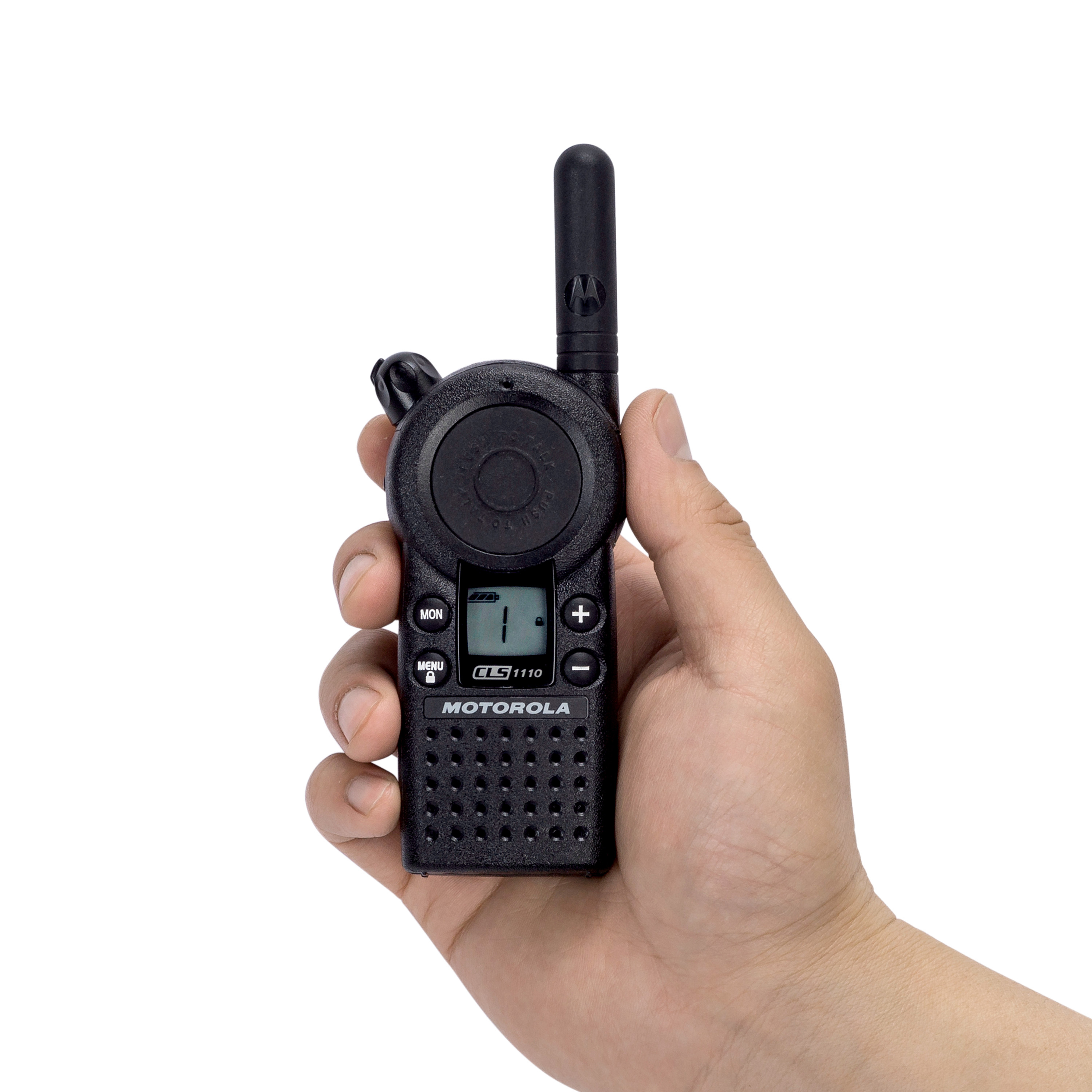
Double the coverage of the CLPe models at 200,000 sq ft, four channels, and a built-in speaker. That last one is the real difference: this is the first radio on the page a crew member can set on a table and still hear. For a conference or trade show — where most of the work is load-in, registration, AV, and breakdown rather than a ceremony nobody can interrupt — that's the right tradeoff. VibraCall is what keeps it usable in the room. A silent vibrating alert lets a session monitor or a stage manager know they're wanted during a keynote without an audible tone, which is the middle ground between a speaker radio and going fully earpiece-only.
| Specification | Detail |
|---|---|
| Frequency | UHF (460–469 MHz) |
| Power | 1 watt |
| Channels | 4 |
| Indoor Coverage | Up to 200,000 sq ft / 15–20 floors |
| Outdoor Range | Up to 1 mile |
| Battery Life | Up to 14 hours |
| Weight | 4.6 oz |
| Durability | IP55 |
| Audio | Built-in speaker, VibraCall vibration alert, VOX-capable |
Pros:
- 200,000 sq ft covers most single-building hotels and conference centers without a repeater — double the CLPe base coverage
- Built-in speaker suits registration desks, AV booths, and load-in crews who won't wear an earpiece
- VibraCall gives a silent alert without committing the whole fleet to earpieces
- Four channels map onto a standard event plan: planning core, operations, AV, security
- Interference-eliminator codes keep a shared frequency clear of a nearby event's chatter
Cons:
- 14 hours is the shortest rating here alongside the PKT-300, and a 12-to-14-hour production day leaves no margin. Plan a spare battery or a gang charger.
- The speaker rules it out for a coordinator working a ceremony — that's the CLP1080e
- Earpieces are an accessory, not included, so budget them for anyone front-of-house
Best Radio for Large Productions & Event Security: Kenwood PKT-300
Quick Summary: Kenwood ProTalk PKT-300
- Best For: Large event productions, security teams, multi-structure venues, and outdoor festival footprints.
- Key Specifications: 2 Watts UHF (450–470 MHz) | 6 Channels (expandable to 16) | 275,000 sq ft coverage | Up to 18-hour battery life (with battery saver).
- Primary Advantage: High 2-Watt output penetrates thick venue walls, stairwells, and outdoor grounds; features Privacy Talk voice scrambling for security.
- Main Trade-off: IP52 water rating requires shelter during heavy outdoor rain; hands-free VOX requires an optional headset.

Two watts and 275,000 sq ft — the most reach of anything here, and the only radio on the page with the power for a convention center, a festival footprint, or a venue where the command table and the far gate aren't in the same building. Everything else here is 1 watt. The second reason is Busy Channel Lockout, which is underrated until you've run a channel with five departments on it. It stops two people transmitting over each other, so a channel stays usable when gates, transportation, and production are all live at once. Privacy Talk is the third — voice scrambling that keeps an incident conversation from being casually intelligible to anyone scanning the frequency. Treat it as discretion, not encryption; it's the right tool for keeping a guest ejection off the vendor channel, not for anything you'd call confidential.
| Specification | Detail |
|---|---|
| Frequency | UHF (450–470 MHz) |
| Power | 2 watts high / 0.5 watts low |
| Channels | Up to 16 (ships with 6, expandable) |
| Indoor Coverage | Up to 275,000 sq ft |
| Battery Life | Up to 14 hours (2200 mAh Li-ion) |
| Weight | 4.87 oz |
| Durability | IP52 (dust-protected, light dripping moisture only), MIL-STD-810 C/D/E/F/G/H |
| Audio | Built-in speaker, VOX (optional headset required), Privacy Talk voice scrambling |
Pros:
- 2 watts and 275,000 sq ft — the only radio here with real reach across a festival footprint or between structures
- Busy Channel Lockout keeps a heavily shared channel usable during peak load
- Ships with 6 channels and opens to 16 — enough to give gates, vendors, transportation, production, and command their own lanes
- Privacy Talk keeps a security or incident conversation off the general channel
- Analog UHF, so it interoperates with the Motorola CLS1410 on matching frequencies and codes — useful if you're adding to a fleet or mixing in rentals
Cons:
- 14 hours matches the CLS1410 as the shortest here, and a festival day plus load-out will use all of it. Budget spare batteries.
- Unlocking the full 16 channels requires dealer programming. Send us your channel plan and we'll do it before shipping.
- VOX needs an optional headset; it won't trigger off the built-in mic
Buy this if your event spans more ground than one building or you need more than four lanes. Skip it if everything happens in one ballroom and discretion matters — the CLP1080e gives you eight channels and total silence, just less range.
Why Avoid Cheap Consumer Radios (Retevis, Baofeng, FRS) at Live Events
This comes up on nearly every event call that starts with a budget number, and the question is fair: a six-pack from a marketplace listing costs less than one business-grade radio. What does a coordinator actually give up? We don't carry these brands, so treat what follows as a dealer's view rather than a neutral one. The reasoning isn't about brand loyalty — it's about three things that matter more at an event than in almost any other setting.
There Is No Second Saturday
This is the one that separates events from every other industry. A restaurant with a radio that cuts out has a bad Tuesday and orders a replacement. A wedding coordinator with a radio that cuts out during the processional has a client whose day cannot be redone.
Consumer radios don't fail dramatically — they fail intermittently, which is worse. A unit that's held a charge for six months starts dropping to four hours, and you find out at hour five of a twelve-hour production day. Business-grade radios publish a battery figure against a stated duty cycle precisely so you can plan around it.
Guests Will Hear Everything
Most cheap multi-packs are FRS, the license-free consumer band shared with the public. Two consequences follow, neither fixable by spending more within the category. There is no earpiece-only option. FRS radios are built around a speaker, and the accessory ecosystem is usually one proprietary earbud. For a wedding or a gala, that rules them out before coverage even enters the conversation — the entire reason the CLPe series exists is that a transmission physically cannot reach a room.
The band is shared and has no exclusivity. FRS has 22 channels. At a hotel or convention center running three events the same day, you will hear the other two and they will hear you — including guest names, timeline changes, and anything security says about an incident.
Power Is Capped by Regulation, Not Build
Quality FRS is limited to 2 watts on most channels with fixed antennas by rule. That's why a consumer radio that works in an empty ballroom at 2pm still drops at the loading dock at 8pm with 300 guests in the room — the ceiling is legal, and no amount of paying more within the category gets past it. This is also why the walkthrough misleads. Consumer radios test fine in an empty venue and fail at capacity, which is the only time it matters.
Three Things Worth Checking on Any Brand, Ours Included
- Is the durability rating tested or claimed? MIL-STD-810 and IP ratings mean something when the manufacturer publishes the test range. "Military grade" with no standard named means nothing.
- Does the battery figure disclose a duty cycle? A number without 5/5/90 behind it isn't comparable to one that has it.
- Who honors the warranty, and for how long? A two-year manufacturer warranty with a domestic repair network is a different asset than a seller-fulfilled replacement policy from a marketplace account.
If Budget Is the Constraint
The honest answer isn't "buy the expensive one." Two better options exist. Rent. If you run a handful of events a year, renting business-grade radios costs less than owning consumer ones and you get equipment that works. This is genuinely the right answer for a coordinator doing four or five events annually, and it's a smaller sale for us than a fleet purchase.
Buy fewer, better. If you're running events weekly, four business-grade radios that last six years cost less than a dozen consumer units replaced twice — and they work at the far gate with the room full, which is the part that actually matters.
Frequently Asked Questions About Event Radios
Should we rent or buy radios for an event?
Buy if you run events regularly — a fleet pays for itself in a season or two, and there's no airtime cost. Rent for a single event, a one-time production, or a peak month where you need twice your usual count for two weekends. The break-even is usually around four or five events a year. If you're between those, buy the core fleet and rent the overflow rather than owning radios that sit in a case eleven months out of twelve.
Can we hand radios to vendors who don't work for us?
Yes, and most coordinators do — a caterer or DJ on your channel is the whole point. Two things make it work: label each radio with the channel it's set to, and brief the plan at the vendor meeting rather than at load-in. A vendor holding a radio they don't understand will default to whatever channel it's on, which is why a taped channel card on each unit beats a verbal explanation on a busy morning.
How do we keep another event's radios off our channels?
Privacy codes — CTCSS or DCS tones — so your radios only open for your own traffic. This matters more than people expect at hotels and convention centers, where two events run in the same building on the same day and often on the same frequencies. Tell us the venue when you order and we'll program codes that keep you separate.
How do we get radios back at the end of an event?
Check them out against a signed list at load-in and collect at teardown, before crews start loading trucks. Numbered radios in a numbered case make a missing unit obvious in ten seconds rather than at the next event. Radios walking off with vendors is the most common way an event fleet shrinks, and it's entirely preventable with a list.
What accessories actually matter for an event fleet?
Three: a multi-unit charger so the fleet docks overnight in one place, an earpiece for every front-of-house role, and a spare battery per radio for anything over ten hours. Earpieces are the line most coordinators leave out of the budget and the one they need most — they're an accessory on the CLS1410 and PKT-300, and included with the CLPe models. Events tend to like the surveillance style earpiece.
Do the radios arrive ready to use?
Yes - the radios will work right outside of the box. Please note, the Kenwood PKT-300 ships with 6 of its 16 channels active and needs dealer programming for the rest — send us your channel plan and we'll set it before shipping. Any radio can be reprogrammed with different frequencies or privacy codes by hand if you're experiencing nearby interference.
Can we add radios later or mix in ones we already own?
Within analog UHF, yes. All four radios here can share channels when programmed to matching frequencies and privacy codes, including across Motorola and Kenwood. Radios on VHF, MURS, 900 MHz, or a digital-only protocol won't interoperate. Send model numbers of anything you already have and we'll confirm before you order.
Are there monthly fees to use radios?
No. Radio-to-radio on all four models — no airtime, no contract, no app, no subscriptions.
Why Event Coordinators Buy Radios from Tech Wholesale
Tech Wholesale has sold professional two-way radios to event planners, wedding coordinators, and venue operators since 1997. We are an authorized dealer for Motorola and Kenwood, which means every radio we sell carries the full manufacturer warranty — two years on every model in this guide. Every spec on this page is pulled directly from the manufacturers' own spec sheets.
What sets us apart
- Lifetime technical support included with every purchase — call or email our team for the life of your radio fleet, not just through the warranty period.
- Quick Quotes — request a custom quote.
- No-pressure consultation — we'll tell you when a less expensive radio is the right answer for your event, not push you toward a higher-margin product.
- Free shipping on qualifying orders.
- Authorized dealer status — no gray-market inventory, no voided warranties.
If you're not sure which radio fits your event, use our Find My Radio tool or request a quote. We'll ask a few questions about your venue, crew size, and timeline and come back with a specific recommendation — no sales pressure, no obligation.
1-888-925-5982 | Service@TechWholesale.com
Related Event Safety & Industry Communication Resources
Internal Product & Service Pages
- Two-Way Radio Rentals for Events — Flexible short-term radio rental options for single-weekend productions and peak season events.
- Find My Radio: Interactive Selection Tool — Calculate coverage needs based on your venue square footage and team size.
Internal Industry Communication Guides
- Voice-Operated Transmit (VOX) Setup for Event Crews — Hands-free radio operation guidelines for load-in and staging teams.
- Programming Two-Way Radio Privacy Codes — How to block out interference from nearby events in shared hotel and convention spaces.
- UHF vs. VHF Frequency Performance Outdoors & Indoors — Why UHF signals penetrate tents, masonry walls, and dense event crowds better than VHF.
- How Signal Repeaters Extend Coverage — Sizing repeater systems for sprawling outdoor festivals, golf courses, and historic estates.
Official Technical & Regulatory Standards
- OSHA 29 CFR 1910.95 Occupational Noise Exposure — Acoustic noise safety standards for event production and staging environments.
- NFPA 101 Life Safety Code (Assembly Occupancies) — National Fire Protection Association guidelines for emergency egress and crowd management.