
Two-Way Radios for Film Production - Buying Guide (2026)
What is the best two-way radio for film crews?
The Short Answer
The best two-way radios for film production are purpose-built commercial-grade UHF radios with strong battery life, noise cancellation, multi-channel capacity, and accessories that support discreet, hands-free communication. For most productions, the Motorola Curve, Motorola BPR50dx-U, and Motorola CP100d-U cover the full spectrum of needs — from boutique indie shoots to sprawling multi-department studio productions. All three are available at TechWholesale.com with volume pricing, pre-programming support, and same-day shipping.
Buy the wrong one and you're dealing with dead zones, short battery life, and a device that falls apart after a few weeks of heavy use. Buy the right one and your entire crew operates like a well-oiled machine.
We've been selling two-way radios since 1997 and have worked with thousands of production teams across set sizes and budgets.
This guide distills everything we've learned to help you make an informed decision—and walk away with a radio that actually works for your crew.
Why Film Productions Have Unique Communication Demands
A film set is one of the most radio-hostile environments in professional use. You're coordinating 10 to 150+ people across departments that are often operating simultaneously — camera, grip, electric, sound, art, wardrobe, AD, and security — each on their own channel, each with completely different needs.
The challenges are unlike any other industry:
Noise discipline and audio interference. The sound department's nightmare is bleed — a radio transmission audible on a boom microphone mid-take. Radios on set must be manageable with a single finger, have adjustable output power, and support covert earpieces and remote speaker mics to keep radio audio off the set entirely.
Long, unpredictable shoot days. A standard union shooting day is 12 hours. Non-union or documentary productions can run 14 to 18 hours. A radio that dies at hour 10 creates a real coordination and safety liability. The FCC's Part 90 rules governing licensed business radios do not mandate specific battery life, but OSHA General Duty Clause obligations to maintain safe working conditions mean production coordinators must ensure reliable communication throughout the work day — particularly for safety-critical roles like set medics, stunt coordinators, and location security.
Department-specific privacy. AD departments, producers, and security often need to communicate on separate, private channels. Any radio deployed on a professional production must support privacy codes (CTCSS/DCS on analog, color codes and group codes on digital) to prevent cross-department crosstalk.
Multi-location and multi-building shoots. Studio lots, location shoots in urban high-rises, warehouse builds, and exterior locations all present different RF propagation challenges. UHF frequencies (400–470 MHz) are the standard choice for film because they penetrate walls and concrete structures more effectively than VHF, making them effective both indoors and outdoors without switching equipment.
Equipment rental compatibility. Most productions rent bulk radios from a communication vendor and supplement with owned units. Any radio purchased for a production office or owned by a department head must be programmable to match rental frequencies. This requires FCC Part 90 licensed radios programmed with your production's assigned frequencies — not consumer GMRS or FRS radios, which cannot be programmed and are prohibited from commercial use under FCC regulations.
Durability in demanding conditions. Radios on film sets get clipped to G-belts, dropped on concrete, rained on during exterior shoots, and handed from crew member to crew member. Military-standard durability ratings are a baseline requirement, not a premium feature.
FCC and Compliance Requirements for Film Production Radios
Film productions operating commercial two-way radios in the United States are required to comply with FCC regulations under 47 CFR Part 90 (Private Land Mobile Radio Services). Key requirements include:
- FCC license required: Any UHF or VHF radio transmitting on licensed frequencies must be operated under a valid FCC Part 90 Business/Industrial license. This applies to all Motorola CP100d and BPR50dx radios operating outside of pre-programmed business frequencies. Licenses are issued per call sign and tied to specific frequency pairs. Applications are filed through the FCC's Universal Licensing System (ULS).
- License-free exception: The Motorola Curve operates on the 900 MHz ISM band using Frequency Hopping Spread Spectrum (FHSS) technology, which is license-free under FCC Part 15 rules. This is a legal and practical option for smaller productions that want immediate, paperwork-free deployment.
- Narrowbanding compliance: All licensed UHF/VHF radios must operate at 12.5 kHz channel spacing or narrower, per the FCC's narrowbanding mandate. All three radios recommended here are narrowband-compliant.
- Consumer radios prohibited for commercial use: GMRS/FRS radios (e.g., Motorola T-Series, Uniden) may not be used for commercial film production under FCC regulations. Using consumer radios in a commercial context violates Part 95 rules and Part 90 licensing requirements.
TechWholesale.com can assist with FCC licensing guidance and pre-programming your radios to your assigned production frequencies before they ship.
Recommended Radios for Film Production
1. Motorola Curve — Best for Indie and Smaller Productions
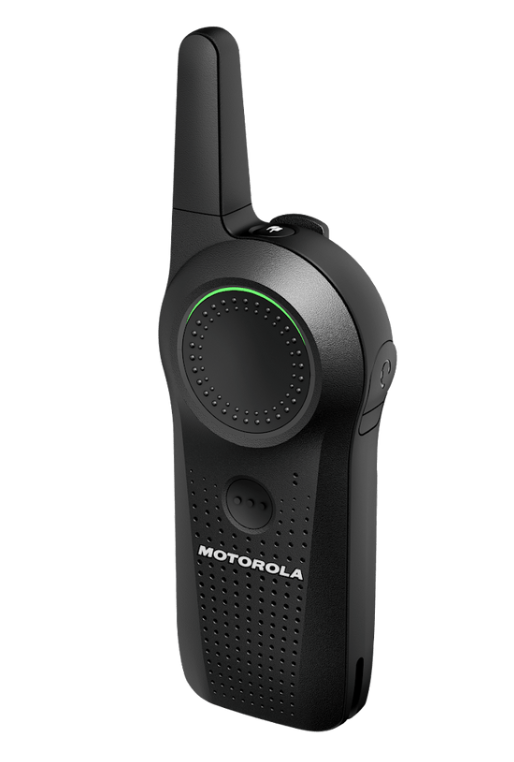
Ideal for: Single-location shoots, productions under 30 people, sets where immediate deployment and zero licensing paperwork are a priority.
The Motorola Curve punches well above its weight class, delivering the effective coverage of a 4-watt analog radio from a compact, 4.2-ounce device. Its 10 channels handle multiple departments comfortably.
Key specs:
- Frequency: 900 MHz ISM band (license-free, FCC Part 15)
- Output: 1 watt digital
- Coverage: up to 300,000 square feet indoors, 20 floors
- Battery life: up to 12 hours standard; optional High Capacity Battery extends further; multi-unit charger charges up to 6 radios simultaneously
- Channels: 10
- Durability: MIL-SPEC 810 standards, IP5X rating for dust and humidity resistance
- Antimicrobial polycarbonate housing — practical for shared equipment changing hands throughout a shoot day
Why it works on set:
Its Frequency Hopping Spread Spectrum technology and 10,000 privacy codes make it one of the most secure radios on the market — important when shooting near other productions. The Page All and Call All Available functions let you reach the entire crew instantly in an emergency, while the Direct Call feature keeps sensitive one-on-one conversations private.
The Curve's heavy-duty audio connection and headset with inline microphone and push-to-talk button support discreet communication — critical for ADs and producers who need to stay on comms without disturbing a quiet set. The optional Voice Assistant button allows hands-free operation, useful for grips, riggers, and anyone whose hands are occupied.
Licensing: None required. Deploy immediately, no FCC paperwork.
Best fit for: Student films, documentary crews, commercial shoots, small narrative productions with a single location.
2. Motorola BPR50dx-U — Best All-Around Radio for Mid-Size Productions
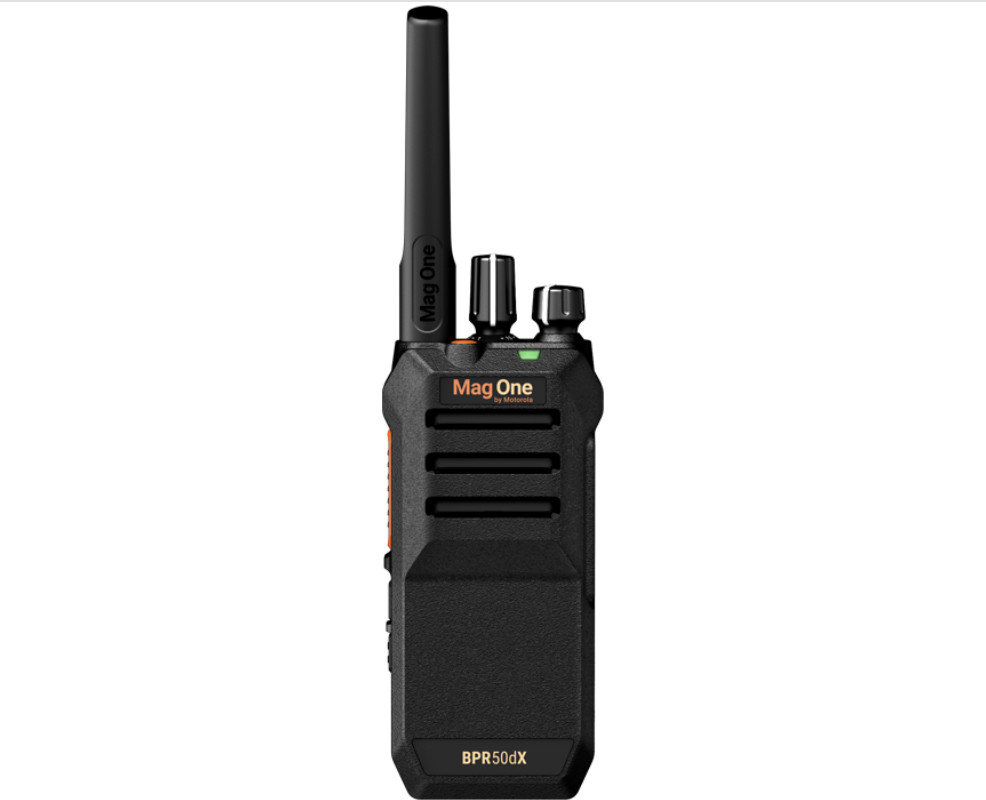
Ideal for: Productions of 30–100+ crew across single or multi-building locations that need long battery life, serious durability, and both analog and digital flexibility.
The BPR50dX supports both analog and digital (DMR) modes at up to 4 watts (UHF), with DMR support delivering clear communications for greater efficiency.
Key specs:
- Frequency: UHF 400–470 MHz (FCC Part 90 licensed)
- Output: 4 watts (UHF)
- Channels: 64 channels distributed over 4 zones (max 16 channels per zone)
- Battery life: 23 hours in digital mode
- Durability: IP55 rating for dust and water resistance, MIL-STD 810 tested
- Charging: USB-C charging built in, compatible with any standard USB charger
- VOX (voice-operated transmission) for hands-free communication
- Dedicated emergency button on top of radio
Why it works on set:
With a 3-watt maximum audio output — the loudest in the Mag One family — and built-in noise cancellation, every message comes through clearly even in loud environments. That matters on sets with generators running, construction sound stages, or practical location effects.
At 10.5 ounces, the BPR50dX is lightweight and compact and easy to carry — a real consideration for department heads who wear their radio 12+ hours a day. The 23-hour battery life is the standout specification for production use: it covers a standard shooting day plus turnaround time without requiring a battery swap. The emergency button is pre-configurable to redirect all radio traffic to a priority channel — an important safety feature for stunt days or emergency evacuations on set.
The BPR50dX supports both analog and digital (DMR) modes, making it easy to transition your existing fleet gradually from analog to digital without replacing all radios at once. If your production is renting analog radios and supplementing with owned units, the BPR50dx can communicate across both systems.
Licensing: FCC Part 90 license required for UHF operation. TechWholesale.com can assist with programming to your licensed frequencies.
Best fit for: Feature films, episodic television, large commercial productions, union shoots with multiple departments, stunt-heavy productions requiring emergency alert functionality.
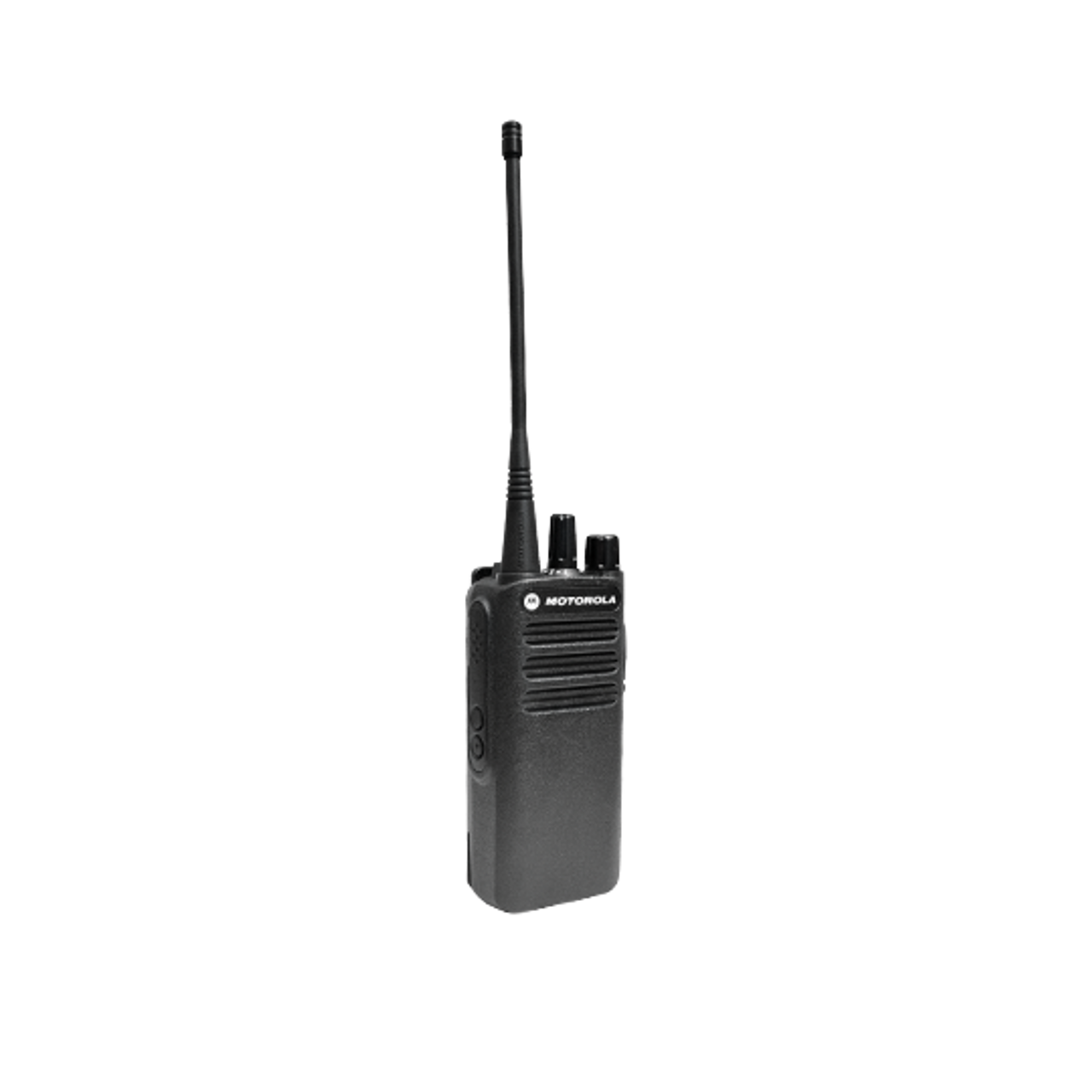
3. Motorola CP100d-U — Best Budget-Friendly Workhorse for Large Fleet Deployments
VOX (Voice Operated Transmission) activates the transmitter automatically when the user speaks, eliminating the need to press a push-to-talk button. For crew members whose hands are occupied — grips, riggers, gaffers, makeup artists, wardrobe — VOX enables truly hands-free communication. The BPR50dx-U has built-in VOX functionality engineered for continuous, hands-free communication. The CP100d-U supports VOX via compatible accessory headsets. The Motorola Curve supports hands-free operation through its Voice Assistant feature with a portal subscription.
Why Buy Your Production Radios from TechWholesale.com
Production coordinators and UPMs ordering communication equipment for a shoot have specific needs that general electronics retailers aren't equipped to handle. TechWholesale.com is built for exactly this type of commercial, volume-driven purchase.
Pre-programming to your FCC frequencies. Order your BPR50dx or CP100d radios and we'll program them to your licensed frequency plan before they ship — no extra equipment, no dealer visits, no delays on your first day of prep.
Bulk pricing. Outfitting a crew of 50 or 150? Contact us for volume pricing on any model. We work with production companies, studios, communication vendors, and independent productions of all sizes.
Fast shipping. Same-day shipping on in-stock orders means you can order during pre-production and have radios in hand before tech scout.
FCC licensing support. Not sure if your production needs a license, or need help understanding your frequency coordination requirements? Our team can help you navigate FCC Part 90 requirements so you're legal and ready on day one.
Expert support. Our radio specialists understand production workflows. Whether you're building a 10-radio fleet for a short or a 200-radio system for a studio feature, we'll help you spec the right combination of radios, accessories, and chargers for your specific shoot.
Shop the Motorola Curve, BPR50dx-U, and CP100d-U at TechWholesale.com, or contact our team at 888.925.5982 or Service@TechWholesale.com for a custom production quote.
Article by Kristin Wood, a two-way radio consultant @ Tech Wholesale | Authorized Motorola & Kenwood Dealer Since 1997 | Last Updated: May 2026