
The Best Two-Way Radios for Event Planning (2026 Guide)
What Are the Best Two-Way Radios for Event Planning?
The Short Answer
The best two-way radios for event planning are the Motorola CLP1080e, Motorola CLS1410, and Motorola Curve. Each fits a different scale of event: the CLP1080e is an earpiece-only radio built for weddings, galas, and boutique venues where staff communication must stay invisible to guests; the CLS1410 covers mid-size venues, conferences, and trade shows with four channels and an external speaker for back-of-house crews; and the digital Motorola Curve delivers ten channels and roughly 300,000 sq ft of coverage for convention centers, hotels, stadiums, and large outdoor festivals.
But the wrong radio costs you more than money — it costs you the moment. A dead battery during a grand entrance, static between the east gate and the command table, or a unit that quits after one season of load-in and load-out turns your communication tool into another problem to manage.
This guide is built to help you match a radio to your actual event — venue size, crew structure, and how visible you want the hardware to be — so you buy once and buy right.
We've outfitted event teams, wedding coordinators, and venue operators for years, and we've seen which radios hold up across a full production day. Here's what we've learned, distilled into one practical reference.
Why Event Teams Need Purpose-Built Two-Way Radios
Events fail quietly, in the gaps between people who can't reach each other fast enough. Cell phones lag, drop, and demand that someone unlock, dial, and wait while the timeline slips. Consumer walkie-talkies die mid-shift, can't punch through a banquet hall's concrete, and broadcast crew chatter straight into a ceremony.
Professional push-to-talk radios solve a specific cluster of problems that few other industries face all at once:
A timeline that doesn't pause. An event runs on cues — doors, first dance, keynote, last call for the shuttle. A coordinator who can't instantly reach the DJ, the caterer, and the front gate at the same second loses the cue. Push-to-talk removes the dial-and-wait latency of a phone: press, speak, done.
Weddings demand silence. At a wedding, the communication has to be there and invisible at the same time. The day-of coordinator cueing the processional, the banquet captain confirming the room flip, the photographer staging the grand entrance — none of it can reach the guests. Earpiece-only radios let an entire team run a wedding without a single audible transmission in the room.
Multi-vendor coordination. Catering, AV, florals, security, transportation, and the planning core all work the same event with different priorities. Without dedicated channels, everyone talks over everyone. Segmenting by role keeps each crew clear and lets leads escalate only when they need to.
Sprawling, RF-hostile venues. Estates, fairgrounds, convention halls, and multi-floor hotels combine distance with concrete, steel, and dense crowds — all of which eat signal. Matching radio power and frequency to the venue is the difference between full coverage and a dead zone at the loading dock.
Crowd safety and emergency response. Whether it's a medical call in the crowd, an over-capacity entrance, or a weather evacuation, security and management need to reach each other instantly. Events held in assembly occupancies fall under NFPA 101: Life Safety Code and local fire-marshal occupancy rules, and the real-time coordination those evacuation procedures depend on is exactly what a professional radio system provides.
The physical grind of load-in and load-out. Radios get dropped off staging, rained on at outdoor setups, and dragged through dusty fairgrounds. Anything without a real durability and water-resistance rating becomes a recurring replacement cost.
What to Look for in an Event Planning Radio
Coverage and Power
Match power to venue size — too little leaves dead zones, too much is money spent on range you'll never use. As a working rule, 1–2 watts of UHF covers a single-building venue up to roughly 200,000 sq ft, while a digital radio like the Curve covers up to 300,000 sq ft or 20 floors on 1 watt of digital power. Thick masonry and poured concrete attenuate signal heavily; if your venue is heavily constructed or multi-building, plan one tier larger than the square footage alone would suggest, or add a repeater.
Battery Life
Event days are long — load-in to teardown can run 14 hours, and multi-day festivals run back-to-back. Choose radios rated for a full day of work; the models on this page carry 12-to-18-hour ratings under the standard 5/5/90 duty cycle. For double shifts and multi-day runs, a multi-unit charger lets you rotate freshly charged units overnight without downtime.
Channels
Channels keep each crew in its own lane. A typical event operation runs well on four dedicated groups — Security, Operations, AV/Production, and the Planning Core (lead planner, stage manager, VIP coordinator). Larger productions with separate catering, transportation, and outdoor teams benefit from eight to ten channels. Avoid single-channel radios for any crew larger than three.
Discretion and Hands-Free Operation
For weddings and upscale events, an earpiece-only radio keeps communication completely silent to guests. For crews on the move — loading trucks, running cable, directing parking — VOX (voice-activated transmission) and a remote speaker-mic keep hands free. Vibrating call alerts let staff receive a message without an audible tone interrupting a quiet moment.
Durability and Water Resistance
Look for a MIL-STD-810 durability rating for shock and vibration, and at minimum an IP54 ingress rating for dust and splash resistance — the realistic baseline for outdoor setups, rain, and the bumps of load-in. None of these radios are submersible, which is not a requirement for standard event work.
Recommended Two-Way Radios for Event Planning
1. Motorola CLP1080e — Best for Weddings, Galas, and Boutique Venues

| Specification | Detail |
|---|---|
| Frequency | UHF (450–470 MHz) |
| Power | 1 watt |
| Channels | 8 |
| Indoor Coverage | Up to 100,000 sq ft / 10 floors (up to 250,000 sq ft / 20 floors with repeater) |
| Battery Life | Up to 18 hours |
| Weight | 3.35 oz with battery |
| Durability | IP54, MIL-STD-810H, antimicrobial housing |
| Audio | Earpiece-only (no external speaker) |
The CLP1080e is the radio we reach for first when a customer says "wedding." It operates entirely through its included earpiece — there is no external speaker — so a day-of coordinator can cue the processional, confirm the room flip, and stage the grand entrance without a single beep or burst of static reaching the guests. At 3.35 oz it disappears on a waistband, and the 18-hour battery comfortably outlasts the longest ceremony-to-send-off day.
Why it fits weddings and upscale events
- Earpiece-only audio keeps every transmission silent to guests — the single most important feature for ceremonies and formal events.
- Eight channels let a wedding team segment cleanly: coordinator, catering, AV/DJ, and photography each get their own lane.
- Antimicrobial polycarbonate housing suits radios that pass between staff across a long day.
- Repeater-capable, so a sprawling estate or multi-floor venue can extend coverage to 250,000 sq ft / 20 floors.
- Ships with an in-line PTT earpiece and belt clip — nothing extra to source before the event.
2. Motorola CLS1410 — Best for Mid-Size Venues, Conferences, and Trade Shows
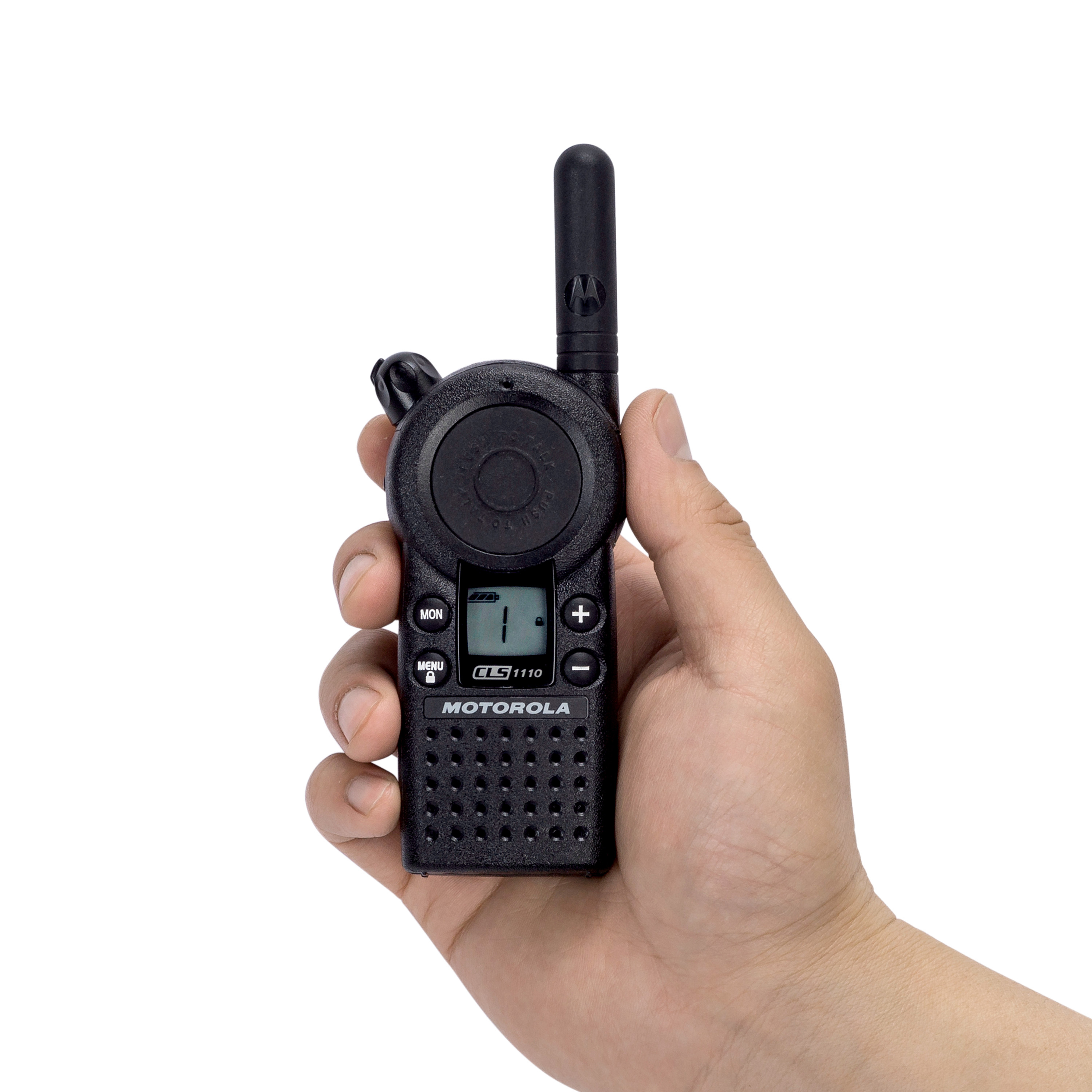
| Specification | Detail |
|---|---|
| Frequency | UHF (460–469 MHz) |
| Power | 1 watt |
| Channels | 4 |
| Indoor Coverage | Up to 200,000 sq ft / 15–20 floors |
| Battery Life | Up to 14 hours |
| Weight | 4.6 oz with battery |
| Durability | IP55, MIL-SPEC 810 (C/D/E/F/G) |
| Audio | Built-in speaker, VibraCall alert, VOX-capable |
CLS stands for Clear, Light, and Simple, and that's exactly why it's the workhorse for conferences, galas, and multi-room events. Its built-in speaker makes it practical for back-of-house crews — setup teams, AV techs, and load-in staff who'd rather set a radio on a table than wear an earpiece — while VibraCall lets front-of-house staff feel an alert instead of hearing one. Simplified cloning matters the morning of an event, when you need to configure a fleet fast.
Why it fits mid-size events
- Four channels cleanly separate Security, Operations, AV, and the planning core for a typical event crew.
- 200,000 sq ft / 15–20 floors of indoor coverage serves most single-building venues, hotels, and conference centers without a repeater.
- VibraCall vibration alerts allow discreet notification during sessions, meals, and presentations.
- IP55 water resistance and MIL-SPEC 810 durability handle the spills, dust, and drops of an active production.
- One-touch cloning makes same-day fleet setup fast and consistent.
3. Motorola Curve — Best for Large Venues, Festivals, and Multi-Building Campuses
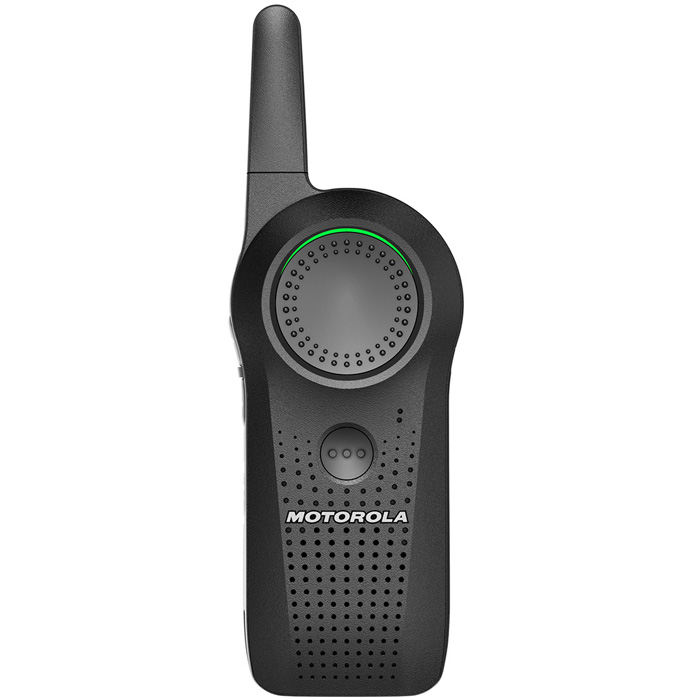
| Specification | Detail |
|---|---|
| Frequency | Digital 900 MHz (902–928 MHz) |
| Power | 1 watt digital (equivalent to roughly 4 watts analog) |
| Channels | 10 |
| Indoor Coverage | Up to 300,000 sq ft / 20 floors |
| Outdoor Range | 1–2 miles |
| Battery Life | Up to 12 hours (4-hour charge) |
| Durability | Military-grade (MIL-STD-810) specifications, antimicrobial coating |
The Curve is where digital pays off. Its 900 MHz digital signal penetrates concrete and steel-reinforced walls more effectively than UHF analog at the same wattage, and 1 watt of digital power delivers roughly the reach of 4 watts analog — close to three times the floor area of the CLS1410, with cleaner audio in crowded, device-dense environments. Ten channels give a large production room to organize every department, and its Private Reply and Call-All-Available features let leads escalate instantly without flooding every channel.
Why it fits large and outdoor events
- Up to 300,000 sq ft / 20 floors of coverage and 1–2 miles outdoors handles convention centers, stadiums, and festival grounds.
- Digital audio stays clear in RF-dense settings where dozens of radios, phones, and Bluetooth devices compete for bandwidth.
- Ten channels support full segmentation: security, gates, vendors, transportation, production, and command.
- Call-All-Available reaches every staff member instantly — the feature you want for a weather call or evacuation.
- Military-grade build and antimicrobial coating stand up to the physical demands of a multi-day outdoor production.
Also Worth Considering
Motorola SL300-U — 3 watts, dual analog/digital, UHF (403–470 MHz). An ultra-slim premium option with digital noise cancellation for productions where audio clarity and extended range are non-negotiable.
Motorola WAVE PTX — LTE/Wi-Fi push-to-talk with effectively unlimited coverage, GPS staff tracking, and smartphone integration. The right tool for traveling event circuits, multi-city productions, or venues spread across a campus. Requires a per-device subscription.
Kenwood ProTalk PKT-300 — 2 watts, 6 channels, UHF (450–470 MHz). A rugged, pocket-sized alternative to the CLS1410 for teams that prefer Kenwood's build or want a couple of extra channels.
Model Comparison
| Feature | Motorola CLP1080e | Motorola CLS1410 | Motorola Curve |
|---|---|---|---|
| Best For | Weddings, galas, boutique venues | Conferences, trade shows, mid-size venues | Festivals, stadiums, multi-building campuses |
| Channels | 8 | 4 | 10 |
| Power | 1 watt UHF | 1 watt UHF | 1 watt digital (~4 W analog) |
| Indoor Coverage | 100,000 sq ft (250,000 w/ repeater) | 200,000 sq ft | 300,000 sq ft |
| Battery Life | Up to 18 hrs | Up to 14 hrs | Up to 12 hrs |
| Weight | 3.35 oz | 4.6 oz | 5.11 oz |
| Audio | Earpiece-only | Built-in speaker + VOX | Built-in speaker, Private Reply |
| Durability | IP54 / MIL-STD-810H | IP55 / MIL-SPEC 810 | Military-grade (MIL-STD-810) |
| Warranty | 2 years | 2 years | 2 years |
Matching Radio to Venue Type
| Event / Venue Type | Recommended Radio | Coverage Capacity |
|---|---|---|
| Wedding, gala, boutique venue (discretion critical) | Motorola CLP1080e | Up to 100,000 sq ft / 10 floors |
| Conference, trade show, mid-size hall | Motorola CLS1410 | Up to 200,000 sq ft / 15–20 floors |
| Convention center, stadium, multi-floor hotel | Motorola Curve | Up to 300,000 sq ft / 20 floors |
| Outdoor festival, multi-building campus | Motorola Curve or WAVE PTX | 1–2 miles / effectively unlimited (LTE) |
For venues with thick masonry or poured-concrete walls, drop one tier larger than your square footage suggests. A 4,000 sq ft estate with stone walls can perform like a much larger building for signal-penetration purposes.
Planning Your Radio Fleet
How Many Radios Does an Event Team Need?
A practical starting point is one radio per key role per shift: lead coordinator, catering captain, AV/production lead, security lead, and the front gate or registration desk. A typical full-service event runs well on six to ten radios; large productions with separate transportation, vendor, and command teams scale from there. We offer quantity pricing on orders of five or more — request a quote and we'll size it with you.
A Simple Channel Plan
Most events organize cleanly into four lanes: Channel 1 — Planning Core (coordinator, stage manager, VIP); Channel 2 — Operations (setup, teardown, logistics); Channel 3 — AV/Production (sound, lighting, DJ/band cues); Channel 4 — Security and gates. Leads can hop to a private channel for a side conversation — "Tom, switch to 5" — without tying up the main lanes.
Multi-Day Events and Charging
For festivals and multi-day conferences, plan for charging downtime. A six-unit charger lets you dock a full squad overnight or rotate spare batteries between shifts so no radio goes dark mid-day. If you only need radios for a single event or a short season, consider two-way radio rentals rather than a purchase.
Not Sure Which Model Fits?
Use our Find My Radio tool, or request a quote. We'll ask a few questions about your venue and crew and come back with a specific recommendation — including whether a less expensive radio is the right answer.
OSHA Noise Considerations for Concerts and Festivals
Under OSHA Standard 29 CFR 1910.95, employers must implement a hearing conservation program when workers are exposed to 85 dB or above as an eight-hour time-weighted average. Many live events — concerts, festivals, and DJ-driven productions — routinely exceed that threshold near the stage. Two-way radio earpieces used in these environments should be selected and used consistent with OSHA hearing-protection guidance, and crews working sustained shifts in high-noise zones should have appropriate hearing protection as part of the production's safety plan.
Frequently Asked Questions
How much range do I need for an event?
For a single-building venue under roughly 100,000–200,000 sq ft, a 1-watt UHF radio like the CLP1080e or CLS1410 provides reliable coverage. For convention centers, stadiums, multi-floor hotels, or outdoor festivals, step up to the digital Motorola Curve, which covers up to 300,000 sq ft / 20 floors indoors and 1–2 miles outdoors. For events spread across multiple buildings or cities, an LTE/Wi-Fi radio like the Motorola WAVE PTX provides effectively unlimited range. When in doubt with heavy concrete construction, size up one tier or add a repeater.
How long does the battery last on an event radio?
The radios recommended here are rated for a full event day: the CLP1080e up to 18 hours, the CLS1410 up to 14 hours, and the Curve up to 12 hours, all measured on the industry-standard 5/5/90 duty cycle. Heavy, constant transmitting shortens real-world life. For double shifts or multi-day events, charge fully the night before and use a multi-unit charger to rotate freshly charged units or spare batteries without downtime.
What durability and water-resistance ratings should I look for?
For event work, look for a MIL-STD-810 durability rating and at least an IP54 ingress rating. The CLP1080e is rated IP54 and MIL-STD-810H; the CLS1410 is rated IP55 and meets MIL-SPEC 810 (C/D/E/F/G); the Curve is built to military-grade (MIL-STD-810) specifications. IP54–IP55 means the radio resists dust and splashing water from any direction — rain at an outdoor setup, a spilled drink, wet hands — but none of these are submersible, which isn't a requirement for standard event use.
Can I use two-way radios at outdoor events?
Yes. UHF radios perform well outdoors, and the Curve's 900 MHz digital signal extends 1–2 miles in open conditions. For large festival footprints or significant distances between zones, the Curve or the LTE-based WAVE PTX series are the strongest options. The IP54–IP55 ratings on these radios handle rain and dust at open-air setups.
Which radio is best for a wedding?
The Motorola CLP1080e. It communicates entirely through its included earpiece with no external speaker, so the coordinator, catering captain, AV/DJ, and photographer can stay in sync without a single audible transmission reaching guests. It weighs 3.35 oz, clips invisibly to a waistband, runs up to 18 hours, and its eight channels keep each vendor team in its own lane.
How many radios does an event team need?
Start with one radio per key role per shift — lead coordinator, catering captain, AV/production lead, security lead, and the front gate or registration desk. A typical full-service event runs well on six to ten radios; larger productions scale up from there. Tech Wholesale offers quantity pricing on orders of five or more.
Should I rent or buy radios for an event?
If you run events regularly, buying pays for itself quickly — there are no recurring airtime fees, and professional radios are tested for years of field use. For a single event or a one-time production, our two-way radio rental program is often the more economical route. If you're unsure, request a quote and we'll lay out both options.
Are two-way radios better than cell phones for events?
For live team coordination, yes. Radios are instant, one-to-many push-to-talk — no dialing, no waiting for a connection, no dropped calls in a crowded venue where cellular networks are saturated. They're more durable than phones, run a full day on a charge, and carry no monthly service fees. A coordinator can reach the entire production crew with one press of a button.
Why Buy from TechWholesale.com
Tech Wholesale has sold professional two-way radios to event planners, wedding coordinators, and venue operators since 1997. We are an authorized dealer for Motorola and Kenwood, which means every radio we sell carries the full manufacturer warranty — typically two years on commercial-grade models — and qualifies for manufacturer service and repair.
What sets us apart
- Lifetime technical support included with every purchase — call or email our team for the life of your radio fleet, not just through the warranty period.
- Quick Quotes — request a custom quote.
- No-pressure consultation — we'll tell you when a less expensive radio is the right answer for your event, not push you toward a higher-margin product.
- Free shipping on qualifying orders.
- Authorized dealer status — no gray-market inventory, no voided warranties.
If you're not sure which radio fits your event, use our Find My Radio tool or request a quote. We'll ask a few questions about your venue, crew size, and timeline and come back with a specific recommendation — no sales pressure, no obligation.
1-888-925-5982 | Service@TechWholesale.com
Related Reading
- Two-Way Radio Rentals for Events
- Find My Radio Tool
- VOX (Hands-Free) Explained
- Privacy Codes – Eliminate Outside Interference
- UHF vs VHF – Frequencies Explained
- Repeaters – Extending Radio Coverage
- OSHA 29 CFR 1910.95 – Occupational Noise Exposure
- NFPA 101 – Life Safety Code
Article by Kristin Wood, a two-way radio consultant @ Tech Wholesale | Authorized Motorola & Kenwood Dealer Since 1997 | Last Updated: May 2026