
When a security situation unfolds during a Sunday service, there's no time to unlock your phone, find a contact, and wait for the call to connect. You need instant communication—clear, reliable, and immediate.
Two-way radios make that possible in a way smartphones simply can't.
Buy the wrong one and you're dealing with static in the sanctuary, dead zones in the parking lot, and a battery that dies halfway through the evening service.
The right radio, matched to your building size and team structure, makes all the difference.
We've sold thousands of radios to churches across the country and have learned a lot along the way.
This guide pulls together everything we know to help you make an informed purchase—not just one based on price or brand recognition. By the end, you'll know exactly what to look for and which models are worth your investment.
Two-Way Radios for Churches: The Complete Buyer's Guide
The best two-way radios for churches are business-grade UHF or digital models with at least 4 channels, 10–14 hours of battery life, and indoor coverage matched to your building’s square footage. For most churches, the Motorola CLS1410 (small congregations), Motorola RMU2040 (mid-size buildings with durability needs), and Motorola Curve (large or multi-building campuses) are the top-performing options. Unlike consumer walkie-talkies or smartphones, these radios provide instant push-to-talk communication with no monthly fees, no cellular dependency, and no delay — critical advantages when managing safety and operations during live services.
Why Churches Need Two-Way Radios
Church environments present a unique combination of communication challenges. Volunteers must coordinate across large, acoustically complex buildings — sanctuaries with high ceilings, concrete walls, multi-story children’s wings, outdoor parking lots — often during services where noise discipline is essential.
Common church communication pain points include:
- Security team members needing to respond to an incident without causing disruption in the sanctuary
- Children’s ministry staff alerting parents silently when a child needs pickup
- Parking lot volunteers cut off from indoor staff by thick walls or distance
- Ushers and greeters coordinating seat availability, late arrivals, and overflow seating
- A/V and production teams cueing transitions without interrupting the service flow
- Emergency response: fire, medical, or security situations requiring instant all-staff alerts
Smartphones fail in these situations because they require unlocking, dialing, and waiting. A two-way radio connects instantly, with one press, to one person or every person on the team simultaneously. For a house of worship responsible for the safety and experience of hundreds of attendees, that difference is significant.
How to Choose the Right Church Radio
Coverage: Match Wattage to Building Size
Radio power output (wattage) determines how far a signal travels and how well it penetrates walls. Purchasing more power than you need wastes money; purchasing too little creates dead zones.
| Building Size | Recommended Power |
|---|---|
| Under 150,000 sq ft | 1 watt (UHF analog) |
| 150,000–250,000 sq ft | 1–2 watts (UHF analog) |
| 250,000–325,000 sq ft | 2–3 watts (UHF analog) |
| Large / multi-building campuses | 1 watt digital (≈ 4 watts analog) |
Buildings with thick concrete construction, metal structures, or reinforced walls should move up one tier. Digital radios (such as the Motorola Curve operating on 900 MHz FHSS) punch above their watt rating because the signal type is more efficient.
Channels: How Many Does a Church Need?
Most church operations run cleanly on five dedicated channels:
- Parking & Traffic — directing vehicles and assisting guests arriving and departing
- Greeters & Ushers — managing entry points, seating coordination, and overflow
- Children’s Ministry — classroom coordination, check-in alerts, and parent notifications
- Security — monitoring the full property and responding to incidents
- Pastoral & Production — service cues, A/V coordination, and leadership updates
Additional channels can be used for one-to-one private conversations between staff members without interrupting team-wide communication. For churches with 6+ departments or multiple simultaneous services, 8–10 channels is ideal.
Battery Life
Church use isn’t limited to Sunday morning. Add rehearsals, Wednesday services, events, funerals, and holiday services — and your radios may be in use 10–14 hours in a single day. Any radio rated below 10 hours of continuous use is a liability. Models rated at 14 hours ensure coverage for even the longest event days without mid-service battery swaps.
Audio Quality and Noise Cancellation
Sanctuaries produce significant ambient noise — music, crowds, PA systems. Parking lots add wind and traffic. Look for radios with built-in noise reduction or cancellation features. UHF frequency radios are preferred over VHF for indoor use because UHF signals penetrate walls and obstacles more effectively.
Durability Ratings
Radios used by church volunteers get dropped. They get left in parking lots. They get knocked off belt clips. Consumer-grade radios rarely survive more than a year of regular use. Commercial-grade radios built to MIL-STD-810 (U.S. military durability specification) are engineered to survive drops, vibration, temperature extremes, and moisture exposure.
For outdoor use (parking, perimeter security), water-resistant models rated for occasional rain or light weather exposure are recommended.
FCC Licensing
Under FCC rules, UHF business radios operating on licensed frequencies require a standard FCC business license. The license is typically valid for 10 years and costs approximately $75-$600 to file. Churches operating on licensed frequencies gain access to more channels with fewer interference concerns.
License-free option: The Motorola Curve operates on the 900 MHz FHSS digital band, which does not require an FCC license. It is legal to use out of the box, making it the lowest-administrative-overhead choice for church staff who don’t want to manage licensing.
Discreet Design
Security personnel and ushers benefit from compact radios that don’t draw visual attention during services. Models without external speakers (like the Motorola CLPe series) are designed specifically for earpiece-only use, keeping communication invisible to the congregation.
Best Two-Way Radios for Churches: Top Recommendations
1. Motorola CLS1410 — Best for Small Churches
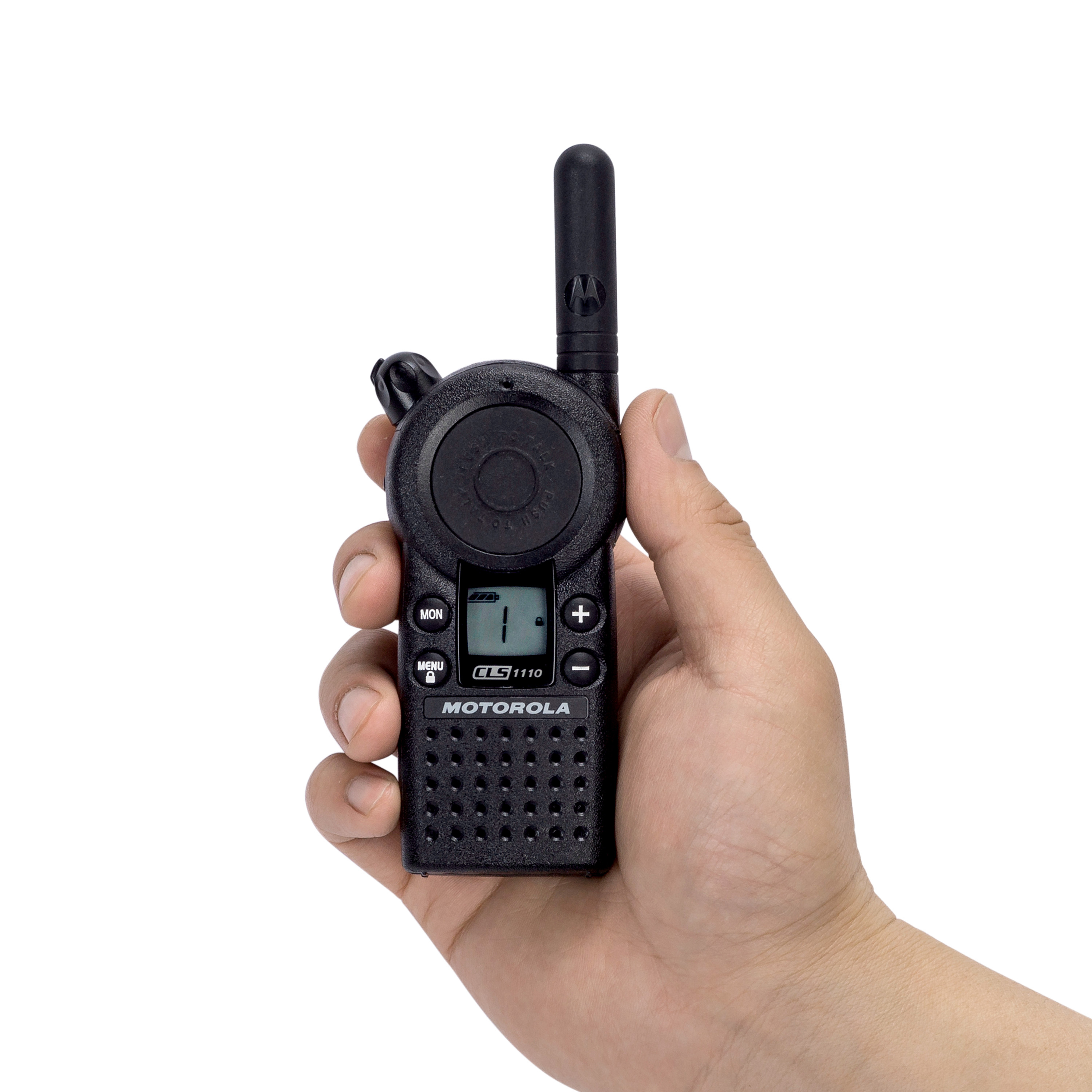
Recommended for: Congregations in buildings under 200,000 sq ft with 4–8 radio users.
The Motorola CLS1410 is the most cost-effective business-grade radio for smaller church teams. Its name stands for Clear, Light, and Simple — and the design lives up to that description. With four channels, 1 watt of UHF power, and indoor coverage up to 200,000 sq ft or 15 floors, it handles the full range of a typical small-to-mid church building without complexity.
Key specs:
- Wattage: 1 watt
- Frequency: UHF (460–469 MHz)
- Channels: 4
- Coverage: Up to 200,000 sq ft / 15 floors indoors; up to 1 mile outdoors
- Battery life: Up to 12 hours
- Features: Audible Call Alerts, Vibracall technology, simplified radio cloning for fast fleet setup, belt clip included
Why it works for churches: The Vibracall feature allows silent alerts — a volunteer can be notified without a radio chirp disrupting the service. Cloning support lets administrators program all radios quickly from a single master unit, reducing setup time when onboarding new volunteers.
2. Motorola RMU2040 — Best for Durability and Privacy
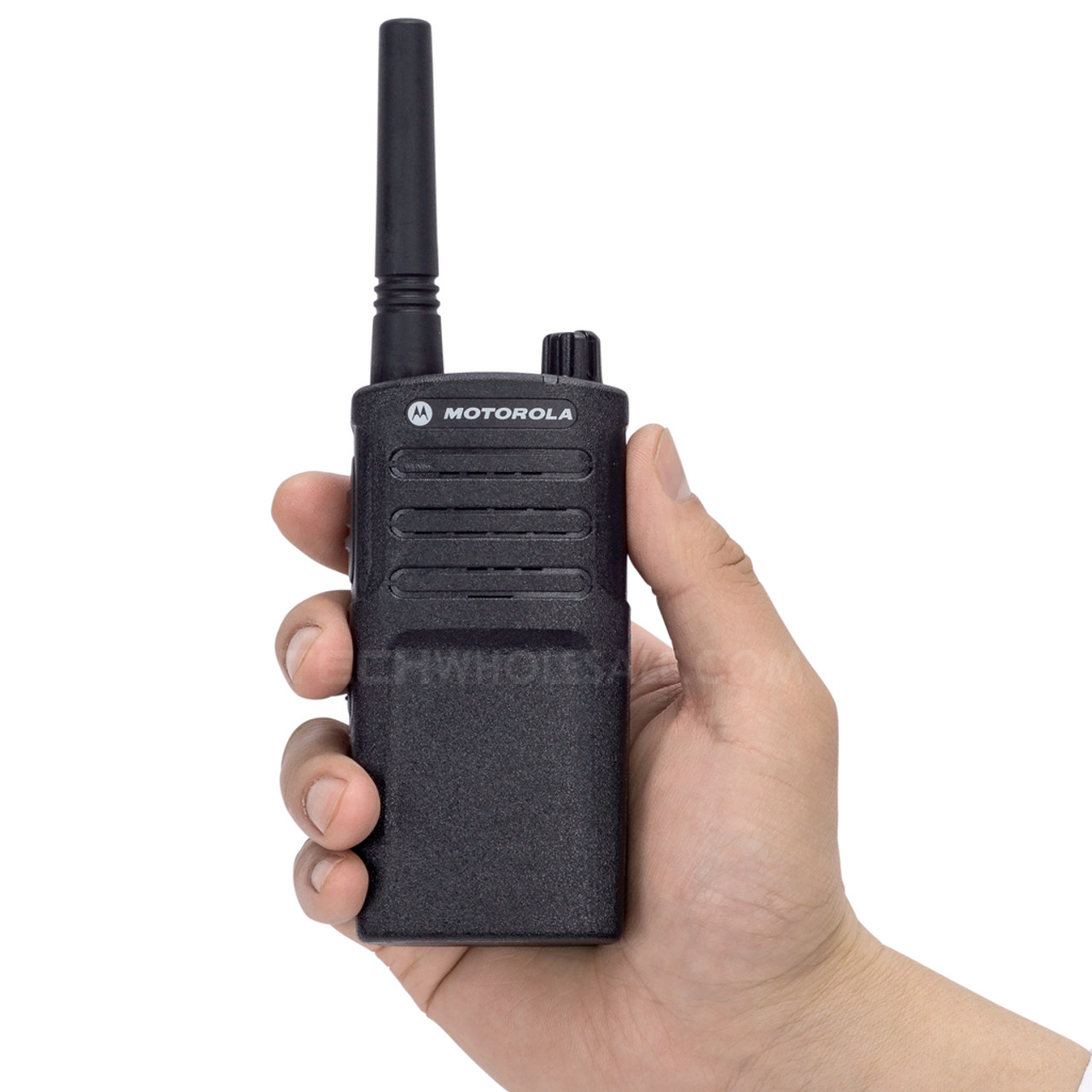
Recommended for: Churches needing a rugged radio rated for heavier use, or those located near schools, event venues, or other radio-dense environments.
The Motorola RMU2040 is built to U.S. military hardware durability standards (MIL-STD 810), designed to survive drops and rough handling that would destroy consumer-grade alternatives. It covers up to 250,000 sq ft indoors or 2 miles outdoors — appropriate for mid-size churches with expansive campuses or outdoor gathering areas.
Its standout feature for churches in urban or suburban environments is its 219 privacy codes (CTCSS/DCS), which prevent crosstalk and interference from neighboring organizations using similar frequencies. If your church is near another business, school, or venue with radios, this is a meaningful protection.
Key specs:
- Wattage: 2 watts
- Frequency: UHF (450–470 MHz)
- Channels: 4
- Coverage: Up to 250,000 sq ft / 20 floors indoors; up to 2 miles outdoors
- Battery life: Up to 14 hours
- Features: 219 privacy codes (CTCSS/DCS), antimicrobial housing, MIL-STD 810 durability, water resistant
Why it works for churches: The antimicrobial housing is a practical benefit for radios that pass between multiple volunteers and are touched constantly throughout the day. The 14-hour battery covers full-day events without interruption. The rugged build reduces replacement costs over time — a meaningful factor for nonprofits managing tight budgets.
3. Motorola Curve — Best for Large or Multi-Building Campuses
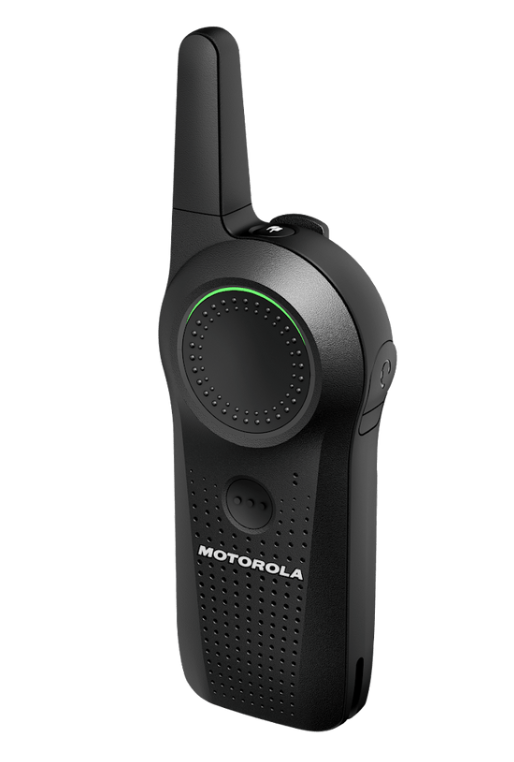
Recommended for: Larger congregations, churches with satellite campuses or multiple buildings, and any church wanting to eliminate FCC licensing requirements.
The Motorola Curve is the most advanced radio on this list and the most popular choice among the large church teams TechWholesale.com works with. It operates on a digital 900 MHz FHSS (Frequency Hopping Spread Spectrum) band, which requires no FCC license — a significant administrative advantage for churches that don’t have staff dedicated to regulatory compliance.
Despite its capability, it weighs just 4.2 ounces, making it one of the lightest business-grade radios available.
Its 10-channel capacity handles the full range of large church departments simultaneously. Page All and Call All Available features allow a single administrator to reach every active radio at once — essential in a security emergency. The Direct Call feature routes a private conversation to a specific individual without broadcasting to the group.
Key specs:
- Wattage: 1 watt digital (equivalent to ≈4 watts analog in coverage)
- Frequency: Digital FHSS (902–928 MHz)
- Channels: 10
- Coverage: Up to 300,000 sq ft / 20 floors indoors; up to 3–5 miles outdoors
- Battery life: 14 hours
- Features: 10,000 privacy codes, Page All / Call All Available / Direct Call, antimicrobial coating, FCC license-free, water resistant
Why it works for churches: The 10,000 privacy codes make channel interference virtually impossible. FHSS technology hops across 75 channels per second, making unauthorized interception of communications extremely difficult — relevant for security teams handling sensitive situations. No licensing means no renewal deadlines, no filing fees, and no regulatory management.
Quick Comparison Table
| Model | Best For | Wattage | Channels | Indoor Coverage | Battery |
|---|---|---|---|---|---|
| Motorola CLS1410 | Small churches | 1W UHF | 4 | 200,000 sq ft | 12 hrs |
| Motorola RMU2040 | Durability / privacy | 2W UHF | 4 | 250,000 sq ft | 14 hrs |
| Motorola Curve | Large / multi-campus | 1W digital | 10 | 300,000 sq ft | 14 hrs |
Frequently Asked Questions
Do churches need an FCC license to use two-way radios?
It depends on the radio. Most UHF business radios (including the Motorola CLS1410 and RMU2040) operate on licensed frequencies under the FCC and technically require a standard business radio license. The license is filed using an FCC Form, costs approximately $70-$600, and is valid for 10 years. The Motorola Curve is the exception — it operates on the 900 MHz FHSS digital band and requires no license, making it fully legal to use out of the box.
Churches that operate multiple radio systems or have radios used by a school or daycare on the same property should consult with a licensed radio dealer (like TechWholesale.com) to ensure their frequency plan is properly coordinated.
What range do church two-way radios need?
Range requirements depend on your building size and layout. For most single-building churches:
- Small sanctuary (under 50,000 sq ft): 1 watt / up to 150,000 sq ft indoor coverage is sufficient
- Mid-size church (50,000–150,000 sq ft): 1–2 watts with 200,000–250,000 sq ft indoor coverage
- Large church or campus: 2+ watts analog or 1 watt digital with 300,000+ sq ft coverage
Parking lot and outdoor use requires additional range. Models like the RMU2040 and Motorola Curve handle most campus footprints. Churches with outdoor amphitheaters, large parking structures, or satellite buildings should evaluate repeater systems to extend coverage.
How long do church radio batteries last?
Commercial-grade church radios are rated for 10–14 hours of continuous use per charge. The Motorola RMU2040 and Motorola Curve both achieve 14-hour battery life. The Motorola CLS1410 runs approximately 12 hours. For churches running events longer than a standard service day, most models support multi-unit charging docks that allow backup radios to charge while the primary fleet is in use.
Are two-way radios better than cell phones for church security?
Yes, for in-building security coordination. Two-way radios provide instant push-to-talk communication with zero connection delay — versus 10–15 seconds to unlock a phone, find a contact, and place a call. They function on their own frequency band independent of cellular network availability, which means they work even during network congestion at large events. They also support group communication: one transmission reaches every team member simultaneously, which is critical for coordinated security response. Smartphones are better suited for communications that require video, messaging, or contact with people outside the building.
What durability rating should a church radio have?
For general church volunteer use, look for radios rated to MIL-STD-810 — the U.S. military’s standard for equipment durability, covering drop resistance, vibration, temperature cycling, and humidity. The Motorola RMU2040 meets this standard. For outdoor security or parking lot use, water resistance rated for occasional rain or light weather exposure is recommended. The IP (Ingress Protection) rating system classifies water resistance: IP54 indicates protection against dust and water splashes from any direction.
Can one radio be used for multiple church departments?
Yes — that’s exactly what multiple channels are for. A single radio can be assigned to multiple channels and switched between them manually. A children’s ministry director might monitor Channel 1 (Children’s Ministry) and switch to Channel 4 (Security) if an incident occurs. Most business-grade church radios support 4–10 channels, allowing one device to cover multiple roles. Privacy codes (CTCSS/DCS tones) further prevent accidental cross-department communication.
How many radios does a church need?
A practical starting point is one radio per active volunteer role per service. A typical small church deployment covers: 2 parking lot attendants, 2 greeters, 2 ushers, 1 children’s ministry coordinator, 1–2 security personnel, and 1 pastoral/production coordinator — totaling 9–10 radios. Larger churches with multiple service times or satellite campuses may operate 20–50+ radios. TechWholesale.com offers quantity discounts; contact us for a custom quote.
Why Buy Church Radios from TechWholesale.com?
TechWholesale.com has been supplying two-way radios to churches, nonprofits, schools, and businesses for over 25 years. Every purchase includes:
Lifetime tech support — Our team is reachable by phone, chat, or email after your purchase, not just before it. If a radio has an issue six months after delivery, we help you resolve it.
Best-in-class pricing — We sell Motorola and Kenwood radios at competitive prices below MSRP, with no monthly fees, no contracts, and no hidden costs.
Quantity discounts — Churches purchasing bulk radios may qualify for fleet pricing. Request a quote and we’ll build a proposal specific to your team size, building, and budget.
Expert matching — Not sure which model fits your sanctuary? Our specialists have helped thousands of church teams make the right call. We ask the right questions — building size, team structure, service schedule, budget — and recommend accordingly.
Authorized dealer — All Motorola and Kenwood radios sold through TechWholesale.com carry full manufacturer warranties. No gray market imports, no voided coverage.
Request a Free Quote | Chat With a Specialist
TechWholesale.com | Authorized Motorola & Kenwood Dealer | Serving Churches, Schools & Businesses Since 1997