
The Best Two-Way Radios for Church Security (2026 Guide)
What Are the Best Two-Way Radios for Churches?
The Short Answer
The best two-way radios for churches are the Motorola CLS1410, Motorola RMU2040, and Motorola Curve. Each model addresses a different church scale: the CLS1410 handles small congregations in single-floor buildings; the RMU2040 delivers MIL-STD-810 durability and 14-hour battery life for mid-size churches and volunteer-heavy operations; and the Motorola Curve provides digital coverage for large sanctuaries, multi-building campuses, and churches that need to connect parking lots to the sanctuary.
But church environments are uniquely demanding. Thick masonry walls, sprawling multi-wing buildings, acoustically complex sanctuaries, and the strict need for discretion during services mean that a radio suited for a warehouse or restaurant will often fail in a house of worship.
We've supplied two-way radios to churches, schools, and nonprofits since 1997 — and the questions we hear most often are the same ones this guide answers.
Why Churches Need Two-Way Radios
Church operations require communication that is instant, discreet, and independent of cell networks. A Sunday morning deployment routinely involves parking lot attendants, greeters, ushers, children's ministry staff, security personnel, and A/V production teams — all operating simultaneously across a building that may span hundreds of thousands of square feet.
Smartphones fail in these scenarios for three structural reasons: connection latency (10–15 seconds to unlock, dial, and connect), cellular dependency (networks can saturate during large events), and one-to-one limitation (a single transmission cannot reach an entire team simultaneously). Professional two-way radios eliminate all three. Push-to-talk communication reaches every radio on a channel in under a second, operates on a dedicated frequency band, and requires no monthly service fees.
Church environments produce a specific set of pain points that no other industry shares in quite the same combination:
Discretion during live services. A security alert, a child pickup, or a facilities issue must be handled without producing audible radio traffic in the sanctuary. Radios without external speakers — or with Vibracall silent alert technology — allow staff to receive notifications without a chirp that disrupts worship.
Structural penetration challenges. Older church buildings frequently feature stone, brick, or poured concrete construction. Steel-reinforced walls in modern multi-story wings can absorb RF signal as effectively as a Faraday cage. Standard consumer walkie-talkies rated for outdoor use may produce dead zones in a basement classroom or third-floor balcony.
Multi-zone coordination during events. A single service may simultaneously require parking lot volunteers outside the building, nursery staff three floors up, ushers at the main entrance, and a security officer on a walking perimeter — all communicating with a central coordinator. Without dedicated channels, every transmission crosses every department.
Security and emergency response. The National Fire Protection Association's NFPA 101: Life Safety Code governs assembly occupancies and implicitly depends on real-time internal communication for emergency evacuation coordination. For fire, medical, or security incidents during a service, instant radio contact between security, pastoral staff, and parking lot personnel is the operational standard that professional radios support.
Volunteer turnover. Radios that require complex setup, programming, or pairing slow down onboarding. Commercial-grade models with radio cloning support allow a fleet of units to be configured identically from a single master radio — a practical advantage for churches with rotating volunteer schedules.
How to Choose the Right Church Radio
Coverage: Match Wattage to Building Size
Radio power output (wattage) determines penetration depth and effective coverage area. Purchasing too little creates dead zones; purchasing more than needed is wasted cost. Digital radios at 1 watt frequently outperform analog radios at 2 watts because their signal modulation is more efficient — a 1-watt digital radio like the Motorola Curve delivers the effective coverage equivalent of approximately 4 watts analog.
| Building Size | Recommended Power | Example Radio |
|---|---|---|
| Under 200,000 sq ft | 1 watt UHF analog | Motorola CLS1410 |
| 200,000–250,000 sq ft | 2 watts UHF analog | Motorola RMU2040 |
| 250,000–300,000 sq ft | 2–3 watts UHF analog | Motorola SL300-U |
| Large or multi-building campus | 1 watt digital (≈ 4W analog) | Motorola Curve |
Buildings with thick masonry, reinforced concrete, or metal structural elements should plan for one tier higher wattage than square footage alone would suggest. A 4,000 sq ft stone sanctuary may perform for RF penetration purposes more like a 20,000 sq ft office building.
Channels: How Many Does a Church Need?
Most church operations run efficiently on five dedicated channels:
- Channel 1: Parking & Traffic — vehicle flow, arrivals, and handicap assistance
- Channel 2: Greeters & Ushers — entry points, overflow seating, late arrivals
- Channel 3: Children's Ministry — classroom coordination, check-in alerts, parent notifications
- Channel 4: Security — perimeter monitoring and incident response
- Channel 5: Pastoral & Production — service cues, A/V transitions, and leadership coordination
Churches with six or more departments, multiple simultaneous services, or satellite campuses benefit from 8–10 channel capacity. Privacy codes (CTCSS/DCS tones) further segment communication and prevent cross-department bleed even on shared frequencies.
Battery Life
A full church event day — Sunday morning service, afternoon fellowship event, evening service — can run 10 to 14 hours. Any radio rated below 10 hours of continuous use creates a liability for mid-service battery failure. Models rated at 14 hours cover even the longest event days without battery swaps. Multi-unit charging cradles allow backup radios to charge while the primary fleet is deployed.
Durability Ratings
Volunteer-deployed radios get dropped, left in parking lots, and handled by dozens of different people across a week. Consumer-grade radios rarely survive more than a year of this treatment. Commercial-grade radios built to MIL-STD-810 — the U.S. military's hardware durability specification covering drop resistance, vibration, temperature cycling, and humidity — are the appropriate standard for regular church use. For outdoor roles (parking, perimeter security), look for water-resistance rated at IP54 or above, indicating protection against dust and directional water splashes.
Discreet Design
Security personnel and ushers in proximity to a live service benefit from small-form radios that are not visually prominent. The Motorola CLPe series operates entirely through an included earpiece with no external speaker — communication is invisible to the congregation. Standard belt-clip radios like the CLS1410 are appropriate for back-of-house and outdoor roles where discretion is less critical.
Recommended Two-Way Radios for Churches
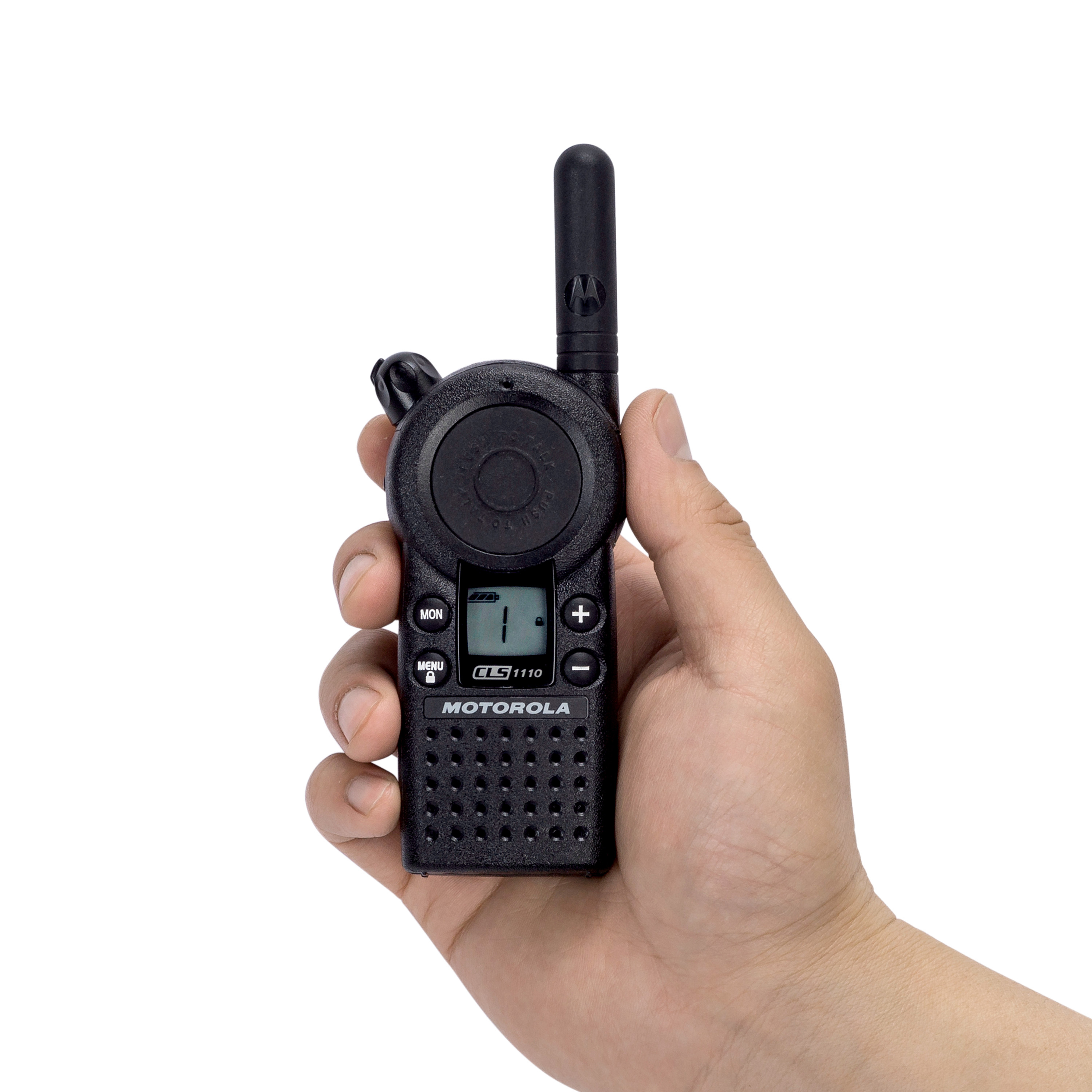
1. Motorola CLS1410 — Best for Small Churches
| Specification | Detail |
|---|---|
| Frequency | UHF (460–469 MHz) |
| Power | 1 watt |
| Channels | 4 |
| Indoor Coverage | 200,000 sq ft / up to 15 floors |
| Outdoor Coverage | Up to 1 mile |
| Battery Life | Up to 12 hours |
| Durability | Commercial-grade, water-resistant |
The Motorola CLS1410 is the most widely deployed commercial radio in small-to-mid-size church environments. Its UHF frequency reliably penetrates the masonry, wood, and drywall construction typical of small church buildings. The Vibracall technology delivers a silent vibrating alert — a critical feature for staff who need to receive messages without producing audible radio chirps during a sermon or worship set.
Why it fits churches specifically
- Vibracall silent alert notifies staff without audible transmission disrupting services
- Radio cloning support allows the full fleet to be programmed quickly from one master unit — practical for volunteer-heavy environments with frequent onboarding
- VOX (hands-free voice-activated transmission) keeps greeters and ushers hands-free during entry management
- 4 channels provide clean role-based segmentation for teams of 4 to 20
- 12-hour battery covers standard Sunday schedules including setup and close
Best for: Congregations in buildings under 200,000 sq ft with 4–15 radio users and a straightforward team structure.
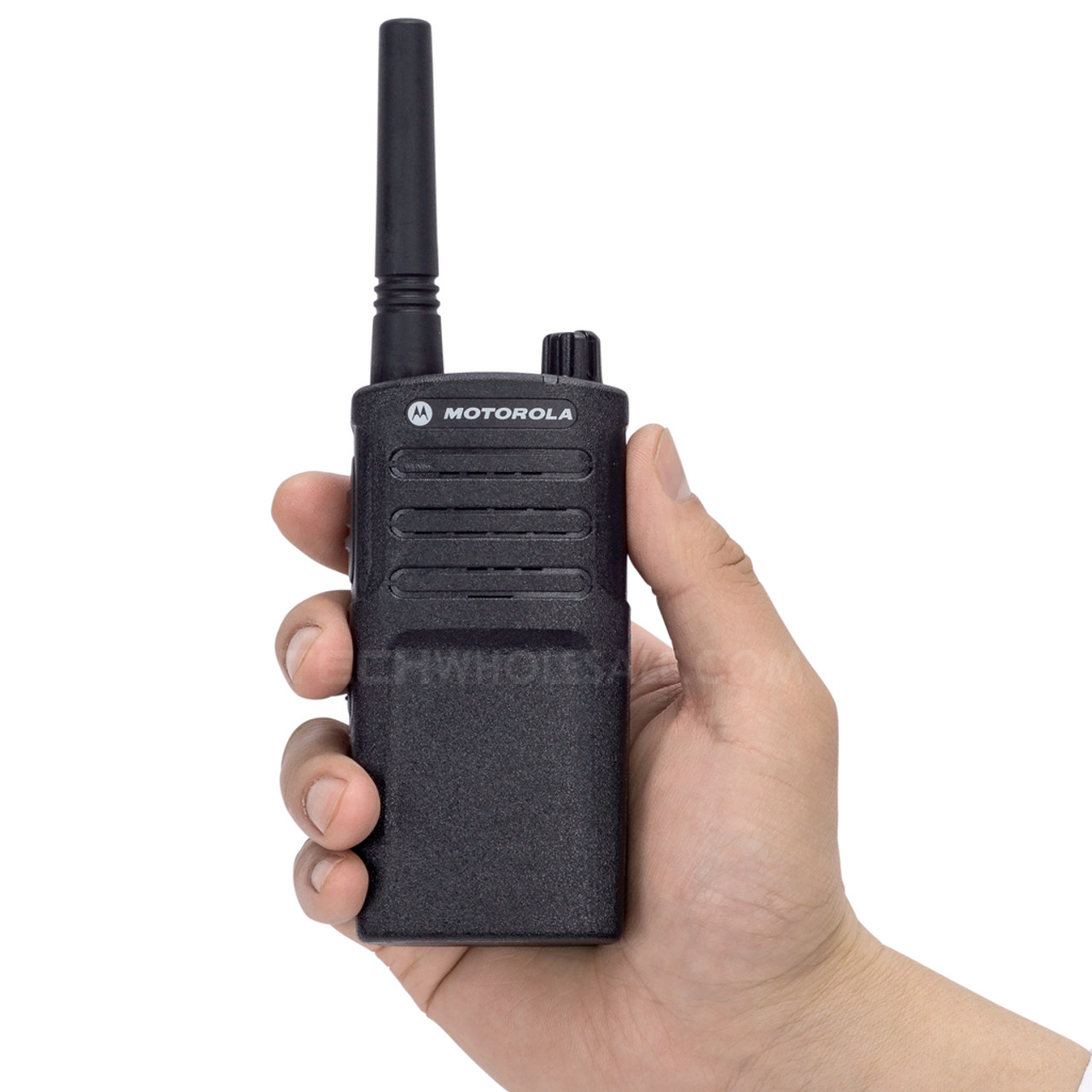
2. Motorola RMU2040 — Best for Durability and Privacy
| Specification | Detail |
|---|---|
| Frequency | UHF (450–470 MHz) |
| Power | 2 watts |
| Channels | 4 |
| Indoor Coverage | 250,000 sq ft / up to 20 floors |
| Outdoor Coverage | Up to 2 miles |
| Battery Life | Up to 14 hours |
| Privacy Codes | 219 (CTCSS/DCS) |
| Durability | MIL-STD-810, antimicrobial housing, water-resistant |
The Motorola RMU2040 is built to U.S. military hardware durability standards (MIL-STD-810), rated to survive drops, vibration, temperature extremes, and humidity. For a nonprofit organization managing radio equipment across dozens of volunteers and multiple years of use, that durability rating meaningfully reduces replacement costs. Its 14-hour battery is the longest on this list, covering full-day event operations without interruption.
The 219 privacy codes (CTCSS/DCS) are particularly relevant for churches located near schools, event venues, or commercial corridors where other organizations may be operating on similar UHF frequencies. Privacy codes filter incoming transmissions so only radios sharing the same code are heard — eliminating crosstalk from neighboring organizations.
Why it fits churches specifically
- MIL-STD-810 durability withstands the rough handling typical of volunteer-managed equipment
- Antimicrobial housing — a practical benefit for radios exchanged between multiple volunteers throughout the day
- 14-hour battery covers full-day events, holiday services, and multi-service Sundays without charging interruptions
- 2 watts and 250,000 sq ft indoor coverage reaches multi-story buildings and churches with extensive classroom wings
- 219 privacy codes prevent interference from neighboring organizations on shared frequencies
Best for: Mid-size churches with heavy volunteer use, buildings in the 150,000–250,000 sq ft range, or any church near other organizations using UHF frequencies.
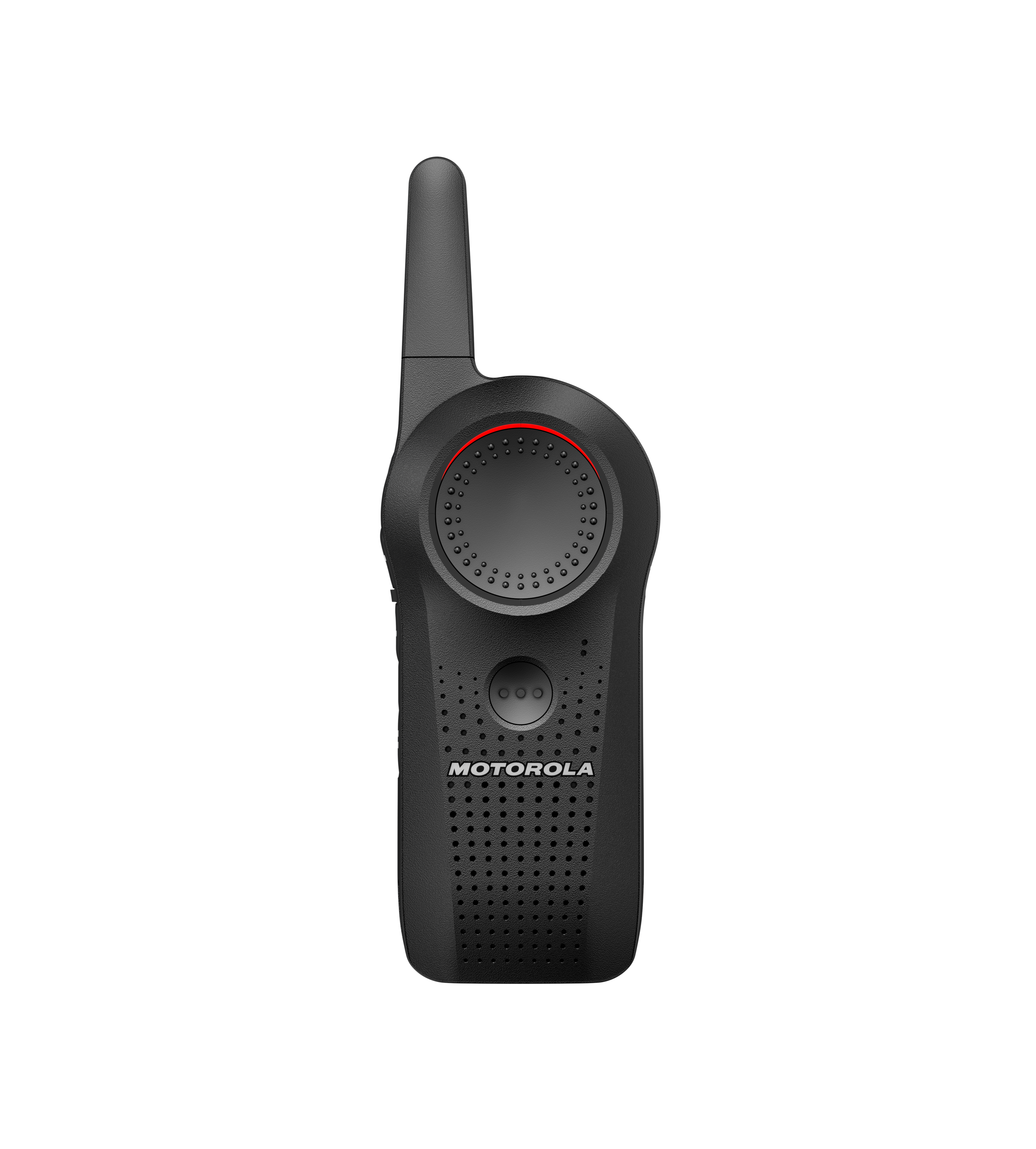
3. Motorola Curve — Best for Large or Multi-Building Campuses
| Specification | Detail |
|---|---|
| Frequency | Digital FHSS (902–928 MHz) |
| Power | 1 watt digital (≈ 4 watts analog coverage) |
| Channels | 10 |
| Indoor Coverage | 300,000 sq ft / up to 20 floors |
| Outdoor Coverage | Up to 3–5 miles |
| Battery Life | 14 hours |
| Privacy Codes | 10,000 |
| Durability | MIL-STD-810, antimicrobial coating, water-resistant |
| Weight | 5.11 oz |
The Motorola Curve operates on the 900 MHz Frequency Hopping Spread Spectrum (FHSS) digital band — a technology that hops across 75 discrete channels per second. This approach provides three distinct advantages for church use: it makes signal interception essentially impossible (relevant for security teams handling sensitive incidents) and its 900 MHz digital signal penetrates concrete and steel-reinforced structures more effectively than UHF analog at comparable wattage.
At 10 channels, it accommodates the full range of a large church's departments simultaneously. The Page All and Call All Available features allow a single transmission to reach every active radio on the network instantly — the appropriate response capability for a security emergency in a facility with hundreds of people present.
Why it fits churches specifically
- 10 channels handle all departments simultaneously with room for private one-to-one Direct Call functionality
- 10,000 privacy codes make cross-channel interference essentially impossible
- FHSS technology prevents unauthorized interception — important for security communications during sensitive incidents
- 300,000 sq ft coverage connects parking lots, satellite buildings, and remote classrooms to the central communication network
- 14-hour battery and 5.11 oz weight make it practical for all-day volunteer use
Best for: Large congregations, churches with multiple buildings or satellite campuses, and any church that wants to avoid FCC licensing administration entirely.
Also Worth Considering
Motorola CLP1080e — 1 watt, 8 channels, UHF, earpiece-only design. The correct choice for church security or ushering teams that require discreet communication with no visible radio during services. Includes earpiece and swivel belt holster.
Motorola SL300-U — 3 watts, 2 channels, dual analog/digital UHF. A slim, professional-grade radio suited to senior pastoral staff or security leads who need maximum signal strength in a low-profile form factor.
Coverage by Church Size
| Church Size / Type | Recommended Radio | Indoor Coverage | Channels |
|---|---|---|---|
| Small congregation, single building under 200,000 sq ft | Motorola CLS1410 | 200,000 sq ft / 15 floors | 4 |
| Mid-size church with classroom wings, 150,000–250,000 sq ft | Motorola RMU2040 | 250,000 sq ft / 20 floors | 4 |
| Large church or campus with outdoor areas | Motorola Curve | 300,000 sq ft / 20 floors | 10 |
| Multi-building or satellite campus | Motorola Curve + repeater or WAVE PTX | Unlimited with LTE/Wi-Fi | 10+ |
| Security / ushering — discreet earpiece use | Motorola CLP1080e | 100,000 sq ft / 10 floors | 8 |
For churches with thick stone or brick construction — common in older sanctuaries — plan for coverage one tier higher than square footage alone suggests. A 6,000 sq ft stone church may require the same radio specification as a 50,000 sq ft modern building with standard drywall interior walls.
Frequently Asked Questions
What is the best two-way radio for a church?
For most churches, the best radio depends on building size. The Motorola CLS1410 is the strongest choice for small congregations in buildings under 200,000 sq ft — four channels, 12-hour battery, and Vibracall silent alerts keep it practical for standard Sunday operations. The Motorola RMU2040 is the better fit for mid-size churches that need MIL-STD-810 durability and a 14-hour battery. The Motorola Curve is the top choice for large churches and multi-building campuses, adding 10 channels, digital coverage up to 300,000 sq ft, and no FCC licensing requirement.
What range do two-way radios need for church use?
Range requirements depend on building size and construction type. For a single-floor sanctuary under 50,000 sq ft with standard construction, 1 watt UHF provides coverage with significant margin. For multi-floor buildings or churches with thick masonry walls, 2 watts UHF or a 1-watt digital radio is appropriate. The Motorola Curve, at 1 watt digital, covers up to 300,000 sq ft indoors and up to 3–5 miles outdoors. For parking lots, satellite buildings, or outdoor amphitheaters that exceed a single radio's reach, a repeater or LTE/Wi-Fi push-to-talk platform extends coverage without limitation.
How long does the battery last on a church radio?
The Motorola RMU2040 and Motorola Curve both carry 14-hour battery ratings, covering even the longest full-day church event schedules without a charge. The Motorola CLS1410 runs approximately 12 hours. For churches with multi-service Sundays or all-day holiday events, multi-unit charging docks allow backup radios to charge while the primary fleet is deployed, enabling battery rotation without downtime.
What durability rating should a church radio have?
For general volunteer use, look for radios meeting MIL-STD-810 — the U.S. military's hardware durability standard covering drop resistance, vibration, temperature cycling, and humidity exposure. Both the Motorola RMU2040 and Motorola Curve meet this standard. For outdoor roles such as parking lot attendants and perimeter security, IP54 water resistance (dust-sealed and splash-resistant from any direction) is the minimum practical rating. The radios recommended on this page all meet or exceed this standard for their intended deployment contexts.
How many radios does a church need?
A practical starting point is one radio per active operational role per service. A typical small church deployment covers 2 parking lot attendants, 2 greeters, 2 ushers, 1 children's ministry coordinator, 1–2 security personnel, and 1 pastoral or production coordinator — approximately 9–10 radios. Larger churches with multiple service times or satellite campuses commonly operate 20–50+ radios. TechWholesale.com offers quantity pricing for fleet purchases; request a custom quote for a proposal specific to your team size and building.
Are two-way radios better than cell phones for church security?
Yes, for in-building coordination. Two-way radios provide push-to-talk communication with no connection delay — versus 10–15 seconds to unlock a phone, find a contact, and complete a call. They operate on a dedicated frequency band independent of cellular network availability, meaning they function reliably during large events when nearby cell towers may be congested. They also support group communication: one transmission reaches every team member on a channel simultaneously, which is essential for coordinated emergency response. Smartphones remain better suited for communications requiring video, documentation, or contact with people outside the building.
Can two-way radios be used discreetly during services?
Yes. Two approaches address discretion. First, Vibracall technology (available on the Motorola CLS1410) sends a silent vibrating notification to the radio rather than an audible alert — staff receive the message without the radio chirp that would disrupt a quiet service moment. Second, earpiece-only radios like the Motorola CLPe series have no external speaker at all; all communication flows through the included earpiece, making the radio completely inaudible to nearby congregation members. Both approaches are in active use at churches across the country.
Can one radio be used across multiple church departments?
Yes — that is the primary function of multi-channel radios. A single radio can monitor one channel and switch manually to another as needed. A children's ministry coordinator might operate on Channel 3 (Children's Ministry) during check-in and switch to Channel 4 (Security) if an incident requires coordination. Business-grade church radios support 4–10 channels, and privacy codes (CTCSS/DCS tones) ensure transmissions on each channel are only heard by radios set to the same code, even if multiple departments share a frequency.
What radio works best for church parking lot use?
Parking lot radios need to bridge the RF gap between outdoor and indoor environments — typically concrete walls, metal doors, or significant building mass. For most churches, the Motorola RMU2040 (2 miles outdoor range) or the Motorola Curve (3–5 miles outdoor range) handle this reliably. For churches where the parking lot is a long distance from the main building or separated by significant physical obstructions, a repeater system extends coverage without requiring an upgrade to the full radio fleet.
Why Buy Church Radios from TechWholesale.com
TechWholesale.com has been supplying two-way radios to churches, nonprofits, schools, and businesses since 1997. We are an authorized dealer for Motorola and Kenwood, meaning every radio we sell carries the full manufacturer warranty and qualifies for manufacturer service and repair. There is no gray market inventory, no voided coverage, and no risk of receiving a unit that isn't eligible for the warranty you paid for.
What sets us apart for churches
- Lifetime technical support included with every purchase — call, chat, or email our team for the life of your radio fleet, not just through the warranty period; if a radio has an issue two years after delivery, we help you resolve it
- Free quotes for larger teams; request a custom quote and we'll build a proposal specific to your team size, building, and budget
- Expert matching at no charge — our specialists have helped thousands of church teams identify the right radio; we ask about building size, construction type, team structure, service schedule, and budget before recommending anything
- Frequency coordination guidance — for churches co-located with schools, daycares, or other organizations, we can advise on frequency planning to prevent interference
- Free shipping on qualifying orders
If you're not sure which radio fits your building, use our Find My Radio tool or request a quote. We'll come back with a specific recommendation — no sales pressure, no obligation.
1-888-925-5982 | Service@TechWholesale.com
Related Reading
On TechWholesale.com
- Find My Radio – Interactive Radio Selector
- VOX Explained – Hands-Free Radio Operation
- UHF vs VHF – Frequencies Explained
- Privacy Codes – Eliminate Outside Interference
- Frequency Hopping Spread Spectrum (FHSS) Explained
- Lone Worker / Man Down Functionality
- Two-Way Radio FAQs
- Shop by Industry – All Verticals
External Resources
- NFPA 101: Life Safety Code – Assembly occupancy requirements relevant to emergency communication in houses of worship
- OSHA 29 CFR 1910.95 – Occupational noise exposure standard; relevant for outdoor event operations and amplified worship environments
Article by Kristin Wood, a two-way radio consultant @ Tech Wholesale | Authorized Motorola & Kenwood Dealer Since 1997 | Last Updated: May 2026