
Two-Way Radios for Crane Operation - Buyer's Guide (2026)
What is the best two-way radio for crane operating teams?
The Short Answer
The best two-way radios for crane operation are UHF business-band radios rated to MIL-STD-810 that support hands-free (VOX) operation, deliver at minimum 2 watts of output power, and can be programmed with dedicated channels for crane operators, riggers, signalpersons, and site supervisors. For most construction crane environments, the Motorola RMU2040, Motorola RMU2080d, and Motorola CP100d-UA are the top-recommended models.
Each is built to survive the physical demands of a job site, and purpose-built for the kind of clear, instant communication that crane operations require.
Buy the wrong radio for your crane team, and you'll know about it fast. Static that cuts out mid-lift. A battery that dies before the shift ends. A build that can't survive a single drop onto concrete.
The wrong radio isn't just frustrating—on a crane site, it's a safety risk. That's why choosing the right two-way radio matters.
We've sold thousands of radios to crane operators, riggers, and site supervisors across the country. We know what works in the field and what doesn't.
This guide pulls from all of that experience to help you make a smart, informed decision—not just buy the cheapest option on the shelf. By the end, you'll know exactly what features to look for, which models are worth your money, and how to match the right radio to your specific site.
Why Crane Operations Have Unique Radio Requirements
Crane operation is one of the most communication-dependent activities on a construction site. A signalperson and crane operator must maintain constant, clear contact — and a single miscommunication during a critical lift can result in catastrophic injury or death. Most radio communication failures on crane sites are caused by the wrong radio, not by user error.
The Core Pain Points
Noise. Tower cranes and mobile cranes operate in environments where diesel engines, concrete saws, and ironwork create sustained ambient noise above 85 dB. A radio with a weak speaker — anything below 1,000 mW output — will simply not be heard.
Distance and line-of-sight gaps. On multi-story construction projects, the crane cab may be 200 feet or more above ground level. VHF radios frequently struggle with vertical distance, particularly in steel-framed structures. UHF frequencies penetrate building materials and travel more reliably across complex vertical terrain.
Hands-free requirements. OSHA 29 CFR §1926.1420 — the federal regulation governing radio signals in crane and derrick construction operations — explicitly states that when radio communication is used as the signaling method, the crane operator's reception of signals must be by a hands-free system. Any radio selected for crane use must support VOX (voice-activated) operation or be compatible with a hands-free accessory.
Multi-team channel management. A crane site typically requires at least three distinct communication channels: crane operator ↔ signalperson, ground crew ↔ foreman, and site supervisor ↔ all teams. Under OSHA 29 CFR §1926.1420, multiple cranes and signal persons may share a dedicated channel to coordinate operations — which means your radio must support enough programmable channels to keep those lines of communication clean and separate.
Durability. Radios on active construction sites face drops from elevated platforms, exposure to concrete dust and intermittent rain, and daily rough handling. A radio without at least IP54 and MIL-STD-810 ratings will not survive a full construction season.
Battery life. A ten-hour shift requires a radio that can sustain communication from first lift to last pour. Running out of battery mid-operation is not a minor inconvenience — in a crane environment, it is a safety event.
Compliance Standards That Apply to Crane Radio Communication
OSHA 29 CFR 1926 Subpart CC — Cranes and Derricks in Construction
OSHA's crane and derrick standard includes specific sections that govern radio use on crane sites:
- §1926.1419 — Signals: general requirements. All signals must be discernible or audible at all times. No movement may be made unless signals are clearly received.
- §1926.1420 — Signals via radio, telephone, or other electronic transmission. When radio is the selected signaling method, the crane operator must receive those signals hands-free. Multiple cranes and signal persons may share a dedicated channel for coordination.
- §1926.1421 — Voice signals: additional requirements. Voice signals must follow agreed-upon terminology established before operations begin.
- §1926.1428 — Signal person qualifications. Each signal person must be qualified and that qualification must be verified before they provide any signals.
Recommended Radios for Crane Operation
1. Motorola RMU2040 — Best for Signalpersons and Ground Crew
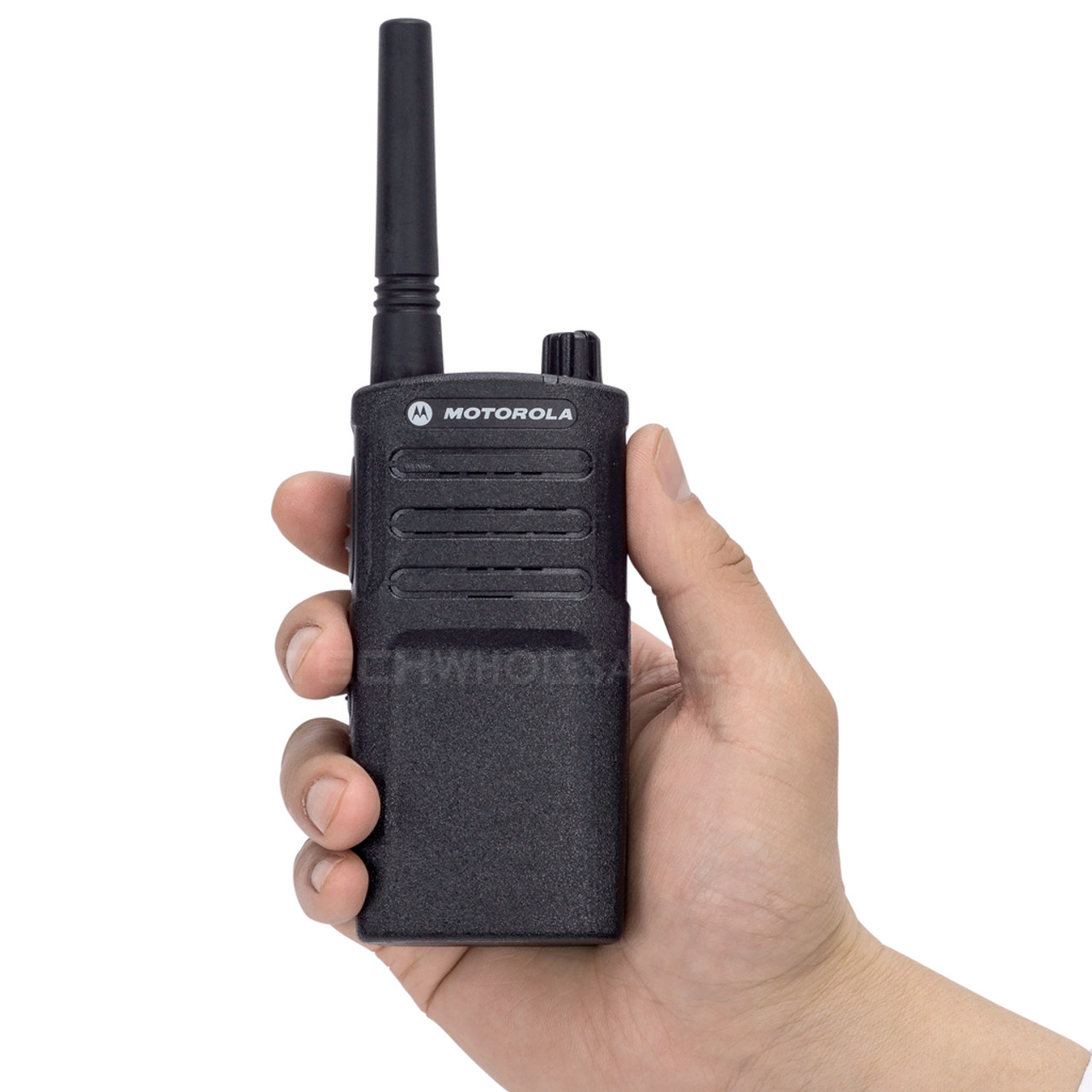
The RMU2040 is the workhorse of the Motorola RM Series and an ideal radio for signalpersons, riggers, and ground-level crew who need a radio that is simple to operate, impossible to accidentally reprogram, and loud enough to hear over site noise.
Key Specs
- Power output: 2 watts UHF
- Channels: 4
- Frequencies: 99 UHF business-exclusive frequencies with 219 PL/DPL codes, including 6 customizable codes
- Dimensions: 4.5" H × 2.2" W × 1.6" D | Weight: 8.6 oz
- Battery: 2,100 mAh Li-ion; coverage up to 250,000 sq. ft. or 20 floors
- Durability: IP54/55 and MIL-STD-810 C, D, E, F, and G — tested against shock, rain, humidity, salt fog, vibration, sand, dust, and temperature extremes
- Speaker output: 1,500 mW
- VOX (hands-free): Yes, with compatible accessory
- No display, no keypad — designed for single-task, heavy-use environments
Why It Works for Crane Operations
The RMU2040's no-display, no-keypad design is a deliberate advantage on an active site. There is no display or keypad, making it an exceptional choice for industrial work environments where the focus must remain on the task, not the radio. The 1,500 mW speaker ensures calls cut through heavy ambient noise.
The VOX capability — when paired with a compatible earpiece — satisfies the OSHA §1926.1420 hands-free requirement for crane operator signal reception. Channel Announcement with Voice Alias lets the user leave the radio on their belt and know exactly what channel they are communicating on — critical when a signalperson is focused on managing a load in the air.
2. Motorola RMU2080d — Best for Supervisors and Multi-Team Sites
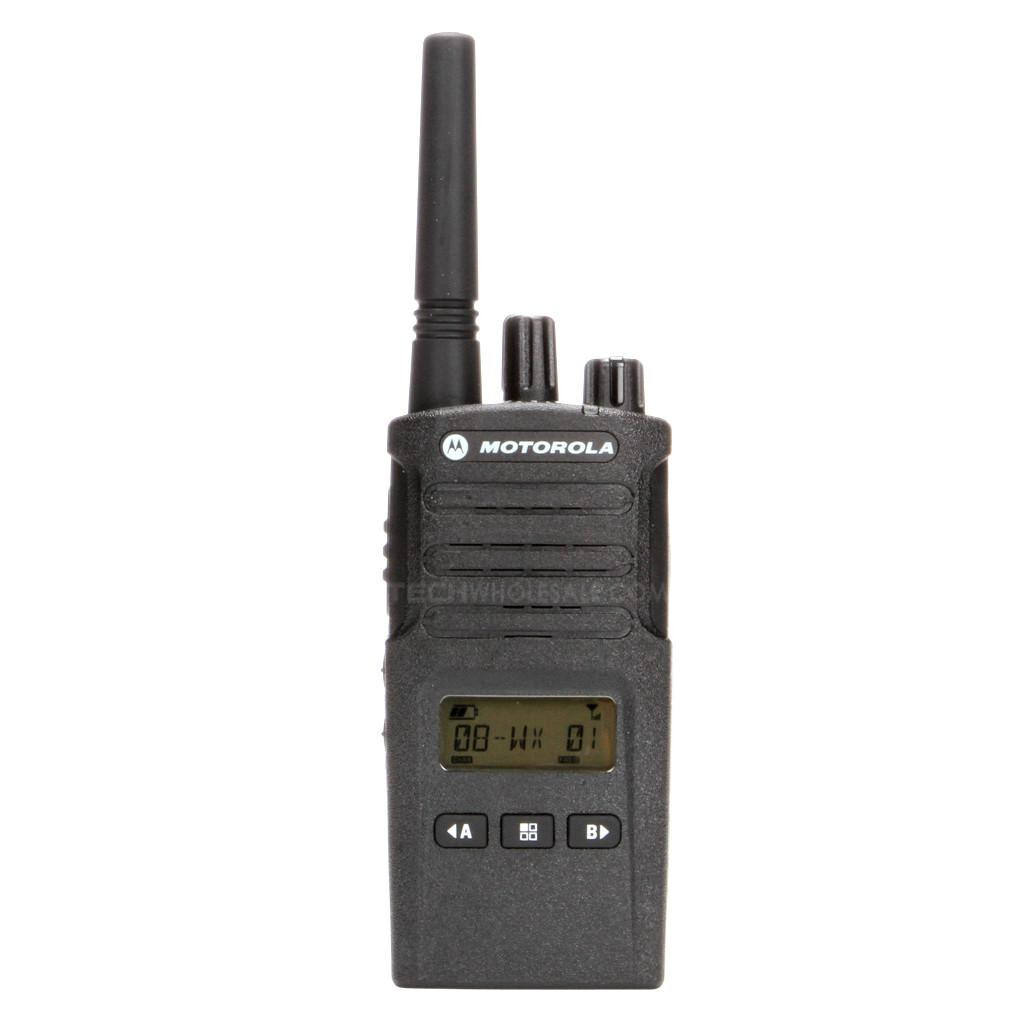
The RMU2080d is the display-equipped step-up in the RM Series, adding 8 channels, a front-panel LCD screen, and NOAA weather alerts. It is the right choice for site supervisors, crane operators managing multi-team lifts, and anyone who needs visual confirmation of channel status without taking their eyes off the work zone.
Key Specs
- Power output: 2 watts UHF
- Channels: 8 (7 UHF + 1 NOAA weather alert channel)
- Frequencies: 99 selectable UHF frequencies with 219 PL/DPL codes, including 6 customizable codes; operates in 12.5 kHz Narrowband
- Battery: 2,100 mAh Li-ion | Range: up to 250,000 sq. ft. or 20 floors
- Durability: IP54/55 and MIL-STD-810 C, D, E, F, and G — shock, rain, humidity, salt fog, vibration, sand, dust, and temperature
- Speaker output: 1,500 mW
- Front-panel display: shows operating channel and radio status at a glance; four programmable buttons enable quick access to features
- VOX (hands-free): Yes, with compatible accessory
- NOAA Weather Radio: Channel 8 is pre-assigned to receive official National Weather Service warnings 24 hours a day, 7 days a week
Why It Works for Crane Operations
With 8 programmable channels, the RMU2080d gives site supervisors the ability to assign dedicated channels for the crane-to-signalperson link, a ground crew channel, a supervisor broadcast channel, and a maintenance channel — all within OSHA's requirement for dedicated crane coordination frequencies. The NOAA weather alert function is particularly valuable for tower crane and mobile crane operations where severe weather can create immediate safety hazards; operators receive automatic warnings without waiting for a dispatcher. The display is recessed into the rugged polycarbonate housing to protect it from drops and scratches, ensuring it withstands the same MIL-STD-810 conditions as the rest of the radio.
3. Motorola CP100d-UA — Best for Operators and Supervisors Requiring Maximum Range and Power
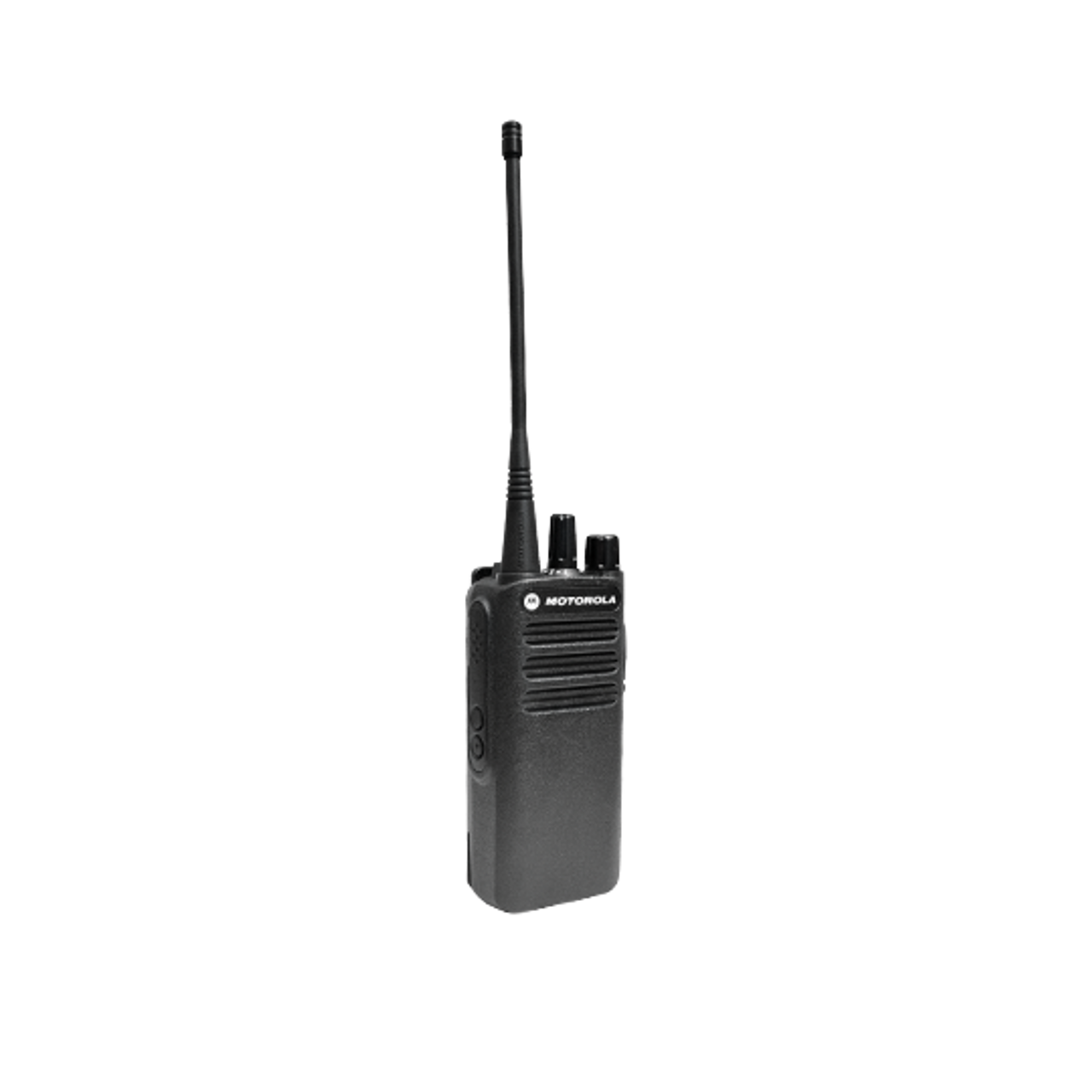
The CP100d-UA is a MOTOTRBO-class commercial radio designed for operations where maximum transmit power, audio clarity, and long battery life are required. It is the strongest radio in this lineup and the right tool for large job sites, wide-area crane operations, or multi-crane environments where the RM Series' 2-watt output may not be sufficient.
Key Specs
- Power output: Up to 4 watts (UHF); frequency range: 403–480 MHz
- Channels: 16 (no-display/no-keypad model) or 160 (display/keypad model)
- Operation modes: Analog (upgrade to digital MOTOTRBO DMR)
- Battery life: 10 hours standard; up to 14 hours with high-capacity battery
- Durability: IP54 rated; meets MIL-STD-810 C, D, E, F, and G for shock, vibration, water, dust, and temperature extremes
- Rapid charger: charges in under 90 minutes
- VOX (hands-free): Supported
Why It Works for Crane Operations
At 4 watts, the CP100d-UA delivers twice the transmit power of the RM Series, which translates to stronger signal penetration across large open sites, across steel structures, and between the ground and a crane cab at height. The digital mode provides up to 35% longer talk-time, twice the voice capacity in a 12.5 kHz channel, and superior audio clarity. For crane operators who need a radio that will last a double shift without reaching for a charger, the CP100d-UA's long hour battery life is a decisive advantage.
Model Comparison at a Glance
| Feature | RMU2040 | RMU2080d | CP100d-UA |
|---|---|---|---|
| Power | 2W UHF | 2W UHF | 4W UHF |
| Channels | 4 | 8 | 16 or 160 |
| Display | No | Yes | Optional |
| NOAA Alerts | No | Yes | No |
| Battery Life | ~15 hrs | ~15 hrs | 14–20 hrs |
| Durability | MIL-810 / IP54/55 | MIL-810 / IP54/55 | MIL-810 / IP54 |
| Digital Mode | No | No | Yes |
| Best For | Signalpersons, riggers | Supervisors, operators | Large sites, heavy use |
Frequently Asked Questions
What range do two-way radios need for crane operation?
Range requirements depend on the type of crane and site layout. For most construction crane operations — tower cranes on mid-rise projects, mobile cranes on active job sites — a 2-watt UHF radio with coverage rated to 250,000 square feet or 20 floors is sufficient for the signalperson-to-operator communication chain. On larger industrial sites, ports, or wide-area operations involving multiple cranes spread across significant horizontal distance, a 4-watt radio like the CP100d-UA provides greater margin. Keep in mind that published range figures assume open conditions; steel-frame construction, concrete, and equipment interference will reduce effective range from rated maximums.
What battery life is required for crane radio use?
A standard construction shift runs 8–10 hours. Crane radio communication must remain active for the full duration — a dead radio on a crane site is a safety violation waiting to happen. The RM Series radios (RMU2040, RMU2080d) deliver approximately 15 hours per charge on a 2,100 mAh lithium-ion battery. The CP100d-UA extends to 14 hours with the high-capacity battery option, making it well-suited for double shifts or 12-hour operations without a mid-shift charge. For any deployment, it is best practice to start every shift with a fully charged radio.
Does OSHA require hands-free operation for crane radio communication?
Yes. OSHA 29 CFR §1926.1420 requires that when radio signals are used for crane operation, the crane operator must receive those signals by a hands-free system. All three radios in this guide support VOX (voice-activated transmission) when paired with a compatible earpiece or remote speaker microphone, satisfying this requirement. For signalpersons, hands-free operation is equally important — the signalperson must maintain visual contact with the load and the crane at all times, which is incompatible with holding a radio to their ear.
What durability ratings should a crane radio have?
At minimum, look for IP54 or IP55 (protection against dust ingress and water spray from any direction) and MIL-STD-810 ratings covering shock, vibration, temperature extremes, humidity, and sand/dust. All three radios in this guide meet both standards. Motorola's Accelerated Life Testing (ALT) simulates up to 5 years of field use, including 30 minutes of blowing rain, 9 hours of vibration exposure, 48 hours of salt fog, 6 hours of blowing dust, and extreme temperature testing ranging from –67°F to 160°F. These are not consumer-grade radios — they are tested to survive the same conditions that crane job sites routinely produce.
Can multiple cranes share radio channels?
Yes, and OSHA specifically addresses this scenario. Under §1926.1420, multiple cranes and one or more signal persons may share a dedicated channel for coordinating operations. What matters is that each crane-to-signalperson pair has a defined, agreed-upon channel, that terminology is established before operations begin per §1926.1421, and that the operator receives all signals hands-free. The RMU2080d (8 channels) and CP100d-UA (16 or 160 channels) are the appropriate choices for multi-crane sites that require segregated communication lanes.
Are these radios compatible with each other on the same job site?
Yes. The Motorola RM Series is compatible with Motorola RDX, XTN, CLS, and Spirit professional two-way radios when programmed to the same UHF frequency and privacy codes. The CP100d-UA can be programmed to operate alongside existing analog radio fleets as well as digital MOTOTRBO devices. For a job site deploying a mixed fleet, all radios should be programmed by your dealer before deployment to ensure channel alignment and privacy code consistency.
Why Buy from TechWholesale.com
TechWholesale.com has been an authorized Motorola dealer since 1997. That means every radio we sell comes with full manufacturer warranty support, genuine OEM accessories, and the assurance that you are not receiving gray-market or refurbished inventory.
We understand that crane operations are not a context for guesswork. When you call us, you reach people who can walk you through channel structure for multi-crane sites, and ensure your fleet arrives programmed and ready to deploy — not in a box waiting for a programmer.
We carry the full RM Series accessory lineup — hands-free earpieces, remote speaker microphones, multi-unit chargers, and extended-capacity batteries — so you can build a complete, OSHA-compliant communication system in a single order.
Article by Kristin Wood, a two-way radio consultant @ Tech Wholesale | Authorized Motorola & Kenwood Dealer Since 1997 | Last Updated: May 2026