

Many crews rely on hand signals, until a blind lift, a long distance, or a tall building puts the signal person out of the operator’s sight. Consumer walkie-talkies are a risk here too, with interference, dropped signals, and housings that don’t survive dust, weather, and drops from height.
Business-grade radios deliver clear, dependable communication on a dedicated channel, and their rugged build holds up lift after lift, protecting your investment for years.
Let’s take the guesswork out of it! Since 1997, we’ve kept hundreds of crane operations nationwide connected. Here’s how to pick the right radio for your crew.
Which Walkie Talkie Fits Your Crane Operation Crew?
The Quick Answer
- Signalpersons and ground crew → Motorola RMU2040. This is the pick for most sites. Two watts, a loud speaker that carries over an idling engine, MIL-STD-810 build, and four channels.
- Supervisors and multi-team lifts → Motorola RMU2080d. The same platform with eight channels, a display that confirms which channel you're on before you key up, and NOAA weather alerts.
- Large sites or multiple cranes → Motorola CP100d-UA. Four watts is the most reach here, for a signalperson working the far side of a structure or a lift where the operator's cab is a long way from the load.
Quick Links
Why Crane Operations Have Unique Radio Requirements
Crane operation is one of the most communication-dependent activities on any job site. The signalperson and the operator must hold constant, unmistakable contact throughout a lift, and the radio is the link that makes that possible. Consumer walkie-talkies and cell phones fail in this environment for the same reasons every time: they cannot cut through site noise, their batteries quit mid-shift, and they cannot survive the physical handling a construction site delivers.
But the wrong radio on a crane site is not just an annoyance — it is a safety risk.
That is why model selection matters here.
The Core Pain Points
Site noise. Tower and mobile cranes work alongside diesel engines, concrete saws, and ironwork that push sustained ambient noise above 85 dB. A radio with a weak speaker — anything under roughly 1,000 mW — simply will not be heard. The radios on this page output 1,500 mW to stay intelligible over that din.
Vertical distance and line-of-sight gaps. On multi-story projects the crane cab may sit 200 feet or more above grade. UHF frequencies penetrate building materials and travel more reliably across complex vertical terrain than the alternatives, which is why crane work is a UHF job. For more on this, see our guide to UHF vs. VHF frequencies.
Hands-free operation. OSHA 29 CFR §1926.1420 requires that, when radio is the signaling method, the operator’s reception of signals be by a hands-free system. Any radio chosen for crane use must support VOX or pair with a hands-free accessory. The signalperson has the same need from the other direction — their eyes and hands stay on the load, not on a radio.
Multi-team channel management. A crane site usually needs at least three distinct channels: operator-to-signalperson, ground crew-to-foreman, and supervisor-to-all. Where multiple cranes work the same site, each operator-signalperson pair needs a clean, dedicated channel. The radio has to carry enough programmable channels to keep those lanes separate.
Durability. Radios on active sites face drops from height, concrete dust, intermittent rain, and daily rough handling. A radio without at least IP54 and MIL-STD-810 ratings will not survive a full construction season.
Battery endurance. A ten-hour shift demands a radio that holds a charge from first lift to last pour. A dead radio in a crane environment is not a minor inconvenience — it is a safety event.
What to Look For in a Crane Radio
Audio Output for High-Noise Sites
Prioritize a loud, clear speaker. Look for a minimum of 1,000 mW of audio output; the RM Series and CP100d models on this page deliver 1,500 mW. Pair the radio with a noise-canceling remote speaker microphone or earpiece so the operator and signalperson hear each transmission the first time.
Hands-Free (VOX) Capability
Because OSHA requires hands-free reception for the operator, VOX support is not optional for crane work — it is a baseline requirement. Confirm the radio supports VOX with a compatible earpiece or remote speaker microphone. Our explainer on how the VOX feature works covers the setup in detail.
Channel Capacity
A small single-crane site can run on a 4-channel radio. Sites with multiple cranes, a dedicated supervisor broadcast, and a maintenance line should step up to 8 or more programmable channels so each communication lane stays clean. Using privacy (PL/DPL) codes on shared frequencies further reduces cross-talk between crews.
Durability Rating
Hold to a hard minimum of IP54 or IP55 (dust ingress and water spray from any direction) plus MIL-STD-810 testing for shock, vibration, temperature extremes, humidity, and dust. Every radio recommended below meets both.
Battery Life
Match battery endurance to your shift. The RM Series radios run on a 2,100 mAh lithium-ion battery; the CP100d-UA reaches up to 14 hours with the high-capacity battery for double shifts. For continuous operations, a multi-unit charger lets crews hot-swap batteries without downtime.
OSHA Compliance Standards for Crane Radio Communication
The federal rules that govern crane communication live in 29 CFR 1926 Subpart CC — Cranes and Derricks in Construction. Four sections bear directly on radio selection and use:
- §1926.1419 — Signals, general requirements. All signals must be discernible or audible at all times, and no movement may proceed unless signals are clearly received.
- §1926.1420 — Signals via radio, telephone, or other electronic transmission. The signaling device must be tested on site before operations begin to confirm the transmission is effective, clear, and reliable. Signal transmission must use a dedicated channel, though multiple cranes and signalpersons may share a dedicated channel to coordinate operations. The operator’s reception of signals must be by a hands-free system.
- §1926.1421 — Voice signals, additional requirements. Operator, signalperson, and lift director must agree on signal terminology before operations begin.
- §1926.1428 — Signal person qualifications. Each signalperson must be qualified, and that qualification must be verified before they give any signals.
The practical takeaways for equipment: choose radios that support hands-free operation, carry enough channels to keep each crane-signalperson pair on a dedicated lane, and are reliable enough to pass the on-site signal test required every shift.
Recommended Two-Way Radios for Crane Operation
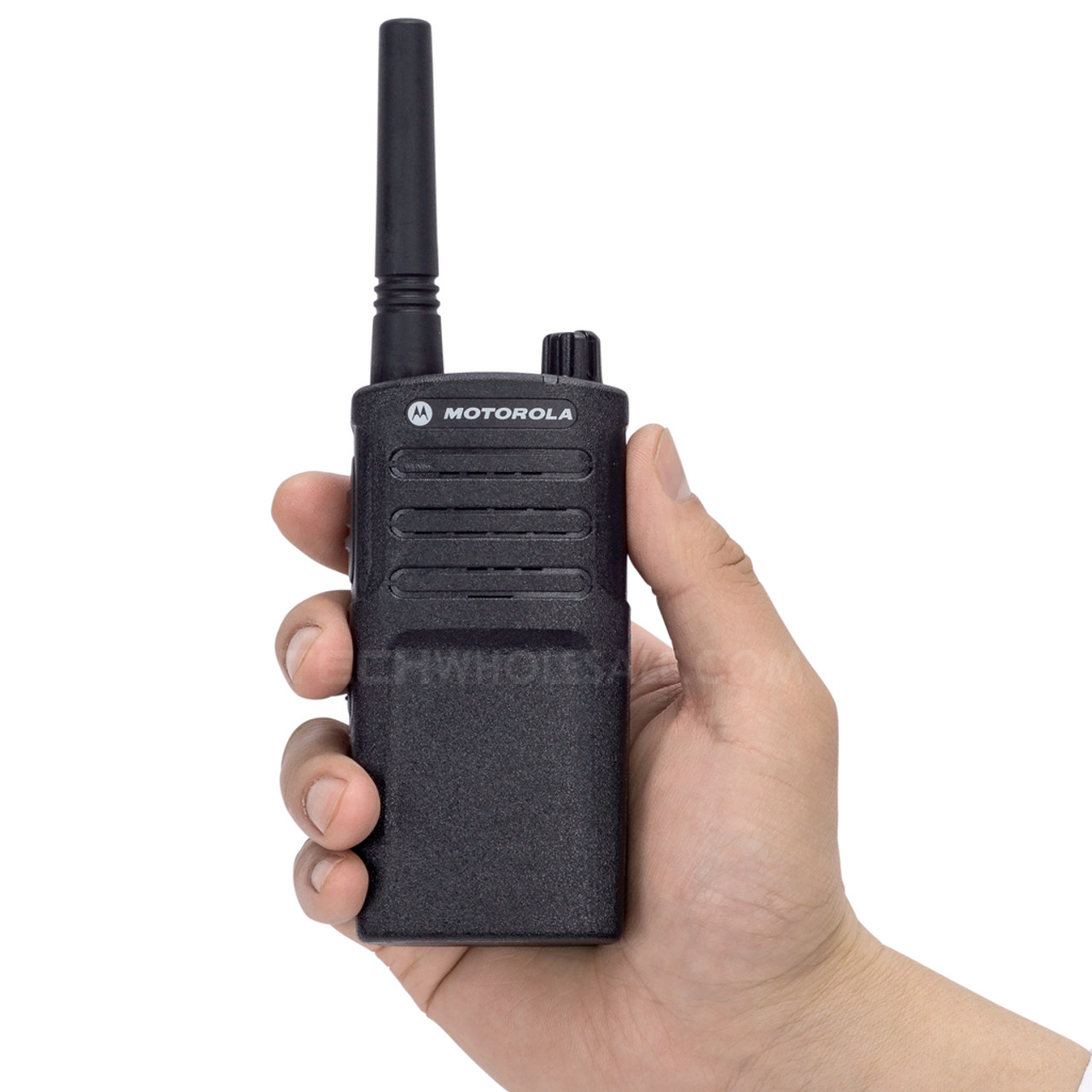
1. Motorola RMU2040 — Best for Signalpersons and Ground Crew
| Specification | Detail |
|---|---|
| Power Output | 2 watts UHF |
| Channels | 4 |
| Frequencies | 99 selectable UHF frequencies; 219 PL/DPL privacy codes (6 customizable) |
| Speaker Output | 1,500 mW |
| Indoor Coverage | Up to 250,000 sq ft / 20 floors |
| Battery | 2,100 mAh Li-ion |
| Durability | IP54/55; MIL-STD-810 C, D, E, F, and G |
| Dimensions / Weight | 4.5" H × 2.2" W × 1.6" D / 8.6 oz |
| Hands-Free (VOX) | Yes, with compatible accessory |
The RMU2040 is the workhorse of the Motorola RM Series and the right radio for signalpersons, riggers, and ground-level crew who need a unit that is simple to operate, hard to accidentally reprogram, and loud enough to hear over site noise.
Why it fits crane operations specifically
- The no-display, no-keypad design keeps the focus on the lift, not the radio — and there is nothing for a gloved hand to bump out of program.
- The 1,500 mW speaker cuts through diesel engines and ironwork noise.
- VOX capability, paired with a compatible earpiece, satisfies the OSHA §1926.1420 hands-free requirement for the operator and frees the signalperson’s hands for the load.
- Channel Announcement with Voice Alias lets a worker confirm the active channel by ear without looking down — useful when managing a load in the air.
- IP54/55 and MIL-STD-810 ratings handle drops, dust, and rain on an active site.
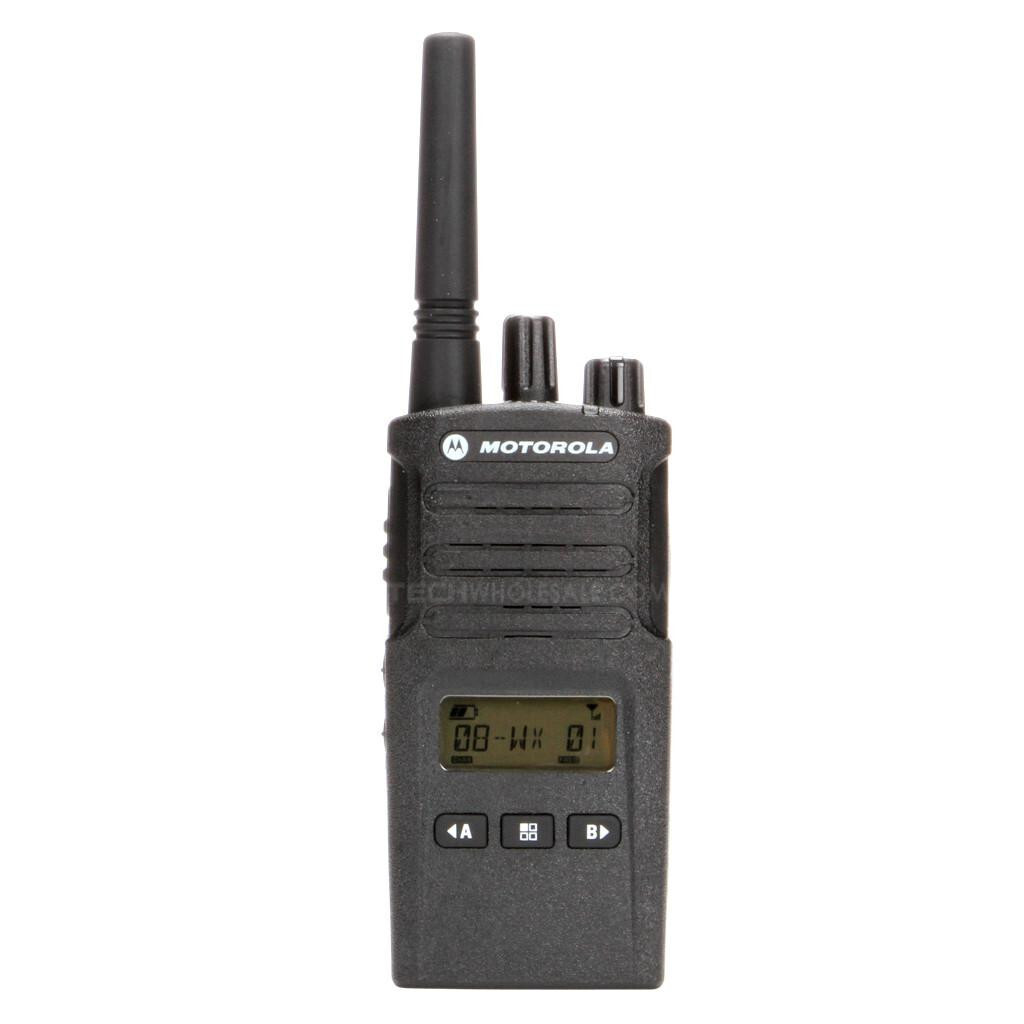
2. Motorola RMU2080d — Best for Supervisors and Multi-Team Sites
| Specification | Detail |
|---|---|
| Power Output | 2 watts UHF |
| Channels | 8 (7 UHF + 1 NOAA weather channel) |
| Frequencies | 99 selectable UHF frequencies; 219 PL/DPL privacy codes (6 customizable); 12.5 kHz narrowband |
| Speaker Output | 1,500 mW |
| Indoor Coverage | Up to 250,000 sq ft / 20 floors |
| Display | Front-panel LCD with four programmable buttons |
| Battery | 2,100 mAh Li-ion |
| Durability | IP54/55; MIL-STD-810 C, D, E, F, and G |
| NOAA Weather Alerts | Yes (Channel 8, 24/7 NWS warnings) |
| Hands-Free (VOX) | Yes, with compatible accessory |
The RMU2080d is the display-equipped step up in the RM Series, adding eight channels, a front-panel LCD, and NOAA weather alerts. It is the right choice for site supervisors, operators managing multi-team lifts, and anyone who needs visual confirmation of channel status without taking their eyes off the work zone for long.
Why it fits crane operations specifically
- Eight channels let a supervisor assign dedicated lanes — operator-to-signalperson, ground crew, supervisor broadcast, and maintenance — in line with OSHA’s dedicated-channel requirement for crane coordination.
- NOAA weather alerts deliver automatic National Weather Service warnings, valuable for tower and mobile crane work where wind and storms create immediate hazards.
- The display is recessed into the polycarbonate housing to survive the same drops and scratches as the rest of the radio.
- Same 1,500 mW audio, IP54/55, and MIL-STD-810 durability as the RMU2040.
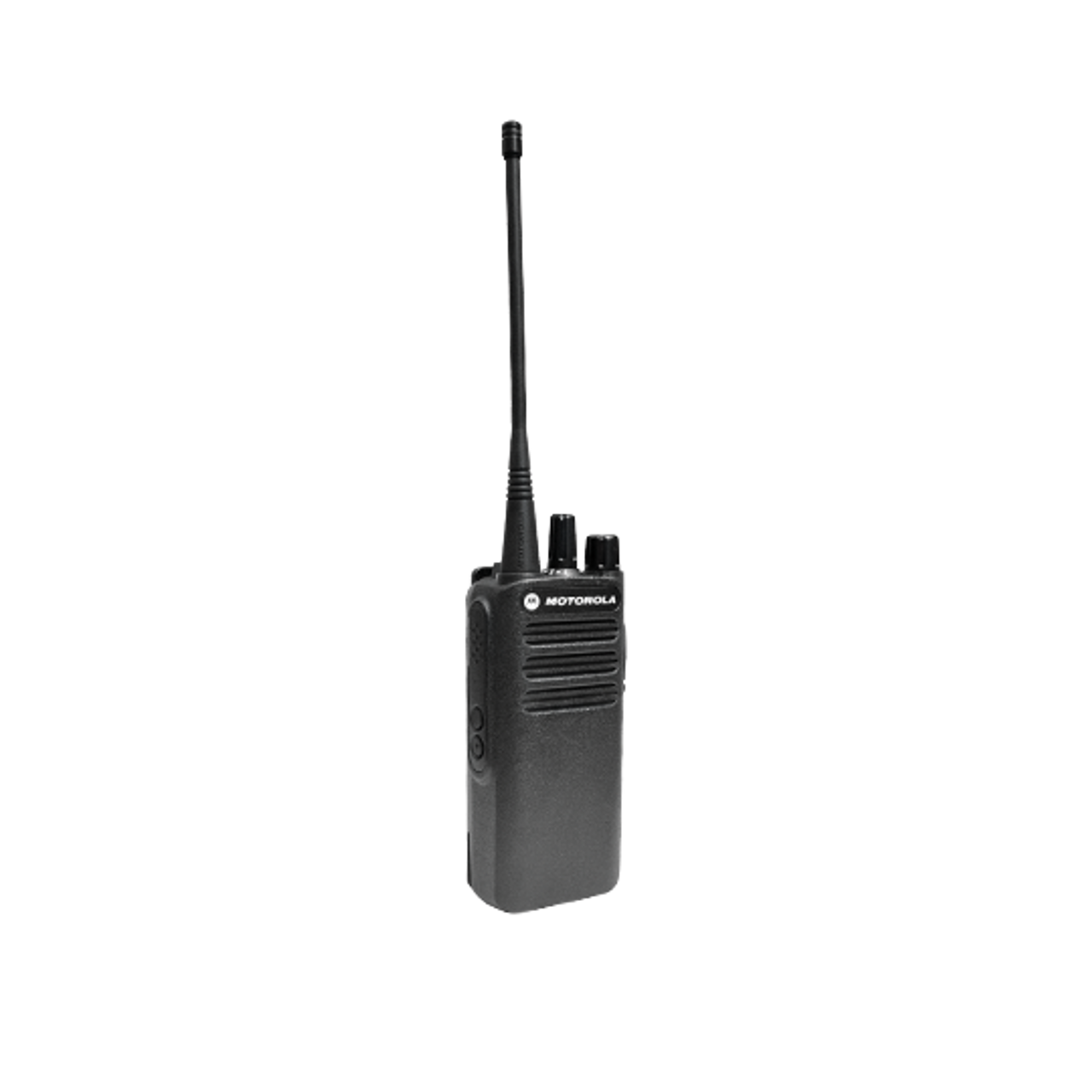
3. Motorola CP100d-UA — Best for Large Sites and Maximum Range
| Specification | Detail |
|---|---|
| Power Output | Up to 4 watts UHF |
| Frequency Range | 403–480 MHz |
| Channels | 16 (no-display model) or 160 (display/keypad model) |
| Operation Modes | Analog, upgradable to digital MOTOTRBO DMR |
| Battery Life | 10 hours standard; up to 14 hours with high-capacity battery |
| Charging | Rapid charger, under 90 minutes |
| Durability | IP54; MIL-STD-810 C, D, E, F, and G |
| Hands-Free (VOX) | Supported |
The CP100d-UA is a MOTOTRBO-class commercial radio built for operations where maximum transmit power, audio clarity, and long battery life matter most. It is the strongest radio in this lineup and the right tool for large job sites, wide-area crane work, or multi-crane environments where the RM Series’ 2-watt output may not reach.
Why it fits crane operations specifically
- At up to 4 watts, it delivers twice the transmit power of the RM Series — stronger penetration across large open sites, through steel structures, and between grade and a crane cab at height.
- Digital mode adds up to 35% longer talk time, twice the voice capacity in a 12.5 kHz channel, and cleaner audio in busy radio environments.
- Up to 14 hours of battery with the high-capacity option carries a double shift without a mid-shift charge.
- IP54 and MIL-STD-810 ratings keep it working through the same site abuse as the rest of the fleet.
Model Comparison at a Glance
| Feature | RMU2040 | RMU2080d | CP100d-UA |
|---|---|---|---|
| Power | 2W UHF | 2W UHF | Up to 4W UHF |
| Channels | 4 | 8 | 16 (or 160) |
| Display | No | Yes | Optional |
| NOAA Alerts | No | Yes | No |
| Speaker Output | 1,500 mW | 1,500 mW | High-output |
| Battery Life | 2,100 mAh Li-ion | 2,100 mAh Li-ion | 10–14 hrs |
| Durability | IP54/55 / MIL-STD-810 | IP54/55 / MIL-STD-810 | IP54 / MIL-STD-810 |
| Digital Mode | No | No | Yes (upgrade) |
| Hands-Free (VOX) | Yes | Yes | Yes |
| Best For | Signalpersons, riggers, ground crew | Supervisors, multi-team lifts | Large sites, heavy use |
Not sure which tier fits your site? Request a quote and we will match the model and channel plan to your crane setup, or use our Find My Radio tool.
Frequently Asked Questions
What range do two-way radios need for crane operation?
Range depends on crane type and site layout. For most construction crane work — tower cranes on mid-rise projects, mobile cranes on active sites — a 2-watt UHF radio rated to 250,000 square feet or 20 floors covers the signalperson-to-operator chain with margin. On larger industrial sites, ports, or wide-area operations with multiple cranes spread across significant distance, a 4-watt radio like the CP100d-UA provides greater reach. Keep in mind that published range figures assume open conditions; steel framing, concrete, and equipment interference will reduce effective range from the rated maximum.
What battery life is required for crane radio use?
A standard construction shift runs 8 to 10 hours, and radio communication must stay active for the full duration — a dead radio on a crane site is a safety event. The RM Series radios (RMU2040 and RMU2080d) run on a 2,100 mAh lithium-ion battery sized for a full shift, and the CP100d-UA extends to 14 hours with its high-capacity battery for double or 12-hour shifts. Whatever you deploy, start every shift fully charged, and add a multi-unit charger so crews can hot-swap batteries during long operations.
Does OSHA require hands-free operation for crane radio communication?
Yes. OSHA 29 CFR §1926.1420 requires that when radio signals are used for crane operation, the operator must receive those signals through a hands-free system. All three radios in this guide support VOX when paired with a compatible earpiece or remote speaker microphone, which satisfies that requirement. Hands-free operation matters for the signalperson too — they must keep visual contact with the load and crane at all times, which is incompatible with holding a radio to their ear.
What durability ratings should a crane radio have?
At minimum, look for IP54 or IP55 (protection against dust ingress and water spray from any direction) plus MIL-STD-810 ratings covering shock, vibration, temperature extremes, humidity, and dust. All three radios here meet both. Motorola’s Accelerated Life Testing simulates up to five years of field use — including blowing rain, extended vibration, salt fog, blowing dust, and extreme temperature exposure — so these units are built to survive the conditions a crane site routinely produces. None are consumer-grade radios.
Can multiple cranes share radio channels?
Yes, and OSHA addresses this directly. Under §1926.1420, multiple cranes and one or more signalpersons may share a dedicated channel to coordinate operations. What matters is that each crane-to-signalperson pair has a defined, agreed-upon channel, that signal terminology is established before operations begin per §1926.1421, and that the operator receives all signals hands-free. The RMU2080d (8 channels) and CP100d-UA (16 or 160 channels) are the right choices for multi-crane sites that need segregated communication lanes.
Do crane radios need to be tested before each shift?
Yes. OSHA §1926.1420(a) requires that the device used to transmit signals be tested on site before operations begin, to confirm the transmission is effective, clear, and reliable. In practice that means a quick radio check between the operator and signalperson at the start of every shift, on the dedicated channel you will use for the lift. Reliable, professional-grade radios with strong audio output make passing that check routine rather than a daily troubleshooting exercise.
Are these radios compatible with each other on the same job site?
Yes. The Motorola RM Series is compatible with Motorola RDX, XTN, CLS, and Spirit professional radios when programmed to the same UHF frequency and privacy codes. The CP100d-UA can operate alongside existing analog fleets as well as digital MOTOTRBO devices. For a mixed fleet, have all radios programmed by your dealer before deployment so channels and privacy codes align across every unit.
Why Buy from TechWholesale.com
Tech Wholesale has been an authorized Motorola and Kenwood dealer since 1997. Every radio we sell carries full manufacturer warranty support and genuine OEM accessories — no gray-market or refurbished inventory, and no voided warranties.
What sets us apart
- We program before we ship. Crane operations are not a context for guesswork. We can walk you through the channel structure for a multi-crane site and ship your fleet programmed and ready to deploy — not in a box waiting for a programmer.
- Complete, OSHA-ready systems in one order. We carry the full RM Series and CP100d accessory lineup — hands-free earpieces, remote speaker microphones, multi-unit chargers, and extended-capacity batteries — so you can build a complete hands-free communication setup at once.
- Lifetime technical support. Call or email our team for the life of your radio fleet, not just through the warranty period.
- Volume pricing for bulk orders. Request a custom quote for fleet pricing.
- No-pressure consultation. If a less expensive radio is the right answer for your site, we will tell you.
Not sure which radio fits your crane operation? Use our Find My Radio tool or request a quote. We will ask a few questions about your site and come back with a specific recommendation and channel plan — no obligation.
1-888-925-5982 | Service@TechWholesale.com
Related Reading
- Medium-Duty Business Two-Way Radios
- VOX Explained — Hands-Free Radio Operation
- UHF vs. VHF — Frequencies Explained
- Privacy Codes — Eliminate Outside Interference
- Man Down Functionality for Lone Workers
- OSHA 29 CFR 1926 Subpart CC — Cranes and Derricks in Construction
- OSHA §1926.1420 — Signals via Radio or Electronic Transmission
Article by Kristin Wood, a two-way radio consultant @ Tech Wholesale | Authorized Motorola & Kenwood Dealer Since 1997 | Last Updated: June 2026