
Servers shouldn't have to sprint across the dining room just to ask a question.
Every second your staff isn't connected is a second your guests are waiting—and in a busy restaurant, those seconds add up fast.
But not all radios are created equal. Buy the wrong one and you're dealing with static, dead zones, and a device that falls apart after six months.
We've sold thousands of radios to restaurants of all sizes and shapes. From cozy neighborhood bistros to high-volume multi-floor venues, we know what works.
This guide breaks down everything you need to make a smart, informed purchase—no guesswork required.
The Best Two-Way Radios for Restaurants (2026 Buyer's Guide)
The best two-way radios for restaurants are compact, UHF-frequency business radios with multi-channel capability, 8–12 hours of battery life, and clear audio that cuts through kitchen noise and ambient dining room sound. For most restaurant operations, the Motorola CLP1080e (small venues), Motorola CLS1410 (mid-size operations), and Motorola Curve (large or multi-floor venues) represent the strongest all-around choices. Each eliminates the delays and miscommunication that cost restaurants table turns, tips, and guest satisfaction — without the recurring cost of smartphones or headset systems.
Why Restaurants Need Two-Way Radios
In a high-volume restaurant, communication breakdowns are not inconveniences — they are operational failures. A server who can't reach the kitchen about a dietary restriction, a host who can't alert the floor about a large walk-in, a manager who can't respond to a spill in real time — each of these moments chips away at the guest experience and your staff's ability to function as a team.
Two-way radios solve a problem that smartphones and shouting across a dining room cannot. They are instant, hands-free, staff-wide, and require zero monthly data plans.
The Specific Pain Points Radios Address in Restaurants
Front-of-House to Back-of-House Coordination: The wall between a dining room and kitchen is one of the most communication-hostile environments in any business. Thick walls, ventilation systems, and high ambient noise all degrade informal communication. Radios bridge that gap instantly.
Table Turn Speed: Every minute a table sits reset-but-unoccupied costs revenue. With radios, bussers signal hosts the moment a table is cleared and ready, cutting reset-to-seat lag to seconds.
Order Accuracy Under Pressure: During a rush, verbal relays through multiple staff members introduce error. A direct radio channel between floor servers and kitchen leads removes intermediaries and reduces misfires.
Staff Discretion: Shouting across a dining room is unprofessional and disruptive to the guest experience. A discreet earpiece and a quiet "table 12 needs a manager" keeps the floor calm and composed.
Safety and Incident Response: OSHA guidelines emphasize prompt communication as a component of workplace safety. When a spill creates a slip hazard or a guest has a medical event, instant radio contact with management can be the difference between a quick response and a liability.
Multi-Zone Operations: Restaurants with a bar, patio, private dining room, and main floor are effectively four separate zones. Radios allow each zone to communicate independently or cross-communicate when needed.
How to Choose the Right Restaurant Radio
Frequency: Why UHF Wins in Restaurants
Two-way radios operate on either UHF (Ultra High Frequency, 400–512 MHz) or VHF (Very High Frequency, 136–174 MHz). For indoor commercial environments, UHF is the clear choice. UHF wavelengths are shorter, which means they penetrate walls, floors, ceilings, and kitchen equipment more effectively. VHF is optimized for open outdoor terrain — not the steel-framed, tile-and-concrete environments most restaurants occupy.
All three recommended models on this page are UHF or digital (which shares UHF's superior indoor propagation characteristics).
Power Output: Match Wattage to Your Square Footage
| Venue Size | Recommended Wattage | Approximate Indoor Coverage |
|---|---|---|
| Small café / QSR (under 5,000 sq ft) | 1 watt UHF | Up to 100,000–200,000 sq ft |
| Mid-size full service (5,000–15,000 sq ft) | 1–2 watts UHF | Up to 250,000 sq ft |
| Large venue / multi-floor | 1 watt digital or 2+ watt analog | 250,000–300,000+ sq ft |
Note: Concrete construction and commercial kitchen equipment absorb radio frequency energy. If your build-out includes concrete block walls, open-span ceilings, or industrial refrigeration units, budget one watt above the minimum recommendation for your footprint.
Channels: Plan for Your Org Chart
A single-channel radio works for a four-person café. A 40-seat full-service restaurant with a bar, host stand, and kitchen needs structured channel separation. The following channel architecture is a proven starting point:
- Channel 1 — Host Stand: Seating coordination, wait list management, table availability
- Channel 2 — Kitchen: Order timing, special requests, priority table communication
- Channel 3 — Servers/Floor: Waitstaff coordination, table assistance, side work alerts
- Channel 4 — Bar: Drink status, bar-to-server coordination
- Channel 5 — Bussers/Runners: Table clearing, food delivery, reset notifications
- Channel 6 — Management: Cross-department oversight, guest issue handling, vendor coordination
Privacy codes (CTCSS/DCS tones) should be programmed on all channels. These sub-audible tones prevent your radios from broadcasting to — or receiving from — neighboring businesses operating on overlapping frequencies, which is especially important in dense commercial districts.
Battery Life: Plan for a Full Double Shift
Restaurant radio batteries need to last through a full service shift, ideally two. Look for a minimum of 10–12 hours on a single charge. Multi-unit charging cradles allow radios to be charged simultaneously between shifts, ensuring every radio on the floor starts at full power. Replaceable battery packs extend hardware life significantly and eliminate the need to replace entire radios when a battery degrades.
Durability: The Kitchen Is a Hostile Environment
Restaurant environments expose radios to grease, moisture, temperature swings, and drops. Key ratings to look for:
- IP54 rating or higher: Protection against dust ingress and water splashing from any direction — adequate for most restaurant environments
- MIL-STD-810: Military-grade testing standard for shock, vibration, humidity, and temperature extremes; present on more rugged models
- Antimicrobial housing: Relevant in food service environments where radios change hands frequently during a shift
Top 3 Recommended Two-Way Radios for Restaurants
1. Motorola CLP1080e — Best for Small and Mid-Size Restaurants
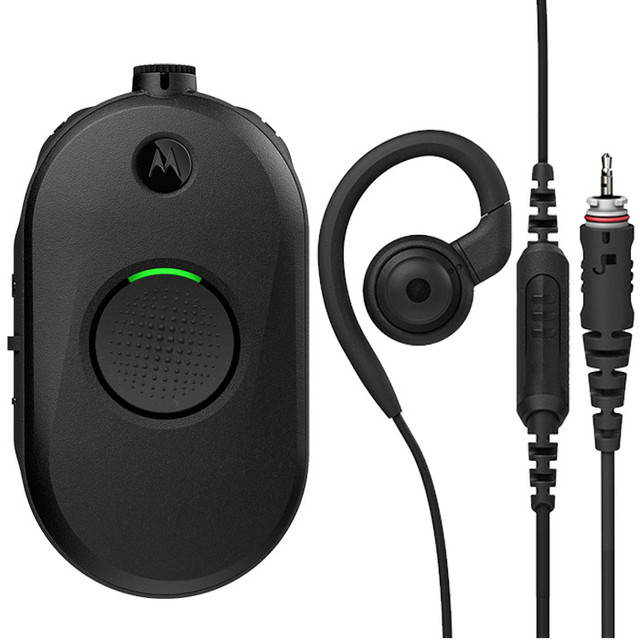
Ideal for: Single-floor restaurants, cafés, fast casual, and operations where front-of-house staff appearances matter
| Specification | Detail |
|---|---|
| Frequency | UHF (450–470 MHz) |
| Power Output | 1 watt |
| Channels | 8 |
| Indoor Range | 100,000 sq ft / 10 floors |
| Outdoor Range | Up to 1 mile |
| Weight | 2.38 oz |
| Battery Life | 12 hours |
| FCC License | Yes. A license is not required to purchase radios. |
| Durability | Light–moderate duty |
| Water Resistance | Water-resistant |
Why it fits restaurants: At 2.38 ounces, the CLP1080e is the most discreet business radio available. It clips flat to a uniform, sits invisibly under an apron, and does not telegraph "walkie-talkie" in a fine-dining environment. The included earpiece allows front-of-house staff to receive communications without visible reaction — a meaningful upgrade in service quality.
Eight channels provide enough segmentation for a full restaurant team. Antimicrobial housing addresses hygiene concerns in a food service context. The large, centered PTT (Push-to-Talk) button is operable with a single thumb motion — critical when a server has both hands engaged. A 12-hour battery covers a full service day, and the radio is repeater-capable if range extension becomes necessary as your operation grows.
Best paired with: Discreet single-wire earpiece; multi-unit 6-bank charging dock for shift changeover
2. Motorola CLS1410 — Best All-Around Workhorse for Full-Service Restaurants
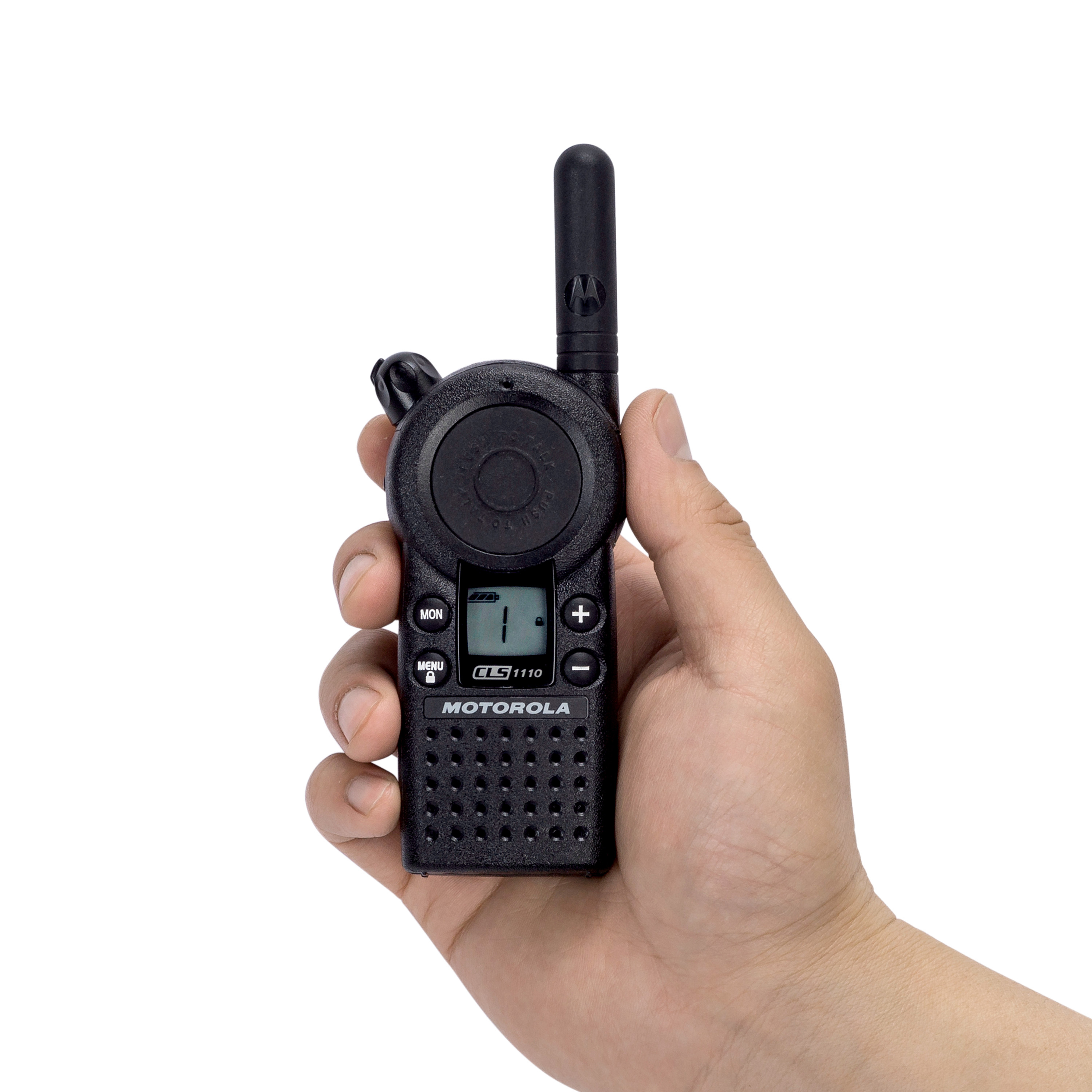
Ideal for: Mid-to-large single-location restaurants, high-volume full-service operations, teams new to two-way radio use
| Specification | Detail |
|---|---|
| Frequency | UHF (460–469 MHz) |
| Power Output | 1 watt |
| Channels | 4 |
| Indoor Range | 200,000 sq ft / 15 floors |
| Outdoor Range | Up to 1 mile |
| Battery Life | Extended (approx. 11–13 hours) |
| FCC License | Yes. A license is not required to purchase radios. |
| Durability | Moderate duty |
| Water Resistance | Water-resistant |
Why it fits restaurants: The CLS1410 is the most consistently recommended restaurant radio for full-service operations of 30–150 covers. Its 200,000 square foot indoor range and 15-floor vertical coverage exceeds the footprint of virtually every single-location restaurant in North America, providing a meaningful margin of reliability over the CLP1080e.
Audible call alerts notify staff when a transmission is incoming — helpful in loud kitchen environments where a missed call can delay service. The four-channel layout maps cleanly to the most common restaurant team structures (host, kitchen, floor, management) without unnecessary complexity. Minimal training time required; staff typically reach proficiency within one shift.
The CLS1410's build is straightforward and resistant to the kind of casual abuse radios experience in a restaurant environment — drops from apron pockets, exposure to steam, and the occasional liquid splash.
3. Motorola Curve — Best for Large Venues, Multi-Floor, and No-License Operations
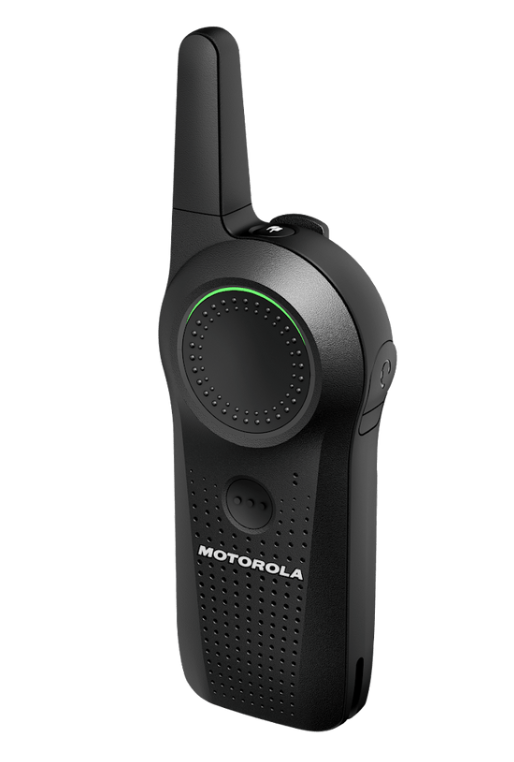
Ideal for: High-volume restaurants, multi-floor venues, restaurant groups, and operations seeking to avoid FCC licensing costs
| Specification | Detail |
|---|---|
| Frequency | Digital (902–928 MHz) |
| Power Output | 1 watt digital (equivalent to ~4 watt analog) |
| Channels | 10 |
| Indoor Range | 300,000 sq ft / 20 floors |
| Outdoor Range | Up to 1.5 miles |
| FCC License | Not required |
| Durability | Moderate duty |
| Water Resistance | Water-resistant |
Why it fits restaurants: The Curve's two defining advantages for restaurants are its digital audio clarity and its FCC license exemption. Digital transmission eliminates the static and audio degradation that analog radios experience at range or through interference — meaning communications stay sharp even in a full Friday night rush when the building is packed with bodies, equipment, and competing RF signals.
The 900 MHz digital band the Curve operates on does not require an FCC business radio license. For context, standard business-band UHF licenses cost approximately $85 per license through the FCC's Universal Licensing System (ULS) and must be renewed every ten years. For restaurant groups equipping multiple locations, license savings compound quickly.
Ten channels provide segmentation room for even the most complex restaurant org charts — including separate channels for valet, security, and event staff in larger venues. The 300,000 square foot indoor range accommodates multi-floor operations, adjacent outdoor dining spaces, and venues with challenging structural layouts.
Frequently Asked Questions
Do I need an FCC license to use two-way radios in my restaurant?
Most business-band UHF radios — including the Motorola CLS1410 and CLP1080e — require an FCC business radio license. These are obtained through the FCC's Universal Licensing System (ULS). A standard license costs approximately $75-$600 and is valid for ten years. The license covers a business entity and its associated radio equipment, not individual devices.
The Motorola Curve is a notable exception: it operates on the 900 MHz digital band, which is license-free under FCC rules. It is important to note that an FCC license is not required to purchase radios — only to operate business-band radios on licensed frequencies.
How much range do I actually need for a restaurant?
Most full-service restaurants — even those with multiple dining rooms — are contained within 10,000–30,000 square feet. A 1-watt UHF radio rated for 100,000–200,000 square feet indoors provides substantial margin above what the majority of restaurant footprints demand.
Where range becomes a real variable: restaurants with outdoor patios or adjacent parking lots (where UHF range opens up to 1 mile line-of-sight), multi-floor venues with dense construction, and restaurant groups with multiple adjacent buildings sharing a radio system. In those scenarios, the Motorola Curve's 300,000 square foot indoor range and 1.5-mile outdoor rating provides the headroom needed.
How long do restaurant radio batteries last?
Business-grade restaurant radios are rated for 10–13 hours of typical use on a single charge. In practice, transmit-heavy roles (kitchen leads, managers) will see slightly shorter runtimes than receive-heavy roles (bussers, hosts). For operations running double shifts or 14+ hour service days, the best practice is to maintain a multi-unit charging dock and rotate charged spares at the shift changeover. Replacement battery packs are available for all models recommended on this page, extending hardware life to 5+ years when properly maintained.
Are two-way radios sanitary enough for food service environments?
The Motorola CLP1080e features antimicrobial casing, which inhibits the growth of bacteria on the radio's surface — a meaningful specification for equipment that changes hands frequently during a shift. For all models, the best practice in food service environments is to assign radios per shift rather than per person where possible, clean housings regularly with approved disinfectant wipes, and store radios in a dedicated charging rack rather than loose in drawers or on prep surfaces.
What IP or durability rating should a restaurant radio have?
For restaurant environments, a minimum IP54 rating is recommended. IP54 indicates protection against dust ingress (sufficient for commercial kitchen particulates) and water splashing from any direction (sufficient for steam exposure and minor spills). Radios used primarily in front-of-house or office management roles can use light-duty rated models; radios carried by kitchen staff or outdoor/patio teams benefit from IP55 or higher. None of the recommended models are rated for submersion — they should not be dropped into a sink or ice bin. If a radio will be used in a commercial kitchen where high-pressure water spray is part of the cleaning process, consider a higher IP rating or a protective case.
Can nearby restaurants interfere with my radio communications?
Yes — but this is solved through privacy codes. CTCSS (Continuous Tone-Coded Squelch System) and DCS (Digital-Coded Squelch) are sub-audible tones programmed into your radios that cause them to ignore transmissions not carrying the matching code. Two restaurants operating on the same UHF channel will not hear each other if they are programmed with different CTCSS/DCS codes.
All models recommended on this page support CTCSS/DCS programming. Note that privacy codes do not encrypt transmissions — anyone with a scanner can still hear your communications. For operations requiring true communication privacy (security, loss prevention, sensitive guest situations), the Motorola Curve's digital transmission provides a meaningful layer of signal obscurity.
Can I mix different radio models in my restaurant?
Yes, with conditions. Radios operating on the same frequency band (e.g., UHF analog) and programmed to the same channel and privacy code will communicate with each other, even across brands. The Motorola CLS1410 and CLP1080e can share channels, allowing restaurants to mix models by role (smaller CLPe for servers, larger CLS for kitchen leads). The Motorola Curve operates on a different digital frequency (900 MHz) and cannot natively communicate with analog UHF radios without a cross-band repeater.
Why Buy from TechWholesale.com
TechWholesale has been a specialist in two-way radio sales and support since 1997. Unlike general electronics retailers, TechWholesale focuses exclusively on business communication technology — which means the staff you reach knows these products in depth, not as a SKU in a catalog.
What sets TechWholesale apart for restaurant buyers:
- Lifetime Technical Support included with every purchase — no support contracts, no per-call fees
- Volume Pricing and Custom Quotes for restaurant groups equipping multiple locations or ordering 5+ radios
- Expert Pre-Sale Guidance: Not sure which model fits your floor plan? The TechWholesale team will walk through your operation and match you to the right radio before you spend a dollar
- Authorized Dealer Status: All Motorola and Kenwood products sold through TechWholesale are manufacturer-authentic, warranty-eligible, and FCC-compliant
- Post-Sale Accountability: Over 25 years and thousands of restaurant installations — the company stands behind every recommendation