
The Best Two-Way Radios That Do Not Require an FCC License
You're ready to buy two-way radios for your team. You've done the research, compared the models, and settled on a budget. Then you find out about FCC licensing—and suddenly, the cost of staying connected just got a lot higher.
FCC license fees can run a business hundreds of dollars upfront, with ongoing renewal costs on top of that. For many small and mid-sized operations, that's a deal-breaker. The good news? It doesn't have to be.
A small selection of two-way radios operate on frequencies that the FCC has designated for public use—no license required, no paperwork, no renewal fees. They're fully legal, FCC-approved, and in many cases, just as capable as their licensed counterparts.
This guide covers everything you need to know: how FCC licensing works, which radios skip it entirely, and how to choose the right model for your specific industry.
What Is the FCC, and Why Does It Matter?
The Federal Communications Commission (FCC) is the U.S. government agency responsible for managing public use of the radio spectrum. Every frequency band has a designated user type, and the FCC controls who can broadcast on each one.
For two-way radios, this means most business-grade frequencies—such as the General Mobile Radio Service (GMRS) and the Business Radio Service (BRS)—require a license to operate.
However, the FCC has also designated certain frequency bands for open public use. Radios built to operate on these bands don't require a license, a fee, or any government paperwork. These include:
- Multi-Use Radio Service (MURS) — A VHF band with five channels, typically used for short-range business communication
- 900 MHz Digital Band — A digital frequency band used by some Motorola radios, operating outside the standard FCC licensing requirements
These aren't loopholes. The FCC has explicitly approved these frequencies and the devices that use them for public use. Everything is above board.
The Best No FCC License Radios
Not all license-free radios are created equal. Here's a breakdown of the top models—and the situations they're best suited for.
Motorola Curve
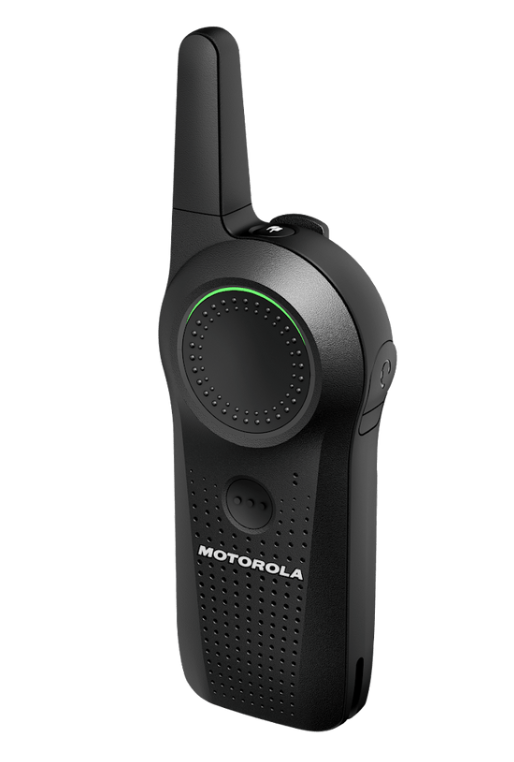
The Motorola Curve is a compact, two-channel digital radio that runs on the 900 MHz band—placing it outside FCC licensing requirements entirely.
With one watt of power, it's best suited for smaller locations. That said, its indoor range is impressive: up to 300,000 square feet or 20 floors. Outdoor range extends up to two miles.
Two channels keep things simple. You can separate your team into two groups—say, floor staff and management—without overcomplicating the setup. It also uses Frequency Hopping Spread Spectrum (FHSS) technology, which encrypts your signal and prevents outside parties from listening in.
Best for: Hotels, Medical offices, Retail, Restauarants and compact multi-story buildings.
Motorola RMM2050

The Motorola RMM2050 takes a different approach. It's a VHF radio that runs on MURS frequencies (151–155 MHz), which sit outside the standard FCC licensing requirements. Two watts of power give it an outdoor range of up to two miles.
VHF signals travel well over open ground, through foliage, and across rolling terrain—making this radio a strong choice for outdoor operations. It's not the best pick for indoor use, though. VHF signals don't penetrate walls and floors as effectively as UHF or digital alternatives.
It comes with five channels for staff segmentation, a VOX voice activation feature for hands-free communication, and a rugged design that can handle drops and rough handling on a job site. There's also an antimicrobial coating on the exterior—a practical feature for teams working in the field.
Best for: Construction sites, landscaping crews, golf courses, outdoor maintenance teams, and any operation that lives and works outside.
Motorola DTR700

The Motorola DTR700 is the most channel-rich option on this list, offering 50 channels on the 900 MHz digital band. It runs on one watt of power and uses FHSS technology for secure, interference-free communication.
With 50 channels, large organizations can create a highly structured communication system—separating departments, floors, shifts, or functions with ease. It's a step up in both capability and price, but for complex operations, the investment is justified.
Best for: Large enterprises, warehouses, campuses, and operations with multiple teams or departments.
Which No FCC License Radio Is Right for Your Industry?
The right radio depends on where your team works and how they communicate. Here's a quick breakdown by industry.
Restaurants
Multi-channel radios shine in restaurant environments. The Motorola Curve is the go-to choice here. Ten channels let you separate kitchen staff, servers, hosts, and management without crosstalk.
One watt of power is more than sufficient for most restaurant footprints, and the indoor range of 300,000 square feet covers even the largest dining rooms with ease.
Medical Facilities
In healthcare settings, two things matter above all else: reliability and privacy. The Motorola Curve delivers on both.
Its FHSS encryption ensures that sensitive patient information stays off the public airwaves. The page-all feature allows staff to broadcast an emergency alert to every radio on the network simultaneously. And with coverage across 20 floors, it works reliably throughout multi-story hospital buildings.
For clinics with a handful of staff, 10 channels is plenty. For larger facilities, the DTR700 may be worth considering.
Outdoor Businesses
Construction crews, golf courses, landscapers, and outdoor events teams need a radio that performs in open terrain. The Motorola RMM2050 is built for exactly that.
VHF signals travel twice as far as UHF over open ground. Two watts of power extend that range further. Add in VOX activation for hands-free use and a rugged, drop-resistant body, and you've got a radio that can keep up with physically demanding work.
FCC License vs. No License: A Quick Comparison
| Feature | Licensed Radios | No-License Radios |
|---|---|---|
| Upfront licensing cost | Yes (can be hundreds) | None |
| Renewal fees | Yes (ongoing) | None |
| Paperwork required | Yes | None |
| FCC-approved | Yes | Yes |
| Suitable for business use | Yes | Yes |
| Frequency options | Broader | Limited to designated bands |
The tradeoff is frequency flexibility. Licensed radios give you access to a wider range of bands, which can be valuable for large-scale or specialized operations. But for the majority of small to mid-sized businesses, no-license radios cover every communication need—without the ongoing cost.
Frequently Asked Questions
Are no FCC license radios legal?
Yes. The FCC has explicitly designated certain frequency bands—including MURS and the 900 MHz digital band—for public use. Radios operating on these frequencies are fully legal and do not require a license.
What's the indoor range of these radios?
The Curve offers 300,000 square feet of coverage and the DTR700 up to 400,000 square feet on the 900 MHz digital band. The RMM2050 is a MURS radio and is not optimized for indoor use.
The Bottom Line on No-License Radios
FCC licensing fees are an unnecessary expense for many businesses. No-license radios—operating on MURS and 900 MHz digital bands—deliver reliable, secure, interference-free communication without the paperwork or ongoing costs.
The right model comes down to your environment, team size, and communication needs. Outdoor crews need VHF. Indoor operations need digital. Multi-department businesses need more channels. And everyone benefits from a radio that just works—without a government fee attached.
If you're ready to find the right no-license radio for your operation, the team at Tech Wholesale is available via live chat, phone at 888-925-5982, or through the contact form on the website. Custom quotes are available for bulk purchases.