
The Best Two-Way Radios for Large Buildings (2026 Guide)
What Are the Best Two-Way Radios for Large Buildings?
The Short Answer
The best two-way radios for large buildings are the Motorola DTR700, Motorola CP100d-UA, and Kenwood NX-P1300NUK. Each model solves a different operational challenge: the DTR700 delivers digital performance with 50 channels and up to 350,000 sq ft of indoor coverage; the CP100d-UA provides maximum UHF power at 4 watts for concrete-heavy construction; and the Kenwood NX-P1300NUK offers 64 channels and a 14-hour battery for large multi-department teams at a competitive price. For operations spanning multiple buildings or locations, the Motorola WAVE PTX series eliminates distance as a constraint entirely via LTE and Wi-Fi connectivity.
A radio that works adequately on a single retail floor will fail in a 30-story office tower or a 400,000-square-foot distribution center. The physics are different: more floors, more concrete, more steel, more RF interference. Matching the radio to the building is what this guide covers.
We have sold two-way radios to large-building operations across every industry since 1997. Here is what we have learned about what actually works.
Why Large Buildings Require Purpose-Built Two-Way Radios
Consumer walkie-talkies and cell phones share a common failure mode in large-building environments: they cannot reliably penetrate the construction materials and RF-dense conditions that define these spaces. A concrete-and-steel high-rise, a hospital complex, or a multi-wing university building presents fundamentally different radio propagation challenges than a single-floor venue.
Large commercial buildings generate specific communication pain points that inadequate radios turn into operational and safety problems:
Signal dead zones in structural cores. Concrete elevator shafts, mechanical rooms, basement levels, and stairwells create RF shadows that absorb or reflect low-power radio signals. Staff in these areas lose contact precisely when they are most likely to need it — during maintenance work, emergency response, or an evacuation.
Floor-to-floor attenuation. Each additional floor a signal must pass through costs approximately 15–20 dB of signal strength, depending on construction type. A 1-watt UHF radio rated for 15 floors under ideal conditions may reach only 8–10 floors in a building with reinforced concrete slabs. Matching radio power and frequency to actual construction type is essential.
Multi-department coordination complexity. Facilities management, security, maintenance, housekeeping, front desk, and loading dock operations all run simultaneously in a large building. Without dedicated radio channels for each function, communication becomes congested and critical messages are missed or delayed.
Emergency response requirements. NFPA 72 (National Fire Alarm and Signaling Code) and NFPA 101 (Life Safety Code) both address the need for reliable internal communication during fire and evacuation events. Many local fire codes and building codes for high-rise occupancies (typically defined as buildings 75 feet or more above grade) specifically require in-building radio coverage systems. A professional radio fleet supports these obligations; a consumer product typically does not meet the reliability threshold.
Lone worker and maintenance exposure. Building engineers, HVAC technicians, and security officers routinely work in isolated mechanical spaces. OSHA General Industry Standard 29 CFR 1910.146 addresses permit-required confined spaces and mandates a communication protocol between entrants and outside attendants. A reliable radio system is the practical mechanism for meeting this requirement.
Shift-length battery demands. Building operations run 8–24 hours. A radio that dies mid-shift is a radio that cannot be relied on, and a replacement cost that accumulates over time. Professional radios designed for large-building use are rated for 10–14 hours of typical transmission loads.
What to Look for in a Large-Building Two-Way Radio
Output Power and Signal Penetration
For buildings up to 350,000 square feet and 35–40 floors, a minimum of 4 watts UHF analog or 1 watt digital is required. Digital radios at 1 watt perform comparably to 4-watt analog radios in most penetration scenarios because of more efficient signal encoding. Buildings with poured concrete construction, lead-lined rooms (common in hospitals and dental facilities), or underground levels may require the addition of a repeater system to maintain consistent coverage.
Frequency: UHF vs. VHF for Indoor Use
UHF (Ultra High Frequency, 400–512 MHz) is the correct frequency band for large-building interior use. UHF wavelengths penetrate concrete, steel, and glass-partition office construction more effectively than VHF (Very High Frequency, 136–174 MHz). VHF retains an advantage for outdoor and open-terrain use but is typically unsuitable as the primary frequency for multi-floor building operations. For a detailed technical comparison, see our guide on UHF vs. VHF frequencies.
Channel Capacity
Teams operating across multiple departments require dedicated channels to prevent communication overlap. A minimum of 5 channels is recommended for most large-building operations; buildings with distinct security, facilities, and tenant service functions may require 16–64 channels. Single-channel or two-channel radios are inappropriate for any team exceeding three to four people with distinct operational roles.
Battery Life
For standard 8-hour shifts, a 10-hour battery rating provides adequate margin. For 24/7 operations or back-to-back shift coverage, 12–14 hour ratings reduce battery swap frequency. Multi-unit charging cradles allow quick battery rotation. Motorola and Kenwood commercial-grade batteries are both rated for five years of regular field use.
Durability Rating
Large buildings include environments that are hard on equipment: loading docks, mechanical rooms, parking structures, and exterior grounds. A minimum IP54 ingress protection rating (resistant to dust and splash water from any direction) is the baseline for radios used in these areas. MIL-STD-810 compliance adds certified protection against shock, vibration, humidity, and temperature extremes — the standard specified on all heavy-duty radios in this category.
Repeater Compatibility
Buildings exceeding 40 floors, those with significant structural interference, or multi-building campuses may benefit from a repeater system. A compatible repeater receives a radio signal and retransmits it at higher power, effectively doubling usable coverage area and eliminating most dead zones.
Recommended Two-Way Radios for Large Buildings
1. Motorola DTR700 — Best Overall for Large Buildings

| Specification | Detail |
|---|---|
| Frequency | 900 MHz ISM Band (902–928 MHz) |
| Power | 1 watt digital (equivalent to ~4 watts analog) |
| Channels | 50 |
| Contacts | Up to 200 |
| Indoor Coverage | Up to 350,000 sq ft |
| Outdoor Coverage | Up to 3 miles (with long whip antenna) |
| Warranty | 2 years |
The DTR700 operates on the 900 MHz ISM band using Frequency Hopping Spread Spectrum (FHSS) technology, which means it is inherently resistant to interference and eavesdropping. It supports up to 50 channels and 200 individual contacts, enabling full department segmentation and private one-to-one calls within the same radio fleet.
Call options include broadcast (call-all) for building-wide announcements and direct private reply for individual conversations — a capability that analog radios on a single channel cannot replicate without channel-switching. At 350,000 sq ft of indoor coverage, the DTR700 serves the overwhelming majority of large commercial buildings without a repeater.
Why it fits large buildings specifically
- FHSS technology prevents external radio interference, important in buildings with dense Wi-Fi, Bluetooth, and radio device environments
- 50 channels support full department segmentation plus emergency, contractor, and visitor channels
- Private call capability lets managers contact individuals without broadcasting to the entire team
- 900 MHz digital signal penetrates concrete and steel effectively at 1-watt equivalent to 4-watt analog performance
For more on how FHSS works and why it matters in high-density RF environments, see our resource on Frequency Hopping Spread Spectrum.
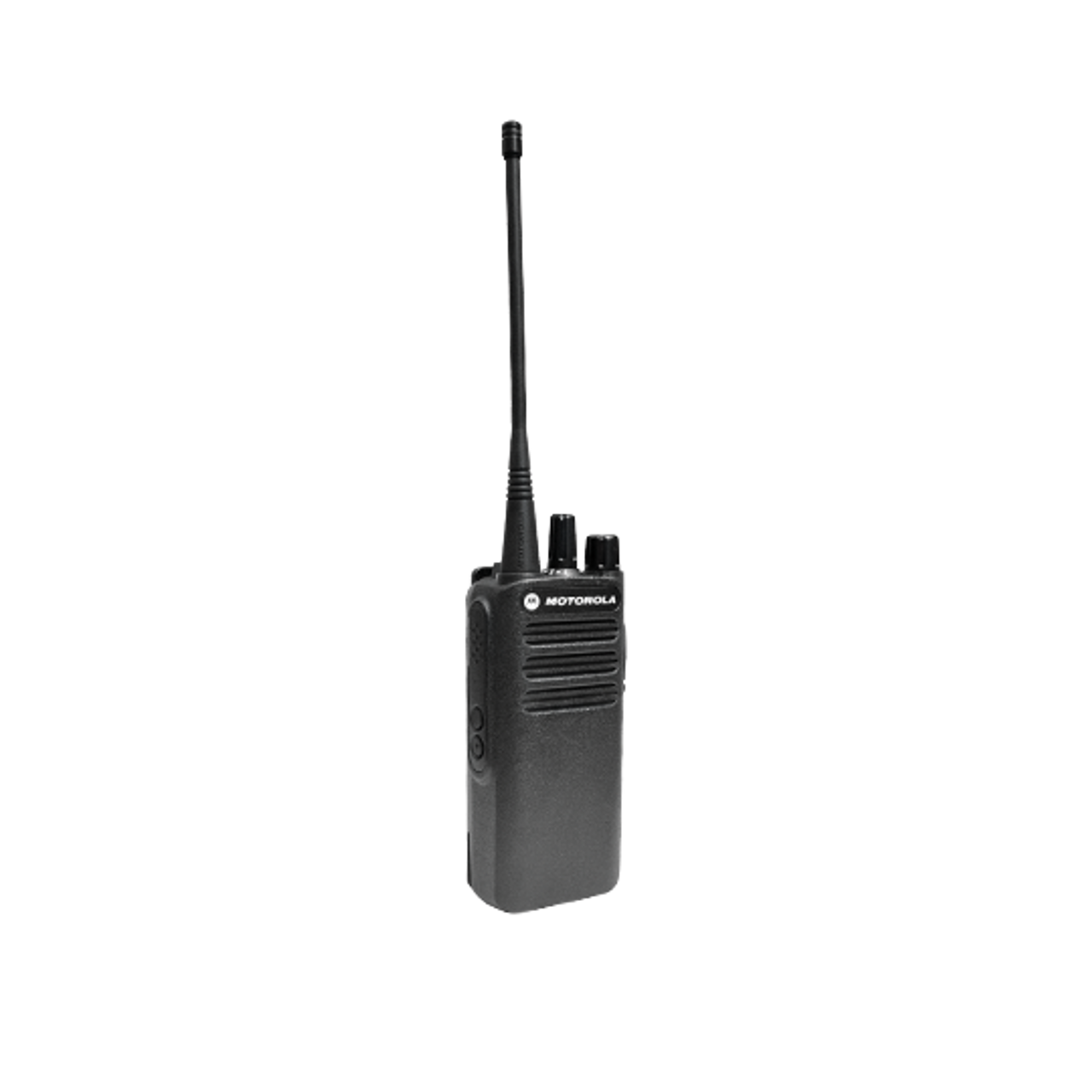
2. Motorola CP100d-UA — Best for Maximum Power and Durability
| Specification | Detail |
|---|---|
| Frequency | UHF (403–480 MHz) |
| Power | 4 watts |
| Channels | 16 |
| Indoor Coverage | Up to 400,000 sq ft / 30 floors |
| Outdoor Coverage | 2–3 miles |
| Durability | IP54, MIL-STD-810 C–F |
The CP100d-UA transmits at 4 watts UHF — the highest output in its class for commercial building use. That output level is meaningful in construction-heavy environments: reinforced concrete floors, lead-lined rooms, dense mechanical equipment, and underground parking structures all attenuate radio signals. Full 4-watt output gives signals the best chance of punching through each layer.
The build matches the power spec. The CP100d-UA uses a military-grade polycarbonate chassis with a metal die-cast frame certified to MIL-STD-810 C–F standards, covering resistance to shock, vibration, humidity, and temperature extremes. The IP54 rating covers dust ingress and splash water from any direction — relevant for loading docks, parking structures, and exterior grounds patrol.
Why it fits large buildings specifically
- 4 watts UHF provides maximum analog signal penetration through concrete-and-steel construction
- MIL-STD-810 C–F certification covers the full range of physical and environmental hazards found in facilities maintenance and security patrol work
- 16 channels accommodate most large-building department configurations
- Coverage up to 400,000 sq ft and 30 floors serves the majority of large commercial and institutional buildings
- Covers 89 business radio frequencies with privacy codes to prevent cross-talk from other buildings or operations sharing the same band
3. Kenwood NX-P1300NUK — Best Value for Large Multi-Department Teams

| Specification | Detail |
|---|---|
| Frequency | UHF (451–470 MHz) with digital capability |
| Power | 4 watts UHF analog / digital |
| Channels | 64 |
| Battery Life | 14 hours |
| Durability | IP54/55 |
| Warranty | 2 years |
The Kenwood NX-P1300NUK leads this category on channel count and battery life. 64 channels gives building management teams enough capacity to assign distinct channels to every department, sub-team, contractor group, and emergency function without overlap or reassignment pressure as the operation scales. The 14-hour rated battery life covers full-day shifts with margin for multi-shift or continuous operations without a mid-day battery swap.
The NX-P1300NUK is also upgradeable: the base model ships in analog mode, and the digital mode can be enabled as a future upgrade, allowing buildings to start with a familiar analog workflow and transition to digital when ready without replacing hardware.
Why it fits large buildings specifically
- 64 channels provide more department and role segmentation capacity than any other radio in this category
- 14-hour battery life is the longest in its class, reducing the frequency of battery swaps on long shifts or 24/7 operations
- IP54/55 ingress protection covers both dust and low-pressure water jets — appropriate for facilities maintenance environments
- Analog-to-digital upgrade path protects the hardware investment when transitioning to digital infrastructure
- 2-year manufacturer warranty is the best standard warranty in the commercial radio segment
Also Worth Considering
Motorola CP100d-UDK — 4 watts, 160 channels, UHF (403–480 MHz), with display and full keyboard. The correct choice for operations that need maximum channel depth and display-based channel identification, such as multi-tenant office buildings or large hospital campuses.
Motorola Mag One BPR50dx — 5 watts, 64 channels, UHF (400–470 MHz), analog and digital. The highest-output radio in the commercial building segment; appropriate for the most RF-challenging environments, including underground infrastructure, large parking structures, and buildings with known signal propagation problems.
Motorola WAVE PTX Series — LTE and Wi-Fi connectivity, unlimited range, GPS tracking, emergency button, and smartphone app compatibility. The correct choice for organizations operating across multiple buildings, campuses, or geographic locations where a traditional radio range is insufficient.
Motorola R2-UA — 4 watts, 64 channels, UHF (400–480 MHz), analog and digital. A MOTOTRBO-grade radio with advanced digital features at a mid-range price point, suitable for buildings transitioning from analog to digital infrastructure.
Coverage by Building Type: Matching Radio to Square Footage and Construction
| Building Type | Recommended Radio | Indoor Coverage Capacity |
|---|---|---|
| Office building, 5–15 floors, light construction | Motorola DTR700 | Up to 350,000 sq ft |
| High-rise office or residential, 15–30 floors, concrete construction | Motorola CP100d-UA | Up to 400,000 sq ft / 30 floors |
| Hospital, university, or large commercial campus | Kenwood NX-P1300NUK or CP100d-UDK | Up to 375,000–400,000 sq ft |
| Warehouse or distribution center, single floor, large footprint | Motorola CP100d-UA or BPR50dx | Up to 450,000 sq ft |
| Multi-building campus or multi-site operation | Motorola WAVE PTX Series | Unlimited (LTE/Wi-Fi) |
Coverage ratings are manufacturer-specified under typical construction conditions. Buildings with reinforced concrete, metal-lined rooms, or known RF interference sources should plan for 20–30% reduced coverage relative to rated specifications. A pre-purchase on-site radio test is the most reliable way to confirm actual coverage before committing to a fleet.
Recommended Channel Setup for Large Buildings
Channel segmentation by role prevents communication overload and ensures that critical messages reach the right team without competing with unrelated traffic. The following is a baseline configuration for most large-building operations; adjust based on the specific departments and contractor relationships your building manages.
| Channel | Assigned Role | Purpose |
|---|---|---|
| 1 | Security | Patrol coordination, incident response, access control |
| 2 | Maintenance / Engineering | HVAC, electrical, plumbing, equipment repairs |
| 3 | Housekeeping / Janitorial | Cleanups, restocking, routine tasks |
| 4 | Front Desk / Concierge | Tenant or guest requests, access coordination, service updates |
| 5 | General Operations / Management | Cross-department coordination, supervisor escalation |
| 6 | Emergency | Reserved for fire, evacuation, medical, or security incidents |
Private call capability (available on DTR700 and MOTOTRBO-series radios) complements channel segmentation by allowing managers to contact specific staff members directly without broadcasting to a full channel — useful for sensitive instructions or one-on-one coordination.
OSHA and Building Code Compliance Considerations
OSHA 29 CFR 1910.146 — Permit-Required Confined Spaces. This standard requires a communication system between an entrant and an outside attendant for permit-required confined space entry. Mechanical rooms, utility tunnels, large HVAC systems, and underground vaults in large buildings may qualify as confined spaces under this definition. A reliable two-way radio system is the standard mechanism for meeting the attendant communication requirement.
NFPA 72 and NFPA 101 — Fire Alarm and Life Safety Codes. NFPA 72 (National Fire Alarm and Signaling Code) includes provisions for emergency communication systems in large buildings, including in-building radio coverage enhancement systems. NFPA 101 (Life Safety Code) addresses occupant notification and staff communication during emergency evacuation. Many local fire codes incorporate these standards by reference and require buildings above a certain height or occupancy threshold to maintain functional in-building radio communication capability. A professional radio fleet supports these obligations.
IBC Section 510 — Emergency Responder Radio Coverage. The International Building Code Section 510 requires adequate radio coverage for emergency responders (fire, police, EMS) throughout new construction in buildings above a specified height. This requirement applies to the emergency responder radio system (typically a Distributed Antenna System or BDA/booster installation), but building management teams often piggyback their internal radio operations on the same infrastructure. Consult with your local Authority Having Jurisdiction (AHJ) for specific requirements applicable to your building.
Frequently Asked Questions
What are the best two-way radios for large buildings?
The Motorola DTR700, Motorola CP100d-UA, and Kenwood NX-P1300NUK are the top-performing radios for most large-building applications. The DTR700 is the best all-around choice for buildings up to 350,000 sq ft that want strong digital performance. The CP100d-UA is the right choice when maximum UHF power (4 watts) is required for heavy concrete construction. The Kenwood NX-P1300NUK leads on channel count (64) and battery life (14 hours) for large multi-department teams. For multi-building or multi-site operations, the Motorola WAVE PTX series provides unlimited range via LTE and Wi-Fi.
How much indoor range do I need for a large building?
Plan for a radio rated at a minimum of 350,000 sq ft for most large commercial buildings. For buildings exceeding 35–40 floors or with particularly dense concrete construction, select a radio rated for 400,000 sq ft or higher, or plan for a repeater system to extend coverage. Manufacturer coverage ratings assume typical construction; buildings with reinforced concrete, lead-lined rooms, or underground levels should budget for 20–30% reduction in actual coverage relative to the rated specification.
How long does the battery last on a large-building radio?
Professional radios in this category are rated for 10–14 hours under normal transmission loads. The Kenwood NX-P1300NUK carries the longest standard rating at 14 hours. Motorola commercial-grade batteries are rated for five years of regular field use. For 24/7 operations or back-to-back shifts, multi-unit charging cradles allow hot-swapping batteries without downtime. Battery life is reduced when radios are used in heavy-transmission environments or when continuous scan mode is active.
Do I need a repeater for my building?
Not necessarily. Most large buildings under 40 floors and 400,000 sq ft can be served by a 4-watt UHF or 1-watt digital radio without a repeater. Repeaters become necessary when a building exceeds the rated coverage of available radios, has significant structural RF interference (dense concrete, metal-lined rooms, underground levels), or spans multiple separate structures. A pre-purchase on-site radio test is the best way to determine whether a repeater is needed before committing to a fleet. Contact Tech Wholesale for guidance on whether your specific building warrants repeater infrastructure. Browse compatible repeaters here.
Can two-way radios work across multiple buildings on a campus?
Yes, with the right equipment. The Motorola WAVE PTX series uses LTE and Wi-Fi connectivity to provide unlimited-range communication across multiple buildings, cities, or states — with no distance limitation. For campuses where buildings are in close proximity, a repeater system can also extend the range of traditional UHF radios between structures. The appropriate solution depends on building proximity, existing network infrastructure, and whether a monthly subscription cost is acceptable.
How many channels do I need for a large building?
Most large-building operations run effectively on 5–10 dedicated channels: security, maintenance, housekeeping, front desk/concierge, general operations, and a reserved emergency channel. Buildings with additional functions — parking, food service, loading dock, tenant services — benefit from 16 or more channels. For maximum future flexibility, the Kenwood NX-P1300NUK (64 channels) and Motorola CP100d-UDK (160 channels) provide channel depth that significantly exceeds most operational requirements, ensuring the radio fleet does not become a constraint as the building's operational needs evolve.
What durability rating should I look for in a large-building radio?
For standard commercial office use, IP54 (dust-resistant, splash-resistant) is the minimum acceptable rating. For facilities maintenance, security patrol, loading dock, and exterior grounds work, IP54/55 combined with MIL-STD-810 certification (covering shock, vibration, humidity, and temperature extremes) is the appropriate standard. The Motorola CP100d-UA and Kenwood NX-P1300NUK both meet this combined threshold. For extreme environments — industrial facilities, construction sites, or operations with regular exposure to water — an IP67 or higher rating may be warranted.
What is the difference between analog and digital two-way radios?
Analog radios transmit voice as a continuous radio wave. Digital radios encode voice as a digital signal before transmission, which produces cleaner audio, more efficient channel use, better resistance to interference, and additional features including private calls, encrypted transmission, and improved battery efficiency. A 1-watt digital radio performs comparably to a 4-watt analog radio in most penetration scenarios. For large buildings with dense radio-frequency environments (office buildings with many wireless devices, hospitals with medical RF equipment), digital is typically the stronger choice.
Can two-way radios support emergency and lone worker safety in large buildings?
Yes. Several models recommended on this page include dedicated emergency features. The Motorola WAVE PTX series includes an emergency button that triggers an immediate alert to designated staff. Some models in the Kenwood NX series and Motorola MOTOTRBO series support man-down and lone worker alert functionality — features that detect if a radio has been motionless for a defined period and automatically transmit an alert. For buildings where staff work in isolated mechanical spaces or conduct overnight security patrols, these features address OSHA obligations around lone worker and confined space communication protocols. See our overview of Lone Worker and Man Down functionality.
Why Buy from TechWholesale.com
Tech Wholesale has been selling professional two-way radios to building management, facilities, and security operations since 1997. We are an authorized dealer for Motorola and Kenwood, which means every radio we sell carries the full manufacturer warranty — typically two years on commercial-grade models — and qualifies for manufacturer service and repair. No gray-market inventory. No voided warranties.
Large-building radio deployments are not one-size-fits-all. A 12-floor office building with light steel construction has different coverage requirements than a 35-floor reinforced concrete residential tower or a 500,000-square-foot distribution warehouse. We do not recommend a radio without understanding your specific building. If you tell us your building dimensions, floor count, construction type, and team size, we will tell you which radio fits — including whether a less expensive option is the correct answer.
What sets us apart
- Lifetime technical support included with every purchase — call or email our team for the life of your radio fleet, not just through the warranty period
- Volume pricing for multi-unit orders — request a custom quote
- Authorized dealer status for Motorola and Kenwood — full manufacturer warranty on every unit
- Free shipping on qualifying orders
- On-site radio testing guidance — we can help you design a pre-purchase building test before committing to a fleet
If you are not sure which radio fits your building, use our Find My Radio tool or request a quote. We will ask about your building and come back with a specific recommendation.
1-888-925-5982 | Service@TechWholesale.com
Related Reading
On TechWholesale.com
- UHF vs. VHF — Frequencies Explained
- Frequency Hopping Spread Spectrum (FHSS)
- Lone Worker / Man Down Functionality
- Privacy Codes — Eliminate Outside Interference
- VOX Explained
- Two-Way Radio Repeaters
- Walkie Talkie FAQs
External Resources
- FCC Private Land Mobile Radio Services — Licensing Guide
- OSHA 29 CFR 1910.146 — Permit-Required Confined Spaces
- NFPA 72 — National Fire Alarm and Signaling Code
- NFPA 101 — Life Safety Code
Article by Kristin Wood, a two-way radio consultant @ Tech Wholesale | Authorized Motorola & Kenwood Dealer Since 1997 | Last Updated: May 2026