
The Best Two-Way Radios for Manufacturing (2026 Guide)
What Are the Best Two-Way Radios for Manufacturing?
The Short Answer
The best two-way radios for manufacturing are the Motorola Curve, the Motorola RMU2080d, the Motorola CP100d-UA, and the Motorola Mag One BPR50dx. Each addresses a different facility profile: the Curve handles most mid-size plants with its 900 MHz digital signal and 14-hour battery; the RMU2080d is built for environments that demand MIL-STD-810 rugged construction and antimicrobial housing for shared use; the CP100d-UA covers large-footprint facilities where repeater compatibility is required; and the BPR50dx is the high-channel, dual analog/digital option for teams that need 64 channels, a 23-hour battery, and IP55 protection in a single rugged package.
Plant floors are hard on radios and hard on communication. Conveyor belts, forklifts, compressed air lines, and high-bay steel structures all work against reliable signal. A radio that performs well in a retail store or hotel may fail completely in a manufacturing environment within weeks.
We've equipped manufacturing teams across the country since 1997—assembly plants, food processing facilities, distribution centers, metal fabrication shops. This guide reflects what we've learned from that experience: which features matter, which specs to verify, and which models hold up under real production conditions.
Communication Challenges Specific to Manufacturing
Consumer-grade walkie-talkies and smartphones share the same failure mode in manufacturing environments: they're not designed for the conditions. Here's where the gaps show up in practice.
High ambient noise. OSHA Standard 29 CFR 1910.95 mandates a hearing conservation program when workers are exposed to 85 dB or above as an eight-hour time-weighted average. Many manufacturing floors exceed this threshold continuously. Standard radio speakers and microphones don't isolate voice from that background. Professional radios compensate with noise-canceling microphone arrays that filter industrial background noise so messages are intelligible on the first transmission.
RF-challenging building materials. Steel framing, concrete block, metal shelving, and machinery mass all absorb and reflect radio frequency signals. A 2-watt radio that covers 250,000 square feet in an open warehouse may cover 80,000 square feet in a steel-reinforced facility with heavy equipment. Matching radio power and frequency to your actual building construction is a critical step most buyers skip.
Shift-length battery demands. Manufacturing operations commonly run 10- to 12-hour shifts, often in continuous operation environments where there's no easy break to swap or charge a battery. A radio rated for 8 hours of talk time may leave your maintenance crew offline before the shift ends.
Multi-team coordination without cross-talk. Production supervisors, maintenance crews, quality control, warehouse, and shipping teams all need dedicated communication lanes. When everyone uses the same channel, critical maintenance alerts get buried under routine production chatter. Multi-channel radios allow team segmentation; private call functions let supervisors reach individuals without broadcasting plant-wide.
Equipment and floor wear. Drops onto concrete, exposure to coolant spray, metalworking dust, and high-humidity environments degrade equipment that isn't purpose-built. A radio without adequate ingress protection rating becomes a replacement cost within months in most plant environments.
Worker safety and lone worker scenarios. Maintenance technicians, forklift operators, and workers in remote areas of large facilities represent a lone worker risk. Without an emergency alert function or man-down capability, an injured worker in an isolated area of a large facility may not be found quickly. OSHA's General Duty Clause (Section 5(a)(1)) requires employers to provide a workplace free from recognized hazards—communication is a foundational element of that obligation for remote or isolated workers.
What to Look for in a Manufacturing Radio
Durability Rating
MIL-STD-810 is the benchmark for industrial radio durability. This U.S. military standard covers resistance to shock, vibration, dust, humidity, extreme temperatures, and other environmental stressors. For manufacturing environments, MIL-STD-810 compliance is a floor, not a bonus feature.
For water and dust resistance, look for an IP (Ingress Protection) rating of at minimum IP54, which protects against dust and splash from any direction. Facilities with coolant spray, washdown areas, or high humidity should target IP67 or higher, which protects against temporary submersion up to one meter.
Battery Life
Plan for at least 12 hours of rated battery life to comfortably cover a 10-hour shift under real-world transmission loads. Rated battery life is measured under controlled conditions; actual battery life varies by how frequently the radio transmits. For continuous-operation facilities, multi-unit charging cradles allow overnight charging of an entire fleet without managing individual chargers.
Noise-Canceling Audio
Look for radios with dedicated noise-canceling microphones, not just a noise-reduction claim. The difference matters: noise-canceling microphones actively filter background frequencies before transmission, while basic noise reduction applies post-transmission processing. For environments above 85 dB, only dedicated noise-canceling performs reliably.
VOX (Hands-Free Operation)
VOX—voice-operated exchange—allows the radio to transmit automatically when it detects your voice, eliminating the need to press a push-to-talk button. For workers operating machinery, handling parts, or wearing gloves, VOX paired with a headset or earpiece is the correct configuration. Without it, workers either remove gloves to transmit or go without communicating entirely.
Channel Capacity
Plan for at least one dedicated channel per operational team, plus an all-call channel for plant-wide announcements. A facility with production, maintenance, quality, warehouse, and management teams needs a minimum of five channels. Radios with fewer than five channels will force teams to share channels and create cross-talk problems within months of deployment.
Emergency Alert Function
A dedicated emergency button that broadcasts an instant alert to supervisors or a monitoring station is a practical safety requirement for facilities where workers operate alone or at height. Higher-end models also offer man-down detection, which uses built-in accelerometers to trigger an alert if the radio detects a fall or extended period of inactivity.
Signal Strength and Building Penetration
UHF (Ultra High Frequency) radios perform better than VHF in most indoor manufacturing environments because UHF wavelengths penetrate walls and obstacles more effectively at comparable power levels. Digital radios operating in the 900 MHz band deliver coverage equivalent to significantly higher analog wattage—the Motorola Curve's 1 watt digital output, for example, performs comparably to a 4-watt analog radio. For facilities over 300,000 square feet or with significant RF challenges, repeater compatibility is the critical specification to confirm before purchase.
Recommended Two-Way Radios for Manufacturing
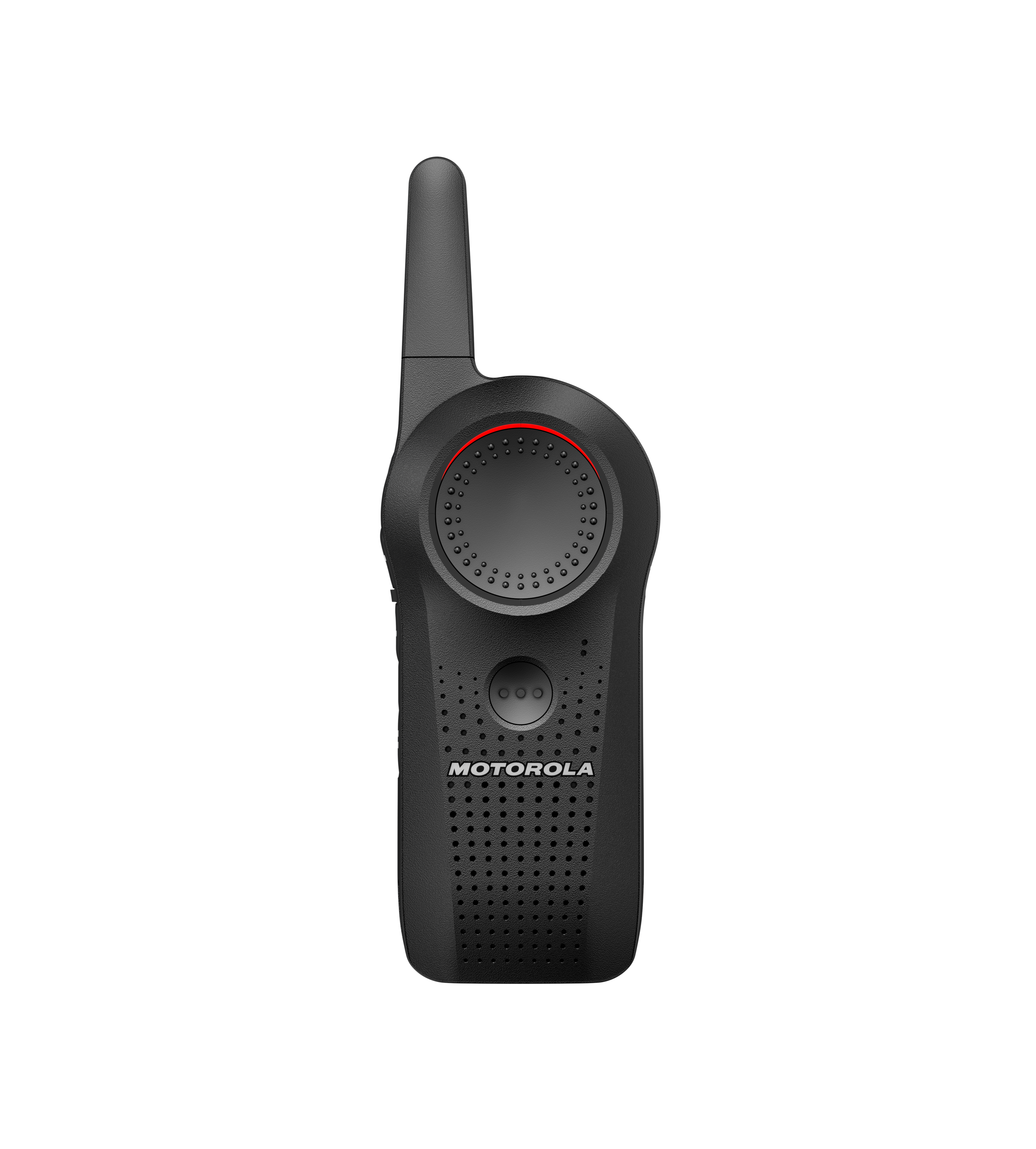
1. Motorola Curve — Best Overall for Mid-Size Manufacturing Plants
| Specification | Detail |
|---|---|
| Frequency | Digital 900 MHz (902–928 MHz) |
| Power | 1 watt digital (equivalent to ~4 watts analog) |
| Channels | 10 |
| Indoor Coverage | Up to 300,000 sq ft / 20 floors |
| Battery Life | ~14 hours |
| Durability | MIL-STD-810 compliant, water-resistant |
| Privacy | Frequency Hopping Spread Spectrum (FHSS), 10,000 privacy codes |
| Weight | 5.11 oz |
The Motorola Curve is the strongest all-around choice for most manufacturing plants. Its 900 MHz digital signal penetrates concrete and steel-reinforced structures more effectively than comparable UHF analog radios, and its 14-hour battery comfortably clears a 12-hour shift with margin. At 5.11 ounces, it's light enough that workers wearing it on a belt clip don't notice it over a full day.
The Page All and Call All Available functions let supervisors reach the entire plant instantly—which is exactly what a production shutdown or safety event requires. The Direct Call function handles the opposite scenario: a supervisor reaching a specific worker without broadcasting to the floor. That distinction—all-call versus private call—is operationally significant in facilities where broadcasting sensitive information plant-wide creates problems.
Frequency Hopping Spread Spectrum (FHSS) technology keeps communications on the Curve secure from outside interception, a practical concern in competitive manufacturing environments where production schedules and inventory positions are proprietary. The 10,000 privacy codes provide an additional layer of channel isolation.
Why it fits manufacturing specifically
- 14-hour battery clears most shift lengths without an opportunity to charge mid-shift
- Digital signal penetrates steel and concrete more effectively than UHF analog at similar wattage
- 10 channels accommodate full team segmentation across production, maintenance, QC, and warehouse
- FHSS encryption keeps plant communications secure from interception
- MIL-STD-810 construction handles drop, dust, and vibration on the plant floor
- 5.11 oz form factor is comfortable for workers across a full shift
2. Motorola RMU2080d — Best for Heavy-Use Shared Environments

| Specification | Detail |
|---|---|
| Frequency | UHF (450–470 MHz) |
| Power | 2 watts |
| Channels | 8 |
| Indoor Coverage | Up to 250,000 sq ft / 25 floors |
| Outdoor Range | Up to 2 miles |
| Battery | Lithium-ion rechargeable |
| Durability | MIL-STD-810 compliant |
| Special Features | Antimicrobial housing, NOAA weather alerts, display screen |
| Weight | 9 oz |
The RMU2080d is built for environments where radios get passed between workers across multiple shifts, handled roughly, and rarely babied. Its MIL-STD-810 construction covers shock, vibration, dust, and moisture—the full range of manufacturing floor conditions. The antimicrobial housing is a practical consideration in food processing, pharmaceutical manufacturing, and any facility where shared-use hygiene matters.
Eight channels and 99 UHF business-exclusive frequencies give the RMU2080d enough capacity for most mid-size plant organizations without crowding. The built-in display makes channel selection and status verification accessible to any worker, without requiring training or a manual. NOAA weather alert integration is particularly useful for facilities with outdoor yard or loading dock operations.
At 9 ounces, it's heavier than the Curve, but that weight reflects a genuinely rugged chassis. For facilities where radios spend their days in tool belts, on forklifts, or in the hands of workers who are hard on equipment, the RMU2080d's construction justifies the weight difference.
Why it fits manufacturing specifically
- MIL-STD-810 construction withstands drop, vibration, and environmental exposure on industrial floors
- Antimicrobial housing appropriate for food processing, pharmaceutical, and shared-use environments
- 8 channels and 99 business-exclusive UHF frequencies provide adequate capacity for most teams
- On-screen display simplifies channel navigation for multi-shift, multi-worker radio pools
- NOAA weather alerts support facilities with outdoor operations or loading dock exposure
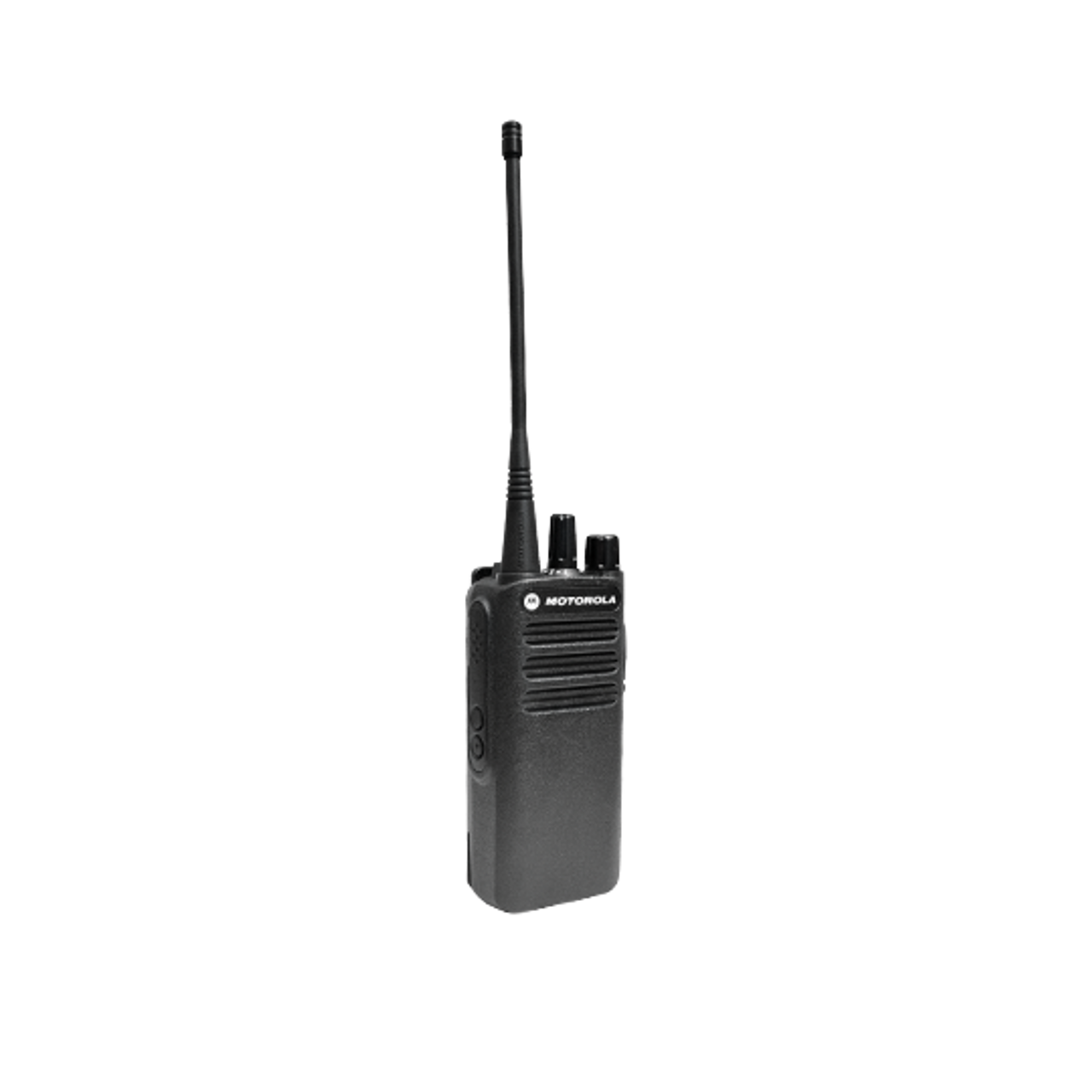
3. Motorola CP100d-UA — Best for Large Facilities and Repeater-Ready Networks
| Specification | Detail |
|---|---|
| Frequency | UHF (403–480 MHz) |
| Power | 4 watts |
| Channels | 16 |
| Indoor Coverage | Up to 350,000 sq ft / 40 floors |
| Repeater Compatible | Yes |
| Durability | Water-resistant, ruggedized chassis |
| Noise Cancellation | Yes |
When a manufacturing facility's square footage, building construction, or multi-building layout exceeds what 1–2 watt radios can reliably cover, the CP100d-UA is the correct next step. At 4 watts UHF, it delivers coverage up to 350,000 square feet indoors and 40 floors—enough for nearly any single-campus manufacturing operation. Its 16 channels accommodate even complex organizational structures without requiring teams to share channels.
The repeater-compatible design is the specification that separates the CP100d-UA from the two models above. A repeater picks up the radio's signal and rebroadcasts it at higher power, extending coverage into areas that direct radio-to-radio transmission can't reach: subterranean maintenance tunnels, heavily shielded machine rooms, remote corners of large campus footprints. Facilities with known dead zones—or that anticipate building expansion—should factor repeater compatibility into their radio selection from the start.
Noise cancellation is built in, which is the standard for a radio designed for industrial use at this power level. The ruggedized chassis is designed for the physical wear of daily use in demanding environments.
Why it fits large-facility manufacturing specifically
- 4-watt UHF output covers up to 350,000 sq ft—sufficient for most large single-campus plants
- 16 channels support full organizational separation across large, complex teams
- Repeater compatibility allows coverage extension into dead zones without a radio system overhaul
- Built-in noise cancellation designed for industrial noise environments
- UHF frequency provides reliable penetration through walls, machinery, and heavy construction
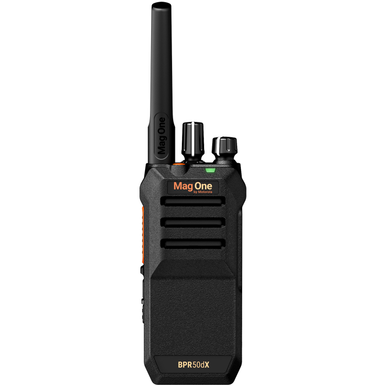
4. Motorola Mag One BPR50dx — Best for High-Channel Capacity and Extended Shifts
| Specification | Detail |
|---|---|
| Frequency / Mode | UHF (400–470 MHz), Analog & Digital (DMR) |
| Power | 4 watts (UHF) |
| Channels | 64 (across 4 zones, up to 16 per zone) |
| Indoor Coverage | Up to 400,000 sq ft / 40 floors |
| Battery Life | Up to 23 hours (2200 mAh Li-ion) |
| Durability | MIL-STD-810, IP55 (dust and water jet resistant) |
| Audio Output | 4 watts speaker output (loudest in Mag One family) |
| Charging | USB-C |
| Emergency | Dedicated emergency button, lone worker function |
| VOX | Yes |
The BPR50dx stands apart from the other models on this list in two ways: its 23-hour battery and its 64-channel capacity. For manufacturing operations running around-the-clock shifts, the 23-hour battery means a radio charged at the start of a day shift can carry through an overnight shift without intervention—a meaningful operational advantage in three-shift facilities where radio handoffs and charging logistics add friction.
The 64 channels, organized across four zones of up to 16 channels each, accommodate highly segmented organizational structures without any team sharing a channel with another. A facility with production lines, maintenance, QC, receiving, shipping, security, and management can give each group a dedicated channel and still have capacity left over for future expansion or cross-functional coordination channels.
The BPR50dx supports both analog and digital (DMR) operation. In digital mode, two conversations can occur simultaneously on a single channel using DMR's dual time-slot technology, effectively doubling channel capacity. This is particularly useful in facilities where channel congestion is already a problem or where the team is transitioning from an existing analog radio infrastructure—the BPR50dx can operate alongside legacy analog radios during a phased migration.
IP55 rating means the radio is protected against dust ingress sufficient to prevent interference with operation, and against water jets from any direction—a stronger water resistance specification than the IP54 minimum adequate for most manufacturing floors, and appropriate for facilities with active washdown operations or significant coolant exposure.
Why it fits manufacturing specifically
- 23-hour battery clears double shifts and three-shift operations without mid-shift charging
- 64 channels across 4 zones accommodate complex organizational structures with room to grow
- Dual analog/digital (DMR) mode allows integration with existing analog radio fleets during transitions
- IP55 water jet resistance appropriate for washdown environments and coolant-heavy floors
- MIL-STD-810 construction rated for shock, vibration, and temperature extremes
- Dedicated emergency button and lone worker function support safety compliance requirements
- USB-C charging simplifies fleet management—same cable as most modern devices
Also Worth Considering
Motorola DTR700 — 1 watt digital (900 MHz), 50 channels, indoor coverage up to 350,000 sq ft. A strong choice for facilities that need extensive channel capacity, digital-grade security via FHSS, and no FCC licensing overhead. The 50-channel capacity makes it particularly suited for large organizations that need granular team segmentation.
Motorola RMU2040 — 2 watts, 4 channels, UHF (450–470 MHz), indoor coverage up to 250,000 sq ft. A compact, cost-effective option for smaller manufacturing teams that don't require the full channel capacity of the RMU2080d.
Motorola WAVE PTX Series — LTE/Wi-Fi connected, unlimited range. For manufacturing organizations with operations across multiple facilities, cities, or states, the WAVE PTX eliminates range limitations entirely. GPS tracking allows supervisors to monitor worker locations across sites. Requires a monthly subscription per device.
Kenwood Intrinsically Safe Radios — For facilities classified as hazardous locations under OSHA 29 CFR 1910.307 or NFPA 70 (National Electrical Code) Article 500—including operations involving flammable solvents, combustible dust, or explosive atmospheres—standard radios are not appropriate. Intrinsically safe radios are specifically engineered and certified for use in Class I, II, and III Division 1 and 2 environments. If your facility falls under these classifications, intrinsically safe certification is a compliance requirement, not an option.
Side-by-Side Model Comparison
| Feature | Motorola Curve | Motorola RMU2080d | Motorola CP100d-UA | Motorola BPR50dx |
|---|---|---|---|---|
| Frequency / Mode | Digital 900 MHz | UHF Analog (450–470 MHz) | UHF Analog (403–480 MHz) | UHF Analog & Digital / DMR (400–470 MHz) |
| Power Output | 1 watt digital (~4W analog equivalent) | 2 watts | 4 watts | 4 watts |
| Channels | 10 | 8 | 16 | 64 (4 zones) |
| Indoor Coverage | 300,000 sq ft / 20 floors | 250,000 sq ft / 25 floors | 350,000 sq ft / 40 floors | 400,000 sq ft / 40 floors |
| Battery Life | ~14 hours | 12 hours | 10.7 hours | Up to 23 hours |
| MIL-STD-810 | Yes | Yes | No (rugged chassis) | Yes |
| IP Rating | Water-resistant | Water-resistant | Water-resistant | IP55 |
| Noise Cancellation | Yes | Yes | Yes | Yes |
| VOX Compatible | Yes | Yes | Yes | Yes |
| Repeater Compatible | No | No | Yes | No |
| Dual Analog/Digital | No (digital only) | No (analog only) | No (analog only) | Yes (DMR) |
| Emergency Button | No | No | No | Yes |
| Lone Worker Function | No | No | No | Yes |
| USB-C Charging | No | No | No | Yes |
| Antimicrobial Housing | No | Yes | No | No |
| Display Screen | No | Yes | Available (UA model: no display) | No |
| Weight | 4.2 oz | 9 oz | 9.9 oz | 10.6 oz |
| Best For | Mid-size plants, license-free use, long shifts | Shared-use fleets, food processing, rugged daily use | Large facilities, repeater networks, high channel count | Complex orgs needing 64 channels, dual mode, extended battery, and IP55 |
OSHA and Industry Compliance Considerations
Noise Exposure and Hearing Conservation
OSHA Standard 29 CFR 1910.95 requires employers to implement a hearing conservation program when noise exposures equal or exceed 85 dB as an eight-hour time-weighted average. Many manufacturing environments exceed this level continuously. When two-way radios are used with earpieces in high-noise environments, the earpiece should not block out ambient sounds needed for situational awareness (such as forklift warnings) while still delivering intelligible audio. Professional-grade earpieces designed for industrial use address this balance; consumer earbuds typically do not.
Hazardous Location Classifications
Facilities that handle flammable liquids, combustible dust, or explosive atmospheres may be classified as hazardous locations under OSHA 29 CFR 1910.307 and the National Electrical Code (NFPA 70) Article 500. Standard commercial two-way radios are not rated for use in these environments. Use of a non-intrinsically safe radio in a Class I Division 1 or Class II Division 1 area can present an ignition risk. If any area of your facility falls under these classifications, confirm with your safety team before deploying standard commercial radios there. Tech Wholesale carries intrinsically safe radio options rated for hazardous locations.
Lone Worker Safety
OSHA's General Duty Clause (Section 5(a)(1)) requires employers to provide a workplace free from recognized hazards. For workers operating alone in remote areas of large facilities—maintenance technicians, overnight security, forklift operators in remote warehouse sections—the ability to send an emergency alert is a recognized element of a reasonable lone worker safety program. Radios with dedicated emergency buttons and, where applicable, man-down detection, support this obligation. Verify that your radio's emergency alert function connects to a monitored channel, not just transmits on an unmanned frequency.
Frequently Asked Questions
How much range do I need for a manufacturing facility?
Coverage requirements depend on your building's square footage, construction materials, and layout. As a working baseline: 1–2 watt radios reliably cover up to 250,000 square feet in typical construction; 4-watt UHF radios extend to 350,000 square feet; digital radios operating in the 900 MHz band deliver comparable coverage to 4-watt analog units at 1 watt. Heavy steel framing, concrete block walls, and dense machinery all reduce effective range significantly. If your facility has these characteristics, plan for one tier more power or wattage than your square footage alone would suggest, or evaluate repeater infrastructure.
What durability rating should a manufacturing plant radio have?
MIL-STD-810 is the appropriate benchmark for manufacturing environments—it covers resistance to shock, vibration, dust, temperature extremes, and humidity. For water and dust ingress protection, an IP54 rating (splash resistant, limited dust protection) is adequate for most dry-to-moderate manufacturing floors. Facilities with active coolant spray, washdown areas, or high humidity should target IP67 or above. If your facility is a food processing or pharmaceutical plant subject to sanitation washdowns, confirm the radio's IP rating against your specific washdown pressure and temperature parameters before purchase.
How long should a manufacturing radio battery last?
For a 10-hour shift, a minimum of 12 hours of rated battery life provides an adequate buffer under typical transmission loads. The Motorola Curve is rated at approximately 14 hours. Keep in mind that rated battery life is measured under controlled conditions; actual battery life depends on transmission frequency, ambient temperature, and battery age. Multi-unit charging cradles allow a full radio fleet to charge overnight without managing individual chargers—a practical necessity for facilities running three-shift operations.
Can workers hear radio transmissions clearly above plant floor noise?
Yes, when using professional-grade radios with dedicated noise-canceling microphones. The noise-canceling microphone suppresses background industrial sound before transmission, so the receiving end hears the speaker's voice rather than the plant floor. On the receiving end, a radio with adequate speaker volume or a proper industrial earpiece delivers intelligible audio even in high-noise environments. Consumer-grade radios typically do not offer noise-canceling microphones; the difference in intelligibility on a loud manufacturing floor is significant.
What is VOX, and do manufacturing workers need it?
VOX stands for voice-operated exchange. When enabled, the radio transmits automatically when it detects speech, eliminating the need to press a push-to-talk button. For workers operating machinery, handling parts, or wearing gloves, VOX is a practical requirement rather than an optional feature. Pair VOX with an industrial-grade headset or earpiece for best results in high-noise environments. Most professional manufacturing radios support VOX; verify accessory compatibility before purchase to confirm your preferred headset works with the specific radio model.
Do we need intrinsically safe radios for our plant?
It depends on your facility's hazardous location classification. If any area of your plant is classified as Class I Division 1 or Class II Division 1 under OSHA 29 CFR 1910.307 and NFPA 70 Article 500—meaning flammable gases, vapors, or combustible dusts are present under normal operating conditions—intrinsically safe radios are required in those areas. Standard commercial radios, including the models on this page, are not rated for hazardous location use. Tech Wholesale carries intrinsically safe options; contact our team and we'll match you to the correct certification for your environment.
How many radios does a manufacturing plant need?
A practical starting point is one radio per role that requires real-time coordination: production supervisors, maintenance leads, quality control, warehouse leads, and management. For a typical 50-person plant with five operational teams, 10–15 radios is a reasonable initial deployment. Multi-shift operations require either enough radios for simultaneous shift use or a charging rotation that ensures fully charged units are available at every shift change. Tech Wholesale offers quantity pricing on orders of five or more units—request a quote and we'll provide best pricing for your fleet size.
What emergency features should manufacturing radios have?
At minimum, a dedicated emergency button that broadcasts an immediate alert to supervisors or a monitoring station. For facilities with lone workers, remote areas, or at-height operations, man-down detection is a meaningful addition—it uses built-in accelerometers to automatically trigger an alert if the radio detects a fall or extended period of immobility. Verify that the emergency broadcast is configured to reach a monitored channel; an emergency transmission on an unmanned frequency provides no practical safety benefit.
Why Buy from TechWholesale.com
Tech Wholesale has been supplying two-way radios to manufacturing teams since 1997. We are an authorized dealer for Motorola and Kenwood—every radio we sell carries the full manufacturer warranty, qualifies for manufacturer service and repair, and is backed by our own lifetime technical support.
What that means for your operation
- Lifetime technical support included with every purchase—call or email our team for the life of your radio fleet, not just through the warranty period
- Quick Quotes—request a custom quote for large teams.
- Straight consultation—we'll tell you when a less expensive radio fits your facility, not push you toward a higher-margin product
- Free shipping on qualifying orders
- Authorized dealer only—no gray market inventory, no voided manufacturer warranties
- Radio rentals available—for project-based or short-term manufacturing needs, radio rentals are an option
If you're not sure which model fits your facility's layout, construction, and team structure, use our Find My Radio tool or request a quote. We'll ask a few specific questions about your plant and respond with a concrete recommendation—no obligation.
1-888-925-5982 | Service@TechWholesale.com
Related Reading
From TechWholesale.com
- Two-Way Radios for Warehouses
- Lone Worker / Man Down Functionality Explained
- VOX: How Voice-Activated Transmission Works
- Frequency Hopping Spread Spectrum (FHSS) Explained
- UHF vs. VHF: Frequencies Explained
- Privacy Codes – How to Eliminate Outside Interference
- Radio Repeaters: When and Why to Use One
- Intrinsically Safe Two-Way Radios for Hazardous Locations
External Resources
- OSHA Occupational Noise Exposure (29 CFR 1910.95)
- OSHA Electrical Safety in Hazardous Locations (29 CFR 1910.307)
- NFPA 70: National Electrical Code (Article 500 – Hazardous Locations)
- Motorola Solutions – Two-Way Radio Product Line
Article by Kristin Wood, a two-way radio consultant @ Tech Wholesale | Authorized Motorola & Kenwood Dealer Since 1997 | Last Updated: June 2026