

Buy the first radio you see, and you might end up with a unit full of static, a battery that dies mid-shift, and a build that won't survive a single drop. That's not a communication tool—that's a waste of money.
The right two-way radio changes that.
We've sold thousands of radios to retailers across the country and compiled everything we know into this guide.
What a Liquor Store Really Needs From a Radio
Picture a Friday night rush. The line at the register stretches ten customers deep. Someone's asking about a specific bourbon, but no one knows if it's in the back or just out of stock. The floor associate is tied up comparing tequila brands with another customer. And a delivery truck just pulled up out front with no one to receive it.
Everyone needs something. Nobody's talking to each other.
A quality two-way radio solves all of this. But not every radio is built the same, and not every radio is right for your store. Here's what to consider before buying.
Coverage & Power
Matching radio power to your store size is the most important decision you'll make. Too little power and you'll get dead zones. Too much and you're overpaying for range you'll never use.
- Small liquor stores: 1–2 watts covers up to 200,000 sq ft—more than enough for a single-floor retail layout.
- Large stores or multiple buildings: Look for 3–4 watts on analog, or 1 watt on digital (which delivers equivalent power with better signal clarity) to cover up to 350,000 sq ft.
- Thick concrete walls: Add at least 1 watt to your requirements to punch through the interference.
- Multiple locations: LTE and Wi-Fi-enabled radios—like the Motorola WAVE PTX series—offer unlimited coverage across any distance.
Number of Channels
Channels let you segment team conversations so not everyone hears everything. A small team might only need one shared channel. A larger operation benefits from multiple channels—for example, one for floor staff, one for the register, and one for management.
Channels also support private communication. "Sam, call Jeff on channel two." Easy breezy. That's concise and direct communication, without cluttering the main channel.
Build Quality & Brand
A radio that falls apart in six months isn't saving you money—it's costing you more. Motorola and Kenwood are the two most trusted names in business two-way radios. Both brands are purpose-built for commercial use, tested for five years of field use, and backed by manufacturer warranties ranging from one to three years. They're also subscription-free, which means no monthly costs eating into your margins.
Key Features to Look For
Not all features are created equal. Here's what actually matters for a liquor store environment:
- Clear audio quality: Background noise from music, customers, and delivery trucks is constant. Your radios need to cut through it.
- Long battery life: Radios should last a full shift—or longer—without needing a recharge, especially for stores with late-night hours.
- Durability: Drops happen. Spills happen. Look for impact-resistant builds that can handle the pace of a busy store.
- Lightweight & compact design: Staff move fast. Radios need to clip on easily and stay out of the way.
- Privacy codes / interference protection: Busy shopping centers often have multiple businesses running radios. Interference eliminator codes keep your team's conversations clean.
- Hands-free / earpiece compatibility: Keeps both hands free for scanning, stocking, and helping customers.
- Easy-to-use interface: New hires shouldn't need a training session just to use a radio.
Our Top Radio Picks for Liquor Stores
Every recommendation below comes from direct experience working with thousands of these units. These aren't guesses—they're proven performers.
Best for Small Liquor Stores
Motorola CLS1110

Best for: Small teams that need simplicity and reliability.
| Feature | Spec |
|---|---|
| Channels | 1 |
| Power | 1 watt (UHF) |
| Coverage | Up to 200,000 sq ft |
| Battery Life | 18 hours |
The CLS1110 is as straightforward as it gets. One channel means everyone communicates together—which works perfectly for a small staff. With 18 hours of battery life from its lithium-ion pack, it'll outlast your longest shift. It also includes 83 digital and 38 analog private lines, 121 interference eliminator codes, and 56 business-exclusive frequencies to keep your conversations clean. A keypad lockout feature prevents unauthorized use.
It's the most affordable option on this list, and for a small team, it delivers everything you need.
Motorola CLP1080e
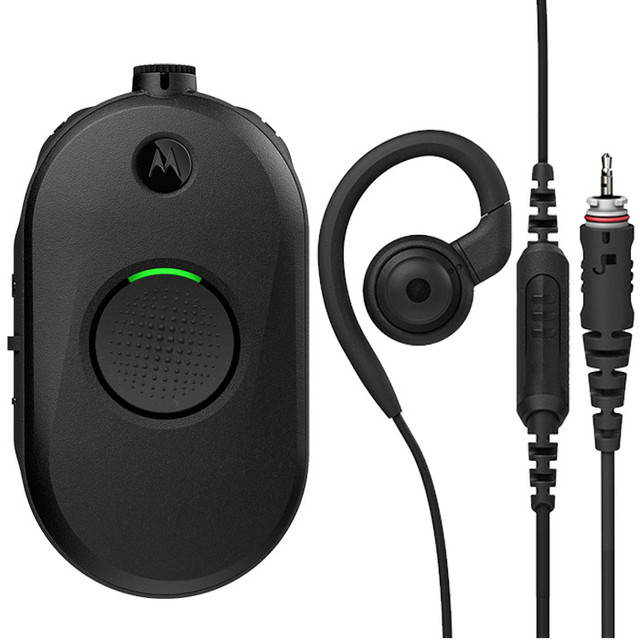
Best for: Staff who need discreet, hands-free communication.
| Feature | Spec |
|---|---|
| Channels | 8 |
| Power | 1 watt (UHF) |
| Coverage | Up to 100,000 sq ft |
| Battery Life | 12 hours |
At just 2.38 ounces, the CLP1080e is the smallest and lightest radio on this list. It's barely noticeable on a uniform—ideal for stores where a professional appearance matters.
Eight channels give a mid-size staff plenty of flexibility to segment conversations. The device ships with a discreet earpiece and belt holster, and the large central push-to-talk (PTT) button keeps operation simple. It's also repeater-capable, meaning you can double its range if needed. Anti-microbial casing is a practical bonus for high-touch environments.
Best for Large Liquor Stores & Multi-Building Operations
Motorola Curve
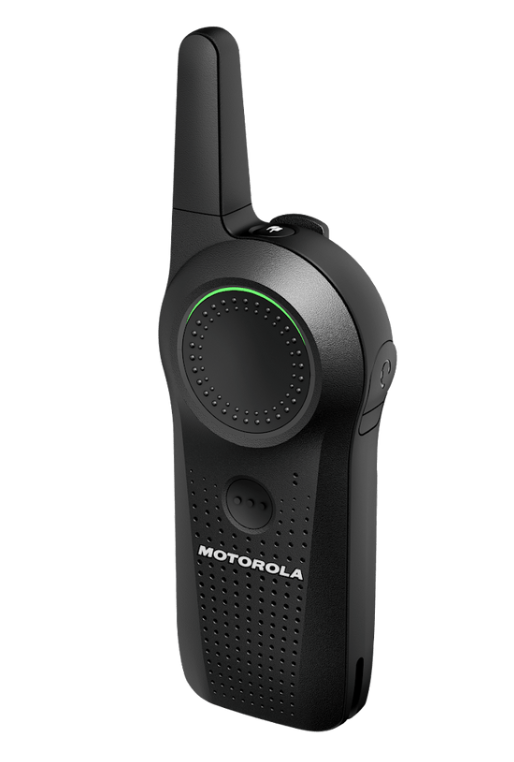
Best for: Larger teams and bigger footprints
| Feature | Spec |
|---|---|
| Channels | 10 |
| Power | 1 watt digital (equivalent to 4 watts analog) |
| Coverage | Up to 300,000 sq ft / 20 floors |
| Battery Life | 14 hours |
The Motorola Curve is built for stores that need serious coverage without serious complexity. Operating on a digital band, it delivers the power of a 4-watt analog radio from a 1-watt digital signal—and because it's digital you get better privacy and audio clarity.
Ten channels give large teams the flexibility to separate conversations by department or task. The Page All and Call All Available functions are especially useful in fast-moving situations—if there's an issue at the front of the store, you can reach everyone instantly.
For sensitive communication, the Curve uses Frequency Hopping Spread Spectrum technology and offers 10,000 privacy codes. A Direct Call feature lets you contact one person without broadcasting to the group. At 4.2 ounces with a 14-hour battery, it's built to last through even the longest shifts.
Best for Multi-Location Operations
Motorola WAVE PTX Series
Best for: Chains or stores that need to stay connected across multiple locations.
| Feature | Spec |
|---|---|
| Coverage | Unlimited (LTE & Wi-Fi) |
| Extras | GPS tracking, emergency button, smartphone-compatible |
| Pricing | Monthly subscription per device; lease-to-own options available |
Need to coordinate with a delivery driver across town? Want to check inventory at another location without picking up a phone? The WAVE PTX series connects staff across unlimited distances using LTE and Wi-Fi, removing all traditional radio range limitations.
GPS tracking keeps you informed of staff locations, and the built-in emergency button adds a safety layer for late-night shifts. You can even communicate from a smartphone—no dedicated radio hardware required on one end.
The trade-off is a monthly subscription fee per device, but lease-to-own payment options help manage the upfront cost.
Frequently Asked Questions
How many radios does a typical liquor store need?
A good rule of thumb is one radio per active staff member per shift. At minimum, you'll want one for the register, one for the floor, and one for the back of house or receiving area.
Can I use consumer walkie-talkies instead?
Consumer-grade radios are built for occasional recreational use, not daily business operations. They tend to have shorter battery lives, weaker signals, fewer privacy features, and less durable builds. For a working retail environment, a business-grade radio pays for itself quickly.
What's the difference between UHF and digital radios?
UHF (analog) radios are reliable, widely used, and cost-effective for most store sizes. Digital radios offer cleaner audio, longer effective range per watt, and better performance in signal-dense environments. For larger stores or multi-building operations, digital is often worth the investment.
How long do business radios typically last?
Motorola and Kenwood radios are tested for five years of commercial field use. With proper care and regular charging practices, many businesses get well beyond that before needing replacements.
Find the Right Radio for Your Store
The right two-way radio for your liquor store comes down to three things: your store's size, your team's size, and how you need to communicate. A small single-location store will thrive with the CLS1110 or CLP1080e. A larger operation needs the range and channel capacity of the Motorola Curve. And if you're managing multiple locations, the WAVE PTX series gives you the connectivity to run everything from one place.
At Tech Wholesale, we've spent over 25 years matching businesses with the right radio for their needs. We include lifetime tech support with every purchase—because buying the radio is just the start.
Ready to equip your team? Request a quote for our best pricing, or reach out to our support team directly with any questions. We're here to help you make the right call.