
Every missed call on the floor is a missed sale. A customer looking for help restocking lumber walks out because no one responded. A cashier needed backup, but the request never made it past the register. The stockroom got a delivery, but the floor team has no idea.
Everyone's busy—but no one's connected.
That's exactly why hardware stores across the country are equipping their teams with two-way radios. They close communication gaps fast, without complicated setups or monthly phone plan fees.
But not every radio is built for the hardware store environment. Buy the wrong one and you're dealing with dead zones, static, short battery life, and a device that falls apart after a few drops on concrete. This guide cuts through the noise to help you find the radio that genuinely fits your store.
We've sold thousands of radios since 1997, and we've compiled everything we know right here. By the end, you'll know exactly what to look for—and which models are worth your investment.
What Is the Best Two-Way Radio for a Hardware Store?
For most hardware stores, the Motorola CLS1410 and the Motorola Curve are our top recommendations. Both are durable, lightweight, and easy for staff to use from day one.
That said, radios are not one-size-fits-all. Store size, team structure, and building materials all affect which radio will perform best in your environment. Here's what to consider before making a decision.
What to Look for in a Hardware Store Radio
Coverage That Matches Your Store Size
Matching radio power to your building size is one of the most important decisions you'll make. Too powerful, and you're overpaying. Too weak, and you're dealing with dead zones and dropped calls.
- Small stores: 1–2 watt radios provide reliable coverage up to 200,000 square feet—more than enough for most compact hardware stores.
- Larger stores or multiple buildings: Step up to 3–4 watt radios (analog), or 1 watt digital, which can cover up to 350,000 square feet and punch through concrete and steel walls.
- Multiple locations: Consider LTE/Wi-Fi-enabled radios like the Motorola WAVE PTX series for truly unlimited range.
Heavy building materials like thick concrete walls can weaken signals. If your store has a lot of structural steel or dense walls, go one watt stronger than you think you need.
Channels for Every Team
Channels let you segment conversations so the right people hear the right information—without clogging everyone's radio with irrelevant chatter.
For a hardware store, we recommend organizing channels like this:
- Front Register Team – Price checks, backup requests, checkout issues
- Sales Floor Staff – Inventory questions, customer assistance, inter-department coordination
- Receiving & Stockroom – Incoming shipments, restock alerts, backstock availability
- Curbside & Delivery – Pickup orders, customer arrival alerts, delivery coordination
- Management – Staffing decisions, emergencies, operational updates
Channels also make private conversations easy. Tell Sarah to meet Tom on channel two, and they can talk without interrupting anyone else. Simple, clean, effective.
Features Worth Having
Here's what separates a great hardware store radio from a mediocre one:
- Long battery life – Staff need reliable communication through full shifts without stopping to recharge mid-day.
- Rugged, durable build – Drops happen. Look for MIL-STD or IP-rated radios that are shock-resistant, dustproof, and water-resistant.
- Clear audio with noise cancellation – Forklifts, saws, and busy aisles create real background noise. You need audio that cuts through it.
- VOX (voice-activated transmission) – Hands-free operation for employees who are lifting, stocking, or otherwise occupied.
- Multiple channels – Avoid crosstalk by giving each team their own dedicated line.
- Earpiece/headset compatibility – Keeps communication discreet on the floor, especially when customers are nearby.
- Emergency alerts or lone worker functions – A safety net for staff working in isolated areas like high racks or during early/late shifts.
- Cloning and programming tools – Saves significant time when deploying radios across a large team.
Quality Brands That Last
A radio that breaks within a year isn't saving you money—it's costing you twice. Motorola and Kenwood are the two most trusted brands in the two-way radio industry. Both are purpose-built for demanding environments, tested for five years of field use, and backed by manufacturer warranties of one to three years depending on the model.
They're also designed to be intuitive. Staff can pick them up and use them with minimal training, which matters when you're busy running a store.
Our Top Two-Way Radio Picks for Hardware Stores
Based on our 25+ years of experience and thousands of radios sold, here are the models we recommend most often for hardware stores.
Given the physical layout and team structure of most hardware stores, we typically recommend 2–3 watt radios with at least four channels.
Best for Small Stores
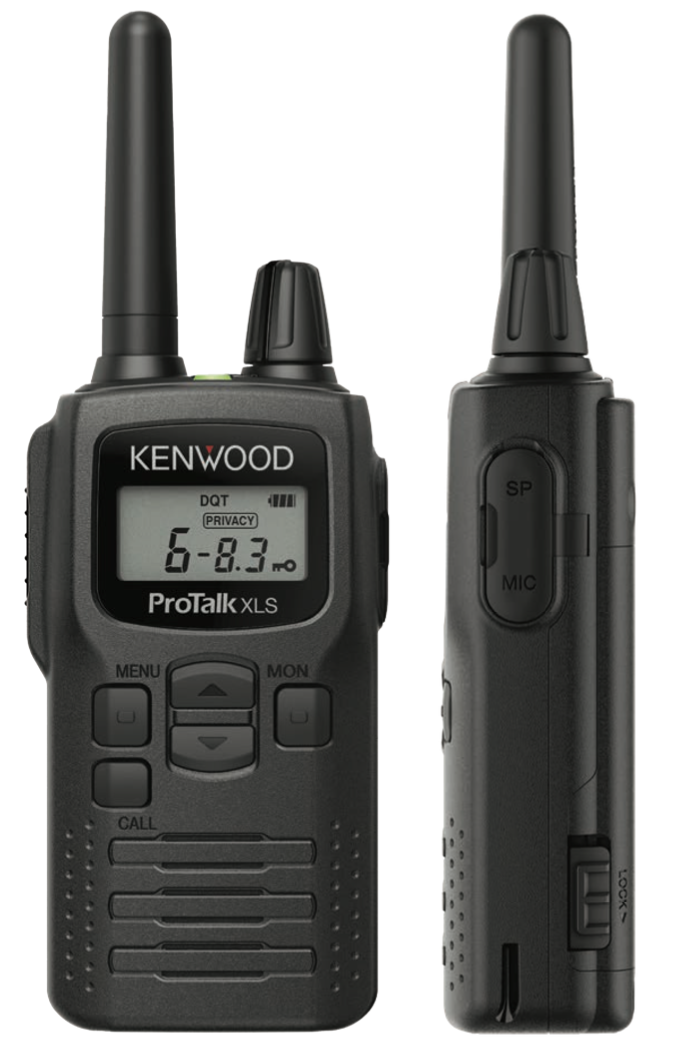
Kenwood PKT300
| Spec | Detail |
|---|---|
| Channels | 6 |
| Power | 2 watts (UHF) |
| Indoor Coverage | Up to 275,000 sq ft / 20 floors |
| Outdoor Range | Up to 2 miles |
| Key Features | Display, VOX, belt clip, standing charging tray |
The PKT300 is compact, easy to use, and built to perform under pressure. Six channels give you plenty of room to segment your team, and UHF frequency means the signal travels well through concrete and steel—common in hardware store construction.
The VOX feature is a genuine productivity boost, allowing hands-free operation for staff who are constantly moving or carrying materials. It comes ready to go with a standing charging tray, wall charger, and belt clip.
This is the right radio if: Your store is under 275,000 square feet, your team needs hands-free operation, and you want a rugged, no-fuss device.
Motorola RMU2040
| Spec | Detail |
|---|---|
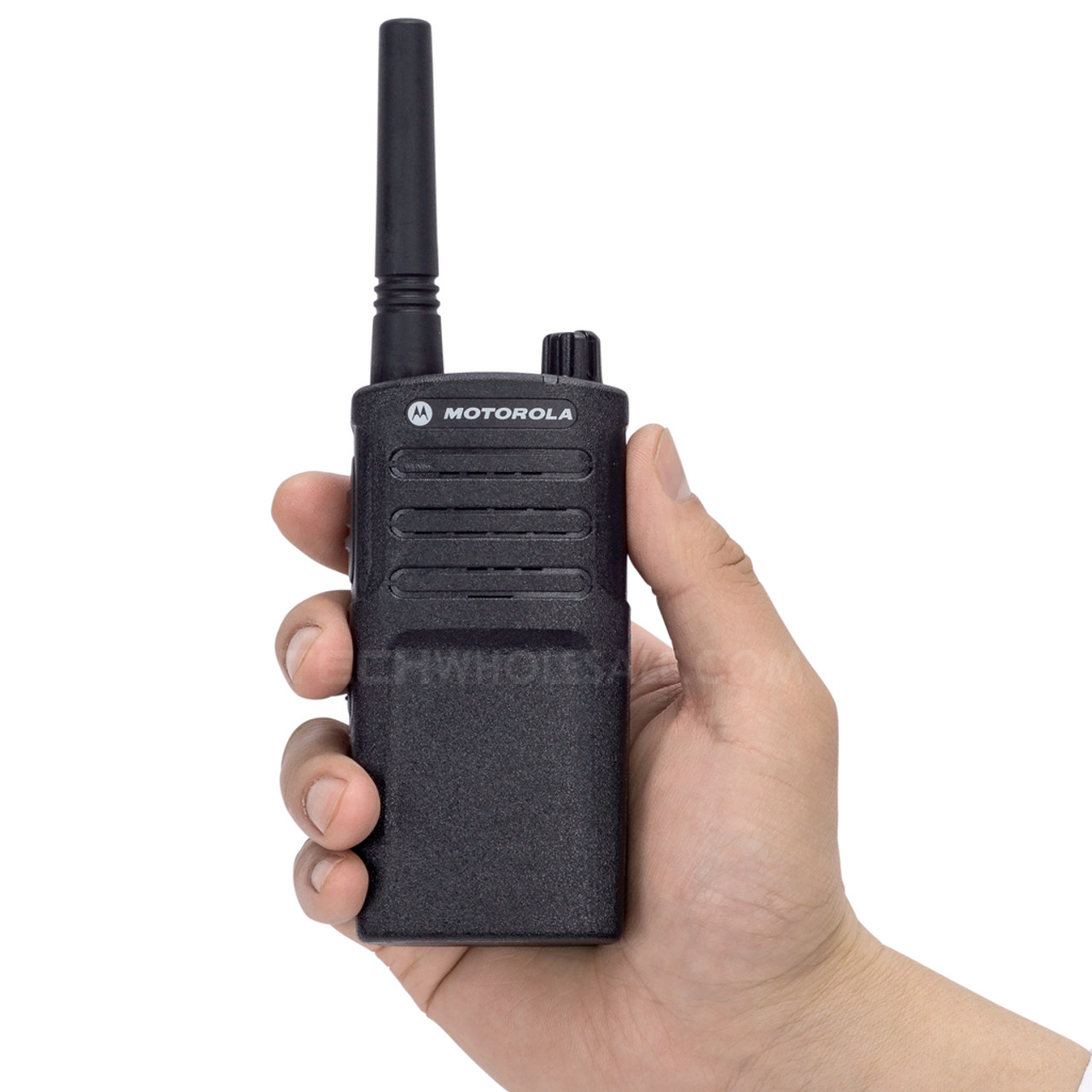
| Channels | 4 |
| Power | 2 watts (UHF, 450–470 MHz) |
| Indoor Coverage | Up to 250,000 sq ft / 20 floors |
| Outdoor Range | Up to 2 miles |
| Key Features | Military-grade hardware, 219 privacy codes, 99 UHF business frequencies, antimicrobial coating |
The RMU2040 is built to military standard—meaning drops, impacts, and rough handling won't take it out of commission. Four channels cover the core team segments for most small to mid-size stores, and 219 privacy codes ensure your channels stay clean and interference-free.
One feature worth highlighting: the antimicrobial coating. Radios pass through many hands during a shift. This keeps things hygienic without any extra effort from staff.
This is the right radio if: You need a durable, interference-resistant radio for a store under 250,000 square feet.
[Contact us for a free quote on the Motorola RMU2040]
Best for Larger Stores & Multiple Buildings
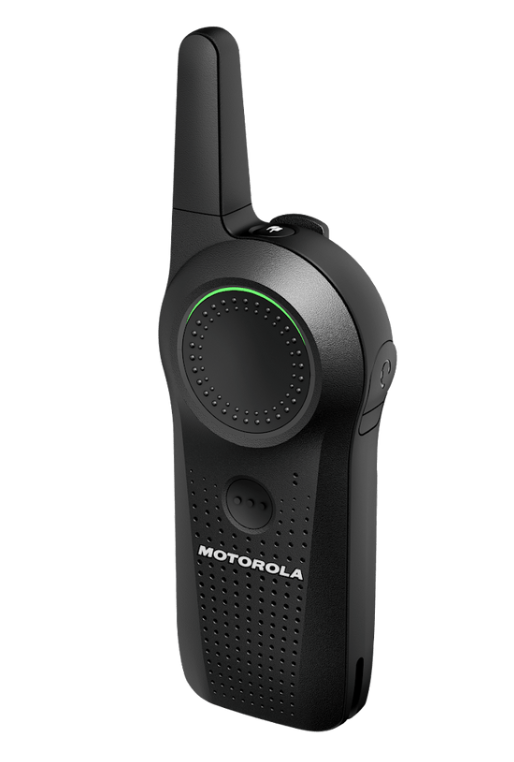
Motorola Curve
| Spec | Detail |
|---|---|
| Channels | 10 |
| Power | 1 watt digital (equivalent to ~4 watts analog) |
| Indoor Coverage | Up to 300,000 sq ft / 20 floors |
| Weight | 4.2 oz |
| Key Features | No FCC license required, 14-hour battery life, Frequency Hopping Spread Spectrum, 10,000 privacy codes, Page All / Call All, antimicrobial coating |
The Motorola Curve is our most popular recommendation for larger hardware stores. Ten channels give you the flexibility to manage multiple departments and shifts cleanly. Digital transmission delivers clearer audio at the same range as a much higher-power analog radio—and it does it without requiring an FCC license, which saves you an ongoing administrative cost.
The 14-hour battery life is one of its standout qualities. Rechargeable lithium-ion keeps staff connected through even the longest shifts without needing a mid-day swap.
Security is also a strong point. Frequency Hopping Spread Spectrum technology combined with 10,000 privacy codes makes this the most secure radio on this list. The Page All and Call All Available functions let management reach the entire team instantly—critical in an emergency.
This is the right radio if: You run a larger store, need 10 channels to manage a bigger team, and want a lightweight, secure, no-license-fee option.
Best for Unlimited Coverage Across Multiple Locations
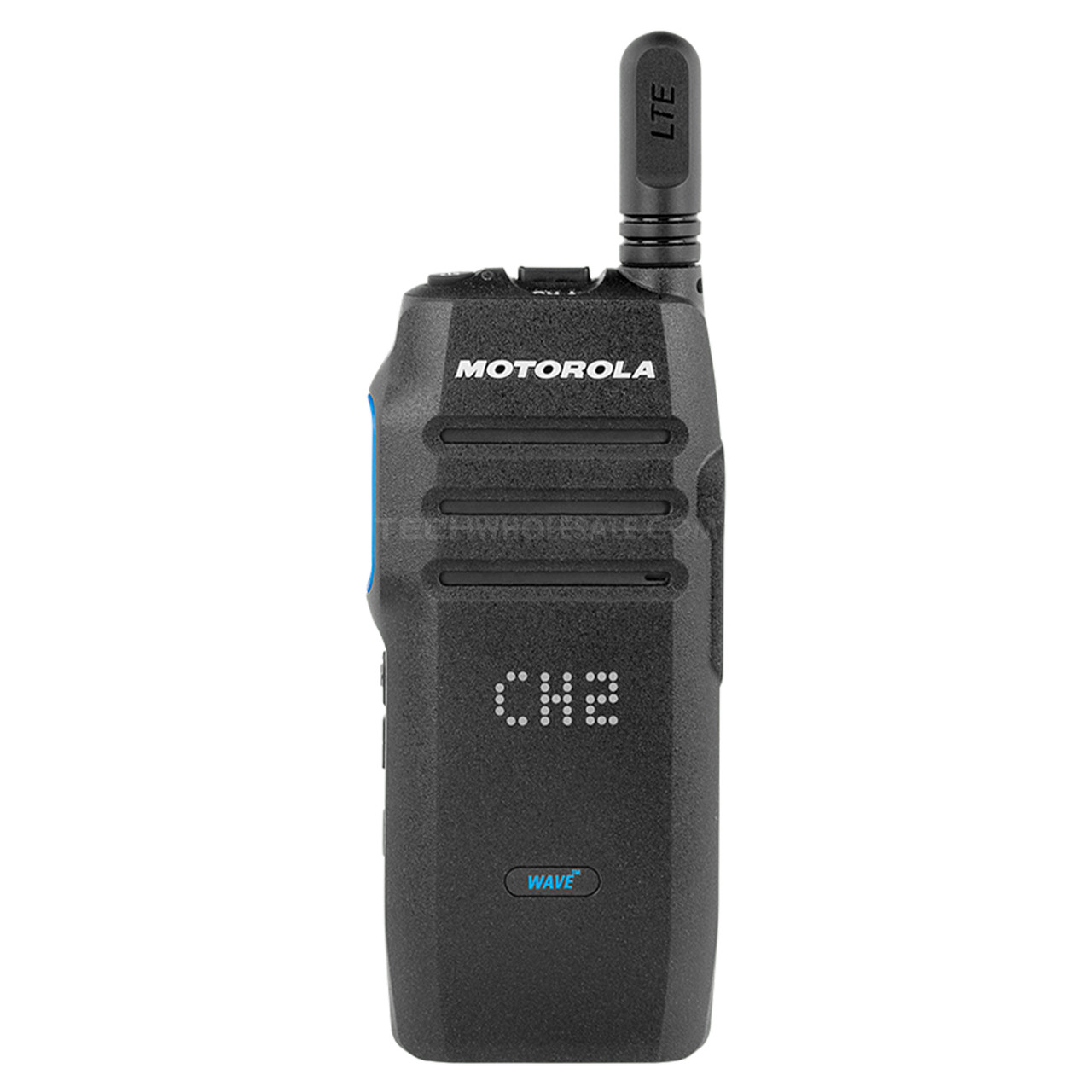
Motorola WAVE PTX Series
| Spec | Detail |
|---|---|
| Coverage | Unlimited (LTE & Wi-Fi) |
| Key Features | GPS tracking, emergency button, talk-to-radio-from-phone, failsafe antenna-to-antenna at 350,000 sq ft |
| Pricing | Monthly subscription per device; lease-to-own options available |
If you operate across multiple locations, cities, or states, traditional radio range is a limitation you can't engineer around. The Motorola WAVE PTX TLK100 solves this by using LTE and Wi-Fi for unlimited coverage.
GPS tracking lets you locate staff in real time. The emergency button adds an important safety layer for lone workers. And if cellular or Wi-Fi goes down, the radio automatically falls back to antenna-to-antenna communication with coverage up to 350,000 square feet—so you're never fully cut off.
Monthly subscriptions apply per device, with lease-to-own options available to reduce upfront costs.
This is the right radio if: Your business spans multiple locations and you need seamless communication regardless of distance.
Frequently Asked Questions
Do I need an FCC license for a two-way radio in my hardware store?
It depends on the radio. Most business-band UHF/VHF radios operating on licensed frequencies require an FCC license. However, some radios—like the Motorola Curve—operate on unlicensed digital frequencies, so no license is required. When in doubt, check with your supplier before purchasing.
How many radios do I need for my hardware store?
A general rule: one radio per active staff member on the floor. For most stores, that means accounting for shift overlap and having one or two spares for charging rotations. If you're unsure, reach out to our team for a recommendation based on your store size and team structure.
How long do two-way radios last?
Motorola and Kenwood radios are tested for five years of field use and backed by manufacturer warranties of one to three years. With proper care and charging habits, many stores get significantly more life than that from their devices.
Can I use radios across different brands or models?
Generally, radios from different manufacturers can communicate if they share the same frequency and channel settings. However, for seamless setup and consistent audio quality, we recommend sticking to one brand across your team. Mixed setups can also complicate programming and cloning.
What's the difference between digital and analog radios?
Analog radios are straightforward and widely compatible. Digital radios—like the Motorola Curve—offer clearer audio, better range per watt, and often more privacy features. Digital also typically requires no FCC license, depending on the model. For most hardware stores, digital is the better long-term investment.
Ready to Connect Your Team?
Communication problems in a hardware store don't just slow things down—they cost you customers and sales every single day. The right two-way radios change that. One call from the floor to receiving. One alert about a restock. One quick check-in that keeps the whole operation moving.
Our top picks for hardware stores:
- Small stores: Kenwood PKT300 or Motorola RMU2040
- Larger stores: Motorola Curve or Motorola CP100d-UA
- Multiple locations: Motorola WAVE PTX TLK100
Not sure which one fits your store? Reach out to the Tech Wholesale team today. With over 25 years of experience and lifetime tech support included with every purchase, we'll help you find the right radio at the right price—no guesswork required.