

Your staff cover every hole, from the first tee to the back nine. Business-grade two-way radios give your pro shop, marshals, and grounds crew instant contact across the course, so play keeps moving and every golfer has a great round.
The right radio makes all the difference, and we’ll help you find it! Since 1997, we’ve worked with hundreds of golf courses across the US. Here’s how to choose.
Which walkie talkie is the right fit for your Golf Course?
The Quick Answer
- A full 18-hole operation → Motorola CP100d-V. Five watts of VHF is the right combination for open ground. 160 channels and a display, so the pro shop, rangers, maintenance, and F&B each have a line and nobody's guessing which one they're on.
- A smaller course or a tighter budget → Motorola CP100d-VA. Same 5-watt VHF platform, 16 channels, no display. If your channel plan is four or five lines and it isn't changing, this is the same reach for less.
- Grounds and maintenance crews, or a Kenwood fleet → Kenwood NX-P1200NVK. Sixty-four channels across four zones for a superintendent running mowing, irrigation, and course setup as separate operations.
Quick Links
Why Golf Courses Have Unique Radio Requirements
Golf course operations are fundamentally different from most commercial environments. Staff are dispersed across 100 to 200 acres of open terrain, often separated by hills, tree lines, and structures that block or scatter radio signals. Teams work across completely separate functional roles—grounds maintenance, pro shop, marshals, starters, beverage cart attendants, and event staff—who need to communicate instantly without cross-talk or confusion.
Unlike a warehouse or hospital, a golf course has no walls to help concentrate radio signal. Outdoor UHF radios that perform well inside buildings often underperform in wide-open terrain where signal travels in line-of-sight paths and elevation changes create dead zones. This is exactly why all three radios on this page are VHF: the longer VHF wavelength is the right tool for open ground.
Golf courses face a specific set of pain points that no other industry shares in quite the same combination:
Coverage across 100–200 acres of open terrain. A standard 18-hole course occupies roughly 100 to 200 acres depending on layout. Signal must reach from the clubhouse to the farthest hole consistently, regardless of terrain features. A 5-watt VHF radio like the CP100d-V is rated for 5–7 miles of range on open land with limited obstructions—more than enough to cover a full 18-hole layout end to end.
Weather exposure throughout the shift. Grounds crews and marshals work in morning dew, afternoon rain showers, high humidity, and summer heat. Radios without adequate ingress protection fail or develop intermittent issues quickly in these conditions. A minimum IP54 rating—resistance to dust and water spray from any direction—is the floor for outdoor golf course use. All three radios here are IP54-rated.
Wind and outdoor ambient noise. A marshal riding a cart at 15 mph, or a grounds crew member operating equipment, faces significant wind noise during transmission and reception. Radios with noise-filtering microphones and sufficient speaker output are required for clear communication in these conditions.
Long shift durations. Golf courses operate from before dawn through evening events. A radio battery that lasts only 8 hours leaves staff without communication for the end of their shift. Battery life should be evaluated against the full operational day, not a standard 8-hour shift.
Multi-role coordination requiring channel discipline. Grounds crew discussions about irrigation schedules do not belong on the same channel as marshal communications about pace of play. Without dedicated channels per operational role, critical information gets buried in irrelevant cross-talk. Most professional golf course operations require a minimum of 4–6 dedicated channels—and a 160-channel radio like the CP100d-V leaves room to grow.
Emergency weather and safety response. Golf courses have a documented obligation to notify players and staff of lightning risk. The National Lightning Safety Institute recommends a 30-minute suspension rule from the last observed lightning strike. Communicating a course-wide weather hold requires instant, simultaneous contact with marshals, starters, and pro shop staff—something a cell phone system cannot reliably deliver at the speed and scale a radio can.
What to Look for in a Golf Course Two-Way Radio
Frequency: VHF vs. UHF for Golf Courses
VHF (Very High Frequency, 136–174 MHz) is the correct frequency band for most golf course applications. VHF waves are longer than UHF waves, which allows them to travel farther in open outdoor environments and diffract more readily around terrain features like hills and berms. UHF excels in buildings with many walls; VHF excels outdoors with unobstructed line of sight. For a course where signal must reach from hole 1 to hole 18 across open fairway, VHF is the appropriate starting point—which is why every radio recommended below operates in the VHF band. Learn more: UHF vs. VHF — Frequencies Explained.
Output Power
Golf course radios should deliver a minimum of 4–5 watts for outdoor VHF use. At this power level, a properly configured VHF radio provides dependable coverage across a standard 18-hole layout under typical terrain conditions. All three radios on this page transmit at the full 5 watts.
Battery Life
Golf course operations routinely run 10 to 14 hours from pre-dawn grounds work through evening events. The Motorola CP100d standard Li-Ion battery (PMNN4476) is rated for up to 10.7 hours in analog mode and up to 14.4 hours in digital mode; the high-capacity battery (PMNN4080) extends that to roughly 15 hours analog and 20 hours digital. For operations running double shifts or back-to-back events, a multi-unit charging cradle allows battery rotation without downtime.
Durability Ratings
Golf course radios should meet two durability benchmarks: IP54 ingress protection (dust and water spray resistance from any direction) and MIL-STD-810 compliance for shock, vibration, temperature, and humidity resistance. All three radios here are IP54-rated, and the Motorola CP100d models additionally meet U.S. Military Standard 810 C, D, E, F, and G and have passed Accelerated Life Testing simulating five years of hard field use. MIL-STD-810 is a U.S. Department of Defense standard that tests equipment against real-world environmental stressors far more extreme than typical outdoor golf course use.
Channel Capacity
A well-organized 18-hole course with a full team structure typically requires 6–8 dedicated channels. Courses running banquet or event operations alongside daily play may require more. The CP100d-VA covers the basics with 16 channels; the NX-P1200NVK offers 64; and the CP100d-V provides up to 160—ample headroom for the most complex multi-department operation.
Recommended Two-Way Radios for Golf Courses
1. Motorola CP100d-V — Best Overall for 18-Hole Courses
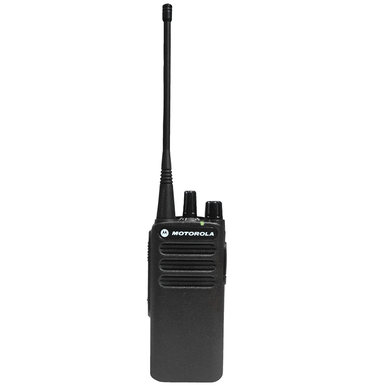
| Specification | Detail |
|---|---|
| Frequency | VHF (136–174 MHz) |
| Power | 5 watts |
| Channels | 160 |
| Mode | Analog & Digital (DMR) |
| Outdoor Range | 5–7 miles open land; 2–4 miles suburban; 10–15 floors indoors |
| Durability | IP54; MIL-STD-810 C/D/E/F/G; Accelerated Life Testing (5-year simulation) |
The CP100d-V is built for teams that can't afford a dropped call, and Motorola designed it specifically for demanding outdoor environments—golf courses, farms, construction sites, and surveying operations. With 5 watts of VHF power and up to 160 channels, it keeps every member of the crew connected across even the largest property, and its dual analog/digital operation lets a course run alongside an existing fleet and migrate to digital at its own pace.
Why it fits golf courses specifically
- 5–7 miles of open-land range comfortably covers a full 18-hole layout from clubhouse to the farthest hole.
- 160 channels accommodate complete multi-department separation—pro shop, marshals, grounds, starter, beverage cart, events—with room to spare.
- Dual analog/digital (DMR) mode protects the investment and supports a gradual migration to digital.
- IP54 plus MIL-STD-810 C–G and 5-year Accelerated Life Testing handle dew, rain, dust, and the daily physical demands of grounds work.
- No-display, knob-driven operation keeps it simple for seasonal staff with minimal training.
2. Motorola CP100d-VA — Best Value for Smaller Courses and Tight Budgets
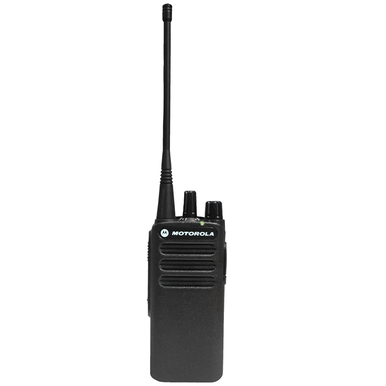
| Specification | Detail |
|---|---|
| Frequency | VHF (136–174 MHz) |
| Power | 5 watts |
| Channels | 16 |
| Mode | Analog |
| Form Factor | Non-keypad / non-display; channel selector knob |
| Durability | IP54; MIL-STD-810 C/D/E/F/G |
The CP100d-VA is the same rugged MOTOTRBO VHF platform as the CP100d-V at a lower entry price, configured with 16 channels instead of 160. For a 9-hole course, a compact par-3, or any operation that runs two or three roles rather than six, 16 channels is plenty—and the savings per unit add up quickly across a fleet. It keeps the features that matter outdoors: VOX hands-free transmit, Auto-Range Transponder System (ARTS) out-of-range alerts, talkaround for direct radio-to-radio communication, and voice announcements that confirm the selected channel without a display.
Why it fits golf courses specifically
- Full 5-watt VHF output delivers the same open-terrain reach as its 160-channel sibling.
- 16 channels cleanly cover smaller operations: pro shop, grounds, and marshals each get a dedicated channel.
- VOX hands-free operation lets a crew member transmit while operating equipment or driving a cart.
- ARTS warns staff with a tone and LED when they drift out of range of the group—useful on a sprawling property.
- IP54 and MIL-STD-810 C–G durability at the lowest cost of entry in the CP100d line.
3. Kenwood NX-P1200NVK — Best for Grounds Crews and Kenwood Fleets
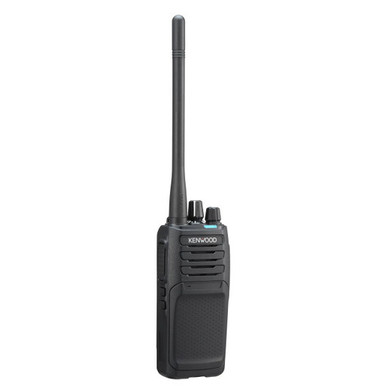
| Specification | Detail |
|---|---|
| Frequency | VHF (151–159 MHz) |
| Power | 5 watts |
| Channels | 64 |
| Mode | Analog & Digital (NXDN) |
| IP Rating | IP54 |
| Warranty | 2 years |
The Kenwood NX-P1200NVK is purpose-built for demanding outdoor environments. Its 5-watt VHF output provides the outdoor range grounds teams need across large properties, and the IP54 rating means it handles morning dew, rain, and humidity without protective cases or add-on accessories. Dual-mode analog/NXDN digital capability lets it operate on an existing analog system or transition to digital as the property's radio fleet upgrades over time. For a course already standardized on Kenwood, or one whose grounds crew is the primary radio user, it's the natural pick.
Why it fits golf courses specifically
- 5-watt VHF output is well-matched to outdoor open-terrain coverage requirements.
- IP54 rating provides verified dust and water spray resistance for grounds crew use in all weather.
- 64-channel capacity supports simultaneous use across multiple departments—a middle ground between the CP100d-VA and CP100d-V.
- Dual analog/NXDN digital mode protects the investment if the course plans to migrate from analog to digital over time.
- Rugged construction rated for the physical demands of grounds crew work: equipment vibration, outdoor storage, and field conditions.
Also Worth Considering
For very large resort properties, 36-hole or multi-course operations, or courses in areas with persistent terrain dead zones, two options extend beyond a standard VHF handheld. A repeater such as the Ritron Liberty RLR-465-N receives and retransmits the signal from an elevated position to eliminate terrain-based dead zones. For properties that need unlimited range and GPS staff tracking across multiple sites, the Motorola WAVE PTX series operates over 4G LTE and Wi-Fi rather than radio frequencies, with no coverage ceiling (subscription required per device). Both pair well with a VHF handheld fleet rather than replacing it.
Golf Course Radio Comparison
| Model | Best For | Frequency | Power | Channels | Mode | Durability |
|---|---|---|---|---|---|---|
| Motorola CP100d-V | Full 18-hole courses | VHF (136–174 MHz) | 5 watts | 160 | Analog & Digital (DMR) | IP54 / MIL-STD-810 C–G |
| Motorola CP100d-VA | Smaller courses / value fleets | VHF (136–174 MHz) | 5 watts | 16 | Analog Only | IP54 / MIL-STD-810 C–G |
| Kenwood NX-P1200NVK | Grounds crews / Kenwood fleets | VHF (151–159 MHz) | 5 watts | 64 | Analog & Digital (NXDN) | IP54 |
All three share the fundamentals that matter on a golf course: 5-watt VHF output for open-terrain range and IP54 weather resistance. The practical decision comes down to channel capacity and platform: choose the CP100d-VA to keep costs down on a smaller operation, the CP100d-V when you want maximum channel headroom and the longest rated range, or the NX-P1200NVK when standardizing on Kenwood or equipping a grounds-focused crew.
Coverage by Course Size: Matching Radio to Property
| Course Type | Recommended Radio | Key Reason |
|---|---|---|
| 9-hole or compact par-3 course | Motorola CP100d-VA | 5W VHF range at the lowest cost; 16 channels cover a small team |
| Standard 18-hole course | Motorola CP100d-V or Kenwood NX-P1200NVK | 5W VHF range with deep channel capacity for full-team segmentation |
| Grounds / maintenance-focused fleet | Kenwood NX-P1200NVK | Rugged VHF built for field crews; 64 channels; NXDN digital path |
| Large or hilly 18-hole course | Motorola CP100d-V + repeater | 160 channels and 5–7 mi range, plus a repeater for terrain dead zones |
Terrain matters as much as acreage. A hilly 18-hole course with significant elevation change between holes may require a repeater to extend effective coverage even when total acreage would otherwise suggest adequate range. A repeater receives a radio signal and retransmits it at higher power from an elevated position, effectively eliminating terrain-based dead zones. Tech Wholesale stocks the Ritron Liberty RLR-465-N Repeater, a practical option for courses where terrain limits direct radio-to-radio coverage.
Suggested Channel Structure for Golf Course Operations
Channel discipline is what separates a well-run radio system from a chaotic one. Assigning each operational role its own dedicated channel prevents cross-talk, reduces distraction, and makes it possible to escalate urgent communications without disruption. A standard 18-hole course with a full staff structure typically uses the following—all of which fit comfortably within the 16 channels of the CP100d-VA, with the NX-P1200NVK (64) and CP100d-V (160) leaving room for additional zones, privacy codes, and event overflow:
| Channel | Assigned Role | Purpose |
|---|---|---|
| 1 | Pro Shop / Front Desk | Tee times, guest check-in, general inquiries |
| 2 | Course Marshals | Pace of play, player assistance, rules enforcement |
| 3 | Grounds / Maintenance | Mowing schedules, irrigation, course repairs |
| 4 | Starter / First Tee | Cart assignments, player flow, tee time management |
| 5 | Beverage Cart | Restock coordination, player location, service requests |
| 6 | Event / Banquet Staff | Tournament coordination, private events, guest services |
| 7 | All-Call / Emergency | Weather holds, medical situations, urgent course-wide alerts |
Channels can also be used for private two-person calls. A marshal who needs to speak directly with the starter without broadcasting to the whole team can direct the conversation: “Switch to channel 4”—enabling private coordination without tying up the primary channel.
Lightning Safety and OSHA Noise Considerations
Two compliance frameworks are directly relevant to golf course radio operations. First, lightning safety: the National Lightning Safety Institute recommends a 30-minute suspension rule from the last observed lightning strike before play or outdoor work resumes. A radio system is the fastest, most reliable way to push a simultaneous weather hold to marshals, starters, and pro shop staff spread across 100–200 acres. Second, occupational noise: under OSHA Standard 29 CFR 1910.95, employers must implement a hearing conservation program when workers are exposed to 85 dB or above as an eight-hour time-weighted average. Grounds crews operating mowers, blowers, and turf equipment can approach or exceed this threshold, so any earpiece or audio accessory issued for use in those roles should be selected with OSHA hearing-protection guidance in mind.
Frequently Asked Questions
How much range do golf course radios need?
A standard 18-hole course occupies roughly 100 to 150 acres, and straight-line distance from the clubhouse to the farthest hole is typically 1 to 2 miles. A 5-watt VHF radio in open terrain comfortably covers this; the Motorola CP100d-V is rated for 5–7 miles of range on open land with limited obstructions, 2–4 miles in suburban settings, and 10–15 floors indoors. For courses with significant elevation change, heavy tree cover, or terrain features that create dead zones, adding a repeater eliminates coverage gaps that simply increasing radio wattage cannot solve.
How long does the battery last on golf course radios?
The Motorola CP100d standard Li-Ion battery (PMNN4476) is rated for up to 10.7 hours in analog mode and up to 14.4 hours in digital mode. The high-capacity battery (PMNN4080) extends that to roughly 15 hours analog and 20 hours digital—enough to cover a pre-dawn grounds shift through evening events on a single charge. Crews running double shifts should stock spare batteries or a multi-unit charging cradle for rotation without downtime. Running the radio in digital mode also extends battery runtime compared with analog.
Do golf course radios need to be waterproof?
Golf course radios should carry at minimum an IP54 ingress protection rating, which verifies resistance to dust and water spray from any direction—appropriate for morning dew, rain showers, and high humidity. All three radios on this page are IP54-rated, and the Motorola CP100d models additionally meet MIL-STD-810 C through G. Radios rated IP54 are not designed for submersion (IPX7 or higher), which is not a typical requirement for golf course operations.
How many radios does a golf course need?
A practical starting point is one radio per operational role per shift. A standard 18-hole course with a full staff structure typically requires: 2–3 for the pro shop and starter, 3–6 for course marshals depending on course length, 4–8 for grounds and maintenance, 1–2 for the beverage cart, and 1–2 for management. A typical full-service course operates with 12 to 25 radios total, and courses running tournaments or private events need additional units for event staff. Tech Wholesale offers quantity pricing for orders of five or more units—request a quote for current fleet pricing.
What is the difference between the Motorola CP100d-V and CP100d-VA?
Both are 5-watt VHF (136–174 MHz) radios on the same rugged MOTOTRBO platform, with IP54 and MIL-STD-810 C–G durability and dual analog/digital (DMR) operation. The key difference is channel capacity: the CP100d-VA supports 16 channels and is the lower-cost entry option, while the CP100d-V supports up to 160 channels for larger, multi-department operations. For a small course running two or three roles, the CP100d-VA is the more economical choice; for a full 18-hole operation that wants room to grow, the CP100d-V is the better long-term fit.
Can two-way radios be used for lightning safety alerts on a golf course?
Yes, and this is one of the most operationally critical uses of a radio system on a golf course. The National Lightning Safety Institute recommends a 30-minute suspension rule from the last observed lightning strike. Simultaneously notifying marshals, starters, and the pro shop of a weather hold via radio is faster and more reliable than cell phone contact, particularly when staff are spread across 100–200 acres with variable cell coverage. Assigning an all-call or emergency channel (see the suggested channel structure above) ensures a weather hold reaches every staff member at once.
What is the difference between analog and digital two-way radios for golf courses?
Analog radios transmit a continuous signal and are the traditional standard—widely compatible, straightforward to operate, and cost-effective. Digital radios encode voice as data, which provides cleaner audio (no static at range edges), more efficient use of available frequencies, longer battery life, and added features like private calling and text messaging. All three radios on this page operate in both modes, so a course can run alongside an existing analog fleet and migrate to digital at its own pace—the Motorola CP100d models use DMR, and the Kenwood NX-P1200NVK uses NXDN.
Why Buy from TechWholesale.com
Tech Wholesale has been an authorized dealer of professional two-way radios since 1997. We are an authorized dealer for Motorola and Kenwood, which means every radio we sell carries the full manufacturer warranty and qualifies for manufacturer service and repair. There is no gray market inventory and no risk of voided warranties.
What sets us apart for golf course operations
- Lifetime technical support included with every purchase — call or email our team for the life of your radio fleet, not just through the warranty period
- Quick quotes — request a custom quote
- No-pressure consultation — our team will tell you when a less expensive radio like the CP100d-VA is the right answer for your course size and structure, not push you toward a higher-margin product
- Free shipping on qualifying orders
- Authorized dealer status with Motorola and Kenwood — full manufacturer warranty on every radio
- Experience across hundreds of golf course fleet deployments since 1997
Not sure whether the CP100d-V, CP100d-VA, or NX-P1200NVK is the right fit? Use our Find My Radio tool or request a quote. We'll ask a few questions about your course layout and team structure and come back with a specific recommendation — no sales pressure, no obligation.
1-888-925-5982 Service@TechWholesale.com
Related Reading
- UHF vs. VHF – Frequencies Explained
- Motorola CP100d Series – Full Lineup
- Two-Way Radio Repeaters – Extend Your Coverage
- VOX (Hands-Free) Feature Explained
- Privacy Codes – Eliminate Outside Interference
- Find My Radio – Interactive Selection Tool
- Walkie Talkie FAQs
- National Lightning Safety Institute – 30-Minute Lightning Suspension Rule
- OSHA 29 CFR 1910.95 – Occupational Noise Exposure Standard
- National Golf Course Owners Association (NGCOA) – Industry Operations Resources
Article by Kristin Wood, a two-way radio consultant @ Tech Wholesale | Authorized Motorola & Kenwood Dealer Since 1997 | Last Updated: June 2026