

The Best Two-Way Radios for Chiropractors (2026)
Which Walkie Talkie Fits Your Chiropractic Team?
- Adjusting rooms, therapy bays, and a doctor whose hands are occupied → Motorola CLP1080e. Earpiece-only with no external speaker, so the front desk can say a patient has arrived without it carrying into the room you're working in. Hands-free VOX matters when you're mid-adjustment, and the antimicrobial housing earns its place on a device handled between patients.
- A small-to-mid practice coordinating front desk, therapy, and billing → Motorola CLS1410. Four channels and a speaker, so the back office and X-ray can hear a radio sitting on a counter while clinical staff wear an earpiece. VibraCall pages someone silently when a room is occupied.
- A large clinic, a multi-suite building, or more than one location → Motorola Curve. Digital 900 MHz and ten channels — the answer when the practice has grown past what one line and one floor can hold.
This guide covers exactly what to look for, compares the top models suited to chiropractic practices, and provides the factual detail you need to make an informed decision.
Why Chiropractic Offices Need Two-Way Radios
Chiropractic offices operate under a set of communication demands that most other professional environments do not share. Patients are actively in treatment—on tables, in traction, or connected to electrical stimulation equipment—and cannot be left unattended. Staff cannot easily leave a treatment room to check in with the front desk or locate a colleague. And the environment requires a level of quiet and professionalism that eliminates shouting across hallways as a workable option.
The result is a specific set of pain points that two-way radios directly address:
Room status coordination. Front desk staff need to know in real time which treatment rooms are available, occupied, or ready for turnover. Without instant communication, patients wait in reception longer than necessary, and room scheduling gaps widen across a full clinic day.
Patient transfer and assist requests. Therapists and assistants frequently need a second set of hands—for patient transfers, for positioning, or for equipment adjustments—but cannot leave a patient unattended to find help. A push-to-talk radio solves this in under three seconds.
Walk-in and appointment flow management. When an unscheduled patient arrives or a scheduled patient is a no-show, the entire schedule adjusts. Front desk and clinical staff need to communicate these changes immediately to avoid bottlenecks.
Supply and equipment logistics. Stocking treatment rooms, retrieving linens, locating supplies, and managing equipment between sessions generates constant low-level coordination work. Without dedicated communication, this work generates foot traffic and interruptions that slow the entire practice.
Professional atmosphere. A visible radio transmitting audible chatter in a treatment room disrupts the patient experience. Radios designed for healthcare settings—small, lightweight, earpiece-driven—let staff communicate without drawing patient attention.
What to Look for in a Chiropractic Office Radio
Discretion and Form Factor
Chiropractic offices are clinical environments. Radios should be compact enough to clip to a lanyard or waistband without adding visible bulk. The Motorola CLPe series, at under 2.5 ounces with battery, is the smallest professional radio on the market and is designed specifically for this use context. Earpiece-only operation means staff receive and transmit without audible sound reaching patients.
Antimicrobial Construction
Radios in clinical settings pass between staff members throughout the day, touching surfaces in treatment areas. Antimicrobial casing—a standard feature on the Motorola CLP1080e—reduces microbial transfer on high-contact device surfaces. This is a practical clinical consideration, not a marketing feature.
Battery Life
A full clinical day in a chiropractic office typically runs nine to twelve hours from open prep to final patient checkout. Radios should carry a minimum ten-hour battery rating under normal transmission loads. The Motorola CLP1080e is rated for twelve hours; the CLS1410 and Motorola Curve are rated for ten to twelve hours.
Channel Capacity and Role Segmentation
Most chiropractic offices operate effectively on three to four dedicated channels: front desk, clinical staff (chiropractors), therapists and assistants, and a shared all-staff channel for practice-wide announcements. Offices with dedicated billing, physical therapy, or massage departments benefit from additional channel capacity. Single-channel radios are not appropriate for any practice with more than two or three staff members.
Headset and Earpiece Compatibility
Hands-free operation is a practical requirement in clinical settings where staff are frequently supporting patients. All professional radios recommended on this page support compatible earpiece and headset accessories. The Motorola CLP1080e ships with a discreet earpiece included.
Audio Clarity in a Clinical Environment
Chiropractic offices are not noise environments in the way that bars or warehouses are, but electrical stimulation equipment, ultrasound therapy devices, and background music systems generate ambient interference. Professional-grade radios include noise-canceling microphone technology that isolates voice from ambient sound. Consumer-grade walkie-talkies typically do not.
Durability
Clinical environments generate daily handling wear: drops onto tile floors, contact with cleaning solutions, and repeated button use across multiple staff members. Radios should be constructed for commercial-grade daily use. The Motorola Curve meets MIL-STD-810 standards for shock resistance; the CLS1410 and CLPe series are rated for commercial light-duty use.
Recommended Two-Way Radios for Chiropractic Offices
1. Motorola CLP1080e — Best for Discretion and Clinical Environments
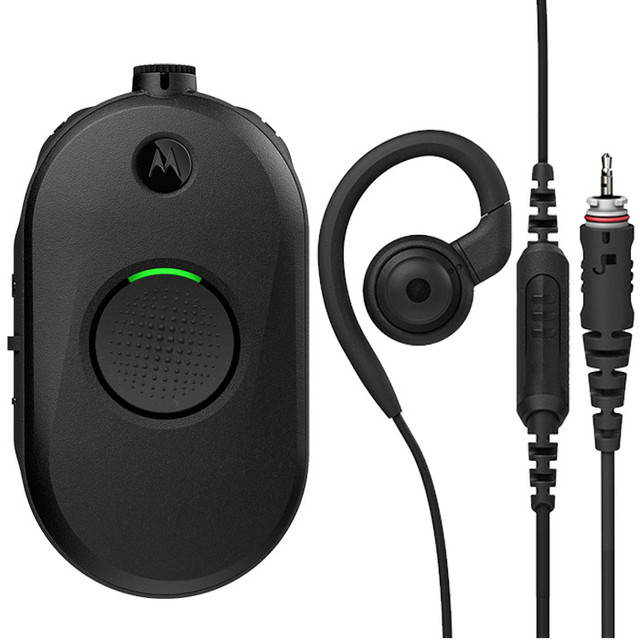
| Specification | Detail |
|---|---|
| Frequency | UHF (450–470 MHz) |
| Power | 1 watt |
| Channels | 8 |
| Indoor Coverage | 100,000 sq ft / up to 10 floors |
| Battery Life | ~12 hours |
| Weight | 2.38 oz. with battery |
| Casing | Antimicrobial |
| Includes | Discreet earpiece and belt holster |
| Repeater Compatible | Yes (up to 20 floors with optional repeater) |
The CLP1080e is the most purpose-fit radio for clinical environments on this list. Its earpiece-only design means no audio escapes into treatment areas; staff receive transmissions privately without interrupting patient sessions. At 2.38 ounces with battery, it is the lightest professional radio available and clips unobtrusively to most uniforms.
The antimicrobial casing is a genuine clinical feature: the Motorola CLP1080e uses an antimicrobial material treatment on its housing that inhibits the growth of microorganisms on device surfaces. In a clinical setting where a radio passes between staff throughout the day and may be handled after patient contact, this construction specification is directly relevant to infection control protocols.
Eight channels give mid-size practices sufficient segmentation for front desk, clinical, therapy, and management roles. The large central push-to-talk button operates reliably with minimal attention, which matters when staff are supporting a patient with both hands.
Why it fits chiropractic offices specifically
- Earpiece-only operation: no audible radio transmission in treatment rooms
- Antimicrobial casing: clinically relevant construction for a high-contact clinical device
- 2.38 oz. form factor: smallest professional radio on the market; does not draw patient attention
- 8 channels: supports full role segmentation for practices with multiple departments
- 12-hour battery: covers a full clinic day without mid-shift recharge
- Repeater capable: range can be extended to 20 floors if practice layout requires it
- Ships with earpiece and holster: no additional accessories required to deploy immediately
Limitation to know: the CLP1080e covers 100,000 sq ft / 10 floors. For practices in multi-story buildings or multi-building campuses, evaluate the Motorola Curve or add a compatible repeater.
2. Motorola CLS1410 — Best for Small to Mid-Size Offices Needing a Speaker Radio
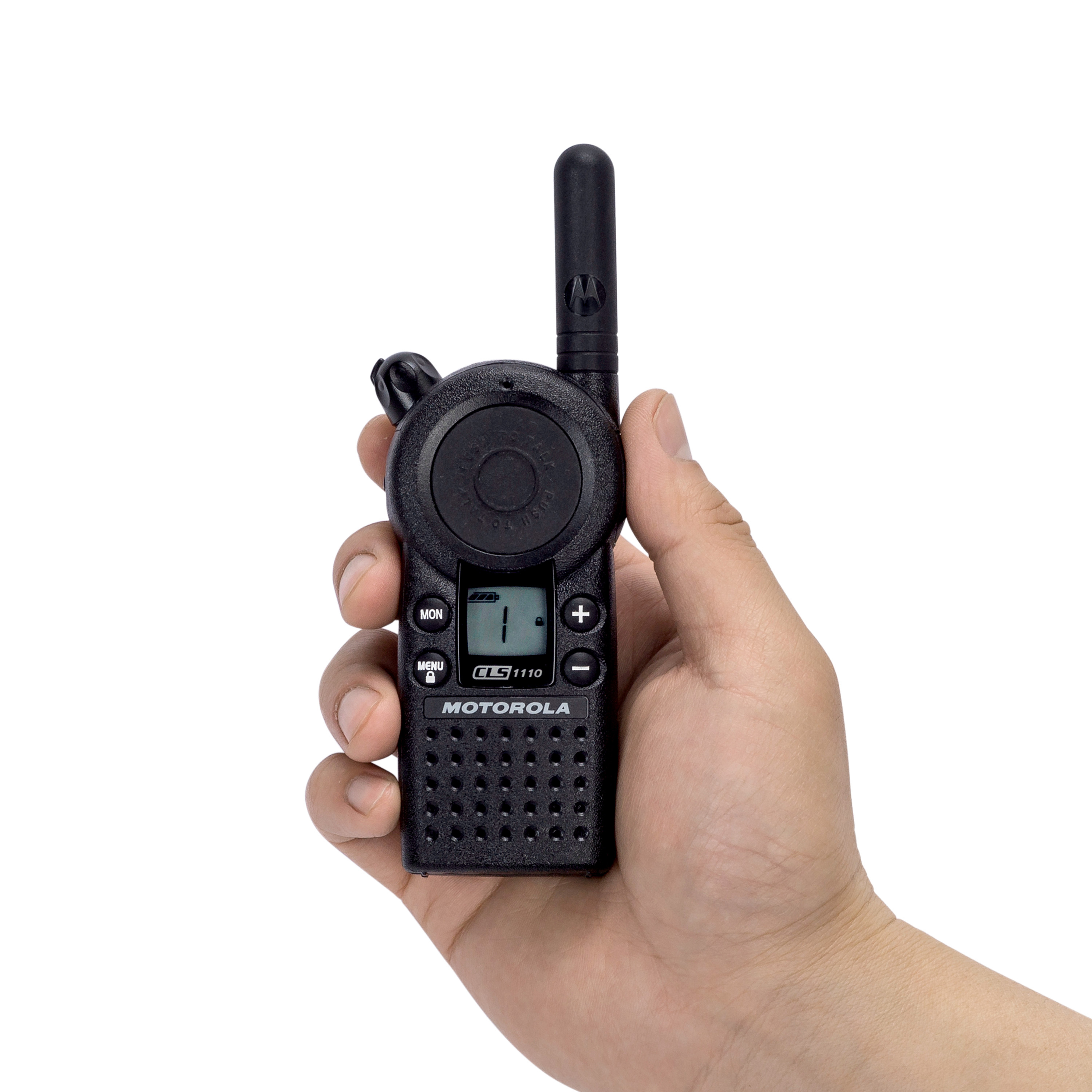
| Specification | Detail |
|---|---|
| Frequency | UHF (460–469 MHz) |
| Power | 1 watt |
| Channels | 4 |
| Indoor Coverage | 200,000 sq ft / up to 15 floors |
| Battery Life | ~10 hours |
| Outdoor Coverage | Up to 2 miles |
| Durability | Commercial-grade, water-resistant |
The CLS1410 includes an external speaker, which makes it the appropriate choice for staff roles where earpiece-only operation is not practical—front desk staff who are stationary, or office managers who are not in clinical areas. Its four-channel configuration covers the role segmentation needs of most small practices, and its 200,000 sq ft indoor coverage is sufficient for a single-building office of nearly any size.
Vibracall technology provides a silent vibration alert option, allowing a staff member to be notified of an incoming transmission without audible sound—a direct clinical consideration when in proximity to a patient. VOX (voice-activated transmission) enables hands-free operation when needed.
Setup is simplified through cloning capability, allowing a configured unit to replicate settings to additional radios without reprogramming each device individually.
Why it fits chiropractic offices specifically
- Vibracall: silent alert option for staff near patients who cannot receive audible transmissions
- VOX: hands-free operation when staff are supporting patients or managing equipment
- 4 channels: clean role segmentation for front desk, clinical, therapy, and management
- 200,000 sq ft / 15 floors: covers most single-building practices with signal to spare
- External speaker: appropriate for front desk or office management roles where discretion is less critical
- Cloning: fast multi-unit deployment for practices adding radios at scale
3. Motorola Curve — Best for Larger Practices and Multi-Building Campuses
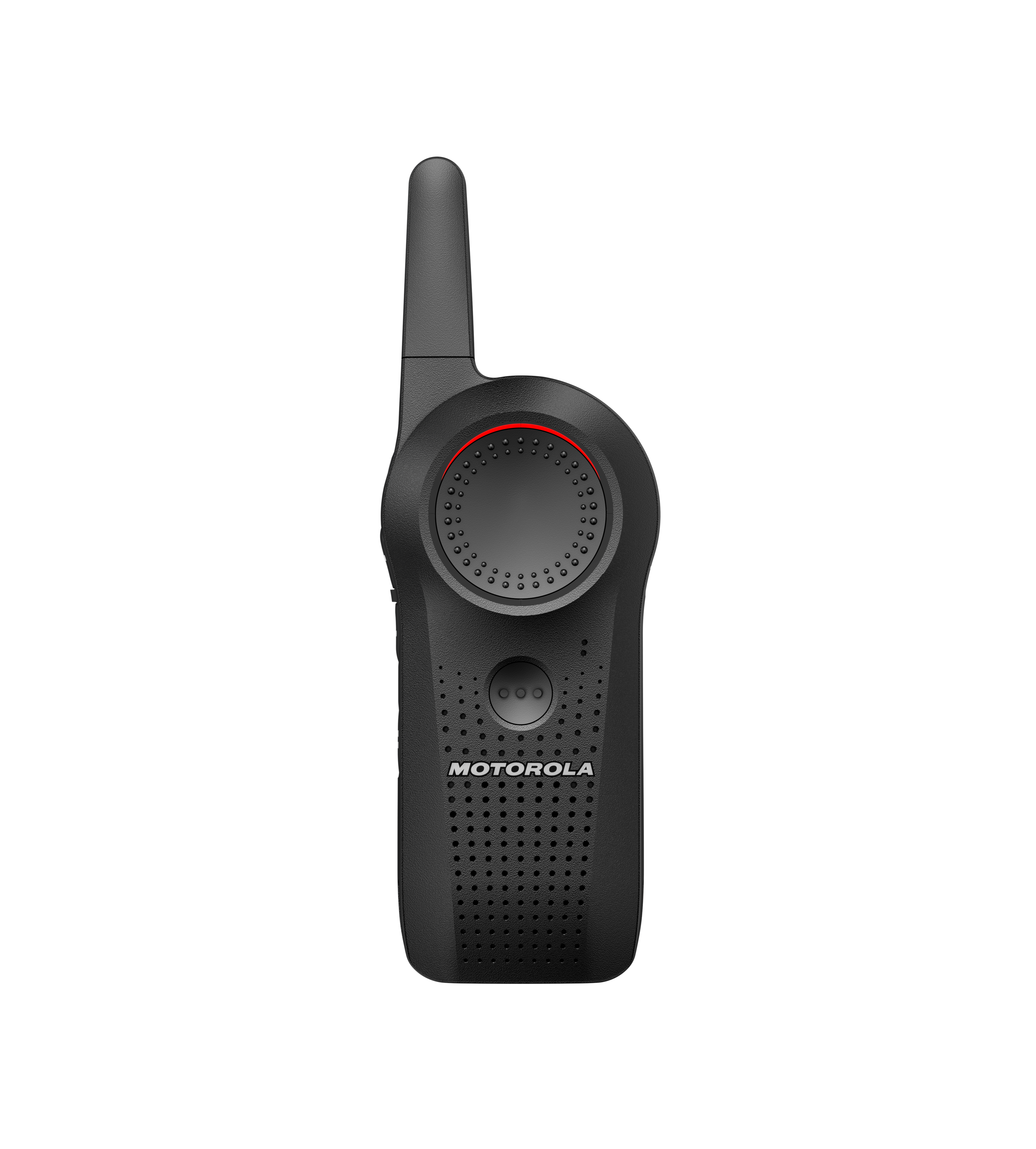
| Specification | Detail |
|---|---|
| Frequency | Digital 900 MHz (902–928 MHz) |
| Power | 1 watt digital (equivalent to ~4 watts analog) |
| Channels | 10 |
| Indoor Coverage | 300,000 sq ft / up to 20 floors |
| Battery Life | ~10–12 hours |
| FCC License Required | No |
| Durability | MIL-STD-810 compliant, water-resistant |
The Motorola Curve uses 900 MHz digital communication, which penetrates concrete and steel-reinforced walls more effectively than UHF analog at comparable wattage. Its effective analog equivalent of approximately 4 watts means it covers nearly three times the floor area of the CLS1410, making it the appropriate choice when a practice occupies a multi-story building or operates across more than one location.
Ten channels support full team segmentation, including separate lines for chiropractic, physical therapy, massage, billing, front desk, and management. The Motorola Curve operates on the 900 MHz FHSS (Frequency Hopping Spread Spectrum) band, which allows for private conversations and clear audio.
Why it fits larger chiropractic practices specifically
- 300,000 sq ft / 20 floors: appropriate for multi-story or multi-building practices
- 10 channels: supports full departmental segmentation for practices with multiple specialties
- Digital audio: cleaner signal than analog in RF-dense medical building environments
- MIL-STD-810: rated for physical durability demands of a high-traffic clinical environment
Also Worth Considering
Motorola CLP1010e — 1 watt, 1 channel, UHF (450–470 MHz), 100,000 sq ft / 10 floors. The single-channel entry point for the CLPe series. Appropriate for very small offices with two to three staff members operating on a single shared channel. Upgrade to the CLP1080e for any practice requiring role segmentation.
Kenwood ProTalk PKT-300 — 2 watts, 6 channels, UHF (450–470 MHz), 275,000 sq ft. A strong alternative to the CLS1410 for practices that prefer Kenwood build quality or need six dedicated channels. VOX-capable for hands-free operation.
Coverage by Practice Size: Matching Radio to Building Layout
| Practice Type | Recommended Radio | Coverage Capacity |
|---|---|---|
| Solo or 2-doctor office, single floor | Motorola CLP1010e or CLP1080e | 100,000 sq ft / 10 floors |
| Small to mid-size multi-room office | Motorola CLS1410 or CLP1080e | 100,000–200,000 sq ft |
| Multi-specialty clinic or medical building | Motorola Curve or Kenwood PKT-300 | Up to 300,000 sq ft / 20 floors |
| Multi-building campus or satellite offices | Motorola WAVE PTX (LTE/Wi-Fi) | Unlimited range |
Practices located in medical office buildings with poured concrete construction or significant steel framing should plan for one tier higher than their square footage alone would suggest. Heavy building materials reduce radio frequency penetration and can create dead zones in distant treatment rooms.
HIPAA Compliance and Two-Way Radios in Chiropractic Offices
Under the Health Insurance Portability and Accountability Act (HIPAA), the Privacy Rule (45 CFR Part 164) governs the use and disclosure of protected health information (PHI). Two-way radios are analog or digital voice communication devices; they do not transmit, store, or process electronic protected health information (ePHI) as defined under the HIPAA Security Rule (45 CFR Part 164.302–318).
As a result, two-way radio hardware itself generally falls outside the direct scope of HIPAA's technical safeguard requirements. However, the content transmitted over radios is subject to HIPAA's Privacy Rule. Best practice in a chiropractic office is to use radio channels strictly for operational coordination—room status, staff requests, supply needs—and to keep patient names, diagnoses, treatment details, and other PHI off radio channels entirely.
For a detailed review of HIPAA compliance considerations in radio communication, see: HIPAA Compliance and Two-Way Radios.
Frequently Asked Questions
What is the best two-way radio for a chiropractic office?
For most chiropractic offices, the Motorola CLP1080e is the strongest choice: it is the smallest professional radio available at 2.38 oz., operates via discreet earpiece only, carries antimicrobial casing, and provides 8 channels and 12-hour battery life for a full clinical day. For practices where front desk staff need an external speaker radio, the CLS1410 is the appropriate complement. For large or multi-building practices, the Motorola Curve provides the coverage and channel capacity required.
Do two-way radios comply with HIPAA regulations?
Two-way radio hardware does not transmit or store electronic protected health information (ePHI) and falls outside the direct scope of HIPAA's Security Rule technical safeguard requirements. The content transmitted over radios is subject to HIPAA's Privacy Rule. Best practice is to keep patient names, diagnoses, and treatment information off radio channels and use radios strictly for operational coordination. For detailed guidance, see HIPAA Compliance and Two-Way Radios.
How much indoor range do I need for a chiropractic office?
Most single-building chiropractic offices—even larger multi-room practices—are well within the 100,000 sq ft coverage range of a 1-watt UHF radio like the CLP1080e or CLS1410. For reference, 100,000 sq ft is roughly the footprint of a mid-size office building. Practices in poured concrete structures, multi-story buildings, or multi-building campuses should consider the Motorola Curve, which covers 300,000 sq ft and 20 floors with digital signal penetration superior to analog UHF at comparable wattage.
How long does the battery last on a chiropractic office radio?
The radios recommended on this page carry 10 to 12 hour battery ratings under normal transmission loads. The Motorola CLP1080e is rated for 12 hours; the CLS1410 and Motorola Curve for 10 to 12 hours. For practices running extended or double shifts, multi-unit charging cradles allow batteries to be swapped mid-shift without downtime. Motorola commercial-grade batteries are tested for five years of regular field use.
How many channels does a chiropractic office need?
Most small to mid-size practices operate effectively on three to four dedicated channels: front desk, chiropractors, therapists and assistants, and a shared all-staff channel. Practices with additional departments—physical therapy, massage, billing—benefit from six to eight channels. The Motorola CLP1080e provides 8 channels; the Motorola Curve provides 10. Single-channel radios are appropriate only for offices with two to three staff members.
How many radios does a chiropractic office need?
A practical starting point is one radio per active staff member per shift: one per chiropractor on duty, one per therapist or assistant, and one per front desk position. A four-person practice typically operates well with four to six radios, including a spare. Larger practices with multiple active treatment rooms or multiple departments should scale proportionally. Tech Wholesale offers volume pricing for orders of five or more units; request a custom quote for practices ordering in quantity.
Can radios be used with earpieces in a clinical setting?
Yes. All professional radios recommended on this page support compatible earpiece and headset accessories. The Motorola CLP1080e ships with a discreet earpiece included. Earpiece-only communication is strongly recommended for clinical staff operating in or near treatment areas, as it prevents radio audio from reaching patients and maintains a professional environment. The CLP1080e's design assumes earpiece use as its primary operating mode.
Are two-way radios durable enough for daily clinical use?
Professional-grade radios from Motorola and Kenwood are tested for commercial daily use and rated for five years of field operation. The Motorola Curve meets MIL-STD-810 standards for shock and environmental resistance. The CLS1410 and CLPe series are rated for commercial light-duty use with water resistance for incidental exposure. None of the radios listed are rated for submersion. For clinical environments where radios may be wiped down with cleaning solutions, confirm compatibility with your disinfection protocol; the CLP1080e's antimicrobial casing is designed with clinical contact in mind.
Why Buy from TechWholesale.com
Tech Wholesale has been selling professional two-way radios to healthcare businesses, medical offices, and chiropractic practices since 1997. We are an authorized dealer for Motorola and Kenwood, which means every radio we sell carries the full manufacturer warranty—typically two years on commercial-grade models—and qualifies for manufacturer service and repair. There is no gray market inventory.
What sets us apart
- Lifetime technical support included with every purchase — call or email our team for the life of your radio fleet, not just through the warranty period
- Quotes for larger teams — request a custom quote
- No-pressure consultation — we will tell you when a less expensive radio is the right answer for your practice
- Free shipping on qualifying orders
- Authorized dealer status — full manufacturer warranty on every unit
- Find My Radio tool — answer a few questions about your office and get a specific recommendation
If you are not sure which radio fits your practice, request a quote. We will ask a few questions about your office size, team structure, and budget and return a specific recommendation. No obligation.
1-888-925-5982 Service@TechWholesale.com
Related Reading
From TechWholesale.com
- HIPAA Compliance and Two-Way Radios
- Privacy Codes – Eliminate Outside Interference
- VOX Explained – Hands-Free Radio Operation
- UHF vs VHF – Frequencies Explained
- Frequency Hopping Spread Spectrum (FHSS)
- Two-Way Radio FAQs – FCC Licensing and More
- Find My Radio – Guided Radio Selector
External Resources
- HHS.gov – HIPAA Privacy Rule Overview
- HHS.gov – HIPAA Security Rule
- OSHA 29 CFR 1910.95 – Occupational Noise Exposure Standard
- FCC – Private Land Mobile Radio Services Licensing
Article by Kristin Wood, a two-way radio consultant @ Tech Wholesale | Authorized Motorola & Kenwood Dealer Since 1997 | Last Updated: May 2026