
The Best Two-Way Radios for Catering (2026 Guide)
What Are the Best Two-Way Radios for Catering?
The Short Answer
The best two-way radios for catering are the Motorola CLP1010e, Motorola CLS1110, and Motorola CLS1410. Each model solves a different catering challenge: the CLP1010e delivers discreet, earpiece-only communication for upscale event service; the CLS1110 provides reliable indoor/outdoor UHF coverage with an anti-microbial coating built for shared use; and the CLS1410 adds four dedicated channels for larger teams that need role-based segmentation across kitchen, service, bar, and management.
But not all radios are built for a catering environment. Weak range across unfamiliar venues, dead batteries before the reception ends, and audible transmissions at exactly the wrong moment can turn a polished operation into a visible one.
That's why we've put together this guide—to help you make an educated decision and find the radio that actually fits your team's needs.
We've sold thousands of radios to catering teams across the country, and we've seen what works. Here's everything you need to know.
Why Catering Teams Need Purpose-Built Two-Way Radios
Catering is a time-compressed, multi-zone operation running inside a venue that your team has never fully mapped.
Consumer walkie-talkies and cell phones fail in this environment for the same reasons: they can't coordinate instantly across kitchen, service floor, bar, and loading dock simultaneously, and they draw exactly the kind of visible attention that professional event service is designed to avoid.
Professional two-way radios solve each of these problems with features purpose-built for high-traffic, time-critical service environments.
Catering teams face pain points unique to other industries:
Unfamiliar venues every shift. Unlike a restaurant, your team works in a different building on almost every event. Coverage range and signal penetration through unknown wall materials, across outdoor terraces, and between kitchen staging and ballroom floor cannot be guaranteed in advance. Radios with UHF frequency or digital 900 MHz band are required to handle these variables reliably—VHF radios, designed for open outdoor environments, are not adequate for the mixed indoor/outdoor layouts typical of catering venues.
Timing precision that has zero margin for error. The ceremony ends. The cocktail hour appetizers must be in the hands of servers within minutes. A missed cue between kitchen lead and service captain doesn't just create a delay—it creates a visible gap in service that guests notice and clients remember. Push-to-talk (PTT) radios eliminate the latency of calling, texting, or hunting down a supervisor across a venue.
Shared equipment across rotating staff. Catering teams often share radios across multiple events and multiple employees. Without an anti-microbial surface treatment, a shared device becomes a hygiene risk for a team that handles food professionally. Motorola's CLS series includes an anti-microbial coating as a standard feature for this reason.
Guest experience and discretion. A radio announcement at full speaker volume during a wedding toast is embarrassing. Professional catering radios must support silent or vibrating alerts and earpiece-only communication options to keep coordination invisible to guests. The Motorola CLPe series operates exclusively through an included earpiece—no external speaker, no audible transmissions.
Multi-role team segmentation. Kitchen staff, service staff, bartenders, event captains, and loading dock personnel all have distinct communication needs. Without dedicated channels, everyone talks over everyone else and critical messages get missed. Most professional catering radios support one to four discrete channels, allowing teams to segment by role.
What to Look for in a Catering Radio
Frequency Band: UHF Only
UHF (Ultra High Frequency) radios operate in the 450–470 MHz range and penetrate walls, floors, and commercial construction reliably. For catering teams moving between indoor kitchens, outdoor courtyards, and multi-story venues, UHF is the minimum standard. Digital 900 MHz radios (like the Motorola Curve) provide an additional step up in penetration for large or structurally complex venues. VHF radios are not recommended for catering—their signal characteristics are optimized for open outdoor environments and degrade quickly in interior settings.
Battery Life
A catering event can run from morning setup through late-night breakdown—12 hours or more in some cases. Radios should support a minimum 10-hour battery life under typical transmission loads. Motorola commercial-grade batteries are rated for 10 to 12 hours and tested to five years of regular field use. For back-to-back event schedules, multi-unit charging cradles allow overnight preparation of a full radio fleet.
Discretion: Form Factor and Alert Mode
Catering radios should be small enough to clip to a waistband or apron and equipped with either VibraCall silent alerts or an included earpiece. The Motorola CLPe series weighs under 3 oz. and operates entirely through an earpiece—making it the correct choice for formal event service where visible equipment would undermine the guest experience.
Anti-Microbial Coating
Any radio used in a food service environment and shared across staff should carry an anti-microbial surface treatment. The Motorola CLS series includes this coating as standard equipment. This is not a cosmetic feature—it directly reduces bacterial transmission in high-contact shared devices.
Channel Capacity
Single-channel radios work for small teams (two to four people) operating in a single zone. For most catering operations with distinct kitchen, service, and management roles, four channels is the practical minimum. Multi-channel configurations allow supervisors to monitor all channels simultaneously and switch between role-based groups as needed.
Durability
Catering is physically demanding work. Radios should meet MIL-STD-810 standards for shock resistance to handle drops on venue floors, in kitchens, and during transport between events. At minimum, look for a water-resistance rating that handles occasional splash and spill exposure in a kitchen staging environment.
Recommended Two-Way Radios for Catering
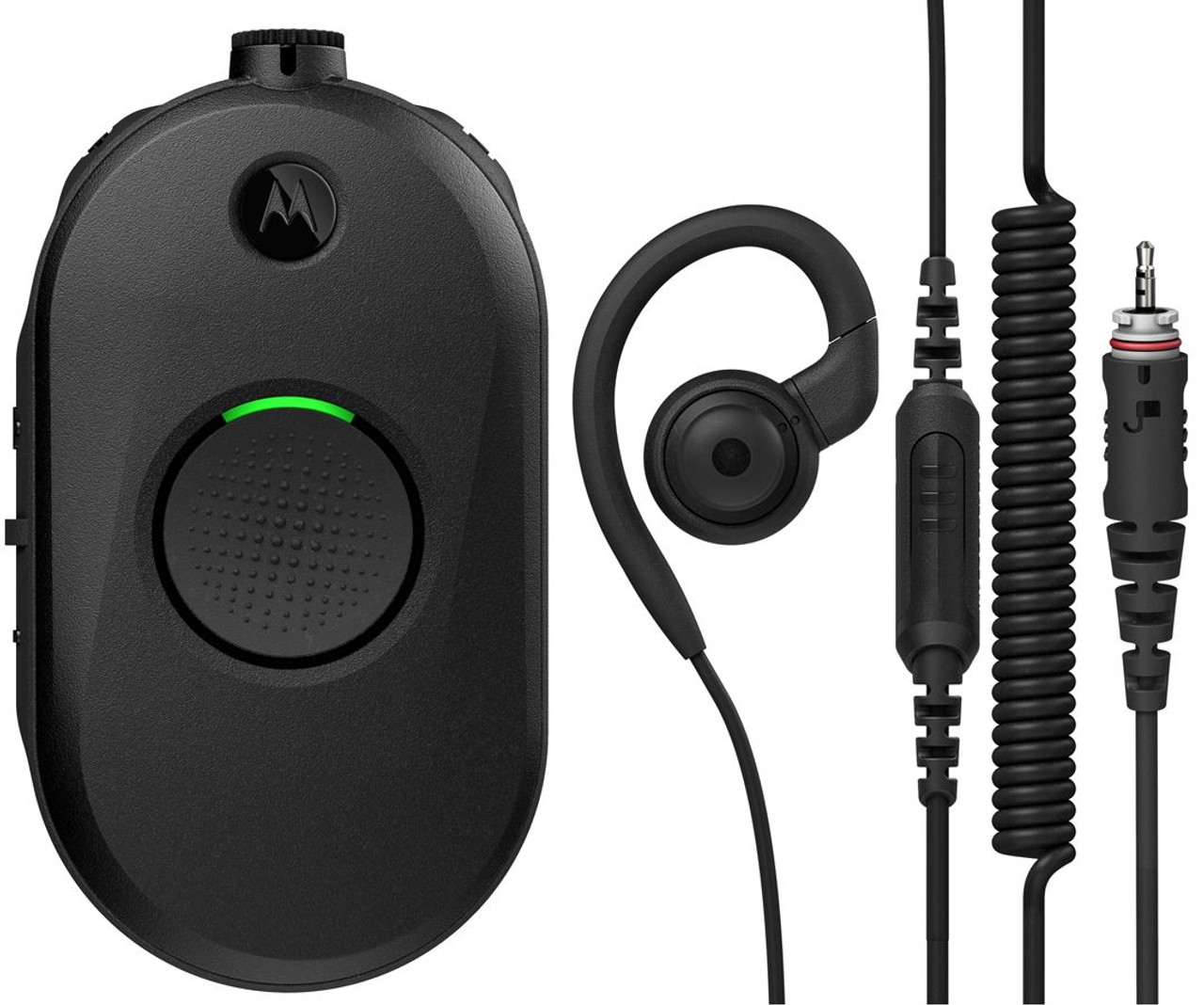
1. Motorola CLP1010e — Best for Discretion and Small Venues
| Specification | Detail |
|---|---|
| Frequency | UHF (450–470 MHz) |
| Power | 1 watt |
| Channels | 1 (upgrade to CLP1080e for 8 channels) |
| Indoor Coverage | 100,000 sq ft / up to 10 floors |
| Outdoor Range | Up to 1 mile |
| Battery Life | ~10 hours |
| Weight | 2.38 oz with battery |
| Includes | Swivel belt holster and discreet earpiece |
| Repeater Capable | Yes (doubles indoor range) |
The CLP1010e operates entirely through its included earpiece—there is no external speaker. For formal catering events where an audible transmission during a toast or ceremony would be unacceptable, this is the correct choice. Staff communicate privately; guests see nothing unusual.
Why it fits catering specifically
- Smallest form factor of any professional radio on the market—clips invisibly to a waistband, apron, or jacket
- Earpiece-only communication preserves event atmosphere at weddings, galas, and corporate dinners
- VibraCall-compatible design supports silent notification without audible alerts
- Included swivel holster and earpiece mean no additional accessories to source before an event
- Repeater capable—range can be doubled for larger venues when needed
- Built-in privacy technology keeps team communications internal to your channel
Limitation to know: Single-channel configuration on the base model limits role-based segmentation. For teams requiring dedicated kitchen, service, and management channels, start with the CLP1080e (8 channels).
2. Motorola CLS1110 — Best for Indoor/Outdoor Versatility and Mid-Size Venues

| Specification | Detail |
|---|---|
| Frequency | UHF (460–469 MHz) |
| Power | 1 watt |
| Channels | 1 |
| Indoor Coverage | 200,000 sq ft / up to 15 floors |
| Outdoor Range | Up to 1.5 miles |
| Battery | Long-lasting lithium-ion |
| Durability | MIL-STD-810 compliant |
| Anti-Microbial Coating | Yes |
The CLS1110 is the most practical all-around catering radio for teams that work across multiple venue types. Its UHF signal handles both indoor ballroom environments and outdoor garden or terrace settings without a configuration change, and its 200,000 sq ft indoor coverage reaches the majority of catering venue footprints without requiring a repeater.
Why it fits catering specifically
- Anti-microbial coating reduces bacterial transmission on shared devices used across a rotating food service staff
- MIL-STD-810 military-grade construction handles drops and rough handling during transport and setup
- 1.5-mile outdoor range covers outdoor wedding grounds, large estate venues, and parking/loading dock coordination
- Direct Call feature allows one-on-one private communication between staff without broadcasting to the full channel
- Private line codes (PL tones) eliminate signal interference from other radio users operating in the same venue
- Simplified cloning process allows rapid configuration of multiple units before an event
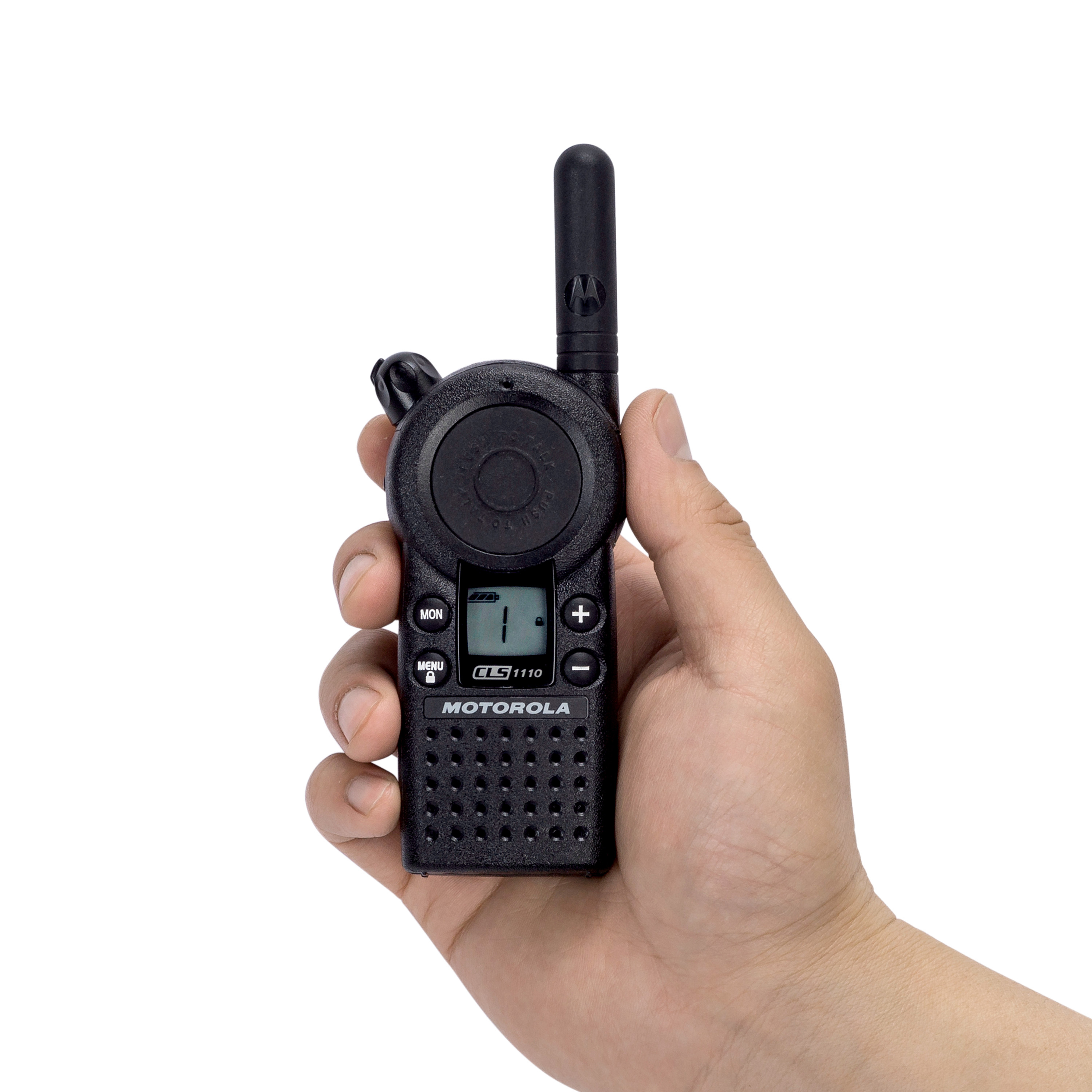
3. Motorola CLS1410 — Best for Larger Teams with Multiple Departments
| Specification | Detail |
|---|---|
| Frequency | UHF (460–469 MHz) |
| Power | 1 watt |
| Channels | 4 |
| Indoor Coverage | 200,000 sq ft / up to 15 floors |
| Outdoor Range | Up to 1.5 miles |
| Battery Life | ~10 hours |
| Durability | Commercial-grade, water-resistant |
| Anti-Microbial Coating | Yes |
The CLS1410 is the four-channel version of the CLS1110 and the correct upgrade path for catering operations that have outgrown a single shared channel. Four dedicated channels allow clean segmentation: one for kitchen staff, one for servers, one for bartenders, and one for the event captain or management—without cross-talk between departments.
Why it fits larger catering teams specifically
- 4 channels support role-based segmentation for teams of 6 to 25+
- Audible Call Alerts with VibraCall technology ensure staff receive messages without disrupting a guest interaction
- VOX (voice-activated transmission) keeps servers and kitchen staff hands-free during service
- UHF frequency provides reliable penetration through commercial kitchen walls, staging areas, and multi-room venue layouts
- Same MIL-STD-810 durability and anti-microbial coating as the CLS1110
Also Worth Considering
Kenwood ProTalk PKT-300 — 2 watts, 6 channels, UHF (450–470 MHz), indoor coverage up to 275,000 sq ft. A strong alternative for catering operations that prefer Kenwood's build quality or need six discrete channels for larger event staff configurations.
Motorola RMU2040 — 2 watts, 4 channels, UHF (450–470 MHz), indoor coverage up to 250,000 sq ft. Compact and rugged; suitable for catering teams that need UHF power above the 1-watt CLS range without moving to a digital radio.
Coverage by Venue Type: Matching Radio to Catering Environment
| Venue Type | Recommended Radio | Coverage Capacity |
|---|---|---|
| Private residence / small venue under 5,000 sq ft | Motorola CLP1010e or CLS1110 | 100,000–200,000 sq ft |
| Mid-size ballroom / hotel event space | Motorola CLS1410 or CLS1110 | Up to 200,000 sq ft / 15 floors |
| Outdoor estate / garden wedding / tent event | Motorola CLS1110 or CLS1410 | Up to 1.5 miles outdoor |
| Large convention center / multi-room gala | Kenwood PKT-300 or Motorola RMU2040 | Up to 275,000 sq ft |
| Multi-building campus / outdoor festival catering | Motorola WAVE PTX (LTE/Wi-Fi) | Unlimited range |
For venues with unusually thick masonry construction—historic buildings, stone estates, reinforced concrete conference centers—plan for reduced indoor range and consider upgrading one tier above your square footage would otherwise suggest.
Frequently Asked Questions
What are the best two-way radios for catering?
The Motorola CLP1010e, CLS1110, and CLS1410 are the top three choices for most catering operations. The CLP1010e is best for formal events where discretion is critical—it operates through an included earpiece with no external speaker. The CLS1110 is the best all-around option for teams working across both indoor and outdoor venues, and it includes an anti-microbial coating for shared use. The CLS1410 adds four dedicated channels for larger teams that need kitchen, service, bar, and management on separate lines.
How much range do I need for a catering radio?
For most catering events in venues under 50,000 sq ft, a 1-watt UHF radio provides adequate indoor coverage with significant margin to spare. The Motorola CLS1110 covers up to 200,000 sq ft indoors and 1.5 miles outdoors—more than sufficient for the vast majority of catering venues. For larger convention centers, multi-building campuses, or events with outdoor coverage needs beyond 1.5 miles, upgrade to a 2-watt UHF model like the Kenwood PKT-300 or consider the Motorola WAVE PTX for truly unlimited range via LTE.
How long does the battery last on a catering radio?
Professional catering radios recommended here are rated for 10 to 12 hours of battery life under normal transmission loads—sufficient for a full event day from setup through breakdown. Motorola commercial-grade lithium-ion batteries are tested to five years of regular field use. For catering companies running back-to-back multi-day events, multi-unit charging cradles allow overnight preparation of the full radio fleet without manual swapping.
Do catering radios need to be discreet during events?
Yes, for most professional catering environments. The standard for formal event service is earpiece-only communication with no audible external speaker transmission. The Motorola CLP1010e is specifically designed for this requirement—its earpiece-only design means no transmissions are audible to guests under any circumstances. Radios with external speakers (like the CLS series) can be paired with aftermarket earpieces and used with VibraCall silent alert mode to achieve a similar result.
Are catering radios hygienic for shared use?
Radios without an anti-microbial surface treatment are a hygiene risk in any food service environment where multiple staff members handle the same device across a shift or across events. The Motorola CLS series (CLS1110 and CLS1410) includes an anti-microbial coating as standard equipment, which reduces bacterial transmission between handlers. This is the primary reason the CLS series is recommended over similarly priced alternatives for catering specifically.
What durability rating should a catering radio have?
At minimum, look for a radio meeting MIL-STD-810 military specification standards for shock resistance. This standard tests radios against drops, vibration, and environmental stress that are routine in catering operations—loading dock transfers, kitchen environments, and outdoor venue setups. The Motorola CLS1110 and CLS1410 both meet MIL-STD-810. Water resistance sufficient for splash and spill exposure is a practical baseline for any radio used in a kitchen staging area.
How many radios does a catering team need?
A practical starting point is one radio per key operational role per event: one for the event captain, one for the kitchen lead, one for the head server, one for the bar lead, and one for the loading dock or logistics coordinator. For a team of 10 to 20 staff, most catering companies begin with 6 to 10 units and scale based on event size. Tech Wholesale offers quantity pricing for orders of five or more units—request a custom quote for fleet pricing.
Can catering radios work across indoor and outdoor venues?
Yes, UHF radios perform reliably in both indoor and outdoor environments, which is one reason they are the recommended frequency band for catering. The Motorola CLS1110 and CLS1410 provide up to 200,000 sq ft indoor coverage and 1.5 miles outdoor range from the same device without any configuration change between events. VHF radios are not recommended for catering because their signal characteristics degrade significantly inside buildings.
Are two-way radios better than cell phones for catering coordination?
Yes, for real-time operational coordination during active service. Push-to-talk radios provide instant one-to-many communication with no dialing, unlocking, or hold time. A radio call reaches every team member on a channel simultaneously in under a second. Cell phones are useful for pre-event logistics and post-event communication, but they cannot match the speed and simultaneous broadcast capability of two-way radios during live service. Additionally, radios do not depend on cellular network coverage, which can be unreliable in rural estate venues or large buildings with poor in-building signal.
Why Buy from TechWholesale.com
Tech Wholesale has been selling professional two-way radios to catering companies and event service professionals since 1997. We are an authorized dealer for Motorola and Kenwood, which means every radio we sell carries the full manufacturer warranty—typically two years on commercial-grade models—and qualifies for manufacturer service and repair.
What sets us apart
- Lifetime technical support included with every purchase—call or email our team for the life of your radio fleet, not just through the warranty period
- Quotes for larger teams—request a custom quote
- No-pressure consultation—our team will tell you when a less expensive radio is the right answer for your operation, not push you toward a higher margin product
- Free shipping on qualifying orders
- Authorized dealer status—no gray market inventory, no voided warranties
- Guidance on FCC licensing at the time of purchase for teams new to licensed business radios
If you're not sure which radio fits your catering operation, use our Find My Radio tool or request a quote. We'll ask a few questions about your team size and venue types and come back with a specific recommendation—no sales pressure, no obligation.
1-888-925-5982 Service@TechWholesale.com
Related Reading
From TechWholesale.com
- Privacy Codes – Eliminate Outside Interference
- VOX Explained – Hands-Free Transmission
- UHF vs VHF – Frequencies Explained
- Frequency Hopping Spread Spectrum (FHSS)
- Two-Way Radio FAQs
- Find My Radio Tool
External Resources
- OSHA Occupational Noise Exposure Standard (29 CFR 1910.95)
- FDA Food Code – Food Safety Standards for Catering Operations
Article by Kristin Wood, a two-way radio consultant @ Tech Wholesale | Authorized Motorola & Kenwood Dealer Since 1997 | Last Updated: May 2026