

The Safe Campus Blueprint for K-12 Schools
School safety used to mean a locked door and a fire drill. It doesn't anymore.
I've spent years talking to administrators, security directors, and district IT staff about what actually keeps a campus safe, and one thing has become clear to me: there's no single fix. Physical threats, mental health crises, vaping in the bathrooms, and communication breakdowns during an actual emergency are all part of the same problem. Treat them separately and you end up with gaps. Treat them as one system, and you get something districts are increasingly calling a "Safe Campus Blueprint."
This post walks through what that blueprint actually looks like — physical security, mental health support, AI-driven detection, real-time communication, and community involvement — with real products, real specs, and real numbers, so you're working from facts rather than vendor marketing.
The Problem Isn't New. The Scale Is.
A few realities schools are dealing with right now:
- Communication gaps are dangerous. When something happens, seconds matter. If staff can't reach each other instantly — not "eventually," instantly — the response slows down and the risk grows.
- Mental health needs have surged. More students need support than schools are staffed to provide, and unaddressed mental health issues often show up before a safety incident does.
- Physical security infrastructure is aging. A lot of buildings have blind spots that were fine in 1998 and aren't fine now.
- Vaping and substance use keep climbing, mostly in the places you can't put a camera: bathrooms, locker rooms, stairwells.
None of these problems exist in isolation, so the solution can't either.
Pillar One: Physical Security
This is the layer people picture first — controlled entry points, camera systems, security personnel — and it matters. Done well, it's both a deterrent and a way to catch problems early.
Body-worn cameras deserve a specific mention here. The Motorola VB400 is worth knowing about: it delivers 1080p HD video with up to 12 hours of continuous recording on a single charge, dual-microphone audio capture, and encrypted footage that offloads securely at the end of a shift. For security personnel who are on campus for an entire school day, a camera that doesn't need a mid-shift charge is a real operational advantage, not just a spec sheet number.
Key considerations for this pillar:
- Controlled entry points with ID verification for all visitors
- Cameras covering entrances, hallways, and common areas
- Body-worn cameras for security staff — clear documentation, and a track record of reducing escalation simply because people know they're being recorded
Pillar Two: Mental Health Support
Cameras and locked doors don't fix what's happening inside a student's head, and most of the serious incidents schools worry about have a mental health thread running through them somewhere.
This pillar includes:
- Dedicated mental health counselors available daily, not just by appointment
- Anonymous reporting systems so students can flag concerns about a peer without exposing themselves
- Regular mental health screenings to catch problems early
- Staff training on recognizing warning signs — not just counselors, everyone
I want to be direct about something: physical security and mental health aren't competing budget lines. They're the same conversation. A campus with great cameras and no counseling capacity is only half-protected.
Pillar Three: AI-Driven Detection and Real-Time Response
This is where the technology has moved fastest, and it's worth understanding what's actually available now — not the vague "AI will help" pitch, but specific tools doing specific jobs.
Smart sensors for the places cameras can't go. The HALO Smart Sensor, made by IPVideo Corporation, is built specifically for spaces where cameras are impractical or legally off-limits — bathrooms, locker rooms, dorms. It detects vaping and THC chemically, distinguishes between the two, and can flag aggression, gunshots, and air quality issues, all without recording audio or video. That last part matters for FERPA compliance and just plain student privacy — HALO isn't listening to conversations, it's reading the air.
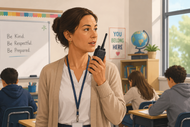
Real-time communication, because cell phones aren't built for this. During a lockdown or a medical emergency, cell phones are the wrong tool — they depend on signal strength, require dialing, and can't broadcast to an entire staff at once. Two-way radios solve exactly this problem: instant, no-dial, one-to-many, no cell signal required.
A few models worth knowing, with verified specs:
- Motorola Curve — My top recommendation for most single-campus schools. It operates on the license-free 900 MHz band (no FCC paperwork, no ongoing fees), supports 10 channels for organizing communication by department, and covers up to 300,000 square feet indoors. For a typical elementary or middle school building, that's more than enough range.
- Motorola CP100d-UA — Built for larger or multi-building campuses. It runs at 4 watts of UHF power with 16 channels and nearly 350,000 sqft of coverage.
- Motorola WAVE PTX (TLK series) — The right call for multi-location districts. It runs over LTE and Wi-Fi rather than local radio frequencies, so coverage is effectively unlimited across buildings, cities, or states. It includes GPS tracking and a dedicated emergency button, both managed through the WAVE PTX portal.
On the case study front: Motorola has documented real deployments of this technology in schools. The Greater Dayton School, for example, implemented TLK 100 radios (part of the WAVE PTX family) alongside upgraded camera and access control systems. Their documented outcomes included improved range and audio quality across the radio network, better visual coverage of the campus, and — notably — the ability to share security footage directly with local police when needed. That last point is easy to overlook, but it's often the difference between a slow, manual handoff to law enforcement and an immediate one.
When a lockdown is called, staff shouldn't be fumbling with a phone. They should press a button and talk.
Pillar Four: Staff Training and Community Involvement
Technology builds the infrastructure. People are what make it work.
Staff training should go beyond the standard fire drill:
- Emergency response drills that simulate real scenarios
- Mental health first aid training for all staff, not just counselors
- Hands-on familiarity with the communication equipment, so nobody is learning the radio system for the first time mid-emergency
Most Motorola and Kenwood radios are intuitive enough that staff can pick them up with minimal instruction — but running one drill before the school year starts still catches problems you'd rather not discover during an actual event.
Community involvement extends the safety net past the school gates:
- Regular communication with parents about safety policies and how to report concerns
- Partnerships with local law enforcement for joint training and response planning
- Community-based mental health resources that reach past school hours
- Student-led safety initiatives that build a sense of ownership
When the community is engaged, students are more likely to speak up — and early warnings are more likely to reach someone who can act on them in time.
Building Toward Something That Actually Holds Up
Campus safety isn't a project with an end date. It's an ongoing commitment — one that needs regular reassessment, updated technology, trained people, and real relationships between the school and the community around it.
The blueprint here — physical security, mental health support, smart detection, real-time communication, and community involvement — isn't a checklist to complete once. It's the operating system for a campus that lets students and staff stop worrying about safety long enough to focus on why the school exists in the first place: learning.
If you're evaluating communication equipment for your district, Tech Wholesale's team can help match the right radios, body cameras, and sensors to your campus size and layout.