

When a customer asks if you have a size 8 in the back, every minute an associate spends walking to the stockroom is a minute that customer might walk out the door.
Business-grade radios with discreet earpieces keep your sales floor, stockroom, registers, fitting rooms, and managers connected, so stock checks take seconds, lines get backup fast, and loss prevention can act quietly.
The right radio makes all the difference, and we’ll help you find it! Since 1997, we’ve worked with hundreds of retail stores across the US. Here’s how to choose.
Which Walkie Talkie Fits Your Retail Store or Showroom?
The Quick Answer
- A small or mid-size store, back-of-house heavy → Motorola CLS1410. Built-in speaker for the stockroom and receiving, four channels, and VibraCall so someone on the floor gets a silent page instead of an announcement.
- A customer-facing floor where presentation matters → Motorola CLP1080e. Earpiece-only, no external speaker, 3.35 oz. Eight channels segment sales, stock, and management, and a shopper two feet away hears none of it.
- A large-format store or multiple departments → Motorola Curve. Digital 900 MHz, 300,000 sq ft, 10 channels — and it doesn't compete with the store Wi-Fi, handheld scanners, and payment terminals saturating a modern retail floor.
Article by Kristin Wood, a two-way radio consultant @ Tech Wholesale | Authorized Motorola & Kenwood Dealer Since 1997 | Last Updated: June 2026
Why Retail Stores Need Purpose-Built Two-Way Radios
Most stores try phones first, and the failure isn't reliability — it's what a phone does to the interaction. An associate who pulls out a phone in front of a customer has visibly stopped helping them, even if they're checking stock. A radio press takes a second and doesn't break the conversation. That's the difference, and it's why retail treats communication hardware differently than a back-of-house operation does.
The Stockroom Is Where Radios Fail
Not the sales floor. Stockrooms sit in the far corner, often behind block or a fire-rated wall, sometimes below grade, and packed with steel shelving that absorbs and reflects signal. Add a loading dock with a metal roll-up door, a walk-in cooler, or a basement overstock area and you have the specific spots where staff most need to reach each other and where consumer radios drop out. This is why store square footage is the wrong sizing metric. A 6,000 sq ft store with a basement stockroom is harder to cover than a 20,000 sq ft open showroom, and the coverage rating on the box assumes the showroom.
A Customer Is Standing Right There
This is the constraint that separates retail from a warehouse or a restaurant kitchen. Staff carry these in front of the people they're serving, which means the radio is part of the customer's impression of the store. A squawking transmission during a fitting-room conversation, or a price check broadcast across the register queue, is a worse interaction than no radio at all. For anyone customer-facing, earpiece-only is the baseline — and for staff who won't wear one, a vibrating alert is the minimum alternative.
The Sale You Lose Is the One You Never See
A size in the back, a price check, a second register during a rush — all of them are measured in the seconds before a customer decides it isn't worth waiting. Nobody complains on the way out, which is why this cost is invisible in a way that a stockout or a bad review isn't. Push-to-talk removes the dial-and-wait entirely, and it's one-to-many: an associate asking whether a size exists reaches everyone in the back at once rather than guessing who to call.
Six Roles, Different Urgencies
Front-end, sales floor, fitting rooms, stockroom, loss prevention, and management all run at the same time with different priorities. On one channel, a loss-prevention call sits behind a routine price check. The useful question isn't headcount, it's which two conversations can't afford to collide. In most stores that's loss prevention and everything else.
Loss Prevention and Lone Staff
Two safety cases that no other retail tool covers well. Discreet real-time contact lets an LP associate flag activity to a manager without alerting anyone or leaving their position — a phone call can't do that quietly, and walking to find someone means losing eyes on the subject.
The second is the opener and the closer. A staff member alone in a store before or after hours, or in a basement stockroom, needs a way to summon help that doesn't require unlocking a phone. That's the case worth speccing a fleet around even if it never happens.
Worn All Day, in Front of People
A radio that's heavy, visible, or awkward gets left on the counter — and a fleet nobody carries is worse than no fleet, because everyone assumes it's working. Under four ounces disappears on a belt or a lanyard. Over six is noticeable by mid-afternoon. Simplicity matters for the same reason. Retail turnover is high, and a radio a new hire can't operate on their first shift is one they'll stop reaching for.
Key Features to Consider for Retail Store Walkie Talkies
Six things decide a retail fleet.
Earpiece, Speaker, or Vibrate — by Role
This isn't one decision for the store, it's one per position.
Earpiece-only for anyone on the sales floor, at the register, or near fitting rooms. No external speaker means nothing to leave up at the wrong moment.
Speaker for the stockroom, receiving, and back office, where a radio can sit on a shelf and someone can hear it across the room while their hands are full of boxes.
Vibrate is the underrated middle. A radio with a vibrating alert lets a floor associate know they're wanted, finish the conversation they're in, and step away to respond — which is often better than an earpiece for staff who won't wear one all shift.
Most stores past a few people run a mix. Budget for it rather than standardizing on one model, and one thing worth testing before you commit a fleet to earpieces: some associates won't wear them for eight hours. Buy a few, run a Saturday, and see who still has one in at close.
Recommended Retail Store Radios
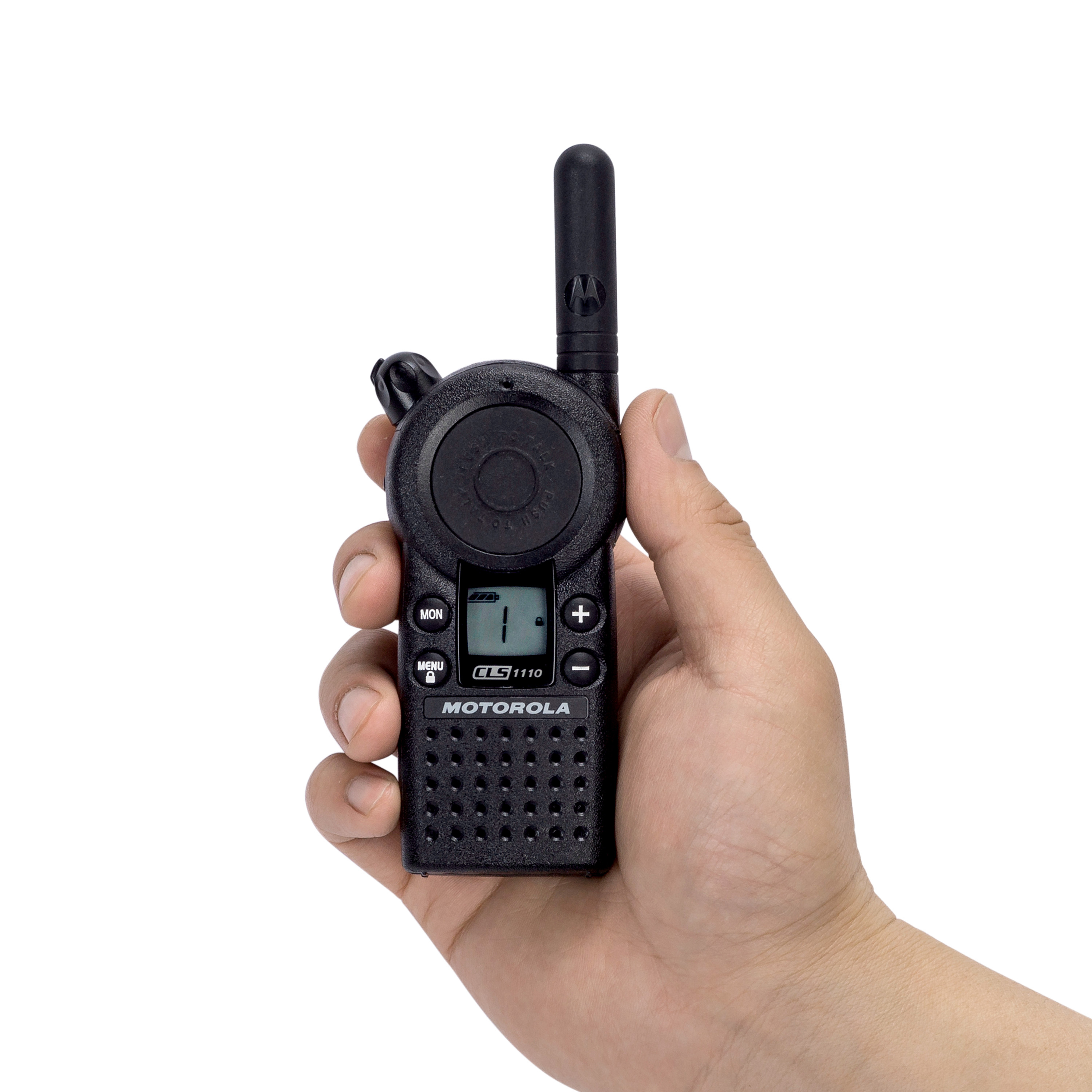
Best Radio for Small & Mid-Size Stores: Motorola CLS1410
Quick Summary: Motorola CLS1410
- Best For: Small-to-mid-size retail stores where stockroom and receiving communication relies on speaker audio.
- Key Specifications: 1 Watt UHF (460–469 MHz) | 4 Channels | Up to 200,000 sq ft coverage | Up to 14-hour battery life | IP55 rating.
- Primary Advantage: Built-in speaker allows stockroom staff to hear calls while handling boxes, while VibraCall provides silent alerts on the sales floor.
- Main Trade-off: Earpieces are sold separately and must be budgeted for customer-facing staff to maintain floor discretion.
| Specification | Detail |
|---|---|
| Frequency | UHF (460–469 MHz) |
| Power | 1 watt |
| Channels | 4 |
| Indoor Coverage | Up to 200,000 sq ft / 15–20 floors |
| Outdoor Range | Up to 1 mile |
| Battery Life | Up to 14 hours |
| Weight | 4.6 oz (with battery) |
| Durability | MIL-SPEC 810 (C–G), IP55 water-resistant |
Four channels, IP55, and a built-in speaker — and that last one is why this is the small-store answer. It's the only model here a stockroom associate can set on a shelf and still hear while both hands are in a box. For a store where most of the coordination happens between the floor and the back, that's worth more than earpiece discretion.
VibraCall is what makes it workable out front. A floor associate mid-conversation with a customer feels the alert instead of the store hearing it, finishes the interaction, and steps away to respond. That's the middle ground between a speaker radio and going fully earpiece-only, and it's the reason this works for staff who won't wear an earpiece for an eight-hour shift.
Four channels maps cleanly onto how a small store actually splits: sales floor, stockroom, management, and one held for loss prevention or a seasonal team.
Pros
- Built-in speaker for the stockroom, receiving, and back office — the roles an earpiece-only radio serves badly
- VibraCall gives a silent page without committing every associate to an earpiece
- IP55 is the highest moisture rating in this lineup, which matters for a garden center, a deli counter, or a dock open to weather
- Four channels covers a small store's structure with one line left for LP or seasonal staff
- 121 interference-eliminator codes keep a neighboring store's chatter off your channel — common in a strip center or a mall
- Simple enough that a new hire is operating it correctly on their first shift, which matters at retail turnover rates
Cons
- Earpieces are a separate accessory, unlike the CLP1080e which includes one. Budget them for every customer-facing role — it's the line most stores leave out of the quote.
- The speaker means discretion depends on discipline, not design. Anyone on the floor needs to be wearing the earpiece, and someone has to own that.
- VOX requires a compatible accessory; it won't trigger off the built-in mic
- 1 watt is fine for a single-floor store but thins out through a basement stockroom or a detached receiving area — that's where a repeater or the Curve comes in
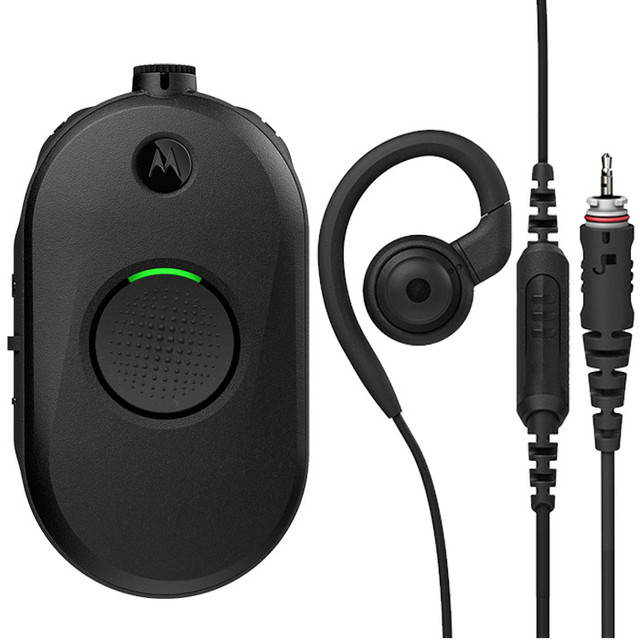
Best Discreet Radio for Customer-Facing Floors: Motorola CLP1080e
Quick Summary: Motorola CLP1080e
- Best For: Apparel boutiques, customer-facing sales floors, registers, and fitting rooms where total guest discretion is required.
- Key Specifications: 1 Watt UHF (450–470 MHz) | 8 Channels | Up to 100,000 sq ft coverage | Up to 18-hour battery life | 3.35 oz | IP54 rating.
- Primary Advantage: Earpiece-only design (no external speaker) guarantees shoppers hear zero radio noise; lightweight 3.35 oz body clips invisibly onto lanyards or belts.
- Main Trade-off: Requires staff to wear an earpiece; 100,000 sq ft base coverage may require a repeater for basement stockrooms.
| Specification | Detail |
|---|---|
| Frequency | UHF (450–470 MHz) |
| Power | 1 watt |
| Channels | 8 |
| Indoor Coverage | Up to 100,000 sq ft / 10 floors (up to 250,000 sq ft / 20 floors with repeater) |
| Outdoor Range | Up to 1 mile |
| Battery Life | Up to 18 hours |
| Weight | 3.35 oz (with battery) |
| Durability | MIL-STD-810H, IP54, antimicrobial housing |
| Includes | Swivel earpiece with in-line PTT mic and belt clip |
No external speaker at all — audio goes to the included earpiece or nowhere. That's not a discretion feature, it's a design constraint, and it's the difference between a store where staff should keep the radio quiet and one where it isn't possible for it to make noise. At 3.35 oz with nothing visible on a belt, a customer standing next to an associate has no idea a radio is in the conversation.
Eight channels is more than most single-location stores use, which is the point. Four covers the daily structure — floor, stockroom, management, loss prevention — and the rest absorb a seasonal team, a fitting-room line during a busy weekend, or a receiving channel on truck day, without buying a different radio.
Pros
- Earpiece-only, so pricing, stock counts, and staffing conversations physically can't reach a customer
- Earpiece included in the box — on the CLS1410 and Curve it's a separate purchase
- 18-hour battery, the longest here, covers open-to-close plus holiday hours on one overnight charge
- Lightest at 3.35 oz, with nothing on the belt line to notice
- Antimicrobial housing on a radio that changes hands between shifts
- Repeater-capable to 250,000 sq ft, which is how a growing store extends coverage without replacing the fleet
- 219 interference-elimination codes keep a neighboring tenant's traffic off your channel
Cons
- Earpiece or nothing. There's no speaker fallback for a stockroom associate whose hands are in a box, and some staff won't wear one for a full shift — order a few and run a weekend before committing the whole fleet.
- 100,000 sq ft base coverage is the smallest here. A basement stockroom or a detached receiving area will need the repeater.
- IP54 rather than the CLS1410's IP55 — fine on a sales floor, thinner for a garden center or a dock open to weather
- Costs more than the CLS1410 for capacity a small single-team store won't use
Buy this if most of your staff work in front of customers and the radio would otherwise be part of the shopping experience. Skip it if most of your traffic is back-of-house — the CLS1410's speaker serves that better for less — or if you're covering a large-format or multi-floor store, which is the Curve.
The common build for a mid-size store is both: CLP1080e units for the sales floor and register, a couple of CLS1410s for the stockroom and receiving. Both are analog UHF and share channels on matching frequencies, so it's one fleet, not two. Please note the accessories and chargers are not interchangable.
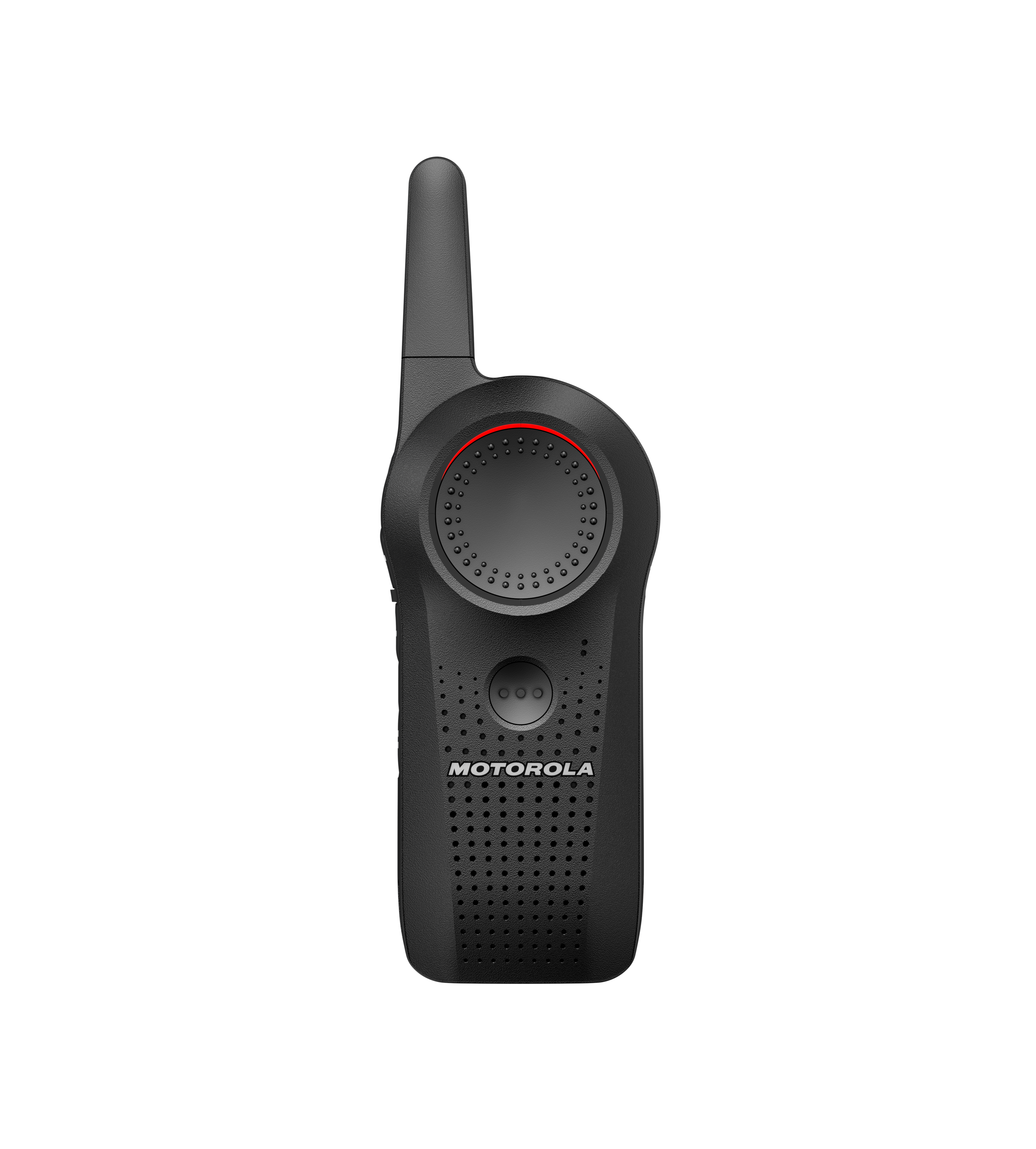
Best Digital Radio for Big-Box & Multi-Floor Stores: Motorola Curve
Quick Summary: Motorola Curve
- Best For: Big-box stores, multi-level retail, mall locations, and floors congested with heavy Wi-Fi, scanner, and POS traffic.
- Key Specifications: 1 Watt Digital 900 MHz (FHSS) | 10 Channels | Up to 300,000 sq ft / 20 floors coverage | 11.5-hour battery life | Private Reply feature.
- Primary Advantage: Frequency-Hopping Spread Spectrum (FHSS) tech sidesteps Wi-Fi access point and Bluetooth scanner noise; features one-to-one Private Reply.
- Main Trade-off: Operates on 900 MHz digital protocol and cannot interoperate with existing analog UHF radios without starting a second fleet.
| Specification | Detail |
|---|---|
| Frequency | Digital 900 MHz (902–928 MHz) |
| Power | 1 watt digital |
| Channels | 10 |
| Indoor Coverage | Up to 300,000 sq ft / 20 floors |
| Outdoor Range | 1–2 miles |
| Battery Life | Up to 11.5 hours (4-hour recharge) |
| Weight | 5.11 oz |
| Durability | MIL-STD 810 (C–H), IP5X, antimicrobial housing |
The Curve is a different platform, not a bigger radio — 900 MHz digital instead of analog UHF — and it earns its place in a large store for two reasons. The first is the building. A big-box footprint, a second floor, a basement stockroom, or a store built into a mall with block demising walls is asking a signal to cross more than a 1-watt UHF radio handles reliably. At 300,000 sq ft it's the largest footprint here.
The second is what else is on the air. A modern large-format store runs Wi-Fi across the floor, handheld scanners on every cart, wireless payment terminals at every register, and electronic shelf labels on the shelves. That congestion is where analog UHF starts sounding rough. The Curve hops across the 900 MHz band rather than sitting on one frequency, so it stays clear in a building saturated with everything else.
The feature worth calling out for retail specifically is Private Reply. In a store where ten people share a channel through a full shift, being able to answer one teammate directly instead of broadcasting to everyone cuts the volume of traffic each associate has to listen through. Ear fatigue is a real reason radios get set down, and this is the practical fix.
Pros
- 300,000 sq ft / 20 floors — the only option here built for a big-box or multi-level store
- Digital signal holds up against the Wi-Fi, scanner, and POS congestion a large store generates
- Ten channels covers every department with room for a seasonal or receiving line
- Private Reply keeps one-to-one answers off the group channel; Call All reaches everyone at once for an evacuation or an all-store page
- Works with Motorola call boxes, so a customer-service button in an aisle can ping straight to staff radios
Cons
- It won't talk to your CLS1410 or CLP1080e. Different band and protocol, so if you're running analog UHF this starts a second fleet rather than expanding the first.
- Built-in speaker, no earpiece-only option — floor staff still need an earpiece accessory and the discipline to wear it, which the CLP1080e solves by design
- 11.5 hours is the shortest rating here. Fine for a standard shift, tight for holiday hours — budget the high-capacity battery.
- IP5X means the water digit was never tested, not that resistance is zero. Splash-aware, not weatherproof, so it's the wrong unit for a garden center or an open dock.
- Highest cost of the three, and a single-floor store under 100,000 sq ft is paying for coverage it won't use
Buy this if you're covering a big-box footprint, more than one floor, or a store where scanner and Wi-Fi density has already made analog sound rough. Skip it if everything happens on one floor in a moderate footprint — the CLS1410 does that job for less — or if discretion is the priority, which is the CLP1080e.
Additional Retail Models Worth Considering (PKT-300, CLP1010e, WAVE PTX)
Kenwood ProTalk PKT-300 — 2 watts, six channels, UHF. The reason to look at it over the CLS1410 is power rather than features: double the transmit output, which is what reaches a basement stockroom or a detached receiving area that a 1-watt radio doesn't. Ships with six channels and opens to 16 with dealer programming. Two things to know: it's IP52, the lightest water rating in this guide, so it's not the pick for a garden center or an open dock — and Kenwood accessories don't cross over with Motorola, so a mixed fleet means stocking two lines.
Motorola CLP1010e — the single-channel version of the CLP1080e. Identical earpiece-only design, same 3.35 oz, same 18-hour battery, lower price. The right answer for a small boutique or a specialty store where four or five people all work the floor together and there's nothing to segment. One channel also means there's no wrong channel, which matters more than it sounds at retail turnover rates.
Motorola WAVE PTX (TLK Series) — LTE and Wi-Fi rather than radio frequency, so coverage stops being a building question. This is the one for a multi-location retailer: a district manager reaching four stores at once, or coordinating a stock transfer between locations without a phone tree. GPS and an emergency button come with it, which is genuinely useful for a lone closer. The tradeoff is a per-device subscription rather than a one-time purchase — an operating expense rather than a capital one, which for some retailers is a different approval path entirely. Lease-to-own is available. Worth noting it also depends on cellular and Wi-Fi coverage, so a basement stockroom with neither is a dead zone in a way it isn't for a UHF handheld.
Retail Radio Comparison
| Feature | Motorola CLS1410 | Motorola CLP1080e | Motorola Curve |
|---|---|---|---|
| Best for | Small to mid-size stores; speaker audio | Discreet, multi-department floors | Large stores & multi-team operations |
| Frequency | UHF (460–469 MHz) | UHF (450–470 MHz) | Digital 900 MHz (902–928 MHz) |
| Power | 1 watt | 1 watt | 1 watt digital |
| Channels | 4 | 8 | 10 |
| Indoor Coverage | Up to 200,000 sq ft | Up to 100,000 sq ft (250,000 with repeater) | Up to 300,000 sq ft / 20 floors |
| Outdoor Range | Up to 1 mile | Up to 1 mile | 1–2 miles |
| Battery Life | Up to 14 hours | Up to 18 hours | Up to 12 hours |
| Weight | 4.6 oz | 3.35 oz | 5.11 oz |
| Audio | External speaker | Earpiece-only | External speaker |
| Durability | MIL-SPEC 810, IP55 | MIL-STD-810H, IP54 | MIL-STD 810, IP5X |
| Antimicrobial Housing | No | Yes | Yes |
| Warranty | 2 years | 2 years | 2 years |
Why Avoid Cheap Consumer Radios (Retevis, Baofeng, FRS) on Retail Floors
This comes up on nearly every retail call where the starting point is budget, and the question is fair: a four-pack off a marketplace listing is a fraction of the price of one business-grade radio. What does a store actually give up? We don't carry these brands, so treat what follows as a dealer's view rather than a neutral one. But the reasoning isn't about brand loyalty — it's about two specific things that make consumer radios a poor fit for a sales floor.
FRS Is the Wrong Class of Radio for a Business
Most cheap multi-packs are FRS — the license-free consumer band shared with families at campgrounds and kids on bikes. Two consequences follow.
Power is capped by regulation, not by build quality. FRS radios are limited to 2 watts on most channels and have fixed antennas by rule. That's a ceiling no amount of paying more within the category gets you past, and it's why a consumer radio that works on your sales floor still drops in the basement stockroom.
You're sharing the band with the public. FRS has 22 channels and no exclusivity. In a strip center, a mall, or a busy retail corridor, you will hear other people's traffic and they will hear yours — including conversations about pricing, cash handling, and loss prevention. Privacy codes reduce what you hear; they don't stop anyone from hearing you. Business-grade UHF operates on licensed frequencies coordinated to your location, which is a genuinely different situation.
Build Quality Shows Up as Replacement Frequency
A retail fleet is shared equipment handled by a lot of people across a year — dropped on tile, carried through a full shift, handed to a seasonal hire in November, charged by whoever remembers. That's harder duty than most buyers expect, and it's where the difference appears as a replacement line rather than a spec on a listing. Three things worth checking on any brand, ours included:
- Is the durability rating tested or claimed? MIL-STD-810 and IP ratings mean something when the manufacturer publishes the test range. "Military grade" with no standard named means nothing.
- Does the battery figure disclose a duty cycle? A number without 5/5/90 behind it can't be compared to one that has it.
- Who honors the warranty, and for how long? A two-year manufacturer warranty with a domestic repair network is a different asset than a seller-fulfilled replacement policy from a marketplace account.
If Budget Is the Constraint
The honest answer isn't "buy the expensive one." It's that the entry point for business-grade is closer to consumer pricing than most people assume — the CLS1410 and the single-channel CLP1010e both sit near the top of the consumer range while carrying published durability testing, licensed-frequency operation, and a real warranty.
A cheaper alternative worth naming: buy fewer good radios rather than more bad ones. A five-person store fleet of business-grade units that lasts six years costs less than twelve consumer radios replaced twice, and it works in the stockroom, which is the part that actually matters.
OSHA Compliance & Workplace Safety Guidelines for Retail Staff
Two-way radios are not themselves a regulated safety device, but they directly support several workplace-safety obligations retailers carry:
Emergency Action Plans. Under OSHA's Emergency Action Plan standard (29 CFR 1910.38), employers that maintain an emergency action plan must include a means of reporting emergencies and an employee alarm system. An internal radio network gives staff a reliable, real-time way to report incidents and coordinate an evacuation — the kind of communication these plans depend on.
Workplace-violence prevention. OSHA's guidance on preventing workplace violence, including its recommendations for late-night retail establishments, identifies staff communication devices as a practical control for employees who work alone or during high-risk hours. A radio lets a lone opener or closer summon help immediately.
Occupational noise. In stockroom, dock, or compactor areas where noise can approach OSHA's action level of 85 dB as an 8-hour time-weighted average (29 CFR 1910.95), professional radios with noise-isolating earpieces help staff stay in contact without removing required hearing protection.
Frequently Asked Questions About Retail Store Communications
What accessories does a retail fleet actually need?
Three, in order of impact. Earpieces for every customer-facing role — included with the CLPe models, a separate purchase on the CLS1410 and Curve, and the line most stores leave out of the budget. A multi-unit charging tray behind the counter, so the whole fleet docks in one place instead of chargers scattered around the back. A spare battery per radio if you run holiday hours. Surveillance-style acoustic tube earpieces are the common retail choice — they're discreet enough for a sales floor and don't tangle in a lanyard.
How do we stop radios from disappearing?
Check them out at the start of a shift against a numbered charging bank and collect at close. That makes a missing unit obvious the same day rather than at the next inventory, and it guarantees everyone starts charged. Seasonal hiring is when this matters most — a November fleet that isn't tracked is a January fleet that's two radios short.
Should we assign radios to people or to positions?
Positions, in almost every store. Assigning to individuals means a radio goes home in someone's bag, sits in a locker on their day off, and doesn't get charged when they're out. Assigning to positions — register, floor, stockroom, manager — means the radio stays with the role and the channel plan stays correct regardless of who's working. It also makes a new hire's first shift simpler: they pick up the floor radio, and it's already on the floor channel.
What if the store next door is on the same frequency?
Common in strip centers and malls, where several tenants buy the same radios and land on identical defaults. Privacy codes filter transmissions so your radios only open for your own traffic. They don't encrypt anything — but they stop your associates hearing the salon two doors down.
Do the radios arrive ready to use?
Yes, the Motorola models work out of the box on their default channels. Additional programming may be needed if you need to unlock features like VOX or if you need to eliminate outside interference by updating frequencies and privacy codes.
Can radios connect to a customer-service call button?
Yes. Call boxes let a customer press a button — at a service desk, paint counter, or fitting room — and send a notification directly to staff radios.
Can we add radios later or use ones we already own?
Within analog UHF, yes. The CLS1410, CLP1080e, and CLP1010e all share channels when programmed to matching frequencies and privacy codes. The Curve runs 900 MHz digital and won't talk to any of them. Send model numbers of anything you have and we'll confirm before you order.
Are there monthly fees?
No, for all three recommended models — no airtime, no contract, no app. The only exception in this guide is WAVE PTX, which is subscription-based by design and is what buys the multi-location coverage. The Motorola Curve can be upgraded from push-to-talk to voice assistant capabilities which does require a monthly subscription. This unlocks the ability to direct call teams or individuals and leave voicemails.
What do we do about seasonal staff in Q4?
Two options. Buy a few above headcount and hold them for peak — the simpler answer if your seasonal bump is predictable. Or rent the overflow for six to ten weeks, which usually beats owning units that sit in a drawer from January to October. If your peak count is more than about a third above your baseline, renting the difference is worth pricing.
Why Retailers Buy from Tech Wholesale
We've been an authorized Motorola and Kenwood dealer since 1997, and retail fleets are among the most common we build. Every radio carries the full manufacturer warranty — typically two years on commercial-grade models. No gray-market inventory.
What sets us apart
- Lifetime technical support included with every purchase — call or email our team for the life of your radio fleet, not just through the warranty period
- No-pressure consultation — we'll tell you when a less expensive radio is the right answer for your store, rather than push a higher-margin product
- Quick Quotes — request a custom quote for fleets of radios
- Free shipping on qualifying orders and a 30-day return window
- Authorized dealer status — no counterfeit inventory, no voided warranties
Not sure which radio fits your store? Use our Find My Radio tool or request a quote. We'll ask a few questions about your floor plan and team size and come back with a specific recommendation — no obligation.
1-888-925-5982 | Service@TechWholesale.com
Related Retail Safety & Industry Communication Resources
Internal Industry Communication Guides
- How to Program Radio Privacy Codes — Eliminating channel cross-talk and outside chatter in busy shopping malls and strip centers.
- Voice-Operated Transmit (VOX) Setup for Retail Crews — Hands-free radio operation guidelines for stockroom and receiving staff.
- UHF vs. VHF Frequency Guide for Retail Buildings — Why UHF signals penetrate steel shelving, basement stockrooms, and concrete walls better than VHF.
- Find My Radio: Interactive Store Selection Tool — Calculate store radio coverage needs based on floor plan square footage and stockroom barriers.
Official Technical & Regulatory Standards
- OSHA 29 CFR 1910.38 Emergency Action Plans — Official federal requirements for workplace emergency reporting, alarm systems, and evacuation protocols.
- OSHA Guidelines for Preventing Workplace Violence in Late-Night Retail — Federal safety recommendations for lone openers, closers, and cash-handling staff.