

Most kennels start with cheap walkie-talkies and quickly learn the hard way. Calls get lost in the barking, signal drops between the kennel building and the outdoor runs, and the radios don’t survive a wet floor or a drop on concrete. Business-grade UHF radios fix all three: clear audio through an earpiece, signal that reaches the yard, and housings built to handle water and rough use.
We’ve equipped boarding kennels since 1997. Here’s how to pick the right radio for your facility.
Which walkie talkie is the right fit for your Kennel?
The Quick Answer
- A small-to-mid kennel, one building → Motorola RMU2040. Two watts, four channels, and a 1,500 mW speaker — the loudest option here, which is what a kennel run at full volume actually requires. IP55 for hose-down areas.
- A growing operation needing more lanes on a budget → Kenwood PKT-300. Two watts and six channels expandable to sixteen, so boarding, daycare, grooming, and the front desk each get a line as the business adds services.
- A larger facility or multiple buildings → Motorola Curve. Digital 900 MHz, 300,000 sq ft, ten channels — for a kennel with detached buildings, outdoor play yards, and a boarding wing across the property.
Article by Kristin Wood, a two-way radio consultant @ Tech Wholesale | Authorized Motorola & Kenwood Dealer Since 1997 | Last Updated: May 2026
Boarding Kennel Radio Comparison
| Spec | Motorola RMU2040 | Kenwood ProTalk PKT-300 | Motorola Curve |
|---|---|---|---|
| Best for | Small-to-mid kennels, one building | Growing operations adding services | Larger facilities, multiple buildings |
| Frequency | UHF 450–470 MHz | UHF 450–470 MHz | Digital 900 MHz FHSS |
| Power | 2 watts | 2 W high / 0.5 W low | 1 watt digital |
| Indoor coverage | Up to 250,000 sq ft | Up to 275,000 sq ft | Up to 300,000 sq ft / 20 floors |
| Battery life | Up to 12 hrs (15 with battery save) | 14 hrs (18 with battery saver) | 11.5 hrs (16 with high-capacity) |
| Ingress rating | IP55 | IP52 | IP5X |
| Durability | MIL-STD-810 C–G | MIL-STD-810 C–H | MIL-STD-810 C–H |
| Weight | 9.7 oz | 4.87 oz | 5.11 oz |
| Hands-free | VOX (headset required) | VOX (headset required) | VOX |
| Warranty | 2 years | 2 years | 2 years |
Jump To
Why Boarding Kennels Need Specialized Two-Way Radios
Most kennels start with phones or shouting down a hall, and both fail for the same reason: a tech who's holding a leash, hosing a run, or restraining a dog for a nail trim has no free hands and can't be heard anyway. A radio on a shoulder mic takes one press. That's the whole argument, and everything below is a version of it.
Nothing Else We Sell Into Is This Loud
A run of thirty dogs at feeding time or during a shift change is one of the loudest sustained environments in any commercial setting — and it's the sustained part that matters. A kitchen is intermittent; a kennel run at full volume is continuous, broadband, and lasts as long as the trigger does. That reorders the whole buying decision. Speaker output matters more here than coverage, channels, or anything else on a spec sheet, because a radio nobody can hear over the runs is a radio that ends up on the front desk. It's also the argument for a shoulder-mounted speaker mic over a radio on a belt — six inches from the ear instead of two feet, which is a bigger difference than any wattage increase.
Everything Gets Hosed Down, Every Day
Runs, floors, bathing rooms, sometimes walls. Add staff who spend most of a shift with wet hands — cleaning, bathing, filling bowls, hydrotherapy — and a kennel radio is handled wet dozens of times a day and works within a few feet of a running hose.
This is one of the few environments where IP55 rather than IP54 is worth specifying rather than treating as a bonus. IP54 covers splashing; IP55 adds low-pressure water jets, which is what a hose actually is. The failure point on a radio in a kennel is almost never the drop — it's the seal at the battery contacts after a year of moisture.
Staff Have an Animal in Both Hands
A tech walking two dogs to a yard, holding a nervous boarder on a grooming table, or restraining a dog for a nail trim cannot pick up a radio. This is the case for a shoulder-mounted speaker mic over a belt-clipped radio, and for VOX where a role genuinely never has a free hand.
It's also an argument against a heavy radio. Kennel work is physical — bending, lifting, kneeling in runs — and a unit that's noticeable at hour three ends up on a counter by hour five.
One Loose Dog Is the Whole Reason
Every kennel operator has a version of this story. A gate left unlatched, a dog through a door during a handoff, an escape from a play yard. The response is time-critical and it needs everyone at once: who has eyes on the animal, who's covering the exits, who's calling the owner.
That's the one-to-many case a phone structurally can't do. A radio call reaches the front desk, the yard, and the back building in the same second — and it's the single scenario that justifies a fleet even in a facility where daily coordination could technically limp along without one.
Medical and Feeding Instructions Have to Reach the Right Person
Boarding facilities handle medications, special diets, senior dogs, and post-surgical animals. A verbal handoff shouted across a run or relayed through two people is how a dose gets missed or doubled.
A dedicated channel for the boarding wing — separate from daycare, grooming, and the front desk — is what keeps a medication call from landing in the middle of check-in traffic. It's the same argument for channel segmentation that any business makes, with a higher consequence attached.
Somebody Is Always Working Alone
Early feeds, late checks, weekend coverage, and the back building on a slow Tuesday. A kennel tech alone with animals, sometimes handling a large or reactive dog, needs a way to summon help that doesn't require putting the dog down first. This is worth speccing a fleet around even if it never happens — and it's why battery margin matters more here than the price difference suggests. A radio that dies at hour nine of a twelve-hour weekend shift is dead exactly when there's nobody else in the building.
Coverage That Includes the Yard and the Back Building
Kennels sprawl. A boarding wing, a detached daycare building, outdoor play yards, an isolation area, a grooming room behind block walls. Coverage failures show up in predictable spots — the far yard, an isolation room, anything across a driveway — and those are precisely where a lone staff member is most likely to be.
This is why square footage is the wrong sizing metric. A 4,000 sq ft facility with a detached building and two outdoor yards is harder to cover than a 12,000 sq ft single structure, and the rating on the box assumes the single structure.
What to Look for in a Kennel Two-Way Radio
Six things decide a kennel fleet.
Building the Mix: Who Carries What
Not everyone needs the same unit, and standardizing on one model usually means over-buying for the front desk and under-buying for the runs.
Kennel and yard staff need the loudest speaker and the best ingress rating you're willing to pay for. This is where an IP55 unit belongs, and where a shoulder-mounted speaker mic beats a radio on the hip — a tech holding a leash in each hand can reach a mic at the collar without free hands.
Grooming and bathing need water protection above all. A radio three feet from a running tub sees more moisture than anything else in the building.
Front desk and management can carry the lightest unit with an earpiece — reception is the one place in a kennel where a squawking radio is heard by a paying client standing at the counter. Managers usually want a unit that can scan every channel, so an emergency call on the kennel line doesn't sit unheard because everyone with authority is on the front-desk channel.
A Channel Plan That Survives a Bad Day
Four lanes cover most kennels: front desk, kennel staff, grooming, and one reserved for emergencies and all-staff calls.
The reserved channel is the part that goes wrong. Once grooming starts using the emergency line because it's the quiet one, it stops being available for a loose dog — and that's the only call the plan exists for. Keeping it genuinely empty is a discipline decision more than a hardware one, and it's worth naming in your onboarding.
One practical detail: write the channel map on a card and tape it inside the charging bank. Kennel staffing turns over, weekend coverage rotates, and a tech on their third shift shouldn't have to ask which channel grooming is on.
Privacy codes on each channel keep a neighboring business off your traffic — worth asking about if you're in a light-industrial park or a strip of commercial units, where the same default frequencies get bought repeatedly.
Reading Coverage Ratings Honestly
Published figures assume open indoor space, and a kennel isn't one. Concrete block, steel kenneling, and detached buildings all take a bite, and the number on the box accounts for none of them.
Rather than sizing off the figure, walk it before you commit. Stand at the far corner of the back yard, or inside the isolation room with the door shut, and try to reach the front desk. If it's marginal there, it fails there on the day it matters. For a detached building or a yard across a driveway, a repeater usually solves it for less than upgrading every handheld.
Batteries and the Charging Routine
Look for 12 hours rated minimum, and lithium-ion rather than AA or AAA — alkaline is inconsistent in commercial radios and becomes a recurring supply cost. Worth knowing how the ratings are produced: manufacturers measure at the standard 5/5/90 duty cycle — 5% transmitting, 5% receiving, 90% standby. That describes a quiet weekday and badly describes a Saturday check-out rush or a holiday boarding week. Treat the figure as a ceiling.
The bigger factor is the routine. A multi-unit charging tray in one place, docked as part of closing, is what makes a fleet reliable — individual chargers scattered around the building don't get used. Battery-level indicators matter more in a kennel than most places, because the person most likely to run out is the one working a long weekend alone.
Weight and How It's Carried
Kennel work is physical: bending into runs, lifting dogs, kneeling to clean. A radio that's noticeable at hour three is on a counter by hour five. Under five ounces is comfortable for a full shift. Past that, plan on a shoulder mic or a chest harness rather than a belt clip — and check the clip itself. A standard belt clip doesn't hold well on scrub-style kennel uniforms or a smock, and a radio that falls into a run once usually ends up staying at the desk.
Cleaning Without Wrecking the Seals
Kennel equipment gets disinfected, and radios passing between shifts should be part of that. Two practical notes: wipe the surface rather than saturating the seams, speaker grille, or charging contacts — and know what your disinfectant is. Quat and accelerated hydrogen peroxide products at kennel concentrations are harder on plastics and rubber gaskets than most people expect, and a radio wiped with a soaked rag daily shows it at the battery seal first.
A radio rated IP55 is rated against water. It isn't rated against a year of chemical exposure, and that distinction is the difference between a fleet that lasts five years and one that lasts two.
Boarding Kennel Radio Recommendations
What is the Best Radio for Small to Mid-Size Kennels?
Motorola RMU2040
Quick Summary: Motorola RMU2040
- Best For: Single-building boarding kennels and dog daycares requiring high audio volume and daily washdown protection.
- Key Specifications: 2 Watts UHF (450–470 MHz) | 4 Channels | Up to 225,000 sq ft coverage | Up to 15-hour battery life | IP55 rating.
- Primary Advantage: Features a high-output 1,500 mW speaker to cut through loud barking runs, and an IP55 rating to withstand low-pressure water jets during daily hose-downs.
- Main Trade-off: Slightly heavier unit (9.7 oz); limited to 4 channels and analog UHF frequencies.
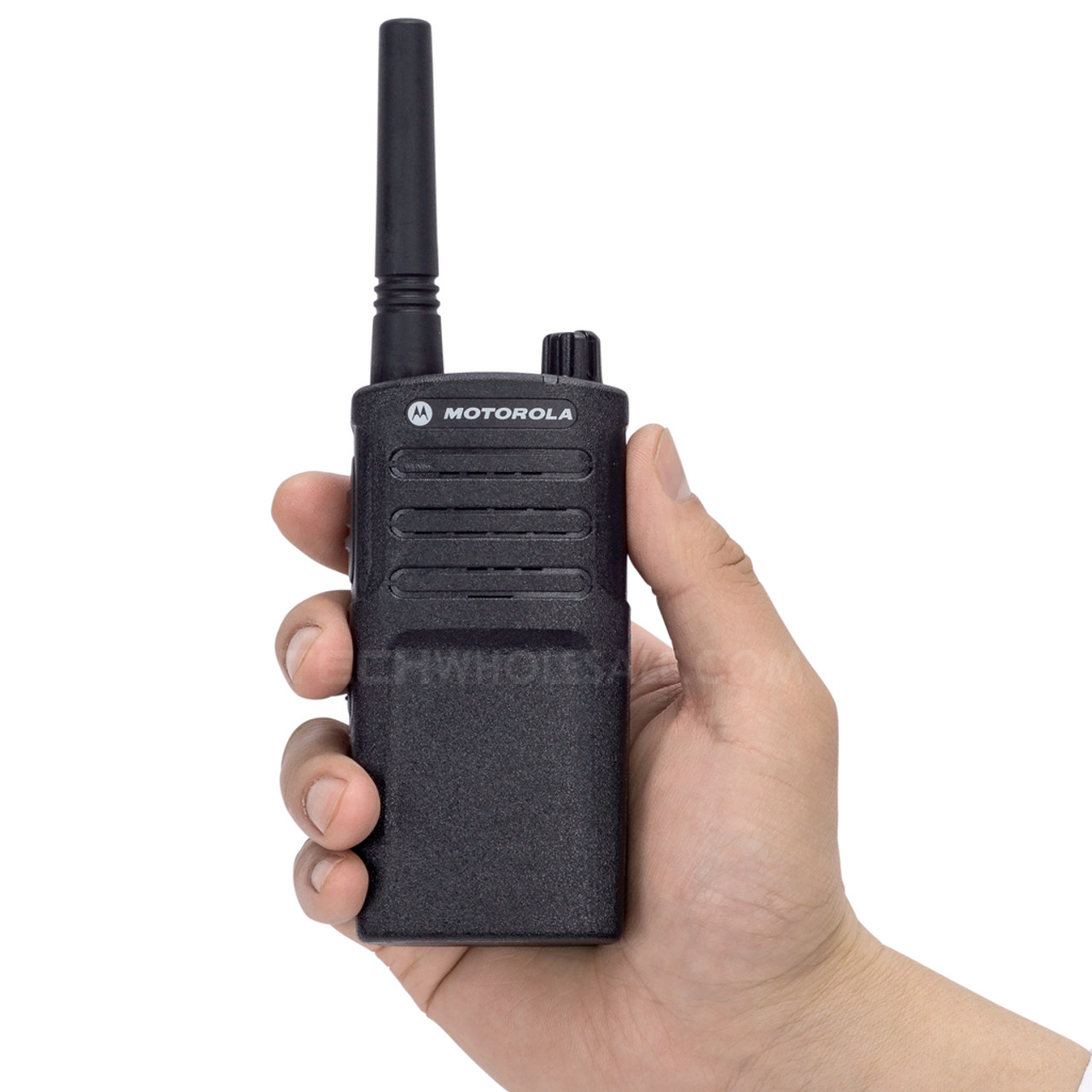
| Specification | Detail |
|---|---|
| Frequency | UHF |
| Power | 2 watts |
| Channels | 4 |
| Indoor Coverage | Up to 225,000 sq ft / 20 floors |
| Outdoor Range | Up to 1.5 miles |
| Durability | MIL-STD-810, IP55 rated |
| Battery | Li-Ion, 14+ hours |
| Water Resistance | IP55 (water jets from any direction) |
| VOX | Yes |
| Privacy Codes | 219 |
IP55 and a 1,500 mW speaker — and in a kennel those two specs matter more than everything else on the sheet combined. This is the only radio here rated against water jets rather than splashing, which is what a hose actually is, and the loudest of the three, which is what a run of barking dogs actually requires. If you buy one model for the whole facility, this is it.
Four channels maps onto how most kennels split: front desk, kennel staff, grooming, and one held empty for emergencies. Two watts of UHF handles concrete block and steel kenneling in a single building without a repeater.
Pros
- IP55 — rated against low-pressure water jets, not just splashing. The only unit here genuinely built for a daily hose-down.
- 1,500 mW speaker, the loudest of the three, which is the spec that decides whether a radio gets carried in a kennel
- 2 watts covers a single building through block walls and steel runs
- Four channels covers the standard kennel structure with one reserved for emergencies
- 219 privacy codes keep a neighboring business off your traffic — common in a light-industrial park Simple enough that a weekend tech on their second shift operates it correctly
Cons
- At 9.7 oz it's roughly double the weight of the other two. For a tech bending into runs and lifting dogs all shift, that's real — plan on a shoulder mic or a chest carry rather than a belt clip.
- Four channels is the ceiling. If you add daycare or a second boarding wing as a separate lane, you're at the limit.
- Analog only, so it won't expand into a digital fleet later
- VOX requires a compatible headset; it won't trigger off the built-in mic
- Coverage thins out to a detached building or a yard across a driveway — that's a repeater or the Curve
Buy this if you're a single-building kennel and the daily reality is water and noise rather than distance. Skip it if you have a detached boarding building or outdoor yards well off the main structure, which is the Curve — or if you're adding services fast enough that four channels won't hold, which is the PKT-300.
What is the Best Radio for Larger Facilities and Multi-Department Teams?
Motorola Curve
Quick Summary: Motorola Curve
- Best For: Sprawling boarding facilities, multi-building kennels, and properties with outdoor play yards or detached isolation wings.
- Key Specifications: 1 Watt Digital 900 MHz (FHSS) | 10 Channels | Up to 300,000 sq ft / 20 floors coverage | Up to 16-hour battery life | Private Reply feature.
- Primary Advantage: Digital 900 MHz signal penetrates concrete structures, detached buildings, and outdoor play yards; Private Reply eliminates group channel clutter.
- Main Trade-off: IP5X dust rating provides less splash/water protection than IP55 models; cannot interoperate with analog UHF radios.
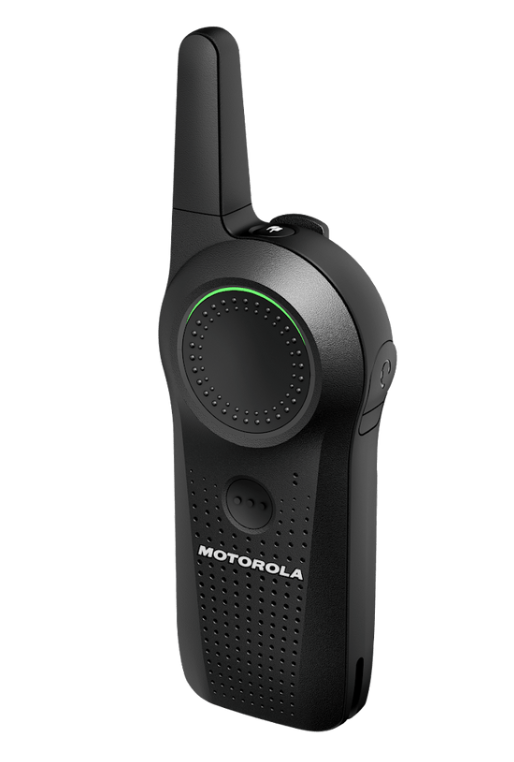
| Specification | Detail |
|---|---|
| Frequency | 900 MHz |
| Power | 1 watt digital (≈ 4W analog equivalent) |
| Channels | 10 |
| Indoor Coverage | Up to 300,000 sq ft / 20 floors |
| Outdoor Range | Up to 2 miles |
| Durability | Ruggedized for commercial use |
| Battery | Li-Ion, 10+ hours |
| VOX | Yes |
| Audio | Digital clarity with noise suppression |
The Curve is a different platform, not a bigger radio — 900 MHz digital instead of analog UHF — and in a kennel it earns its place for one reason above the others: it's the only option here that reaches across a property. A detached boarding building, a play yard past the parking area, an isolation wing at the back — those are the spots where a 2-watt analog radio thins out, and they're exactly where a tech is most likely to be working alone.
The digital audio is the second reason and it matters more here than in most industries. Analog audio degrades gracefully into static; digital either delivers a clean signal or doesn't. In a room with thirty dogs, "clean or nothing" is better than "audible but garbled," because a half-heard instruction about a medication is worse than no instruction at all.
Ten channels lets a larger operation separate what actually needs separating: indoor runs, outdoor yards, grooming, reception, medical and isolation, and management. Private Reply is the feature worth calling out — a manager can answer one tech directly instead of broadcasting, which cuts the traffic everyone else has to listen through across a twelve-hour day.
Pros
- 300,000 sq ft — the only unit here built for detached buildings, outdoor yards, and a spread-out property
- Digital audio doesn't degrade into static; a transmission is either clear or it isn't
- Ten channels supports genuine department separation including a dedicated medical and isolation line
- Private Reply keeps one-to-one answers off the group channel
- Frequency hopping keeps a neighboring business or a scanner off your traffic
Cons
- IP5X is the weakest water protection here, and the X means the water digit was never tested. In a facility that hoses down daily, that's a real limitation — this is a front-desk, management, and yard-supervisor radio, not a runs-and-grooming radio.
- It won't talk to your RMU2040 or PKT-300. Different band and protocol, so this starts a second fleet rather than expanding an analog one.
- 11.5 hours on the standard battery is the shortest here — budget the high-capacity pack for weekend and holiday coverage
- Highest cost of the three, and a single-building kennel is paying for coverage it won't use
What is the Best Budget Radio for Growing Kennels?
Kenwood PKT300
Quick Summary: Kenwood ProTalk PKT-300
- Best For: Growing pet care businesses adding daycare, grooming, and training services needing extra channel capacity on a budget.
- Key Specifications: 2 Watts UHF (450–470 MHz) | 6 Channels (expandable to 16) | 275,000 sq ft coverage | Up to 18-hour battery life | Backlit LCD display.
- Primary Advantage: Lightweight 4.87 oz body reduces fatigue during physical shifts, while 6-to-16 channels allow dedicated lines for boarding, grooming, and reception.
- Main Trade-off: IP52 rating covers light dripping moisture only; unsuited for direct hose-down areas or bathing stations.
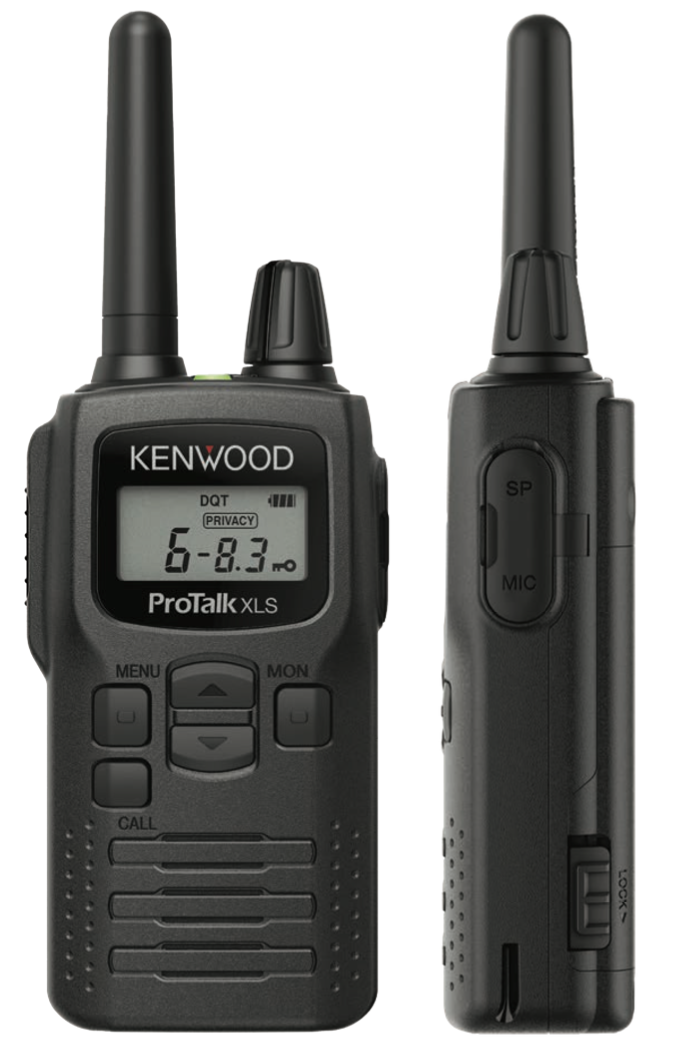
| Specification | Detail |
|---|---|
| Frequency | UHF (450–470 MHz) |
| Power | 2 watts |
| Channels | 6 |
| Indoor Coverage | Up to 275,000 sq ft |
| Outdoor Range | Up to 1.5 miles |
| Durability | Commercial-grade, IP54 rated |
| Battery | Li-Ion |
| VOX | Yes |
| Display | Yes — backlit LCD |
This is the value pick, and the case for it is specific: two channels more than the RMU2040 and roughly half the weight, at a moderate price. For a kennel that's added daycare or grooming and is now running out of lanes, six channels — expandable to sixteen with programming — is room to grow without a fleet replacement.
The weight is the underrated part. At 4.87 oz it's roughly half the RMU2040, which matters for a tech kneeling in runs and lifting dogs across a twelve-hour shift. It's also one of the smallest commercial UHF radios made, so it clips to a smock or a scrub waistband without pulling.
The backlit display is genuinely useful in a kennel specifically. Channel discipline slips fastest in facilities with weekend and rotating staff, and a tech who can glance down and confirm they're on the kennel channel rather than the emergency one is a tech who doesn't clutter the line that has to stay clear.
Pros
- Six channels standard, sixteen with dealer programming — room for daycare, a second boarding wing, or a seasonal lane
- 4.87 oz, roughly half the RMU2040's weight, for staff doing physical work all shift
- 2 watts and 275,000 sq ft, matching the RMU2040 on power in a smaller body
- Backlit display for channel confirmation, which matters with rotating weekend staff
- 14 hours rated, up to 18 with battery saver — the longest runtime here for holiday boarding weeks
- Busy Channel Lockout stops two techs transmitting over each other on a shared line
Cons
- IP52 is the weakest ingress rating of the three UHF options — light dripping moisture only, not splashing and not jets. In a kennel that's the wrong direction. This isn't the radio for the runs, bathing, or grooming; those roles need the RMU2040's IP55.
- Kenwood's speaker output is lower than the RMU2040's 1,500 mW, so in the loudest part of the building it's the one more likely to be missed
- Unlocking the full 16 channels requires dealer programming — send us your channel plan and we'll set it before shipping
- VOX needs a headset accessory; it won't trigger off the built-in mic
Buy this if you're adding departments, your staff are carrying radios through long physical shifts, and most of the fleet lives in drier areas — reception, management, yard supervision, daycare floor. Skip it if the fleet's main job is the runs and the bathing room, where the RMU2040's IP55 and louder speaker are worth more than two extra channels.
Other Radios Worth Considering
Motorola CLS1110 — single channel, 1 watt, IP55, 4.6 oz. The lightest business-grade option here and the simplest: one channel means there's no wrong channel, which matters when a weekend tech is on their second shift. IP55 puts it in the same water class as the RMU2040, so it survives the runs and the bathing room. The right answer for a small kennel where three or four people all work together and there's nothing to segment — or as an inexpensive way to add a couple of units to an existing CLS fleet.
Motorola CLS1410 — same hardware, same IP55, same weight, four channels instead of one. This is the lighter alternative to the RMU2040 for kennels that want channel separation without a 9.7 oz radio on a tech all shift. The tradeoff is power and volume: 1 watt against the RMU2040's 2, and a smaller speaker. In a single-building kennel with moderate construction it's often enough; in a facility with block walls and thirty dogs at feeding time, the RMU2040 is the safer call.
Both share accessories, chargers, and channels with each other, and both talk to the RMU2040 and PKT-300 on matching frequencies and privacy codes — so a CLS unit slots into an existing analog fleet without starting a second one.
What About Retevis, Baofeng, or Other Budget Radios?
This comes up on nearly every kennel call that starts with a budget number, and the question is fair: a four-pack from a marketplace listing costs less than one business-grade radio. What does a kennel actually give up?
We don't carry these brands, so treat what follows as a dealer's view rather than a neutral one. The reasoning isn't about brand loyalty — it's about three things that make consumer radios a particularly poor fit for a boarding facility.
They Can't Be Heard Over the Runs
This is the one that ends the conversation for most kennels. Consumer radios use small speakers with output typically well under half what a commercial unit delivers, and no published figure at all in most cases.
In a room with thirty dogs, that's the difference between a radio staff use and one that lives on the front desk. It's also the specification you can't fix later — you can add an earpiece or a speaker mic to a business-grade radio, but a consumer unit's accessory ecosystem is usually a single proprietary earbud that doesn't help in a high-noise room.
Water Is What Actually Kills Them
Consumer radios generally carry no ingress rating, or an unpublished one. "Water resistant" on a listing with no IP number behind it is a marketing phrase, not a tested specification.
In a facility that hoses down runs daily and where staff handle radios with wet hands through most of a shift, that's the single biggest predictor of how long a fleet lasts. A business-grade IP55 rating means the unit was tested against low-pressure water jets.
An untested consumer radio in the same environment typically fails at the battery seal within a year — and it fails quietly, holding less charge each week until someone notices it dies at hour six.
FRS Is the Wrong Class of Radio for a Business
Most cheap multi-packs are FRS, the license-free consumer band shared with families at campgrounds. Two consequences follow, and neither is fixable by spending more within the category.
Power is capped by regulation. FRS is limited to 2 watts on most channels with fixed antennas by rule. That's why a consumer radio that works in your lobby still drops in the back building or the far yard — the ceiling is legal, not a build-quality issue.
You're sharing the band with the public. FRS has 22 channels and no exclusivity. In a light-industrial park or a commercial strip, you'll hear other people's traffic and they'll hear yours — including client names, payment conversations, and anything a manager says about an animal or an owner. Privacy codes reduce what you hear; they don't stop anyone from hearing you.
Three Things Worth Checking on Any Brand, Ours Included
- Is the durability rating tested or claimed? MIL-STD-810 and IP ratings mean something when the manufacturer publishes the test range. "Military grade" with no standard named means nothing.
- Does the battery figure disclose a duty cycle? A number without 5/5/90 behind it isn't comparable to one that has it.
- Who honors the warranty, and for how long? A two-year manufacturer warranty with a domestic repair network is a different asset than a seller-fulfilled replacement policy from a marketplace account.
If Budget Is the Constraint
The honest answer isn't "buy the expensive one." The entry point for business-grade sits closer to consumer pricing than most operators expect — the single-channel CLS1110 carries an IP55 rating, published durability testing, licensed-frequency operation, and a real warranty.
The better move is buying fewer good radios rather than more cheap ones. Four business-grade units that last six years cost less than a dozen consumer radios replaced twice — and they work in the bathing room and the back yard, which is the part that actually matters.
Frequently Asked Questions
Will radios stress or startle anxious dogs?
It's a fair question and the answer is mostly about volume and tone rather than the radio itself. A speaker at full volume with a sharp squelch break in a quiet boarding wing will get a reaction from reactive or recovering animals. Two practical fixes: turn tone alerts off on radios assigned to isolation and medical, and use earpieces or shoulder mics in those areas so audio goes to the handler rather than the room. Most kennels end up running speakers loud in the main runs, where the noise floor is already high, and earpieces in the quiet zones.
Can we use radios in the bathing room and around cleaning chemicals?
Yes, with the same caution you'd apply to any electronics. An IP55 radio handles the moisture. What it isn't rated for is chemical exposure — quat and accelerated hydrogen peroxide at kennel concentrations are harder on plastics and rubber gaskets than water is, so wipe the surface rather than saturating seams and charging contacts. If your facility stores flammable disinfectants or compressed gases, ask us about intrinsically safe models; standard business radios are fine for typical kennel cleaning chemicals but that's worth confirming for your specific setup.
How do we get radios to the outdoor yards and the back building?
Depends on the distance and what's between them. A yard adjacent to the main structure is usually fine on 2 watts. A detached building across a driveway, or a yard past a parking area, often isn't — and that's a repeater rather than more handheld power. A repeater is a one-time install that lifts coverage for the whole fleet and is almost always cheaper than upgrading every radio. Send us a site layout and we'll tell you which one you're looking at.
Should radios be assigned to people or to positions?
Positions. A kennel runs on rotating weekend and holiday coverage, and assigning to individuals means a radio sits in a locker on someone's day off and doesn't get charged. Assigning to positions — kennel one, kennel two, grooming, front desk, manager — keeps the radio with the role and the channel correct regardless of who's working. It also means a new tech picks up the kennel radio and it's already on the kennel channel.
Can I use these radios across multiple kennel locations?
Standard business radios operate on local RF frequencies — they communicate within a facility, not across cities. For communication between multiple physical locations, consider the Motorola WAVE PTX LTE series, which connects over cellular and Wi-Fi networks for unlimited geographic range. This allows a manager at one location to reach staff at another instantly, using the same push-to-talk interface. TechWholesale stocks the full WAVE PTX lineup and can configure multi-site deployments.
How do we stop radios from disappearing?
Check-out at the start of a shift against a numbered charging bank, collect at close. Kennel staffing turns over and weekend coverage rotates, so attrition is the quiet way a fleet shrinks — six radios become four across a year and nobody can say when. A numbered rack makes a missing unit obvious the same day.
What accessories does a kennel fleet actually need?
Three. A shoulder speaker mic for kennel and yard staff — this is the highest-value accessory in a kennel, because it puts the speaker six inches from the ear instead of two feet from a belt. Earpieces for reception and the quiet zones. A multi-unit charging tray in one place, docked as part of closing. Use manufacturer batteries rather than third-party; that's the most common cause of a fleet that stops holding charge in year two.
Can we add radios later or use ones we already own?
Within analog UHF, yes. The RMU2040, PKT-300, CLS1110, and CLS1410 all share channels when programmed to matching frequencies and privacy codes. But please note, the accessories and chargers are not cross compatible. The Curve runs 900 MHz digital and won't talk to any of them. Send model numbers of what you have and we'll confirm before you order.
Are there monthly fees?
No, for all the radios recommended here. No airtime, no contract, no app, no subscription.
What if a nearby business is on our channel?
Common in light-industrial parks, where several businesses buy the same radios and land on the same factory defaults. Privacy codes — CTCSS or DCS tones — filter transmissions so your radios only open for your own traffic. They don't encrypt anything, so anything genuinely sensitive still belongs off the radio. Programming can easily be done by hand.
Will the radios work when they arrive?
Yes the radios will work right out of the box. Additional programming may be necessary if you would like to eliminate outside interference by nearby businesses. This can easily be done by updating the privacy and frequency codes - which can be done by hand.
Why Buy Kennel Radios from TechWholesale.com
We've been an authorized Motorola and Kenwood dealer since 1997, and animal care facilities — boarding kennels, daycares, grooming operations, and veterinary practices — are a regular part of what we build fleets for. Every radio ships with the full manufacturer warranty and qualifies for manufacturer service and repair. No gray-market inventory.
What you get with every order:
- Competitive pricing
- Free shipping on qualifying orders
- 2-year warranty on all radios sold
- Lifetime tech support — our team is reachable by phone, email, and live chat long after your purchase
- Expert pre-sale guidance — not sure which radio fits your facility? We'll assess your square footage, staff count and building construction, before you commit
Chat with a radio specialist now → Call us: 1-888-925-5982
We don't just sell radios. We make sure the right ones end up in the right hands — so your team can focus on what matters: keeping every animal in your care safe, and every client confident their pet is in good hands.
Related Animal Care & Hospitality Radio Guides
Internal Industry Communication Guides
- Voice-Operated Transmit (VOX) Setup for Kennel Staff — Hands-free radio operation guidelines for techs handling leashes and animals.
- Lone Worker Safety Features for Pet Care Staff — Automated emergency alert protocols for solo night feeders and weekend shift staff.
- How to Program Radio Privacy Codes — Eliminating channel cross-talk and outside chatter in commercial parks.
- Frequency Hopping Spread Spectrum (FHSS) Explained — How 900 MHz digital radios maintain signal across multi-building properties.
- UHF vs. VHF Frequency Guide for Animal Care Buildings — Why UHF signals penetrate concrete runs, metal gates, and outdoor yards better than VHF.
Official Technical & Regulatory Standards
- OSHA Workplace Guidelines for Personal Protective Equipment in Animal Handling — Federal safety considerations for noise protection, wet environments, and staff communication.
- OSHA Guidance on First Aid Procedures in High-Risk Animal Care Workspaces — Instant communication standards for emergency pet care and handler assistance.